Processing Broadcast Audio for Information Access
Jean-Luc Gauvain, Lori Lamel, Gilles Adda, Martine Adda-Decker,
Claude Barras, Langzhou Chen, and Yannick de Kercadio
Spoken Language Processing Group
LIMSI-CNRS, B.P. 133, 91403 Orsay cedex, France
([email protected] http://www.limsi.fr/tlp)
Abstract
This paper addresses recent progress in speaker-independent, large vocabulary, continuous speech recognition, which has opened up a wide range of near and mid-term applications. One rapidly ex-panding application area is the process-ing of broadcast audio for information access. At LIMSI, broadcast news tran-scription systems have been developed for English, French, German, Mandarin and Portuguese, and systems for other languages are under development. Au-dio indexation must take into account the specificities of audio data, such as needing to deal with the continuous data stream and an imperfect word tran-scription. Some near-term applications areas are audio data mining, selective dissemination of information and me-dia monitoring.
1
Introduction
A major advance in speech processing technology is the ability of todays systems to deal with non-homogeneous data as is exemplified by broadcast data. With the rapid expansion of different me-dia sources, there is a pressing need for automatic processing of such audio streams. Broadcast au-dio is challenging as it contains segments of vari-ous acvari-oustic and linguistic natures, which require appropriate modeling. A special section in the Communications of the ACM devoted to “News
on Demand” (Maybury, 2000) includes contribu-tions from many of the sites carrying out active research in this area.
Via speech recognition, spoken document re-trieval (SDR) can support random access to rel-evant portions of audio documents, reducing the time needed to identify recordings in large multi-media databases. The TREC (Text REtrieval Con-ference) SDR evaluation showed that only small differences in information retrieval performance are observed for automatic and manual transcrip-tions (Garofolo et al., 2000).
Large vocabulary continuous speech recogni-tion (LVCSR) is a key technology that can be used to enable content-based information access in au-dio and video documents. Since most of the lin-guistic information is encoded in the audio chan-nel of video data, which once transcribed can be accessed using text-based tools. This research has been carried out in a multilingual environment in the context of several recent and ongoing Euro-pean projects. We highlight recent progress in LVCSR and describe some of our work in de-veloping a system for processing broadcast au-dio for information access. The system has two main components, the speech transcription com-ponent and the information retrieval comcom-ponent. Versions of the LIMSI broadcast news transcrip-tion system have been developed in American En-glish, French, German, Mandarin and Portuguese.
2
Progress in LVCSR
pri-marily associated with small vocabulary isolated word recognition and with speaker-dependent (of-ten also domain-specific) dictation systems. The same core technology serves as the basis for a range of applications such as voice-interactive database access or limited-domain dictation, as well as more demanding tasks such as the tran-scription of broadcast data. With the exception of the inherent variability of telephone channels, for most applications it is reasonable to assume that the speech is produced in relatively stable envi-ronmental and in some cases is spoken with the purpose of being recognized by the machine.
The ability of systems to deal with non-homogeneous data as is found in broadcast au-dio (changing speakers, languages, backgrounds, topics) has been enabled by advances in a vari-ety of areas including techniques for robust signal processing and normalization; improved training techniques which can take advantage of very large audio and textual corpora; algorithms for audio segmentation; unsupervised acoustic model adap-tation; efficient decoding with long span language models; ability to use much larger vocabularies than in the past - 64 k words or more is common to reduce errors due to out-of-vocabulary words.
With the rapid expansion of different media sources for information dissemination including via the internet, there is a pressing need for au-tomatic processing of the audio data stream. The vast majority of audio and video documents that are produced and broadcast do not have associ-ated annotations for indexation and retrieval pur-poses, and since most of today’s annotation meth-ods require substantial manual intervention, and the cost is too large to treat the ever increasing volume of documents. Broadcast audio is chal-lenging to process as it contains segments of vari-ous acvari-oustic and linguistic natures, which require appropriate modeling. Transcribing such data re-quires significantly higher processing power than what is needed to transcribe read speech data in a controlled environment, such as for speaker adapted dictation. Although it is usually as-sumed that processing time is not a major issue since computer power has been increasing con-tinuously, it is also known that the amount of data appearing on information channels is increasing at a close rate. Therefore processing time is an
important factor in making a speech transcription system viable for audio data mining and other re-lated applications. Transcription word error rates of about 20% have been reported for unrestricted broadcast news data in several languages.
As shown in Figure 1 the LIMSI broadcast news transcription system for automatic indexa-tion consists of an audio partiindexa-tioner and a speech recognizer.
3
Audio partitioning
The goal of audio partitioning is to divide the acoustic signal into homogeneous segments, la-beling and structuring the acoustic content of the data, and identifying and removing non-speech segments. The LIMSI BN audio partitioner re-lies on an audio stream mixture model (Gauvain et al., 1998). While it is possible to transcribe the continuous stream of audio data without any prior segmentation, partitioning offers several advan-tages over this straight-forward solution. First, in addition to the transcription of what was said, other interesting information can be extracted such as the division into speaker turns and the speaker identities, and background acoustic con-ditions. This information can be used both di-rectly and indidi-rectly for indexation and retrieval purposes. Second, by clustering segments from the same speaker, acoustic model adaptation can be carried out on a per cluster basis, as opposed to on a single segment basis, thus providing more adaptation data. Third, prior segmentation can avoid problems caused by linguistic discontinu-ity at speaker changes. Fourth, by using acoustic models trained on particular acoustic conditions (such as wide-band or telephone band), overall performance can be significantly improved. Fi-nally, eliminating non-speech segments substan-tially reduces the computation time. The result of the partitioning process is a set of speech seg-ments usually corresponding to speaker turns with speaker, gender and telephone/wide-band labels (see Figure 2).
4
Transcription of Broadcast News
confidence measure with each word. The LIMSI
system, in common with most of today’s state-of-the-art systems, makes use of statistical models of speech generation. From this point of view, message generation is represented by a language model which provides an estimate of the probabil-ity of any given word string, and the encoding of the message in the acoustic signal is represented by a probability density function. The speaker-independent 65k word, continuous speech rec-ognizer makes use of 4-gram statistics for lan-guage modeling and of continuous density hidden Markov models (HMMs) with Gaussian mixtures for acoustic modeling. Each word is represented by one or more sequences of context-dependent phone models as determined by its pronunciation. The acoustic and language models are trained on large, representative corpora for each task and language.
Processing time is an important factor in mak-ing a speech transcription system viable for au-tomatic indexation of radio and television broad-casts. For many applications there are limita-tions on the response time and the available com-putational resources, which in turn can signifi-cantly affect the design of the acoustic and lan-guage models. Word recognition is carried out in one or more decoding passes with more accurate acoustic and language models used in successive passes. A 4-gram single pass dynamic network decoder has been developed (Gauvain and Lamel, 2000) which can achieve faster than real-time de-coding with a word error under 30%, running in less than 100 Mb of memory on widely available platforms such Pentium III or Alpha machines.
5
Multilinguality
A characteristic of the broadcast news domain is that, at least for what concerns major news events, similar topics are simultaneously covered in dif-ferent emissions and in difdif-ferent countries and languages. Automatic processing carried out on contemporaneous data sources in different lan-guages can serve for multi-lingual indexation and retrieval. Multilinguality is thus of particular in-terest for media watch applications, where news may first break in another country or language.
At LIMSIbroadcast news transcription systems have been developed for the American English,
French, German, Mandarin and Portuguese lan-guages. The Mandarin language was chosen be-cause it is quite different from the other lan-guages (tone and syllable-based), and Mandarin resources are available via the LDC as well as ref-erence performance results.
Our system and other state-of-the-art sys-tems can transcribe unrestricted American En-glish broadcast news data with word error rates under 20%. Our transcription systems for French and German have comparable error rates for news broadcasts (Adda-Decker et al., 2000). The character error rate for Mandarin is also about 20% (Chen et al., 2000). Based on our expe-rience, it appears that with appropriately trained models, recognizer performance is more depen-dent upon the type and source of data, than on the language. For example, documentaries are partic-ularly challenging to transcribe, as the audio qual-ity is often not very high, and there is a large pro-portion of voice over.
6
Spoken Document Retrieval
The automatically generated partition and word transcription can be used for indexation and in-formation retrieval purposes. Techniques com-monly applied to automatic text indexation can be applied to the automatic transcriptions of the broadcast news radio and TV documents. These techniques are based on document term frequen-cies, where the terms are obtained after standard text processing, such as text normalization, tok-enization, stopping and stemming. Most of these preprocessing steps are the same as those used to prepare the texts for training the speech recog-nizer language models. While this offers advan-tages for speech recognition, it can lead to IR er-rors. For better IR results, some words sequences corresponding to acronymns, multiword named-entities (e.g. Los Angeles), and words preceded by some particular prefixes (anti, co, bi, counter) are rewritten as a single word. Stemming is used to reduce the number of lexical items for a given word sense. The stemming lexicon contains about 32000 entries and was constructed using Porter’s algorithm (Porter80, 1980) on the most frequent words in the collection, and then manually cor-rected.
un-Lexicon Acoustic models
RecognitionWord
Audio signal
Language model
Analysis Acoustic
partitioned speech acoustic models
Music, noise and
non speechFilter out segments
telephone/non-tel models
word transcription (SGML file) data
Male/female models
Iterative segmentation
[image:4.612.82.517.38.151.2]and labelling
Figure 1: Overview of an audio transcription system. The audio partitioner divides the data stream into homogeneous acoustic segments, removing non-speech portions. The word recognizer identifies the words in each speech segment, associating time-markers with each word.
audiofile filename=19980411 1600 1630 CNN HDL language=english
segment type=wideband gender=female spkr=1 stime=50.25 etime=86.83
wtime stime=50.38 etime=50.77 c.n.n.
wtime stime=50.77 etime=51.10 headline
wtime stime=51.10 etime=51.44 news
wtime stime=51.44 etime=51.63 i’m
wtime stime=51.63 etime=51.92 robert
wtime stime=51.92 etime=52.46 johnson
it is a day of final farewells in alabama the first funerals for victims of this week’s tornadoes are being held today along with causing massive property damage the twisters killed thirty three people in alabama five in georgia and one each in mississippi and north carolina the national weather service says the tornado that hit jefferson county in alabama had winds of more than two hundred sixty miles per hour authorities speculated was the most powerful tornado ever to hit the southeast twisters destroyed two churches to fire stations and a school parishioners were in one church when the tornado struck
/segment
segment type=wideband gender=female spkr=2 stime=88.37 etime=104.86
at one point when the table came onto my back i thought yes this is it i’m ready ready protects protect the children because the children screaming the children were screaming they were screaming in prayer that were screaming god help us
/segment
segment type=wideband gender=female spkr=1 stime=104.86 etime=132.37
vice president al gore toured the area yesterday he called it the worst tornado devastation he’s ever seen we will have a complete look at the weather across the u. s. in our extended weather forecast in six minutes
/segment
. . .
segment type=wideband gender=male spkr=19 stime=1635.60 etime=1645.71
so if their computing systems don’t tackle this problem well we have a potential business disruption and either erroneous deliveries or misdeliveries or whatever savvy businesses are preparing now so the january first two thousand would just be another day on the town not a day when fast food and everything else slows down rick lockridge c.n.n.
/segment
/audiofile
Transcriptions Werr Base BRF Closed-captions - 46.9% 54.3% 10xRT 20.5% 45.3% 53.9% 1.4xRT 32.6% 40.9% 49.4%
Table 1: Impact of the word error rate on the mean average precision using using a 1-gram doc-ument model. The docdoc-ument collection contains 557 hours of broadcast news from the period of February through June 1998. (21750 stories, 50 queries with the associated relevance judgments.)
igram model per story. The score of a story is ob-tained by summing the query term weights which are simply the log probabilities of the terms given the story model once interpolated with a general English model. This term weighting has been shown to perform as well as the popular TF IDF weighting scheme (Hiemstra and Wessel, 1998; Miller et al., 1998; Ng, 1999; Sp¨ark Jones et al., 1998).
The text of the query may or may not include the index terms associated with relevant docu-ments. One way to cope with this problem is to use query expansion (Blind Relevance Feedback, BRF (Walker and de Vere, 1990)) based on terms present in retrieved contemporary texts.
The system was evaluated in the TREC SDR track, with known story boundaries. The SDR data collection contains 557 hours of broadcast news from the period of February through June 1998. This data includes 21750 stories and a set of 50 queries with the associated relevance judg-ments (Garofolo et al., 2000).
In order to assess the effect of the recogni-tion time on the informarecogni-tion retrieval results we transcribed the 557 hours of broadcast news data using two decoder configurations: a single pass 1.4xRT system and a three pass 10xRT system. The word error rates are measured on a 10h test subset (Garofolo et al., 2000). The information retrieval results are given in terms of mean av-erage precision (MAP), as is done for the TREC benchmarks in Table 1 with and without query ex-pansion. For comparison, results are also given for manually produced closed captions. With query expansion comparable IR results are ob-tained using the closed captions and the 10xRT
0 5 10 15 20 25 30 35 40 45 50
0 1 2 3 4 5 6 7 8 9 10 11 12 13 14 15
Percentage of sections
Number of speaker turns
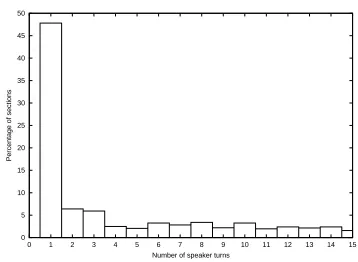
Figure 3: Histogram of the number of speaker turns per section in 100 hours of audio data from radio and TV sources (NPR, ABC, CNN, CSPAN) from May-June 1996.
transcriptions, and a moderate degradation (4% absolute) is observed using the 1.4xRT transcrip-tions.
7
Locating Story Boundaries
0 0.002 0.004 0.006 0.008 0.01 0.012 0.014 0.016 0.018
0 30 60 90 120 150 180 210 240 270 300
Density
Duration (seconds)
1997 Hub-4
0 0.005 0.01 0.015 0.02 0.025
0 30 60 90 120 150 180 210 240 270 300
Density
Duration (seconds)
[image:6.612.90.269.17.275.2]TREC-9 SDR Corpus
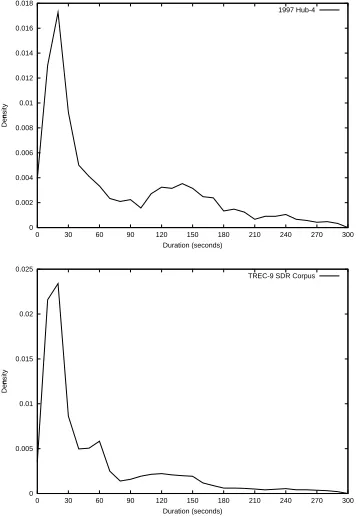
Figure 4: Distribution of document durations for 100 hours of data from May-June 1996 (top) and for 557 hours from February-June 1998 (bottom).
speaker turn boundaries cannot be used as the pri-mary cue for locating document boundaries. They can, however, be used to refine the placement of a document boundary located near a speaker change.
We also investigated using simple statistics on the durations of the documents. A histogram of the 2096 sections is shown in Figure 4. One third of the sections are shorter than 30 seconds. The histogram has a bimodal distribution with a sharp peak around 20 seconds, and a smaller, flat peak around 2 minutes. Very short documents are typical of headlines which are uttered by sin-gle speaker, whereas longer documents are more likely to contain data from multiple talkers. This distribution led us to consider using a multi-scale segmentation of the audio stream into documents. Similar statistics were measured on the larger cor-pus (Figure 4 bottom).
As proposed in (Abberley et al., 1999; John-son et al., 1999), we segment the audio stream into overlapping documents of a fixed duration. As a result of optimization, we chose a 30 sec-ond window duration with a 15 secsec-ond overlap.
Since there are many stories significantly shorter than 30s in broadcast shows (see Figure 4) we conjunctured that it may be of interest to use a double windowing system in order to better tar-get short stories (Gauvain et al., 2000). The win-dow size of the smaller winwin-dow was selected to be 10 seconds. So for each query, we indepen-dently retrieved two sets of documents, one set for each window size. Then for each document set, document recombination is done by merging overlapping documents until no further merges are possible. The score of a combined document is set to maximum score of any one of the com-ponents. For each document derived from the 30s windows, we produce a time stamp located at the center point of the document. However, if any smaller documents are embedded in this document, we take the center of the best scor-ing document. This way we try to take advantage of both window sizes. The MAP using a single 30s window and the double windowing strategy are shown in Table 2. For comparison, the IR re-sults using the manual story segmentation and the speaker turns located by the audio partitioner are also given. All conditions use the same word hy-potheses obtained with a speech recognizer which had no knowledge about the story boundaries.
manual segmentation (NIST) 59.6% audio partitioner 33.3% single window (30s) 50.0%
double window 52.3%
Table 2: Mean average precision with manual and automatically determined story boundaries. The document collection contains 557 hours of broad-cast news from the period of February through June 1998. (21750 stories, 50 queries with the associated relevance judgments.)
[image:6.612.328.504.395.453.2]removed. This reduces the risk of having out-of-topic hits and explains part of the difference be-tween this condition and the other conditions.
The problem of locating story boundaries is be-ing further pursued in the context of the ALERT
project, where one of the goals is to identify “doc-uments” given topic profiles. This project is in-vestigating the combined use of audio and video segmentation to more accurately locate document boundaries in the continuous data stream.
8
Recent Research Projects
The work presented in this paper has benefited from a variety of research projects both at the Eu-ropean and National levels. These collaborative efforts have enabled access to reworld data al-lowing us to develop algorithms and models well-suited for near-term applications.
The European project LE-4 OLIVE: A Multilingual Indexing Tool for Broadcast Material Based on Speech Recognition (http://twentyone.tpd.tno.nl/ olive/) addressed methods to automate the disclosure of the infor-mation content of broadcast data thus allowing content-based indexation. Speech recognition was used to produce a time-linked transcript of the audio channel of a broadcast, which was then used to produce a concept index for retrieval. Broadcast news transcription systems for French and German were developed. The French data come from a variety of television news shows and radio stations. The German data consist of TV news and documentaries from ARTE. OLIVEalso developed tools for users to query the database, as well as cross-lingual access based on off-line machine translation of the archived documents, and online query translation.
The European project IST ALERT: Alert sys-tem for selective dissemination (http://www.fb9-ti.uni-duisburg.de/alert) aims to associate state-of-the-art speech recognition with audio and video segmentation and automatic topic index-ing to develop an automatic media monitorindex-ing demonstrator and evaluate it in the context of real world applications. The targeted languages are French, German and Portuguese. Major media-monitoring companies in Europe are participating in this project.
Two other related FP5 IST projects are: CORE
-TEX: Improving Core Speech Recognition Tech-nology and ECHO: European CHronicles On-line. CORETEX (http://coretex.itc.it/), aims at
improving core speech recognition technologies, which are central to most applications involv-ing voice technology. In particular the project addresses the development of generic speech recognition technology and methods to rapidly port technology to new domains and languages with limited supervision, and to produce en-riched symbolic speech transcriptions. The ECHO
project (http://pc-erato2.iei.pi.cnr.it/echo) aims to develop an infrastructure for access to histori-cal films belonging to large national audiovisual archives. The project will integrate state-of-the-art language technologies for indexing, searching and retrieval, cross-language retrieval capabilities and automatic film summary creation.
9
Conclusions
This paper has described some of the ongoing re-search activites at LIMSI in automatic transcrip-tion and indexatranscrip-tion of broadcast data. Much of this research, which is at the forefront of todays technology, is carried out with partners with real needs for advanced audio processing technolo-gies.
Automatic speech recognition is a key tech-nology for audio and video indexing. Most of the linguistic information is encoded in the au-dio channel of video data, which once transcribed can be accessed using text-based tools. This is in contrast to the image data for which no common description language is widely adpoted. A va-riety of near-term applications are possible such as audio data mining, selective dissemination of information (News-on-Demand), media monitor-ing, content-based audio and video retrieval.
Acknowledgments
This work has been partially financed by the Eu-ropean Commission and the French Ministry of Defense. The authors thank Jean-Jacques Gan-golf, Sylvia Hermier and Patrick Paroubek for their participation in the development of differ-ent aspects of the automatic indexation system de-scribed here.
References
Dave Abberley, Steve Renals, Dan Ellis and Tony Robinson, “The THISL SDR System at TREC-8”,
Proc. of the 8th Text Retrieval Conference TREC-8,
Nov 1999.
Martine Adda-Decker, Gilles Adda, Lori Lamel, “In-vestigating text normalization and pronunciation variants for German broadcast transcription,” Proc.
ICSLP’2000, Beijing, China, October 2000.
Claude Barras, Lori Lamel, Jean-Luc Gauvain, “Auto-matic Transcription of Compressed Broadcast Au-dio Proc. ICASSP’2001, Salt Lake City, May 2001.
Langzhou Chen, Lori Lamel, Gilles Adda and Jean-Luc Gauvain, “Broadcast News Transcription in Mandarin,” Proc. ICSLP’2000, Beijing, China, Oc-tober 2000.
John S. Garofolo, Cedric G.P. Auzanne, and Ellen M. Voorhees, “The TREC Spoken Document Re-trieval Track: A Success Story,” Proc. of the 6th
RIAO Conference, Paris, April 2000. Also John
S. Garofolo et al., “1999 Trec-8 Spoken Docu-ment Retrieval Track Overview and Results,” Proc.
8th Text Retrieval Conference TREC-8, Nov 1999.
(http://trec.nist.gov).
Jean-Luc Gauvain, Lori Lamel, “Fast Decoding for Indexation of Broadcast Data,” Proc. ICSLP’2000,
3:794-798, Oct 2000.
Jean-Luc Gauvain, Lori Lamel, Gilles Adda, “Parti-tioning and Transcription of Broadcast News Data,”
ICSLP’98, 5, pp. 1335-1338, Dec. 1998.
Jean-Luc Gauvain, Lori Lamel, Claude Barras, Gilles
Adda, Yannick de Kercadio “The LIMSISDR
sys-tem for TREC-9,” Proc. of the 9th Text Retrieval
Conference TREC-9, Nov 2000.
Alexander G. Hauptmann and Michael J. Witbrock, “Informedia: News-on-Demand Multimedia Infor-mation Acquisition and Retrieval,” Proc
Intelli-gent Multimedia Information Retrieval, M.
May-bury, ed., AAAI Press, pp. 213-239, 1997.
Djoerd Hiemstra, Wessel Kraaij, “Twenty-One at TREC-7: Ad-hoc and Cross-language track,” Proc.
of the 8th Text Retrieval Conference TREC-7, Nov
1998.
Sue E. Johnson, Pierre Jourlin, Karen Sp¨arck Jones, Phil C. Woodland, “Spoken Document Retrieval for TREC-8 at Cambridge University”, Proc. of the 8th
Text Retrieval Conference TREC-8, Nov 1999.
Mark Maybury, ed., Special Section on “News on De-mand”, Communications of the ACM, 43(2), Feb 2000.
David Miller, Tim Leek, Richard Schwartz, “Using Hidden Markov Models for Information Retrieval”,
Proc. of the 8th Text Retrieval Conference TREC-7,
Nov 1998.
Kenney Ng, “A Maximum Likelihood Ratio Informa-tion Retrieval Model,” Proc. of the 8th Text
Re-trieval Conference TREC-8, 413-435, Nov 1999.
M. F. Porter, “An algorithm for suffix stripping”,
Pro-gram, 14, pp. 130–137, 1980.
Karen Sp¨ark Jones, S. Walker, Stephen E. Robert-son, “A probabilistic model of information retrieval: development and status,” Technical Report of the
Computer Laboratory, University of Cambridge, U.K., 1998.
J.M. Van Thong, David Goddeau, Anna Litvi-nova, Beth Logan, Pedro Moreno, Michael Swain, “SpeechBot: a Speech Recognition based Audio In-dexing System for the Web”, Proc. of the 6th RIAO
Conference, Paris, April 2000.