Post-Communist Transition as a Path
Break: Comparing Legal Institutional
Effects on Economic Growth between
Path-Breaking and Path-Drifting
Institutional Reforms
Tamilina, Larysa and Tamilina, Natalya
Independent Research
1 January 2016
Post-Communist Transition as a Path Break: Comparing Legal Institutional Effects on Economic Growth between Path-Breaking and Path-Drifting Institutional Reforms
Larysa Tamilina and Natalya Tamilina
Independent Research
Diakogianni Str. 7
Marousi Athens
15126 Greece
Phone: +30 210 7777640
E-mail: [email protected]
Author Note
Correspondence concerning this article should be addressed to Larysa Tamilina
Abstract
This article explains the peculiarities of institutional effects on growth rates in
post-communist countries. By proposing a certain dependence of the institution-growth nexus on
the mode of institutional grafting, the distinction between drift-phase and path-breaking
institutional change is introduced. Theoretical juxtapositions show that transition countries’
institutions built through path-breaking institutional reforms differ from those that emerge
evolutionarily in the drift phase in a twofold manner in their relationship to growth. Growth
rates of their economies are less likely to depend on the quality of legal institutions and are
more likely to be a function of the maturity of political institutions. In addition, legal
institutional change in the post-communist world is a product of the quality of the political
environment to a greater extent than their drift-phase alternatives. These propositions are
tested empirically based on a sample of 87 countries derived from the POLITY IV Project's
website.
Keywords:Institutional Economics, Formal Institutions, Institutional Change, Post-Communist Transition
Post-Communist Transition as a Path Break: Comparing Legal Institutional Effects on Economic Growth between Path-Breaking and Path-Drifting Institutional Reforms
1. Introduction
Growth theory asserts that good formal institutions are conducive to rapid economic
development. Empirical studies from economically developed and/or developing countries
(Eicher & Leukert, 2009) largely support this claim (see Acemoglu and Robinson (2012) for
an overview) but exclude the post-communist world as a unique group from the analysis
(Bosworth & Collins, 2003). Research has been conducted independently on these countries
and either substantiates conventional findings (see Aslund (2007) for a detailed overview).
Or, it recognizes peculiarities concerning the effect that formal institutional frameworks have
on economic growth, with the sign and strength of this impact varying depending on the
phase of transition or the maturity of formal institutions (Fidrmuc & Tichit, 2009; De Melo,
Denizer, Gelb, & Tenev, 1997; Falcetti, Raiser, & Sanfey, 2000).
Studies stemming from post-communist countries go even further and entirely negate
the claim that free-market formal institutions per se may lead to economic prosperity in the
course of transition (Mau, 2008; Polischuk, 2008; Polterovich, 2008). Capitalist formal
institutions lack compatibility with post-communist informal norms due to the countries'
insignificant historical experience with democracy and free markets (Yasin, 2003) or due to
unique features of their economic systems (Polterovich & Popov, 2006). The lack of strong
political contexts, which assumes an independent political sector from the economic sector, is
believed to hinder these countries from improving formal institutions, as a result of which
improvement is only associated with considerable economic and social losses (Polterovich,
2008).
Irrespective of the sign found in the relationship between formal institutions and
economic growth, studies on transition economies possess one common feature: The impact
of their formal institutions on growth is rarely tested in conjunction with developed and/or
developing countries. An indirect comparison of results is hardly possible, since analyses do
not use a standard set of conditioning variables and standard periods that would enable
comparing findings. One should note that, in general, growth theory recognizes the existence
of heterogeneity in the effects of formal institutions. It is well-established that the direction
and strength of institutional impacts on growth vary depending on the maturity level of
formal institutions (Barro, 1997; Fidrmuc & Tichit, 2009; Przeworski & Limongi, 1993) or a
country’s level of economic prosperity (Eicher & Leukert, 2009; Lee & Kim, 2009).
However, we doubt that these two explanations are exhaustive for all post-communist
countries. Transition economies started their institutional reforms from a relatively similar
platform in terms of their level of economic development and the type and degree of
institutional maturity but ended up at very different success levels. We argue that the
cross-country variation of institutional effects on economic growth can also be attributed to the way
in which such institutions were formed. The peculiar relationship of economic institutions to
growth rates in transition economies can also be explained by the top-down nature of their
institution building and socio-economic forces resulting from this process.
This research’s main objective is to juxtapose the post-communist pattern of
institution building with the pattern prevalent in other countries to identify implications that
this mode of institutional grafting may have for a country’s growth dynamics. This study
narrows the concept of formal institutions to legal institutions, such as property rights and
(North, 1990) and have been the least successfully reformed in post-communist countries
(Aslund, 2007).
2. Analytical Model
Institutional economics distinguishes between two modes of institutional grafting:
drift/evolution and critical junctures. The first describes institutional change that evolves in
small cumulative stages within an established institutional path. The second considers radical
changes that result from a country's exposure to shocks sufficient to break society out of the
outmoded, suboptimal path and shift into a new one (Acemoglu & Robinson, 2012). Drawn
upon this distinction, we alternatively use the adjective "drift-phase" to describe the
evolutionary type of institutional change and the term "path-breaking" when referring to
institutional change at critical junctures.
Each mode of institutional change is characterized by a distinct logic of the institution
formation process, affecting economic development in a certain way. We introduce a new
conceptual framework to juxtapose the two types of institutional grafting processes. Since we
primarily focus on the post-communist world, our point of departure is derived from the logic
of a free-market economy defined as an economic system based on the exchange of goods
and services between economic agents at market prices (Aslund, 2007). Given this definition,
we suggest that the formation of legal rules regulating economic processes can be understood
by accounting for: (1) economic agents' values and attitudes concerning production and
exchange processes; (2) the economic system's structural elements in which production and
exchange occur; and (3) the behavior of actors who devise legal rules that regulate
interactions concerning production and exchange. Based on this reasoning, we present
institutional grafting as shaped by three forces that correspond to three dimensions of the
The first dimension is a cultural one (Boettke, Coyne, & Leeson, 2008; Portes, 2006)
which is similar to North's concept of informal institutions (North, 1990). It includes
prevalent values/norms that dictate right and wrong, as well as behaviors describing how
likely it is that an individual’s conduct deviates from their good morals. The second
dimension is structural and encompasses economic forces that reflect a country's economic
infrastructure and the nature of economic arrangements. It predefines the extent to which a
country's economic system is in tune with the logic of free-market economic processes and
includes financial and banking systems, taxation, trade union, labor market institutions,
industrial relations, etc. The third dimension is called political and includes two aspects: (1)
political elites that deal with the formalization of new institutions, and (2) political
institutions that comprise the rules that formalize the prevailing political interests into a legal
framework.
We argue that legal institutions should be commensurate with the logic of each of the
three dimensions in order to function effectively and promote economic development. We
further argue that the level of this congruence may vary across the phases of institutional
change (drift/evolution or path-breaking/critical junctures) and can be a priory identified
from the logic of institution building in each of these phases.
The logic of drift-phase institutional change can be described as follows. As economic
agents operate, they accumulate knowledge and experiences, which leads to technological
advancements and further promotes the division of labor. This changes the organization of
production processes in a country and shifts the structural dimension by establishing new
industries, competition terms, pricing mechanisms, and conditions of resource allocation
across various economic sectors. Profound change in the economic domain leads to
transformations in how economic agents think and the values they hold. As a result, existing
structures and values among economic agents, thereby raising market transaction costs
(North, 1990). Contractual arrangements begin to create demand for institutional change that
can lower transaction costs to exploit new opportunities (Pejovich, 1999). In trying to
overcome the existing inconsistencies, economic agents introduce informal changes
(Eggertsson, 1997) among formal “rules of the game” in order to make the institutional
framework more flexible. If efficient and compatible with the interests of political elites
(Portes, 2006), these changes are captured by the political system, which formalizes and
legalizes them. As a result, they acquire the status of formal institutions. Private international
commercial law provides an example of the drift-phase institutional grafting (Boettke et al.,
2008): The development of cross-culture exchange in 11th- and 12th-century Europe led to
the spontaneous formation of the lex mercatoria, an informal system of customary law rooted
in international commercial norms (Boettke et al., 2008). These informal institutions
appeared to be effective and were later formalized into international commercial law.
The drift-phase institutional change is hence likely to produce legal institutions that
are congruent with our model's three dimensions: First, institutional change is initiated by
economic agents through the bottom-up approach, as a result of which the new institutions
are commensurate with the dominant values. Second, formal institutions are also congruent
with the existing economic structure, since changes in the old institutions primarily occur as a
reaction to shifts in the economic system or technologies. Third, the political dimension’s
role in institution creation is inferior and restricted to formalizing institutions. This suggests
that the political dimension’s quality only weakly determines the quality of institutional
change.
The logic of path-breaking institutional change differs substantially from the
drift-phase logic. The distinct feature of this mode of institutional change is that shifts in a
its economic system (Fidrmuc, 2003). Such reforms rarely require the population’s broad
support, since the economic crisis caused by the previous regime’s shortcomings serves to
justify introducing essential alterations in both political and economic systems (Olson, 1982).
Alternatively, the population’s dissatisfaction with the current regime can encourage citizens
to demand changes in both political and economic domains even if the incumbent elites resist
such reforms. Radical political change can occur either through revolutions (Acemoglu &
Robinson, 2012), as recent events in Arabic countries demonstrate, or in a peaceful manner
without wars and coups (Olson, 1982), as in the majority of post-communist countries during
the collapse of socialism (Aslund, 2007).
The radical political alterations require adjusting the institutional framework to the
new political logic and promote an immediate introduction of an entirely new set of legal
institutions, commensurate with the logic of the new political regime. Many pitfalls exist at
various stages of carrying out institutional reforms. First, a shift in the political power and the
initial immaturity of new political institutions may create a temporary vacuum of power and
opportunities for political or economic elites to seek rents through the new legal institutional
framework (Aslund, 2007). Second, even if this is not the case and the population's interests
dominate in the process of building a new legal institutional framework, the quality of the
new legal institutions ultimately depends on whether the political elites incumbent to handle
the institutional grafting are sufficiently familiar with the new economic system and relevant
legal rules. Third, since such knowledge and skills are often missing, it is likely that building
a new institutional framework involves borrowing legal rules from countries with political
and economic orders close to those desired. As a result, the new legal institutions become
imposed from without (Pejovich, 1999), which in turn leads to two kinds of problems.
On the one hand, implanting foreign institutions into another local context may
introduction of Western industrial legislation in many post-communist countries is a good
example of this. The new rules proved inefficient for post-communist economic systems,
since Western legislation was designed for postindustrial societies with a prevalence of
medium and small businesses, while many CIS economies were characterized by the
overrepresentation of large (state) enterprises (Polterovich & Popov, 2006). On the other
hand, a similar incongruence may also emerge between the new legal institutions and the
local cultural dimension (Boettke et al., 2008; Kyriazis & Zouboulakis, 2005; Portes, 2006).
Because culture is unique, economic agents may perceive and interpret the newly imported
legal rules through the prism of their specific values, as a result of which the meanings
assigned by economic agents to the new laws might appear completely different from their
initial context (Portes, 2006). This may further lead to a mutation of the new legal institutions
(Vernikov, 2009) or low levels of their enforcement (Portes, 2006).
The learning experience is expected to minimize or eliminate both kinds of
incongruence (Nelson & Sampat, 2001). If policymakers design and introduce adjustment
policies for the system’s orderly operation at each stage during the transition period, the
incompatibility between the new legal institutions and economic structures is believed to be
gradually narrowed. Similarly, if economic actors learn that adapting to the new legal
institutions can expand their opportunity set, they may change their cultural values and
behaviors. For instance, post-communist countries in which new democratic governments
successfully introduced economic reforms experienced a rise in pro-democratic attitudes
among citizens (Aslund, 2007). Successful reformers have also nurtured strong support for a
free-market economy (Aslund, 2007). These learning processes imply, however, that there
are lags between fundamental institutional change being initiated and the time when the
relevant actors get the structures right (Eggertsson, 1997), producing a positive impact for the
Japan’s post-war reconstruction and transition from socialism to capitalism, which included changes in the political regime, major economic rules, and legislation, are good
examples of the path-breaking approach to institutional grafting (Boettke et al., 2008).
Overall, the path-breaking process of institution formation is unlikely to produce legal
institutions that are congruent with our model's three dimensions: First, institutional change is
profound and may include the top-down introduction of radical institutional reforms by
implanting foreign institutions into the local systems. It is possible that these legal institutions
will be incongruent with existing cultures, at least at the initial reform stage. Second, similar
incongruence may also exist between the new legal institutions and the current economic
structure for the same reason as above. Third, the political dimension’s role is superior and
cannot be confined to legalizing new institutions but extends to their selection, design,
introduction, and subsequent adjustments to the cultural and structural dimensions in place.
The quality of new legal institutions might hence depend on the quality of the country's
political change and the professionalism of political elites incumbent to handle institutional
grafting under the new conditions.
The above discussion suggests that the odds of ensuring congruence between the new
legal institutions and the three dimensions differ substantially for the two modes of
institutional change. This allows us to argue that economies might be endowed with different
opportunity sets for growth, depending on the mode of institutional grafting through which
the new legal institutions emerge:
Proposition 1: Because legal institutions formed in the drift phase are more likely to
be congruent with the three dimensions, they will more effectively enhance economic
development than legal institutions introduced at critical junctures. The rationale behind our
between economic agents, making more transactions possible and leading to higher rates of
economic growth.
Proposition 2: Since the political dimension’s role is superior at critical junctures, we expect that the political dimension’s quality is of particular importance to the country's growth rate during the path-breaking institutional reforms. We identify two major
mechanisms through which the political dimension's role manifests itself: (a) mitigating the
negative impact of incongruence between the new legal institutions and the cultural or
structural dimensions on economic growth (see Proposition 3) and (b) designing and
introducing new legal institutions that are not only of good qualities but also congruent with
the existing cultural and structural dimensions (see Proposition 4).
Proposition 3: Since critical junctures are more likely to produce legal institutions
that are incongruent with the cultural and structural dimensions, a country's growth rates
become a function of the ability of political elites to adjust economic structures and/or
cultures to the new legal institutions' logic. By contrast, the drift-phase institutional reforms
produce legal institutions congruent with our model's dimensions and hence seldom require
such adaptation measures or coordinating actions on the part of the government.
Proposition 4: Since path-breaking institutional change at critical junctures
presupposes a radical transformation of the entire institutional framework through a top-down
approach, the quality of the new legal institutions becomes a function of the experience and
skillfulness of political elites who handle the institutional grafting process. Their ability to
choose the appropriate set of institutions determines the extent to which institution building
processes are successful and newly imported legal institutions are of good qualities and
congruent with local cultures and existing economic structures.
Hypothesis 1: A positive impact of legal institutions on economic growth is greater
when these institutions emerge in the drift phase rather than at critical junctures.
Hypothesis 2: The political dimension's positive impact on economic growth is
greater at critical junctures than in the drift phase of institutional grafting.
Hypothesis 3: At critical junctures, the negative impact of incongruence on economic
growth is smaller where the political dimension is of better quality.
Hypothesis 4:The political dimension's positive impact on the quality of legal
institutional change is greater at critical junctures than in the drift phase.
3. Data and Method Description
To test these hypotheses, we use Eicher’s and Leukert’s (2009) approach of splitting the
sample into subsamples and conducting an empirical analysis for each of them. In forming
our subsamples, we use the idea that institutional change at critical junctures presupposes a
simultaneous transformation of the entire framework of formal institutions. Since such a
radical transformation usually occurs because of a shift in the nature of economic relations
and the logic of economic processes, we assume that only a political regime change can
initiate path-breaking legal institutional reforms. This idea is also in line with the hierarchy of
institutions hypothesis that views formal legal institutions as a function of political
institutions within which a certain political regime is embedded (Eicher & Leukert, 2009).
To identify whether a country has experienced recent changes in its political regime,
we use the POLITY IV Project’s website (http://www.systemicpeace.org/polity/polity4.htm),
which provides information about political regime characteristics and transitions between
1800 and 2012 with a polity score for a wide range of countries (see
https://mpra.ub.uni-muenchen.de/68648/1/MPRA_paper_68648.pdf for a country choice description). The values
democracy and -6 and below denoting full autocracy. In our analysis, a country qualifies as
being at critical junctures if: (1) there was a political regime change in which values shifted
from at least -6 or below to at least 6 and above; (2) this change is rapid and occurred within
a few years; (3) this change occurred after 1970. Any earlier transition is expected to produce
institutions that would adhere to the local structural and cultural characteristics through the
learning process and eliminate any incongruence. In this case, the new formal institutions
would follow an evolutionary or drift-phase path in their maturation process; (4) the change is
stable with no signs of reverting to the previous regime in the following years; (5) there have
not been persistent fluctuations in the regime trend of more than 3 points since 1970. Regime
trend fluctuations denote political instability, which is a separate issue with respect to growth
analysis and has both positive and negative effects on economic development (Jong-A-Pin,
2009).
Since we are primarily interested in transition economies, our base path-breaking
subsample only includes 21 post-communist countries that correspond to the above criteria.
One should note that these countries are relatively heterogeneous in their historical trends
(Soviet Union membership, experience with private property during communism, etc.) and
present characteristics (EU membership, democracy types, etc.). We justify unifying them in
one sample, because they all had a one-party political regime during communism with a
centrally planned economic system. And they all underwent a profound institutional
transformation with the same target: Transition to a free market economy and the
introduction of democracy, which involved a radical change in the rules governing both
political and economic processes. The fact that they slightly differ in their starting points does
not contradict the purpose of our analysis, since the quantitative impact of initial conditions
on the set of reforms and economic growth is small and tends to rapidly decline over time
empirical results are not unique to post-communist countries, we expand the path-breaking
subsample by including non-post-communist countries that meet the above criteria, thereby
increasing this subsample to 42 countries.
Countries that have not experienced political regime change or have experienced
profound but gradual change (each stage of change not being greater than a 3-point
fluctuation in the polity score) are considered to be in the drift phase. The base drift
subsample is limited to 22 old and stable democracies or autocracies to avoid a
disproportionate subsample size. Since most of these countries are relatively advanced in
their economic development, we expand this subsample by adding other developed and
developing countries, augmenting this subsample to 45 countries. Appendix 1 lists the
countries included in the analysis. One should note that some of these countries lack data on
institutional or political indexes, which results in a smaller number of cases actually used in
each type of analysis.
We are primarily interested in comparing how formal legal and political institutions
impact economic growth for the two country groups: evolutionary/drift versus
path-breaking/critical junctures. The quality of legal institutions is approximated through a
contract enforcement and property rights protection index sourced from the 2007 Economic
Freedom of the World annual report (see Gwartney, Lawson, Sobel, & Leeson (2007) for the
detailed description of the index composition). The values vary from 1 (bad legal institutions)
to 10 (good legal institutions). Formal institutions are considered to be good when they are
clearly defined and well-enforced, which means that the institutional scores are closer to 10.
The political dimension's quality is measured through the control of corruption in
government, government effectiveness, the quality of regulation, and voice and
accountability. All political indexes are sourced from the World Bank Group database and
highly correlated, with the voice and accountability index showing the greatest uniqueness in
its variance (due to space limits, we do not report factor loading and unique variances for
political scores, but they can be sent upon request). We use this index to describe the quality
of democratic settings in a country and hence the quality of political institutions. The three
remaining indexes are combined by using the STATA predict option for factor analysis to
construct a single measure of the policymaking quality which is expected to approximate the
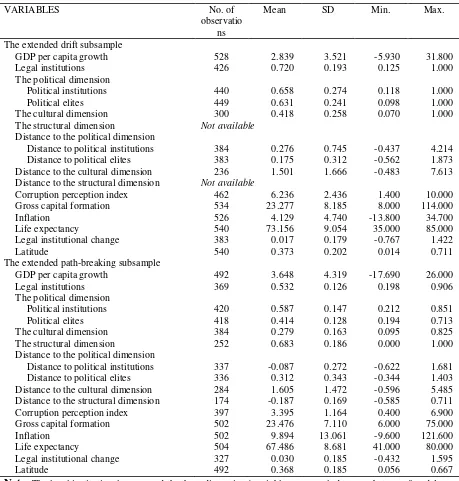
political elites’ quality. Table 1 presents descriptive statistics for the key variables (see table
1).
[insert Table 1 here]
We follow Tabellini (2008) in measuring the cultural dimension through the four
aspects (control, respect, trust, and obedience) and source the relevant measures from the
World Values Survey. Obedience represents the percentage of people in the sample who
mentioned obedience as an important factor in society. Trust and respect are positive
responses to questions about trusting most of the people and whether most people show
tolerance and respect towards others. Control is operationalized through the question about
how much freedom of choice and control people have over their own lives. The aggregate
variable is constructed by adding up the values of control, respect, and trust, and subtracting
the value of obedience. Since many countries included in the subsamples participated in one
wave of the WVS, the cultural variable is available only on a cross-sectional basis.
We follow Eicher and Schreiber (2010) in operationalizing the structural dimension
and utilize the EBRD measures to construct a structural policy index, consisting of price
liberalization, foreign exchange/trade liberalization, small/large scale privatization, enterprise
reform, competition policy reform, banking sector reform, and non-banking financial
construct. We limit the analysis of the structural dimension to the base path-breaking
subsample, since the relevant data are only available for this set of countries.
To test our hypotheses empirically, we use the dynamic GMM method proposed by
Arellano and Bond (Arellano & Bover, 1995; Blundell & Bond, 1998). The procedure for
applying this technique is well-documented by Eicher and Schreiber (2010), Lee and Kim
(2009), and Pääkkönen (2010). It requires that the equation is first-differenced to eliminate
the heterogeneity in production functions and then an instrumental variable method is applied
on the differenced model, with lagged values of the endogenous variables used as instruments
for the variables themselves. To avoid an overfitting bias, we often restrict instruments to
only few lags of the respective variables. We further use the STATA collapse sub-option to
create one instrument for each variable and lag distance rather than one for each time period,
variable, and lag distance. We also add the sub-options small to request small-sample
corrections to the covariance matrix estimate. We calculate a two step estimator instead of a
one step. Additionally, we use the sub-option noleveleq that invokes difference instead of
system GMM. To demonstrate the correctness of the model, we report the number of
instruments generated by the model, the results from a Hansen overidentification test, and the
Arellano-Bond test for AR(2) serial correlation in the residuals. STATA command extabond2
is used for calculating the model parameters.
In line with Pääkkönen’s study (2010), we utilize yearly data for the period from 1996
to 2008. We exclude the initial transition years from the analysis, since the outset of
transition entailed profound systemic changes (Fidrmuc, 2003). We apply the same model to
both subsamples while ensuring that a standard set of conditioning variables and standard
periods are used. Our base growth model includes two variables: investment and inflation.
Investment is included, since it is the key predictor in the majority of growth models (Solow,
during transition in the post-communist world (Fischer, Sahay, & Vegh, 1996). Hence, the
base model is:
lnYit =αlnYit-1 + β1lnKit + β2lnMSit + εit (1)
Where Yit is a measure of economic development limited to economic growth and
operationalized through an annual real GDP growth rate, Yit-1 is one-period-lagged economic
growth. K stands for the investment in physical capital measured through gross capital
formation as a percentage of GDP. MS represents macroeconomic stability captured by
annual consumer price inflation. The main source for the above variables is the World Bank
electronic database.
We begin the analysis with testing the key premise of our theoretical model that
incongruence between the new legal institutions and our model's three dimensions is
detrimental to economic growth:
lnYit =αlnYit-1 + β1lnKit + β2lnMSit + β3D_Cultureit + β4D_Structureit + β5D_Politicsit
+ εit (2)
WhereD_ is a measure of incongruence expressed through the distance between the
quality of a country's legal institutions and one of the three dimensions and calculated as
follows: Distance = [(Legal institutional index - Dimensions' value) / Dimensions' value].
Since cultural measures are available on a cross-sectional basis, we calculate annual distances
between legal institutions and the cultural dimension as differences between legal scores for
every year and the constant cultural scores.
We further include formal legal institutions (LI) into the base model:
lnYit =αlnYit-1 + β1lnKit + β2lnMSit + β3LIit + εit (3)
Similarly, we include political dimension indexes (PI) into the base model as:
lnYit =αlnYit-1 + β1lnKit + β2lnMSit + β3PIit + εit (4)
At this stage of the analysis, we are able to compare the coefficient estimates of the
legal institutional variable, LI, and the political dimension variable, PI, between the drift and
path-breaking subsamples.
We further analyze the political dimension’s role in mitigating the detrimental impact
of incongruence on economic growth by allowing interactions between the distance variables
and the political dimension's measures:
lnYit =αlnYit-1 + β1lnKit + β2lnMSit + β3PIit + β4D_Culture it + β5D_Structureit + β6PI*D_Culture it + β7PI*D_Structureit + εit (5)
Where PI*D_Culture and PI*D_Structure are interaction terms between the political
indexes and distances that legal institutions develop to culture or economic structure
respectively.
We proceed with exploring the impact of political indexes on the quality of legal
institutional change:
Where LI_change stands for an annual change in the legal institutional index during
the period analyzed and is calculated as [(Legal Institutional Index in year t - Legal
Institutional Index in year (t-1)] / Legal Institutional Index in year (t-1). LI it-1 is a lagged
value of the legal institutional index, PI is political indexes, and Life_expect stands for life
expectancy as in Acemoglu, Johnson, and Robinson (2001) and Islam (2004).
4. Empirical Results
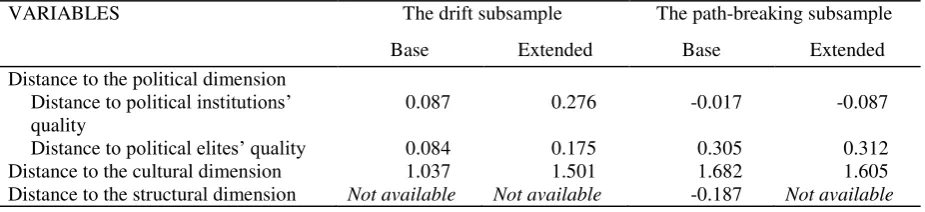
Our data confirm the idea that path-breaking institutional reforms are more likely to produce
institutions that are incongruent with our model's three dimensions (see table 2). The absolute
values of the distance variables are greater for the path-breaking subsamples than for the drift
subsamples. The only exception is the distance to the political institutions’ quality that proves
greater in the drift phase than at critical junctures.
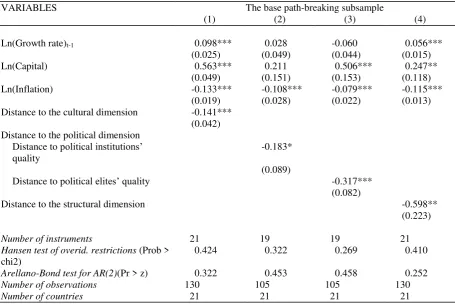
We also receive support for our key assumption that the distance between legal
institutions and the three dimensions may worsen a transition country's economic
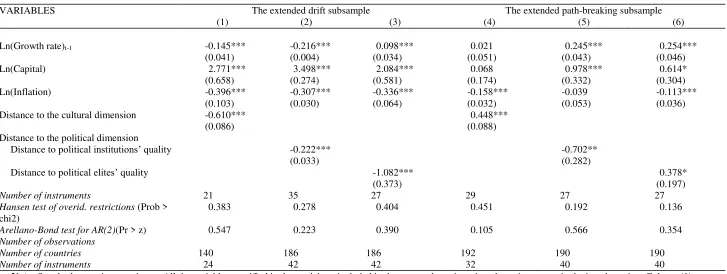
performance (see table 3). A similar relationship is found for the extended drift subsample,
but only partially confirmed for the extended path-breaking subsample (see table 4). The lack
of complete evidence for the extended path-breaking subsample can be attributed to a great
number of missing values for the cultural variable. Concerning the political elites index, this
may also mean that at critical junctures, what matters is not the distance that legal institutions
develop to the political dimension, but the actual quality of this political dimension.
[insert Table 2, Table 3 and Table 4 here]
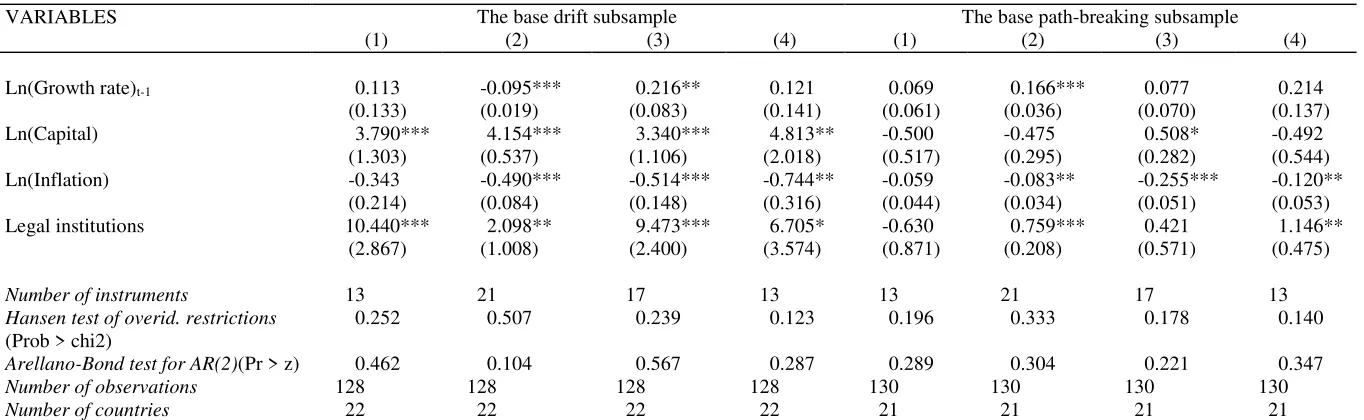
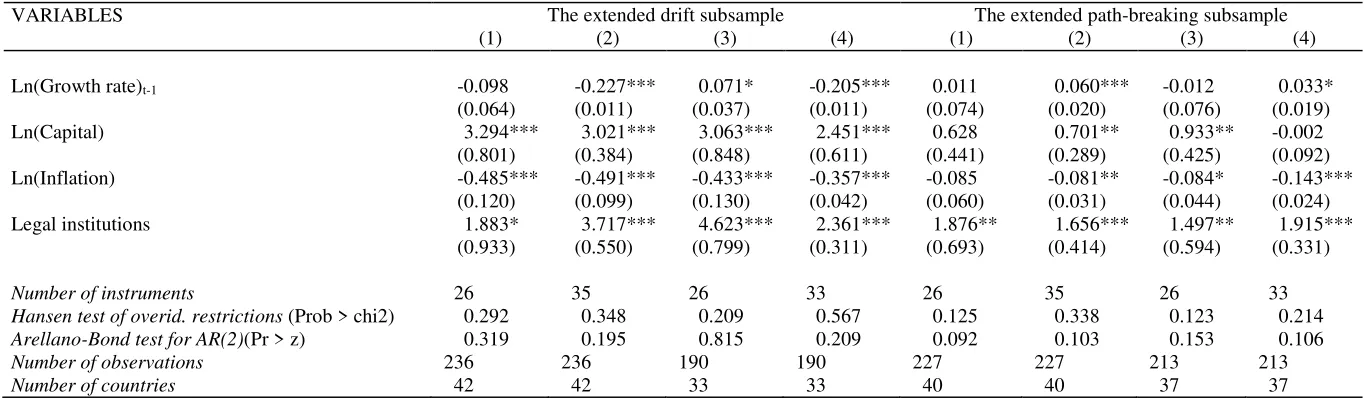
Our empirical results also confirm the idea of heterogeneity in the impact of legal and
political indexes on the economic growth. Legal institutions strongly affect growth rates of
economies operating within the institutions formed via drift-phase institutional change (see
positive relationship between legal institutional indexes and growth rates but this impact is
substantially smaller compared to the drift subsamples. This is in line with Hypothesis 1.
These results stand up to the alternative model specification choice and to the exclusion of
resource-rich countries from the analysis.
[insert Table 5 and Table 6 here]
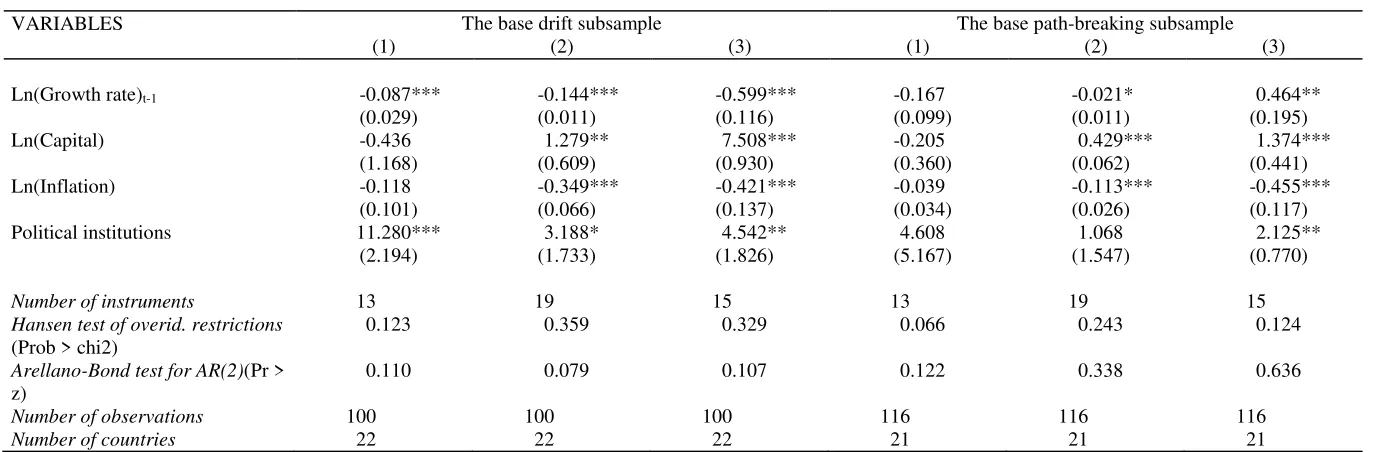
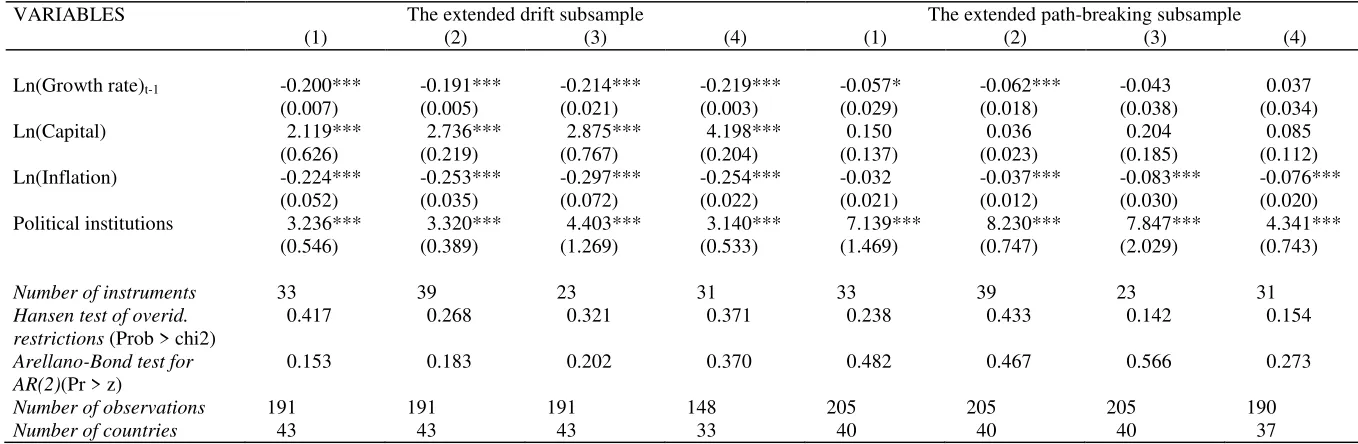
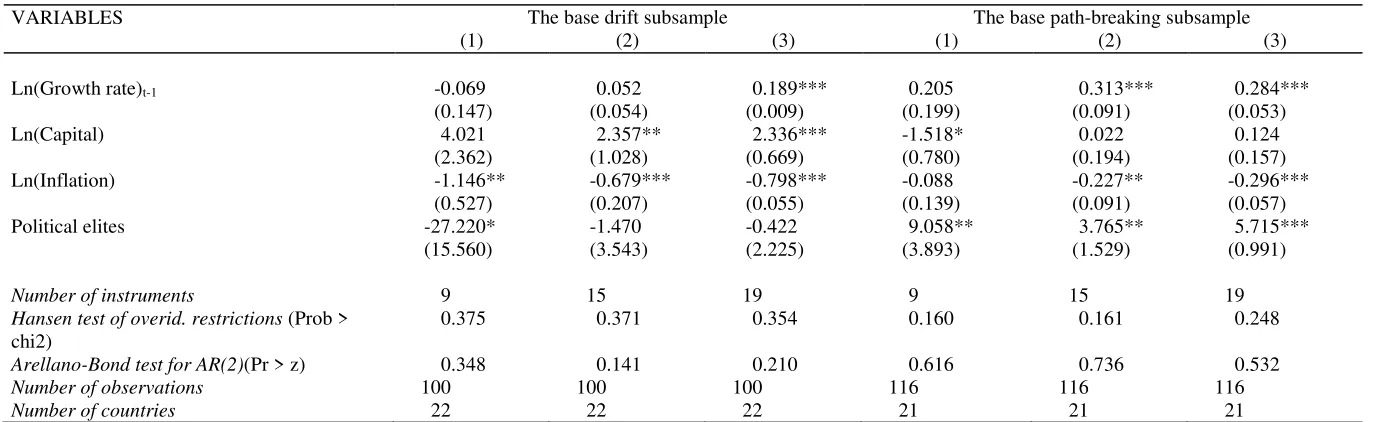
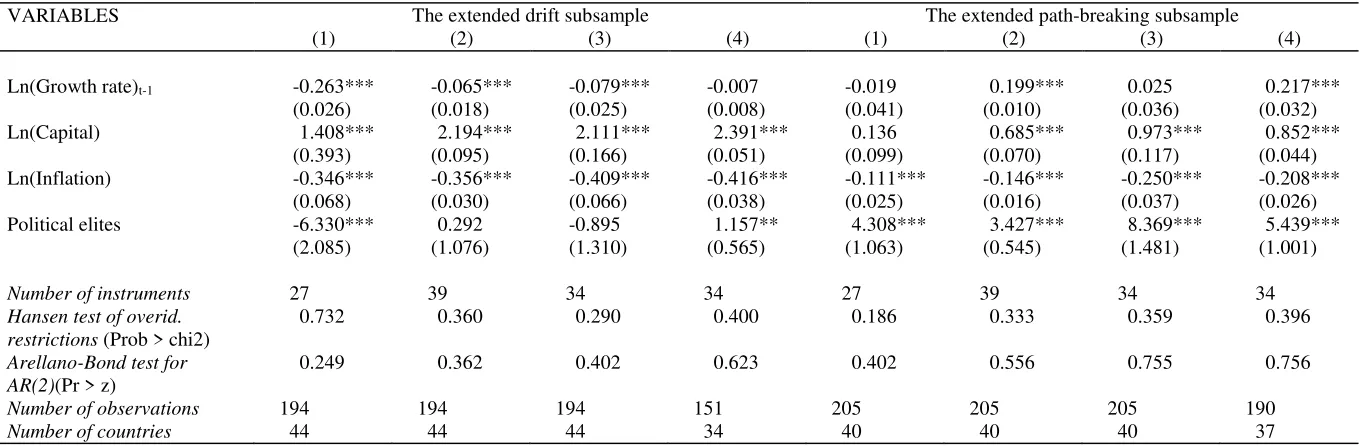
Tables 7 to 10 juxtapose the impact of the political dimension on economic growth
between the drift and critical juncture subsamples. The results are largely consistent with
hypothesis 2 and suggest that economies operating within a path-breaking institutional
framework are more sensitive to the quality of their political sector, especially concerning
political elites. In the case of the drift subsamples, it is more important that strong political
institutions exist to allow these economies to grow faster. The results also remain robust to
alternative model specification choices or to the exclusion of resource rich countries from the
extended subsamples.
[insert Table 7, Table 8, Table 9 and Table 10 here]
To further understand the political dimension’s role at critical junctures, we introduce
interactions between political indexes and the distance between legal institutions and our
model's dimensions. The negative main effect (see table 11) suggests that increasing the
distance to the cultural or structural dimensions may slow down economic growth. The
positive coefficient estimates on the interaction terms further suggest that the mature political
environment may cushion the negative impact of this distance, supporting hypothesis 3. The
interaction effect is especially strong for the extended path-breaking subsample.
[insert Table 11 here]
Our results also indicate that during the path-breaking institutional reforms, the
political dimension’s quality is instrumental in building legal institutions (see table 12),
change is relatively independent from the quality of political elites but proves influenced by
political institutions’ quality. Similarly, the distance variables' negative impact on the legal
institutional change can be mitigated when the political dimension’s quality improves (see
table 13). Both findings are consistent with hypothesis 4.
[insert Table 12 and Table 13 here]
Overall, the empirical analysis supports the original hypotheses. Moreover, the results
can be considered robust given the selected robustness check strategies: (1) the drift
subsample included economically developing countries to avoid the difference in coefficients
being caused by variances in the level of economic or institutional maturity between the two
country groups; (2) we included non-post-communist countries in the path-breaking
subsample to verify whether the specificities found for post-communist countries are
universal or unique to the post-communist world; (3) we eliminated resource rich countries
and small economies from both subsamples. The list of such countries was retrieved from
Mankiw, Romer, and Weil (1992). One should note that the results for transition economies
(the base path-breaking subsample) show slight peculiarities as compared to other countries
from the extended path-breaking subsample. We believe that this difference is due to
specificities of the socialist regime. While Communism represented a dictatorship, it was
characterized by relatively high industrialization levels, albeit militarized to a great extent, a
highly educated labor force, high levels of urbanization, and extended social programs.
5. Conclusion and Discussion
This study introduces the idea that institutional grafting is shaped by three forces: cultural,
structural, and political. The success of institutional reforms is viewed as dependent not only
on the actual quality of newly introduced legal institutions but also on the level of congruence
is considered a function of the phase in which such institutions emerge. Drift-phase
institutional change produces legal institutions that are congruent with the logic of the three
dimensions and that promote economic development. Path-breaking institutional change in
contrast leads to the emergence of institutions that develop distances to the defined
dimensions and that, thereby, have only a limited impact on growth rates. In this case, the
actual quality of the political dimension will predetermine both a local economy's growth
dynamics and the success of institutional change.
Future research is needed to eliminate three major limitations of our study. First, a
more careful grouping of countries for both subsamples is necessary to eliminate stark
heterogeneities in their political, economic, social, and historical characteristics. Second, one
should consider integrating countries with unstable regime trends into the analysis. Finally,
alternative economic development measures should be used to demonstrate the robustness of
our findings on the impact that the mode of institution building has on patterns of economic
References
Acemoglu, D., Johnson, S., & Robinson, J. A. (2001). The colonial origins of comparative
development: An empirical investigation. American Economic Review, 91(5), 1369–
1401.
Acemoglu, D., & Robinson, J.A. (2012). Why nations fail: The origins of power, prosperity
and poverty. New York: Crown Publishers.
Arellano, M., & Bover, O. (1995). Another look at the instrumental variable estimation of
error-component model. Journal of Econometrics,68(1), 29–51.
Aslund, A. (2007). How capitalism was built: The transformation of Central and Eastern
Europe, Russia and Central Asia. Cambridge: Cambridge University Press.
Barro, R.J. (1997). Determinants of economic growth: A cross-country empirical study.
Cambridge, MA: MIT Press.
Berg, A., Borensztein, E., Sahay, R., & Zettelmeyer, J. (1999). The evolution of output in
transition economies: Explaining the differences. IMF Working Paper WP/99/73,
International Monetary Fund.
Blundell, R., & Bond, S. (1998). Initial conditions and moment conditions in dynamic panel
data models. Journal of Econometrics, 87(1), 115–143.
Boettke, P.J., Coyne, C.J., & Leeson, P.T. (2008). Institutional stickiness and the new
development economics. American Journal of Economics and Sociology, 67(2), 331–
358.
Bosworth, B.P., & Collins, S.M. (2003). The empirics of growth: An update. Brookings
Papers on Economic Activity, 2, 113–206.
De Melo, M., Denizer, C., Gelb, A., & Tenev, S. (1997). Circumstances and choice: The role
of initial conditions and policies in transition economies. World Bank Policy
Eggertsson, T. (1997). The old theory of economic policy and the New Institutionalism.
World Development, 25(8), 1187–1203.
Eicher, T.S., & Leukert, A. (2009). Institutions and economic performance: Endogeneity and
parameters heterogeneity. Journal of Money, Credit and Banking, 41(1), 197–218.
Eicher, T.S., & Schreiber, T. (2010). Structural policies and growth: Time series evidence
from a natural experiment. Journal of Development Economics, 91(1), 169–179.
Falcetti, E., Raiser, M., & Sanfey, P. (2000). Defying the odds: Initial conditions, reforms
and growth in the first decade of transition. EBRD Working Paper No. 55, European
Bank for Reconstruction and Development.
Fidrmuc, J., & Tichit, A. (2009). Mind the break! Accounting for changing patterns of growth
during transition. Economic Systems, 33(2), 138–154.
Fidrmuc, J. (2003). Economic reform, democracy and growth during Post-Communist
transition. European Journal of Political Economy,19(3), 583–604.
Fischer, S., Sahay R., & Vegh, C.A. (1996). Stabilisation and growth in transition economies:
The early experience. Journal of Economic Perspectives, 10, 45–66.
Gwartney, J., Lawson, R., Sobel, R.S., & Leeson, P.T. (2007). Economic freedom of the
World: 2007 Annual Report. The Fraser Institute, Economic Freedom Network.
Islam, N. (2004). Settler mortality rate as an instrument for institutional quality. Working
Paper Series Vol. 2004-28, International Centre for the Study of East Asian
Development.
Jong-A-Pin, R. (2009). On the measurement of political instability and its impact on
economic growth. European Journal of Political Economy, 25(1), 15–29.
Kyriazis, N.C., & Zouboulakis, M.S. (2005). Modeling institutional change in transition
Lee, K., & Kim, B.-Y. (2009). Both institutions and policies matter but differently for
different income groups of countries: Determinants of long-run economic growth
revisited. World Development, 37(3), 533–549.
Mankiw, N.G., Romer, D., & Weil, D.N. (1992). A contribution to the empirics of economic
growth. Quarterly Journal of Economics, 107(2), 407–437.
Маu, V. (2008). Ekonomicheskaya politika 2007 goda: Uspehi i riski. Voprosi Ekonomiki
(Economic policy in 2007: Successes and risks. Economic Issues), 2, 23–38.
Nelson, R.R., & Sampat, B.N. (2001). Making sense of institutions as a factor shaping
economic performance. Journal of Economic Behavior and Organization, 44(1), 31–
54.
North, D.C. (1990). Institutions, institutional change and economic performance. Cambridge:
Cambridge University Press.
Olson, M. (1982). The rise and decline of nations. Economic growth, stagnation and social
rigidities. New Haven, CT: Yale University Press.
Pääkkönen, J. (2010). Economic freedom as driver of growth in transition. Economic
Systems, 34(4), 469–479.
Pejovich, S. (1999). The effects of the interaction of formal and informal institutions on
social stability and economic development. Journal of Markets and Morality, 2(2),
164–181.
Polischuk, L. (2008). Nezelevoe ispolsovanie institutov: Prichini i sledstviya. Voprosi
Ekonomiki (Non-intentional use of institutions: Causes and consequences. Economic
Issues),8, 28–44.
Polterovich, V. (2008). Strategii modernizasii, instituti i coalisii. Voprosi Ekonomiki
Polterovich, V., & Popov, V. (2006). Evoluzionnaya teoria ekonomicheskoy politiki.
Voprosi Ekonomiki (Evolutionary theory of economic policy-making. Economic
Issues), 7, 4–22.
Portes, A. (2006). Institutions and development: A conceptual re-analysis. Population and
Development Review, 32(2), 233–262.
Przeworski, A., & Limongi, F. (1993). Political regimes and economic growth. Journal of
Economic Perspectives, 7(3), 51–69.
Solow, R. M. (1956). A contribution to the theory of economic growth. Quarterly Journal of
Economics, 70(1), 65–94.
Tabellini, G. (2008). The scope of cooperation: Values and incentives. Quarterly Journal of
Economics, 123(3), 905–950.
Vernikov, A. (2009). Corporate governance institutions in Russia: Import and mutation.
Working Paper 15379, Munich Personal RePEc Archive.
Yasin, E.G. (2003). Modernizatsia ekonomiki i sistema tsennostey (Economy modernization
and values system). Retrieved from: http://www.amicable.ru/library/yasin2003.pdf.
Table 1 Descriptive Statistics for Key Variables of the Extended Subsamples
VARIABLES No. of
observatio ns
Mean SD Min. Max.
The extended drift subsample
GDP per capita growth 528 2.839 3.521 -5.930 31.800
Legal institutions 426 0.720 0.193 0.125 1.000
The political dimension
Political institutions 440 0.658 0.274 0.118 1.000
Political elites 449 0.631 0.241 0.098 1.000
The cultural dimension 300 0.418 0.258 0.070 1.000
The structural dimension Not available
Distance to the political dimension
Distance to political institutions 384 0.276 0.745 -0.437 4.214
Distance to political elites 383 0.175 0.312 -0.562 1.873
Distance to the cultural dimension 236 1.501 1.666 -0.483 7.613
Distance to the structural dimension Not available
Corruption perception index 462 6.236 2.436 1.400 10.000
Gross capital formation 534 23.277 8.185 8.000 114.000
Inflation 526 4.129 4.740 -13.800 34.700
Life expectancy 540 73.156 9.054 35.000 85.000
Legal institutional change 383 0.017 0.179 -0.767 1.422
Latitude 540 0.373 0.202 0.014 0.711
The extended path-breaking subsample
GDP per capita growth 492 3.648 4.319 -17.690 26.000
Legal institutions 369 0.532 0.126 0.198 0.906
The political dimension
Political institutions 420 0.587 0.147 0.212 0.851
Political elites 418 0.414 0.128 0.194 0.713
The cultural dimension 384 0.279 0.163 0.095 0.825
The structural dimension 252 0.683 0.186 0.000 1.000
Distance to the political dimension
Distance to political institutions 337 -0.087 0.272 -0.622 1.681
Distance to political elites 336 0.312 0.343 -0.344 1.403
Distance to the cultural dimension 284 1.605 1.472 -0.596 5.485
Distance to the structural dimension 174 -0.187 0.169 -0.585 0.711
Corruption perception index 397 3.395 1.164 0.400 6.900
Gross capital formation 502 23.476 7.110 6.000 75.000
Inflation 502 9.894 13.061 -9.600 121.600
Life expectancy 504 67.486 8.681 41.000 80.000
Legal institutional change 327 0.030 0.185 -0.432 1.595
Latitude 492 0.368 0.185 0.056 0.667
Table 2 Mean Values for the Distance Variables, by Mode of Institutional Grafting
VARIABLES The drift subsample The path-breaking subsample
Base Extended Base Extended
Distance to the political dimension Distance to political institutions’ quality
0.087 0.276 -0.017 -0.087
Distance to political elites’ quality 0.084 0.175 0.305 0.312
Distance to the cultural dimension 1.037 1.501 1.682 1.605
Table 3 The Impact of the Distance Variables on Economic Growth for the Base Subsamples
VARIABLES The base path-breaking subsample
(1) (2) (3) (4)
Ln(Growth rate)t-1 0.098*** 0.028 -0.060 0.056***
(0.025) (0.049) (0.044) (0.015)
Ln(Capital) 0.563*** 0.211 0.506*** 0.247**
(0.049) (0.151) (0.153) (0.118)
Ln(Inflation) -0.133*** -0.108*** -0.079*** -0.115***
(0.019) (0.028) (0.022) (0.013)
Distance to the cultural dimension -0.141***
(0.042) Distance to the political dimension
Distance to political institutions’ quality
-0.183*
(0.089)
Distance to political elites’ quality -0.317***
(0.082)
Distance to the structural dimension -0.598**
(0.223)
Number of instruments 21 19 19 21
Hansen test of overid. restrictions (Prob > chi2)
0.424 0.322 0.269 0.410
Arellano-Bond test for AR(2)(Pr > z) 0.322 0.453 0.458 0.252
Number of observations 130 105 105 130
Number of countries 21 21 21 21
Note: Standard errors in parentheses. Results are only reported for the base path-breaking subsample. We do not run a similar analysis for the base drift subsample due to a great number of missing values for the cultural variable and the lack of data for the structural variable. All the variables specified in the model are included in the gmmstyle option. Instruments are restricted to the first, second and third lags of the respective variables; time dummies appear in the ivstyle option.
Table 4 The Impact of the Distance Variables on Economic Growth for the Extended Subsamples
VARIABLES The extended drift subsample The extended path-breaking subsample
(1) (2) (3) (4) (5) (6)
Ln(Growth rate)t-1 -0.145*** -0.216*** 0.098*** 0.021 0.245*** 0.254***
(0.041) (0.004) (0.034) (0.051) (0.043) (0.046)
Ln(Capital) 2.771*** 3.498*** 2.084*** 0.068 0.978*** 0.614*
(0.658) (0.274) (0.581) (0.174) (0.332) (0.304)
Ln(Inflation) -0.396*** -0.307*** -0.336*** -0.158*** -0.039 -0.113***
(0.103) (0.030) (0.064) (0.032) (0.053) (0.036)
Distance to the cultural dimension -0.610*** 0.448***
(0.086) (0.088)
Distance to the political dimension
Distance to political institutions’ quality -0.222*** -0.702**
(0.033) (0.282)
Distance to political elites’ quality -1.082*** 0.378*
(0.373) (0.197)
Number of instruments 21 35 27 29 27 27
Hansen test of overid. restrictions (Prob > chi2)
0.383 0.278 0.404 0.451 0.192 0.136
Arellano-Bond test for AR(2)(Pr > z) 0.547 0.223 0.390 0.105 0.566 0.354
Number of observations
Number of countries 140 186 186 192 190 190
Number of instruments 24 42 42 32 40 40
Note: Standard errors in parentheses. All the variables specified in the model are included in the gmmstyle option; time dummies appear in the ivstyle option. Column (1): Instruments are restricted to the first, second and third lags of the respective variables; Column (2): Instruments are increased to the seventh lags of the respective variables; Column (3): Instruments used are from the second to the sixth lags of the respective variables; Columns (4, 5 and 6): Instruments used are from the fifth to the ninth lags of the respective variables.
Table 5 The Impact of Legal Institutions on Economic Growth for the Base Subsamples
VARIABLES The base drift subsample The base path-breaking subsample
(1) (2) (3) (4) (1) (2) (3) (4)
Ln(Growth rate)t-1 0.113 -0.095*** 0.216** 0.121 0.069 0.166*** 0.077 0.214
(0.133) (0.019) (0.083) (0.141) (0.061) (0.036) (0.070) (0.137)
Ln(Capital) 3.790*** 4.154*** 3.340*** 4.813** -0.500 -0.475 0.508* -0.492
(1.303) (0.537) (1.106) (2.018) (0.517) (0.295) (0.282) (0.544)
Ln(Inflation) -0.343 -0.490*** -0.514*** -0.744** -0.059 -0.083** -0.255*** -0.120**
(0.214) (0.084) (0.148) (0.316) (0.044) (0.034) (0.051) (0.053)
Legal institutions 10.440*** 2.098** 9.473*** 6.705* -0.630 0.759*** 0.421 1.146**
(2.867) (1.008) (2.400) (3.574) (0.871) (0.208) (0.571) (0.475)
Number of instruments 13 21 17 13 13 21 17 13
Hansen test of overid. restrictions (Prob > chi2)
0.252 0.507 0.239 0.123 0.196 0.333 0.178 0.140
Arellano-Bond test for AR(2)(Pr > z) 0.462 0.104 0.567 0.287 0.289 0.304 0.221 0.347
Number of observations 128 128 128 128 130 130 130 130
Number of countries 22 22 22 22 21 21 21 21
Note: Standard errors in parentheses. Column (1): All the variables specified in the model are included in the gmmstyle option. Instruments are restricted to the third, fourth and fifth lags of the respective variables; Column (2): In addition to the above specification choice, time dummies appear in the ivstyle option; Column (3): An alternative model specification choice is used such as restricting instruments to the ninth and tenth lags of the respective variables; Column (4): An alternative model specification choice is used such as restricting instruments to the fifth lags of the respective variables and omitting the collapse sub-option.
Table 6 The Impact of Legal Institutions on Economic Growth for the Extended Subsamples
VARIABLES The extended drift subsample The extended path-breaking subsample
(1) (2) (3) (4) (1) (2) (3) (4)
Ln(Growth rate)t-1 -0.098 -0.227*** 0.071* -0.205*** 0.011 0.060*** -0.012 0.033*
(0.064) (0.011) (0.037) (0.011) (0.074) (0.020) (0.076) (0.019)
Ln(Capital) 3.294*** 3.021*** 3.063*** 2.451*** 0.628 0.701** 0.933** -0.002
(0.801) (0.384) (0.848) (0.611) (0.441) (0.289) (0.425) (0.092)
Ln(Inflation) -0.485*** -0.491*** -0.433*** -0.357*** -0.085 -0.081** -0.084* -0.143***
(0.120) (0.099) (0.130) (0.042) (0.060) (0.031) (0.044) (0.024)
Legal institutions 1.883* 3.717*** 4.623*** 2.361*** 1.876** 1.656*** 1.497** 1.915***
(0.933) (0.550) (0.799) (0.311) (0.693) (0.414) (0.594) (0.331)
Number of instruments 26 35 26 33 26 35 26 33
Hansen test of overid. restrictions (Prob > chi2) 0.292 0.348 0.209 0.567 0.125 0.338 0.123 0.214
Arellano-Bond test for AR(2)(Pr > z) 0.319 0.195 0.815 0.209 0.092 0.103 0.153 0.106
Number of observations 236 236 190 190 227 227 213 213
Number of countries 42 42 33 33 40 40 37 37
Note: Standard errors in parentheses. Column (1): All the variables specified in the model are included in the gmmstyle option. Instruments are restricted to the ninth and tenth lags of the respective variables. The collapse sub-option is not included. Time dummies appear in the ivstyle option; Column (2): An alternative model specification choice is used such as restricting instruments to the sixth lags of the respective variables and including the collapse sub-option; Column (3): Resource rich countries are excluded from the analysis; specification choice of Model 1 is applied; Column (4): Resource rich countries are excluded from the analysis; the
Table 7The Impact of Political Institutions on Economic Growth for the Base Subsamples
VARIABLES The base drift subsample The base path-breaking subsample
(1) (2) (3) (1) (2) (3)
Ln(Growth rate)t-1 -0.087*** -0.144*** -0.599*** -0.167 -0.021* 0.464**
(0.029) (0.011) (0.116) (0.099) (0.011) (0.195)
Ln(Capital) -0.436 1.279** 7.508*** -0.205 0.429*** 1.374***
(1.168) (0.609) (0.930) (0.360) (0.062) (0.441)
Ln(Inflation) -0.118 -0.349*** -0.421*** -0.039 -0.113*** -0.455***
(0.101) (0.066) (0.137) (0.034) (0.026) (0.117)
Political institutions 11.280*** 3.188* 4.542** 4.608 1.068 2.125**
(2.194) (1.733) (1.826) (5.167) (1.547) (0.770)
Number of instruments 13 19 15 13 19 15
Hansen test of overid. restrictions (Prob > chi2)
0.123 0.359 0.329 0.066 0.243 0.124
Arellano-Bond test for AR(2)(Pr > z)
0.110 0.079 0.107 0.122 0.338 0.636
Number of observations 100 100 100 116 116 116
Number of countries 22 22 22 21 21 21
Note: Standard errors in parentheses. Column (1): All the variables specified in the model are included in the gmmstyle option. Instruments are restricted to the first, second and third lags of the respective variables; (2) Additionally, time dummies appear in the ivstyle option; (3) An alternative model specification choice is used such as restricting instruments only to the tenth lags of the respective variables and omitting the collapse sub-option.
Table 8 The Impact of Political Institutions on Economic Growth for the Extended Subsamples
VARIABLES The extended drift subsample The extended path-breaking subsample
(1) (2) (3) (4) (1) (2) (3) (4)
Ln(Growth rate)t-1 -0.200*** -0.191*** -0.214*** -0.219*** -0.057* -0.062*** -0.043 0.037
(0.007) (0.005) (0.021) (0.003) (0.029) (0.018) (0.038) (0.034)
Ln(Capital) 2.119*** 2.736*** 2.875*** 4.198*** 0.150 0.036 0.204 0.085
(0.626) (0.219) (0.767) (0.204) (0.137) (0.023) (0.185) (0.112)
Ln(Inflation) -0.224*** -0.253*** -0.297*** -0.254*** -0.032 -0.037*** -0.083*** -0.076***
(0.052) (0.035) (0.072) (0.022) (0.021) (0.012) (0.030) (0.020)
Political institutions 3.236*** 3.320*** 4.403*** 3.140*** 7.139*** 8.230*** 7.847*** 4.341***
(0.546) (0.389) (1.269) (0.533) (1.469) (0.747) (2.029) (0.743)
Number of instruments 33 39 23 31 33 39 23 31
Hansen test of overid. restrictions (Prob > chi2)
0.417 0.268 0.321 0.371 0.238 0.433 0.142 0.154
Arellano-Bond test for AR(2)(Pr > z)
0.153 0.183 0.202 0.370 0.482 0.467 0.566 0.273
Number of observations 191 191 191 148 205 205 205 190
Number of countries 43 43 43 33 40 40 40 37
Note: Standard errors in parentheses. Column (1): All the variables specified in the model are included in the gmmstyle option. Instruments used are from the first to the eighth lags of the respective variables; Column (2): Additionally, time dummies appear in the ivstyle option; Column (3) An alternative model specification choice is used such as reducing the instruments to the fourth lags of the respective variables; Column (4): Resource rich countries are omitted from the analysis, the
Table 9The Impact of Political Elites on Economic Growth for the Base Subsamples
VARIABLES The base drift subsample The base path-breaking subsample
(1) (2) (3) (1) (2) (3)
Ln(Growth rate)t-1 -0.069 0.052 0.189*** 0.205 0.313*** 0.284***
(0.147) (0.054) (0.009) (0.199) (0.091) (0.053)
Ln(Capital) 4.021 2.357** 2.336*** -1.518* 0.022 0.124
(2.362) (1.028) (0.669) (0.780) (0.194) (0.157)
Ln(Inflation) -1.146** -0.679*** -0.798*** -0.088 -0.227** -0.296***
(0.527) (0.207) (0.055) (0.139) (0.091) (0.057)
Political elites -27.220* -1.470 -0.422 9.058** 3.765** 5.715***
(15.560) (3.543) (2.225) (3.893) (1.529) (0.991)
Number of instruments 9 15 19 9 15 19
Hansen test of overid. restrictions (Prob > chi2)
0.375 0.371 0.354 0.160 0.161 0.248
Arellano-Bond test for AR(2)(Pr > z) 0.348 0.141 0.210 0.616 0.736 0.532
Number of observations 100 100 100 116 116 116
Number of countries 22 22 22 21 21 21
Note: Standard errors in parentheses. Column (1): All the variables specified in the model are included in the gmmstyle option. Instruments are restricted to the second and third lags of the respective variables; Column (2): Additionally, time dummies appear in the ivstyle option; Column (3): An alternative model specification choice is used such as increasing instruments to the fourth lags of the respective variables.
Table 10 The Impact of Political Elites on Economic Growth for the Extended Subsamples
VARIABLES The extended drift subsample The extended path-breaking subsample
(1) (2) (3) (4) (1) (2) (3) (4)
Ln(Growth rate)t-1 -0.263*** -0.065*** -0.079*** -0.007 -0.019 0.199*** 0.025 0.217***
(0.026) (0.018) (0.025) (0.008) (0.041) (0.010) (0.036) (0.032)
Ln(Capital) 1.408*** 2.194*** 2.111*** 2.391*** 0.136 0.685*** 0.973*** 0.852***
(0.393) (0.095) (0.166) (0.051) (0.099) (0.070) (0.117) (0.044)
Ln(Inflation) -0.346*** -0.356*** -0.409*** -0.416*** -0.111*** -0.146*** -0.250*** -0.208***
(0.068) (0.030) (0.066) (0.038) (0.025) (0.016) (0.037) (0.026)
Political elites -6.330*** 0.292 -0.895 1.157** 4.308*** 3.427*** 8.369*** 5.439***
(2.085) (1.076) (1.310) (0.565) (1.063) (0.545) (1.481) (1.001)
Number of instruments 27 39 34 34 27 39 34 34
Hansen test of overid. restrictions (Prob > chi2)
0.732 0.360 0.290 0.400 0.186 0.333 0.359 0.396
Arellano-Bond test for AR(2)(Pr > z)
0.249 0.362 0.402 0.623 0.402 0.556 0.755 0.756
Number of observations 194 194 194 151 205 205 205 190
Number of countries 44 44 44 34 40 40 40 37
Note: Standard errors in parentheses. Column (1): All the variables specified in the model are included in the gmmstyle option. Instruments used are from the first to the fifth lags of the respective variables; Column (2): An alternative model specification choice is applied such as allowing instruments to vary from the third to the tenth lags of the respective variables; Column (3): An alternative model specification choice is used such as restricting instruments to the fourth lags of the respective variables and omitting the collapse suboption; Column (4): Resource rich countries are omitted from the analysis.
Table 11 The Impact of Interactions between the Political Dimension and the Distance Variables on Economic Growth for the Path-Breaking Subsamples
VARIABLES The base path-breaking subsample The extended path-breaking subsample
(1) (2) (3) (4) (5) (6)
Ln(Growth rate)t-1 0.184* 0.529*** 0.784 -0.005 -0.079*** 0.261***
(0.094) (0.170) (0.516) (0.104) (0.028) (0.080)
Political institutions -0.824 9.319** -1.077
(1.886) (3.904) (1.912)
Political elites 0.517 9.612*** -0.641
(4.302) (2.909) (2.684)
Distance to the cultural dimension -0.210 -1.807 -0.045 -1.212**
(0.562) (1.276) (0.360) (0.545)
Distance to the cultural dimension* 0.791 1.279*
* Political institutions (0.973) (0.641)
Distance to the cultural dimension* 4.222* 3.511**
* Political elites (2.358) (1.445)
Distance to the structural dimension -1.123 -3.986
(7.939) (3.564)
Distance to the structural dimension* 3.036
* Political institutions (15.980)
Distance to the structural dimension* 11.060
* Political elites (9.324)
Number of instruments 17 12 12 17 27 22
Hansen test of overid. restrictions (Prob > chi2) 0.538 0.134 0.305 0.186 0.197 0.134
Arellano-Bond test for AR(2)(Pr > z) 0.151 0.490 0.413 0.396 0.163 0.958
Number of observations 105 105 105 105 158 158
Number of countries 21 21 21 21 32 32
Table 12 The Impact of the Political Dimension on Legal Institutional Change, by Mode of Institutional Grafting
VARIABLES The drift subsample The path-breaking subsample
Base Extended Base Extended
(1) (2) (3) (4) (1) (2) (3) (4)
Legal institutionst-1 -1.331*** -0.253** -0.880*** -0.588*** -1.561*** -1.397*** -1.943*** -1.869***
(0.029) (0.099) (0.028) (0.092) (0.061) (0.116) (0.039) (0.109)
Life expectancy -0.013*** -0.005*** 0.016*** 0.002 0.008 0.006 0.025*** 0.001
(0.002) (0.001) (0.001) (0.004) (0.010) (0.010) (0.003) (0.009)
Political institutions 0.509*** 0.467*** -0.765** 0.271**
(0.120) (0.031) (0.337) (0.132)
Political elites 0.127 -0.168 1.792*** 1.807***
(0.131) (0.331) (0.591) (0.403)
Number of instruments 18 14 38 22 18 14 38 22
Hansen test of overid. restrictions (Prob > chi2)
0.218 0.153 0.216 0.185 0.459 0.331 0.404 0.123
Arellano-Bond test for AR(2)(Pr > z)
0.484 0.635 0.267 0.234 0.123 0.210 0.122 0.165
Number of observations 132 132 256 256 102 102 219 219
Number of countries 22 22 43 43 20 20 41 41
Note:Standard errors in parentheses. All the variables specified in the model are included in the gmmstyle option. Time dummies appear in the ivstyle option. Since formal institutions may influence the quality of life and impact life expectancy, we consider this variable endogenous and insert it into the gmmstyle option to instrument it with the lagged values of the variable itself. The latitude variable is considered strictly exogenous and is included in the ivstyle option.Columns (1): Instruments are restricted to the first, second and third lags of the respective variables; Columns (2): Instruments are restricted to the second and third lags of the respective variables; Columns (3): Instruments used are from the third to the tenth lags of the respective variables; Columns (4): Instruments used are from the second to the fifth lags of the respective variables.