N e g a t i v e Polarity Licensing at t h e S y n t a x - S e m a n t i c s Interface
J o h n
Fry
Stanford University and X e r o x P A R C D e p t . o f L i n g u i s t i c s
S t a n f o r d U n i v e r s i t y S t a n f o r d , C A 9 4 3 0 5 - 2 1 5 0 , U S A
fry@csli, stanford, edu
A b s t r a c t
Recent work on the syntax-semantics in- terface (see e.g. (Dalrymple et al., 1994)) uses a fragment of linear logic as a 'glue language' for assembling meanings compositionally. This paper presents a glue language account of how nega- tive polarity items (e.g. ever, any) get licensed within the scope of negative or downward-entailing contexts (Ladusaw, 1979), e.g. Nobody ever left. This treat- ment of licensing operates precisely at the syntax-semantics interface, since it is car- ried out entirely within the interface glue language (linear logic). In addition to t h e account of negative polarity licensing, we show in detail how linear-logic proof nets (Girard, 1987; Gallier, 1992) can be used for efficient meaning deduction within this 'glue language' framework.
1 B a c k g r o u n d
A recent strain of research on the interface between syntax and semantics, starting with (Dalrymple et al., 1993), uses a fragment of linear logic as a 'glue language' for assembling the meaning of a sentence compositionally. In this approach, meaning assem- bly is guided not by a syntactic constituent tree but rather by the flatter functional structure (the LFG f-structure) of the sentence.
As a brief review of this approach, consider sen- tence (1):
(1) Everyone left.
[ PRED 'LEAVE'
SUBJ [
]
g PR D 'EWRYONE']
Each word in the sentence is associated with a 'meaning constructor' template, specified in the lex-
icon; these meaning constructors are then instanti- ated with values from the f-structure. For sentence (1), this produces two premises of the linear logic glue language:
e v e r y o n e :
left:
--o H"-*t every(person, S) g~,',-% X --o fa"-*t leave(X)
In the e v e r y o n e premise the higher-order variable S ranges over the possible scope meanings of the quantifier, with lower-case x acting as a traditional first-order variable "placeholder" within the scope. H ranges over LFG structures corresponding to the meaning of the entire generalized quantifier3
A meaning for (1) can be derived by applying the linear version of modus ponens, during which (unlike classical logic) the first premise e v e r y o n e "consumes" the second premise left. This deduc- tion, along with the substitutions H ~-~ f~, X ~-~ x and S ~-~ Az.leave(x), produces the final mean- ing f~"-*t every(person, Ax.leave(x)), which is in this simple case the only reading for the sentence.
One advantage of this deductive style of meaning assembly is that it provides an elegant account of quantifier scoping: each possible scope has a cor- responding proof, obviating the need for quantifier storage.
2 Meaning deduction via proof nets
A proo] net (Girard, 1987) is an undirected, con- nected graph whose node labels are propositions. Af
lg_~,_"2*~x_)~ H".*tS_(z)_
((g~-,~,
zF- ~ H~.~ s(z)) ( H',-*t every(person, S) ) ± g,,',~e - X ~((g='~e x) ~ ~ H"-*t S(x)) ® (H',.** every(person, S)) J- g~-,~ X @ (.f~',~, leave(X)) ± .f,,"~t M
Figure 1: P r o o f net for Everyone left.
theorem of multiplicative linear logic corresponds to only one proof net; thus the manipulation of proof nets is more efficient than sequent deduction, in which the same theorem might have different proofs corresponding to different orderings of the inference steps. A further advantage of proof nets for our pur- poses is that an invalid meaning deduction, e.g. one corresponding to some spurious scope reading of a particular sentence, can be illustrated by exhibiting its defective graph which demonstrates visually why no proof exists for it. Proof net techniques have also been exploited within the categorial grammar com- munity, for example for reasons of efficiency (Mor- rill, 1996) and in order to give logical descriptions of certain syntactic phenomena (Lecomte and Retord, 1995).
In this section we construct a proof net from the premises for sentence (1), showing how to apply higher-order unification to the meaning terms in the process. We then review the O(n 2) algorithm of Gallier (1992) for propositional (multiplicative) lin- ear logic which checks whether a given proof net is valid, i.e. corresponds to a proof. The complete pro- cess for assembling a meaning from its premises will be shown in four steps: (1) rewrite the premises in a normalized form, (2) assemble the premises into a graph, (3) connect together the positive ("pro- ducer") and negative ("consumer") meaning terms, unifying them in the process, and (4) test whether the resulting graph encodes a proof.
2.1 Step 1: set up t h e s e q u e n t
Since our goal is to derive, from the premises of sen- tence (1), a meaning M for the f-structure f of the entire sentence, what we seek is a proof of the form
everyone ® left I- fa-,-q M.
Glue language semantics has so far been restricted to the multiplicative fragment of linear logic, which uses only the multiplicative conjunction operator ® (tensor) and the linear implication operator --o. The same fragment is obtained by replacing --o
multiplicative 'or '2 and ± is linear negation and (A --o B) - (A ± ~ B). Using the version with- out --% we normalize two sided sequents of the form A1, . . . , Am t- B1, . . . , B , into right-sided sequents of the form I- A ~ , . . . , A : m, B 1 , . . . , B , . (In sequent representations of this style, the comma represents ® on the left side of the sequent and ~ on the right side.) In our new format, then, the proof takes the form
F e v e r y o n e ±, left ± , .f~',ot M.
The proof net further requires that sequents be in negation normal form, in which negation is applied only to atomic terms. 3 Moving the negations in- ward (the usual double-negation and 'de Morgan' properties hold), and displaying the full premises, we obtain the normalized sequent
}- ((g~-,.%x) ± ~
H~S(x))
®(H"~t every(person, S ) ) ±, g~"~e X ® (l~-,~t leave(X))', f~',~t M.2.2 S t e p 2: create t h e graph
The next step is to create a graph whose nodes con- sist of all the terms which occur in the sequent. That is, a node is created for each literal C and for each negated literal C ' ; a node is created for each com- pound term A ® B or A ~ B; and nodes are also created for its subterms A and B. Then, for each node of the form A ~ B, we draw a soft edge in the form of a horizontal dashed line connecting it to nodes A and B. For each node of the form A ® B , we draw a hard edge (solid line) connecting it to nodes A and B. For the example at hand, this produces the graph in Figure 1 (ignoring the curved edges at the top).
2This notation is Gallier's (1992).
[image:2.612.124.474.63.130.2]2.3 Step 3: connect the U t e r a l s
T h e final step in assembling the proof net is to con- nect together the literal nodes at the top of the graph. It is at this stage that unification is applied to the variables in order to assign them the values they will assume in the final meaning. Each differ- ent way of connecting the literals and instantiating their variables corresponds to a different reading for the sentence.
For each literal, we draw an edge connecting it to a matching literal of opposite sign; i.e. each literal A is connected to a literal B " where A unifies with B. Every literal in the graph must be connected in this way. If for some literal A there exists no matching literal B of opposite sign then the graph does not encode a proof and the algorithm fails.
In this process the unifications apply to whole ex- pressions of the form S - ~ M, including both vari- ables over LFG structures and variables over mean- ing terms. For the meaning terms, this requires a limited higher-order unification scheme t h a t pro- duces the unifier ~x.p (x) from a second-order t e r m T and a first-order term p(z). As noted by Dalrymple et al. (to appear), all the apparatus t h a t is required for their simple intensional meaning language falls within the decidable l)~ fragment of Miller (1990), and therefore can be implemented as an extension of a first-order unification scheme such as t h a t of Prolog.
For the example at hand, there is only one way to connect the literals (and hence at most one read- ing for the sentence), as shown in Figure 1. At this stage, the unifications would bind the vari- ables in Figure 1 as follows: X ~-~ x, H ~-~ f~, S ,-+ )~x.leave(x), M ~+ every(person, )~x.leaue(x)).
2.4 S t e p 4: test the g r a p h f o r v a l i d i t y Finally, we apply Gallier's (1992) algorithm to the connected graph in order to check t h a t it corre- sponds to a proof. This algorithm recursively de- composes the graph from the b o t t o m up while check- ing for cycles. Here we present the algorithm infor- mally; for proofs of its correctness and O(n 2) time complexity see (Gallier, 1992).
Base case: If the graph consists of a single link be- tween literals A and A -L, the algorithm succeeds and the graph corresponds to a proof.
Recursive case 1: Begin the decomposition by deleting the bottom-level par nodes. If there is some terminal node A ~ B connected to higher nodes A and B, delete A l~ B. This of course eliminates the dashed edge from A ~ B to A and to B, but does not
remove nodes A and B. Then run the algorithm on the resulting smaller (possibly unconnected) graph.
Recursive case 2: Otherwise, if no terminal par node is available, find a terminal tensor node to delete. This case is more complicated because not every way of deleting a tensor node necessarily leads to success, even for a valid proof net. Just choose some terminal tensor node A ® B. If deleting t h a t node results in a single, connected (i.e. cyclic) graph, then t h a t node was not a valid splitting tensor and a different one must be chosen instead, or else halt with failure if none is available. Otherwise, delete A ® B, which leaves nodes A and B belonging to two unconnected graphs G1 and G2. Then run the algorithm on G1 and G2.
This process will be demonstrated in the examples which follow.
3 A g l u e l a n g u a g e t r e a t m e n t o f N P I l i c e n s i n g
Ladusaw (1979) established what is now a well- known generalization in semantics, namely t h a t neg- ative polarity lexical items (NPI's, e.g. any, ever) are licensed within the scope of downward-entailing operators (e.g. no, few). For example, the N P I ever occurs felicitously in a context like No one ever left but not in *John ever left3 Ladusaw showed t h a t the status of a lexical item as a N P I or licenser de- pends on its meaning; i.e. on semantic rather than syntactic or lexical properties. On the other hand, the requirement t h a t NPI's be licensed in order to appear felicitously in a sentence is a constraint on surface syntactic form. So the domain of N P I li- censing is really the inter/ace between syntax and semantics, where meanings are composed under syn- tactic guidance.
This section gives an implementation of N P I li- censing at the syntax-semantics interface using glue language. No separate proof or interpretation appa- ratus is required, only modification of the relevant meaning constructors specified in the lexicon.
3.1 Meaning constructors f o r N P I ' s
There is a resource-based interpretation of the N P I licensing problem: the negative or decreasing licens- ing operator must make available a resource, call it e, which will license the NPI's, if any, within its scope. If no such resource is made available the N P I ' s are unlicensed and the sentence is rejected.
~ t
( f~-,-*t s i n g ( Y ) ) ± f~,",.*t
(go"*, At) ± g~ "*e Y ® (f~"*t s i n g ( Y ) ) ± (re,".*, P ® l) @ ((/~"-*, yet(P)) ± ~ l J- ) ]~"-*t M
Figure 2: Invalid proof net of *AI sang yet.
The N P I ' s must be made to require the l resource. T h e way one implements such a requirement in lin- ear logic is to put the required resource on the left side of the implication operator --o. This is precisely our approach. However, since the N P I is just 'bor- rowing' the license, not consuming it (after all, more than one N P I may be licensed, as in No one ever saw anyone), we also add the resource to the right hand side of the implication. T h a t is, for a mean- ing constructor of the form A --o B, we can make a corresponding N P I meaning constructor of the form
(A ® £) --o (B ® e).
For example, the meaning constructor proposed in (Dalrymple et al., 1993) for the sentential modifier obviously is
o b v i o u s l y : f~,,,z t P ---o fa"~t obviously(P).
Under this analysis of sentential modification, N P I adverbs such as yet or ever would take the same form, but with the licensing apparatus added:
e v e r : (fa.,~t P ® £) --o (fa"*t ever(P) ® g).
This technique can be readily applied to the other categories of N P I as well. In the case of the N P I quantifier phrase anyone 5 the licensing apparatus is added to the earlier template for everyone to pro- duce the meaning constructor
a n y o n e : (ga".~e X ---o H " * t S ( x ) @ £) ---o (H"-*t any(person, S) ® £).
The only function of the £ --o £ pattern inside an N P I is to consume the resource ~ and then produce it again. However, for this to happen, the resource £ will have to be generated by some licenser whose scope includes the NPI, as we show below. If no outside £ resource is made available, then the extra- neous, unconsumed g material in the N P I guarantees t h a t no proof will be generated. In proof net terms,
5Any also has another, so-called 'free choice' inter- pretation (as in e.g. Anyone will do) (Ladusaw, 1979; Kadmon and Landman, 1993), which we ignore here.
the output £ cannot feed back into the input l with- out producing a cycle.
We now demonstrate how the deduction is blocked for a sentence containing an unlicensed N P I such as (2).
(2) , A I sang yet.
{[PR .o
The relevant premises are
AI: g~"* e AI
sang: g~'~e Y ---o f,,"*t s i n g ( Y )
y e t : (fa,~,t p ® £) --o (fa,x,+t y e t ( P ) ® £)
The graph of (2), shown in Figure 2, does not encode a proof. The reason is shown in Figure 3. At this point in the algorithm, we have deleted the leftmost terminal tensor node. However, the only remaining terminal tensor node cannot be deleted, since doing so would produce a single connected subgraph; the cycle is in the edge from £ to £±. At this point the algorithm fails and no meaning is derived.
3.2 M e a n i n g c o n s t r u c t o r s f o r N P I l i c e n s e r s
It is clear from the proposal so far t h a t lexical items which license NPI's must make available a £ resource within their scope which can be consumed by the NPI. However, that is not enough; a licenser can still occur inside a sentence without an NPI, as in e.g. No one left. The resource accounting of linear logic requires t h a t w e 'clean up' by consuming any excess £ resources in order for the meaning deduction to go through.
Fortunately, we can solve this problem within the licenser's meaning constructor itself. For a lexical category whose meaning constructor is of the form A--®B, we assign to the NPI licensers of that cate- gory the meaning constructor
(e - o (A ® t)) --o B.
[image:4.612.313.515.192.349.2]~ . Y
(9.~., At) ± (].~-'t P @ t) @ ((.f~-., y e t ( P ) ) x ~ l ~) J.~-*, M
Figure 3: Point of failure. B o t t o m tensor node cannot be deleted.
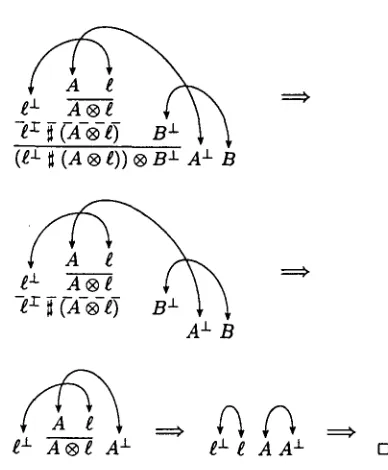
to introduce 'hypothetical' material. All of the N P I licensing occurs within the hypothetical (left) side of the outermost implication. Since the l resource is made available to the N P I only within this hypo- thetical, it is guaranteed t h a t the N P I is assembled within, and therefore falls under, the scope of the li- censer. Furthermore, the formula is 'self cleaning', in t h a t the £ resource, even if not used by an NPI, does not survive the hypothetical and so cannot affect the meaning of the licenser in some other way. T h a t is, the licensing constructor (£ --o (A ® l)) --o B can derive all of the same meanings as the nonlicensing version A --o B.
Fact 1 (g-o(A ® l))--oB F- A--oB
Proof We construct the proof net of the equivalent right-sided sequent
I- (g~ I~ (A ® g)) ® B ±, A ± , B
and then test that it is valid.
( £ ~ I ~ ( A ® £ ) ) ® B ± A 1 B
==~
A ± B
::=$
£± A ® ~ A ± ~ z g A A ± []
This self-cleaning property means that a licensing resource £ is exactly t h a t - - a license. Within the
scope of the licenser, the g is available to be used once, several times (in a "chain" of N P I ' s which pass it along), or not at all, as required. 6
A simple example is provided by the NPIAicensing adverb rarely. We modify our sentential adverb template to create a meaning constructor for rarely which licenses an N P I within the sentence it modi- fies.
r a r e l y : (£ -.-o (fa,~t p ® £)) --.o fa,,~t rarely(P)
The case of licensing quantifier phrases such as nobody and Jew students follows the same pattern. For example, nobody takes the form
n o b o d y : ((g#"*e x ® £) - o (H"-*t S ( x ) ® £)) --o H"~t no(person, S).
We can now derive a meaning for sentence (3), in which nobody and anyone play the roles of licenser and NPI, respectively.
(3) Nobody saw anyone.
:[PREo ' OBODY']
h:[PRED 'ANYONE']
Normally, a sentence with two quantifiers would generate two different scope readings--in this case, (4) and (5).
(4) f~"~t no(person, ~x.any(person, Ay.see(x, y) ) )
(5) f a"-* t any(person, Ay.no(person, Ax.see ( x, y ) ) )
However, Ladusaw's generalization is t h a t N P I ' s are licensed within the scope of their licensers. In fact, the semantics of any prevent it from taking wide scope in such a case (Kadmon and Landman, 1993; Ladusaw, 1979, p. 96-101). Our analysis, then, should derive (4) but block (5).
[image:5.612.95.289.393.628.2]~2
o
~o
~o
f~ o
~9 ~D
~9
@
o
The premises are
n o b o d y :
s a w : a n y o n e :
((g,,"~ x ® £) .-o (H".*t S(x) ® ~))
--o H~-*t no(person, S)
(ga',ze X ® ha'x~e Y) --o fa-,~t see(X, Y)
(h~.% y --o I~.*, T(y) ® i)
--o (I~.,t any(person, T) ® £)
The proof net for reading (4) is shown in Figure 4. T As required, the net in Figure 4, corresponding to wide scope for
no,
is valid. The first step in the proof of Figure 4 is to delete the only available splitting tensor, which is boxed in the figure. A second way of linking the positive and negative literals in Fig- ure 4 produces a net which corresponds to (5), the spurious reading in whichany
has wide scope. In that graph, however, all three of the available termi- nal tensor nodes produce a single, connected (cyclic) graph if deleted, so decomposition cannot even be- gin and the algorithm fails. Once again, it is the licensing resources which are enforcing the desired constraint.4 C a t e g o r i a l g r a m m a r a p p r o a c h e s
The £ atom used here is somewhat analogous to the (negative) lexical 'monotonicity markers' proposed by S ~ c h e z Valencia (1991; 1995) and Dowty (1994) for categorial grammar. In these approaches, cate- gories of the form
A/B axe
marked with monotonic- ity properties, i.e. asA+/B +, A+/B -, A - / B +,
orA - / B - ,
and similarly for left-leaning categories of the formA\B.
Then monotonicity constraints can be enforced using category assignments like the fol- lowing from (Dowty, 1994):n o : {
( S + / V P - ) / C N -
(S-/VP+)/CN + }
a n y :
( S - / V P - ) / C N -
ever:
V P - / V P -
S ~ c h e z Valencia and Dowty, however, are less concerned with the distribution of NPI's than they are with using monotonicity properties to character- ize valid inference patterns, an issue which we have ignored here. Hence their work emphasizes
logical
polarity, where an odd number of negative marks indicates negative polarity, and an even number of negatives cancel each other to produce positive po- larity. For example, the category of n o above "flips" the polarity of its argument. By contrast, our sys- tem, like Ladusaw's (1979) original proposal, is what Dowty (1994, p. 134-137) would call "intuitionistic":
since multiple negative contexts do not cancel each other out, we permit doubly-licensed NPI's as in Nobody rarely sees anyone. To handle such cases, while at the same time accounting for monotonic in- ference properties, Dowty (1994) proposes a double- marking framework whereby categories like A - / B + are marked for both logical polarity and syntactic polarity.
5 C o n c l u s i o n
We have elaborated on and extended slightly the 'glue language' approach to semantics of Dalrymple et al. It was shown how linear logic proof nets can be used for efficient natural-language meaning de- ductions in this framework. We then presented a glue language treatment of negative polarity licens- ing which ensures that NPI's are licensed within the semantic scope of their licensers, following (Ladu- saw, 1979). This system uses no new global rules or features, nor ambiguous lexical entries, but only the addition of Cs to the relevant items within the lexicon. The licensing takes place precisely at the syntax-semantics interface, since it is implemented entirely in the interface glue language. Finally, we noted briefly some similarities and differences be- tween this system and categorial grammar 'mono- tonicity marking' approaches.
6 A c k n o w l e d g e m e n t s
I'm grateful to Mary Dalrymple, John Lamping and Stanley Peters for very helpful discussions of this material. Vineet Gupta, Martin Kay, Fernando Pereira and four anonymous reviewers also provided helpful comments on several points. All remaining errors are naturally my own.
R e f e r e n c e s
Mary Dalrymple, John Lamping, and Vijay Saraswat. 1993. LFG semantics via constraints. In Proceedings of the 6th Meeting of the European Association for Computational Linguistics, Uni- versity of Utrecht, April.
Mary Dalrymple, John Lamping, Fernando Pereira, and Vijay Saraswat. 1994. A deductive account of quantification in LFG. In Makoto Kanazawa, Christopher J. Pifi6n, and Henriette de Swart, ed- itors, QuantiJ~ers, Deduction, and Context. CSLI Publications, Stanford, CA.
Mary Dalrymple, John Lamping, Fernando Pereira, and Vijay Saraswat. To appear. Quantifiers, anaphora, and intensionality. Journal of Logic, Language and Information.
David Dowty. 1994. The role of negative polar- ity and concord marking in natural language rea- soning. In Mandy Harvey and Lynn Santelmann, editors, Proceedings of SALT IV, pages 114-144, Ithaca, NY. Cornell University.
Jean Gallier. 1992. Constructive logics. Part II: Linear logic and proof nets. MS, Department of Computer and Information Science, University of Pennsylvania.
Jean-Yves Girard. 1987. Linear logic. Theoretical Computer Science, 50.
Nirit Kadmon and Fred Landman. 1993. Any. Lin- guistics and Philosophy 16, pages 353-422.
William A. Ladusaw. 1979. Polarity Sensitivity as Inherent Scope Relations. Ph.D. thesis, University of Texas, Austin. Reprinted in Jorge Hankamer, editor, Outstanding Dissertations in Linguistics. Garland, 1980.
Alain Lecomte and Christian Retor6. 1995. Pom- set logic as an alternative categorial grammar. In Glyn V. Morrill and Richard T. Oehrle, editors, Formal Grammar. Proceedings of the Conference of the European Summer School in Logic, Lan- guage, and Information, Barcelona.
Dale A. Miller. 1990. A logic programming language with lambda abstraction, function variables and simple unification. In Peter Schroeder-Heister, ed- itor, Extensions of Logic Programming, Lecture Notes in Artificial Intelligence. Springer-Verlag.
Glyn V. Morrill. 1996. Memoisation of categorial proof nets: parallelism in categorial processing. In V. Michele Abrusci and Claudia Casadio, editors, Proceedings of the Roma Workshop on Proofs and Linguistic Categories, Rome.
Victor Shnchez Valencia. 1991. Studies on Natu- ral Logic and Categorial Grammar. Ph.D. thesis, University of Amsterdam.