Processing and Mechanical Properties of Fine Grained Magnesium
by Equal Channel Angular Pressing
Eun Jeong Kwak
1, Cheon Hee Bok
1, Min Hong Seo
2,
Taek-Soo Kim
3and Hyoung Seop Kim
1;*1Department of Nano Materials Engineering, Chungnam National University, Daejeon 305-764, Korea 2Technical Research Lab., POSCO, Korea
3Advanced Materials R&D Center, Korea Institute of Industrial Technology (KITECH),
Techno-Park Songdo, Incheon 406-130, Korea
In this paper, grain refinement of pure magnesium using severe plastic deformation was investigated in order to enhance mechanical properties of the hard-to-deform metallic material. The microstructure and the mechanical properties of Mg processed by equal channel angular pressing (ECAP) at various processing temperatures were examined experimentally. ECAP of channel angle of 90and corner angle of 0was successful without fracture of the magnesium workpiece at 300C, but not under 200C. The hardness of the ECAP processed magnesium decreased with increasing ECAP processing temperature. The effect of temperature on the hardness, instrumented indenting response and microstructure of the ECAP processed magnesium were discussed. Fracture behavior during ECAP under different processing temperatures was demonstrated using the finite element method associated with ductile fracture model. [doi:10.2320/matertrans.MC200725]
(Received October 5, 2007; Accepted February 4, 2008; Published April 25, 2008)
Keywords: magnesium; equal channel angular pressing; severe plastic deformation; grain refinement; processing temperature; instrumented indentation
1. Introduction
Magnesium and its alloys are attractive as light weight structural/functional materials for high performance appli-cations in automobile and electronics industries because of their excellent properties such as low density, high specific strength, relatively excellent dent resistance, damping ca-pacity and shield caca-pacity of electromagnetic waves.1) However their poor ductility due to a small number of available slip systems in the basal plane and a difficulty in dislocation activities in the non-basal plane limits further engineering applications. A general strategy to enhance ductility of metallic materials without sacrificing strength is grain refinement, which is an aim of this study.
It is generally accepted that if metallic materials are deformed at room temperature (RT), average sub-grain/cell size decreases with strain. Hence, plastic deformation processing can be a viable method for grain refinement of metallic materials. In recent years, severe plastic defor-mation (SPD) was developed as a new method of manufac-turing bulk metallic specimens having ultrafine grained (UFG) microstructures.2,3) The SPD processed materials show not only the unique physical and mechanical properties inherent in various UFG materials but also a number of advantages over nanostructured materials manufactured by other methods through powder processing. Among many SPD processes, such as accumulated roll bonding, equal channel pressing (ECAP) and high pressure torsion, the ECAP process is so far the most viable forming procedure to extrude material by using specially designed channel dies without any substantial changes in geometry and to produce UFG materials. While a significant literature on ECAP is available, most publications deal with materials having the
fcc and bcc structures. Reports on ECAP of hcp materials are rather scarce, and the processing and the deformation behavior of these materials under ECAP are not well understood. Especially, important processing variables in hard-to-deform materials, e.g. hcp Mg and Ti, die angles and processing temperature need to be carefully controlled to prevent fracture during ECAP.
In the present study, we employed ECAP as a method of SPD for grain refinement of pure magnesium and inves-tigated the ECAP processing in terms of the processing temperature, the microstructural features and the mechanical properties.
2. Experimental Procedures
The material used in this investigation was commercial purity magnesium (0.11% Mn, 0.03% Si, and Mg balance). For ECAP processing, the billet was cut into6mm6mm
50mm workpieces, which were surface-polished using 1200 grit SiC paper. The die parameter used, viz. the channel angle (c¼90), the outer corner angle (o¼0) and the inner corner angle (I¼0) yield a maximum effective strain of 1.155 for a single pass of ECAP. The pressing speed was 1 mm/s. A mixture of MoS2powder and commercial oil was
used for lubrication between the workpiece and the channel surfaces.
The Vickers microhardness was measured using an Akashi HM0-122 tester by applying a load of 100 gram force for 15 s and taking an average over 7 separate measurements. Instrumented indenting behavior using a hemisphere ball indenter of 2 mm in diameter was employed.
Microstructures of the Y planes of the samples were examined before and after ECAP by optical microscopy, where the Y plane denotes the plane parallel to the longitudinal axis of the sample.
*Corresponding author, E-mail: [email protected]
Special Issue on Platform Science and Technology for Advanced Magnesium Alloys, IV
3. Results and Discussion
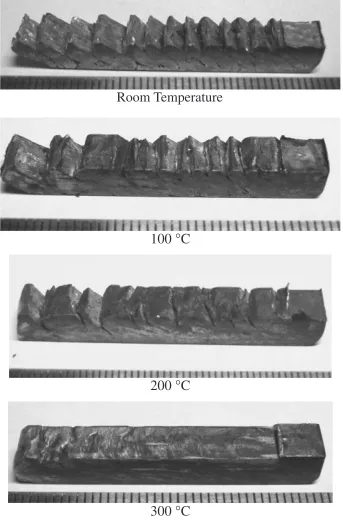
Figure 1 shows the samples after ECAP processed at RT, 100C, 200C and 300C. Cracks and brittle fractures were
observed for the samples which were ECAP processed at 200C and below. The cracks were along the 45 of the
sample longitudinal axis, which coincides with a shearing plane direction in the deforming zone of ECAP. The fractures occur not only from the top surfaces but also within the samples. With increasing the ECAP processing temperature, the number of cracks decreased, because the activity of non-basal slip systems,4) hence the ductility of magnesium,
increases with increasing temperature. The activity of non-basal slip systems leading to annihilation of dislocation and deformation twinning can enhance the ductility of magne-sium.4) At 300C, distinct cracks were not found in the
sample, which is attributable to both the activities of more slip systems and the microstructural contributions, that is, the dynamic recrystallization and the dynamic recovery.
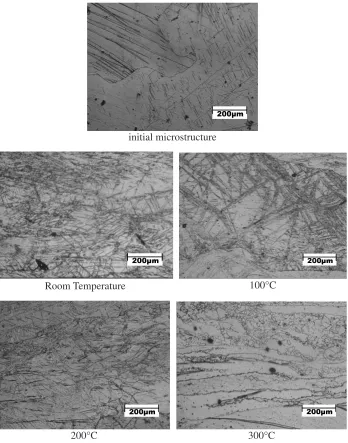
Microstructures of initial and ECAP processed pure magnesium are shown in Fig. 2. The scale bars in Fig. 2 represent 100mm. The initial grain is equiaxed and larger than 1 mm (although micrographs on the three directional surfaces are not shown here), showing a recrystallized state
Room Temperature
100
°
C
200
°
C
300
°
C
[image:2.595.127.470.74.595.2]with some twinning in the grain interior. The micrograph of the RT ECAP sample shows a severely deformed micro-structure, having many shear bands and twinning. The shear banding during severe plastic deformation was well ana-lyzed.2)The former grain boundaries cannot be distinguished. Increase in the processing temperature increases internal energy and thereby promotes dynamic recrystallization (DRX), showing fewer shear bands and twins in the 200C
sample. A clearly visible microstructural feature is strong serrations of the grain boundaries, as analyzed by Estrin
et al.5) The formation of serrated boundaries was also observed in ECAP of AZ315) and compression tests per-formed on AZ31 at 250C,6) where the authors described the bulging of a grain boundary due to DRX leading to microscopic strain localization in slip lines near the grain boundaries. They assumed that the interfering dislocation slip systems on both sides of the boundary contribute to the emergence of the grain boundary serrations. This effect was
also found in other hot deformed magnesium alloy systems, such as Mg–rare earth alloys after creep tests at 300–350C7) and ZK60.8)Basically, lower processing temperature ECAP is beneficial to grain refinement, hence we need to determine a minimum processing temperature where fractures are not occur.
The 300C ECAP processed sample shows a very different
and inhomogeneous microstructure,i.e.bimodal microstruc-ture of several hundreds mm long band-like grains and smaller grains of 10mm, unlike the common equiaxed ultrafine grains in the ECAP processed Al alloys and Fe alloys. This bimodal microstructure is attributed to the recrystallization and grain growth during ECAP at temper-ature of higher than 1/2Tm(¼188C), where Tmis melting temperature.1)The formation of the large band-like elongated grains suggests that a possible inhomogeneous deformation could have caused local internal energy buildup and local grain growth.9)
initial microstructure
Room Temperature
200°C 300°C
100°C
[image:3.595.125.473.71.514.2]The microhardness of the ECAP processed pure magne-sium is summarized in Table 1. The hardness increased after ECAP by 9–21%, depending on the processing temperature. This increase in hardness after ECAP is attributed to the work hardening caused by the formation of subgrain bands and the increase of dislocation density occurring with the shear deformation in the initial grain interior,1) which can be found in Fig. 2, as well. The hardness decreases with increasing the ECAP temperature, because the work harden-ing is limited more at higher temperatures by the occurrence of the dynamics recovery, a thermally activated softening mechanism.
The hardness of 300C ECAP processed magnesium is a
little higher than the initial state due to finer grain sizes, although lower than the lower temperature ECAP processed magnesium. It is also expected that the bimodal micro-structure induces strain hardening mechanism that stabilize tensile deformation, leading to enhanced elongation without sacrificing much of strength, as reported in AZ31 magnesium alloys.1)Indeed, a marked improvement in uniform elonga-tion was found10)in pure copper with bimodal microstructure consisting of micrometer-sized grains embedded inside a matrix of nano-sized grains. In addition, magnesium alloys with fine grains of less than 10mm(this is similar to our small
grain size) introduced by ECAP activated the cross slip to not only basal plane but also non-basal plane in grain interior.11) Therefore, ECAP of magnesium at 300C is best in terms of
fracture and microstructural evolution under the current ECAP condition.
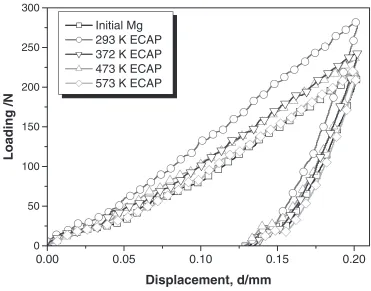
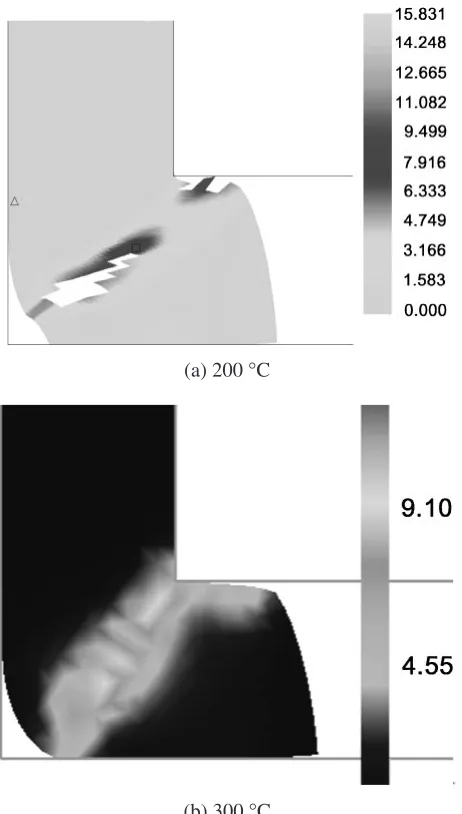
Figure 3 shows instrumented indentation behavior using 2 mm diameter hemispherical ball indenter. The indenting curves are consistent with the hardness testing results; high strength in 372 K sample, and decreasing strength trend with increasing ECAP processing temperature. It should be noted that the unloading gradients of all samples are the same, and elastic properties are insensitive to microstructural changes. Theoretical simulations during plastic deformation proc-essing are of importance in engineering procproc-essing design and optimization. The finite element/volume method is the most widely used simulation technique applied for elastic/ plastic deformation and heat transfer analyses. Several researches on plastic deformation of magnesium alloys during ECAP have been analyzed using FEM/FVM.12–14) However, none of the previous reports simulated fracture behavior during ECAP. Indeed, in case of ECAP for hard-to-deform materials, such as magnesium and titanium, fracture prediction as well as plastic deformation analysis is neces-sary. Figure 4 shows a predicted examples of the fracture simulations; ECAP of magnesium under 200C and 300C.
The simulation results are in agreement with the experimen-tal ones showing fracture at 200C and sound processing at
300C. This fracture trend with temperature can be
ration-alized that damage proportional to plastic deformation energy is accumulated with ECAP and ductile fracture is generated at a critical damage level. The accumulated plastic deformation energy decreases due to low stress level with
0.00
0
50
100
150
200
250
300
Loading /N
Displacement, d/mm
Initial Mg
293 K ECAP
372 K ECAP
473 K ECAP
573 K ECAP
0.20
0.15
0.10
0.05
[image:4.595.46.291.403.451.2]Fig. 3 Instrumented indention curves of pure magnesium using a hemispherical ball of 2 mm in diameter. Table 1 Average hardness under different ECAP processing temperatures.
Processing
Temperature Initial
Room
Temperature 100
C 200C 300C
Hardness,
[image:4.595.112.483.479.770.2]increasing processing temperature. Therefore, fracture de-creases with temperature. However, the critical damage level is sensitive to material, microstructure and temperature, and should be experimentally obtained. A systematic experiments
and finite element simulations for fracture behavior are underway for optimization of the ECAP processing.
4. Summary
Pure magnesium was processed by ECAP at room temper-ature, 100C, 200 and 300C. Fracture tendency decreases
with increasing processing temperature, and ECAP at temperatures of 300C and above was possible without
fracture. However, grain size and inhomogeneity increase due to the dynamic recrystallization and strength decreases with increasing the processing temperature. ECAP of pure magnesium at 300C was best in terms of fracture and
microstructural evolution.
Acknowledgements
This research was supported by a grant from the Center for Advanced Materials Processing (CAMP) of the 21st Century Frontier R&D Program funded by the Ministry of Science and Technology, Republic of Korea.
REFERENCES
1) S.-Y. Chang, S.-W. Lee, K. M. Kang, S. Kamado and Y. Kojima: Mater. Trans.45(2004) 488.
2) R. Z. Valiev, R. K. Islamgaliev and I. V. Alexandrov: Prog. Mater. Sci.
45(2000) 103.
3) H. S. Kim, M. H. Seo and S. I. Hong: Mater. Sci. Eng.291A(2000) 86. 4) A. Jager, P. Lukac, V. Gartnerova, J. Bohlen and K. U. Kainer:
J. Alloys Comp.378(2004) 184.
5) Y. Estrin, S. B. Yi, H.-G. Brokmeier, Z. Zuberova, S. C. Yoon, H. S. Kim and R. J. Hellmig: Int. J. Mater. Res.99(2008) 50.
6) Q. Guo, H. G. Yan, H. Zhang, Z. H. Chen and Z. F. Wang: Mater. Sci. Technol.21(2005) 1349.
7) L. L. Rokhlin: Magnesium Alloys Containing Rare-Earth Metals: Structures and Properties, Taylor & Francis (2003).
8) A. Galiyev, R. Kaibyshev and G. Gottstein: Acta Mater.49(2001) 1199.
9) M. Chandrasekaran and Y. M. S. John: Mater. Sci. Eng. A381(2004) 308.
10) Y. Wang, M. Chen, F. Zhou and E. Ma: Nature419(2003) 912. 11) J. Koike: Mater. Sci. Forum419–422(2003) 189.
12) S. W. Chung, W. J. Kim, M. Kohzu and K. Higashi: Mater. Trans.44
(2003) 973.
13) S. W. Chung, H. Somekawa, T. Kinoshita, W. J. Kim and K. Higashi: Scripta Mater.50(2004) 1079.
14) S. W. Chung, W. J. Kim and K. Higashi: Scripta Mater.51(2004) 1117.
(a) 200 °C
(b) 300 °C
[image:5.595.55.286.70.477.2]