Regular tree grammars as a formalism for scope underspecification
Alexander Koller∗ [email protected]
∗University of Edinburgh
Michaela Regneri† § [email protected] †University of Groningen
Stefan Thater§ [email protected] §
Saarland University
Abstract
We propose the use of regular tree grammars (RTGs) as a formalism for the underspecified processing of scope ambiguities. By applying standard results on RTGs, we obtain a novel algorithm for eliminating equivalent readings and the first efficient algorithm for computing the best reading of a scope ambiguity. We also show how to derive RTGs from more tradi-tional underspecified descriptions.
1 Introduction
Underspecification (Reyle, 1993; Copestake et al., 2005; Bos, 1996; Egg et al., 2001) has become the standard approach to dealing with scope ambiguity in large-scale hand-written grammars (see e.g. Cope-stake and Flickinger (2000)). The key idea behind underspecification is that the parser avoids comput-ing all scope readcomput-ings. Instead, it computes a scomput-ingle
compact underspecified description for each parse.
One can then strengthen the underspecified descrip-tion to efficiently eliminate subsets of readings that were not intended in the given context (Koller and Niehren, 2000; Koller and Thater, 2006); so when the individual readings are eventually computed, the number of remaining readings is much smaller and much closer to the actual perceived ambiguity of the sentence.
In the past few years, a “standard model” of scope underspecification has emerged: A range of for-malisms from Underspecified DRT (Reyle, 1993) to dominance graphs (Althaus et al., 2003) have offered mechanisms to specify the “semantic mate-rial” of which the semantic representations are built up, plus dominance or outscoping relations between these building blocks. This has been a very suc-cessful approach, but recent algorithms for elimi-nating subsets of readings have pushed the
expres-sive power of these formalisms to their limits; for instance, Koller and Thater (2006) speculate that further improvements over their (incomplete) redun-dancy elimination algorithm require a more expres-sive formalism than dominance graphs. On the theo-retical side, Ebert (2005) has shown that none of
the major underspecification formalisms are
expres-sively complete, i.e. supports the description of an
arbitrary subset of readings. Furthermore, the some-what implicit nature of dominance-based descrip-tions makes it difficult to systematically associate readings with probabilities or costs and then com-pute a best reading.
In this paper, we address both of these
shortcom-ings by proposing regular tree grammars (RTGs)
as a novel underspecification formalism. Regular tree grammars (Comon et al., 2007) are a standard approach for specifying sets of trees in theoretical computer science, and are closely related to regu-lar tree transducers as used e.g. in recent work on statistical MT (Knight and Graehl, 2005) and gram-mar formalisms (Shieber, 2006). We show that the “dominance charts” proposed by Koller and Thater (2005b) can be naturally seen as regular tree gram-mars; using their algorithm, classical underspecified descriptions (dominance graphs) can be translated into RTGs that describe the same sets of readings. However, RTGs are trivially expressively complete because every finite tree language is also regular. We exploit this increase in expressive power in present-ing a novel redundancy elimination algorithm that is simpler and more powerful than the one by Koller and Thater (2006); in our algorithm, redundancy elimination amounts to intersection of regular tree languages. Furthermore, we show how to define a PCFG-style cost model on RTGs and compute best readings of deterministic RTGs efficiently, and illus-trate this model on a machine learning based model
of scope preferences (Higgins and Sadock, 2003). To our knowledge, this is the first efficient algorithm for computing best readings of a scope ambiguity in the literature.
The paper is structured as follows. In Section 2, we will first sketch the existing standard approach to underspecification. We will then define regular tree grammars and show how to see them as an un-derspecification formalism in Section 3. We will present the new redundancy elimination algorithm, based on language intersection, in Section 4, and show how to equip RTGs with weights and compute best readings in Section 5. We conclude in Section 6.
2 Underspecification
The key idea behind scope underspecification is to describe all readings of an ambiguous expression with a single, compact underspecified representation (USR). This simplifies semantics construction, and current algorithms (Koller and Thater, 2005a) sup-port the efficient enumeration of readings from an USR when it is necessary. Furthermore, it is possible to perform certain semantic processing tasks such as eliminating redundant readings (see Section 4) di-rectly on the level of underspecified representations without explicitly enumerating individual readings.
Under the “standard model” of scope underspeci-fication, readings are considered as formulas or trees. USRs specify the “semantic material” common to all readings, plus dominance or outscopes relations between these building blocks. In this paper, we con-sider dominance graphs (Egg et al., 2001; Althaus et al., 2003) as one representative of this class. An example dominance graph is shown on the left of Fig. 1. It represents the five readings of the sentence “a representative of a company saw every sample.”
The (directed, labelled) graph consists of seven
sub-trees, or fragments, plus dominance edgesrelating
nodes of these fragments. Each reading is encoded
as oneconfigurationof the dominance graph, which
can be obtained by “plugging” the tree fragments into each other, in a way that respects the dominance edges: The source node of each dominance edge must dominate (i.e., be an ancestor of) the target node in each configuration. The trees in Fig. 1a–e are the five configurations of the example graph.
An important class of dominance graphs are
hy-pernormally connected dominance graphs, or
dom-inance nets (Niehren and Thater, 2003). The
pre-cise definition of dominance nets is not important here, but note that virtually all underspecified de-scriptions that are produced by current grammars are nets (Flickinger et al., 2005). For the rest of the pa-per, we restrict ourselves to dominance graphs that are hypernormally connected.
3 Regular tree grammars
We will now recall the definition of regular tree grammars and show how they can be used as an un-derspecification formalism.
3.1 Definition
LetΣbe an alphabet, or signature, of tree
construc-tors{f,g,a, . . .}, each of which is equipped with an arityar(f)≥0. Afinite constructor tree t is a finite tree in which each node is labelled with a symbol of
Σ, and the number of children of the node is exactly
the arity of this symbol. For instance, the configura-tions in Fig. 1a-e are finite constructor trees over the signature{ax|2,ay|2,compz|0, . . .}. Finite
construc-tor trees can be seen as ground terms over Σ that
respect the arities. We writeT(Σ)for the finite
con-structor trees overΣ.
Aregular tree grammar (RTG) is a 4-tupleG=
(S,N,Σ,R) consisting of anonterminal alphabet N,
aterminal alphabet Σ, astart symbol S∈N, and a
finite set ofproduction rules Rof the form A→β,
where A∈N andβ ∈T(Σ∪N); the nonterminals
count as zero-place constructors. Two finite con-structor trees t,t0 ∈T(Σ∪N) stand in the
deriva-tion reladeriva-tion, t→Gt0, if t0 can be built from t by
replacing an occurrence of some nonterminalA by
the tree on the right-hand side of some production forA. Thelanguage generated by G,L(G), is the set {t∈T(Σ)|S→∗Gt}, i.e. all terms of terminal
sym-bols that can be derived from the start symbol by a
sequence of rule applications. Note that L(G) is a
possibly infinite language of finite trees. As usual, we writeA→t1|. . .|tn as shorthand for then
pro-duction rulesA→ti (1≤i≤n). See Comon et al.
(2007) for more details.
The languages that can be accepted by regular tree
grammars are calledregular tree languages (RTLs),
everyy
sampley
seex,y ax
repr-ofx,z az
compz 1
2 3
4 5 6
7
everyy
ax sampley
seex,y repr-ofx,z
az
compz
(a)
everyy az
ax sampley
seex,y compz
repr-ofx,z
(c)
everyy az
ax
sampley seex,y compz
repr-ofx,z
(d) (b)
everyy
sampleyseex,y ax
repr-ofx,z az
compz
(e) everyy
sampley ax
repr-ofx,z seex,y az
[image:3.612.74.535.64.130.2]compz
Figure 1: A dominance graph (left) and its five configurations.
tree automata, which are defined essentially like the
well-known regular string automata, except that they assign states to the nodes in a tree rather than the po-sitions in a string. Tree automata are related to tree transducers as used e.g. in statistical machine trans-lation (Knight and Graehl, 2005) exactly like finite-state string automata are related to finite-finite-state string transducers, i.e. they use identical mechanisms to ac-cept rather than transduce languages. Many theoreti-cal results carry over from regular string languages to regular tree languages; for instance, membership of a tree in a RTL can be decided in linear time, RTLs are closed under intersection, union, and com-plement, and so forth.
3.2 Regular tree grammars in
underspecification
We can now use regular tree grammars in underspeci-fication by representing the semantic representations
as trees and taking an RTGGas an underspecified
description of the trees in L(G). For example, the
five configurations in Fig. 1 can be represented as the tree language accepted by the following
gram-mar with start symbolS.
S → ax(A1,A2)|az(B1,A3)|everyy(B3,A4) A1 → az(B1,B2)
A2 → everyy(B3,B4)
A3 → ax(B2,A2)|everyy(B3,A5)
A4 → ax(A1,B4)|az(B1,A5)
A5 → ax(B2,B4)
B1 → compz B2 → repr-ofx,z
B3 → sampley B4 → seex,y
More generally, every finite set of trees can be written as the tree language accepted by a non-recursive regular tree grammar such as this. This grammar can be much smaller than the set of trees, because nonterminal symbols (which stand for sets of possibly many subtrees) can be used on the right-hand sides of multiple rules. Thus an RTG is a com-pact representation of a set of trees in the same way that a parse chart is a compact representation of the
set of parse trees of a context-free string grammar. Note that each tree can be enumerated from the RTG in linear time.
3.3 From dominance graphs to tree grammars
Furthermore, regular tree grammars can be system-atically computed from more traditional underspeci-fied descriptions. Koller and Thater (2005b)
demon-strate how to compute a dominance chart from a
dominance graph D by tabulating how a subgraph
can be decomposed into smaller subgraphs by
re-moving what they call a “free fragment”. If D is
hypernormally connected, this chart can be read as a regular tree grammar whose nonterminal symbols are subgraphs of the dominance graph, and whose terminal symbols are names of fragments. For the example graph in Fig. 1, it looks as follows.
{1,2,3,4,5,6,7} → 1({2,4,5},{3,6,7})
{1,2,3,4,5,6,7} → 2({4},{1,3,5,6,7})
{1,2,3,4,5,6,7} → 3({6},{1,2,4,5,7})
{1,3,5,6,7} → 1({5},{3,6,7})|3({6},{1,5,7})
{1,2,4,5,7} → 1({2,4,5},{7})|2({4},{1,5,7})
{1,5,7} → 1({5},{7})
{2,4,5} →2({4},{5}) {4} →4 {6} → 6 {3,6,7} →3({6},{7}) {5} →5 {7} → 7
This grammar accepts, again, five different trees, whose labels are the node names of the dominance graph, for instance 1(2(4,5),3(6,7)). If f :Σ→Σ0
is a relabelling function from one terminal
alpha-bet to another, we can write f(G) for the grammar
(S,N,Σ0,R0), where R0 = {A→ f(a)(B1, . . . ,Bn)|
A→a(B1, . . . ,Bn)∈R}. Now if we choose f to be
the labelling function ofD(which maps node names
to node labels) andGis the chart ofD, thenL(f(G))
will be the set of configurations ofD. The grammar
in Section 3.2 is simply f(G)for the chart above (up to consistent renaming of nonterminals).
In the worst case, the dominance chart of a
dom-inance graph with n fragments has O(2n)
1,0E+00 1,0E+04 1,0E+08 1,0E+12 1,0E+16
1 3 5 7 9 11 13 15 17 19 21 23 25 27 29 31 33 #fragments
#configurations/rules
0 10 20 30 40 50 60 70 80
#sentences
[image:4.612.96.273.66.153.2]#sentences #production rules in chart #configurations
Figure 2: Chart sizes in the Rondane corpus.
improvement over the n! configurations that these
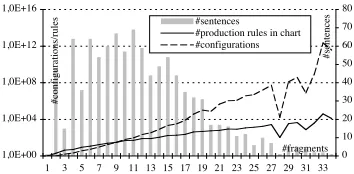
worst-case examples have. In practice, RTGs that are computed by converting the USR computed by a grammar remain compact: Fig. 2 compares the aver-age number of configurations and the averaver-age num-ber of RTG production rules for USRs of increasing sizes in the Rondane treebank (see Sect. 4.3); the bars represent the number of sentences for USRs of a certain size. Even for the most ambiguous sentence,
which has about 4.5×10¹²scope readings, the
domi-nance chart has only about 75 000 rules, and it takes only 15 seconds on a modern consumer PC (Intel Core 2 Duo at 2 GHz) to compute the grammar from the graph. Computing the charts for all 999 MRS-nets in the treebank takes about 45 seconds.
4 Expressive completeness and redundancy elimination
Because every finite tree language is regular, RTGs
constitute an expressively complete
underspecifica-tion formalism in the sense of Ebert (2005): They can represent arbitrary subsets of the original set of readings. Ebert shows that the classical dominance-based underspecification formalisms, such as MRS, Hole Semantics, and dominance graphs, are all expressively incomplete, which Koller and Thater (2006) speculate might be a practical problem for al-gorithms that strengthen USRs to remove unwanted readings. We will now show how both the expres-sive completeness and the availability of standard constructions for RTGs can be exploited to get an improved redundancy elimination algorithm.
4.1 Redundancy elimination
Redundancy elimination (Vestre, 1991; Chaves, 2003; Koller and Thater, 2006) is the problem of
de-riving from an USRU another USRU0, such that
the readings ofU0 are a proper subset of the
read-ings of U, but every reading inU is semantically
equivalent to some reading inU0. For instance, the
following sentence from the Rondane treebank is an-alyzed as having six quantifiers and 480 readings by the ERG grammar; these readings fall into just two semantic equivalence classes, characterized by the relative scope of “the lee of” and “a small hillside”. A redundancy elimination would therefore ideally re-duce the underspecified description to one that has only two readings (one for each class).
(1) We quickly put up the tents in the lee of a small hillside and cook for the first time in the open. (Rondane 892)
Koller and Thater (2006) define semantic equiva-lence in terms of a rewrite system that specifies un-der what conditions two quantifiers may exchange their positions without changing the meaning of the semantic representation. For example, if we assume the following rewrite system (with just a single rule), the five configurations in Fig. 1a-e fall into three equivalence classes – indicated by the dotted boxes around the names a-e – because two pairs of read-ings can be rewritten into each other.
(2) ax(az(P,Q),R)→az(P,ax(Q,R))
Based on this definition, Koller and Thater (2006) present an algorithm (henceforth, KT06) that deletes rules from a dominance chart and thus removes sub-sets of readings from the USR. The KT06 algorithm is fast and quite effective in practice. However, it es-sentially predicts for each production rule of a dom-inance chart whether each configuration that can be built with this rule is equivalent to a configuration that can be built with some other production for the same subgraph, and is therefore rather complex.
4.2 Redundancy elimination as language
intersection
We now define a new algorithm for redundancy elim-ination. It is based on the intersection of regular tree languages, and will be much simpler and more pow-erful than KT06.
Let G= (S,N,Σ,R) be an RTG with a linear
or-der on the terminalsΣ; for ease of presentation, we
assumeΣ⊆N. Furthermore, let f :Σ→Σ0 be a
system. For example, G could be the dominance
chart of some dominance graphD, and f could be
the labelling function ofD.
We can then define a tree languageLF as follows:
LF contains all trees overΣthat do not contain a
sub-tree of the formq1(x1, . . . ,xi−1,q2(. . .),xi+1, . . . ,xk)
whereq1>q2and the rewrite system contains a rule that has f(q1)(X1, . . . ,Xi−1,f(q2)(. . .),Xi+1, . . . ,Xk)
on the left or right hand side.LF is a regular tree lan-guage, and can be accepted by a regular tree
gram-mar GF with O(n) nonterminals and O(n2) rules,
where n=|Σ0|. A filter grammar for Fig. 1 looks
as follows:
S →1(S,S)|2(S,Q1) |3(S,S)|4|. . .|7
Q1 →2(S,Q1) |3(S,S)|4|. . .|7
This grammar accepts all trees overΣexcept ones
in which a node with label 2 is the parent of a node with label 1, because such trees correspond to
config-urations in which a node with labelazis the parent of
a node with labelax,azandax are permutable, and
2>1. In particular, it will accept the configurations (b), (c), and (e) in Fig. 1, but not (a) or (d).
Since regular tree languages are closed under
in-tersection, we can compute a grammarG0 such that
L(G0) =L(G)∩LF. This grammar hasO(nk)
nonter-minals andO(n2k)productions, wherekis the
num-ber of production rules inG, and can be computed
in timeO(n2k). The relabelled grammar f(G0) ac-cepts all trees in which adjacent occurrences of per-mutable quantifiers are in a canonical order (sorted from lowest to highest node name). For example, the
grammarG0 for the example looks as follows; note
that the nonterminal alphabet ofG0is the product of
the nonterminal alphabets ofGandGF.
{1,2,3,4,5,6,7}S → 1({2,4,5}S,{3,6,7}S)
{1,2,3,4,5,6,7}S → 2({4}S,{1,3,5,6,7}Q1)
{1,2,3,4,5,6,7}S → 3({6}S,{1,2,4,5,7}S)
{1,3,5,6,7}Q1 → 3({6}S,{1,5,7}S)
{1,2,4,5,7}S → 1({2,4,5}S,{7}S)
{1,2,4,5,7}S → 2({4}S,{1,5,7}Q1)
{2,4,5}S → 2({4}S,{5}Q1) {4}S → 4
{3,6,7}S → 3({6}S,{7}S) {5}S → 5
{1,5,7}S → 1({5}S,{7}S) {5}Q1 → 5
{6}S → 6 {7}S → 7
Significantly, the grammar contains no produc-tions for{1,3,5,6,7}Q1 with terminal symbol 1, and
no production for{1,5,7}Q1. This reduces the tree
language accepted by f(G0) to just the
configura-tions (b), (c), and (e) in Fig. 1, i.e. exactly one
representative of every equivalence class. Notice that there are two different nonterminals,{5}Q1 and
{5}S, corresponding to the subgraph{5}, so the
in-tersected RTG is not a dominance chart any more. As we will see below, this increased expressivity in-creases the power of the redundancy elimination al-gorithm.
4.3 Evaluation
The algorithm presented here is not only more trans-parent than KT06, but also more powerful; for exam-ple, it will reduce the graph in Fig. 4 of Koller and Thater (2006) completely, whereas KT06 won’t.
To measure the extent to which the new rithm improves upon KT06, we compare both algo-rithms on the USRs in the Rondane treebank (ver-sion of January 2006). The Rondane treebank is a “Redwoods style” treebank (Oepen et al., 2002)
con-taining MRS-based underspecified representations for sentences from the tourism domain, and is dis-tributed together with the English Resource Gram-mar (ERG) (Copestake and Flickinger, 2000).
The treebank contains 999 MRS-nets, which we translate automatically into dominance graphs and further into RTGs; the median number of scope read-ings per sentence is 56. For our experiment, we sider all 950 MRS-nets with less than 650 000 con-figurations. We use a slightly weaker version of the rewrite system that Koller and Thater (2006) used in their evaluation.
0% 20% 40% 60% 80% 100%
1 3 5 7 9 11 13
[image:6.612.92.279.67.168.2]KT06 RTG
Figure 3: Percentage of USRs in Rondane for which the algorithms achieve complete reduction.
it computes RTGs that are not dominance charts. KT06 was only able to reduce 5 of these 263 graphs completely.
The algorithm needs 25 seconds to run for the entire corpus (old algorithm: 17 seconds), and it would take 50 (38) more seconds to run on the 49 large USRs that we exclude from the experiment. By contrast, it takes about 7 hours to compute the equivalence classes by pairwise comparison, and it would take an estimated several billion years to com-pute the equivalence classes of the excluded USRs. In short, the redundancy elimination algorithm pre-sented here achieves nearly complete reduction at a tiny fraction of the runtime, and makes a useful task that was completely infeasible before possible.
4.4 Compactness
Finally, let us briefly consider the ramifications of expressive completeness on efficiency. Ebert (2005) proves that no expressively complete
underspecifi-cation formalism can becompact, i.e. in the worst
case, the USR of a set of readings become exponen-tially large in the number of scope-bearing operators. In the case of RTGs, this worst case is achieved by grammars of the formS→t1|. . .|tn, wheret1, . . . ,tn
are the trees we want to describe. This grammar is as big as the number of readings, i.e. worst-case
expo-nential in the number nof scope-bearing operators,
and essentially amounts to a meta-level disjunction over the readings.
Ebert takes the incompatibility between compact-ness and expressive completecompact-ness as a fundamental problem for underspecification. We don’t see things quite as bleakly. Expressions of natural language it-self are (extremely underspecified) descriptions of sets of semantic representations, and so Ebert’s
ar-gument applies to NL expressions as well. This
means that describing a given set of readings may require an exponentially long discourse. Ebert’s def-inition of compactness may be too harsh: An USR, although exponential-size in the number of quanti-fiers, may still be polynomial-size in the length of the discourse in the worst case.
Nevertheless, the tradeoff between compactness and expressive power is important for the design of underspecification formalisms, and RTGs offer a unique answer. They are expressively complete; but as we have seen in Fig. 2, the RTGs that are derived by semantic construction are compact, and even in-tersecting them with filter grammars for redundancy elimination only blows up their sizes by a factor of
O(n2). As we add more and more information to an RTG to reduce the set of readings, ultimately to those readings that were meant in the actual context of the utterance, the grammar will become less and less compact; but this trend is counterbalanced by the overall reduction in the number of readings. For the USRs in Rondane, the intersected RTGs are, on average, 6% smaller than the original charts. Only 30% are larger than the charts, by a maximal factor of 3.66. Therefore we believe that the theoretical non-compactness should not be a major problem in a well-designed practical system.
5 Computing best configurations
A second advantage of using RTGs as an under-specification formalism is that we can apply exist-ing algorithms for computexist-ing the best derivations
ofweightedregular tree grammars to compute best
(that is, cheapest or most probable) configurations. This gives us the first efficient algorithm for comput-ing the preferred readcomput-ing of a scope ambiguity.
We define weighted dominance graphs and weighted tree grammars, show how to translate the former into the latter and discuss an example.
5.1 Weighted dominance graphs
A weighted dominance graph D = (V,ET]ED]
WD]WI)is a dominance graph with two new types
of edges – soft dominance edges, WD, andsoft
dis-jointness edges, WI –, each of which is equipped
with a numeric weight. Soft dominance and
ex-everyy
sampley
seex,y ax
repr-ofx,z az
compz
1
2 3
4 5 6
7
[image:7.612.120.248.62.149.2]9 8
Figure 4: The graph of Fig. 1 with soft constraints
presses a preference that two nodes dominate each other in a configuration, whereas a soft disjointness
edge expresses a preference that two nodes are
dis-joint, i.e. neither dominates the other.
We take thehard backboneofDto be the ordinary
dominance graphB(D) = (V,ET]ED) obtained by
removing all soft edges. The set of configurations
of a weighted graph D is the set of configurations
of its hard backbone. For each configuration t of
D, we define the weight c(t) to be the product of
the weights of all soft dominance and disjointness
edges that are satisfied in t. We can then ask for
configurations of maximal weight.
Weighted dominance graphs can be used to en-code the standard models of scope preferences (Pafel, 1997; Higgins and Sadock, 2003). For exam-ple, Higgins and Sadock (2003) present a machine learning approach for determining pairwise
prefer-ences as to whether a quantifier Q1 dominates
an-other quantifierQ2,Q2dominatesQ1, or neither (i.e.
they are disjoint). We can represent these numbers as the weights of soft dominance and disjointness edges. An example (with artificial weights) is shown in Fig. 4; we draw the soft dominance edges as curved dotted arrows and the soft disjointness edges as as angled double-headed arrows. Each soft edge is annotated with its weight. The hard backbone of this dominance graph is our example graph from Fig. 1, so it has the same five configurations. The weighted graph assigns a weight of 8 to configura-tion (a), a weight of 1 to (d), and a weight of 9 to (e); this is also the configuration of maximum weight.
5.2 Weighted tree grammars
In order to compute the maximal-weight configura-tion of a weighted dominance graph, we will first
translate it into aweighted regular tree grammar. A
weighted regular tree grammar (wRTG) (Graehl and Knight, 2004) is a 5-tuple G= (S,N,Σ,R,c) such
thatG0= (S,N,Σ,R)is a regular tree grammar and
c:R→Ris a function that assigns each production
rule a weight. Gaccepts the same language of trees
asG0. It assigns each derivation a cost equal to the
product of the costs of the production rules used in this derivation, and it assigns each tree in the lan-guage a cost equal to the sum of the costs of its derivations. Thus wRTGs define weights in a way that is extremely similar to PCFGs, except that we don’t require any weights to sum to one.
Given a weighted, hypernormally connected
dom-inance graphD, we can extend the chart ofB(D)to
a wRTG by assigning rule weights as follows: The weight of a rule D0 →i(D1, . . . ,Dn) is the product
over the weights of all soft dominance and disjoint-ness edges that are established by this rule. We say that a rule establishes a soft dominance edge from
u to v if u =i and v is in one of the subgraphs
D1, . . . ,Dn; we say that it establishes a soft
disjoint-ness edge betweenuandvifuandvare in different
subgraphsDj andDk (j6=k). It can be shown that
the weight this grammar assigns to each derivation is equal to the weight that the original dominance graph assigns to the corresponding configuration.
If we apply this construction to the example graph in Fig. 4, we obtain the following wRTG:
{1, ...,7} → ax({2,4,5},{3,6,7}) [9]
{1, ...,7} → az({4},{1,3,5,6,7}) [1]
{1, ...,7} → everyy({6},{1,2,4,5,7}) [8]
{2,4,5} → az({4},{5}) [1]
{3,6,7} → everyy({6},{7}) [1]
{1,3,5,6,7} → ax({5},{3,6,7}) [1]
{1,3,5,6,7} → everyy({6},{1,5,7}) [8]
{1,2,4,5,7} → ax({2,4,5},{7}) [1]
{1,2,4,5,7} → az({4},{1,5,7}) [1]
{1,5,7} → ax({5},{7}) [1]
{4} → compz [1] {5} → repr−o fx,z [1]
{6} → sampley [1] {7} → seex,y [1]
For example, picking “az” as the root of a
con-figuration (Fig. 1 (c), (d)) of the entire graph has a weight of 1, because this rule establishes no soft
edges. On the other hand, choosing “ax” as the root
has a weight of 9, because this establishes the soft disjointness edge (and in fact, leads to the derivation of the maximum-weight configuration in Fig. 1 (e)).
5.3 Computing the best configuration
[image:7.612.323.528.421.555.2]best derivation of a weighted tree grammar – can now be solved by standard algorithms for wRTGs. For example, Knight and Graehl (2005) present an algorithm to extract the best derivation of a wRTG in
timeO(t+nlogn)wherenis the number of
nonter-minals andtis the number of rules. In practice, we
can extract the best reading of the most ambiguous
sentence in the Rondane treebank (4.5×10¹²
read-ings, 75 000 grammar rules) with random soft edges in about a second.
However, notice that this is not the same problem
as computing the besttreein the language accepted
by a wRTG, as trees may have multiple deriva-tions. The problem of computing the best tree is NP-complete (Sima’an, 1996). However, if the weighted regular tree automaton corresponding to the wRTG is deterministic, every tree has only one derivation, and thus computing best trees becomes easy again. The tree automata for dominance charts are always deterministic, and the automata for RTGs as in Sec-tion 3.2 (whose terminals correspond to the graph’s node labels) are also typically deterministic if the variable names are part of the quantifier node labels. Furthermore, there are algorithms for determinizing weighted tree automata (Borchardt and Vogler, 2003; May and Knight, 2006), which could be applied as preprocessing steps for wRTGs.
6 Conclusion
In this paper, we have shown how regular tree gram-mars can be used as a formalism for scope under-specification, and have exploited the power of this view in a novel, simpler, and more complete algo-rithm for redundancy elimination and the first effi-cient algorithm for computing the best reading of a scope ambiguity. In both cases, we have adapted standard algorithms for RTGs, which illustrates the usefulness of using such a well-understood formal-ism. In the worst case, the RTG for a scope ambigu-ity is exponential in the number of scope bearers in the sentence; this is a necessary consequence of their expressive completeness. However, those RTGs that are computed by semantic construction and redun-dancy elimination remain compact.
Rather than showing how to do semantic construc-tion for RTGs, we have presented an algorithm that computes RTGs from more standard
underspecifica-tion formalisms. We see RTGs as an “underspecifi-cation assembly language” – they support efficient and useful algorithms, but direct semantic construc-tion may be inconvenient, and RTGs will rather be obtained by “compiling” higher-level underspecified representations such as dominance graphs or MRS.
This perspective also allows us to establish a connection to approaches to semantic construc-tion which use chart-based packing methods rather than dominance-based underspecification to manage scope ambiguities. For instance, both Combinatory Categorial Grammars (Steedman, 2000) and syn-chronous grammars (Nesson and Shieber, 2006) rep-resent syntactic and semantic ambiguity as part of the same parse chart. These parse charts can be seen as regular tree grammars that accept the lan-guage of parse trees, and conceivably an RTG that describes only the semantic and not the syntactic
ambiguity could be automatically extracted. We
could thus reconcile these completely separate ap-proaches to semantic construction within the same formal framework, and RTG-based algorithms (e.g., for redundancy elimination) would apply equally to dominance-based and chart-based approaches. In-deed, for one particular grammar formalism it has even been shown that the parse chart contains an isomorphic image of a dominance chart (Koller and Rambow, 2007).
Finally, we have only scratched the surface of what can be be done with the computation of best
configurations in Section 5. The algorithms
gen-eralize easily to weights that are taken from an ar-bitrary ordered semiring (Golan, 1999; Borchardt and Vogler, 2003) and to computing minimal-weight rather than maximal-weight configurations. It is also useful in applications beyond semantic construction, e.g. in discourse parsing (Regneri et al., 2008).
Acknowledgments. We have benefited greatly
from fruitful discussions on weighted tree grammars with Kevin Knight and Jonathan Graehl, and on
dis-course underspecification with Markus Egg. We
References
E. Althaus, D. Duchier, A. Koller, K. Mehlhorn, J. Niehren, and S. Thiel. 2003. An efficient graph algorithm for dominance constraints. J. Algorithms, 48:194–219.
B. Borchardt and H. Vogler. 2003. Determinization of finite state weighted tree automata. Journal of Au-tomata, Languages and Combinatorics, 8(3):417–463. J. Bos. 1996. Predicate logic unplugged. InProceedings of the Tenth Amsterdam Colloquium, pages 133–143. R. P. Chaves. 2003. Non-redundant scope
disambigua-tion in underspecified semantics. In Proceedings of the 8th ESSLLI Student Session, pages 47–58, Vienna. H. Comon, M. Dauchet, R. Gilleron, C. L¨oding, F. Jacquemard, D. Lugiez, S. Tison, and M. Tommasi. 2007. Tree automata techniques and applications. Available on: http://www.grappa.univ-lille3.fr/tata. A. Copestake and D. Flickinger. 2000. An
open-source grammar development environment and broad-coverage English grammar using HPSG. In Confer-ence on Language Resources and Evaluation. A. Copestake, D. Flickinger, C. Pollard, and I. Sag. 2005.
Minimal recursion semantics: An introduction. Re-search on Language and Computation, 3:281–332. C. Ebert. 2005. Formal investigations of underspecified
representations. Ph.D. thesis, King’s College, Lon-don.
M. Egg, A. Koller, and J. Niehren. 2001. The Constraint Language for Lambda Structures. Logic, Language, and Information, 10:457–485.
D. Flickinger, A. Koller, and S. Thater. 2005. A new well-formedness criterion for semantics debugging. In
Proceedings of the 12th HPSG Conference, Lisbon. J. S. Golan. 1999. Semirings and their applications.
Kluwer, Dordrecht.
J. Graehl and K. Knight. 2004. Training tree transducers. InHLT-NAACL 2004, Boston.
D. Higgins and J. Sadock. 2003. A machine learning ap-proach to modeling scope preferences. Computational Linguistics, 29(1).
K. Knight and J. Graehl. 2005. An overview of proba-bilistic tree transducers for natural language process-ing. InComputational linguistics and intelligent text processing, pages 1–24. Springer.
A. Koller and J. Niehren. 2000. On underspecified processing of dynamic semantics. InProceedings of COLING-2000, Saarbr¨ucken.
A. Koller and O. Rambow. 2007. Relating dominance formalisms. InProceedings of the 12th Conference on Formal Grammar, Dublin.
A. Koller and S. Thater. 2005a. Efficient solving and exploration of scope ambiguities. Proceedings of the ACL-05 Demo Session.
A. Koller and S. Thater. 2005b. The evolution of dom-inance constraint solvers. InProceedings of the ACL-05 Workshop on Software.
A. Koller and S. Thater. 2006. An improved redundancy elimination algorithm for underspecified descriptions. InProceedings of COLING/ACL-2006, Sydney. J. May and K. Knight. 2006. A better n-best list:
Prac-tical determinization of weighted finite tree automata. InProceedings of HLT-NAACL.
R. Nesson and S. Shieber. 2006. Simpler TAG semantics through synchronization. InProceedings of the 11th Conference on Formal Grammar.
J. Niehren and S. Thater. 2003. Bridging the gap be-tween underspecification formalisms: Minimal recur-sion semantics as dominance constraints. In Proceed-ings of ACL 2003.
S. Oepen, K. Toutanova, S. Shieber, C. Manning, D. Flickinger, and T. Brants. 2002. The LinGO Red-woods treebank: Motivation and preliminary applica-tions. InProceedings of the 19th International Con-ference on Computational Linguistics (COLING’02), pages 1253–1257.
J. Pafel. 1997. Skopus und logische Struktur: Studien zum Quantorenskopus im Deutschen. Habilitationss-chrift, Eberhard-Karls-Universit¨at T¨ubingen.
M. Regneri, M. Egg, and A. Koller. 2008. Efficient pro-cessing of underspecified discourse representations. In
Proceedings of the 46th Annual Meeting of the Asso-ciation for Computational Linguistics: Human Lan-guage Technologies (ACL-08: HLT) – Short Papers, Columbus, Ohio.
U. Reyle. 1993. Dealing with ambiguities by underspec-ification: Construction, representation and deduction.
Journal of Semantics, 10(1).
S. Shieber. 2006. Unifying synchronous tree-adjoining grammars and tree transducers via bimorphisms. In
Proceedings of the 11th Conference of the European Chapter of the Association for Computational Linguis-tics (EACL-06), Trento, Italy.
K. Sima’an. 1996. Computational complexity of proba-bilistic disambiguation by means of tree-grammars. In
Proceedings of the 16th conference on Computational linguistics, pages 1175–1180, Morristown, NJ, USA. Association for Computational Linguistics.
M. Steedman. 2000. The syntactic process. MIT Press. E. Vestre. 1991. An algorithm for generating