Grounded Unsupervised Semantic Parsing
Hoifung Poon
One Microsoft Way Microsoft Research Redmond, WA 98052, USA
Abstract
We present the first unsupervised ap-proach for semantic parsing that rivals the accuracy of supervised approaches in translating natural-language questions to database queries. Our GUSP system produces a semantic parse by annotat-ing the dependency-tree nodes and edges with latent states, and learns a proba-bilistic grammar using EM. To compen-sate for the lack of example annotations or question-answer pairs, GUSP adopts a novel grounded-learning approach to leverage database for indirect supervision. On the challenging ATIS dataset, GUSP attained an accuracy of 84%, effectively tying with the best published results by su-pervised approaches.
1 Introduction
Semantic parsing maps text to a formal mean-ing representation such as logical forms or struc-tured queries. Recently, there has been a bur-geoning interest in developing machine-learning approaches for semantic parsing (Zettlemoyer and Collins, 2005; Zettlemoyer and Collins, 2007; Mooney, 2007; Kwiatkowski et al., 2011), but the predominant paradigm uses supervised learn-ing, which requires example annotations that are costly to obtain. More recently, several grounded-learning approaches have been proposed to alle-viate the annotation burden (Chen and Mooney, 2008; Kim and Mooney, 2010; B¨orschinger et al., 2011; Clarke et al., 2010; Liang et al., 2011). In particular, Clarke et al. (2010) and Liang et al. (2011) proposed methods to learn from question-answer pairs alone, which represents a significant advance. However, although these methods exon-erate annotators from mastering specialized logi-cal forms, finding the answers for complex
ques-tions still requires non-trivial effort.1
Poon & Domingos (2009, 2010) proposed the USP system for unsupervised semantic parsing, which learns a parser by recursively clustering and composing synonymous expressions. While their approach completely obviates the need for di-rect supervision, their target logic forms are self-induced clusters, which do not align with existing database or ontology. As a result, USP can not be used directly to answer complex questions against an existing database. More importantly, it misses the opportunity to leverage database for indirect supervision.
In this paper, we present the GUSP system, which combines unsupervised semantic parsing with grounded learning from a database. GUSP starts with the dependency tree of a sentence and produces a semantic parse by annotating the nodes and edges with latent semantic states derived from the database. Given a set of natural-language questions and a database, GUSP learns a prob-abilistic semantic grammar using EM. To com-pensate for the lack of direct supervision, GUSP constrains the search space using the database schema, and bootstraps learning using lexical scores computed from the names and values of database elements.
Unlike previous grounded-learning approaches, GUSP does not require ambiguous annotations or oracle answers, but rather focuses on lever-aging database contents that are readily avail-able. Unlike USP, GUSP predetermines the tar-get logical forms based on the database schema, which alleviates the difficulty in learning and en-sures that the output semantic parses can be di-rectly used in querying the database. To handle syntax-semantics mismatch, GUSP introduces a novel dependency-based meaning representation
1Clarke et al. (2010) and Liang et al. (2011) used the annotated logical forms to compute answers for their experi-ments.
by augmenting the state space to represent seman-tic relations beyond immediate dependency neigh-borhood. This representation also factorizes over nodes and edges, enabling linear-time exact infer-ence in GUSP.
We evaluated GUSP on end-to-end question answering using the ATIS dataset for semantic parsing (Zettlemoyer and Collins, 2007). Com-pared to other standard datasets such as GEO and JOBS, ATIS features a database that is an order of magnitude larger in the numbers of relations and instances, as well as a more irregular lan-guage (ATIS questions were derived from spo-ken dialogs). Despite these challenges, GUSP attains an accuracy of 84% in end-to-end ques-tion answering, effectively tying with the state-of-the-art supervised approaches (85% by Zettle-moyer & Collins (2007), 83% by Kwiatkowski et al. (2011)).
2 Background
2.1 Semantic Parsing
The goal of semantic parsing is to map text to a complete and detailed meaning representation (Mooney, 2007). This is in contrast with semantic role labeling (Carreras and Marquez, 2004) and in-formation extraction (Banko et al., 2007; Poon and Domingos, 2007), which have a more restricted goal of identifying local semantic roles or extract-ing selected information slots.
The standard language for meaning representa-tion is first-order logic or a sublanguage, such as FunQL (Kate et al., 2005; Clarke et al., 2010) and lambda calculus (Zettlemoyer and Collins, 2005; Zettlemoyer and Collins, 2007). Poon & Domin-gos (2009, 2010) induce a meaning representa-tion by clustering synonymous lambda-calculus forms stemming from partitions of dependency trees. More recently, Liang et al. (2011) proposed DCS for dependency-based compositional seman-tics, which represents a semantic parse as a tree with nodes representing database elements and op-erations, and edges representing relational joins.
In this paper, we focus on semantic parsing for natural-language interface to database (Grosz et al., 1987). In this problem setting, a natural-language question is first translated into a mean-ing representation by semantic parsmean-ing, and then converted into a structured query such as SQL to obtain answer from the database.
2.2 Unsupervised Semantic Parsing
Unsupervised semantic parsing was first proposed by Poon & Domingos (2009, 2010) with their USP system. USP defines a probabilistic model over the dependency tree and semantic parse us-ing Markov logic (Domus-ingos and Lowd, 2009), and recursively clusters and composes synony-mous dependency treelets using a hard EM-like procedure. Since USP uses nonlocal features (e.g., the argument-number feature) and operates over partitions, exact inference is intractable, and USP resorts to a greedy approach to find the MAP parse by searching over partitions. Titov & Klementiev (2011) proposed a Bayesian version of USP and Titov & Klementiev (2012) adapted it for seman-tic role induction. In USP, the meaning is repre-sented by self-induced clusters. Therefore, to an-swer complex questions against a database, it quires an additional ontology matching step to re-solve USP clusters with database elements.
Popescu et al. (2003, 2004) proposed the PRE-CISE system, which does not require labeled ex-amples and can be directly applied to question answering with a database. The PRECISE sys-tem, however, requires substantial amount of engi-neering, including a domain-specific lexicon that specifies the synonyms for names and values of database elements, a restricted set of potential in-terpretations for domain verbs and prepositions, as well as a set of domain questions with manually la-beled POS tags for retraining the tagger and parser. It also focuses on the subset of easy questions (“se-mantically tractable” questions), and sidesteps the problem of dealing with complex and nested struc-tures, as well as ambiguous interpretations. Re-markably, while PRECISE can be very accurate on easy questions, it does not try to learn from these interpretations. In contrast, Goldwasser et al. (2011) proposed a self-supervised approach, which iteratively chose high-confidence parses to retrain the parser. Their system, however, still required a lexicon manually constructed for the given domain. Moreover, it was only applied to a small domain (a subset of GEO), and the result still trailed supervised systems by a wide margin.
2.3 Grounded Learning for Semantic Parsing
get
toronto
flight from to
diego
in
san stopping
dtw
E:flight:R
E:flight
V:city.name
V:city.name:C
E:flight_stop
V:airport.code V:city.name +E:flight
Figure 1: End-to-end question answering by GUSP for sentence get flight from toronto to san diego stopping in dtw. Top: the dependency tree of the sentence is annotated with latent semantic states by GUSP. For brevity, we omit the edge states. Raising occurs fromflighttogetand sink-ing occurs fromgettodiego. Bottom: the seman-tic tree is determinisseman-tically converted into SQL to obtain answer from the database.
and Mooney, 2008; Kim and Mooney, 2010; B¨orschinger et al., 2011) or example question-answer pairs (Clarke et al., 2010; Liang et al., 2011). In general, however, such supervision is not always available or easy to obtain. In con-trast, databases are often abundantly available, es-pecially for important domains.
The database community has considerable amount of work on leveraging databases in various tasks such as entity resolution, schema matching, and others. To the best of our knowledge, this ap-proach is still underexplored in the NLP commu-nity. One notable exception is distant supervision (Mintz et al., 2009; Riedel et al., 2010; Hoffmann et al., 2011; Krishnamurthy and Mitchell, 2012; Heck et al., 2013), which used database instances to derive training examples for relation extraction. This approach, however, still has considerable lim-itations. For example, it only handles binary rela-tions, and the quality of the training examples is inherently noisy and hard to control. Moreover, this approach is not applicable to the question-answering setting considered in this paper, since entity pairs in questions need not correspond to valid relational instances in the database.
3 Grounded Unsupervised Semantic Parsing
In this section, we present the GUSP system for grounded unsupervised semantic parsing. GUSP is unsupervised and does not require example log-ical forms or question-answer pairs. Figure 1 shows an example of end-to-end question answer-ing usanswer-ing GUSP. GUSP produces a semantic parse of the question by annotating its dependency tree with latent semantic states. The semantic tree can then be deterministically converted into SQL to obtain answer from the database. Given a set of natural-language questions and a database, GUSP learns a probabilistic semantic grammar us-ing EM.
To compensate for the lack of annotated ex-amples, GUSP derives indirect supervision from a novel combination of three key sources. First, GUSP leverages the target database to constrain the search space. Specifically, it defines the se-mantic states based on the database schema, and derives lexical-trigger scores from database ele-ments to bootstrap learning.
Second, in contrast to most existing approaches for semantic parsing, GUSP starts directly from dependency trees and focuses on translating them into semantic parses. While syntax may not al-ways align perfectly with semantics, it is still highly informative about the latter. In particular, dependency edges are often indicative of semantic relations. On the other hand, syntax and semantic often diverge, and synactic parsing errors abound. To combat this problem, GUSP introduces a novel dependency-based meaning representation with an augmented state space to account for semantic re-lations that are nonlocal in the dependency tree.
GUSP’s approach of starting directly from de-pendency tree is inspired by USP. However, GUSP uses a different meaning representation defined over individual nodes and edges, rather than par-titions, which enables linear-time exact inference. GUSP also handles complex linguistic phenomena and syntax-semantics mismatch by explicitly aug-menting the state space, whereas USP’s capability in handling such phenomena is indirect and more limited.
a dependency tree and annotating it. Their ap-proach alleviates some complexity in the mean-ing representation for handlmean-ing syntax-semantics mismatch, but it has to search over a much larger search space involving exponentially many candi-date trees. This might partially explain why it has not yet been scaled up to the ATIS dataset.
Finally, GUSP recognizes that certain aspects in semantic parsing may not be worth learn-ing uslearn-ing precious annotated examples. These are domain-independent and closed-class expres-sions, such as times and dates (e.g., before 5pm
and July seventeenth), logical connectives (e.g.,
and, or, not), and numerics (e.g., 200 dol-lars). GUSP preprocesses the text to detect such expressions and restricts their interpretation to database elements of compatible types (e.g., be-fore 5pm vs. flight.departure time or flight.arrival time). Short of training ex-amples, GUSP also resolves quantifier scoping ambiguities deterministically by a fixed ordering. For example, in the phrasecheapest flight to Seat-tle, the scope of cheapest can be either flight or
flight to seattle. GUSP always chooses to apply the superlative at last, amounting to choosing the most restricted scope (flight to seattle), which is usually the correct interpretation.
In the remainder of this section, we first formal-ize the problem setting and introduce the GUSP meaning representation. We then present the GUSP model and learning and inference algo-rithms. Finally, we describe how to convert a GUSP semantic parse into SQL.
3.1 Problem Formulation
Let d be a dependency tree, N(d) and E(d) be
its nodes and edges. In GUSP, a semantic parse of d is an assignment z : N(d) ∪ E(d) → S
that maps its nodes and edges to semantic states in S. For example, in the example in Figure 1, z(f light) = E:flight. At the core of GUSP
is a joint probability distributionPθ(d, z)over the
dependency tree and the semantic parse. Seman-tic parsing in GUSP amounts to finding the most probable parse z∗ = arg maxzPθ(d, z). Given
a set of sentences and their dependency treesD, learning in GUSP maximizes the log-likelihood of Dwhile summing out the latent parsesz:
θ∗ = arg max logPθ(D)
= arg maxX d∈D
logX z
Pθ(d, z)
3.2 Simple Semantic States
Node states GUSP creates a stateE:X (Eshort for entity) for each database entity X (i.e., a database table), a state P:Y (P short for prop-erty) andV:Y(Vshort for value) for each database attribute Y (i.e., a database column). Node states are assigned to dependency nodes. Intu-itively, they represent database entities, proper-ties, and values. For example, the ATIS do-main contains entities such asflightandfare, which may contain properties such as the depar-ture timeflight.departure timeor ticket pricefare.one direction cost. The men-tions of entities and properties are represented by entity and property states, whereas constants such as 9:25am or 120 dollars are repre-sented by value states. In the semantic parse in Figure 1, for example, flight is assigned to en-tity state E:flight, where toronto is assigned to value stateV:city.name. There is a special node stateNULL, which signifies that the subtree headed by the word contributes no meaning to the semantic parse (e.g., an auxilliary verb).
Edge states GUSP creates an edge state for each valid relational join paths connecting two node states. Edge states are assigned to de-pendency edges. GUSP enforces the constraints that the node states of the dependency par-ent and child must agree with the node states in the edge state. For example, E:flight--V:flight.departure time represents a natural join between the flight entity and the prop-erty value departure time. For a dependency edge e : a → b, the assignment to E:flight--V:flight.departure time signifies that a represents a flight entity, and b represents the value of its departure time. An edge state may also represent a relational path consisting of a serial of joins. For example, Zettlemoyer and Collins (2007) used a predicate from(f,c) to signify that flightfstarts from cityc. In the ATIS database, however, this amounts to a path of three joins:
flight.from airport-airport airport-airport service airport service-city
GUSP only creates edge states for relational join paths up to length four, as longer paths rarely correspond to meaningful semantic relations.
Composition To handle compositions such as
American Airlines and New York City, it helps to distinguish the head words (Airlines andCity) from the rest. In GUSP, this is handled by intro-ducing, for each node state such asE:airline, a new node state such asE:airline:C, where C signifies composition. For example, in Figure 1, diegois assigned to V:city.name, whereas
san is assigned to V:city.name:C, since san diegoforms a single meaning unit, and should be translated into SQL as a whole.
3.3 Domain-Independent States
These are for handling special linguistic phenom-ena that are not domain-specific, such as negation, superlatives, and quantifiers.
Operator states GUSP create node states for the logical and comparison operators (OR, AND, NOT, MORE, LESS, EQ). Additionally, to han-dle the cases when prepositions and logical connectives are collapsed into the label of a dependency edge, as in Stanford dependency, GUSP introduces an edge state for each triple of an operator and two node states, such as E:flight-AND-E:fare.
Quantifier states GUSP creates a node state for each of the standard SQL functions: argmin, argmax, count, sum. Additionally, it cre-ates a node state for each pair of compatible func-tion and property. For example, argmin can be applied to any numeric property, in particular flight.departure time, and so the node state P:flight.departure time:argmin is created and can be assigned to superlatives such asearliest.
3.4 Complex Semantic States
For sentences with a correct dependency tree and well-aligned syntax and semantics, the simple mantic states suffice for annotating the correct se-mantic parse. However, in complex sentences, syntax and semantic often diverge, either due to their differing goals or simply stemming from syn-tactic parsing errors. In Figure 1, the dependency tree contains multiple errors: from torontoandto san diego are mistakenly attached to get, which has no literal meaning here;stopping in dtwis also
wrongly attached to diegorather thanflight. An-notating such a tree with only simple states will lead to incorrect semantic parses, e.g., by joining V:city:san diego with V:airport:dtw via E:airport service, rather than join-ing E:flight with V:airport:dtw via E:flight stop.
To overcome these challenges, GUSP intro-duces three types of complex states to handle syntax-semantics divergence. Figure 1 shows the correct semantic parse for the above sentence us-ing the complex states.
Raising For each simple node state N, GUSP creates a “raised” stateN:R(Rshort for raised). A raised state signifies a word that has little or none of its own meaning, but effectively takes one of its child states to be its own (“raises”). Correspond-ingly, GUSP creates a “raising” edge stateN-R-N, which signifies that the parent is a raised state and its meaning is derived from the dependency child of state N. For all other children, the parent be-haves just as stateN. For example, in Figure 1,get
is assigned to the raised stateE:flight:R, and the edge betweengetandflightis assigned to the raising edge stateE:flight-R-E:flight.
Sinking For simple node states A, B and an edge state E connecting the two, GUSP creates a “sinking” node stateA+E+B:S(Sfor sinking). When a nodenis assigned to such a sinking state, n can behave as either A or B for its children (i.e., the edge states can connect to either one), and n’s parent must be of state B. In Figure 1, for example, diegois assigned to a sinking state V:city.name + E:flight(the edge state is omitted for brevity). E:flightcomes from its parentget. For childsan,diegobehaves as in state V:city.name, and their edge state is a simple compositional join. For the other childstopping,
diego behaves as in state E:flight, and their edge state is a relational join connectingflight with flight stop. Effectively, this connects
stoppingwithgetand eventually withflight(due to raising), virtually correcting the syntax-semantics mismatch stemming from attachment errors.
to obtain the correct semantic parse for Give me the fare from Seattle to Boston, one needs to infer the existence of a flightentity, as inGive me the fare (of a flight) from Seattle to Boston. Implicit states offer candidates for addressing such needs. As in sinking, child nodes have access to either of the two simple states, but the implicit state is not visible to the parent node.
3.5 Lexical-Trigger Scores
GUSP uses the database elements to automatically derive a simple scoring scheme for lexical triggers. If a database element has a name ofkwords, each word is assigned score1/kfor the corresponding node state. Similarly for property values and value node states. In a sentence, if a wordwtriggers a node state with score s, its dependency children and left and right neighbors all get a trigger score of0.1·sfor the same state. To score relevant words not appearing in the database (due to incomplete-ness of the database or lexical variations), GUSP uses DASH (Pantel et al., 2009) to provide addi-tional word-pair scoring based on lexical distribu-tional similarity computed over general text cor-pora (Wikipedia in this case). In the case of multi-ple score assignments for the same word, the max-imum score is used.
For multi-word values of property Y, and for a dependency edge connecting two collocated words, GUSP assigns a score 1.0 to the edge state joining the value node state V:Y to its composi-tion stateV:Y:C, as well as the edge state joining two composition statesV:Y:C.
GUSP also uses a domain-independent list of superlatives with the corresponding data types and polarity (e.g.,first, last, earliest, latest, cheapest) and assigns a trigger score of 1.0 for each prop-erty of a compatible data type (e.g., cheapestfor properties of typeMONEY).
3.6 The GUSP Model
In a nutshell, the GUSP model resembles a tree-HMM, which models the emission of words and dependencies by node and edge states, as well as transition between an edge state and the parent and child node states. In preliminary experiments on the development set, we found that the na¨ıve model (with multinomials as conditional probabil-ities) did not perform well in EM. We thus chose to apply feature-rich EM (Berg-Kirkpatrick et al., 2010) in GUSP, which enabled the use of more generalizable features. Specifically, GUSP defines
a probability distribution over dependency tree d and semantic parsezby
Pθ(d, z) = 1
Z exp X
i
fi(d, z)·wi(d, z)
wherefiandwiare features and their weights, and
Z is the normalization constant that sums over all possibled, z (over the same unlabeled tree). The features of GUSP are as follows:
Lexical-trigger scores These are implemented as emission features with fixed weights. For ex-ample, given a token t that triggers node state Nwith score s, there is a corresponding features
1(lemma=t, state=N)with weightα·s, where αis a parameter.
Emission features for node states GUSP uses two templates for emission of node states: for raised states, 1(token = ·), i.e., the emission
weights for all raised states are tied; for non-raised states,1(lemma=·, state=N).
Emission features for edge states GUSP uses the following templates for emission of edge states:
Child node state isNULL, dependency=·;
Edge state isRAISING, dependency=·; Parent node state is same as the child node state, dependency=·;
Otherwise, parent node state= ·, child node state=·, edge state type=·, dependency=·.
Transition features GUSP uses the following templates for transition features, which are similar to the edge emission features except for the depen-dency label:
Child node state isNULL; Edge state isRAISING;
Parent node state is same as the child node state; Otherwise, parent node state= ·, child node
state=·, edge state type=·.
Complexity Prior To favor simple semantic parses, GUSP imposes an exponential prior with weightβon nodes states that are not null or raised, and on each relational join in an edge state.
3.7 Learning and Inference
be computed by tree-Viterbi and inside-outside (Petrov and Klein, 2008). The parameters can be estimated by feature-rich EM (Berg-Kirkpatrick et al., 2010).
Because the Viterbi and inside-outside are ap-plied to a fixed tree (i.e., the input dependency tree), their running times are only linear in the sen-tence length in GUSP.
3.8 Query Generation
Given a semantic parse, GUSP generates the SQL by a depth-first traversal that recursively computes the denotation of a node from the denotations of its children and its node state and edge states. Each denotation is a structured query that contains: a list of entities for projection (corresponding to theFROM statement in SQL); a computation tree where the leaves are simple joins or value compar-isons, and the internal nodes are logical or quan-tifier operators (theWHEREstatement); the salient database elements (the SELECT statement). Be-low, we illustrate this procedure using the seman-tic parse in Figure 1 as a running example.
Value node state GUSP creates a semantic ob-ject of the given type with a unique index and the word constant. For example, the denotation for nodetoronto is acity.name object with a unique index and constant “toronto”. The unique index is necessary in case the SQL involves mul-tiple instances of the same entity. For example, the SQL in Figure 1 involves two instances of the entity city, corresponding to the departure and arrival cities, respectively. By default, such a se-mantic object will be translated into an equality constraint, such ascity.name=toronto.
Entity or property node state GUSP creates a semantic object of the given type with a unique re-lation index. For example, the denotation for node
flightis simply aflightobject with a unique in-dex. By default, such an object will contribute to the list of entities in SQL projection (the FROM statement), but not any constraints.
NULL state GUSP returns an empty denotation.
Simple edge state GUSP appends the child de-notation to that of the parent, and appends equal-ity constraints corresponding to the relational join path. In the case of composition, such as the join between diegoand san, GUSP simply keeps the parent object, while adding to it the words from
the child. In the case of a more complex join, such as that betweenstoppinganddtw, GUSP adds the relational constraints that joinflight stop withairport:
f light stop.stop airport=airport.airport id.
Raising edge state GUSP simply takes the child denotation and sets that to the parent.
Implicit and sinking states GUSP maintains two separate denotations for the two simple states in the complex state, and processes their respec-tive edge states accordingly. For example, the node diego contains two denotations, one for V:city.name, and one for E:flight, with the corresponding child being san and stopping, respectively.
Domain-independent states For comparator states such asMOREorLESS, GUSP changes the default equality constraints to an inequality one, such as flight.depart time < 600for before
6am. For logical connectives, GUSP combines the projection and constraints accordingly. For quan-tifier states, GUSP applies the given function to the query.
Resolve scoping ambiguities GUSP delays ap-plying quantifiers until the child semantic object differs from the parent one or when reaching the root. GUSP employs the following fixed ordering in evaluating quantifiers and operators: superla-tives and other quantifiers are evaluated at last (i.e., after evaluating all other joins or operators for the given object), whereas negation is ated first, conjunctions and disjunctions are evalu-ated in their order of appearance.
4 Experiments 4.1 Task
for evaluation only. The dataset is split into train-ing, development, and test, containing 4500, 478, and 449 sentences, respectively. We used the de-velopment set for initial dede-velopment and tuning hyperparameters. At test time, we ran GUSP over the test set to learn a semantic parser and output the MAP parses.2
4.2 Preprocessing
The ATIS sentences were originally derived from spoken dialog and were therefore in lower cases. Since case information is important for parsers and taggers, we first truecased the sentences us-ing DASH (Pantel et al., 2009), which stores the case for each phrase in Wikipedia.
We then ran the sentences through SPLAT, a state-of-the-art NLP toolkit (Quirk et al., 2012), to conduct tokenization, part-of-speech tagging, and constituency parsing. Since SPLAT does not out-put dependency trees, we ran the Stanford parser over SPLAT parses to generate the dependency trees in Stanford dependency (de Marneffe et al., 2006).
4.3 Systems
For the GUSP system, we set the hyperparame-ters from initial experiments on the development set, and used them in all subsequent experiments. Specifically, we setα = 50 andβ = −0.1, and
ran three iterations of feature-rich EM with anL2
prior of 10 over the feature weights.
To evaluate the importance of complex states, we considered two versions of GUSP :
GUSP-SIMPLE and GUSP-FULL, where
GUSP-SIMPLE only admits simple states, whereas
GUSP-FULLadmits all states.
During development, we found that some questions are inherently ambiguous that can-not be solved except with some domain knowledge or labeled examples. In Sec-tion 3.2, we discuss an edge state that joins a flight with its starting city: flight--flight.from airport-airport--airport service-city. The ATIS database also contains another path of the same length: flight-flight.from airport--airport-ground service-city. The only difference is thatair serviceis replaced by ground service. In some occasions, the
[image:8.595.353.479.183.258.2]2This doesn’t lead to overfitting since we did not use any labeled information in the test set.
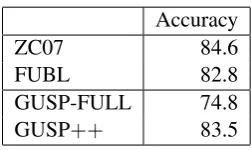
Table 1: Comparison of semantic parsing accu-racy on the ATIS test dataset. Both ZC07 and FUBL used annotated logical forms in training, whereas GUSP-FULL and GUSP++did not. The
numbers for GUSP-FULL and GUSP++are
end-to-end question answering accuracy, whereas the numbers for ZC07 and FUBL are recall on exact match in logical forms.
Accuracy
ZC07 84.6
FUBL 82.8
GUSP-FULL 74.8
GUSP++ 83.5
answers are identical whereas in others they are different. Without other information, neither the complexity prior nor EM can properly discrimi-nate one against another. (Note that this ambiguity is not present in the ZC07 logical forms, which use a single predicatefrom(f,c)for the entire relation paths. In other words, to translate ZC07 logical forms into SQL, one also needs to decide on which path to use.)
Another type of domain-specific ambigui-ties involves sentences such as give me in-formation on flights after 4pm on wednesday. There is no obvious information to disam-biguate between flight.departure time andflight.arrival timefor4pm.
Such ambiguities suggest opportunities for in-teractive learning,3 but this is clearly out of the scope of this paper. Instead, we incor-porated a simple disambiguation feature with a small weight of 0.01 that fires over the sim-ple states of flight.departure time and airport service. We named the resulting systemGUSP++.
To gauge the difficulty of the task and the qual-ity of lexical-trigger scores, we also considered a deterministic baseline LEXICAL, which com-puted semantic parses using lexical-trigger scores alone.
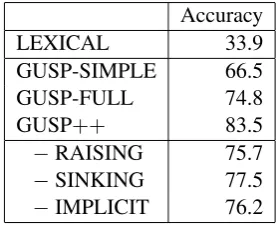
Table 2: Comparison of question answering accu-racy in ablation experiments.
Accuracy
LEXICAL 33.9
GUSP-SIMPLE 66.5
GUSP-FULL 74.8
GUSP++ 83.5
−RAISING 75.7
−SINKING 77.5
−IMPLICIT 76.2
4.4 Results
We first compared the results of GUSP-FULL and GUSP++with ZC07 and FUBL (Kwiatkowski et
al., 2011).4 Note that ZC07 and FUBL were eval-uated on exact match in logical forms. We used their recall numbers which are the percentages of sentences with fully correct logical forms. Given that the questions are quite specific and generally admit nonzero number of answers, the question-answer accuracy should be quite comparable with these numbers.
Table 1 shows the comparison. Surprisingly, even without the additional disambiguation fea-ture, GUSP-FULL already attained an accuracy broadly in range with supervised results. With the feature, GUSP++ effectively tied with the best supervised approach.
To evaluate the importance of various compo-nents in GUSP, we conducted ablation test to com-pare the variants of GUSP. Table 2 shows the re-sults. LEXICAL can parse more than one third of the sentences correctly, which is quite remark-able in itself, considering that it only used the lex-ical scores. On the other hand, roughly two-third of the sentences cannot be correctly parsed in this way, suggesting that the lexical scores are noisy and ambiguous. In comparison, all GUSP variants achieved significant gains over LEXICAL. Addi-tionally, GUSP-FULL substantially outperformed GUSP-SIMPLE, highlighting the challenges of syntax-semantics mismatch in ATIS, and demon-strating the importance and effectiveness of com-plex states for handling such mismatch. All three types of complex states produced significant con-tributions. For example, compared to GUSP++,
4We should note that while the more recent system of FUBL slightly trails ZC07, it is language-independent and can parse questions in multiple languages.
removingRAISINGdropped accuracy by almost 8 points.
4.5 Discussion
Upon manual inspection, many of the remaining errors are due to syntactic parsing errors that are too severe to fix. This is partly due to the fact that ATIS sentences are out of domain compared to the newswired text on which the syntactic parsers were trained. For example, show, listwere regu-larly parsed as nouns, whereasround(as inround trip) were often parsed as a verb and northwest
were parsed as an auxilliary verb. Another reason is that ATIS sentences are typically less formal or grammatical, which exacerbates the difficulty in parsing. In this paper, we used the 1-best depen-dency tree to produce semantic parse. An interest-ing future direction is to consider joint syntactic-semantic parsing, using k-best trees or even the parse forest as input and reranking the top parse using semantic information.5
5 Conclusion
This paper introduces grounded unsupervised semantic parsing, which leverages available database for indirect supervision and uses a grounded meaning representation to account for syntax-semantics mismatch in dependency-based semantic parsing. The resulting GUSP system is the first unsupervised approach to attain an accu-racy comparable to the best supervised systems in translating complex natural-language questions to database queries.
Directions for future work include: joint syntactic-semantic parsing, developing better fea-tures for learning; interactive learning in a dialog setting; generalizing distant supervision; applica-tion to knowledge extracapplica-tion from database-rich domains such as biomedical sciences.
Acknowledgments
We would like to thank Kristina Toutanova, Chris Quirk, Luke Zettlemoyer, and Yoav Artzi for use-ful discussions, and Patrick Pantel and Michael Gammon for help with the datasets.
References
Michele Banko, Michael J. Cafarella, Stephen Soder-land, Matt Broadhead, and Oren Etzioni. 2007. Open information extraction from the web. In Pro-ceedings of the Twentieth International Joint Con-ference on Artificial Intelligence, pages 2670–2676, Hyderabad, India. AAAI Press.
Taylor Berg-Kirkpatrick, John DeNero, and Dan Klein. 2010. Painless unsupervised learning with features. In Proceedings of Human Language Technologies: The 2010 Annual Conference of the North American Chapter of the Association for Computational Lin-guistics.
Benjamin B¨orschinger, Bevan K. Jones, and Mark Johnson. 2011. Reducing grounded learning tasks to grammatical inference. In Proceedings of the 2011 Conference on Empirical Methods in Natural Language Processing.
Xavier Carreras and Luis Marquez. 2004. Introduction to the CoNLL-2004 shared task: Semantic role la-beling. InProceedings of the Eighth Conference on Computational Natural Language Learning, pages 89–97, Boston, MA. ACL.
David L. Chen and Raymond J. Mooney. 2008. Learn-ing to sportscast: A test of grounded language ac-quisition. InICML-08.
James Clarke, Dan Goldwasser, Ming-Wei Chang, and Dan Roth. 2010. Driving semantic parsing from world’s response. InProceedings of the 2010 Con-ference on Natural Language Learning.
Marie-Catherine de Marneffe, Bill MacCartney, and Christopher D. Manning. 2006. Generating typed dependency parses from phrase structure parses. In Proceedings of the Fifth International Conference on Language Resources and Evaluation, pages 449– 454, Genoa, Italy. ELRA.
Pedro Domingos and Daniel Lowd. 2009. Markov Logic: An Interface Layer for Artificial Intelligence. Morgan & Claypool, San Rafael, CA.
Dan Goldwasser, Roi Reichart, James Clarke, and Dan Roth. 2011. Confidence driven unsupervised se-mantic parsing. In Proceedings of the Forty Ninth Annual Meeting of the Association for Computa-tional Linguistics.
B.J. Grosz, D. Appelt, P. Martin, and F. Pereira. 1987. Team: An experiment in the design of transportable natural language interfaces. Artificial Intelligence, 32:173–243.
Yulan He and Steve Young. 2005. Semantic process-ing usprocess-ing the hidden vector state model. In Com-puter Speech and Language.
Yulan He and Steve Young. 2006. Spoken lan-guage understanding using the hidden vector state model. InSpeech Communication Special Issue on
Spoken Language understanding for Conversational Systems.
Larry Heck, Dilek Hakkani-Tur, and Gokhan Tur. 2013. Leveraging knowledge graphs for web-scale unsupervised semantic parsing. In Proceedings of the Interspeech 2013.
Raphael Hoffmann, Congle Zhang, Xiao Ling, Luke Zettlemoyer, and Daniel S. Weld. 2011. Knowledge-based weak supervision for information extraction of overlapping relations. InProceedings of the Forty Ninth Annual Meeting of the Association for Computational Linguistics.
R. J. Kate, Y. W. Wong, and R. J. Mooney. 2005. Learning to transform natural to formal languages. In Proceedings of the Twentieth National Confer-ence on Artificial IntelligConfer-ence.
Joohyun Kim and Raymond J. Mooney. 2010. Gen-erative alignment and semantic parsing for learning from ambiguous supervision. InCOLING10.
Jayant Krishnamurthy and Tom M. Mitchell. 2012. Weakly supervised training of semantic parsers. In EMNLP-12.
Tom Kwiatkowski, Luke Zettlemoyer, Sharon Goldwa-ter, and Mark Steedman. 2011. Lexical generaliza-tion in ccg grammar inducgeneraliza-tion for semantic parsing. InProceedings of the 2011 Conference on Empirical Methods in Natural Language Processing.
Percy Liang, Michael Jordan, and Dan Klein. 2011. Learning dependency-based compositional seman-tics. InProceedings of the Forty Ninth Annual Meet-ing of the Association for Computational LMeet-inguis- Linguis-tics.
Mike Mintz, Steven Bills, Rion Snow, and Dan Ju-rafsky. 2009. Distant supervision for relation ex-traction without labeled data. InProceedings of the Forty Seventh Annual Meeting of the Association for Computational Linguistics.
Raymond J. Mooney. 2007. Learning for semantic parsing. InProceedings of the Eighth International Conference on Computational Linguistics and Intel-ligent Text Processing, pages 311–324, Mexico City, Mexico. Springer.
Patrick Pantel, Eric Crestan, Arkady Borkovsky, Ana-Maria Popescu, and Vishnu Vyas. 2009. Web-scale distributional similarity and entity set expansion. In Proceedings of the 2009 Conference on Empirical Methods in Natural Language Processing.
Slav Petrov and Dan Klein. 2008. Discriminative log-linear grammars with latent variables. InNIPS-08.
Hoifung Poon and Pedro Domingos. 2009. Unsuper-vised semantic parsing. InProceedings of the 2009 Conference on Empirical Methods in Natural Lan-guage Processing, pages 1–10, Singapore. ACL.
Hoifung Poon and Pedro Domingos. 2010. Unsuper-vised ontological induction from text. In Proceed-ings of the Forty Eighth Annual Meeting of the As-sociation for Computational Linguistics, pages 296– 305, Uppsala, Sweden. ACL.
Ana-Maria Popescu, Oren Etzioni, and Henry Kautz. 2003. Towards a theory of natural language inter-faces to databases. InIUI-03.
Ana-Maria Popescu, Alex Armanasu, Oren Etzioni, David Ko, and Alexander Yates. 2004. Modern natural language interfaces to databases: Compos-ing statistical parsCompos-ing with semantic tractability. In COLING-04.
Chris Quirk, Pallavi Choudhury, Jianfeng Gao, Hisami Suzuki, Kristina Toutanova, Michael Gamon, Wen-tau Yih, and Lucy Vanderwende. 2012. MSR SPLAT, a language analysis toolkit. InProceedings of NAACL HLT 2012 Demonstration Session.
Sebastian Riedel, Limin Yao, and Andrew McCallum. 2010. Modeling relations and their mentions with-out labeled text. InProceedings of the Sixteen Euro-pean Conference on Machine Learning.
Ivan Titov and Alexandre Klementiev. 2011. A bayesian model for unsupervised semantic parsing. InProceedings of the Forty Ninth Annual Meeting of the Association for Computational Linguistics.
Ivan Titov and Alexandre Klementiev. 2012. A bayesian approach to unsupervised semantic role in-duction. In Proceedings of the Conference of the European Chapter of the Association for Computa-tional Linguistics.
Luke S. Zettlemoyer and Michael Collins. 2005. Learning to map sentences to logical form: Struc-tured classification with probabilistic categorial grammers. In Proceedings of the Twenty First Conference on Uncertainty in Artificial Intelligence, pages 658–666, Edinburgh, Scotland. AUAI Press.