Decentralized Entity-Level Modeling for Coreference Resolution
Greg Durrett, David Hall, and Dan Klein
Computer Science Division University of California, Berkeley
{gdurrett,dlwh,klein}@cs.berkeley.edu
Abstract
Efficiently incorporating entity-level in-formation is a challenge for coreference resolution systems due to the difficulty of exact inference over partitions. We de-scribe an end-to-end discriminative prob-abilistic model for coreference that, along with standard pairwise features, enforces structural agreement constraints between specified properties of coreferent men-tions. This model can be represented as a factor graph for each document that ad-mits efficient inference via belief propaga-tion. We show that our method can use entity-level information to outperform a basic pairwise system.
1 Introduction
The inclusion of entity-level features has been a driving force behind the development of many coreference resolution systems (Luo et al., 2004; Rahman and Ng, 2009; Haghighi and Klein, 2010; Lee et al., 2011). There is no polynomial-time dy-namic program for inference in a model with ar-bitrary entity-level features, so systems that use such features typically rely on making decisions in a pipelined manner and sticking with them, op-erating greedily in a left-to-right fashion (Rahman and Ng, 2009) or in a multi-pass, sieve-like man-ner (Raghunathan et al., 2010). However, such systems may be locked into bad coreference deci-sions and are difficult to directly optimize for stan-dard evaluation metrics.
In this work, we present a new structured model of entity-level information designed to allow effi-cient inference. We use a log-linear model that can be expressed as a factor graph. Pairwise features appear in the model as unary factors, adjacent to nodes representing a choice of antecedent (or none) for each mention. Additional nodes model entity-level properties on a per-mention basis, and
structural agreement factors softly drive properties of coreferent mentions to agree with one another. This is a key feature of our model: mentions man-age their partial membership in various corefer-ence chains, so that information about entity-level properties is decentralized and propagated across individual mentions, and we never need to explic-itly instantiate entities.
Exact inference in this factor graph is in-tractable, but efficient approximate inference can be carried out with belief propagation. Our model is the first discriminatively-trained model that both makes joint decisions over an entire document and models specific entity-level properties, rather than simply enforcing transitivity of pairwise decisions (Finkel and Manning, 2008; Song et al., 2012).
We evaluate our system on the dataset from the CoNLL 2011 shared task using three differ-ent types of properties: synthetic oracle proper-ties, entity phi features (number, gender, animacy, and NER type), and properties derived from un-supervised clusters targeting semantic type infor-mation. In all cases, our transitive model of en-tity properties equals or outperforms our pairwise system and our reimplementation of a previous entity-level system (Rahman and Ng, 2009). Our final system is competitive with the winner of the CoNLL 2011 shared task (Lee et al., 2011). 2 Example
We begin with an example motivating our use of entity-level features. Consider the following ex-cerpt concerning two famous auction houses:
When looking for [art items], [people] go to[Sotheby’s and Christie’s]because[they]A
believe [they]B can get the best price for
[them].
The first three mentions are all distinct entities, theyAandtheyBrefer topeople, andthemrefers to
art items. The three pronouns are tricky to resolve
automatically because they could at first glance re-solve to any of the preceding mentions. We focus in particular on the resolution of theyA andthem.
In order to correctly resolvetheyAtopeoplerather
than Sotheby’s and Christie’s, we must take ad-vantage of the fact thattheyAappears as the
sub-ject of the verbbelieve, which is much more likely to be attributed to people than to auction houses.
Binding principles preventthemfrom attaching totheyB. But how do we prevent it from
choos-ing as its antecedent the next closest agreechoos-ing pro-noun, theyA? One way is to exploit the correct
coreference decision we have already made,theyA
referring topeople, since people are not as likely to have a price as art items are. This observa-tion argues for enforcing agreement of entity-level semantic properties during inference, specifically properties relating to permitted semantic roles. Because even these six mentions have hundreds of potential partitions into coreference chains, we cannot search over partitions exhaustively, and therefore we must design our model to be able to use this information while still admitting an effi-cient inference scheme.
3 Models
We will first present our BASIC model (Sec-tion 3.1) and describe the features it incorporates (Section 3.2), then explain how to extend it to use transitive features (Sections 3.3 and 3.4).
Throughout this section, letxbe a variable con-taining the words in a document along with any relevant precomputed annotation (such as parse in-formation, semantic roles, etc.), and let ndenote the number of mentions in a given document.
3.1 BASICModel
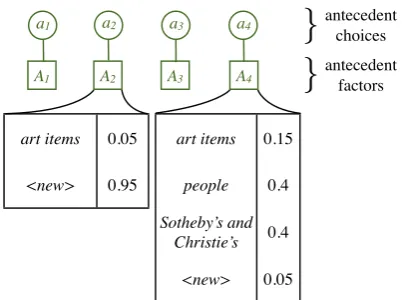
Our BASICmodel is depicted in Figure 1 in stan-dard factor graph notation. Each mention i has an associated random variableai taking values in
the set{1, . . . , i−1, <new>}; this variable spec-ifies mention i’s selected antecedent or indicates that it begins a new coreference chain. Leta = (a1, ..., an)be the vector of theai. Note that a set
of coreference chainsC (the final desired output) can be uniquely determined from a, buta is not uniquely determined byC.
We use a log linear model of the conditional dis-tributionP(a|x)as follows:
P(a|x)∝exp n
X
i=1
wTfA(i, ai, x)
!
When looking for [art items], [people] go to [Sotheby's and Christie's] because [they]A believe [they]B can get
the best price for [them].
art items 0.15
people 0.4
Sotheby’s and Christie’s 0.4
<new> 0.05
a2 a3 a4
a1
A1 A2 A3 A4
art items 0.05
<new> 0.95
antecedent choices
[image:2.595.317.520.95.245.2]antecedent factors
}
}
Figure 1: Our BASIC coreference model. A de-cision ai is made independently for each
men-tion about what its antecedent menmen-tion should be or whether it should start a new coreference chain. Each unary factorAihas a log-linear form
with features examining mentioni, its selected an-tecedentai, and the document contextx.
wherefA(i, ai, x)is a feature function that
exam-ines the coreference decisionaifor mentioniwith
document contextx; note that this feature function can include pairwise features based on mentioni and the chosen antecedent ai, since information
about each mention is contained inx.
Because the model factors completely over the individualai, these feature functionsfAcan be
ex-pressed as unary factors Ai (see Figure 1), with
Ai(j) ∝ exp wTfA(i, j, x). Given a setting of
w, we can determine ˆa = arg maxaP(a|x) and
then deterministically computeC(a), the final set
of coreference chains.
While the features of this model factor over coreference links, this approach differs from clas-sical pairwise systems such as Bengtson and Roth (2008) or Stoyanov et al. (2010). Because poten-tial antecedents compete with each other and with the non-anaphoric hypothesis, the choice ofai
ac-tually represents a joint decision about i−1
wise links, as opposed to systems that use a pair-wise binary classifier and a separate agglomera-tion step, which consider one link at a time during learning. This approach is similar to the mention-ranking model of Rahman and Ng (2009).
3.2 Pairwise Features
We now present the set of featuresfAused by our
an-tecedent choiceai of the current mention as well
as the observed information x in the document. For each of the features we present, two conjoined versions are included: one with an indicator of the type of the current mention being resolved, and one with an indicator of the types of the current and antecedent mentions. Mention types are either NOMINAL, PROPER, or, if the mention is pronom-inal, a canonicalized version of the pronoun ab-stracting away case.1
Several features, especially those based on the precise constructs (apposition, etc.) and those in-corporating phi feature information, are computed using the machinery in Lee et al. (2011). Other features were inspired by Song et al. (2012) and Rahman and Ng (2009).
Anaphoricity features: Indicator of anaphoric-ity, indicator on definiteness.
Configurational features: Indicator on distance in mentions (capped at 10), indicator on dis-tance in sentences (capped at 10), does the an-tecedent c-command the current mention, are the two mentions in a subject/object construction, are the mentions nested, are the mentions in determin-istic appositive/role appositive/predicate nomina-tive/relative pronoun constructions.
Match features: Is one mention an acronym of
the other, head match, head contained (each way), string match, string contained (each way), relaxed head match features from Lee et al. (2011).
Agreement features: Gender, number,
ani-macy, and NER type of the current mention and the antecedent (separately and conjoined).
Discourse features: Speaker match conjoined
with an indicator of whether the document is an article or conversation.
Because we use conjunctions of these base fea-tures together with the antecedent and mention type, our system can capture many relationships that previous systems hand-coded, especially re-garding pronouns. For example, our system has access to features such as “it is non-anaphoric”, “it has as its antecedent a geopolitical entity”, or “I has as its antecedentIwith the same speaker.”
1While this canonicalization could theoretically impair
our ability to resolve, for example, reflexive pronouns, con-joining features with raw pronoun strings does not improve performance.
We experimented with synonymy and hyper-nymy features from WordNet (Miller, 1995), but these did not empirically improve performance.
3.3 TRANSITIVEModel
The BASICmodel can capture many relationships between pairs of mentions, but cannot necessarily capture entity-level properties like those discussed in Section 2. We could of course model entities directly (Luo et al., 2004; Rahman and Ng, 2009), saying that each mention refers to some prior en-tity rather than to some prior mention. However, inference in this model would require reasoning about all possible partitions of mentions, which is computationally infeasible without resorting to se-vere approximations like a left-to-right inference method (Rahman and Ng, 2009).
Instead, we would like to try to preserve the tractability of the BASIC model while still being able to exploit entity-level information. To do so, we will allow each mention to maintain its own distributions over values for a number of proper-ties; these properties could include gender, named-entity type, or semantic class. Then, we will re-quire each anaphoric mention to agree with its an-tecedent on the value of each of these properties.
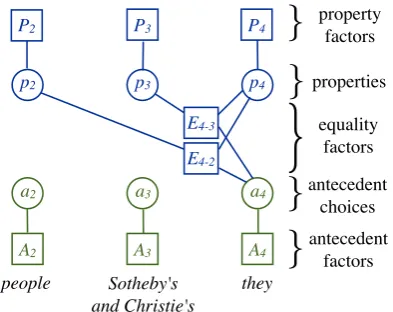
Our TRANSITIVEmodel which implements this scheme is shown in Figure 2. Each mention i has been augmented with a single property node pi ∈ {1, ..., k}. The unaryPifactors encode prior
knowledge about the setting of eachpi; these
fac-tors may be hard (Iwill not refer to a plural entity), soft (such as a distribution over named entity types output by an NER tagger), or practically uniform (e.g. the last name Smith does not specify a partic-ular gender).
To enforce agreement of a particular property, we require a mention to have the same property value as its antecedent. That is, for mentionsiand j, if ai = j, we want to ensure that pi and pj
agree. We can achieve this with the following set of structural equality factors:
Ei−j(ai, pi, pj) = 1−I[ai=j∧pi6=pj]
In words, this factor is zero if both ai = j and
pi disagrees with pj. These equality factors
es-sentially provide a mechanism by which these pri-orsPi can influence the coreference decisions: if,
for example, the factorsPi andPj disagree very
strongly, choosingai 6=j will be preferred in
or-der to avoid forcing one ofpi orpj to take an
E4-3
a2 a4
p4
p3
p2
E4-2
A2 A3 A4
P2 P3 P4
antecedent choices
antecedent factors property
factors
properties
equality factors
a3
}
}
}
}
}
people Sotheby'sand Christie's
they
Figure 2: The factor graph for our TRANSI -TIVE coreference model. Each nodeai now has
a propertypi, which is informed by its own unary
factor Pi. In our example, a4 strongly indicates
that mentions 2 and 4 are coreferent; the factor E4−2 then enforces equality between p2 and p4,
while the factorE4−3has no effect.
only indicates a single antecedent, the transitive nature of theE factors forcespi to agree with the
p nodes of all other mentions likely to be in the same entity.
3.4 Property Projection
So far, our model as specified ensures agreement of our entity-level properties, but strictly enforc-ing agreement may not always be correct. Suppose that we are using named entity type as an entity-level property. Organizations and geo-political en-tities are two frequently confused and ambiguous tags, and in the gold-standard coreference chains it may be the case that a single chain contains in-stances of both. We might wish to learn that or-ganizations and geo-political entities are “compat-ible” in the sense that we should forgive entities for containing both, but without losing the ability to reject a chain containing both organizations and people, for example.
To address these effects, we expand our model as indicated in Figure 3. As before, we have a set of propertiespiand agreement factorsEij. On
top of that, we introduce the notion of raw prop-erty valuesri ∈ {1, ..., k}together with priors in
the form of theRi factors. Theri andpi could in
principle have different domains, but for this work we take them to have the same domain. The Pi
factors now have a new structure: they now rep-resent a featurized projection of the ri onto the
pi, which can now be thought of as
“coreference-p4
p3
p2
r4
r3
r2
P2 P3 P4
R2 R3 R4 raw property factors
raw properties
projection factors
projected properties
}
}
}
}
a2 a4
A2 A3 A4
a3
E3-1 E
4-1
Figure 3: The complete factor graph for our TRANSITIVE coreference model. Compared to Figure 2, theRicontain the raw cluster posteriors,
and thePifactors now project raw cluster valuesri
into a set of “coreference-adapted” clusterspithat
are used as before. This projection allows men-tions with different but compatible raw property values to coexist in the same coreference chain. adapted” properties. ThePifactors are defined by
Pi(pi, ri)∝exp(wTfP(pi, ri)), wherefP is a
fea-ture vector over the projection ofriontopi. While
there are many possible choices offP, we choose
it to be an indicator of the values ofpi andri, so
that we learn a fully-parameterized projection ma-trix.2 TheR
i are constant factors, and may come
from an upstream model or some other source de-pending on the property being modeled.
Our description thus far has assumed that we are modeling only one type of property. In fact, we can use multiple properties for each mention by duplicating the r and p nodes and the R, P, and E factors across each desired property. We index each of these byl∈ {1, . . . , m}for each of mproperties.
The final log-linear model is given by the fol-lowing formula:
P(a|x)∝X
p,r
Y
i,j,l
El,i−j(ai, pli, plj)
Y
i,l
Rli(rli)
exp wTX
i
fA(i, ai, x) +
X
l
fP(pli, rli)
!!#
whereiandj range over mentions,lranges over
2Initialized to zero (or small values), this matrix actually
causes the transitive machinery to have no effect, since all posteriors over thepiare flat and completely uninformative. Therefore, we regularize the weights of the indicators ofpi=
[image:4.595.312.518.60.234.2] [image:4.595.84.281.61.217.2]each ofmproperties, and the outer sum indicates marginalization over allpandrvariables.
4 Learning
Now that we have defined our model, we must decide how to train its weights w. The first
issue to address is one of the supervision pro-vided. Our model traffics in sets of labels a which are more specified than gold coreference chainsC, which give cluster membership for each mention but not antecedence. Let A(C) be the
set of labelings a that are consistent with a set of coreference chains C. For example, if C = {{1,2,3},{4}}, then (<new>,1,2, <new>) ∈ A(C) and (<new>,1,1, <new>) ∈ A(C) but (<new>,1, <new>,3) ∈ A/ (C), since this im-plies the chainsC={{1,2},{3,4}}
The most natural objective is a variant of standard conditional log-likelihood that treats the choice ofafor the specifiedCas a latent variable to be marginalized out:
`(w) = t
X
i=1 log
X
a∈A(Ci)
P(a|xi)
(1)
where(xi, Ci)is theith labeled training example.
This optimizes for the 0-1 loss; however, we are much more interested in optimizing with respect to a coreference-specific loss function.
To this end, we will use softmax-margin (Gim-pel and Smith, 2010), which augments the proba-bility of each example with a term proportional to its loss, pushing the model to assign less mass to highly incorrect examples. We modify Equation 1 to use a new probability distribution P0 instead of P, where P0(a|xi) ∝ P(a|xi) exp (l(a, C))
and l(a, C) is a loss function. In order to
perform inference efficiently, l(a, C) must
de-compose linearly across mentions: l(a, C) =
Pn
i=1l(ai, C). Commonly-used coreference
met-rics such as MUC (Vilain et al., 1995) and B3 (Bagga and Baldwin, 1998) do not have this prop-erty, so we instead make use of a parameterized loss function that does and fit the parameters to give good performance. Specifically, we take
l(a, C) = n
X
i=1
[c1I(K1(ai, C)) +c2I(K2(ai, C))
+c3I(K3(ai, C))]
wherec1,c2, and c3 are real-valued weights,K1
denotes the event thataiis falsely anaphoric when
it should be non-anaphoric,K2 denotes the event
thataiis falsely non-anaphoric when it should be
anaphoric, andK3denotes the event thataiis
cor-rectly determined to be anaphoric but . These can be computed based on onlyai andC. By setting
c1 low and c2 high relative to c3, we can force
the system to be less conservative about making anaphoricity decisions and achieve a better bal-ance with the final coreference metrics.
Finally, we incorporate L1 regularization,
giv-ing us our final objective:
`(w) = t
X
i=1 log
X
a∈A(Ci)
P0(a|xi)
+λkwk1
We optimize this objective using AdaGrad (Duchi et al., 2011); we found this to be faster and give higher performance than L-BFGS using L2
regularization (Liu and Nocedal, 1989). Note that because of the marginalization overA(Ci), even
the objective for the BASICmodel is not convex. 5 Inference
Inference in the BASIC model is straightforward. Given a set of weightsw, we can predict
ˆ
a= arg max a
P(a|x)
We then report the corresponding chains C(a)
as the system output.3 For learning, the
gradi-ent takes the standard form of the gradigradi-ent of a log-linear model, a difference of expected feature counts under the gold annotation and under no annotation. This requires computing marginals P0(ai|x) for each mention i, but because the model already factors this way, this step is easy.
The TRANSITIVEmodel is more complex. Ex-act inference is intrEx-actable due to theEfactors that couple all of theaiby way of thepinodes.
How-ever, we can compute approximate marginals for theai,pi, andriusing belief propagation. BP has
been effectively used on other NLP tasks (Smith and Eisner, 2008; Burkett and Klein, 2012), and is effective in cases such as this where the model is largely driven by non-loopy factors (here, theAi).
From marginals over each node, we can com-pute the necessary gradient and decode as before:
ˆ
a= arg max a
ˆ
P(a|x)
3One could use ILP-based decoding in the style of Finkel
This corresponds to minimum-risk decoding with respect to the Hamming loss over antecedence pre-dictions.
Pruning. The TRANSITIVE model requires
in-stantiating a factor for each potential setting of eachai. This factor graph grows quadratically in
the size of the document, and even approximate in-ference becomes slow when a document contains over 200 mentions. Therefore, we use our BA -SIC model to prune antecedent choices for each
ai in order to reduce the size of the factor graph
that we must instantiate. Specifically, we prune links between pairs of mentions that are of men-tion distance more than 100, as well as values for aithat fall below a particular odds ratio threshold
with respect to the best setting of that ai in the
BASICmodel; that is, those for which
log
PBASIC(ai|x) maxjPBASIC(ai =j|x)
is below a cutoffγ. 6 Related Work
Our BASIC model is a mention-ranking approach resembling models used by Denis and Baldridge (2008) and Rahman and Ng (2009), though it is trained using a novel parameterized loss function. It is also similar to the MLN-JOINT(BF) model of Song et al. (2012), but we enforce the single-parent constraint at a deeper structural level, al-lowing us to treat non-anaphoricity symmetrically with coreference as in Denis and Baldridge (2007) and Stoyanov and Eisner (2012). The model of Fernandes et al. (2012) also uses the single-parent constraint structurally, but with learning via la-tent perceptron and ILP-based one-best decod-ing rather than logistic regression and BP-based marginal computation.
Our TRANSITIVE model is novel; while Mc-Callum and Wellner (2004) proposed the idea of using attributes for mentions, they do not actu-ally implement a model that does so. Other sys-tems include entity-level information via hand-written rules (Raghunathan et al., 2010), induced rules (Yang et al., 2008), or features with learned weights (Luo et al., 2004; Rahman and Ng, 2011), but all of these systems freeze past coreference de-cisions in order to compute their entities.
Most similar to our entity-level approach is the system of Haghighi and Klein (2010), which
also uses approximate global inference; however, theirs is an unsupervised, generative system and they attempt to directly model multinomials over words in each mention. Their system could be ex-tended to handle property information like we do, but our system has many other advantages, such as freedom from a pre-specified list of entity types, the ability to use multiple input clusterings, and discriminative projection of clusters.
7 Experiments
We use the datasets, experimental setup, and scor-ing program from the CoNLL 2011 shared task (Pradhan et al., 2011), based on the OntoNotes corpus (Hovy et al., 2006). We use the standard automatic parses and NER tags for each docu-ment. Our mentions are those output by the sys-tem of Lee et al. (2011); we also use their postpro-cessing to remove appositives, predicate nomina-tives, and singletons before evaluation. For each experiment, we report MUC (Vilain et al., 1995), B3(Bagga and Baldwin, 1998), and CEAFe(Luo,
2005), as well as their average.
Parameter settings. We take the regularization constant λ = 0.001 and the parameters of our surrogate loss (c1, c2, c3) = (0.15,2.5,1)for all
models.4 All models are trained for 20 iterations.
We take the pruning thresholdγ =−2.
7.1 Systems
Besides our BASICand TRANSITIVEsystems, we evaluate a strictly pairwise system that incorpo-rates property information by way of indicator fea-tures on the current mention’s most likely property value and the proposed antecedent’s most likely property value. We call this system PAIRPROP -ERTY; it is simply the BASIC system with an ex-panded feature set.
Furthermore, we compare against a LEFT -TORIGHTentity-level system like that of Rahman and Ng (2009).5 Decoding now operates in a
se-quential fashion, with BASIC features computed as before and entity features computed for each mention based on the coreference decisions made thus far. Following Rahman and Ng (2009), fea-tures for each property indicate whether the
cur-4Additional tuning of these hyper parameters did not
sig-nificantly improve any of the models under any of the exper-imental conditions.
5Unfortunately, their publicly-available system is
rent mention agrees with no mentions in the an-tecedent cluster, at least one mention, over half of the mentions, or all of the mentions; antecedent clusters of size 1 or 2 fire special-cased features. These additional features beyond those in Rah-man and Ng (2009) were helpful, but more in-volved conjunction schemes and fine-grained fea-tures were not. During training, entity feafea-tures of both the gold and the prediction are computed us-ing the Viterbi clusterus-ing of precedus-ing mentions under the current model parameters.6
All systems are run in a two-pass manner: first, the BASIC model is run, then antecedent choices are pruned, then our second-round model is trained from scratch on the pruned data.7 7.2 Noisy Oracle Features
We first evaluate our model’s ability to exploit syn-thetic entity-level properties. For this experiment, mention properties are derived from corrupted or-acle information about the true underlying corefer-ence cluster. Each corefercorefer-ence cluster is assumed to have one underlying value for each ofm coref-erence properties, each taking values over a do-mainD. Mentions then sample distributions over Dfrom a Dirichlet distribution peaked around the true underlying value.8 These posteriors are taken
as theRifor the TRANSITIVEmodel.
We choose this setup to reflect two important properties of entity-level information: first, that it may come from a variety of disparate sources, and second, that it may be based on the determinations of upstream models which produce posteriors nat-urally. A strength of our model is that it can accept such posteriors as input, naturally making use of this information in a model-based way.
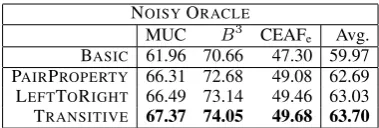
Table 1 shows development results averaged across ten train-test splits with m = 3
proper-ties, each taking one of|D| = 5values. We
em-phasize that these parameter settings give fairly weak oracle information: a document may have hundreds of clusters, so even in the absence of noise these oracle properties do not have high
dis-6Using gold entities for training as in Rahman and Ng
(2009) resulted in a lower-performing system.
7We even do this for the BASICmodel, since we found
that performance of the pruned and retrained model was gen-erally higher.
8Specifically, the distribution used is a Dirichlet with
α= 3.5for the true underlying cluster andα= 1for other values, chosen so that 25% of samples from the distribution did not have the correct mode. Though these parameters af-fect the quality of the oracle information, varying them did not change the relative performance of the different models.
NOISYORACLE
MUC B3 CEAFe Avg.
BASIC 61.96 70.66 47.30 59.97 PAIRPROPERTY 66.31 72.68 49.08 62.69
LEFTTORIGHT 66.49 73.14 49.46 63.03
[image:7.595.321.511.61.125.2]TRANSITIVE 67.37 74.05 49.68 63.70
Table 1: CoNLL metric scores for our four dif-ferent systems incorporating noisy oracle data. This information helps substantially in all cases. Both entity-level models outperform the PAIR -PROPERTYmodel, but we observe that the TRAN -SITIVE model is more effective than the LEFT -TORIGHTmodel at using this information. criminating power. Still, we see that all mod-els are able to benefit from incorporating this in-formation; however, our TRANSITIVEmodel out-performs both the PAIRPROPERTYmodel and the LEFTTORIGHT model. There are a few reasons for this: first, our model is able to directly use soft posteriors, so it is able to exploit the fact that more peaked samples from the Dirichlet are more likely to be correct. Moreover, our model can propagate information backwards in a document as well as forwards, so the effects of noise can be more eas-ily mitigated. By contrast, in the LEFTTORIGHT model, if the first or second mention in a cluster has the wrong property value, features indicating high levels of property agreement will not fire on the next few mentions in those clusters.
7.3 Phi Features
As we have seen, our TRANSITIVEmodel can ex-ploit high-quality entity-level features. How does it perform using real features that have been pro-posed for entity-level coreference?
Here, we use hard phi feature determinations extracted from the system of Lee et al. (2011). Named-entity type and animacy are both com-puted based on the output of a named-entity tag-ger, while number and gender use the dataset of Bergsma and Lin (2006). Once this informa-tion is determined, the PAIRPROPERTYand LEFT -TORIGHTsystems can compute features over it di-rectly. In the TRANSITIVEmodel, each of theRi
factors places 3
4 of its mass on the determined
la-bel and distributes the remainder uniformly among the possible options.
PHIFEATURES
MUC B3 CEAFe Avg.
BASIC 61.96 70.66 47.30 59.97 LEFTTORIGHT 61.34 70.41 47.64 59.80 TRANSITIVE 62.66 70.92 46.88 60.16
PHIFEATURES(ABLATEDBASIC)
[image:8.595.318.513.60.125.2]BASIC-PHI 59.45 69.21 46.02 58.23 PAIRPROPERTY 61.88 70.66 47.14 59.90 LEFTTORIGHT 61.42 70.53 47.49 59.81 TRANSITIVE 62.23 70.78 46.74 59.92
Table 2: CoNLL metric scores for our systems in-corporating phi features. Our standard BASIC sys-tem already includes phi features, so no results are reported for PAIRPROPERTY. Here, our TRAN -SITIVE system does not give substantial improve-ment on the averaged metric. Over a baseline which does not include phi features, all systems are able to incorporate them comparably.
phi features. Our entity-level systems successfully captures phi features when they are not present in the baseline, but there is only slight benefit over pairwise incorporation, a result which has been noted previously (Luo et al., 2004).
7.4 Clustering Features
Finally, we consider mention properties derived from unsupervised clusterings; these properties are designed to target semantic properties of nom-inals that should behave more like the oracle fea-tures than the phi feafea-tures do.
We consider clusterings that take as input pairs
(n, r)of a noun headnand a stringr which con-tains the semantic role ofn(or some approxima-tion thereof) conjoined with its governor. Two dif-ferent algorithms are used to cluster these pairs: a NAIVEBAYES model, wherecgeneratesnandr, and a CONDITIONALmodel, wherecis generated conditioned onr and thennis generated fromc. Parameters for each can be learned with the ex-pectation maximization (EM) algorithm (Demp-ster et al., 1977), with symmetry broken by a small amount of random noise at initialization.
Similar models have been used to learn sub-categorization information (Rooth et al., 1999) or properties of verb argument slots (Yao et al., 2011). We choose this kind of clustering for its rel-ative simplicity and because it allows pronouns to have more informed properties (from their verbal context) than would be possible using a model that makes type-level decisions about nominals only. Though these specific cluster features are novel to coreference, previous work has used similar
CLUSTERS
MUC B3 CEAFe Avg.
[image:8.595.88.277.61.167.2]BASIC 61.96 70.66 47.30 59.97 PAIRPROPERTY 62.88 70.71 47.45 60.35 LEFTTORIGHT 61.98 70.19 45.77 59.31 TRANSITIVE 63.34 70.89 46.88 60.37
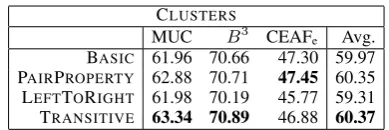
Table 3: CoNLL metric scores for our systems incorporating clustering features. These features are equally effectively incorporated by our PAIR -PROPERTYsystem and our TRANSITIVEsystem.
government officials
court authorities
ARG0:said ARG0:say ARG0:found ARG0:announced
prices shares index rates
ARG1:rose ARG1:fell ARG1:cut ARG1:closed way
law agreement
plan
ARG1:signed ARG1:announced ARG1:set ARG1:approved attack
problems attacks charges
ARG1:cause ARG2:following ARG1:reported ARG1:filed
...
...
...
...
...
...
...
...
...
Figure 4: Examples of clusters produced by the NAIVEBAYES model on SRL-tagged data with pronouns discarded.
types of fine-grained semantic class information (Hendrickx and Daelemans, 2007; Ng, 2007; Rah-man and Ng, 2010). Other approaches incorpo-rate information from other sources (Ponzetto and Strube, 2006) or compute heuristic scores for real-valued features based on a large corpus or the web (Dagan and Itai, 1990; Yang et al., 2005; Bansal and Klein, 2012).
We use four different clusterings in our experiments, each with twenty clusters: dependency-parse-derived NAIVEBAYESclusters, semantic-role-derived CONDITIONAL clusters, SRL-derived NAIVEBAYES clusters generating a NOVERB token whenr cannot be determined, and SRL-derived NAIVEBAYES clusters with all pronoun tuples discarded. Examples of the latter clusters are shown in Figure 4. Each clustering is learned for 30 iterations of EM over English Gigaword (Graff et al., 2007), parsed with the Berkeley Parser (Petrov et al., 2006) and with SRL determined by Senna (Collobert et al., 2011). Table 3 shows results of modeling these cluster properties. As in the case of oracle features, the PAIRPROPERTYand LEFTTORIGHTsystems use the modes of the cluster posteriors, and the TRAN -SITIVE system uses the posteriors directly as the
Ri. We see comparable performance from
[image:8.595.308.523.201.303.2]-MUC B3 CEAF
e Avg.
Prec. Rec. F1 Prec. Rec. F1 Prec. Rec. F1 F1
BASIC 69.99 55.59 61.96 80.96 62.69 70.66 41.37 55.21 47.30 59.97
STANFORD 61.49 59.59 60.49 74.60 68.25 71.28 47.57 49.45 48.49 60.10
NOISYORACLE
PAIRPROPERTY 76.49 58.53 66.31 84.98 63.48 72.68 41.84 59.36 49.08 62.69
LEFTTORIGHT 76.92 58.55 66.49 85.68 63.81 73.14 42.07 60.01 49.46 63.03
TRANSITIVE 76.48 60.20 *67.37 84.84 65.69 *74.05 42.89 59.01 *49.68 63.70
PHIFEATURES
LEFTTORIGHT 69.77 54.73 61.34 81.40 62.04 70.41 41.49 55.92 47.64 59.80
TRANSITIVE 70.27 56.54 *62.66 79.81 63.82 *70.92 41.17 54.44 46.88 60.16
PHIFEATURES(ABLATEDBASIC)
BASIC-PHI 67.04 53.41 59.45 78.93 61.63 69.21 40.40 53.46 46.02 58.23
PAIRPROPERTY 70.24 55.31 61.88 81.10 62.60 70.66 41.04 55.38 47.14 59.90
LEFTTORIGHT 69.94 54.75 61.42 81.38 62.23 70.53 41.29 55.87 47.49 59.81
TRANSITIVE 70.06 55.98 *62.23 79.92 63.52 70.78 40.90 54.52 46.74 59.92
CLUSTERS
PAIRPROPERTY 71.77 55.95 62.88 81.76 62.30 70.71 40.98 56.35 47.45 60.35
LEFTTORIGHT 69.75 54.82 61.39 81.48 62.29 70.60 41.62 55.89 47.71 59.90
[image:9.595.95.500.61.268.2]TRANSITIVE 71.54 56.83 *63.34 80.55 63.31 *70.89 40.77 55.14 46.88 60.37
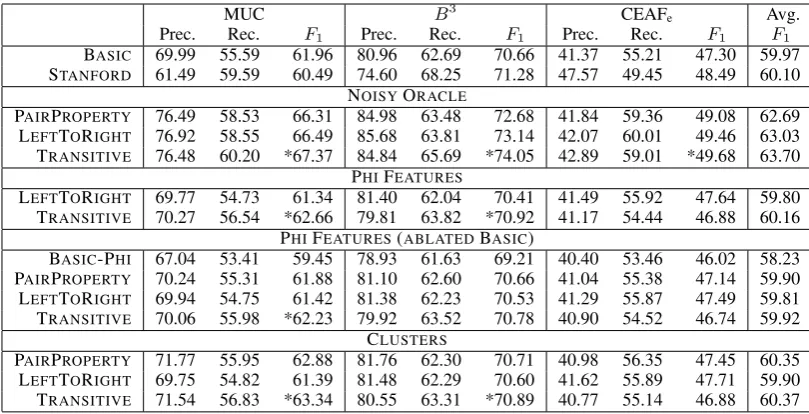
Table 4: CoNLL metric scores averaged across ten different splits of the training set for each experiment. We include precision, recall, andF1for each metric for completeness. StarredF1values on the individual
metrics for the TRANSITIVEsystem are significantly better than all other results in the same block at the
p= 0.01level according to a bootstrap resampling test.
MUC B3 CEAF
e Avg.
Prec. Rec. F1 Prec. Rec. F1 Prec. Rec. F1 F1
BASIC 68.84 56.08 61.81 77.60 61.40 68.56 38.25 50.57 43.55 57.97
PAIRPROPERTY 70.90 56.26 62.73 78.95 60.79 68.69 37.69 51.92 43.67 58.37
LEFTTORIGHT 68.84 55.56 61.49 78.64 61.03 68.72 38.97 51.74 44.46 58.22
TRANSITIVE 70.62 58.06 *63.73 76.93 62.24 68.81 38.00 50.40 43.33 58.62
STANFORD 60.91 62.13 61.51 70.61 67.75 69.15 45.79 44.55 45.16 58.61
Table 5: CoNLL metric scores for our best systems (including clustering features) on the CoNLL blind test set, reported in the same manner as Table 4.
TIVEsystem appears to be more effective than the LEFTTORIGHTsystem.
7.5 Final Results
Table 4 shows expanded results on our develop-ment sets for the different types of entity-level information we considered. We also show in in Table 5 the results of our system on the CoNLL test set, and see that it performs comparably to the Stanford coreference system (Lee et al., 2011). Here, our TRANSITIVE system provides modest improvements over all our other systems.
Based on Table 4, our TRANSITIVEsystem ap-pears to do better on MUC andB3than on CEAFe.
However, we found no simple way to change the relative performance characteristics of our various systems; notably, modifying the parameters of the loss function mentioned in Section 4 or changing it entirely did not trade off these three metrics but merely increased or decreased them in lockstep. Therefore, the TRANSITIVE system actually sub-stantially improves over our baselines and is not
merely trading off metrics in a way that could be easily reproduced through other means.
8 Conclusion
In this work, we presented a novel coreference ar-chitecture that can both take advantage of standard pairwise features as well as use transitivity to en-force coherence of decentralized entity-level prop-erties within coreference clusters. Our transitive system is more effective at using properties than a pairwise system and a previous entity-level sys-tem, and it achieves performance comparable to that of the Stanford coreference resolution system, the winner of the CoNLL 2011 shared task. Acknowledgments
References
Amit Bagga and Breck Baldwin. 1998. Algorithms for Scoring Coreference Chains. InProceedings of the Conference on Language Resources and Evaluation Workshop on Linguistics Coreference.
Mohit Bansal and Dan Klein. 2012. Coreference Se-mantics from Web Features. InProceedings of the Association for Computational Linguistics.
Eric Bengtson and Dan Roth. 2008. Understanding the Value of Features for Coreference Resolution. In Proceedings of the Conference on Empirical Meth-ods in Natural Language Processing.
Shane Bergsma and Dekang Lin. 2006. Bootstrap-ping Path-Based Pronoun Resolution. In Proceed-ings of the Conference on Computational Linguistics and the Association for Computational Linguistics. David Burkett and Dan Klein. 2012. Fast Inference in
Phrase Extraction Models with Belief Propagation. In Proceedings of the North American Chapter of the Association for Computational Linguistics. Ronan Collobert, Jason Weston, L´eon Bottou, Michael
Karlen, Koray Kavukcuoglu, and Pavel Kuksa. 2011. Natural Language Processing (Almost) from Scratch. Journal of Machine Learning Research, 12:2493–2537, November.
Ido Dagan and Alon Itai. 1990. Automatic Process-ing of Large Corpora for the Resolution of Anaphora References. In Proceedings of the Conference on Computational Linguistics - Volume 3.
Arthur P. Dempster, Nan M. Laird, and Donald B. Ru-bin. 1977. Maximum Likelihood from Incomplete Data via the EM Algorithm. Journal of the Royal Statistical Society, Series B, 39(1):1–38.
Pascal Denis and Jason Baldridge. 2007. Joint Deter-mination of Anaphoricity and Coreference Resolu-tion using Integer Programming. InProceedings of the North American Chapter of the Association for Computational Linguistics.
Pascal Denis and Jason Baldridge. 2008. Specialized Models and Ranking for Coreference Resolution. In Proceedings of the Conference on Empirical Meth-ods in Natural Language Processing.
John Duchi, Elad Hazan, and Yoram Singer. 2011. Adaptive Subgradient Methods for Online Learning and Stochastic Optimization. Journal of Machine Learning Research, 12:2121–2159, July.
Eraldo Rezende Fernandes, C´ıcero Nogueira dos San-tos, and Ruy Luiz Milidi´u. 2012. Latent Structure Perceptron with Feature Induction for Unrestricted Coreference Resolution. InProceedings of the Joint Conference on Empirical Methods in Natural Lan-guage Proceedings and Conference on Computa-tional Natural Language Learning - Shared Task.
Jenny Rose Finkel and Christopher D. Manning. 2008. Enforcing Transitivity in Coreference Resolution. InProceedings of the Association for Computational Linguistics: Short Papers.
Kevin Gimpel and Noah A. Smith. 2010. Softmax-Margin CRFs: Training Log-Linear Models with Cost Functions. InProceedings of the North Amer-ican Chapter for the Association for Computational Linguistics.
David Graff, Junbo Kong, Ke Chen, and Kazuaki Maeda. 2007. English Gigaword Third Edi-tion. Linguistic Data Consortium, Catalog Number LDC2007T07.
Aria Haghighi and Dan Klein. 2010. Coreference Res-olution in a Modular, Entity-Centered Model. In Proceedings of the North American Chapter of the Association for Computational Linguistics.
Iris Hendrickx and Walter Daelemans, 2007. Adding Semantic Information: Unsupervised Clusters for Coreference Resolution.
Eduard Hovy, Mitchell Marcus, Martha Palmer, Lance Ramshaw, and Ralph Weischedel. 2006. OntoNotes: the 90% solution. In Proceedings of the North American Chapter of the Association for Computational Linguistics: Short Papers.
Heeyoung Lee, Yves Peirsman, Angel Chang, Nathanael Chambers, Mihai Surdeanu, and Dan Ju-rafsky. 2011. Stanford’s Multi-Pass Sieve Corefer-ence Resolution System at the CoNLL-2011 Shared Task. InProceedings of the Conference on Compu-tational Natural Language Learning: Shared Task. Dong C. Liu and Jorge Nocedal. 1989. On the Limited
Memory BFGS Method for Large Scale Optimiza-tion. Mathematical Programming, 45(3):503–528, December.
Xiaoqiang Luo, Abe Ittycheriah, Hongyan Jing, Nanda Kambhatla, and Salim Roukos. 2004. A Mention-Synchronous Coreference Resolution Al-gorithm Based on the Bell Tree. InProceedings of the Association for Computational Linguistics. Xiaoqiang Luo. 2005. On Coreference Resolution
Performance Metrics. In Proceedings of the Con-ference on Empirical Methods in Natural Language Processing.
Andrew McCallum and Ben Wellner. 2004. Condi-tional Models of Identity Uncertainty with Applica-tion to Noun Coreference. In Proceedings of Ad-vances in Neural Information Processing Systems. George A. Miller. 1995. WordNet: A Lexical
Database for English.Communications of the ACM, 38:39–41.
Slav Petrov, Leon Barrett, Romain Thibaux, and Dan Klein. 2006. Learning Accurate, Compact, and In-terpretable Tree Annotation. InProceedings of the Conference on Computational Linguistics and the Association for Computational Linguistics.
Simone Paolo Ponzetto and Michael Strube. 2006. Exploiting Semantic Role Labeling, WordNet and Wikipedia for Coreference Resolution. In Proceed-ings of the North American Chapter of the Associa-tion of ComputaAssocia-tional Linguistics.
Sameer Pradhan, Lance Ramshaw, Mitchell Marcus, Martha Palmer, Ralph Weischedel, and Nianwen Xue. 2011. CoNLL-2011 Shared Task: Modeling Unrestricted Coreference in OntoNotes. In Proceed-ings of the Conference on Computational Natural Language Learning: Shared Task.
Karthik Raghunathan, Heeyoung Lee, Sudarshan Ran-garajan, Nathanael Chambers, Mihai Surdeanu, Dan Jurafsky, and Christopher Manning. 2010. A Multi-Pass Sieve for Coreference Resolution. In Proceed-ings of the Conference on Empirical Methods in Nat-ural Language Processing.
Altaf Rahman and Vincent Ng. 2009. Supervised Models for Coreference Resolution. InProceedings of the Conference on Empirical Methods in Natural Language Processing.
Altaf Rahman and Vincent Ng. 2010. Inducing Fine-Grained Semantic Classes via Hierarchical and Col-lective Classification. InProceedings of the Interna-tional Conference on ComputaInterna-tional Linguistics. Altaf Rahman and Vincent Ng. 2011. Narrowing
the Modeling Gap: A Cluster-Ranking Approach to Coreference Resolution. Journal of Artificial Intel-ligence Research, 40(1):469–521, January.
Mats Rooth, Stefan Riezler, Detlef Prescher, Glenn Carroll, and Franz Beil. 1999. Inducing a Semanti-cally Annotated Lexicon via EM-Based Clustering. InProceedings of the Association for Computational Linguistics.
David A. Smith and Jason Eisner. 2008. Dependency Parsing by Belief Propagation. InProceedings of the Conference on Empirical Methods in Natural Lan-guage Processing.
Yang Song, Jing Jiang, Wayne Xin Zhao, Sujian Li, and Houfeng Wang. 2012. Joint Learning for Corefer-ence Resolution with Markov Logic. InProceedings of the Conference on Empirical Methods in Natural Language Processing.
Veselin Stoyanov and Jason Eisner. 2012. Easy-first Coreference Resolution. In Proceedings of the In-ternational Conference on Computational Linguis-tics.
Veselin Stoyanov, Claire Cardie, Nathan Gilbert, Ellen Riloff, David Buttler, and David Hysom. 2010.
Coreference Resolution with Reconcile. In Pro-ceedings of the Association for Computational Lin-guistics: Short Papers.
Marc Vilain, John Burger, John Aberdeen, Dennis Con-nolly, and Lynette Hirschman. 1995. A Model-Theoretic Coreference Scoring Scheme. In Pro-ceedings of the Conference on Message Understand-ing.
Xiaofeng Yang, Jian Su, and Chew Lim Tan. 2005. Im-proving Pronoun Resolution Using Statistics-Based Semantic Compatibility Information. In Proceed-ings of the Association for Computational Linguis-tics.
Xiaofeng Yang, Jian Su, Jun Lang, Chew L. Tan, Ting Liu, and Sheng Li. 2008. An Entity-Mention Model for Coreference Resolution with Inductive Logic Programming. InProceedings of the Association for Computational Linguistics.