Exploiting Sophisticated Representations for Document
Retrieval
S t e v e n Finch
L a n g u a g e T e c h n o l o g y G r o u p , H C R C U n i v e r s i t y of E d i n b u r g h
S. F i n c h ~ e d . a c . u k
A b s t r a c t
The use of NLP techniques for docu- ment classification has not produced signif- icant improvements in performance within the standard term weighting statistical as- signment paradigm (Fagan 1987; Lewis, 1992bc; Buckley, 1993). This perplexing fact needs both an explanation and a so- lution if the power of recently developed NLP techniques are to be successfully ap- plied in IR. A novel method for adding lin- guistic annotation to corpora is presented which involves using a statistical POS tag- ger in conjunction with unsupervised struc- ture finding methods to derive notions of "noun group", "verb group", and so on which is inherently extensible to more so- phisticated annotation, and does not re- quire a pre-tagged corpus to fit. One of the distinguishing features of a more linguisti- cally sophisticated representation of docu- ments over a word set based representation of them is that linguistically sophisticated units are more frequently individually good predictors of document descriptors (key- words) than single words are. This leads us to consider the assignment of descriptors from individual phrases rather than from the weighted sum of a word set representa- tion. We investigate how sets of individu- ally high-precision rules can result in a low precision when used together, and develop some theory about these probably-correct rules. We then proceed to repeat results which show that standard statistical mod- els are not particularly suitable for exploit- ing linguistically sophisticated representa- tions, and show that a statistically fitted rule-based model provides significantly im- proved performance for sophisticated rep- resentations. It therefore shows that statis- tical systems can exploit sophisticated rep- resentations of documents, and lends some suppor t to the use of more linguistically
sophisticated representations for document classification. This paper reports on work done for the LRE project SmTA, which is creating a PC based tool to be used in the technical abstracting industry.
1 M o d e l s
and R e p r e s e n t a t i o n s
First, I discuss the general paradigm for document classification, along with the conventions for nota- tion used throughout this document. We have a set of documents
{zi},
and set ofdescriptors, {di}.
Each document is represented in one or more ways in some domain, usually as a set. The elements of this set will be calleddiagnostic units
orpredicates,
{wi}
or {¢i). These diagnostic units might be the words comprising the document, or more linguisti- cally sophisticated annotations of parts of the doc- ument. They may, in general, be predicates over documents. The representation of the document bydiagnostic units
will be called theDU-representation
of the document, and for a document z, will be de- noted T~(x). From the DU representation of the doc- uments, one or more descriptors are assigned to each of them by some automatic system. This paradigm of description is applicable to much of the work on text classification (and other fields in information retrieval).This paper assesses the utility of using linguisti- cally sophisticated diagnostic units together with a slightly non-standard statistical assignment model
in
order to assign descriptors to a document.2 T h e C o r p u s
This paper reports work undertaken for the LRE project SISTA (Semi-automatic Indexing System for Technical Abstracts). This section briefly describes one of the corpora used by this project.
is assigned to each article. The frequency of assign- ment of descriptors varies roughly in the same way as the frequency of word use varies (the frequencies of descriptor tokens (very) approximately satisfies the Zipf-Mandelbrot law). Descriptors are assigned by expert indexers from the entire article and expert domain knowledge, not just from the abstract, so it is unlikely that any automatic system which analy- ses only the abstracts can assign all the descriptors which are manually assigned to the abstract.
We show a fairly typical example below. It is clear t h a t m a n y of these descriptors must have been as- signed from the main text of the article, and not from the abstract alone. Moreover, this is common practice in the technical abstract indexing industry, so it seems unlikely t h a t the situation will be better for other corpora. Nevertheless, we can hope to fol- low a strategy of assigning descriptors when there is enough information to do so.
M a c r o m o l e c u l a r D e f o r m a t i o n M o d e l t o E s t i m a t e V i s c o e l a s t i c Flow Effects in P o l y m e r M e l t s
The elastic deformation of polymer macromolecules in a shear field is used as the basis for quantitative predic- tions of viscoelastic flow effects in a polymer melt. Non- Newtonian viscosity, capillary end correction factor, maxi- mum die swell, and die swell profile of a polymer melt arc predicted by the model. All these effects can be reduced to generic master curves, which are independent of polymer type. Macromolecular deformation also influences the brit- tle failure strength of a processed polymer glass. The model gives simple and accurate estimates of practically important processing effects, and uses fitting parameters with the clear physical identity of viscoelastic constants, which follow well established trends with respect to changes in polymcr com- position or processing conditions. 12 refs.
O r i g i n a l a s s i g n m e n t : BRITTLE FAILURE; COMPANY; DATA; DIE SWELL; ELASTIC DEFORMATION; EQUATION; GRAPH; MACROMOLECULE; MELT FLOW; MODEL; NON- NEWTONIAN; PLASTIC; POLYMERIC GLASS; PROCESSING; RHEOLOGICAL PROPERTIES; RHEOLOGY; TECHNICAL; THE- ORY; THERMOPLASTIC; VISCOELASTIC PROPERTIES; VIS- COELASTICITY; VISCOSITY
3 M o d e l s
Two classes of models for assessing descriptor appro- priateness were used. One class comprises variants of Salton's
term-weighting
models, and one is more allied to fuzzy or default logic in so much as it assigns descriptors due to the presence of certain diagnos- tic units. W h a t is interesting for us is that term weighting models do not seem able to easily exploit the additional information provided by a more so- phisticated representation of a document, while an alternative statistical single term model can.3.1 T e r m w e i g h t i n g m o d e l s
The standard term weighting model is defined by chosing a set of parameters
{c~ij
} (one for each word- descriptor pair) and{fli}
(one for each desc,'iptor) so that a likelihood or appropriateness function, /2, can be defined byC(alw) = (1)
wEW
This has been widely used, and is provably equiv- alent to a large class of probabilistic models (e.g. Van Risjbergen, 1979) which make various assump- tions about the independence between descriptors and diagnostic units (Fuhr & Buckley, 1993). Vari- ous strategies for estimating the parameters for this model have been proposed (e.g. Salton & Yang, 1973, Buckley 1993, Fuhr & Buekley, 1993). Some of these concentrate on the need for re-estimating weights according to relevance feedback information, while some make use of various functions of term frequency, document frequency, m a x i m u m within- document frequency, and various other measure- ments of corpora. Nevertheless, the problem of esti- mating the huge number of parameters needed for such a model is statistically problematic, and as Buckley (1993) points out, the choice of weights has a large influence on the effectiveness of any model for classification or for retrieval.
There are so m a n y variations on the theme of t e r m weighting models t h a t it is impossible to try t h e m all in one experiment, so this paper uses a variation of a model used by Lewis (1992e) in which he re- .ports the results of some experiments using phrases In a term weighting model (which has a probabilistic interpretation). Several term weighting models have been tried, but they all evaluate within 5 points of each other on both precision and recall (when suit- ably tweaked).
The model eventually chosen for the tests reported here was a smoothed logistic model which gave the best results of all the probabilistically inspired term weighting models considered.
3.2 S i n g l e t e r m m o d e l
In contrast to making assumptions of independence about the relationship between diagnostic units and words, the next model utilises only those diagnostic units which strongly predict descriptors (i.e. have frequently been associated with descriptors) with- out making assumptions about the independence of diagnostic units given descriptors.
to infer m u c h a b o u t P ( d I w ~ ) , where • is some ad- ditional i n f o r m a t i o n (e.g. the other DUs which rep- resent the document), since these probabilities have not been estimated, and would take a far larger cor- pus to reliably e s t i m a t e in any case. T h e situation gets exponentially worse as the information we have a b o u t the d o c u m e n t increases. T h e exception to this rule is when P ( d l w ) is close to 1, in which case it is very unlikely t h a t additional information changes its value much. This fact is further investigated now.
T h e s t r a t e g y explored here is to concentrate on finding "sure-fire" indicators of descriptors, in a s o m e w h a t similar m a n n e r to how Carnegie's T C S works, by exploiting the fact t h a t with a pre- classified training corpus we can identify sure-fire indicators empirically and "trawl" in a large set of i n f o r m a t i v e diagnostic units for those which identify descriptors with high precision. T h e basis of the model is the following:
We consider a likelihood function, Z: defined by:
Z ( d l w ) = gd~
N~
T h a t is, the n u m b e r of articles in the training cor- pus t h a t d was observed to occur with w divided by the n u m b e r of articles in which w occurred in the training corpus. T h i s is an empirical e s t i m a t e of the conditional probability, P(d[w). We shall assume (for simplicity's sake) t h a t we have a large enough corpus do reliably e s t i m a t e these probabilities.
T h e s t r a t e g y for descriptor assignment we are in- vestigating is to assign a descriptor d if and only if one of a set of predicates over representations of d o c u m e n t s is true. We define the rule ¢(x) ~ d to be Probably Correct do degree ¢ if and only if P ( d l ¢ ) > 1 - ¢ . We wish to keep the precision result- ing f r o m using this s t r a t e g y high while increasing the n u m b e r of rules to improve recall. T h e predicates ¢ we shall consider for this p a p e r will be very simple (they will typically be true iff w E T~(x) for some diagnostic unit w), but in principle, they could be arbitrarily complex (as they are in Carnegie's TCS). T h e p r i m a r y question of concern is whether the en- semble of rules {¢i --~ d} retains precision or not. Unfortunately, the answer to this question is t h a t this is not necessarily the case unless we put some constraints on the predicates.
P r o p o s i t i o n 1 Let • be a set of predicates with the property that for some fixed descriptor d, ¢ E • ---+ P ( d ] ¢ ) > 1 - ¢. That is each of the rules ¢i --+ d is p r o b a b l y correct to degree c.
The expected precision of the rule (V ¢i) --* d is _ ne where n is the cardinality, ](I)]. at least 1
P r o o f :
[Straight-forward and omitted]
This proposition asserts t h a t one cannot be guar- anteed to be able to keep adding diagnostic units to i m p r o v e recall w i t h o u t hurting precision, unless the
quality of those diagnostic units is also i m p r o v e d (i.e. c is decreased in proportion to the n u m b e r of DUs which are considered). This is unfortunate, b u t nev- ertheless the question of how m u c h adding diagnostic units to help recall will hurt precision is an entirely empirical m a t t e r dependent on the true nature of P ; this proposition is a worst case, and gives us reason to be careful. Performance will be expected to be poorest if there are m a n y rules which correspond to the s a m e true positives, but different sets of false positives. If the predicates are disjoint, for example, then the precision of a disjunction is at least as great as the precision of applying any single rule.
So if we design our predicates so t h a t they are dis- joint, then we retain precision while increasing recall. In practice, this is infeasible, but it is feasible to look more carefully at frequently co-occurring predicates, since these will be m o s t likely to reduce precision. 1 T h e m a i n moral we can draw f r o m the above two propositions is t h a t we m u s t be careful a b o u t the case where diagnostic units are highly correlated.
One situation which is relatively frequent as the sophistication of representation increases is t h a t some diagnostic units always co-occur with others. For example, if the d o c u m e n t were represented by sequences of words, then the sequence "olefin poly- merisation" always occurs whenever the sequence "high t e m p e r a t u r e olefin p o l y m e r i s a t i o n " occurs. In this case, it might be t h o u g h t to p a y to look only at the m o s t specific diagnostic units since we have if wl --* w2, then P ( Z ] w l w 2 C ) = P ( X I w l C ) for any distribution P whatsoever (here, C represents any other contextual information we have, for e x a m - ple the other diagnostic units representing the doc- ument). However, if wl is significantly less frequent t h a n w2 estimation errors of P(d[wl) will be larger for P(dlw2) for any descriptor d, so there m a y not be a significant advantage. However, it does give us a
theoretical reason to believe that representing a doc- ument by its set of most specific predicates is worth investigating, and this shall be investigated below.
If one considers a calculus similar to the one de- scribed here, but allows ~ to limit to 0, then a weak default logic ensues which has been studied by Adams (1975), and further investigated by Pearl (1988).
4 Adding linguistic description
T h e simplest way of representing a document is as a set or multi set of words. Many people (eg. Lewis 1992bc; Jacobs & Rau 1990) have suggested t h a t a more linguistically sophisticated representation of a d o c u m e n t might be more effective for the purposes of statistical keyword assignment. Unfortunately, at- t e m p t s to do this have not been found to reliably improve performance as measured by recall and pre- cision for the task of document classification. I shall present evidence t h a t a more sophisticated repre- sentation makes b e t t e r predictions from the Single T e r m model defined above than it does from stan- dard t e r m weighting models.
4.1 Linguistic description
T h e simplest form of linguistic description of the content of a machine-readable document is in the form of a sequence (or a set) of words. More so- phisticated linguistic information comes in several forms, all of which m a y need to be represented if performance in an a u t o m a t i c categorisation exper- iment is to be improved. Typical examples of lin- guistically sophisticated a n n o t a t i o n include tagging words with their syntactic category (although this has not been found to be effective for 1R), l e m m a of the word (e.g. "corpus" for "corpora"), phrasal in- f o r m a t i o n (e.g. identifying noun groups and phrases (Lewis 1992c, Church 1988)), and subject-predicate identification (e.g. Hindle 1990). For the R A P R A corpus, we currently identify noun groups and ad- jective groups.
This is achieved in a m a n n e r similar to Church's (1988) PARTS algorithm used by Lewis (1992bc), in the sense t h a t its main properties are robustness and corpus sensitivity. All that is i m p o r t a n t for this paper is t h a t the technique identifies various group- ings of words (for example, noun-groups, adjective groups, and so on) with a high level of accuracy. Major parts of the technique are described in detail in Finch, 1993. As an example, this is some of the linguistic m a r k u p which represents the title of the sample d o c u m e n t shown earlier.
• macromolecular deformation
(NG);
macromolecular defor- mation model(NG); deformation (NG);
deformation model (NG); model (NG); viscoelastic flow(NG);
viscoelastic flow effects (NGS); flow (NG); flow effects (NGS); effects (NGS); polymer (NG); polymer melts (NGS); melts (NGS)It is clear t h a t the m a r k u p is far from sophisti- cated, and is very much a small variation on a sim- ple sequence-based representation. Nevertheless, it is fairly accurate in so much as well over 90% of what are claimed to be noun groups can be inter- preted as such. One very useful by-product of using a linguistically based representation is t h a t Il~ can help in linguistic tasks such as terminological col- lection. I shall present some examples of diagnostic units which are highly associated with descriptors later.
5
P r e d i c t i n g from
sophisticated
representations
In what follows, we shall compare the relative per- formance of a term weighting model with the single term model as we vary the sophistication of repre- sentation.
Proportional assignmen~
(Lewis 1992b) is used to assign the descriptors from statistical measurements of their appropriateness. This m e t h o d ensures t h a t roughly the same number of assignments of particu- lar descriptors are made as are actually m a d e in the test corpus. T h e strategy is simply to assign descrip- tor d to the N documents which score highest for this descriptor, where N is chosen in proportion to the occurrence of d in the training corpus. For t e r m weighting models, the score is simply the combined weight of the document; for the single t e r m model, the score is sup~eT¢(~ )P(dlw).
T h eRule Based
as- signment strategy applies only to the single t e r m model and the rule w --~ d is included just in caseP(dlw )> 1-¢.
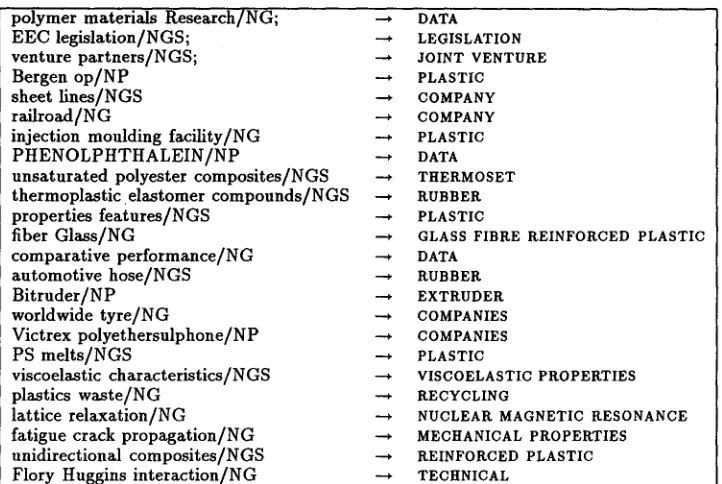
Figure 1 shows a few of the rules. All of these entries share the property that
P(d]w)
> 0.8. T h e y were selected at r a n d o m from the 85,500 associations which were found.5.1 Representations and m o d e l s
polymer materials Research/NG; EEC legislation/NGS;
venture partners/NGS; B e r g e n op/NP
s h e e t lines/NGS railroad/NG
injection moulding fa~:ility/NG PHENOLPHTHALEIN/NP
unsaturated polyester composites/NGS thermoplastic elastomer compounds/NGS properties features/NGS
fiber Glass/NG
comparative performance/NG automotive hose/NGS Bitruder/NP
worldwide tyre/NG
Victrex polyethersulphone/NP PS melts/NGS
viscoelastic characteristics/NGS plastics waste/NG
lattice relaxation/NG
fatigue crack propagation/NG unidirectional composites/NGS Flory Huggins interaction/NG
DATA "-* LEGISLATION --* JOINT VENTURE --* PLASTIC ---* COMPANY --* COMPANY --* PLASTIC --* DATA --~ THERMOSET ---* RUBBER ---* PLASTIC
--* GLASS FIBRE REINFORCED PLASTIC --* DATA
--, RUBBER --, EXTRUDER
COMPANIES -'~ COMPANIES ---+ PLASTIC
---* VISCOELASTIC PROPERTIES RECYCLING
NUCLEAR MAGNETIC RESONANCE "--+ MECHANICAL PROPERTIES
REINFORCED PLASTIC TECHNICAL
Figure 1: This figure shows some probably correct rules for the R A P R A corpus. In all, there are over 85,000 such rules.
appeared in the abstract, then ordinarily this would include the sequence "elastomer compounds", which would be included in the representation. The results of section 3.2 might encourage us to believe t h a t rep- resenting a d o c u m e n t by only its most specific diag- nostic units will improve performance (or, at least, precision). Consequently, a sequence of words is de- fined to be most specific if (a) it is a diagnostic unit and (b) it is not properly contained in a token of any other diagnostic unit present in the document. 2
The noun-groups are found by performing a sim- ple parse of the documents as described above, and identifying likely noun groups of length 3 or less. The contingency table of diagnostic units verses m a n u a l l y assigned descriptors on a training corpus of 200,000 documents was collected, and this was used as the basis for two term appropriateness models. Probabilities were estimated by adding a constant (usually 0.02 was found fairly optimal) to each cell, and directly estimating from these slightly adjusted counts.
The 50,000 most frequent diagnostic unit types were chosen, and terms which appeared in more than 10% of documents were discarded.
2If "elastomer compounds" appeared separately in the document from "thermoplastic elastomer com- pounds", then both of these sequences would be rep- resented in the experiments reported here.
6
R e s u l t s
The results of the experiments on the R A P R A cor- pus are presented below. 3
Despite the peculiarities of the corpus, the mes- sage is clear. The result that the s t a n d a r d model fares no better on word sequence sets t h a n on word sets is repeated, and it is clear t h a t the Single Term model fares much better than the Logit model on this d a t a set. However, what is most interesting is that the Single Term models fares significantly bet- ter on the more sophisticated sequence based repre- sentations of the document than on the simpler word based representation. There is, however, no signifi- cant advantage identified by parsing the corpus into noun-groups over simply considering all word se- quences. The recall scores for the rule-based tagging strategy show that the improved performance of the sequence based representations can be explained by
[image:5.612.142.503.81.323.2]the presence of m a n y more "good" descriptor indi- cators.
Assignment Prop. Prop. Prop. Prop. Prop. Prop. Prop. Prop. Prop. Rule ¢ = .2 Rule ¢ = .2 Rule ¢ = .2 Rule ¢ = .2 Rule ¢ = .2
Model T W T W T W T W T W S T S T S T ST ST S T S T ST S T
Repn Prec Rec
Word 33% 32%
Seq all 32% 34% Seq spec 33% 34% NG all 31% 36% NG spec 32% 32%
Word 54% 48%
Seq all 57% 55% Seq spec 55% 55%
NG 56% 60%
Word 83% 7%
Seq all 77% 42% Seq spec 80% 40% NG all 82% 42% NG spec 84% 37%
7 C o n c l u s i o n
T h e significant theoretical result is t h a t as the so- phistication of the representation of abstracts is in- creased, the performance of the single t e r m model improves, while the performance of the term weight- ing models does not improve significantly. This has been a fairly universal experience among re- searchers working within the t e r m weighting clas- sification paradigm.
Although there is a very marginally significant i m p r o v e m e n t from using linguistically sophisticated representations over simple sequence representations if all of the sequences are represented, this largely (though not entirely) disappears when only most specific sequences are considered, so it might be a result of the effects discussed in section 3.2.
T h e rule based assignment strategy exploits the Single T e r m model's estimates, and also performs much b e t t e r on word sequence representations than on word set representations. This assignment strat- egy is promising because it can exploit more sophis- ticated representations well, has a sound theory be- hind it, and will assign descriptors only where it has enough information to do so. Some of the descrip- tors in the R A P R A corpus, for example, are only ever assigned from the entire article from which the abstract is taken, so no assignment strategy will ever do well on these. On the other hand this model also shows promise t h a t IR techniques might be applied to help infer linguistic resources such as term banks from large classified corpora.
T h e next stage is to add more sophisticated lin- guistic a n n o t a t i o n to corpora, and to trawl for rules in boolean combinations of descriptors, thus ad- dressing the results of section 3.2. In this way this work can be considered similar in spirit to t h a t un- dertaken by Apte et al (1994), but differs in the forms of representation which are being considered for documents.
R e f e r e n c e s
Adams, E. (1975) The Logic of Conditionals: an appli- cation of probability to deductive logic Reidel.
Apte, C, F. Demerau & S. Weiss (1994) Towards Lan- guage Independent Automated Learning of Text Cate- gorization Methods. the proceeding of the Seventeenth ACM-SIGIR Conference on Information Retrieval. 23- 30, DCU, Dublin.
Buckley, C. (1993) The Importance of Proper Weighting Methods. ARPA Workshop on Human Language Tech- nology.
Church, K. (1988) A stochastic parts program and noun phrase parser for unrestricted text. In Second conference on applied NLP, pp 136-43.
Church, K., W. Gale, P. Hanks & D. Hindle (1989) Pars- ing, Word Associations and Typical Predicate-Argument Relations. In International Parsing Technologies Work- shop. CMU, Pittsburgh.
Fagan, J. (1987) Experiments in Automatic Phrase In- dexing for Document Retrieval: Comparison of Syntactic and Non-Syntactic Methods. PhD Thesis. Cornell Uni- versity, Dept. of Computer Science.
Finch, S. P. & N. Chater (1991) A Hybrid Approach to the Automatic Learning of Linguistic Categorie s . Artifi- cial Intelligence and Simulated Behaviour Quarterly. 78 16-24.
Finch, S. (1993) Finding Structure in Language. Ph.D. thesis, Centre for Cognitive Science, University of Edin- burgh, Edinburgh.
Fuhr, N. (1989) Models for retrieval with probabilistic in- dexing. Information processing and management. 25(1): 55-72.
Fuhr, N. & Buckley, C (1993) Optimizing Document In- dexing and Search Term Weighting Based on Probabilis- tic Models First TREC Conference.
Hindle, D. (1990) Noun Classification from Predicate- Argument Structures. In Proceedings of the 22nd meet- ing of the Association of Computational Linguistics. 268-75.
Jacobs, P. & Rau, L. (1990) SCISOR: Extracting Infor- mation from On-line News Correspondence of the A CM 3 3 11 88-97
Kupiec, J. (1992) Robust part-of-speech tagging Using a hidden Markov model. Computer Speech and Language, 6:3 225-42.
Lewis, D. (1991) Evaluating text categorisation. In Speech and natural language workshop, pp 136-143. Lewis, D. (1992a) Representation and learning in infor- mation retrieval. Ph.D. thesis, Computer Science Dept., Univ. Mass., Amherst, Ma.
Lewis, D. (1992b) An Evaluation of Phrasal and Clus- tered Representations on a Text categorization problem. Proceedings of SIGIR 92.
Lewis, D. (1992c) Feature selection and feature extrac- tion for text categorization. In Speech and Natural Lan- guage: Proceedings of a Workshop held at Harrimn, NY. pp 212-217.
Pearl, J. (1988) Probabilistic Reasoning in Intelligent Systems: Networks of Plausible Inference Morgan Kauf- mann, San Mateo, Ca.
van Rijsbergen, C. J. (1979) Information retrieval. But- terworths, London.
Sacks-Davis, R. (1990) Using Syntactic Analysis in a Document Retrieval System that Uses Signature Files. A CM SIGIR- 9O.
Salton, G. & McGill, M. J. (1983) Introduction to mod- ern information retrieval. McGraw-Hill, NY.
Salton, G. & C. Buckley (1988) Term Weighting Ap- proaches in Automatic Text Retrieval Information Pro- cessing and Management 24 5 513-23