Incremental Parsing with the Perceptron Algorithm
Michael Collins
MIT CSAIL
[email protected]
Brian Roark
AT&T Labs - Research
[email protected]
Abstract
This paper describes an incremental parsing approach where parameters are estimated using a variant of the perceptron algorithm. A beam-search algorithm is used during both training and decoding phases of the method. The perceptron approach was implemented with the same feature set as that of an existing generative model (Roark, 2001a), and experimental results show that it gives competitive performance to the generative model on parsing the Penn treebank. We demonstrate that train-ing a perceptron model to combine with the generative model during search provides a 2.1 percent F-measure improvement over the generative model alone, to 88.8 percent.
1
Introduction
In statistical approaches to NLP problems such as tag-ging or parsing, it seems clear that the representation used as input to a learning algorithm is central to the ac-curacy of an approach. In an ideal world, the designer of a parser or tagger would be free to choose any fea-tures which might be useful in discriminating good from bad structures, without concerns about how the features interact with the problems of training (parameter estima-tion) or decoding (search for the most plausible candidate under the model). To this end, a number of recently pro-posed methods allow a model to incorporate “arbitrary” global features of candidate analyses or parses. Exam-ples of such techniques are Markov Random Fields (Rat-naparkhi et al., 1994; Abney, 1997; Della Pietra et al., 1997; Johnson et al., 1999), and boosting or perceptron approaches to reranking (Freund et al., 1998; Collins, 2000; Collins and Duffy, 2002).
A drawback of these approaches is that in the general case, they can require exhaustive enumeration of the set of candidates for each input sentence in both the train-ing and decodtrain-ing phases1. For example, Johnson et al. (1999) and Riezler et al. (2002) use all parses generated by an LFG parser as input to an MRF approach – given the level of ambiguity in natural language, this set can presumably become extremely large. Collins (2000) and Collins and Duffy (2002) rerank the topN parses from an existing generative parser, but this kind of approach
1Dynamic programming methods (Geman and Johnson, 2002;
Laf-ferty et al., 2001) can sometimes be used for both training and decod-ing, but this requires fairly strong restrictions on the features in the model.
presupposes that there is an existing baseline model with reasonable performance. Many of these baseline models are themselves used with heuristic search techniques, so that the potential gain through the use of discriminative re-ranking techniques is further dependent on effective search.
This paper explores an alternative approach to pars-ing, based on the perceptron training algorithm intro-duced in Collins (2002). In this approach the training and decoding problems are very closely related – the training method decodes training examples in sequence, and makes simple corrective updates to the parameters when errors are made. Thus the main complexity of the method is isolated to the decoding problem. We describe an approach that uses an incremental, left-to-right parser, with beam search, to find the highest scoring analysis un-der the model. The same search method is used in both training and decoding. We implemented the perceptron approach with the same feature set as that of an existing generative model (Roark, 2001a), and show that the per-ceptron model gives performance competitive to that of the generative model on parsing the Penn treebank, thus demonstrating that an unnormalized discriminative pars-ing model can be applied with heuristic search. We also describe several refinements to the training algorithm, and demonstrate their impact on convergence properties of the method.
Finally, we describe training the perceptron model with the negative log probability given by the generative model as another feature. This provides the perceptron algorithm with a better starting point, leading to large improvements over using either the generative model or the perceptron algorithm in isolation (the hybrid model achieves 88.8% f-measure on the WSJ treebank, com-pared to figures of 86.7% and 86.6% for the separate generative and perceptron models). The approach is an extremely simple method for integrating new features into the generative model: essentially all that is needed is a definition of feature-vector representations of entire parse trees, and then the existing parsing algorithms can be used for both training and decoding with the models.
2
The General Framework
give an abstract description of an incremental parser, and describe how it can be used with the perceptron algo-rithm.
2.1 Linear Models for NLP
We follow the framework outlined in Collins (2002; 2004). The task is to learn a mapping from inputsx∈ X to outputsy ∈ Y. For example,X might be a set of sen-tences, with Y being a set of possible parse trees. We assume:
.
Training examples(xi, yi)fori= 1. . . n..
A functionGENwhich enumerates a set of candi-datesGEN(x)for an inputx..
A representationΦmapping each(x, y)∈ X × Y to a feature vectorΦ(x, y)∈Rd..
A parameter vectorα¯ ∈Rd.The componentsGEN,Φandα¯define a mapping from an inputxto an outputF(x)through
F(x) = arg max
y∈GEN(x)Φ(x, y)·α¯ (1)
whereΦ(x, y)·α¯ is the inner productP
sαsΦs(x, y). The learning task is to set the parameter valuesα¯ using the training examples as evidence. The decoding
algo-rithm is a method for searching for thearg maxin Eq. 1. This framework is general enough to encompass sev-eral tasks in NLP. In this paper we are interested in pars-ing, where(xi, yi),GEN, andΦcan be defined as fol-lows:
• Each training example(xi, yi)is a pair wherexi is a sentence, andyiis the gold-standard parse for that sentence.
• Given an input sentence x, GEN(x) is a set of possible parses for that sentence. For example,
GEN(x) could be defined as the set of possible parses forxunder some context-free grammar, per-haps a context-free grammar induced from the train-ing examples.
• The representation Φ(x, y) could track arbitrary features of parse trees. As one example, suppose that there are m rules in a context-free grammar (CFG) that definesGEN(x). Then we could define thei’th component of the representation,Φi(x, y), to be the number of times thei’th context-free rule appears in the parse tree(x, y). This is implicitly the representation used in probabilistic or weighted CFGs.
Note that the difficulty of finding thearg maxin Eq. 1 is dependent on the interaction ofGENandΦ. In many casesGEN(x)could grow exponentially with the size of x, making brute force enumeration of the members of GEN(x) intractable. For example, a context-free grammar could easily produce an exponentially growing number of analyses with sentence length. For some rep-resentations, such as the “rule-based” representation de-scribed above, thearg maxin the set enumerated by the CFG can be found efficiently, using dynamic program-ming algorithms, without having to explicitly enumer-ate all members of GEN(x). However in many cases
we may be interested in representations which do not al-low efficient dynamic programming solutions. One way around this problem is to adopt a two-pass approach, whereGEN(x)is the topNanalyses under some initial model, as in the reranking approach of Collins (2000). In the current paper we explore alternatives to rerank-ing approaches, namely heuristic methods for findrerank-ing the
arg max, specifically incremental beam-search strategies related to the parsers of Roark (2001a) and Ratnaparkhi (1999).
2.2 The Perceptron Algorithm for Parameter
Estimation
We now consider the problem of setting the parameters,
¯
α, given training examples(xi, yi). We will briefly re-view the perceptron algorithm, and its convergence prop-erties – see Collins (2002) for a full description. The algorithm and theorems are based on the approach to classification problems described in Freund and Schapire (1999).
Figure 1 shows the algorithm. Note that the most complex step of the method is finding zi =
arg maxz∈GEN(xi)Φ(xi, z)·α¯– and this is precisely the
decoding problem. Thus the training algorithm is in prin-ciple a simple part of the parser: any system will need a decoding method, and once the decoding algorithm is implemented the training algorithm is relatively straight-forward.
We will now give a first theorem regarding the con-vergence of this algorithm. First, we need the following definition:
Definition 1 Let GEN(xi) = GEN(xi)− {yi}. In
other wordsGEN(xi)is the set of incorrect candidates
for an examplexi. We will say that a training sequence
(xi, yi)fori= 1. . . nis separable with marginδ >0
if there exists some vectorUwith||U||= 1such that
∀i,∀z∈GEN(xi), U·Φ(xi, yi)−U·Φ(xi, z)≥δ (2)
(||U||is the 2-norm ofU, i.e.,||U||=pP
sU2s.) Next, define Ne to be the number of times an error is made by the algorithm in figure 1 – that is, the number of times thatzi 6=yifor some(t, i)pair. We can then state the following theorem (see (Collins, 2002) for a proof):
Theorem 1 For any training sequence (xi, yi) that is
separable with margin δ, for any value of T, then for the perceptron algorithm in figure 1
Ne≤ R2
δ2
where R is a constant such that ∀i,∀z ∈
GEN(xi) ||Φ(xi, yi)−Φ(xi, z)|| ≤R.
Inputs: Training examples(xi, yi) Algorithm:
Initialization: Setα¯= 0 Fort= 1. . . T,i= 1. . . n
Output: Parametersα¯ Calculatezi= arg maxz∈GEN(xi)Φ(xi, z)·α¯
If(zi6=yi) thenα¯= ¯α+ Φ(xi, yi)−Φ(xi, zi)
Figure 1: A variant of the perceptron algorithm.
(i.e. the size ofGEN(xi)for eachi), depending only on the separation of the training data, where separation is defined above. This is important because in many NLP problemsGEN(x)can be exponential in the size of the inputs. All of the convergence and generalization results in Collins (2002) depend on notions of separability rather than the size ofGEN.
Two questions come to mind. First, are there guar-antees for the algorithm if the training data is not sepa-rable? Second, performance on a training sample is all very well, but what does this guarantee about how well the algorithm generalizes to newly drawn test examples? Freund and Schapire (1999) discuss how the theory for classification problems can be extended to deal with both of these questions; Collins (2002) describes how these results apply to NLP problems.
As a final note, following Collins (2002), we used the
averaged parameters from the training algorithm in
de-coding test examples in our experiments. Sayα¯t i is the parameter vector after thei’th example is processed on the t’th pass through the data in the algorithm in fig-ure 1. Then the averaged parametersα¯AV Gare defined asα¯AV G = Pi,tα¯
t
i/N T. Freund and Schapire (1999) originally proposed the averaged parameter method; it was shown to give substantial improvements in accuracy for tagging tasks in Collins (2002).
2.3 An Abstract Description of Incremental
Parsing
This section gives a description of the basic incremental parsing approach. The input to the parser is a sentence xwith length n. A hypothesis is a triple hx, t, iisuch thatxis the sentence being parsed,tis a partial or full analysis of that sentence, andiis an integer specifying the number of words of the sentence which have been processed. Each full parse for a sentence will have the formhx, t, ni. The initial state ishx,∅,0iwhere∅is a “null” or empty analysis.
We assume an “advance” function ADV which takes a hypothesis triple as input, and returns a set of new hy-potheses as output. The advance function will absorb another word in the sentence: this means that if the input to ADV ishx, t, ii, then each member of ADV(hx, t, ii)
will have the formhx, t0,i+1i. Each new analysist0will be formed by somehow incorporating the i+1’th word into the previous analysist.
With these definitions in place, we can iteratively de-fine the full set of partial analysesHifor the firstiwords of the sentence asH0(x) = {hx,∅,0i}, andHi(x) =
∪h0∈Hi
−1(x)ADV(h0) for i = 1. . . n. The full set of
parses for a sentencexis thenGEN(x) =Hn(x)where nis the length ofx.
Under this definition GEN(x) can include a huge
number of parses, and searching for the highest scor-ing parse,arg maxh∈Hn(x)Φ(h)·α¯, will be intractable.
For this reason we introduce one additional function, FILTER(H), which takes a set of hypothesesH, and re-turns a much smaller set of “filtered” hypotheses. Typi-cally, FILTER will calculate the scoreΦ(h)·α¯for each h ∈ H, and then eliminate partial analyses which have low scores under this criterion. For example, a simple version of FILTER would take the topNhighest scoring members ofHfor some constantN. We can then rede-fine the set of partial analyses as follows (we useFi(x)
to denote the set of filtered partial analyses for the firsti words of the sentence):
F0(x)={hx,∅,0i}
Fi(x)= FILTER ∪h0∈Fi
−1(x)ADV(h0)
fori=1. . . n The parsing algorithm returns arg maxh∈FnΦ(h)· α¯.
Note that this is a heuristic, in that there is no guar-antee that this procedure will find the highest scoring parse, arg maxh∈HnΦ(h) · α¯. Search errors, where arg maxh∈FnΦ(h)·α¯ = arg max6 h∈HnΦ(h)·α¯, will
create errors in decoding test sentences, and also errors in implementing the perceptron training algorithm in Fig-ure 1. In this paper we give empirical results that suggest that FILTER can be chosen in such a way as to give ef-ficient parsing performance together with high parsing accuracy.
The exact implementation of the parser will depend on the definition of partial analyses, of ADV and FILTER, and of the representationΦ. The next section describes our instantiation of these choices.
3
A full description of the parsing
approach
The parser is an incremental beam-search parser very similar to the sort described in Roark (2001a; 2004), with some changes in the search strategy to accommodate the perceptron feature weights. We first describe the parsing algorithm, and then move on to the baseline feature set for the perceptron model.
3.1 Parser control
The input to the parser is a string wn
0, a grammarG, a
mappingΦfrom derivations to feature vectors, and a pa-rameter vectorα¯. The grammarG= (V, T,S†,¯S, C, B)
S†
S ! ! NP
NN
Trash
. . . .. . . . .
NN
can
. . . .
. . . .. . VP
MD
can
. . . VP
VP
MD
[image:4.595.87.256.69.160.2]can
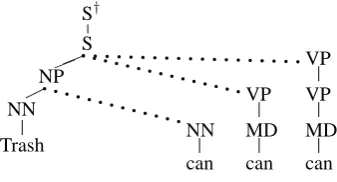
Figure 2: Left child chains and connection paths. Dotted lines represent potential attachments
Trashi. Each “allowable triple” is a tuplehX, Y, Zi where X, Y, Z ∈ V. The triples specify which non-terminalsZ are allowed to follow a non-terminalY un-der a parent X. For example, the triple hS,NP,VPi specifies that a VP can follow anNP under an S. The triplehNP,NN,S¯iwould specify that the¯Ssymbol can follow anNNunder anNP– i.e., that the symbolNNis allowed to be the final child of a rule with parentNP
The initial state of the parser is the input string alone, wn
0. In absorbing the first word, we add all chains of the
form S†. . . → w0. For example, in figure 2 the chain
hS† →S→NP→NN→Trashiis used to construct
an analysis for the first word alone. Other chains which start withS†and end withTrashwould give competing analyses for the first word of the string.
Figure 2 shows an example of how the next word in a sentence can be incorporated into a partial analysis for the previous words. For any partial analysis there will be a set of potential attachment sites: in the example, the attachment sites are under theNP or the S. There will also be a set of possible chains terminating in the next word – there are three in the example. Each chain could potentially be attached at each attachment site, giving 6 ways of incorporating the next word in the example. For illustration, assume that the setB is{hS,NP,VPi, hNP,NN,NNi,hNP,NN,S¯i,hS,NP,VPi}. Then some of the 6 possible attachments may be disallowed because they create triples that are not in the setB. For example, in figure 2 attaching either of theVP chains under the
NPis disallowed because the triplehNP,NN,VPiis not inB. Similarly, attaching theNNchain under theSwill be disallowed if the triplehS,NP,NNiis not in B. In contrast, adjoininghNN→caniunder theNPcreates a single triple,hNP,NN,NNi, which is allowed. Adjoining either of theVPchains under theScreates two triples, hS,NP,VPiandhNP,NN,S¯i, which are both in the set B.
Note that the “allowable chains” in our grammar are what Costa et al. (2001) call “connection paths” from the partial parse to the next word. It can be shown that the method is equivalent to parsing with a transformed context-free grammar (a first-order “Markov” grammar) – for brevity we omit the details here.
In this way, given a set of candidatesFi(x)for the first iwords of the string, we can generate a set of candidates
Tree POS f24 f2-21 f2-21, #>1
transform tags Type Type OOV Type OOV
None Gold 386 1680 0.1% 1013 0.1%
None Tagged 401 1776 0.1% 1043 0.2%
FSLC Gold 289 1214 0.1% 746 0.1%
FSLC Tagged 300 1294 0.1% 781 0.1%
Table 1: Left-child chain type counts (of length>2) for sections of the Wall St. Journal Treebank, and out-of-vocabulary (OOV) rate on the held-out corpus.
for the firsti+ 1words,∪h0∈Fi(x)ADV(h0), where the
ADV function uses the grammar as described above. We then calculateΦ(h)·α¯for all of these partial hypotheses, and rank the set from best to worst. A FILTER function is then applied to this ranked set to giveFi+1. Lethkbe the kth ranked hypothesis inHi+1(x). Thenhk ∈ Fi+1 if
and only ifΦ(hk)·α¯≥θk. In our case, we parameterize the calculation ofθkwithγas follows:
θk = Φ(h0)·α¯−
γ
k3. (3)
The problem with using left-child chains is limiting them in number. With a left-recursive grammar, of course, the set of all possible left-child chains is infinite. We use two techniques to reduce the number of left-child chains: first, we remove some (but not all) of the recur-sion from the grammar through a tree transform; next, we limit the left-child chains consisting of more than two non-terminal categories to those actually observed in the training data more than once. Left-child chains of length less than or equal to two are all those observed in training data. As a practical matter, the set of left-child chains for a terminalxis taken to be the union of the sets of left-child chains for all pre-terminal part-of-speech (POS) tagsTforx.
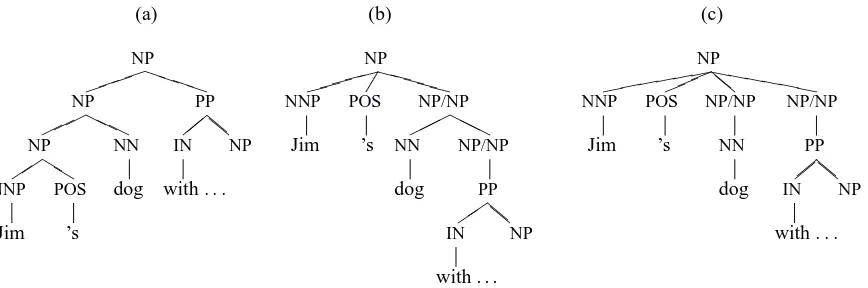
Before inducing the left-child chains and allowable triples from the treebank, the trees are transformed with a selective left-corner transformation (Johnson and Roark, 2000) that has been flattened as presented in Roark (2001b). This transform is only applied to left-recursive productions, i.e. productions of the form A → Aγ. The transformed trees look as in figure 3. The transform has the benefit of dramatically reducing the number of left-child chains, without unduly disrupting the immedi-ate dominance relationships that provide features for the model. The parse trees that are returned by the parser are then de-transformed to the original form of the grammar for evaluation2.
Table 1 presents the number of left-child chains of length greater than 2 in sections 2-21 and 24 of the Penn Wall St. Journal Treebank, both with and without the flattened selective left-corner transformation (FSLC), for gold-standard part-of-speech (POS) tags and automati-cally tagged POS tags. When the FSLC has been applied and the set is restricted to those occurring more than once
2See Johnson (1998) for a presentation of the
[image:4.595.314.543.71.147.2](a)
NP
NP
NP
NNP
Jim b
b
POS
’s
HH
H
NN
dog
PP
PP
PP
, ,
IN
with. . .
ll
NP
(b)
NP
NNP
Jim
POS
’s
XX
XXX
NP/NP
NN
dog
HH
H
NP/NP
PP
IN
with . . .
ll
NP
(c)
NP
NNP
Jim
! ! !
POS
’s
ll
NP/NP
NN
dog
``````
NP/NP
PP
, ,
IN
with. . .
ll
[image:5.595.77.511.70.214.2]NP
Figure 3: Three representations of NP modifications: (a) the original treebank representation; (b) Selective left-corner representation; and (c) a flat structure that is unambiguously equivalent to (b)
F0={L00, L10} F4=F3∪ {L03} F8=F7∪ {L21} F12=F11∪ {L11}
F1=F0∪ {LKP} F5=F4∪ {L20} F9=F8∪ {CL} F13=F12∪ {L30}
F2=F1∪ {L01} F6=F5∪ {L11} F10=F9∪ {LK} F14=F13∪ {CCP}
F3=F2∪ {L02} F7=F6∪ {L30} F11=F0∪ {L20} F15=F14∪ {CC}
Table 2: Baseline feature set. FeaturesF0−F10fire at non-terminal nodes. FeaturesF0, F11−F15fire at terminal
nodes.
in the training corpus, we can reduce the total number of left-child chains of length greater than 2 by half, while leaving the number of words in the held-out corpus with an unobserved left-child chain (out-of-vocabulary rate – OOV) to just one in every thousand words.
3.2 Features
For this paper, we wanted to compare the results of a perceptron model with a generative model for a compa-rable feature set. Unlike in Roark (2001a; 2004), there is no look-ahead statistic, so we modified the feature set from those papers to explicitly include the lexical item and POS tag of the next word. Otherwise the features are basically the same as in those papers. We then built a generative model with this feature set and the same tree transform, for use with the beam-search parser from Roark (2004) to compare against our baseline perceptron model.
To concisely present the baseline feature set, let us establish a notation. Features will fire whenever a new node is built in the tree. The features are labels from the left-context, i.e. the already built part of the tree. All of the labels that we will include in our feature sets are ilevels above the current node in the tree, andj nodes to the left, which we will denoteLij. Hence,L00is the
node label itself;L10is the label of parent of the current
node;L01is the label of the sibling of the node,
imme-diately to its left; L11 is the label of the sibling of the
parent node, etc. We also include: the lexical head of the current constituent (CL); the c-commanding lexical head (CC) and its POS (CCP); and the look-ahead word (LK) and its POS (LKP). All of these features are discussed at more length in the citations above. Table 2 presents the baseline feature set.
In addition to the baseline feature set, we will also
present results using features that would be more dif-ficult to embed in a generative model. We included some punctuation-oriented features, which included (i) a Boolean feature indicating whether the final punctua-tion is a quespunctua-tion mark or not; (ii) the POS label of the word after the current ahead, if the current look-ahead is punctuation or a coordinating conjunction; and (iii) a Boolean feature indicating whether the look-ahead is punctuation or not, that fires when the category imme-diately to the left of the current position is immeimme-diately preceded by punctuation.
4
Refinements to the Training Algorithm
This section describes two modifications to the “basic” training algorithm in figure 1.4.1 Making Repeated Use of Hypotheses
Figure 4 shows a modified algorithm for parameter es-timation. The input to the function is a gold standard parse, together with a set of candidates F generated by the incremental parser. There are two steps. First, the model is updated as usual with the current example, which is then added to a cache of examples. Second, the method repeatedly iterates over the cache, updating the model at each cached example if the gold standard parse is not the best scoring parse from among the stored can-didates for that example. In our experiments, the cache was restricted to contain the parses from up to N pre-viously processed sentences, whereN was set to be the size of the training set.
Input: A gold-standard parse = g for sentence k of N. A set of candidate parses F. Current parameters
¯
α. A Cache of triples hgj,Fj, cji for j = 1. . . N where each gj is a previously generated gold standard parse, Fj is a previously generated set of candidate parses, and cj is a counter of the number of times that α¯ has been updated due to this particular triple. Parameters T1 and T2 controlling the number of iterations
be-low. In our experiments, T1 = 5 and T2 = 50. Initialize the Cache to include, forj = 1. . . N, hgj,∅, T2i.
Step 1: Step 2:
Calculatez= arg maxt∈FΦ(t)·α¯ Fort= 1. . . T1, j= 1. . . N
If (z6=g) thenα¯ = ¯α+ Φ(g)−Φ(z) Ifcj< T2then
Set thekth triple in the Cache tohg,F,0i Calculatez= arg maxt∈FjΦ(t)·α¯
If (z6=gj) then
¯
[image:6.595.319.537.251.426.2]α= ¯α+ Φ(gj)−Φ(z) cj =cj+ 1
Figure 4: The refined parameter update method makes repeated use of hypotheses
a method for dynamically generating constraints (i.e. in-correct parses) which are violated, or close to being vio-lated, under the current parameter settings. The basic al-gorithm in Figure 1 is extremely wasteful with the gener-ated constraints, in that it only looks at one constraint on each sentence (the arg max), and it ignores constraints implied by previously parsed sentences. This is ineffi-cient because the generation of constraints (i.e., parsing an input sentence), is computationally quite demanding.
More formally, it can be shown that the algorithm in figure 4 also has the upper bound in theorem 1 on the number of parameter updates performed. If the cost of steps 1 and 2 of the method are negligible compared to the cost of parsing a sentence, then the refined algorithm will certainly converge no more slowly than the basic al-gorithm, and may well converge more quickly.
As a final note, we used the parametersT1 andT2to
limit the number of passes over examples, the aim being to prevent repeated updates based on outlier examples which are not separable.
4.2 Early Update During Training
As before, defineyito be the gold standard parse for the i’th sentence, and also defineyijto be the partial
analy-sis under the gold-standard parse for the firstj words of thei’th sentence. Then ifyji ∈ Fj/ (xi)a search error has been made, and there is no possibility of the gold stan-dard parseyibeing in the final set of parses,Fn(xi). We call the following modification to the parsing algorithm during training “early update”: ifyji ∈ Fj/ (xi), exit the parsing process, passyij,Fj(xi)to the parameter estima-tion method, and move on to the next string in the train-ing set. Intuitively, the motivation behind this is clear. It makes sense to make a correction to the parameter values at the point that a search error has been made, rather than allowing the parser to continue to the end of the sentence. This is likely to lead to less noisy input to the parameter estimation algorithm; and early update will also improve efficiency, as at the early stages of training the parser will frequently give up after a small proportion of each sen-tence is processed. It is more difficult to justify from a formal point of view, we leave this to future work.
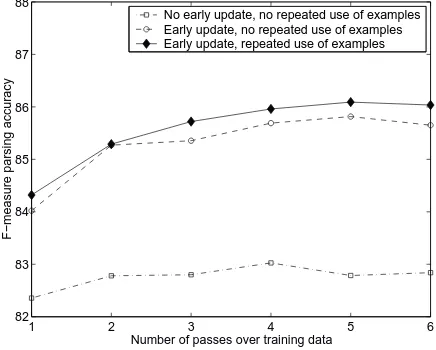
Figure 5 shows the convergence of the training algo-rithm with neither of the two refinements presented; with just early update; and with both. Early update makes
1 2 3 4 5 6
82 83 84 85 86 87 88
Number of passes over training data
F−measure parsing accuracy
No early update, no repeated use of examples Early update, no repeated use of examples Early update, repeated use of examples
Figure 5: Performance on development data (section f24) after each pass over the training data, with and without repeated use of examples and early update.
an enormous difference in the quality of the resulting model; repeated use of examples gives a small improve-ment, mainly in recall.
5
Empirical results
The parsing models were trained and tested on treebanks from the Penn Wall St. Journal Treebank: sections 2-21 were kept training data; section 24 was held-out devel-opment data; and section 23 was for evaluation. After each pass over the training data, the averaged perceptron model was scored on the development data, and the best performing model was used for test evaluation. For this paper, we used POS tags that were provided either by the Treebank itself (gold standard tags) or by the per-ceptron POS tagger3 presented in Collins (2002). The former gives us an upper bound on the improvement that we might expect if we integrated the POS tagging with the parsing.
3For trials when the generative or perceptron parser was given POS
Model Gold-standard tags POS-tagger tags
LP LR F LP LR F
Generative 88.1 87.6 87.8 86.8 86.5 86.7
Perceptron (baseline) 87.5 86.9 87.2 86.2 85.5 85.8
[image:7.595.139.477.72.137.2]Perceptron (w/ punctuation features) 88.1 87.6 87.8 87.0 86.3 86.6
Table 3: Parsing results, section 23, all sentences, including labeled precision (LP), labeled recall (LR), and F-measure
Table 3 shows results on section 23, when either gold-standard or POS-tagger tags are provided to the parser4. With the base features, the generative model outperforms the perceptron parser by between a half and one point, but with the additional punctuation features, the percep-tron model matches the generative model performance.
Of course, using the generative model and using the perceptron algorithm are not necessarily mutually ex-clusive. Another training scenario would be to include the generative model score as another feature, with some weight in the linear model learned by the perceptron al-gorithm. This sort of scenario was used in Roark et al. (2004) for training an n-gram language model using the perceptron algorithm. We follow that paper in fixing the weight of the generative model, rather than learning the weight along the the weights of the other perceptron fea-tures. The value of the weight was empirically optimized on the held-out set by performing trials with several val-ues. Our optimal value was 10.
In order to train this model, we had to provide gen-erative model scores for strings in the training set. Of course, to be similar to the testing conditions, we can-not use the standard generative model trained on every sentence, since then the generative score would be from a model that had already seen that string in the training data. To control for this, we built ten generative models, each trained on 90 percent of the training data, and used each of the ten to score the remaining 10 percent that was not seen in that training set. For the held-out and testing conditions, we used the generative model trained on all of sections 2-21.
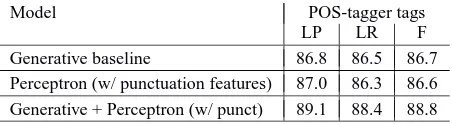
In table 4 we present the results of including the gen-erative model score along with the other perceptron fea-tures, just for the run with POS-tagger tags. The gen-erative model score (negative log probability) effectively provides a much better initial starting point for the per-ceptron algorithm. The resulting F-measure on section 23 is 2.1 percent higher than either the generative model or perceptron-trained model used in isolation.
6
Conclusions
In this paper we have presented a discriminative train-ing approach, based on the perceptron algorithm with a couple of effective refinements, that provides a model capable of effective heuristic search over a very difficult search space. In such an approach, the unnormalized dis-criminative parsing model can be applied without either
4When POS tagging is integrated directly into the generative
pars-ing process, the baseline performance is 87.0. For comparison with the perceptron model, results are shown with pre-tagged input.
Model POS-tagger tags
LP LR F
Generative baseline 86.8 86.5 86.7
Perceptron (w/ punctuation features) 87.0 86.3 86.6 Generative + Perceptron (w/ punct) 89.1 88.4 88.8
Table 4: Parsing results, section 23, all sentences, in-cluding labeled precision (LP), labeled recall (LR), and F-measure
an external model to present it with candidates, or poten-tially expensive dynamic programming. When the train-ing algorithm is provided the generative model scores as an additional feature, the resulting parser is quite com-petitive on this task. The improvement that was derived from the additional punctuation features demonstrates the flexibility of the approach in incorporating novel fea-tures in the model.
Future research will look in two directions. First, we will look to include more useful features that are diffi-cult for a generative model to include. This paper was intended to compare search with the generative model and the perceptron model with roughly similar feature sets. Much improvement could potentially be had by looking for other features that could improve the mod-els. Secondly, combining with the generative model can be done in several ways. Some of the constraints on the search technique that were required in the absence of the generative model can be relaxed if the generative model score is included as another feature. In the current paper, the generative score was simply added as another feature. Another approach might be to use the generative model to produce candidates at a word, then assign perceptron features for those candidates. Such variants deserve in-vestigation.
Overall, these results show much promise in the use of discriminative learning techniques such as the perceptron algorithm to help perform heuristic search in difficult do-mains such as statistical parsing.
Acknowledgements
The work by Michael Collins was supported by the Na-tional Science Foundation under Grant No. 0347631.
References
Steven Abney. 1997. Stochastic attribute-value gram-mars. Computational Linguistics, 23(4):597–617. Michael Collins and Nigel Duffy. 2002. New ranking
[image:7.595.316.542.183.245.2]dis-crete structures and the voted perceptron. In
Proceed-ings of the 40th Annual Meeting of the Association for Computational Linguistics, pages 263–270.
Michael Collins. 2000. Discriminative reranking for natural language parsing. In The Proceedings of the
17th International Conference on Machine Learning.
Michael Collins. 2002. Discriminative training meth-ods for hidden markov models: Theory and experi-ments with perceptron algorithms. In Proceedings of
the Conference on Empirical Methods in Natural Lan-guage Processing (EMNLP), pages 1–8.
Michael Collins. 2004. Parameter estimation for sta-tistical parsing models: Theory and practice of distribution-free methods. In Harry Bunt, John Car-roll, and Giorgio Satta, editors, New Developments in
Parsing Technology. Kluwer.
Fabrizio Costa, Vincenzo Lombardo, Paolo Frasconi, and Giovanni Soda. 2001. Wide coverage incremental parsing by learning attachment preferences. In
Con-ference of the Italian Association for Artificial Intelli-gence (AIIA), pages 297–307.
Stephen Della Pietra, Vincent Della Pietra, and John Laf-ferty. 1997. Inducing features of random fields. IEEE
Transactions on Pattern Analysis and Machine Intelli-gence, 19:380–393.
Yoav Freund and Robert Schapire. 1999. Large mar-gin classification using the perceptron algorithm.
Ma-chine Learning, 3(37):277–296.
Yoav Freund, Raj Iyer, Robert Schapire, and Yoram Singer. 1998. An efficient boosting algorithm for combining preferences. In Proc. of the 15th Intl.
Con-ference on Machine Learning.
Stuart Geman and Mark Johnson. 2002. Dynamic pro-gramming for parsing and estimation of stochastic unification-based grammars. In Proceedings of the
40th Annual Meeting of the Association for Compu-tational Linguistics, pages 279–286.
Mark Johnson and Brian Roark. 2000. Compact non-left-recursive grammars using the selective left-corner transform and factoring. In Proceedings of the 18th
International Conference on Computational Linguis-tics (COLING), pages 355–361.
Mark Johnson, Stuart Geman, Steven Canon, Zhiyi Chi, and Stefan Riezler. 1999. Estimators for stochastic “unification-based” grammars. In Proceedings of the
37th Annual Meeting of the Association for Computa-tional Linguistics, pages 535–541.
Mark Johnson. 1998. PCFG models of linguis-tic tree representations. Computational Linguislinguis-tics, 24(4):617–636.
John Lafferty, Andrew McCallum, and Fernando Pereira. 2001. Conditional random fields: Probabilistic mod-els for segmenting and labeling sequence data. In
Pro-ceedings of the 18th International Conference on Ma-chine Learning, pages 282–289.
Adwait Ratnaparkhi, Salim Roukos, and R. Todd Ward. 1994. A maximum entropy model for parsing. In
Pro-ceedings of the International Conference on Spoken Language Processing (ICSLP), pages 803–806.
Adwait Ratnaparkhi. 1999. Learning to parse natural
language with maximum entropy models. Machine
Learning, 34:151–175.
Stefan Riezler, Tracy King, Ronald M. Kaplan, Richard Crouch, John T. Maxwell III, and Mark Johnson. 2002. Parsing the wall street journal using a lexical-functional grammar and discriminative estimation techniques. In Proceedings of the 40th Annual
Meet-ing of the Association for Computational LMeet-inguistics,
pages 271–278.
Brian Roark, Murat Saraclar, and Michael Collins. 2004. Corrective language modeling for large vocabulary
ASR with the perceptron algorithm. In Proceedings
of the International Conference on Acoustics, Speech, and Signal Processing (ICASSP), pages 749–752.
Brian Roark. 2001a. Probabilistic top-down parsing and language modeling. Computational Linguistics, 27(2):249–276.
Brian Roark. 2001b. Robust Probabilistic Predictive
Syntactic Processing. Ph.D. thesis, Brown University.
http://arXiv.org/abs/cs/0105019.
Brian Roark. 2004. Robust garden path parsing. Natural