Tense and Aspect Error Correction for ESL Learners
Using Global Context
Toshikazu Tajiri Mamoru Komachi Yuji Matsumoto Graduate School of Information Science
Nara Institute of Science and Technology 8916-5 Takayama, Ikoma, Nara, 630-0192, Japan
{toshikazu-t, komachi, matsu}@is.naist.jp
Abstract
As the number of learners of English is con-stantly growing, automatic error correction of ESL learners’ writing is an increasingly ac-tive area of research. However, most research has mainly focused on errors concerning arti-cles and prepositions even though tense/aspect errors are also important. One of the main reasons why tense/aspect error correction is difficult is that the choice of tense/aspect is highly dependent on global context. Previous research on grammatical error correction typ-ically uses pointwise prediction that performs classification on each word independently, and thus fails to capture the information of neigh-boring labels. In order to take global infor-mation into account, we regard the task as se-quence labeling: each verb phrase in a doc-ument is labeled with tense/aspect depending on surrounding labels. Our experiments show that the global context makes a moderate con-tribution to tense/aspect error correction.
1 Introduction
Because of the growing number of learners of En-glish, there is an increasing demand to help learn-ers of English. It is highly effective for learnlearn-ers to receive feedback on their essays from a human tu-tor (Nagata and Nakatani, 2010). However, man-ual feedback needs a lot of work and time, and it also requires much grammatical knowledge. Thus, a variety of automatic methods for helping English learning and education have been proposed.
The mainstream of English error detection and correction has focused on article errors (Knight and Chander, 1994; Brockett et al., 2006) and preposi-tion errors (Chodorow et al., 2007; Rozovskaya and
Roth, 2011), that commonly occur in essays by ESL learners. On the other hand, tense and aspect errors have been little studied, even though they are also commonly found in learners’ essays (Lee and Sen-eff, 2006; Bitchener et al., 2005). For instance, Lee (2008) corrects English verb inflection errors, but they do not deal with tense/aspect errors because the choice of tense and aspect highly depends on global context, which makes correction difficult. Consider the following sentences taken from a corpus of a Japanese learner of English.
(1) I had a good time this Summer Vacation. First, I *go to KAIYUKAN1with my friends.
In this example, go in the second sentence should be written aswent. It is difficult to correct this type of error because there are two choices for correc-tion, namely went and will go. In this case, we can exploit global context to determine which cor-rection is appropriate: the first sentence describes a past event, and the second sentence refers the first sentence. Thus, the verb should be changed to past tense. This deduction is easy for humans, but is dif-ficult for machines.
One way to incorporate such global context into tense/aspect error correction is to use a machine learning-based sequence labeling approach. There-fore, we regard the task as sequence labeling: each verb phrase in the document is labeled with tense/aspect depending on surrounding labels. This model naturally takes global context into account. Our experiments show that global context makes a moderate contribution to tense/aspect correction.
1
Kaiyukan is an aquarium in Osaka, Japan.
2 Tense/Aspect Error Corpus
Developing a high-quality tense and aspect error correction system requires a large corpus annotated with tense/aspect errors. However, existing anno-tated corpora are limited in size,2 which precludes the possibility of machine learning-based approach. Therefore, we constructed a large-scale tense/aspect corpus from Lang-8,3 a social networking service for learners of foreign languages. ESL learners post their writing to be collaboratively corrected by na-tive speakers. We leverage these corrections in creat-ing our tense/aspect annotation. Lang-8 has 300,000 users from 180 countries worldwide, with more than 580,000 entries, approximately 170,000 of them in English.4 After cleaning the data, the corpus consists of approximately 120,000 English entries containing 2,000,000 verb phrases with 750,000 verb phrases having corrections.5 The annotated tense/aspect labels include 12 combinations of tense (past, present, future) and aspect (nothing, perfect, progressive, perfect progressive).
3 Error Correction Using Global Context
As we described in Section 1, using only local in-formation about the target verb phrase may lead to inaccurate correction of tense/aspect errors. Thus, we take into account global context: the relation be-tween target and preceding/following verb phrases. In this paper, we formulate the task as sequence la-beling, and use Conditional Random Fields (Laf-ferty, 2001), which provides state-of-the-art perfor-mance in sequence labeling while allowing flexible feature design for combining local and global fea-ture sets.
3.1 Local Features
Table 1 shows the local features used to train the er-ror correction model.
2Konan-JIEM Learner Corpus Second Edition (http://
gsk.or.jp/catalog/GSK2011-B/catalog.html) contains 170 essays, and Cambridge English First Certificate in English (http://www.cambridgeesol.org/exams/ fce/index.html) contains 1244 essays.
3
http://lang-8.com/
4
As of January, 2012. More details about the Lang-8 corpus can be found in (Mizumoto et al., 2011).
5
[image:2.612.314.541.93.277.2]Note that not all the 750,000 verb phrases were corrected due to the misuse of tense/aspect.
Table 1: Local features for a verb phrase
name description
t-learn tense/aspect written by the learner (surface tense/aspect)
bare the verb lemma L the word to the left R the word to the right nsubj nominal subject
dobj direct object aux auxiliary verb pobj object of a preposition p-tmod temporal adverb
norm-p-tmod normalized temporal adverb advmod other adverb
conj subordinating conjunction
main-clause true if the target VP is in main clause sub-clause true if the target VP is in subordinate clause
We use dependency relations such asnsubj,dobj, aux,pobj, andadvmodfor syntactic features. If a sentence including a target verb phrase is a complex sentence, we use theconjfeature and add either the main-clauseor thesub-clausefeature depending on whether the target verb is in the main clause or in a subordinate clause. For example, the following two sentences have the same features although they have different structures.
(2) It pours when it rains.
(3) When it rains it pours.
In both sentences, we use the feature main-clause for the verb phrase pours, and sub-clause for the verb phraserainsalong with the featureconj:when for both verb phrases.
Regardingp-tmod, we extract a noun phrase in-cluding a word labeledtmod(temporal adverb). For instance, consider the following sentence containing a temporal adverb:
(4) I had a good time last night.
In (4), the wordnightis the head of the noun phrase
last night and is a temporal noun,6 so we add the featurep-tmod:last nightfor the verb phrasehad.
Additionally,norm-p-tmodis a normalized form of p-tmod. Table 2 shows the value of the fea-ture norm-p-tmod and the corresponding tempo-ral keywords. We usenorm-p-tmodwhenp-tmod
6
Table 2: The value of the featurenorm-p-tmodand cor-responding temporal keywords
temporal keywords value yesterdayorlast past
now present
tomorrowornext future todayorthis this
Table 3: Feature templates
Local Feature Templates
<head> <head, t-learn> <head, L, R> <L> <L, head> <L, t-learn> <R> <R, head> <R, t-learn> <nsubj> <nsubj, t-learn> <aux> <aux, head> <aux, t-learn> <pobj> <pobj, t-learn> <norm-p-tmod>
<norm-p-tmod, t-learn> <advmod> <advmod, t-learn> <tmod> <tmod, t-learn> <conj> <conj, t-learn> <main-clause> <main-clause, t-learn> <sub-clause> <sub-clause, t-learn> <conj, main-clause> <conj, sub-clause> Global Context Feature Templates
<p-tmod′> <p-tmod′, t-learn> <p-tmod′, t-learn′> <p-tmod′, t-learn′, t-learn> <norm-p-tmod′> <norm-p-tmod′, t-learn> <norm-p-tmod′, t-learn′> <norm-p-tmod′, t-learn′, t-learn>
includes any temporal keywords. For instance, in the sentence (4), we identifylast nightas temporal adverb representing past, and thus create a feature time:pastfor the verb phrasehad.
3.2 Feature Template
Table 3 shows feature templates. <a>represents a singleton feature and<a, b>represents a combina-tion of featuresaandb. Also,a′ means the feature
aof the preceding verb phrase. A local feature tem-plate is a feature function combining features in the target verb phrase, and a global context feature tem-plate is a feature function including features from a non-target verb phrase. Suppose we have following learner’s sentences:
(5) Iwentto Kyoto yesterday.
I*eatyatsuhashi7anddrankgreen tea.
In (5), the verb before eat is went, and p-tmod:yesterdayandnorm-p-tmod:pastare added to the feature set of verb went. Accordingly,
7
Yatsuhashi is a Japanese snack.
Table 4: Example of global context feature functions gen-erated by feature templates
<p-tmod′:yesterday>
<p-tmod′:yesterday, t-learn′:simple past> <p-tmod′:yesterday, t-learn:simple present>
<p-tmod′:yesterday, t-learn′:simple past, t-learn:simple past> <norm-p-tmod′:past>
<norm-p-tmod′:past, t-learn′:simple past> <norm-p-tmod′:past, t-learn:simple present>
<norm-p-tmod′:past, t-learn′:simple past, t-learn:simple present>
the global context featuresp-tmod′:yesterdayand norm-p-tmod′:pastare added to the verbeat.
Table 4 lists all the global context features for the verbeatgenerated by the feature templates.
3.3 Trade-off between Precision and Recall
Use of surface tense/aspect forms of target verbs im-proves precision but harms recall. This is because in most cases the surface tense/aspect and the cor-rect tense/aspect form of a verb are the same. It is, of course, desirable to achieve high precision, but very low recall leads to the system making no cor-rections. In order to control the trade-off between precision and recall, we re-estimate the best output labelyˆbased on the originally estimated labely as follows:
ˆ
y= arg max
y
s(y)
s(y) =
{
αc(y), if y is the same as learner’s tense/aspect
c(y) otherwise.
wherec(y) is the confidence value of y estimated by the originally trained model (explained in 4.3), and α (0 ≤ α < 1) is the weight of the surface tense/aspect.
We first calculatec(y) of all the labels, and dis-count only the label that is the same as learner’s tense/aspect, and finally we choose the best output label. This process leads to an increase of recall. We call this methodT-correction.
4 Experiments
4.1 Data and Feature Extraction
0 0.2 0.4 0.6 0.8 1
0 0.2 0.4 0.6P
R
(a) tense
0 0.2 0.4 0.6 0.8 1
0 0.2 0.4 0.6P
R
(b) aspect
0 0.2 0.4 0.6 0.8 1
0 0.2 0.4 0.6
P R
(c) tense/aspect
Figure 1: Precision-Recall curve for error detection
0 0.2 0.4 0.6 0.8 1
0 0.2 0.4 0.6P
R
(a) tense
0 0.2 0.4 0.6 0.8 1
0 0.2 0.4 0.6P
R
(b) aspect
0 0.2 0.4 0.6 0.8 1
0 0.2 0.4 0.6P
R
[image:4.612.90.518.69.331.2](c) tense/aspect
Figure 2: Precision-Recall curve for error correction
0 0.2 0.4 0.6 0.8 1
0
0.2 0.4 0.6 0.8 1 SVM MAXENT CRF
data includes 16,308 verb phrases, of which 1,072 (6.6%) contain tense/aspect errors. We used Stan-ford Parser 1.6.98for generating syntactic features and tense/aspect tagging.
4.2 Classifiers
Because we want to know the effect of using global context information with CRF, we trained a one-versus-rest multiclass SVM and a maximum entropy classifier (MAXENT) as baselines.
We built a SVM model with LIBLINEAR 1.89 and a CRF and a MAXENT model with CRF++ 0.54.10 We use the default parameters for each toolkit.
In every method, we use the same features and feature described in Section 3, and use T-correction for choosing the final output. The confidence mea-sure of the SVM is the distance to the separating hy-perplane, and that of the MAXENT and the CRF is the marginal probability of the estimated label.
8
http://nlp.stanford.edu/software/ lex-parser.shtml
9
http://www.csie.ntu.edu.tw/~cjlin/ liblinear/
10
http://crfpp.sourceforge.net/
5 Results
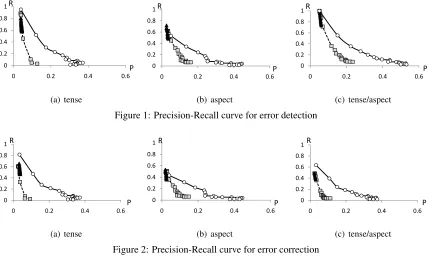
Figures 1 and 2 show the Precision-Recall curves of the error detection and correction performance of each model. The figures are grouped by error types: tense, aspect, and both tense and aspect. All figures indicate that the CRF model achieves better perfor-mance than SVM and MAXENT.
6 Analysis
We analysed the results of experiments with theα
References
John Bitchener, Stuart Young, and Denise Cameron. 2005. The Effect of Different Types of Corrective Feedback on ESL Student Writing.Journal of Second Language Writing, 14(3):191–205.
Chris Brockett, William B. Dolan, and Michael Gamon.
2006. Correcting ESL Errors Using Phrasal SMT
Techniques. InProceedings of COLING-ACL, pages 249–256.
Martin Chodorow, Joel R. Tetreault, and Na-Rae Han. 2007. Detection of Grammatical Errors Involving Prepositions. InProceedings of ACL-SIGSEM, pages 25–30.
Kevin Knight and Ishwar Chander. 1994. Automated Postediting of Documents. In Proceedings of the AAAI’94, pages 779–784.
John Lafferty. 2001. Conditional Random Fields: Proba-bilistic Models for Segmenting and Labeling Sequence Data. InProceedings of ICML, pages 282–289. John Lee and Stephanie Seneff. 2006. Automatic
Gram-mar Correction for Second-Language Learners. In
Proceedings of the 9th ICSLP, pages 1978–1981. John Lee and Stephanie Seneff. 2008. Correcting Misuse
of Verb Forms. InProceedings of the 46th ACL:HLT, pages 174–182.
Tomoya Mizumoto, Mamoru Komachi, Masaaki Nagata, and Yuji Matsumoto. 2011. Mining Revision Log of Language Learning SNS for Automated Japanese Er-ror Correction of Second Language Learners. In Pro-ceedings of 5th IJCNLP, pages 147–155.
Ryo Nagata and Kazuhide Nakatani. 2010. Evaluating Performance of Grammatical Error Detection to Max-imize Learning Effect. InProceedings of COLING, pages 894–900.