Improving Multi-Modal Representations Using Image Dispersion:
Why Less is Sometimes More
Douwe Kiela*, Felix Hill*, Anna Korhonen and Stephen Clark
University of Cambridge Computer Laboratory
{douwe.kiela|felix.hill|anna.korhonen|stephen.clark}@cl.cam.ac.uk
Abstract
Models that learn semantic representations from both linguistic and perceptual in-put outperform text-only models in many contexts and better reflect human concept acquisition. However, experiments sug-gest that while the inclusion of perceptual input improves representations of certain concepts, it degrades the representations of others. We propose an unsupervised method to determine whether to include perceptual input for a concept, and show that it significantly improves the ability of multi-modal models to learn and represent word meanings. The method relies solely on image data, and can be applied to a va-riety of other NLP tasks.
1 Introduction
Multi-modal models that learn semantic concept representations from both linguistic and percep-tual input were originally motivated by parallels with human concept acquisition, and evidence that many concepts aregroundedin the perceptual sys-tem (Barsalou et al., 2003). Such models extract information about the perceptible characteristics of words from data collected in property norming experiments (Roller and Schulte im Walde, 2013; Silberer and Lapata, 2012) or directly from ‘raw’ data sources such as images (Feng and Lapata, 2010; Bruni et al., 2012). This input is combined with information from linguistic corpora to pro-duce enhanced representations of concept mean-ing. Multi-modal models outperform language-only models on a range of tasks, including mod-elling conceptual association and predicting com-positionality (Bruni et al., 2012; Silberer and Lap-ata, 2012; Roller and Schulte im Walde, 2013).
Despite these results, the advantage of multi-modal over linguistic-only models has only been
demonstrated on concrete concepts, such as
chocolateorcheeseburger, as opposed to abstract
concepts such as such asguiltorobesity. Indeed, experiments indicate that while the addition of perceptual input is generally beneficial for repre-sentations of concrete concepts (Hill et al., 2013a; Bruni et al., 2014), it can in fact be detrimental to representations of abstract concepts (Hill et al., 2013a). Further, while the theoretical importance of the perceptual modalities to concrete represen-tations is well known, evidence suggests this is not the case for more abstract concepts (Paivio, 1990; Hill et al., 2013b). Indeed, perhaps the most influ-ential characterization of the abstract/concrete dis-tinction, the Dual Coding Theory (Paivio, 1990), posits that concrete representations are encoded in both the linguistic and perceptual modalities whereas abstract concepts are encoded only in the linguistic modality.
Existing multi-modal architectures generally extract and process all the information from their specified sources of perceptual input. Since per-ceptual data sources typically contain information about both abstract and concrete concepts, such in-formation is included for both concept types. The potential effect of this design decision on perfor-mance is significant because the vast majority of meaning-bearing words in everyday language cor-respond to abstract concepts. For instance, 72% of word tokens in the British National Corpus (Leech et al., 1994) were rated by contributors to the Uni-versity of South Florida dataset (USF) (Nelson et al., 2004) as more abstract than the noun war, a concept that many would consider quite abstract.
In light of these considerations, we propose a novel algorithm for approximating conceptual concreteness. Multi-modal models in which per-ceptual input is filtered according to our algorithm learn higher-quality semantic representations than previous approaches, resulting in a significant per-formance improvement of up to 17% in
ing the semantic similarity of concepts. Further, our algorithm constitutes the first means of quan-tifying conceptual concreteness that does not rely on labor-intensive experimental studies or annota-tors. Finally, we demonstrate the application of this unsupervised concreteness metric to the se-mantic classification of adjective-noun pairs, an existing NLP task to which concreteness data has proved valuable previously.
2 Experimental Approach
Our experiments focus on multi-modal models that extract their perceptual input automatically from images. Image-based models more natu-rally mirror the process of human concept acquisi-tion than those whose input derives from exper-imental datasets or expert annotation. They are also more scalable since high-quality tagged ages are freely available in several web-scale im-age datasets.
We use Google Images as our image source, and extract the firstnimage results for each con-cept word. It has been shown that images from Google yield higher-quality representations than comparable sources such asFlickr(Bergsma and Goebel, 2011). Other potential sources, such as ImageNet (Deng et al., 2009) or the ESP Game Dataset (Von Ahn and Dabbish, 2004), either do not contain images for abstract concepts or do not contain sufficient images for the concepts in our evaluation sets.
2.1 Image Dispersion-Based Filtering
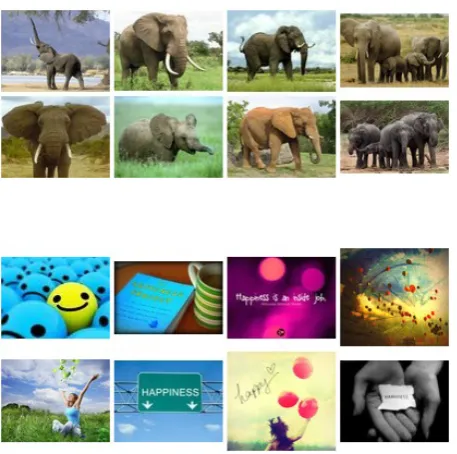
Following the motivation outlined in Section 1, we aim to distinguish visual input corresponding to concrete concepts from visual input correspond-ing to abstract concepts. Our algorithm is moti-vated by the intuition that the diversity of images returned for a particular concept depends on its concreteness (see Figure 1). Specifically, we an-ticipate greater congruence or similarity among a set of images for, say, elephant than among im-ages forhappiness. By exploiting this connection, the method approximates the concreteness of con-cepts, and provides a basis to filter the correspond-ing perceptual information.
Formally, we propose a measure,image disper-sion dof a concept wordw, defined as the aver-age pairwise cosine distance between all the imaver-age representations {w~1. . . ~wn} in the set of images
[image:2.595.308.537.60.287.2]for that concept:
Figure 1: Example images for a concrete (elephant
– little diversity, low dispersion) and an abstract concept (happiness – greater diversity, high dis-persion).
Figure 2: Computation of PHOW descriptors us-ing dense SIFT for levelsl = 0tol = 2 and the corresponding histogram representations (Bosch et al., 2007).
d(w) = 2n(n1−1) X i<j≤n
1−|ww~~i·w~j
i||w~j| (1)
We use an average pairwise distance-based met-ric because this emphasizes the total variation more than e.g. the mean distance from the cen-troid. In all experiments we setn= 50.
Generating Visual Representations Visual vector representations for each image were ob-tained using the well-knownbag of visual words
[image:2.595.311.530.372.466.2]image by mapping each of its local descriptors to a cluster histogram using a standard clustering algorithm such as k-means.
Previous NLP-related work uses SIFT (Feng and Lapata, 2010; Bruni et al., 2012) or SURF
(Roller and Schulte im Walde, 2013) descriptors for identifying points of interest in an image, quantified by 128-dimensional local descriptors. We apply Pyramid Histogram Of visual Words
(PHOW) descriptors, which are particularly well-suited for object categorization, a key component of image similarity and thus dispersion (Bosch et al., 2007). PHOW is roughly equivalent to run-ning SIFT on a dense grid of locations at a fixed scale and orientation and at multiple scales (see Fig 2), but is both more efficient and more accu-rate than regular (dense) SIFT approaches (Bosch et al., 2007). We resize the images in our dataset to 100x100 pixels and compute PHOW descriptors usingVLFeat(Vedaldi and Fulkerson, 2008).
The descriptors for the images were subse-quently clustered using mini-batchk-means (Scul-ley, 2010) with k = 50 to obtain histograms of visual words, yielding 50-dimensional visual vec-tors for each of the images.
Generating Linguistic Representations We extract continuous vector representations (also of 50 dimensions) for concepts using the continu-ous log-linear skipgram model of Mikolov et al. (2013a), trained on the 100M word British Na-tional Corpus (Leech et al., 1994). This model learns high quality lexical semantic representa-tions based on the distributional properties of words in text, and has been shown to outperform simple distributional models on applications such as semantic composition and analogical mapping (Mikolov et al., 2013b).
2.2 Evaluation Gold-standards
We evaluate models by measuring the Spearman correlation of model output with two well-known gold-standards reflecting semantic proximity – a standard measure for evaluating the quality of rep-resentations (see e.g. Agirre et al. (2009)).
To test the ability of our model to capture concept similarity, we measure correlations with WordSim353 (Finkelstein et al., 2001), a selec-tion of 353 concept pairs together with a similar-ity rating provided by human annotators. Word-Sim has been used as a benchmark for distribu-tional semantic models in numerous studies (see
e.g. (Huang et al., 2012; Bruni et al., 2012)). As a complementary gold-standard, we use the University of South Florida Norms (USF) (Nelson et al., 2004). This dataset contains scores forfree
association, an experimental measure of cognitive
association, between over 40,000 concept pairs. The USF norms have been used in many previous studies to evaluate semantic representations (An-drews et al., 2009; Feng and Lapata, 2010; Sil-berer and Lapata, 2012; Roller and Schulte im Walde, 2013). The USF evaluation set is partic-ularly appropriate in the present context because concepts in the dataset are also rated for concep-tual concreteness by at least 10 human annotators. We create a representative evaluation set of USF pairs as follows. We randomly sample 100 con-cepts from the upper quartile and 100 concon-cepts from the lower quartile of a list of all USF con-cepts ranked by concreteness. We denote these sets C, for concrete, and A for abstract respec-tively. We then extract all pairs (w1, w2) in the
USF dataset such that bothw1andw2are inA∪C.
This yields an evaluation set of 903 pairs, of which 304 are such that w1, w2 ∈ C and 317 are such
thatw1, w2 ∈A.
The images used in our experiments and the evaluation gold-standards can be
down-loaded from http://www.cl.cam.ac.uk/
˜dk427/dispersion.html.
3 Improving Multi-Modal Representations
We applyimage dispersion-based filteringas fol-lows: if both concepts in an evaluation pair have an image dispersion below a given threshold, both the linguistic and the visual representations are in-cluded. If not, in accordance with the Dual Cod-ing Theory of human concept processCod-ing (Paivio, 1990), only the linguistic representation is used. For both datasets, we set the threshold as the median image dispersion, although performance could in principle be improved by adjusting this parameter. We compare dispersion filtered rep-resentations with linguistic, perceptual and stan-dard multi-modal representations (concatenated linguistic and perceptual representations). Sim-ilarity between concept pairs is calculated using cosine similarity.
0.145 0.532
0.477 0.542
0.189 0.229
0.203 0.247
0.0 0.1 0.2 0.3 0.4 0.5
Similarity − WordSim 353 Free association − USF (903) Evaluation Set
Correlation
Model Representations
Linguistic only Image only Standard multi−modal Dispersion filtered
Figure 3: Performance of conventional multi-modal (visual input included for all concepts) vs. image dispersion-based filtering models (visual in-put only for concepts classified as concrete) on the two evaluation gold-standards.
standard multi-modal representations on both evaluation datasets. We observe a 17% increase in Spearman correlation on WordSim353 and a 22% increase on the USF norms. Based on the corre-lation comparison method of Steiger (1980), both represent significant improvements (WordSim353,
t = 2.42,p <0.05; USF,t = 1.86,p <0.1). In both cases, models with the dispersion-based filter also outperform the purely linguistic model, which is not the case for other multi-modal approaches that evaluate on WordSim353 (e.g. Bruni et al. (2012)).
4 Concreteness and Image Dispersion The filtering approach described thus far improves multi-modal representations because image dis-persion provides a means to distinguish concrete concepts from more abstract concepts. Since re-search has demonstrated the applicability of con-creteness to a range of other NLP tasks (Turney et al., 2011; Kwong, 2008), it is important to exam-ine the connection between image dispersion and concreteness in more detail.
4.1 Quantifying Concreteness
To evaluate the effectiveness of image dispersion as a proxy for concreteness we evaluated our al-gorithm on a binary classification task based on the set of 100 concrete and 100 abstract concepts
A∪Cintroduced in Section 2. By classifying
con-0.184 0.257
0.29
0.054 0.189
0.167
0.0 0.1 0.2 0.3 0.4
'concrete' pairs (304) 'abstract' pairs (317) Concept Type
Correlation
Representation Modality
[image:4.595.312.526.66.242.2]Linguistic Visual Linguistic+Visual
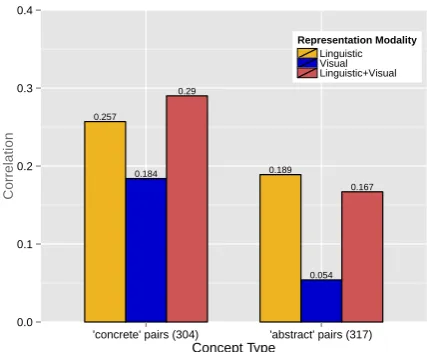
Figure 4: Visual input is valuable for representing concepts that are classified as concrete by the im-age dispersion algorithm, but not so for concepts classified as abstract. All correlations are with the USF gold-standard.
cepts with image dispersion below the median as concrete and concepts above this threshold as ab-stract we achieved an abab-stract-concrete prediction accuracy of 81%.
While well-understood intuitively, concreteness is not a formally defined notion. Quantities such as the USF concreteness score depend on the sub-jective judgement of raters and the particular an-notation guidelines. According to the Dual Cod-ing Theory, however, concrete concepts are pre-cisely those with a salient perceptual representa-tion. As illustrated in Figure 4, our binary clas-sification conforms to this characterization. The importance of the visual modality is significantly greater when evaluating on pairs for which both concepts are classified as concrete than on pairs of two abstract concepts.
[image:4.595.77.290.70.242.2]Concept Image Dispersion Conc. (USF)
shirt .488 6.05
bed .495 5.91
knife .560 6.08
dress .578 6.59
car .580 6.35
ego 1.000 1.93
nonsense .999 1.90
memory .999 1.78
potential .997 1.90
[image:5.595.71.289.62.212.2]know .996 2.70
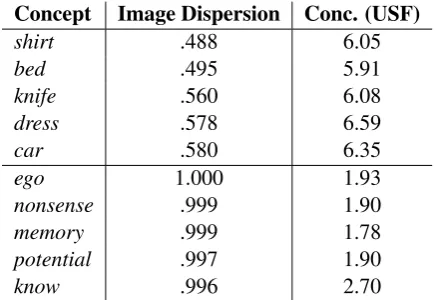
Table 1: Concepts with highest and lowest image dispersion scores in our evaluation set, and con-creteness ratings from the USF dataset.
the very abstract or very concrete concepts. As Table 1 illustrates, the concepts with the lowest dispersion in this sample are, without exception, highly concrete, and the concepts of highest dis-persion are clearly very abstract.
It should be noted that all previous approaches to the automatic measurement of concreteness rely on annotator ratings, dictionaries or manually-constructed resources. Kwong (2008) proposes a method based on the presence of hard-coded phrasal features in dictionary entries correspond-ing to each concept. By contrast, S´anchez et al. (2011) present an approach based on the position of word senses corresponding to each concept in the WordNet ontology (Fellbaum, 1999). Turney et al. (2011) propose a method that extends a large set of concreteness ratings similar to those in the USF dataset. The Turney et al. algorithm quanti-fies the concreteness of concepts that lack such a rating based on their proximity to rated concepts in a semantic vector space. In contrast to each of these approaches, the image dispersion approach requires no hand-coded resources. It is therefore more scalable, and instantly applicable to a wide range of languages.
4.2 Classifying Adjective-Noun Pairs
Finally, we explored whether image dispersion can be applied to specific NLP tasks as an effec-tive proxy for concreteness. Turney et al. (2011) showed that concreteness is applicable to the clas-sification of adjective-noun modification as either literal or non-literal. By applying a logistic regres-sion with noun concreteness as the predictor vari-able, Turney et al. achieved a classification
accu-racy of 79% on this task. This model relies on sig-nificant supervision in the form of over 4,000 hu-man lexical concreteness ratings.1 Applying im-age dispersion in place of concreteness in an iden-tical classifier on the same dataset, our entirely un-supervised approach achieves an accuracy of 63%. This is a notable improvement on the largest-class baseline of 55%.
5 Conclusions
We presented a novel method, image dispersion-based filtering, that improves multi-modal repre-sentations by approximating conceptual concrete-ness from images and filtering model input. The results clearly show that including more percep-tual input in multi-modal models is not always bet-ter. Motivated by this fact, our approach provides an intuitive and straightforward metric to deter-mine whether or not to include such information.
In addition to improving multi-modal represen-tations, we have shown the applicability of the im-age dispersion metric to several other tasks. To our knowledge, our algorithm constitutes the first unsupervised method for quantifying conceptual concreteness as applied to NLP, although it does, of course, rely on the Google Images retrieval al-gorithm. Moreover, we presented a method to classify adjective-noun pairs according to modi-fication type that exploits the link between image dispersion and concreteness. It is striking that this apparently linguistic problem can be addressed solely using the raw data encoded in images.
In future work, we will investigate the precise quantity of perceptual information to be included for best performance, as well as the optimal filter-ing threshold. In addition, we will explore whether the application of image data, and the interaction between images and language, can yield improve-ments on other tasks in semantic processing and representation.
Acknowledgments
DK is supported by EPSRC grant EP/I037512/1. FH is supported by St John’s College, Cambridge. AK is supported by The Royal Society. SC is sup-ported by ERC Starting Grant DisCoTex (306920) and EPSRC grant EP/I037512/1. We thank the anonymous reviewers for their helpful comments. 1The MRC Psycholinguistics concreteness ratings
References
Eneko Agirre, Enrique Alfonseca, Keith Hall, Jana Kravalova, Marius Pas¸ca, and Aitor Soroa. 2009. A study on similarity and relatedness using distribu-tional and wordnet-based approaches. In Proceed-ings of Human Language Technologies: The 2009 Annual Conference of the North American Chap-ter of the Association for Computational Linguistics, NAACL ’09, pages 19–27, Boulder, Colorado. Mark Andrews, Gabriella Vigliocco, and David
Vin-son. 2009. Integrating experiential and distribu-tional data to learn semantic representations. Psy-chological review, 116(3):463.
Lawrence W Barsalou, W Kyle Simmons, Aron K Bar-bey, and Christine D Wilson. 2003. Grounding conceptual knowledge in modality-specific systems.
Trends in cognitive sciences, 7(2):84–91.
Shane Bergsma and Randy Goebel. 2011. Using vi-sual information to predict lexical preference. In
RANLP, pages 399–405.
Anna Bosch, Andrew Zisserman, and Xavier Munoz. 2007. Image classification using random forests and ferns. InProceedings of ICCV.
Elia Bruni, Gemma Boleda, Marco Baroni, and Nam-Khanh Tran. 2012. Distributional semantics in tech-nicolor. In Proceedings of the 50th Annual Meet-ing of the Association for Computational LMeet-inguis-
Linguis-tics: Long Papers-Volume 1, pages 136–145.
Asso-ciation for Computational Linguistics.
Elia Bruni, Nam Khanh Tran, and Marco Baroni. 2014. Multimodal distributional semantics. Journal of Ar-tificial Intelligence Research, 49:1–47.
Max Coltheart. 1981. The MRC psycholinguistic database. The Quarterly Journal of Experimental
Psychology, 33(4):497–505.
Jia Deng, Wei Dong, Richard Socher, Li-Jia Li, Kai Li, and Li Fei-Fei. 2009. Imagenet: A large-scale hi-erarchical image database. InComputer Vision and Pattern Recognition, 2009. CVPR 2009. IEEE Con-ference on, pages 248–255. IEEE.
Christiane Fellbaum. 1999. WordNet. Wiley Online Library.
Yansong Feng and Mirella Lapata. 2010. Visual infor-mation in semantic representation. In Human Lan-guage Technologies: The 2010 Annual Conference of the North American Chapter of the Association
for Computational Linguistics, pages 91–99.
Asso-ciation for Computational Linguistics.
Lev Finkelstein, Evgeniy Gabrilovich, Yossi Matias, Ehud Rivlin, Zach Solan, Gadi Wolfman, and Ey-tan Ruppin. 2001. Placing search in context: The concept revisited. InProceedings of the 10th
inter-national conference on World Wide Web, pages 406–
414. ACM.
Felix Hill, Douwe Kiela, and Anna Korhonen. 2013a. Concreteness and corpora: A theoretical and practi-cal analysis. CMCL 2013.
Felix Hill, Anna Korhonen, and Christian Bentz. 2013b. A quantitative empirical analysis of the ab-stract/concrete distinction. Cognitive science, 38(1). Eric H Huang, Richard Socher, Christopher D Man-ning, and Andrew Y Ng. 2012. Improving word representations via global context and multiple word prototypes. InProceedings of the 50th Annual Meet-ing of the Association for Computational LMeet-inguis-
Linguis-tics: Long Papers-Volume 1, pages 873–882.
Asso-ciation for Computational Linguistics.
Oi Yee Kwong. 2008. A preliminary study on the im-pact of lexical concreteness on word sense disam-biguation. InPACLIC, pages 235–244.
Geoffrey Leech, Roger Garside, and Michael Bryant. 1994. Claws4: the tagging of the british national corpus. In Proceedings of the 15th conference
on Computational linguistics-Volume 1, pages 622–
628. Association for Computational Linguistics. Tomas Mikolov, Kai Chen, Greg Corrado, and Jeffrey
Dean. 2013a. Efficient estimation of word repre-sentations in vector space. InProceedings of
Inter-national Conference of Learning Representations,
Scottsdale, Arizona, USA.
Tomas Mikolov, Ilya Sutskever, Kai Chen, Greg S Cor-rado, and Jeff Dean. 2013b. Distributed representa-tions of words and phrases and their compositional-ity. InAdvances in Neural Information Processing
Systems, pages 3111–3119.
Douglas L Nelson, Cathy L McEvoy, and Thomas A Schreiber. 2004. The University of South Florida free association, rhyme, and word fragment norms.
Behavior Research Methods, Instruments, & Com-puters, 36(3):402–407.
Allan Paivio. 1990. Mental representations: A dual coding approach. Oxford University Press.
Stephen Roller and Sabine Schulte im Walde. 2013. A multimodal LDA model integrating textual, cog-nitive and visual modalities. InProceedings of the 2013 Conference on Empirical Methods in Natu-ral Language Processing, pages 1146–1157, Seattle, Washington, USA, October. Association for Compu-tational Linguistics.
David S´anchez, Montserrat Batet, and David Isern. 2011. Ontology-based information content compu-tation.Knowledge-Based Systems, 24(2):297–303. D Sculley. 2010. Web-scale k-means clustering. In
Proceedings of the 19th international conference on
World wide web, pages 1177–1178. ACM.
in Natural Language Processing and Computational
Natural Language Learning, pages 1423–1433.
As-sociation for Computational Linguistics.
J. Sivic and A. Zisserman. 2003. Video Google: a text retrieval approach to object matching in videos. In
Proceedings of the Ninth IEEE International
Con-ference on Computer Vision, volume 2, pages 1470–
1477, Oct.
James H Steiger. 1980. Tests for comparing ele-ments of a correlation matrix. Psychological Bul-letin, 87(2):245.
Peter D Turney, Yair Neuman, Dan Assaf, and Yohai Cohen. 2011. Literal and metaphorical sense iden-tification through concrete and abstract context. In
Proceedings of the 2011 Conference on the
Empiri-cal Methods in Natural Language Processing, pages
680–690.
A. Vedaldi and B. Fulkerson. 2008. VLFeat: An open and portable library of computer vision algorithms.
http://www.vlfeat.org/.
Luis Von Ahn and Laura Dabbish. 2004. Labeling images with a computer game. InProceedings of the SIGCHI conference on Human factors in computing