cdec: A Decoder, Alignment, and Learning Framework for
Finite-State and Context-Free Translation Models
Chris Dyer
University of Maryland [email protected]
Adam Lopez
University of Edinburgh [email protected]
Juri Ganitkevitch
Johns Hopkins University [email protected]
Jonathan Weese
Johns Hopkins University [email protected]
Ferhan Ture
University of Maryland [email protected]
Phil Blunsom
Oxford University [email protected]
Hendra Setiawan
University of Maryland [email protected]
Vladimir Eidelman
University of Maryland [email protected]
Philip Resnik
University of Maryland [email protected]
Abstract
We presentcdec, an open source frame-work for decoding, aligning with, and training a number of statistical machine translation models, including word-based models, phrase-based models, and models based on synchronous context-free gram-mars. Using a single unified internal representation for translation forests, the decoder strictly separates model-specific translation logic from general rescoring, pruning, and inference algorithms. From this unified representation, the decoder can extract not only the 1- or k-best transla-tions, but also alignments to a reference, or the quantities necessary to drive dis-criminative training using gradient-based or gradient-free optimization techniques. Its efficient C++ implementation means that memory use and runtime performance are significantly better than comparable decoders.
1 Introduction
The dominant models used in machine transla-tion and sequence tagging are formally based on either weighted finite-state transducers (FSTs) or weighted synchronous context-free grammars
(SCFGs) (Lopez, 2008). Phrase-based models
(Koehn et al., 2003), lexical translation models (Brown et al., 1993), and finite-state conditional random fields (Sha and Pereira, 2003) exemplify the former, and hierarchical phrase-based models the latter (Chiang, 2007). We introduce a soft-ware package calledcdecthat manipulates both
classes in a unified way.1
Although open source decoders for both phrase-based and hierarchical translation models have been available for several years (Koehn et al., 2007; Li et al., 2009), their extensibility to new models and algorithms is limited by two sig-nificant design flaws that we have avoided with
cdec. First, their implementations tightly couple the translation, language model integration (which we callrescoring), and pruning algorithms. This makes it difficult to explore alternative transla-tion models without also re-implementing rescor-ing and prunrescor-ing logic. In cdec, model-specific code is only required to construct a translation for-est (§3).Generalrescoring (with language models or other models), pruning, inference, and align-ment algorithms then apply to the unified data structure (§4). Henceall model types benefit im-mediately from new algorithms (for rescoring, in-ference, etc.); new models can be more easily pro-totyped; and controlled comparison of models is made easier.
Second, existing open source decoders were de-signed with the traditional phrase-based parame-terization using a very small number of dense fea-tures (typically less than 10). cdechas been de-signed from the ground up to support any parame-terization, from those with a handful of dense fea-tures up to models with millions of sparse feafea-tures (Blunsom et al., 2008; Chiang et al., 2009). Since the inference algorithms necessary to compute a training objective (e.g. conditional likelihood or expected BLEU) and its gradient operate on the unified data structure (§5), any model type can be trained using with any of the supported training
1
The software is released under the Apache License, ver-sion 2.0, and is available from http://cdec-decoder.org/ .
criteria. The software package includes general function optimization utilities that can be used for discriminative training (§6).
These features are implemented without com-promising on performance. We show experimen-tally that cdec uses less memory and time than comparable decoders on a controlled translation task (§7).
2 Decoder workflow
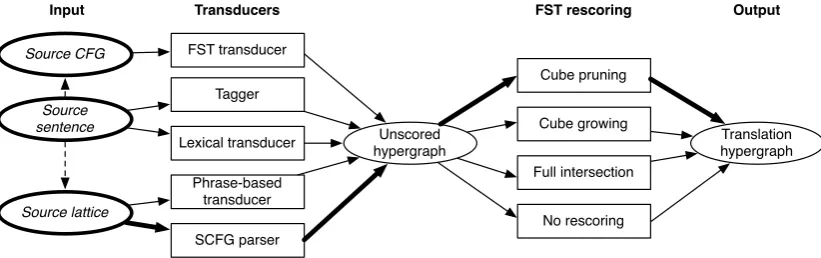
The decoding pipeline consists of two phases. The first (Figure 1) transforms input, which may be represented as a source language sentence, lattice (Dyer et al., 2008), or context-free forest (Dyer and Resnik, 2010), into a translation forest that has been rescored with all applicable models.
Incdec, the only model-specific logic is con-fined to the first step in the process where an input string (or lattice, etc.) is transduced into the unified hypergraph representation. Since the model-specific code need not worry about integra-tion with rescoring models, it can be made quite simple and efficient. Furthermore, prior to lan-guage model integration (and distortion model in-tegration, in the case of phrase based translation), pruning is unnecessary for most kinds of mod-els, further simplifying the model-specific code. Once this unscored translation forest has been generated, any non-coaccessible states (i.e., states that are not reachable from the goal node) are re-moved and the resulting structure is rescored with language models using a user-specified intersec-tion/pruning strategy (§4) resulting in a rescored translation forest and completing phase 1.
The second phase of the decoding pipeline (de-picted in Figure 2) computes a value from the rescored forest: 1- or k-best derivations, feature expectations, or intersection with a target language reference (sentence or lattice). The last option generates analignment forest, from which a word alignment or feature expectations can be extracted. Most of these values are computed in a time com-plexity that is linear in the number of edges and nodes in the translation hypergraph usingcdec’s semiring framework (§5).
2.1 Alignment forests and alignment
Alignment is the process of determining if and how a translation model generates a hsource, tar-geti string pair. To compute an alignment under a translation model, the phase 1 translation hyper-graph is reinterpreted as a synchronous
context-free grammar and then used to parse the target
sentence.2 This results in an alignment forest, which is a compact representation of all the deriva-tions of the sentence pair under the translation model. From this forest, the Viterbi or maximuma posterioriword alignment can be generated. This alignment algorithm is explored in depth by Dyer (2010). Note that if the phase 1 forest has been pruned in some way, or the grammar does not de-rive the sentence pair, the target intersection parse may fail, meaning that an alignment will not be recoverable.
3 Translation hypergraphs
Recent research has proposed a unified repre-sentation for the various translation and tagging formalisms that is based on weighted logic pro-gramming (Lopez, 2009). In this view, trans-lation (or tagging) deductions have the structure of a context-free forest, or directed hypergraph, where edges have a single head and 0 or more tail nodes (Nederhof, 2003). Once a forest has been constructed representing the possible translations, general inference algorithms can be applied.
In cdec’s translation hypergraph, a node rep-resents a contiguous sequence of target language
words. For SCFG models and sequential
tag-ging models, a node also corresponds to a source span and non-terminal type, but for word-based and phrase-based models, the relationship to the source string (or lattice) may be more compli-cated. In a phrase-based translation hypergraph, the node will correspond to a sourcecoverage vec-tor(Koehn et al., 2003). In word-based models, a single node may derive multiple different source language coverages since word based models im-pose no requirements on covering all words in the input. Figure 3 illustrates two example hyper-graphs, one generated using a SCFG model and other from a phrase-based model.
Edges are associated with exactly one syn-chronous production in the source and target lan-guage, and alternative translation possibilities are expressed as alternative edges. Edges are further annotated with feature values, and are annotated with the source span vector the edge corresponds to. An edge’s output label may contain mixtures of terminal symbol yields and positions indicating where a child node’s yield should be substituted.
2
SCFG parser FST transducer
Tagger
Lexical transducer
Phrase-based transducer Source CFG
Source sentence
Source lattice
Unscored hypergraph
Input Transducers
Cube pruning
Full intersection
FST rescoring
Translation hypergraph
Output
Cube growing
[image:3.595.92.503.62.191.2]No rescoring
Figure 1: Forest generation workflow (first half of decoding pipeline). The decoder’s configuration specifies what path is taken from the input (one of the bold ovals) to a unified translation hypergraph. The highlighted path is the workflow used in the test reported in§7.
Translation hypergraph
Target reference
Viterbi extraction
k-best extraction
max-translation extraction
feature expectations
intersection by parsing
Alignment hypergraph
feature expectations
max posterior alignment
Viterbi alignment
Translation outputs Alignment outputs
Figure 2: Output generation workflow (second half of decoding pipeline). Possible output types are designated with a double box.
In the case of SCFG grammars, the edges corre-spond simply to rules in the synchronous gram-mar. For non-SCFG translation models, there are two kinds of edges. The first have zero tail nodes (i.e., an arity of 0), and correspond to word or phrase translation pairs (with all translation op-tions existing on edges deriving the same head node), or glue rules that glue phrases together. For tagging, word-based, and phrase-based mod-els, these are strictly arranged in a monotone, left-branching structure.
4 Rescoring with weighted FSTs
The design of cdec separates the creation of a translation forest from its rescoring with a lan-guage models or similar models.3 Since the struc-ture of the unified search space is context free (§3), we use the logic for language model rescoring de-scribed by Chiang (2007), although any weighted intersection algorithm can be applied. The
rescor-3
Other rescoring models that depend on sequential con-text include distance-based reordering models or Markov fea-tures in tagging models.
ing models need not be explicitly represented as FSTs—the state space can be inferred.
Although intersection using the Chiang algo-rithm runs in polynomial time and space, the re-sulting rescored forest may still be too large to rep-resent completely. cdectherefore supports three pruning strategies that can be used during intersec-tion: full unpruned intersection (useful for tagging models to incorporate, e.g., Markov features, but not generally practical for translation), cube prun-ing, and cube growing (Huang and Chiang, 2007).
5 Semiring framework
Semirings are a useful mathematical abstraction for dealing with translation forests since many useful quantities can be computed using a single linear-time algorithm but with different semirings. A semiring is a 5-tuple (K,⊕,⊗,0,1) that indi-cates the set from which the values will be drawn, K, a generic addition and multiplication operation,
[image:3.595.113.486.254.401.2]Goal
JJ NN
1 2 a
small little
house shell
Goal
010
100 101
110
a
small
little 1 a
1 house
1 shell
1 little
1 small 1 house
1 shell 1 little
[image:4.595.149.450.62.164.2]1 small
Figure 3: Example unrescored translation hypergraphs generated for the German input ein(a) kleines
(small/little)Haus(house/shell) using a SCFG-based model (left) and phrase-based model with a distor-tion limit of 1 (right).
must equal0. Values that can be computed using the semirings include the number of derivations, the expected translation length, the entropy of the translation posterior distribution, and the expected values of feature functions (Li and Eisner, 2009).
Since semirings are such a useful abstraction,
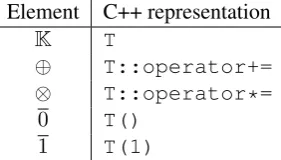
cdechas been designed to facilitate implementa-tion of new semirings. Table 1 shows the C++ rep-resentation used for semirings. Note that because of our representation, built-in types likedouble,
int, and bool (together with their default op-erators) are semirings. Beyond these, the type
prob tis provided which stores the logarithm of the value it represents, which helps avoid under-flow and overunder-flow problems that may otherwise be encountered. A generic first-order expectation semiring is also provided (Li and Eisner, 2009).
Table 1: Semiring representation. Tis a C++ type name.
Element C++ representation
K T
⊕ T::operator+=
⊗ T::operator*=
0 T()
1 T(1)
Three standard algorithms parameterized with semirings are provided: INSIDE, OUTSIDE, and INSIDEOUTSIDE, and the semiring is specified us-ing C++ generics (templates). Additionally, each algorithm takes aweight function that maps from hypergraph edges to a value inK, making it possi-ble to use many different semirings without alter-ing the underlyalter-ing hypergraph.
5.1 Viterbi andk-best extraction
Although Viterbi andk-best extraction algorithms are often expressed as INSIDE algorithms with
the tropical semiring, cdec provides a separate derivation extraction framework that makes use of a < operator (Huang and Chiang, 2005). Thus, many of the semiring types define not only the el-ements shown in Table 1 butT::operator<as well. Thek-best extraction algorithm is also pa-rameterized by an optional predicate that can filter out derivations at each node, enabling extraction of only derivations that yield different strings as in Huang et al. (2006).
6 Model training
Two training pipelines are provided with cdec. The first, called Viterbi envelope semiring train-ing, VEST, implements the minimum error rate training (MERT) algorithm, a gradient-free opti-mization technique capable of maximizing arbi-trary loss functions (Och, 2003).
6.1 VEST
Rather than computing an error surface using k-best approximations of the decoder search space,
cdec’s implementation performs inference over the full hypergraph structure (Kumar et al., 2009). In particular, by defining a semiring whose values are sets of line segments, having an addition op-eration equivalent to union, and a multiplication operation equivalent to a linear transformation of the line segments, Och’s line search can be com-puted simply using the INSIDEalgorithm. Since the translation hypergraphs generated by cdec
may be quite large making inference expensive, the logic for constructing error surfaces is fac-tored according to the MapReduce programming paradigm (Dean and Ghemawat, 2004), enabling parallelization across a cluster of machines. Im-plementations of theBLEUandTERloss functions
[image:4.595.111.252.510.590.2]6.2 Large-scale discriminative training
In addition to the widely used MERT
algo-rithm,cdecalso provides a training pipeline for discriminatively trained probabilistic translation models (Blunsom et al., 2008; Blunsom and Os-borne, 2008). In these models, the translation model is trained to maximize conditional log like-lihood of the training data under a specified gram-mar. Since log likelihood is differentiable with respect to the feature weights in an exponential model, it is possible to use gradient-based opti-mization techniques to train the system, enabling the parameterization of the model using millions of sparse features. While this training approach was originally proposed for SCFG-based transla-tion models, it can be used to train any model type incdec. When used with sequential tagging models, this pipeline is identical to traditional se-quential CRF training (Sha and Pereira, 2003).
Both the objective (conditional log likelihood) and its gradient have the form of a difference in two quantities: each has one term that is com-puted over the translation hypergraph which is subtracted from the result of the same computa-tion over thealignment hypergraph (refer to Fig-ures 1 and 2). The conditional log likelihood is the difference in the log partition of the translation and alignment hypergraph, and is computed using the INSIDE algorithm. The gradient with respect to a particular feature is the difference in this fea-ture’s expected value in the translation and align-ment hypergraphs, and can be computed using ei-ther INSIDEOUTSIDEor the expectation semiring and INSIDE. Since a translation forest is generated as an intermediate step in generating an alignment forest (§2) this computation is straightforward.
Since gradient-based optimization techniques may require thousands of evaluations to converge, the batch training pipeline is split into map and reduce components, facilitating distribution over very large clusters. Briefly, thecdecis run as the map function, and sentence pairs are mapped over. The reduce function aggregates the results and per-forms the optimization using standard algorithms, includingLBFGS(Liu et al., 1989),RPROP (Ried-miller and Braun, 1993), and stochastic gradient descent.
7 Experiments
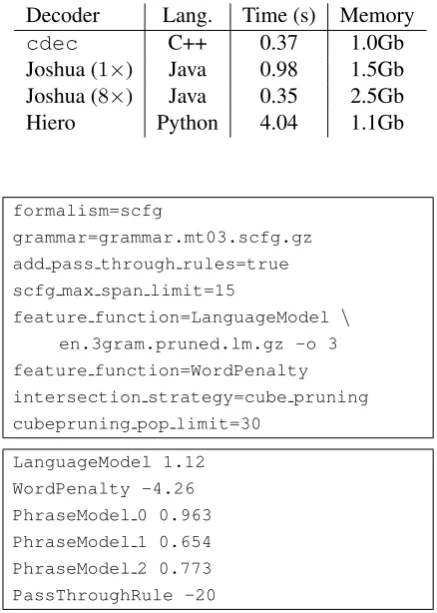
Table 2 compares the performance ofcdec, Hi-ero, and Joshua 1.3 (running with 1 or 8 threads) decoding using a hierarchical phrase-based
trans-lation grammar and identical pruning settings.4
Figure 4 shows the cdec configuration and
weights file used for this test.
The workstation used has two 2GHz quad-core Intel Xenon processors, 32GB RAM, is running Linux kernel version 2.6.18 and gcc version 4.1.2. All decoders use SRI’s language model toolkit, version 1.5.9 (Stolcke, 2002). Joshua was run on the Sun HotSpot JVM, version 1.6.0 12. A hierar-chical phrase-based translation grammar was ex-tracted for the NIST MT03 Chinese-English trans-lation using a suffix array rule extractor (Lopez, 2007). A non-terminal span limit of 15 was used, and all decoders were configured to use cube prun-ing with a limit of 30 candidates at each node and no further pruning. All decoders produced aBLEU
[image:5.595.306.525.380.687.2]score between 31.4 and 31.6 (small differences are accounted for by different tie-breaking behavior and OOV handling).
Table 2: Memory usage and average per-sentence running time, in seconds, for decoding a Chinese-English test set.
Decoder Lang. Time (s) Memory
cdec C++ 0.37 1.0Gb
Joshua (1×) Java 0.98 1.5Gb
Joshua (8×) Java 0.35 2.5Gb
Hiero Python 4.04 1.1Gb
formalism=scfg
grammar=grammar.mt03.scfg.gz
add pass through rules=true
scfg max span limit=15
feature function=LanguageModel \
en.3gram.pruned.lm.gz -o 3
feature function=WordPenalty
intersection strategy=cube pruning
cubepruning pop limit=30
LanguageModel 1.12
WordPenalty -4.26
PhraseModel 0 0.963
PhraseModel 1 0.654
PhraseModel 2 0.773
PassThroughRule -20
Figure 4: Configuration file (above) and feature weights file (below) used for the decoding test de-scribed in§7.
8 Future work
cdec continues to be under active development. We are taking advantage of its modular design to study alternative algorithms for language model integration. Further training pipelines are un-der development, including minimum risk train-ing ustrain-ing a linearly decomposable approximation ofBLEU (Li and Eisner, 2009), and MIRA train-ing (Chiang et al., 2009). All of these will be made publicly available as the projects progress. We are also improving support for parallel training using Hadoop (an open-source implementation of MapReduce).
Acknowledgements
This work was partially supported by the GALE program of the Defense Advanced Research Projects Agency, Contract No. HR0011-06-2-001. Any opinions, findings, conclusions or recommen-dations expressed in this paper are those of the au-thors and do not necessarily reflect the views of the sponsors. Further support was provided the Euro-Matrix project funded by the European Commis-sion (7th Framework Programme). DiscusCommis-sions with Philipp Koehn, Chris Callison-Burch, Zhifei Li, Lane Schwarz, and Jimmy Lin were likewise crucial to the successful execution of this project.
References
P. Blunsom and M. Osborne. 2008. Probalistic inference for machine translation. InProc. of EMNLP.
P. Blunsom, T. Cohn, and M. Osborne. 2008. A discrimina-tive latent variable model for statistical machine transla-tion. InProc. of ACL-HLT.
P. F. Brown, V. J. Della Pietra, S. A. Della Pietra, and R. L. Mercer. 1993. The mathematics of statistical machine translation: parameter estimation. Computational Lin-guistics, 19(2):263–311.
D. Chiang, K. Knight, and W. Wang. 2009. 11,001 new features for statistical machine translation. InProc. of NAACL, pages 218–226.
D. Chiang. 2007. Hierarchical phrase-based translation.
Comp. Ling., 33(2):201–228.
J. Dean and S. Ghemawat. 2004. MapReduce: Simplified data processing on large clusters. InProc. of the 6th Sym-posium on Operating System Design and Implementation (OSDI 2004), pages 137–150.
C. Dyer and P. Resnik. 2010. Context-free reordering, finite-state translation. InProc. of HLT-NAACL.
C. Dyer, S. Muresan, and P. Resnik. 2008. Generalizing word lattice translation. InProc. of HLT-ACL.
C. Dyer. 2010. Two monolingual parses are better than one (synchronous parse). InProc. of HLT-NAACL.
L. Huang and D. Chiang. 2005. Betterk-best parsing. InIn Proc. of IWPT, pages 53–64.
L. Huang and D. Chiang. 2007. Forest rescoring: Faster decoding with integrated language models. InProc. ACL. L. Huang, K. Knight, and A. Joshi. 2006. A syntax-directed translator with extended domain of locality. InProc. of AMTA.
P. Koehn, F. J. Och, and D. Marcu. 2003. Statistical phrase-based translation. InProc. of HLT/NAACL, pages 48–54. P. Koehn, H. Hoang, A. B. Mayne, C. Callison-Burch,
M. Federico, N. Bertoldi, B. Cowan, W. Shen, C. Moran, R. Zens, C. Dyer, O. Bojar, A. Constantin, and E. Herbst. 2007. Moses: Open source toolkit for statistical ma-chine translation. InProc. of ACL, Demonstration Ses-sion, pages 177–180, June.
S. Kumar, W. Macherey, C. Dyer, and F. Och. 2009. Efficient minimum error rate training and minimum B ayes-risk de-coding for translation hypergraphs and lattices. InProc. of ACL, pages 163–171.
Z. Li and J. Eisner. 2009. First- and second-order expectation semirings with applications to minimum-risk training on translation forests. InProc. of EMNLP, pages 40–51. Z. Li, C. Callison-Burch, C. Dyer, J. Ganitkevitch, S.
Khu-danpur, L. Schwartz, W. N. G. Thornton, J. Weese, and O. F. Zaidan. 2009. Joshua: an open source toolkit for parsing-based machine translation. InProc. of the Fourth Workshop on Stat. Machine Translation, pages 135–139. D. C. Liu, J. Nocedal, D. C. Liu, and J. Nocedal. 1989. On
the limited memory BFGS method for large scale opti-mization. Mathematical Programming B, 45(3):503–528. A. Lopez. 2007. Hierarchical phrase-based translation with
suffix arrays. InProc. of EMNLP, pages 976–985. A. Lopez. 2008. Statistical machine translation.ACM
Com-puting Surveys, 40(3), Aug.
A. Lopez. 2009. Translation as weighted deduction. InProc. of EACL, pages 532–540.
M.-J. Nederhof. 2003. Weighted deductive parsing and Knuth’s algorithm.Comp. Ling., 29(1):135–143, Mar. F. Och. 2003. Minimum error rate training in statistical
ma-chine translation. InProc. of ACL, pages 160–167. K. Papineni, S. Roukos, T. Ward, and W.-J. Zhu. 2002.
BLEU: a method for automatic evaluation of machine translation. InProc. of ACL, pages 311–318.
M. Riedmiller and H. Braun. 1993. A direct adaptive method for faster backpropagation learning: The RPROP algo-rithm. InProc. of the IEEE international conference on neural networks, pages 586–591.
F. Sha and F. Pereira. 2003. Shallow parsing with conditional random fields. InProc. of NAACL, pages 134–141. M. Snover, B. Dorr, R. Schwartz, L. Micciulla, and
J. Makhoul. 2006. A study of translation edit rate with targeted human annotation. InProc. AMTA.