Towards A Modular Data Model For Multi-Layer Annotated Corpora
Richard Eckart
Department of English Linguistics Darmstadt University of Technology
64289 Darmstadt, Germany
Abstract
In this paper we discuss the current meth-ods in the representation of corpora anno-tated at multiple levels of linguistic organi-zation (so-calledmulti-levelormulti-layer
corpora). Taking five approaches which are representative of the current practice in this area, we discuss the commonalities and differences between them focusing on the underlying data models. The goal of the paper is to identify the common con-cerns in multi-layer corpus representation and processing so as to lay a foundation for a unifying, modular data model.
1 Introduction
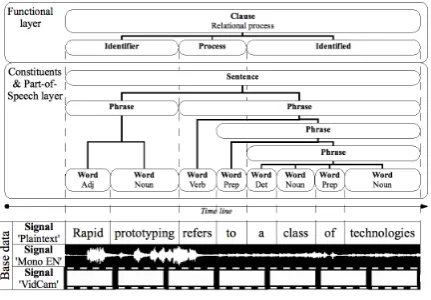
Five approaches to representing multi-layer anno-tated corpora are reviewed in this paper. These re-flect the current practice in the field and show the requirements typically posed on multi-layer cor-pus applications. Multi-layer annotated corpora keep annotations at different levels of linguistic organization separate from each other. Figure 1 illustrates two annotation layers on a transcrip-tion of an audio/video signal. One layer contains a functional annotation of a sentence in the tran-scription. The other contains a phrase structure annotation and Part-of-Speech tags for each word. Layers and signals are coordinated by a common timeline.
[image:1.595.309.525.246.396.2]The motivation for this research is rooted in finding a proper data model for PACE-Ling (Sec. 2.2). The ultimate goal of our research is to create a modular extensible data model for multi-layer annotated corpora. To achieve this, we aim to create a data model based on the current state-of-the-art that covers all current requirements and
Figure 1: Multi-layer annotation on multi-modal base data
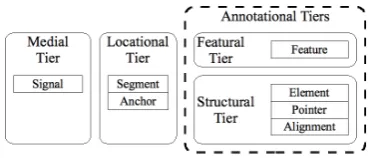
then decompose it into exchangeable components. We identify and discuss objects contained in four tiers commonly playing an important role in multi-layer corpus scenarios (see Fig. 2): medial, loca-tional,structuralandfeaturaltiers. These are gen-eralized categories that are in principle present in any multi-layer context, but come in different in-carnations. Since query language and data model are closely related, common query requirements are also surveyed and examined for modular de-composition. While parts of the suggested data model and query operators are implemented by the projects discussed here, so far no comprehensive implementation exists.
2 Data models
There are three purposes data models can serve. The first purpose is context suitability. A data model used for this purpose must reflect as well as possible the data the user wants to query. The second purpose is storage. The data model used in the database backend can be very different from
the one exposed to the user, e.g. hierarchical struc-tures may be stored in tables, indices might be kept to speed up queries, etc. The third purpose isexchangeandarchival. Here the data model, or rather the serialization of the data model, has to be easily parsable and follow a widely used standard. Our review focuses on the suitability of data models for the first purpose. As extensions of the XML data model are used in most of the ap-proaches reviewed here, a short introduction to this data model will be given first.
Figure 2: Tiers and objects
2.1 XML
Today XML has become the de-facto standard representation format for annotated text corpora. While the XML standard specifies a data model and serialization format for XML, a semantics is largely left to be defined for a particular ap-plication. Many data models can be mapped to the XML data model and serialized to XML (cf. Sec. 2.5).
The XML data model describes an ordered tree and defines several types of nodes. We examine a simplification of this data model here, limited to elements, attributes and text nodes. An ele-ment (parent) can containchildren: elements and text nodes. Elements are named and can carry at-tributes, which are identified by a name and bear a value.
This data model is immediately suitable for sim-ple text annotations. For examsim-ple in a positional annotation, name-value pairs (features) can be as-signed to tokens, which are obtained via tokeniza-tion of a text. These features and tokens can be represented by attributes and text nodes. The XML data model requires that both share a parent element which binds them together. Because the XML data model defines a tree, an additional root element is required to govern all positional anno-tation elements.
If the tree is constructed in such a way that one particular traversal strategy yields all tokens
in their original order, then the data model is ca-pable of covering all tiers: medial tier (textual base data), locational tier (sequential token order), structural tier (tokens) and featural tier (linguis-tic feature annotations). The structural tier can be expanded by adding additional elements en-route from the root element to the text nodes (leaves). In this way hierarchical structures can be modeled, for instance constituency structures. However, the XML data model covers these tiers only in a lim-ited way. For example, tokens can not overlap each other without destroying the linear token or-der and thus sacrificing the temporal tier, a prob-lem commonly known asoverlapping hierarchies.
2.2 PACE-Ling
PACE-Ling (Bartsch et al., 05) aims at develop-ing register profiles of texts from mechanical engi-neering (domain: data processing in construction) based on the multi-dimensional model of Systemic Functional Linguistics (SFL) (Halliday, 04).
The XML data model is a good foundation for this project as only written texts are analyzed, but SFL annotation requires multiple annotation lay-ers with overlapping hierarchies. To solve this problem, the project applies a strategy known as
stand-off annotation, first discussed in the context of SFL in (Teich et al., 05) and based on previous work by (Teich et al., 01). This strategy separates the annotation data from the base data and intro-duces references from the annotations to the base data, thus allowing to keep multiple layers of an-notations on the same base data separate.
The tools developed in the project treat anno-tation data in XML from any source as separate annotation layers, provided the text nodes in each layer contain the same base data. The base data is extracted and kept in a text file and the annotation layers each in an XML file. The PACE-Ling data model substitutes text nodes from the XML data model bysegments. Segments carrystartandend
attributes which specify the location of the text in the text file.
2.3 NITE XML Toolkit
The NITE XML toolkit (NXT) (Carletta et al., 04) was created with the intention to provide a frame-work for building applications frame-working with anno-tated multi-modal data. NXT is based on the NITE Object Model (NOM) which is an extension of the XML data model. NOM features a similar separa-tion of tiers as the PACE-Ling data model, but is more general.
NOM uses a continuous timelineto coordinate annotations. Instead of having dedicated segment elements, any annotation element can have special
startandendattributes that anchor it to the time-line. This makes the data model less modular, be-cause support for handling other locational strate-gies than a timeline can not be added by changing the semantics of segments (cf. Sec. 3.2).
NXT can deal with audio, video and textual base data, but due to being limited to the concept of a single common timeline, it is not possible to annotate a specific region in one video frame.
NOM introduces a new structural relation be-tween annotation elements. Arbitrary links can be created by adding a pointer to an annotation ment bearing a reference to another annotation ele-ment which designates the first annotation eleele-ment to be a parent of the latter. Each pointer carries a role attribute describing its use.
Using pointers, arbitrary directed graphs can be overlaid on annotation layers and annotation el-ements can have multiple parents, one from the layer structure and any number of parents indi-cated by pointer references. This facilitates the reuse of annotations, e.g. when a number of an-notations are kept that apply to words, the bound-aries of words can be defined in one annotation layer and the other annotations can refer to that via pointers instead of defining the word bound-aries explicitly in each layer. Using these pointers in queries is cumbersome, because they have to be processed one at a time (Evert et al., 03).
2.4 Deutsch Diachron Digital
The goal of Deutsch Diachron Digital (DDD) (Faulstich et al., 05) is the creation of a diachronic corpus, ranging from the earliest Old High Ger-man or Old Saxon texts from the 9th century up to Modern German at the end of the 19th century.
DDD requires each text to be available in sev-eral versions, ranging from the original facsimile over several transcription versions to translations
into a modern language stage. This calls for a high degree of alignment between those versions as well as the annotations on those texts. Due to the vast amount of data involved in the project, the data model is not mapped to XML files, but to a SQL database for a better query performance.
The DDD data model can be seen as an exten-sion of NOM. Because the corpus contains mul-tiple versions of documents, coordination of an-notations and base data along a single timeline is not sufficient. Therefore DDD segments refer to a specific version of a document.
DDD defines howalignmentsare modeled, thus elevating them from the level of structural anno-tation to an independent object in the structural tier: an alignment as a set of elements or segments, each of which is associated with a role.
Treating alignments as an independent object is reasonable because they are conceptually different from pointers and it facilitates providing an effi-cient storage for alignments.
2.5 ATLAS
The ATLAS project (Laprun et al., 02) imple-ments a three tier data model model, resembling the separation of medial, locational and annota-tion tiers. This approach features two character-istic traits setting it apart from the others. First the data model is not inspired by XML, but by Annotation Graphs (AGs) (Bird & Liberman, 01). Second, it does not put any restriction on the kind of base data by leaving the semantics of segments and anchors undefined.
The ATLAS data model defines signals, ele-ments,attributes,pointers,segmentsandanchors. Signals are base data objects (text, audio, etc.). El-ements are related to each other only using point-ers. While elements and pointers can be used to form trees, the ATLAS data model does not en-force this. As a result, the problem of overlapping hierarchies does not apply to the model. Elements are not contained within layers, instead they carry a type. However all elements of the same type can be interpreted as belonging to one layer. Segments do not carry start and end attributes, they carry a number of anchors. How exactly anchors are real-ized depends on the signals and is not specified in the data model.
represent structural annotations as e.g. NXT does. The annotation data is stored as a flat set of ele-ments, pointers, etc., which precludes the efficient use of existing tools like XPath to do structural queries. This is especially inconvenient as the AT-LAS project does not provide a query language and query engine yet.
2.6 ISO 24610-1 - Feature Structures
The philosophy behind (ISO-24610-1, 06) is dif-ferent from that of the four previous approaches. Here the base data is an XML document con-forming to the TEI standard (Sperberg-McQueen & Burnard, 02). XML elements in the TEI base data can reference feature stuctures. A feature structure is a single-rooted graph, not necessarily a tree. The inner nodes of the graph are typed ele-ments, the leaves arevalues, which can be shared amongst elements using pointers or can be ob-tained functionally from other values.
While in the four previously discussed ap-proaches the annotations contain references to the base data in the leaves of the annotation structure, here the base data contains references to the root of the annotation structures. This is a powerful approach to identifying features of base data seg-ments, but it is not very well suited for represent-ing constituent hierarchies.
Feature structures put a layer of abstraction on top of the facilities provided by XML. XML val-idation schemes are used only to check the well-formedness of the serialization but not to validate the features structures. For this purpose feature structure declarations(FSD) have been defined.
3 A comprehensive data model
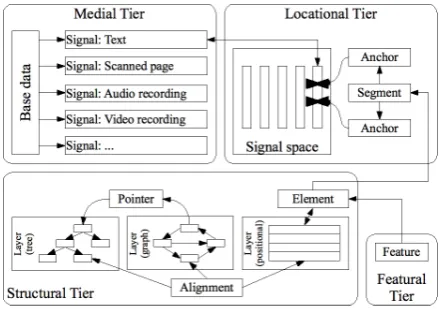
This section suggests a data model covering the objects that have been discussed in the context of the approaches presented in Sections 2.1-2.6. See Figure 3 for an overview.
3.1 Objects of the medial tier
[image:4.595.306.526.61.216.2]We use the termbase datafor any data we want to annotate. A single instance of base data is called signal. Signals can be of many different kinds such as images (e.g. scans of facsimiles) or streams of text, audio or video data.
Figure 3: Comprehensive data model
3.2 Objects of the locational tier
Signals live in a virtual multi-dimensionalsignal space1. Each point of a signal is mapped to a unique point in signal space and vice versa. A
segmentidentifies an area of signal space using a number ofanchors, which uniquely identify points in signal space.
Depending on the kind of signal the dimen-sions of signal space have to be interpreted dif-ferently. For instance streams have a single di-mension: time. At each point along the time axis, we may find a character or sound sample. Other kinds of signals can however have more dimen-sions: height, width, depth, etc. which can be con-tinuous or discrete, bounded or open. For instance, a sheet of paper has two bounded and continuous dimensions: height and width. Thus a segment to capture a paragraph may have to describe a poly-gon. A single sheet of paper does not have a time dimension, however when multiple sheets are ob-served, these can be interpreted as a third dimen-sion of discrete time.
3.3 Objects of the annotational tiers
An annotationelement has a name and can have
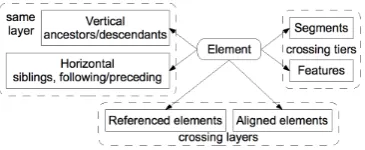
features, pointers and segments. A pointer is a typed directed reference to one or more elements. Elements relate to each other in different ways: di-rectly by structural relations of the layer, pointers and alignments and indirectly by locational and medial relations (cf. Fig. 4).
An annotation layercontains elements and de-fines structural relations between them, e.g. domi-nanceorneighborhoodrelations.
1(Laprun et al., 02) calls this
Analignmentdefines an equivalence class of el-ements, to each of which arolecan be assigned.
Pointerscan be used for structural relations that cross-cut the structural model of a layer or to create a relation across layer boundaries. Each pointer carries a role that specifies the kind of re-lation it models. Pointers allow an element to have multiple parents and to refer to other elements across annotation layers.
Featureshave a name and a value. They are al-ways bound to an annotation element and cannot exist on their own. For the time being we use this simple definition of a feature, as it mirrors the con-cept of XML attributes. However, future work has to analyze if the ISO 24610 feature structures can and should be modelled as a part of the structural tier or if the featural tier should be extended.
4 Query
To make use of annotated corpora, query methods need to be defined. Depending on the data storage model that is used, different query languages are possible, e.g. XQuery for XML or SQL for rela-tional databases. But these complicate query for-mulating because they are tailored to query a low level data storage model rather than a high level annotation data model.
A high level query language is necessary to get a good user acceptance and to achieve independence from lower level data models used to represent an-notation data in an efficient way. NXT comes with NQL (Evert et al., 03), a sophisticated declarative high level query language. NQL is implemented in a completely new query engine instead of us-ing XPath, XQuery or SQL. LPath, another recent development (Bird et al., 06), is a path-like query language. It is a linguistically motivated extension of XPath with additional axes and operators that allow additional queries and simplify others.
In some cases XML or SQL databases are sim-ply not suited for a specific query. While we might be able to do regular expression matches on textual base data in a SQL or XML environment, doing a similar operation on video base data is beyond their scope.
The NXT project plans a translation of NQL to XQuery in order to use existing XQuery engines. LPath and DDD map high level query languages to SQL. (Grust et al., 04) are working on translat-ing XQuery to SQL. The possibility of translattranslat-ing high level query languages into lower level query
languages seems a good point for modularization.
4.1 Structural queries
Structural query operators are strongly tied to the structure of annotation layers, because they reflect the structural relations inside a layer. However, we also define structural relations such as alignments and pointers that exist independently of layers (cf. Sec. 3.3). The separation between pointers, align-ments and different kinds of layers offers potential for modularization
[image:5.595.326.509.328.403.2]Layers allowing only for positional annotations know only one structural relation: the neigh-borhood relation between two adjacent positions. Layers following the XML data model know parent-child relations and neighborhood relations. Layers with different internal structures may offer other relations. A number of possible relations is shown in Figure 4.
Figure 4: Structural relations and crossing to other tiers
While the implementation of query operators depends on the internal layer structure, the syn-tax does not necessarily have to be different. For instance a f ollowing(a) operator of a positional layer will yield all elements following element
a. A hierarchical layer can have two kinds of
f ollowingoperators, one that only yields siblings followingaand one yielding all elements follow-inga. Here a choice has to be made if one of these operators is similar enough to the f ollowing(a) to share that name without confusing the user.
Operators to follow pointers or alignments can be implemented independently of the layer struc-ture.
Structural queries could look like this:
• Which noun phrases are inside verb phrases? //VP//NP
Result: a set of annotation elements.
• Anaphora are annotated using a pointer with the role ”anaphor”. What do determiners in the corpus refer to?
//DET/=>anaphor
Result: a set of annotation elements.
• Translated elements are aligned in an align-ment called ”translation”. What are the trans-lations of the current element?
self/#translation
Result: a set of annotation elements.
4.2 Featural queries
If we use the simple definition of features from Section 3.3, there is only one operator native to the featural tier that can be used to access the an-notation element associated with a feature. If we use the complex definition from ISO 24610, the operators of the featural tier are largely the same as in hierarchically structured annotation layers.
Operators to test the value of a feature can not strictly be assigned to the featural tier. Using the simple definition, the value of a feature is some typed atomic value. The query language has to provide generic operators to compare atomic val-ues like strings or numbers with each other. E.g. XPath provides a weakly typed system that pro-vides such operators.
Queries involving features could look like this:
• What is the value of the ”PoS” feature of the current annotation element?
self/@PoS
Result: a string value.
• What elements have a feature called ”PoS” with the value ”N”?
//*[@PoS=’N’]
Result: a set of annotation elements.
4.3 Locational queries
Locational queries operate on segment data. The inner structure of segments reflects the structure of signal space and different kinds of signals re-quire different operators. Most of the time opera-tors working on single continuous dimensions, e.g. a timeline, will be used. An operator working on
higher dimensions could be an intersection opera-tor of two dimensional signal space areas (scan of a newspaper page, video frames, etc.).
Queries involving locations could look like this:
• What parts of segmentsaandboverlap? overlap($a,$b)
Result: the empty set or a segment defining the overlapping part.
• Merge segmentsaandb. merge($a, $b)
Result: ifaandboverlap, the result is a new segment that covers both, otherwise the re-sults is a set consisting ofaandb.
• Is segmentafollowing segmentb? is-following($a, $b) Result: true or false.
Locational operators are probably best bundled into modules by the kind of locational structure they support: a module for sequential data such as text or audio, one for two-dimensional data such as pictures, and so on.
4.4 Medial queries
Medial query operators access base data, but often they take locational arguments or return locational information. When a medial operator is used to access textual base data, the result is a string. As with feature values, such a string could be evalu-ated by a query language that supports some prim-itive data types.
Assume there is a textual signal named ’plain-text’. Queries on base data could look like this:
• Where does the string ”rapid” occur? signal(’plaintext’)/’rapid’ Result: a set of segments.
• Where does the string ”prototyping” occur to the right of the location of ”rapid”?
signal(’plaintext’)/
’rapid’>>’prototyping’ Result: a set of segments.
• What is the base data between offset5and9 of the signal ”plaintext”?
signal(’plaintext’)/<{5,9}> Result: a portion of base data (e.g. a string).
be insufficient. In such a case a module provid-ing support for audio or video storage should also provide necessary query operators and data type extensions to the query engine.
4.5 Projection between annotational and medial tiers
So far we have considered crossing the borders be-tween the structural and featural tiers and bebe-tween the locational and medial tiers. Now we examine the border between the locational and structural tier. An operator can be used to collect all loca-tional data associated with an annotation element and its children:
seg(//S/VP/)
The result would be a set of potentially overlap-ping segments. Depending on the query, it will be necessary to merge overlapping segments to get a list of non-overlappping segments. Assume we have a recorded interview annotated for speakers and at some point speaker A and B speak at the same time. We want to listen to all parts of the interview in which speakers A or B speak. If we query without merging overlapping segments, we will hear the part in which both speak at the same time twice.
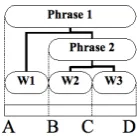
[image:7.595.146.215.528.596.2]Similar decisions have to be made when pro-jecting up from a segment into the structural layer. Figure 5 shows a hierarchical annotation struc-ture. Only the elements W1, W2 andW3 bear segments that anchor them to the base data at the pointsA-D.
Figure 5: Example structure
When projecting up from the segment {B, D}
there are a number of potentially desirable results. Some are given here:
1. no result: because there is no annotation ele-ment that is anchored to{B, D}.
2. W2 andW3: because both are anchored to an area inside{B, D}.
3. Phrase 2,W2andW3: because applying the seg operator to either element yields seg-ments inside{B, D}.
4. Phrase 2only: because applying theseg op-erator to this element yields an area that cov-ers exactly{B, D}.
5. Phrase 1, Phrase 2: because applying the seg operator to either element yields seg-ments containing{B, D}.
The query language has to provide operators that enable the user to choose the desired result. Queries that yield the desired results could look like in Figure 6. Here the same-extent operator takes two sets of segments and returns those seg-ments that are present in both lists and have the same start and end positions. Theanchored oper-ator takes an annotation element and returnstrue
if the element is anchored. Thecontainsoperator takes two sets of segmentsaandband returns all segments from setbthat are contained in an area covered by any segment in seta. Thegrow opera-tor takes a set of segments and returns a segment, which starts at the smallest offset and ends at the largest offset present in any segment of the input list. In the tests an empty set is interpreted asfalse
and a non-empty set astrue.
1. //*[same-extent(seg(.),
<{B,D}>)]
2. //*[anchored(.) and
contains(<{B,D}>, seg(.))]
3. //*[contains(<{B,D}>, seg(.))]
4. //*[same-extent(grow(seg(.)),
<{B,D}>)]
5. //*[contains(seg(.)), <{B,D}>]
Figure 6: Projection examples
5 Conclusion
ATLAS or NXT are very powerful, yet they suffer from lack of accessibility to programmers who have to adapt them to project-specific needs. Most specialized annotation editors do not build upon these frameworks and neither offer conver-sion tools between their data formats.
Projects such as DDD do not make use of the frameworks, because they are not easily extensi-ble, e.g. with a SQL backend instead of an XML storage. Instead, again a high level query language is developed and a completely new framework is created which works with a SQL backend.
In the previous sections, objects from selected approaches with different foci in their work with annotated corpora have been collected and forged into a comprehensive data model. The potential for modularization of corpus annotation frame-works has been shown with respect to data models and query languages. As a next step, an existing framework should be taken and refactored into an extensible modular architecture. From a practical point of view reusing existing technology as much as possible is a desirable goal. This means reusing existing facilities provided for XML data, such as XPath, XQuery and XSchema and where neces-sary trying to extend them, instead of creating a new data model from scratch. For the annotational tiers, as LPath has shown, a good starting point to do so is to extend existing languages like XPath. Locational and medial operators seem to be best implemented as XQuery functions. The possibil-ity to map between SQL and XML provides ac-cess to additional efficient resources for storing and querying annotation data. Support for various kinds of base data or locational information can be encapsulated in modules. Which modules exactly should be created and what they should cover in detail has to be further examined.
Acknowledgements
Many thanks go to Elke Teich and Peter Fankhauser for their support. Part of this research was financially supported by Hessischer Innova-tionsfonds and PACE (Partners for the Advance-ment of Collaborative Engineering Education).
References
S. Bartsch, R. Eckart, M. Holtz & E. Teich 2005.
Corpus-based register profiling of texts form
me-chanical engineering InProceedings of Corpus
Lin-guistics, Birmingham, UK, July 2005.
S. Bird & M. Liberman 2001. A Formal Framework
for Linguistic Annotation In Speech
Communica-tion 33(1,2), pp 23-60
S. Bird, Y. Chen, S. B. Davidson, H. Lee and Y. Zheng. 2006. Designing and Evaluating an XPath Dialect for Linguistic Queries. InProceedings of the 22nd International Conference on Data
Engineer-ing, ICDE 2006, 3-8 April 2006, Atlanta, GA, USA
J. Carletta, D. McKelvie, A. Isard, A. Mengel, M. Klein & M.B. Møller 2004 A generic approach to soft-ware support for linguistic annotation using XML InG. Sampson and D. McCarthy (eds.), Corpus Lin-guistics: Readings in a Widening Discipline. Lon-don and NY: Continuum International.
S. Evert, J. Carletta, T. J. O’Donnell, J. Kilgour, A.
V¨ogele & H. Voormann 2003. The NITE Object
Modelv2.1 http://www.ltg.ed.ac.uk/NITE/ documents/NiteObjectModel.v2.1.pdf
L. C. Faulstich, U. Leser & A. L¨udeling 2005. Storing and querying historical texts in a relational database In Informatik-Bericht 176, Institut f¨ur Informatik, Humboldt-Universit¨at zu Berlin, 2005.
T. Grust and S. Sakr and J. Teubner 2002. XQuery
on SQL Hosts InProceedings of the 30th Int’l
Con-ference on Very Large Data Bases (VLDB) Toronto, Canada, Aug. 2004.
M.A.K. Halliday. 2004. Introduction to Functional
Grammar. Arnold, London. Revised by CMIM Matthiessen
C. Laprun, J.G. Fiscus, J. Garofolo, S.
Pa-jot 2002. A practical introduction to
AT-LAS In Proceedings LREC 2002 Las Palmas
http://www.nist.gov/speech/atlas/download/lrec2002-atlas.pdf
M. Laurent Romary (chair) and TC 37/SC 4/WG 2
2006. Language resource management - Feature
structures - Part 1: Feature structure representation. InISO 24610-1.
C. M. Sperberg-McQueen & L. Burnard, (eds.) 2002.
TEI P4: Guidelines for Electronic Text Encoding and Interchange. Text Encoding Initiative Con-sortium. XML Version: Oxford, Providence, Char-lottesville, Bergen
E. Teich, P. Fankhauser, R. Eckart, S. Bartsch, M. Holtz. 2005. Representing SFL-annotated corpora. InProceedings of the First Computational Systemic Functional Grammar Workshop (CSFG), Sydney, Australia.
E. Teich, S. Hansen, and P. Fankhauser. 2001.
Rep-resenting and querying multi-layer corpora. In