Extractive Summarization using Inter- and Intra- Event Relevance
Wenjie Li, Mingli Wu and Qin Lu
Department of Computing
The Hong Kong Polytechnic University
{cswjli,csmlwu,csluqin}@comp
.polyu.edu.hk
Wei Xu and Chunfa Yuan
Department of Computer Science and
Technology, Tsinghua University
{vivian00,cfyuan}@mail.ts
inghua.edu.cn
Abstract
Event-based summarization attempts to select and organize the sentences in a summary with respect to the events or the sub-events that the sentences de-scribe. Each event has its own internal structure, and meanwhile often relates to other events semantically, temporally, spatially, causally or conditionally. In this paper, we define an event as one or more event terms along with the named entities associated, and present a novel approach to derive intra- and inter- event relevance using the information of inter-nal association, semantic relatedness, distributional similarity and named en-tity clustering. We then apply PageRank ranking algorithm to estimate the sig-nificance of an event for inclusion in a summary from the event relevance de-rived. Experiments on the DUC 2001 test data shows that the relevance of the named entities involved in events achieves better result when their rele-vance is derived from the event terms they associate. It also reveals that the topic-specific relevance from documents themselves outperforms the semantic relevance from a general purpose knowledge base like Word-Net.
1. Introduction
Extractive summarization selects sentences which contain the most salient concepts in documents. Two important issues with it are how the concepts are defined and what criteria should be used to judge the salience of the con-cepts. Existing work has typically been based on
techniques that extract key textual elements, such as keywords (also known as significant terms) as weighed by their tf*idf score, or con-cepts (such as events or entities) with linguistic and/or statistical analysis. Then, sentences are selected according to either the important textual units they contain or certain types of inter-sentence relations they hold.
Event-based summarization which has e-merged recently attempts to select and organize sentences in a summary with respect to events or sub-events that the sentences describe. With re-gard to the concept of events, people do not have the same definition when introducing it in different domains. While traditional linguistics work on semantic theory of events and the se-mantic structures of verbs, studies in information retrieval (IR) within topic detection and tracking framework look at events as narrowly defined topics which can be categorized or clustered as a set of related documents (TDT). IR events are broader (or to say complex) events in the sense that they may include happenings and their causes, consequences or even more extended effects. In the information extraction (IE) community, events are defined as the pre-specified and struc-tured templates that relate an action to its participants, times, locations and other entities involved (MUC-7). IE defines what people call atomic events.
Regardless of their distinct perspectives, peo-ple all agree that events are collections of activi-ties together with associated entiactivi-ties. To apply the concept of events in the context of text sum-marization, we believe it is more appropriate to consider events at the sentence level, rather than at the document level. To avoid the complexity of deep semantic and syntactic processing, we complement the advantages of statistical techniques from the IR community and struc-tured information provided by the IE community.
We propose to extract semi-structured events with shallow natural language processing (NLP) techniques and estimate their importance for inclusion in a summary with IR techniques.
Though it is most likely that documents nar-rate more than one similar or related event, most event-based summarization techniques reported so far explore the importance of the events inde-pendently. Motivated by this observation, this paper addresses the task of event-relevance based summarization and explores what sorts of relevance make a contribution. To this end, we investigate intra-event relevance, that is action-entity relevance, and inter-event relevance, that is event-event relevance. While intra-event rele-vance is measured with frequencies of the asso-ciated events and entities directly, inter-event relevance is derived indirectly from a general WordNet similarity utility, distributional simi-larity in the documents to be summarized, named entity clustering and so on. Pagerank ranking algorithm is then applied to estimate the event importance for inclusion in a summary using the aforesaid relevance.
The remainder of this paper is organized as follows. Section 2 introduces related work. Sec-tions 3 introduces our proposed event-based summarization approaches which make use of intra- and inter- event relevance. Section 4 pre-sents experiments and evaluates different ap-proaches. Finally, Section 5 concludes the paper.
2. Related Work
Event-based summarization has been investi-gated in recent research. It was first presented in (Daniel, Radev and Allison, 2003), who treated a news topic in multi-document summarization as a series of sub-events according to human understanding of the topic. They determined the degree of sentence relevance to each sub-event through human judgment and evaluated six ex-tractive approaches. Their paper concluded that recognizing the sub-events that comprise a sin-gle news event is essential for producing better summaries. However, it is difficult to automati-cally break a news topic into sub-events.
Later, atomic events were defined as the rela-tionships between the important named entities (Filatova and Hatzivassiloglou, 2004), such as participants, locations and times (which are called relations) through the verbs or action nouns labeling the events themselves (which are called connectors). They evaluated sentences
based on co-occurrence statistics of the named entity relations and the event connectors in-volved. The proposed approach claimed to out-perform conventional tf*idf approach. Appar-ently, named entities are key elements in their model. However, the constraints defining events seemed quite stringent.
The application of dependency parsing, anaphora and co-reference resolution in recog-nizing events were presented involving NLP and IE techniques more or less (Yoshioka and Hara-guchi, 2004), (Vanderwende, Banko and Mene-zes, 2004) and (Leskovec, Grobelnik and Fral-ing, 2004). Rather than pre-specifying events, these efforts extracted (verb)-(dependent rela-tion)-(noun) triples as events and took the triples to form a graph merged by relations.
As a matter of fact, events in documents are related in some ways. Judging whether the sen-tences are salient or not and organizing them in a coherent summary can take advantage from event relevance. Unfortunately, this was ne-glected in most previous work. Barzilay and La-pata (2005) exploited the use of the distribu-tional and referential information of discourse entities to improve summary coherence. While they captured text relatedness with entity transi-tion sequences, i.e. entity-based summarizatransi-tion, we are particularly interested in relevance be-tween events in event-based summarization.
Extractive summarization requires ranking sentences with respect to their importance. Successfully used in Web-link analysis and more recently in text summarization, Google’s PageRank (Brin and Page, 1998) is one of the most popular ranking algorithms. It is a kind of graph-based ranking algorithm deciding on the importance of a node within a graph by taking into account the global information recursively computed from the entire graph, rather than re-lying on only the local node-specific infor-mation. A graph can be constructed by adding a node for each sentence, phrase or word. Edges between nodes are established using inter-sentence similarity relations as a function of content overlap or grammatically relations be-tween words or phrases.
exten-sively (Mihalcea, 2005). Yoshioka and Haragu-chi (2004) went one step further toward event-based summarization. Two sentences were linked if they shared similar events. When tested on TSC-3, the approach favoured longer sum-maries. In contrast, the importance of the verbs and nouns constructing events was evaluated with PageRank as individual nodes aligned by their dependence relations (Vanderwende, 2004; Leskovec, 2004).
Although we agree that the fabric of event constitutions constructed by their syntactic rela-tions can help dig out the important events, we have two comments. First, not all verbs denote event happenings. Second, semantic similarity or relatedness between action words should be taken into account.
3. Event-based Summarization
3.1. Event Definition and Event Map
Events can be broadly defined as “Who did What to Whom When and Where”. Both lin-guistic and empirical studies acknowledge that event arguments help characterize the effects of a verb’s event structure even though verbs or other words denoting event determine the se-mantics of an event. In this paper, we choose verbs (such as “elect”) and action nouns (such as “supervision”) as event terms that can character-ize or partially charactercharacter-ize actions or incident
occurrences. They roughly relate to “did What”. One or more associated named entities are con-sidered as what are denoted by linguists as event arguments. Four types of named entities are cur-rently under the consideration. These are <Per-son>, <Organization>, <Location> and <Date>. They convey the information of “Who”, “Whom”, “When” and “Where”. A verb or an action noun is deemed as an event term only when it presents itself at least once between two named entities.
[image:3.595.128.472.547.608.2]Events are commonly related with one an-other semantically, temporally, spatially, caus-ally or conditioncaus-ally, especicaus-ally when the docu-ments to be summarized are about the same or very similar topics. Therefore, all event terms and named entities involved can be explicitly connected or implicitly related and weave a document or a set of documents into an event fabric, i.e. an event graphical representation (see Figure 1). The nodes in the graph are of two types. Event terms (ET) are indicated by rectan-gles and named entities (NE) are indicated by ellipses. They represent concepts rather than instances. Words in either their original form or morphological variations are represented with a single node in the graph regardless of how many times they appear in documents. We call this representation an event map, from which the most important concepts can be pick out in the summary.
Figure 1 Sample sentences and their graphical representation
The advantage of representing with separated action and entity nodes over simply combining them into one event or sentence node is to pro-vide a convenient way for analyzing the rele-vance among event terms and named entities either by their semantic or distributional similar-ity. More importantly, this favors extraction of concepts and brings the conceptual compression available.
We then integrate the strength of the connec-tions between nodes into this graphical model in terms of the relevance defined from different perspectives. The relevance is indicated by
) , (nodei nodej
r , where nodei and nodej repre-sent two nodes, and are either event terms (eti) or named entities (nej). Then, the significance of each node, indicated by w(nodei), is
lated with PageRank ranking algorithm. Sec-tions 3.2 and 3.3 address the issues of deriving
) , (nodei nodej
r according to intra- or/and inter-
event relevance and calculating w(nodei) in de-tail.
3.2 Intra- and Inter- Event Relevance
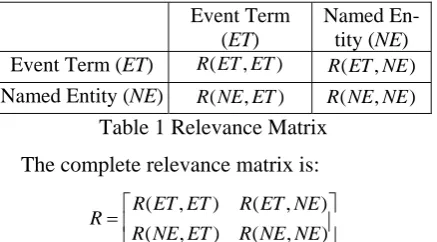
We consider both intra-event and inter-event relevance for summarization. Intra-event rele-vance measures how an action itself is associ-ated with its associassoci-ated arguments. It is indi-cated as R(ET,NE) and R(NE,ET) in Table 1 below. This is a kind of direct relevance as the connections between actions and arguments are established from the text surface directly. No inference or background knowledge is required. We consider that when the connection between an event term eti and a named entity nej is
symmetry, then R(NE,ET)=R(ET,NE)T. Events are related as explained in Section 2. By means of inter-event relevance, we consider how an event term (or a named entity involved in an event) associate to another event term (or an-other named entity involved in the same or dif-ferent events) syntactically, semantically and distributionally. It is indicated by R(ET,ET)or
) , (NE NE
R in Table 1 and measures an indirect
connection which is not explicit in the event map needing to be derived from the external resource or overall event distribution.
Event Term
(ET)
Named En-tity (NE) Event Term (ET) R(ET,ET) R(ET,NE)
[image:4.595.73.292.481.602.2]Named Entity (NE) R(NE,ET) R(NE,NE) Table 1 Relevance Matrix
The complete relevance matrix is:
⎥ ⎦ ⎤ ⎢ ⎣ ⎡ = ) , ( ) , ( ) , ( ) , ( NE NE R ET NE R NE ET R ET ET R R
The intra-event relevance R(ET,NE)can be simply established by counting how many times
i
et and nej are associated, i.e.
) , ( ) ,
( i j i j
Document et ne freqet ne
r = (E1)
One way to measure the term relevance is to make use of a general language knowledge base, such as WordNet (Fellbaum 1998). Word-Net::Similarity is a freely available software package that makes it possible to measure the semantic relatedness between a pair of concepts,
or in our case event terms, based on WordNet (Pedersen, Patwardhan and Michelizzi, 2004). It supports three measures. The one we choose is the function lesk.
) , ( ) , ( ) ,
( i j i j i j
WordNet et et similarity et et lesk et et
r = =
(E2)
Alternatively, term relevance can be meas-ured according to their distributions in the speci-fied documents. We believe that if two events are concerned with the same participants, occur at same location, or at the same time, these two events are interrelated with each other in some ways. This observation motivates us to try deriv-ing event term relevance from the number of name entities they share.
| ) ( ) ( | ) ,
( i j i j
Document et et NE et NE et
r = ∩ (E3)
Where NE(eti)is the set of named entities eti associate. | | indicates the number of the ele-ments in the set. The relevance of named entities can be derived in a similar way.
| ) ( ) ( | ) ,
( i j i j
Document ne ne ET ne ET ne
r = ∩ (E4)
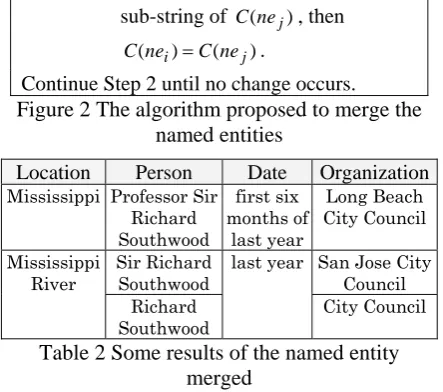
The relevance derived with (E3) and (E4) are indirect relevance. In previous work, a cluster-ing algorithm, shown in Figure 2, has been pro-posed (Xu et al, 2006) to merge the named en-tity that refer to the same person (such as
Ranariddh, Prince Norodom Ranariddh and Presi-dent Prince Norodom Ranariddh). It is used for co-reference resolution and aims at joining the same concept into a single node in the event map. The experimental result suggests that merging named entity improves performance in some extend but not evidently. When applying the same algorithm for clustering all four types of name entities in DUC data, we observe that the name entities in the same cluster do not al-ways refer to the same objects, even when they are indeed related in some way. For example, “Mississippi” is a state in the southeast United States, while “Mississippi River” is the second-longest rever in the United States and flows through “Mississippi”.
Step1: Each name entity is represented by
ik i i i w w w
ne = 1 2... , where wi is the ith word in it. The cluster it belongs to, in-dicated by C(nei), is initialled by
ik i i w w
w1 2... itself. Step2: For each name entity nei =wi1wi2...wik
jl j j
j w w w
ne = 1 2... , if C(nei) is a sub-string of C(nej), then
) ( )
(nei C nej
C = .
[image:5.595.70.292.88.284.2]Continue Step 2 until no change occurs. Figure 2 The algorithm proposed to merge the
named entities
Location Person Date Organization Mississippi Professor Sir
Richard Southwood first six months of last year Long Beach City Council Sir Richard
Southwood San Jose City Council Mississippi River Richard Southwood last year City Council
Table 2 Some results of the named entity merged
It therefore provides a second way to measure named entity relevance based on the clusters found. It is actually a kind of measure of lexical similarity. ⎩ ⎨ ⎧ = otherwise , 0 cluster same in the are , , 1 ) ,
( i j i j
Cluster ne ne ne ne r (E5)
In addition, the relevance of the named enti-ties can be sometimes revealed by sentence con-text. Take the following most frequently used sentence patterns as examples:
Figure 3 The example patterns
Considering that two neighbouring name enti-ties in a sentence are usually relevant, the fol-lowing window-based relevance is also experi-mented with. ⎩ ⎨ ⎧ = otherwise , 0 size window specified -pre a within are , 1, ) , ( j i j i Pattern ne ne ne ne r (E6)
3.3 Significance of Concepts
The significance score, i.e. the weight )
(nodei
w of each nodei, is then estimated recur-sively with PageRank ranking algorithm which assigns the significance score to each node ac-cording to the number of nodes connecting to it as well as the strength of their connections. The
equation calculating w(nodei) using PageRank of a certain nodei is shown as follows.
) ) , ( ) ( ... ) , ( ) ( ... ) , ( ) ( ( ) 1 ( ) ( 1 1 t i t j i j i i node node r node w node node r node w node node r node w d d node w + + + + + − = (E7)
In (E7), nodej ( j =1,2,...t , j≠ i ) are the nodes linking to nodei. d is the factor used to avoid the limitation of loop in the map structure. It is set to 0.85 experimentally. The significance of each sentence to be included in the summary is then obtained from the significance of the events it contains. The sentences with higher significance are picked up into the summary as long as they are not exactly the same sentences. We are aware of the important roles of informa-tion fusion and sentence compression in sum-mary generation. However, the focus of this pa-per is to evaluate event-based approaches in ex-tracting the most important sentences. Concep-tual extraction based on event relevance is our future direction.
4. Experiments and Discussions
To evaluate the event based summarization ap-proaches proposed, we conduct a set of experi-ments on 30 English document sets provide by the DUC 2001 multi-document summarization task. The documents are pre-processed with GATE to recognize the previously mentioned four types of name entities. On average, each set contains 10.3 documents, 602 sentences, 216 event terms and 148.5 name entities.
To evaluate the quality of the generated summaries, we choose an automatic summary evaluation metric ROUGE, which has been used in DUCs. ROUGE is a recall-based metric for fixed length summaries. It bases on N-gram co-occurrence and compares the system generated summaries to human judges (Lin and Hovy, 2003). For each DUC document set, the system creates a summary of 200 word length and pre-sent three of the ROUGE metrics: ROUGE-1 (unigram-based), ROUGE-2 (bigram-based), and ROUGE-W (based on longest common sub-sequence weighed by the length) in the follow-ing experiments and evaluations.
We first evaluate the summaries generated based on R(ET,NE) itself. In the pre-evaluation experiments, we have observed that some
fre-<Person>, a-position-name of <Organization>, does something.
quently occurring nouns, such as “doctors” and “hospitals”, by themselves are not marked by general NE taggers. But they indicate persons, organizations or locations. We compare the ROUGE scores of adding frequent nouns or not to the set of named entities in Table 3. A noun is considered as a frequent noun when its fre-quency is larger than 10. Roughly 5% improve-ment is achieved when high frequent nouns are taken into the consideration. Hereafter, when we mention NE in latter experiments, the high fre-quent nouns are included.
) , (ET NE
R NE Without High Frequency Nouns
NE With High Frequency Nouns
ROUGE-1 0.33320 0.34859
ROUGE-2 0.06260 0.07157
ROUGE-W 0.12965 0.13471
Table 3 ROUGE scores using R(ET,NE) itself
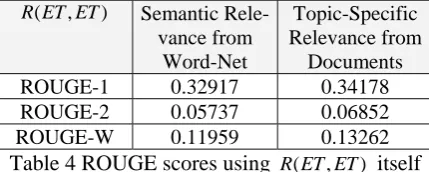
Table 4 below then presents the summariza-tion results by usingR(ET,ET) itself. It com-pares two relevance derivation approaches,
WordNet
R and RDocument. The topic-specific rele-vance derived from the documents to be summa-rized outperforms the general purpose Word-Net relevance by about 4%. This result is reasonable as WordNet may introduce the word relatedness which is not necessary in the topic-specific documents. When we examine the relevance matrix from the event term pairs with the high-est relevant, we find that the pairs, like “abort” and “confirm”, “vote” and confirm”, do reflect semantics (antonymous) and associated (causal) relations to some degree.
) , (ET ET
R Semantic Rele-vance from
Word-Net
Topic-Specific Relevance from
Documents
ROUGE-1 0.32917 0.34178
ROUGE-2 0.05737 0.06852
ROUGE-W 0.11959 0.13262
Table 4 ROUGE scores using R(ET,ET) itself
Surprisingly, the best individual result is from document distributional similarity RDocument
) ,
(NE NE in Table 5. Looking more closely, we conclude that compared to event terms, named entities are more representative of the docu-ments in which they are included. In other words, event terms are more likely to be distributed around all the document sets, whereas named entities are more topic-specific and therefore cluster in a particular document set more. Ex-amples of high related named entities in rele-vance matrix are “Andrew” and “Florida”,
“Louisiana” and “Florida”. Although their rele-vance is not as explicit as the same of event terms (their relevance is more contextual than semantic), we can still deduce that some events may happen in both Louisiana and Florida, or about Andrew in Florida. In addition, it also shows that the relevance we would have ex-pected to be derived from patterns and clustering can also be discovered by RDocument(NE,NE). The window size is set to 5 experimentally in window-based practice.
) , (NE NE
R Relevance
from Documents
Relevance from Clustering
Relevance from
[image:6.595.72.287.515.601.2]Window-based Context ROUGE-1 0.35212 0.33561 0.34466 ROUGE-2 0.07107 0.07286 0.07508 ROUGE-W 0.13603 0.13109 0.13523
Table 5 ROUGE scores using R(NE,NE) itself
Next, we evaluate the integration of )
, (ET NE
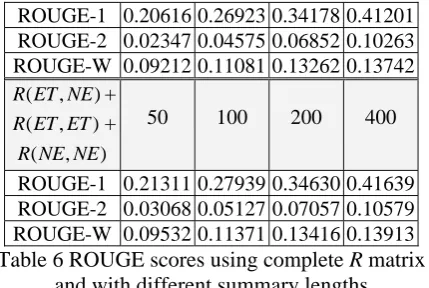
R , R(ET,ET) and R(NE,NE) . As DUC 2001 provides 4 different summary sizes for evaluation, it satisfies our desire to test the sensibility of the proposed event-based summa-rization techniques to the length of summaries. While the previously presented results are evaluated on 200 word summaries, now we move to check the results in four different sizes, i.e. 50, 100, 200 and 400 words. The experi-ments results show that the event-based ap-proaches indeed prefer longer summaries. This is coincident with what we have hypothesized. For this set of experiments, we choose to inte-grate the best method from each individual evaluation presented previously. It appears that using the named entities relevance which is de-rived from the event terms gives the best ROUGE scores in almost all the summery sizes. Compared with the results provided in (Filatova and Hatzivassiloglou, 2004) whose average ROUGE-1 score is below 0.3 on the same data set, the significant improvement is revealed. Of course, we need to test on more data in the fu-ture.
) , (NE NE
R 50 100 200 400
ROUGE-1 0.22383 0.28584 0.35212 0.41612 ROUGE-2 0.03376 0.05489 0.07107 0.10275 ROUGE-W 0.10203 0.11610 0.13603 0.13877
) , (ET NE
R 50 100 200 400
ROUGE-1 0.22224 0.27947 0.34859 0.41644 ROUGE-2 0.03310 0.05073 0.07157 0.10369 ROUGE-W 0.10229 0.11497 0.13471 0.13850
) , (ET ET
ROUGE-1 0.20616 0.26923 0.34178 0.41201 ROUGE-2 0.02347 0.04575 0.06852 0.10263 ROUGE-W 0.09212 0.11081 0.13262 0.13742
) , (ET NE
R +
) , (ET ET
R +
) , (NE NE R
50 100 200 400
ROUGE-1 0.21311 0.27939 0.34630 0.41639 ROUGE-2 0.03068 0.05127 0.07057 0.10579 ROUGE-W 0.09532 0.11371 0.13416 0.13913 Table 6 ROUGE scores using complete R matrix
and with different summary lengths
As discussed in Section 3.2, the named enti-ties in the same cluster may often be relevant but not always be co-referred. In the following last set of experiments, we evaluate the two ways to use the clustering results. One is to consider them as related as if they are in the same cluster and derive the NE-NE relevance with (E5). The other is to merge the entities in one cluster as one reprehensive named entity and then use it in
ET-NE with (E1). The rationality of the former approach is validated.
Clustering is used to derive
NE-NE
Clustering is used to merge entities and then to derive ET-NE
ROUGE-1 0.34072 0.33006
ROUGE-2 0.06727 0.06154
[image:7.595.74.289.71.215.2]ROUGE-W 0.13229 0.12845
Table 7 ROUGE scores with regard to how to use the clustering information
5. Conclusion
In this paper, we propose to integrate event-based approaches to extractive summarization. Both inter-event and intra-event relevance are investigated and PageRank algorithm is used to evaluate the significance of each concept (in-cluding both event terms and named entities). The sentences containing more concepts and highest significance scores are chosen in the summary as long as they are not the same sen-tences.
To derive event relevance, we consider the associations at the syntactic, semantic and con-textual levels. An important finding on the DUC 2001 data set is that making use of named entity relevance derived from the event terms they as-sociate with achieves the best result. The result of 0.35212 significantly outperforms the one reported in the closely related work whose aver-age is below 0.3. We are interested in the issue of how to improve an event representation in
order to build a more powerful event-based summarization system. This would be one of our future directions. We also want to see how con-cepts rather than sentences are selected into the summary in order to develop a more flexible compression technique and to know what char-acteristics of a document set is appropriate for applying event-based summarization techniques.
Acknowledgements
The work presented in this paper is supported partially by Research Grants Council on Hong Kong (reference number CERG PolyU5181/03E) and partially by National Natural Science Foun-dation of China (reference number: NSFC 60573186).
References
Chin-Yew Lin and Eduard Hovy. 2003. Automatic Evaluation of Summaries using N-gram Co-occurrence Statistics. In Proceedings of HLT-NAACL 2003, pp71-78.
Christiane Fellbaum. 1998, WordNet: An Electronic Lexical Database. MIT Press.
Elena Filatova and Vasileios Hatzivassiloglou. 2004. Event-based Extractive summarization. In Pro-ceedings of ACL 2004 Workshop on Summariza-tion, pp104-111.
Gunes Erkan and Dragomir Radev. 2004. LexRank: Graph-based Centrality as Salience in Text Sum-marization. Journal of Artificial Intelligence Re-search.
Jure Leskovec, Marko Grobelnik and Natasa Milic-Frayling. 2004. Learning Sub-structures of Docu-ment Semantic Graphs for DocuDocu-ment Summariza-tion. In LinkKDD 2004.
Lucy Vanderwende, Michele Banko and Arul Mene-zes. 2004. Event-Centric Summary Generation. In Working Notes of DUC 2004.
Masaharu Yoshioka and Makoto Haraguchi. 2004. Multiple News Articles Summarization based on Event Reference Information. In Working Notes of NTCIR-4, Tokyo.
MUC-7. http://www-nlpir.nist.gov/related_projects/ muc/proceeings/ muc_7_toc.html
Page Lawrence, Brin Sergey, Motwani Rajeev and Winograd Terry. 1998. The PageRank Citation Ranking: Bring Order to the Web. Technical Re-port, Stanford University.
Rada Mihalcea. 2005. Language Independent Extrac-tive Summarization. ACL 2005 poster.
Regina Barzilay and Michael Elhadad. 2005. Model-ling Local Coherence: An Entity-based Approach. In Proceedings of ACL, pp141-148.
TDT. http://projects.ldc.upenn.edu/TDT.
Ted Pedersen, Siddharth Patwardhan and Jason Michelizzi. 2004. WordNet::Similarity – Measur-ing the Relatedness of Concepts. In ProceedMeasur-ings of AAAI, pp25-29.