Accurate Collocation Extraction Using a Multilingual Parser
Violeta Seretan
Language Technology Laboratory University of Geneva 2, rue de Candolle, 1211 Geneva
Eric Wehrli
Language Technology Laboratory University of Geneva 2, rue de Candolle, 1211 Geneva
Abstract
This paper focuses on the use of advanced techniques of text analysis as support for collocation extraction. A hybrid system is presented that combines statistical meth-ods and multilingual parsing for detecting accurate collocational information from English, French, Spanish and Italian cor-pora. The advantage of relying on full parsing over using a traditional window method (which ignores the syntactic in-formation) is first theoretically motivated, then empirically validated by a compara-tive evaluation experiment.
1 Introduction
Recent computational linguistics research fully ac-knowledged the stringent need for a systematic and appropriate treatment of phraseological units in natural language processing applications (Sag et al., 2002). Syntagmatic relations between words — also called multi-word expressions, or “id-iosyncratic interpretations that cross word bound-aries” (Sag et al., 2002, 2) — constitute an im-portant part of the lexicon of a language: accord-ing to Jackendoff (1997), they are at least as nu-merous as the single words, while according to Mel’ˇcuk (1998) they outnumber single words ten to one.
Phraseological units include a wide range of phenomena, among which we mention compound nouns (dead end), phrasal verbs (ask out), idioms (lend somebody a hand), and collocations (fierce battle, daunting task, schedule a meeting). They pose important problems for NLP applications, both text analysis and text production perspectives being concerned.
In particular, collocations1are highly problem-atic, for at least two reasons: first, because their linguistic status and properties are unclear (as pointed out by McKeown and Radev (2000), their definition is rather vague, and the distinction from other types of expressions is not clearly drawn); second, because they are prevalent in language. Mel’ˇcuk (1998, 24) claims that “collocations make up the lions share of the phraseme inventory”, and a recent study referred in (Pearce, 2001) showed that each sentence is likely to contain at least one collocation.
Collocational information is not only useful, but also indispensable in many applications. In ma-chine translation, for instance, it is considered “the key to producing more acceptable output” (Orliac and Dillinger, 2003, 292).
This article presents a system that extracts ac-curate collocational information from corpora by using a syntactic parser that supports several lan-guages. After describing the underlying method-ology (section 2), we report several extraction re-sults for English, French, Spanish and Italian (sec-tion 3). Then we present in sec(sec-tions 4 and 5 a com-parative evaluation experiment proving that a hy-brid approach leads to more accurate results than a classical approach in which syntactic information is not taken into account.
2 Hybrid Collocation Extraction
We consider that syntactic analysis of source cor-pora is an inescapable precondition for colloca-tion extraccolloca-tion, and that the syntactic structure of source text has to be taken into account in order to ensure the quality and interpretability of results.
1To put it simply, collocations are non-idiomatical, but
restricted, conventional lexical combinations.
As a matter of fact, some of the existing colloca-tion extraccolloca-tion systems already employ (but only to a limited extent) linguistic tools in order to sup-port the collocation identification in text corpora. For instance, lemmatizers are often used for recog-nizing all the inflected forms of a lexical item, and POS taggers are used for ruling out certain cate-gories of words, e.g., in (Justeson and Katz, 1995). Syntactic analysis has long since been recog-nized as a prerequisite for collocation extraction (for instance, by Smadja2), but the traditional sys-tems simply ignored it because of the lack, at that time, of efficient and robust parsers required for processing large corpora. Oddly enough, this situ-ation is nowadays perpetuated, in spite of the dra-matic advances in parsing technology. Only a few exceptions exists, e.g., (Lin, 1998; Krenn and Ev-ert, 2001).
One possible reason for this might be the way that collocations are generally understood, as a purely statistical phenomenon. Some of the best-known definitions are the following: “Colloca-tions of a given word are statements of the ha-bitual and customary places of that word” (Firth, 1957, 181); “arbitrary and recurrent word combi-nation” (Benson, 1990); or “sequences of lexical items that habitually co-occur” (Cruse, 1986, 40). Most of the authors make no claims with respect to the grammatical status of the collocation, although this can indirectly inferred from the examples they provide.
On the contrary, other definitions state explic-itly that a collocation is an expression of language: “co-occurrence of two or more lexical items as realizations of structural elements within a given syntactic pattern” (Cowie, 1978); “a sequence of two or more consecutive words, that has character-istics of a syntactic and semantic unit” (Choueka, 1988). Our approach is committed to these later definitions, hence the importance we lend to us-ing appropriate extraction methodologies, based on syntactic analysis.
The hybrid method we developed relies on the parser Fips (Wehrli, 2004), that implements the Government and Binding formalism and supports several languages (besides the ones mentioned in
2
“Ideally, in order to identify lexical relations in a corpus one would need to first parse it to verify that the words are used in a single phrase structure. However, in practice, free-style texts contain a great deal of nonstandard features over which automatic parsers would fail. This fact is being seri-ously challenged by current research (...), and might not be true in the near future” (Smadja, 1993, 151).
the abstract, a few other are also partly dealt with). We will not present details about the parser here; what is relevant for this paper is the type of syn-tactic structures it uses. Each constituent is rep-resented by a simplified X-bar structure (without intermediate level), in which to the lexical head is attached a list of left constituents (its specifiers) and right constituents (its complements), and each of these are in turn represented by the same type of structure, recursively.
Generally speaking, a collocation extraction can be seen as a two-stage process:
I. in stage one, collocation candidates are iden-tified from the text corpora, based on criteria which are specific to each system;
II. in stage two, the candidates are scored and ranked using specific association measures
(a review can be found in (Manning and Sch¨utze, 1999; Evert, 2004; Pecina, 2005)).
According to this description, in our approach the parser is used in the first stage of extraction, for identifying the collocation candidates. A pair of lexical items is selected as a candidate only if there is a syntactic relation holding between the two items (one being the head of the current parse structure, and the other the lexical head of its spec-ifier/complement). Therefore, the criterion we em-ploy for candidate selection is the syntactic prox-imity, as opposed to the linear proximity used by traditional, window-based methods.
As the parsing goes on, the syntactic word pairs are extracted from the parse structures created, from each head-specifier or head-complement re-lation. The pairs obtained are then partitioned according to their syntactic configuration (e.g., noun + adjectival or nominal specifier, noun + argument, noun + adjective in predications, verb + adverbial specifier, verb + argument (subject, object), verb + adjunt, etc). Finally, the log-likelihood ratios test (henceforth LLR) (Dunning, 1993) is applied on each set of pairs. We call this method hybrid, since it combines syntactic and statistical information (about word and co-occurrence frequency).
1.a) raise question: The question of political leadership has beenraised
several times by previous speakers.
1.b) play role: Whatrolecan Canada’s immigration programplayin help-ing develophelp-ing nations... ?
1.c) make mistake: We could look back and probably see a lot ofmistakes
that all parties including Canada perhaps may havemade.
3 Multilingual Extraction Results
In this section, we present several extraction re-sults obtained with the system presented in sec-tion 2. The experiments were performed on data in the four languages, and involved the following corpora: for English and French, a subpart or the Hansard Corpus of proceedings from the Canadian Parliament; for Italian, documents from the Swiss Parliament; and for Spanish, a news corpus dis-tributed by the Linguistic Data Consortium.
Some statistics on these corpora, some process-ing details and quantitative results are provided in Table 1. The first row lists the corpora size (in tokens); the next three rows show some parsing statistics3, and the last rows display the number of collocation candidates extracted and of candidates for which the LLR score could be computed4.
Statistics English French Spanish Italian
tokens 3509704 1649914 1023249 287804
sentences 197401 70342 67502 12008
compl. parse 139498 50458 13245 4511
avg. length 17.78 23.46 15.16 23.97
pairs 725025 370932 162802 58258
(extracted) 276670 147293 56717 37914
pairs 633345 308410 128679 47771
(scored) 251046 131384 49495 30586
Table 1: Extraction statistics
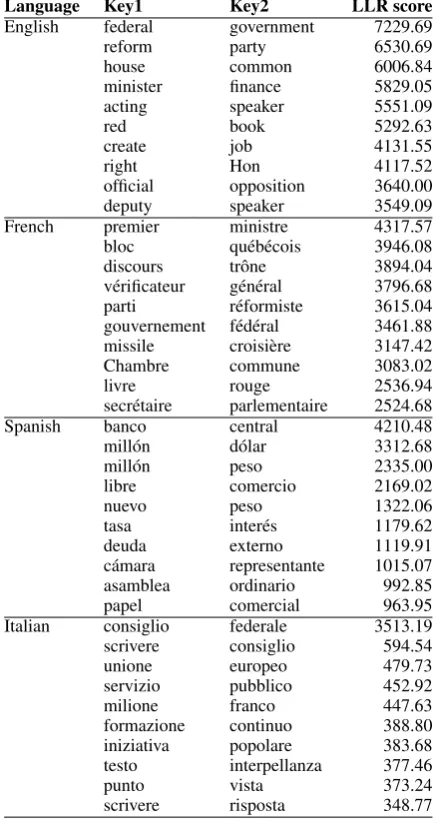
In Table 2 we list the top collocations (of length two) extracted for each language. We do not specifically discuss here multilingual issues in col-location extraction; these are dealt with in a sepa-rate paper (Seretan and Wehrli, 2006).
3The low rate of completely parsed sentences for Spanish
and Italian are due to the relatively reduced coverage of the parsers of these two languages (under development). How-ever, even if a sentence is not assigned a complete parse tree, some syntactic pairs can still be collected from the partial parses.
4The log-likelihood ratios score is undefined for those
pairs having a cell of the contingency table equal to 0.
Language Key1 Key2 LLR score
English federal government 7229.69 reform party 6530.69 house common 6006.84 minister finance 5829.05 acting speaker 5551.09
red book 5292.63
create job 4131.55
right Hon 4117.52
official opposition 3640.00 deputy speaker 3549.09 French premier ministre 4317.57 bloc qu´eb´ecois 3946.08 discours trˆone 3894.04 v´erificateur g´en´eral 3796.68 parti r´eformiste 3615.04 gouvernement f´ed´eral 3461.88 missile croisi`ere 3147.42 Chambre commune 3083.02
livre rouge 2536.94
secr´etaire parlementaire 2524.68 Spanish banco central 4210.48 mill´on d´olar 3312.68 mill´on peso 2335.00 libre comercio 2169.02
nuevo peso 1322.06
tasa inter´es 1179.62 deuda externo 1119.91 c´amara representante 1015.07 asamblea ordinario 992.85 papel comercial 963.95 Italian consiglio federale 3513.19 scrivere consiglio 594.54 unione europeo 479.73 servizio pubblico 452.92 milione franco 447.63 formazione continuo 388.80 iniziativa popolare 383.68 testo interpellanza 377.46
punto vista 373.24
[image:3.595.307.524.64.475.2]scrivere risposta 348.77
Table 2: Top ten collocations extracted for each language
The collocation pairs obtained were further pro-cessed with a procedure of long collocations ex-traction described elsewhere (Seretan et al., 2003). Some examples of collocations of length 3, 4 and 5 obtained are: minister of Canadian her-itage,house proceed to statement by,secretary to leader of gouvernment in house of common(En),
question adresser `a ministre, programme de aide `a r´enovation r´esidentielle, agent employer force susceptible causer (Fr),bolsa de comercio local,
peso en cuota de fondo de inversi´on,permitir uso de papel de deuda esterno(Sp),consiglio federale disporre,creazione di nuovo posto di lavoro, cos-tituire fattore penalizzante per regione(It)5.
5Note that the output of the procedure contains lemmas
4 Comparative Evaluation Hypotheses
4.1 Does ParsingReallyHelp?
Extracting collocations from raw text, without pre-processing the source corpora, offers some clear advantages over linguistically-informed methods such as ours, which is based on the syntactic anal-ysis: speed (in contrast, parsing large corpora of texts is expected to be much more time consum-ing), robustness (symbolic parsers are often not robust enough for processing large quantities of data), portability(no need to a priori define syn-tactic configurations for collocations candidates).
On the other hand, these basic systems suffer from the combinatorial explosion if the candidate pairs are chosen from a large search space. To cope with this problem, a candidate pair is usu-ally chosen so that both words are inside a context (‘collocational’) window of a small length. A 5 -word window is the norm, while longer windows prove impractical (Dias, 2003).
It has been argued that a window size of 5 is actually sufficient for capturing most of the col-locational relations from texts in English. But there is no evidence sustaining that the same holds for other languages, like German or the Romance ones that exhibit freer word order. Therefore, as window-based systems miss the ‘long-distance’ pairs, their recall is presumably lower than that of parse-based systems. However, the parser could also miss relevant pairs due to inherent analysis errors.
As for precision, the window systems are sus-ceptible to return more noise, produced by the grammatically unrelated pairs inside the colloca-tional window. By dividing the number of gram-matical pairs by the total number of candidates considered, we obtain the overall precision with respect to grammaticality; this result is expected to be considerably worse in the case of basic method than for the parse-based methods, just by virtue of the parsing task. As for the overall precision with respect to collocability, we expect the propor-tional figures to be preserved. This is because the parser-based methods return less, but better pairs (i.e., only the pairs identified as grammatical), and because collocations are a subset of the grammat-ical pairs.
Summing up, the evaluation hypothesis that can be stated here is the following: parse-based meth-ods outperform basic methmeth-ods thanks to a drastic reduction of noise. While unquestionable under
the assumption of perfect parsing, this hypothesis has to be empirically validated in an actual setting.
4.2 Is More Data Better Than Better Data?
The hypothesis above refers to the overall preci-sion and recall, that is, relative to the entire list of selected candidates. One might argue that these numbers are less relevant for practice than they are from a theoretical (evaluation) perspective, and that the exact composition of the list of candi-dates identified is unimportant if only the top re-sults (i.e., those pairs situated above a threshold) are looked at by a lexicographer or an application. Considering a threshold for the n-best candi-dates works very much in the favor of basic meth-ods. As the amount of data increases, there is a reduction of the noise among the best-scored pairs, which tend to be more grammatical because the likelihood of encountering many similar noisy pairs is lower. However, as the following example shows, noisy pairs may still appear in top, if they occur often in a longer collocation:
2.a) les essais du missile de croisi`ere 2.b) essai - croisi`ere
The pairessai-croisi`ereis marked by the basic systems as a collocation because of the recurrent association of the two words in text as part or the longer collocationessai du missile de croisi`ere. It is an grammatically unrelated pair, while the cor-rect pairs reflecting the right syntactic attachment areessai missileandmissile (de) croisi`ere.
We mentioned that parsing helps detecting the ‘long-distance’ pairs that are outside the limits of the collocational window. Retrieving all such complex instances (including all the extraposition cases) certainly augment the recall of extraction systems, but this goal might seem unjustified, be-cause the risk of not having a collocation repre-sented at all diminishes as more and more data is processed. One might think that systematically missing long-distance pairs might be very simply compensated by supplying the system with more data, and thus that larger data is a valid alternative to performing complex processing.
a complex grammatical environment (such as pas-sive constructions or with additional material in-serted between the two items); (3) more impor-tantly, the complex cases not taken into account alter the frequency profile of the pairs concerned.
These observations entitle us to believe that, even when more data is added, then-best precision might remain lower for the basic methods with re-spect to the parse-based ones.
4.3 How Real the Counts Are?
Syntactic analysis (including shallower levels of linguistic analysis traditionally used in collocation extraction, such as lemmatization, POS tagging, or chunking) has two main functions.
On the one hand, it guides the extraction system in the candidate selection process, in order to bet-ter pinpoint the pairs that might form collocations and to exclude the ones considered as inappropri-ate (e.g., the pairs combining function words, such as a preposition followed by a determiner).
On the other, parsing supports the association measures that will be applied on the selected can-didates, by providing more exact frequency infor-mation on words — the inflected forms count as instances of the same lexical item — and on their co-occurrence frequency — certain pairs might count as instance of the same pair, others do not.
In the following example, the pairloi modifier
is an instance of a subject-verb collocation in 3.a), and of a verb-object collocation type in 3.b). Basic methods are unable to distinguish between the two types, and therefore count them as equivalent.
3.a) Loi modifiantla Loi sur la respons-abilit´e civile
3.b) laloidevrait ˆetremodifi´ee
Parsing helps to create a more realistic fre-quency profile for the candidate pairs, not only be-cause of the grammaticality constraint it applies on the pairs (wrong pairs are excluded), but also because it can detect the long-distance pairs that are outside the collocational window.
Given that the association measures rely heav-ily on the frequency information, the erroneous counts have a direct influence on the ranking of candidates and, consequently, on the top candi-dates returned. We believe that in order to achieve a good performance, extraction systems should be as close as possible to the real frequency counts
and, of course, to the real syntactic interpretation provided in the source texts6.
Since parser-based methods rely on more accu-rate frequency information for words and their co-occurrence than window methods, it follows that then-best list obtained with the first methods will probably show an increase in quality over the sec-ond.
To conclude this section, we enumerate the hy-potheses that have been formulated so far: (1) Parse methods provide a noise-freer list of collo-cation candidates, in comparison with the window methods; (2) Local precision (of best-scored re-sults) with respect to grammaticality is higher for parse methods, since in basic methods some noise still persists, even if more data is included; (3) Lo-cal precision with respect to collocability is higher for parse methods, because they use a more realis-tic image of word co-occurrence frequency.
5 Comparative Evaluation
We compare our hybrid method (based on syntac-tic processing of texts) against the window method classically used in collocation extraction, from the point of view of their precision with respect to grammaticality and collocability.
5.1 The Method
Then-best extraction results, for a givenn(in our experiment, n varies from 50 to 500at intervals of50) are checked in each case for grammatical well-formedness and for lexicalization. By lexi-calization we mean the quality of a pair to con-stitute (part of) a multi-word expression — be it compound, collocation, idiom or another type of syntagmatic lexical combination. We avoid giving collocability judgments since the classification of multi-word expressions cannot be made precisely and with objective criteria (McKeown and Radev, 2000). We rather distinguish between lexicaliz-able and trivial combinations (completely regular productions, such as big house, buy bread, that do not deserve a place in the lexicon). As in (Choueka, 1988) and (Evert, 2004), we consider that a dominant feature of collocations is that they are unpredictable for speakers and therefore have to be stored into a lexicon.
6
Each collocation from the n-best list at the different levels considered is therefore annotated with one of the three flags: 1. ungrammatical; 2. trivial combination; 3. multi-word expression (MWE).
On the one side, we evaluate the results of our hybrid, parse-based method; on the other, we sim-ulate a window method, by performing the fol-lowing steps: POS-tag the source texts; filter the lexical items and retain only the open-class POS; consider all their combinations within a colloca-tional window of length5; and, finally, apply the log-likelihood ratios test on the pairs of each con-figuration type.
In accordance with (Evert and Kermes, 2003), we consider that the comparative evaluation of collocation extraction systems should not be done at the end of the extraction process, but separately for each stage: after the candidate selection stage, for evaluating the quality (in terms of grammati-cality) of candidates proposed; and after the ap-plication of collocability measures, for evaluating the measures applied. In each of these cases, dif-ferent evaluation methodologies and resources are required. In our case, since we used the same mea-sure for the second stage (the log-likelihood ratios test), we could still compare the final output of ba-sic and parse-based methods, as given by the com-bination of the first stage with the same collocabil-ity measure.
Again, similarly to Krenn and Evert (2001), we believe that the homogeneity of data is important for the collocability measures. We therefore ap-plied the LLR test on our data after first partition-ing it into separate sets, accordpartition-ing to the syntacti-cal relation holding in each candidate pair. As the data used in the basic method contains no syntac-tic information, the partitioning was done based on POS-combination type.
5.2 The Data
The evaluation experiment was performed on the whole French corpus used in the extraction exper-iment (section 2), that is, a subpart of the Hansard corpus of Canadian Parliament proceedings. It contains 112 text files totalling 8.43 MB, with an average of 628.1 sentences/file and 23.46 kens/sentence (as detected by the parser). The to-tal number of tokens is1,649,914.
On the one hand, the texts were parsed and 370,932candidate pairs were extracted using the
hybrid method we presented. Among the pairs ex-tracted, 11.86% (44,002pairs) were multi-word expressions identified at parse-time, since present in the parser’s lexicon. The log-likelihood ratios test was applied on the rest of pairs. A score could be associated to308,410of these pairs (cor-responding to131,384types); for the others, the score was undefined.
On the other hand, the texts were POS-tagged using the same parser as in the first case. If in the first case the candidate pairs were extracted dur-ing the parsdur-ing, in the second they were generated after the open-class filtering. From673,789 POS-filtered tokens, a number of1,024,888 combina-tions (560,073 types) were created using the 5 -length window criterion, while taking care not to cross a punctuation mark. A score could be asso-ciated to1,018,773token pairs (554,202types), which means that the candidate list is considerably larger than in the first case. The processing time was more than twice longer than in the first case, because of the large amount of data to handle.
5.3 Results
The 500 best-scored collocations retrieved with the two methods were manually checked by three human judges and annotated, as explained in 5.1, as either ungrammatical, trivial or MWE. The agreement statistics on the annotations for each method are shown in Table 3.
Method Agr. 1,2,3 1,2 1,3 2,3
parse observed 285 365 362 340
k-score 55.4% 62.6% 69% 64% window observed 226 339 327 269
k-score 43.1% 63.8% 61.1% 48%
Table 3: Inter-annotator agreement
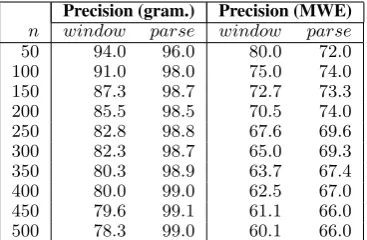
For reporting n-best precision results, we used as reference set the annotated pairs on which at least two of the three annotators agreed. That is, from the 500initial pairs retrieved with each method, 497 pairs were retained in the first case (parse method), and483pairs in the second (win-dow method).
Precision (gram.) Precision (MWE) n window parse window parse
[image:7.595.90.274.62.182.2]50 94.0 96.0 80.0 72.0 100 91.0 98.0 75.0 74.0 150 87.3 98.7 72.7 73.3 200 85.5 98.5 70.5 74.0 250 82.8 98.8 67.6 69.6 300 82.3 98.7 65.0 69.3 350 80.3 98.9 63.7 67.4 400 80.0 99.0 62.5 67.0 450 79.6 99.1 61.1 66.0 500 78.3 99.0 60.1 66.0
Table 4: Comparative evaluation results
respect to grammaticality is, on average, 15.9% for the window method; with parsing, it drops to 1.5% (i.e.,10.6times smaller).
This result confirms our hypothesis regarding the local precision which was stated in section 4.2. Despite the inherent parsing errors, the noise re-duction is substantial. It is also worth noting that we compared our method against a rather high baseline, as we made a series of choices suscep-tible to alleviate the candidates identification with the window-based method: we filtered out func-tion words, we used a parser for POS-tagging (that eliminated POS-ambiguity), and we filtered out cross-punctuation pairs.
As for the MWE precision, the window method performs better for the first100pairs7); on the re-maining part, the parsing-based method is on aver-age3.7% better. The precision curve for the win-dow method shows a more rapid degradation than it does for the other. Therefore we can conclude that parsing is especially advantageous if one in-vestigates more that the first hundred results (as it seems reasonable for large extraction experi-ments).
In spite of the rough classification we used in annotation, we believe that the comparison per-formed is nonetheless meaningful since results should be first checked for grammaticality and ’triviality’ before defining more difficult tasks such as collocability.
6 Conclusion
In this paper, we provided both theoretical and em-pirical arguments in the favor of performing syn-tactic analysis of texts prior to the extraction of collocations with statistical methods.
7A closer look at the data revealed that this might be
ex-plained by some inconsistencies between annotations.
Part of the extraction work that, like ours, re-lies on parsing was cited in section 2. Most of-ten, it concerns chunking rather than complete parsing; specific syntactic configurations (such as adjective-noun, preposition-noun-verb); and lan-guages other than the ones we deal with (usually, English and German). Parsing has been also used after extraction (Smadja, 1993) for filtering out in-valid results. We believe that this is not enough and that parsing is required prior to the applica-tion of statistical tests, for computing a realistic frequency profile for the pairs tested.
As for evaluation, unlike most of the existing work, we are not concerned here with compar-ing the performance of association measures (cf. (Evert, 2004; Pecina, 2005) for comprehensive references), but with a contrastive evaluation of syntactic-based and standard extraction methods, combined with the same statistical computation.
Our study finally clear the doubts on the use-fulness of parsing for collocation extraction. Pre-vious work that quantified the influence of parsing on the quality of results suggested the performance for tagged and parsed texts is similar (Evert and Kermes, 2003). This result applies to a quite rigid syntactic pattern, namely adjective-noun in Ger-man. But a preceding study on noun-verb pairs (Breidt, 1993) came to the conclusion that good precision can only be achieved for German with parsing. Its author had to simulate parsing because of the lack, at the time, of parsing tools for Ger-man. Our report, that concerns an actual system and a large data set, validates Breidt’s finding for a new language (French).
Our experimental results confirm the hypothe-ses put forth in section 4, and show that parsing (even if imperfect) benefits to extraction, notably by a drastic reduction of the noise in the top of the significance list. In future work, we consider investigating other levels of the significance list, extending the evaluation to other languages, com-paring against shallow-parsing methods instead of the window method, and performing recall-based evaluation as well.
Acknowledgements
this paper for useful comments and suggestions.
References
Morton Benson. 1990. Collocations and general-purpose dictionaries. International Journal of Lexi-cography, 3(1):23–35.
Elisabeth Breidt. 1993. Extraction of V-N-collocations from text corpora: A feasibility study for Ger-man. In Proceedings of the Workshop on Very Large Corpora: Academic and Industrial Perspec-tives, Columbus, U.S.A.
Yaacov Choueka. 1988. Looking for needles in a haystack, or locating interesting collocational ex-pressions in large textual databases exex-pressions in large textual databases. In Proceedings of the In-ternational Conference on User-Oriented Content-Based Text and Image Handling, pages 609–623, Cambridge, MA.
Anthony P. Cowie. 1978. The place of illustrative ma-terial and collocations in the design of a learner’s dictionary. In P. Strevens, editor,In Honour of A.S. Hornby, pages 127–139. Oxford: Oxford University Press.
D. Alan Cruse. 1986. Lexical Semantics. Cambridge University Press, Cambridge.
Ga¨el Dias. 2003. Multiword unit hybrid extraction. InProceedings of the ACL Workshop on Multiword Expressions, pages 41–48, Sapporo, Japan.
Ted Dunning. 1993. Accurate methods for the statis-tics of surprise and coincidence. Computational Linguistics, 19(1):61–74.
Stefan Evert and Hannah Kermes. 2003. Experi-ments on candidate data for collocation extraction. InCompanion Volume to the Proceedings of the 10th Conference of The European Chapter of the Associ-ation for ComputAssoci-ational Linguistics, pages 83–86, Budapest, Hungary.
Stefan Evert. 2004. The Statistics of Word Cooccur-rences: Word Pairs and Collocations Word Pairs and Collocations. Ph.D. thesis, University of Stuttgart.
John Rupert Firth. 1957. Papers in Linguistics 1934-1951. Oxford Univ. Press, Oxford.
Ray Jackendoff. 1997. The Architecture of the Lan-guage Faculty. MIT Press, Cambridge, MA.
John S. Justeson and Slava M. Katz. 1995. Technical terminology: Some linguistis properties and an al-gorithm for identification in text. Natural Language Engineering, 1:9–27.
Brigitte Krenn and Stefan Evert. 2001. Can we do better than frequency? A case study on extracting PP-verb collocations. In Proceedings of the ACL Workshop on Collocations, pages 39–46, Toulouse, France.
Dekang Lin. 1998. Extracting collocations from text corpora. InFirst Workshop on Computational Ter-minology, pages 57–63, Montreal.
Christopher Manning and Heinrich Sch¨utze. 1999.
Foundations of Statistical Natural Language Pro-cessing. MIT Press, Cambridge, Mass.
Kathleen R. McKeown and Dragomir R. Radev. 2000. Collocations. In Robert Dale, Hermann Moisl, and Harold Somers, editors, A Handbook of Nat-ural Language Processing, pages 507–523. Marcel Dekker, New York, U.S.A.
Igor Mel’ˇcuk. 1998. Collocations and lexical func-tions. In Anthony P. Cowie, editor, Phraseology. Theory, Analysis, and Applications, pages 23–53. Claredon Press, Oxford.
Brigitte Orliac and Mike Dillinger. 2003. Collocation extraction for machine translation. InProceedings of Machine Translation Summit IX, pages 292–298, New Orleans, Lousiana, U.S.A.
Darren Pearce. 2001. Synonymy in collocation extrac-tion. InWordNet and Other Lexical Resources: Ap-plications, Extensions and Customizations (NAACL 2001 Workshop), pages 41–46, Carnegie Mellon University, Pittsburgh.
Pavel Pecina. 2005. An extensive empirical study of collocation extraction methods. In Proceedings of the ACL Student Research Workshop, pages 13–18, Ann Arbor, Michigan, June. Association for Com-putational Linguistics.
Ivan A. Sag, Timothy Baldwin, Francis Bond, Ann Copestake, and Dan Flickinger. 2002. Multiword expressions: A pain in the neck for NLP. In Pro-ceedings of the Third International Conference on Intelligent Text Processing and Computational Lin-guistics (CICLING 2002), pages 1–15, Mexico City.
Violeta Seretan and Eric Wehrli. 2006. Multilingual collocation extraction: Issues and solutions solu-tions. In Proceedings or COLING/ACL Workshop on Multilingual Language Resources and Interoper-ability, Sydney, Australia, July. To appear.
Violeta Seretan, Luka Nerima, and Eric Wehrli. 2003. Extraction of multi-word collocations using syn-tactic bigram composition. In Proceedings of the Fourth International Conference on Recent Ad-vances in NLP (RANLP-2003), pages 424–431, Borovets, Bulgaria.
Frank Smadja. 1993. Retrieving collocations form text: Xtract. Computational Linguistics, 19(1):143– 177.