A Phrase-based Statistical Model for SMS Text Normalization
AiTi Aw, Min Zhang, Juan Xiao, Jian SuInstitute of Infocomm Research 21 Heng Mui Keng Terrace
Singapore 119613
{aaiti,mzhang,stuxj,sujian}@i2r.a-star.edu.sg
Abstract
Short Messaging Service (SMS) texts be-have quite differently from normal written texts and have some very special phenom-ena. To translate SMS texts, traditional approaches model such irregularities di-rectly in Machine Translation (MT). How-ever, such approaches suffer from customization problem as tremendous ef-fort is required to adapt the language model of the existing translation system to handle SMS text style. We offer an alter-native approach to resolve such irregulari-ties by normalizing SMS texts before MT. In this paper, we view the task of SMS normalization as a translation problem from the SMS language to the English language1 and we propose to adapt a phrase-based statistical MT model for the task. Evaluation by 5-fold cross validation on a parallel SMS normalized corpus of 5000 sentences shows that our method can achieve 0.80702 in BLEU score against the baseline BLEU score 0.6958. Another experiment of translating SMS texts from English to Chinese on a separate SMS text corpus shows that, using SMS normaliza-tion as MT preprocessing can largely boost SMS translation performance from 0.1926 to 0.3770 in BLEU score.
1
Motivation
SMS translation is a mobile Machine Translation (MT) application that translates a message from one language to another. Though there exists many commercial MT systems, direct use of such systems fails to work well due to the special phenomena in SMS texts, e.g. the unique relaxed and creative writing style and the frequent use of unconventional and not yet standardized short-forms. Direct modeling of these special phenom-ena in MT requires tremendous effort. Alterna-tively, we can normalize SMS texts into
1 This paper only discusses English SMS text normalization.
grammatical texts before MT. In this way, the traditional MT is treated as a “black-box” with little or minimal adaptation. One advantage of this pre-translation normalization is that the di-versity in different user groups and domains can be modeled separately without accessing and adapting the language model of the MT system for each SMS application. Another advantage is that the normalization module can be easily util-ized by other applications, such as SMS to voicemail and SMS-based information query.
In this paper, we present a phrase-based statis-tical model for SMS text normalization. The normalization is visualized as a translation prob-lem where messages in the SMS language are to be translated to normal English using a similar phrase-based statistical MT method (Koehn et al., 2003). We use IBM’s BLEU score (Papineni et al., 2002) to measure the performance of SMS text normalization. BLEU score computes the similarity between two sentences using n-gram statistics, which is widely-used in MT evalua-tion. A set of parallel SMS messages, consisting of 5000 raw (un-normalized) SMS messages and their manually normalized references, is con-structed for training and testing. Evaluation by 5-fold cross validation on this corpus shows that our method can achieve accuracy of 0.80702 in BLEU score compared to the baseline system of 0.6985. We also study the impact of our SMS text normalization on the task of SMS transla-tion. The experiment of translating SMS texts from English to Chinese on a corpus comprising 402 SMS texts shows that, SMS normalization as a preprocessing step of MT can boost the transla-tion performance from 0.1926 to 0.3770 in BLEU score.
The rest of the paper is organized as follows. Section 2 reviews the related work. Section 3 summarizes the characteristics of English SMS texts. Section 4 discusses our method and Sec-tion 5 reports our experiments. SecSec-tion 6 con-cludes the paper.
2
Related Work
There is little work reported on SMS normaliza-tion and translanormaliza-tion. Bangalore et al. (2002) used
a consensus translation technique to bootstrap parallel data using off-the-shelf translation sys-tems for training a hierarchical statistical transla-tion model for general domain instant messaging used in Internet chat rooms. Their method deals with the special phenomena of the instant mes-saging language (rather than the SMS language) in each individual MT system. Clark (2003) proposed to unify the process of tokenization, segmentation and spelling correction for nor-malization of general noisy text (rather than SMS or instant messaging texts) based on a noisy channel model at the character level. However, results of the normalization are not reported. Aw et al. (2005) gave a brief description on their in-put pre-processing work for an English-to-Chinese SMS translation system using a word-group model. In addition, in most of the com-mercial SMS translation applications2, SMS lingo (i.e., SMS short form) dictionary is pro-vided to replace SMS short-forms with normal English words. Most of the systems do not han-dle OOV (out-of-vocabulary) items and ambigu-ous inputs. Following compares SMS text normalization with other similar or related appli-cations.
2.1 SMS Normalization versus General Text Normalization
General text normalization deals with Non-Standard Words (NSWs) and has been well-studied in text-to-speech (Sproat et al., 2001) while SMS normalization deals with Non-Words (NSs) or lingoes and has seldom been studied before. NSWs, such as digit sequences, acronyms, mixed case words (WinNT, SunOS), abbrevia-tions and so on, are grammatically correct in lin-guistics. However lingoes, such as “b4” (before) and “bf” (boyfriend), which are usually self-created and only accepted by young SMS users, are not yet formalized in linguistics. Therefore, the special phenomena in SMS texts impose a big challenge to SMS normalization.
2.2 SMS Normalization versus Spelling Correction Problem
Intuitively, many would regard SMS normaliza-tion as a spelling correcnormaliza-tion problem where the lingoes are erroneous words or non-words to be replaced by English words. Researches on spell-ing correction centralize on typographic and cognitive/orthographic errors (Kukich, 1992) and use approaches (M.D. Kernighan, Church and
2 http://www.etranslator.ro and http://www.transl8bit.com
Gale, 1991) that mostly model the edit operations using distance measures (Damerau 1964; Leven-shtein 1966), specific word set confusions (Gold-ing and Roth, 1999) and pronunciation model(Gold-ing (Brill and Moore, 2000; Toutanova and Moore, 2002). These models are mostly character-based or string-based without considering the context. In addition, the author might not be aware of the errors in the word introduced during the edit op-erations, as most errors are due to mistype of characters near to each other on the keyboard or homophones, such as “poor” or “pour”.
In SMS, errors are not isolated within word and are usually not surrounded by clean context. Words are altered deliberately to reflect sender’s distinct creation and idiosyncrasies. A character can be deleted on purpose, such as “wat” (what) and “hv” (have). It also consists of short-forms such as “b4” (before), “bf” (boyfriend). In addi-tion, normalizing SMS text might require the context to be spanned over more than one lexical unit such as “lemme” (let me), “ur” (you are) etc. Therefore, the models used in spelling correction are inadequate for providing a complete solution for SMS normalization.
2.3 SMS Normalization versus Text Para-phrasing Problem
Others may regard SMS normalization as a para-phrasing problem. Broadly speaking, paraphrases capture core aspects of variability in language, by representing equivalencies between different expressions that correspond to the same meaning. In most of the recent works (Barzilay and McKeown, 2001; Shimohata, 2002), they are acquired (semi-) automatically from large com-parable or parallel corpora using lexical and morpho-syntactic information.
3
Characteristics of English SMS
Our corpus consists of 55,000 messages collected from two sources, a SMS chat room and corre-spondences between university students. The content is mostly related to football matches, making friends and casual conversations on “how, what and where about”. We summarize the text behaviors into two categories as below.
3.1 Orthographic Variation
The most significant orthographic variant in SMS texts is in the use of non-standard, self-created short-forms. Usually, sender takes advan-tage of phonetic spellings, initial letters or num-ber homophones to mimic spoken conversation or shorten words or phrases (hw vs. homework or
how, b4 vs. before, cu vs. see you, 2u vs. to you,
oic vs. oh I see, etc.) in the attempt to minimize key strokes. In addition, senders create a new form of written representation to express their oral utterances. Emotions, such as “:(“ symboliz-ing sad,“:)” symbolizing smiling, “:()” symbol-izing shocked, are representations of body language. Verbal effects such as “hehe” for laughter and emphatic discourse particles such as “lor”, “lah”, “meh” for colloquial English are prevalent in the text collection.
The loss of “alpha-case” information posts an-other challenge in lexical disambiguation and introduces difficulty in identifying sentence boundaries, proper nouns, and acronyms. With the flexible use of punctuation or not using punc-tuation at all, translation of SMS messages with-out prior processing is even more difficult.
3.2 Grammar Variation
SMS messages are short, concise and convey much information within the limited space quota (160 letters for English), thus they tend to be im-plicit and influenced by pragmatic and situation reasons. These inadequacies of language expres-sion such as deletion of articles and subject pro-noun, as well as problems in number agreements or tenses make SMS normalization more chal-lenging. Table 1 illustrates some orthographic and grammar variations of SMS texts.
3.3 Corpus Statistics
We investigate the corpus to assess the feasibility of replacing the lingoes with normal English words and performing limited adjustment to the text structure. Similarly to Aw et al. (2005), we focus on the three major cases of transformation as shown in the corpus: (1) replacement of OOV
words and non-standard SMS lingoes; (2) re-moval of slang and (3) insertion of auxiliary or copula verb and subject pronoun.
Phenomena Messages
1. Dropping ‘?’ at the end of question
btw, wat is ur view
(By the way, what is your view?)
2. Not using any punctuation at all
Eh speak english mi malay not tt good
(Eh, speak English! My Ma-lay is not that good.) 3. Using
spell-ing/punctuation for emphasis
goooooood Sunday morning !!!!!!
(Good Sunday morning!) 4. Using phonetic
spelling
dat iz enuf
(That is enough) 5. Dropping
vowel i hv cm to c my luv. (I have come to see my love.)
6. Introducing local flavor
yar lor where u go juz now
(yes, where did you go just now?)
7. Dropping verb
I hv 2 go. Dinner w parents.
[image:3.595.301.529.120.490.2](I have to go. Have dinner with parents.)
Table 1. Examples of SMS Messages
Transformation Percentage (%)
[image:3.595.310.518.515.686.2]Insertion 8.09 Deletion 5.48 Substitution 86.43
Table 2. Distribution of Insertion, Deletion and Substitution Transformation.
Substitution Deletion Insertion
u -> you m are
2 → to lah am
n → and t is
r → are ah you
ur →your leh to
dun → don’t 1 do
man → manches-ter
huh a
no → number one in intro → introduce lor yourself wat → what ahh will
Table 3. Top 10 Most Common Substitu-tion, Deletion and Insertion
If we include the word “null” in the English vocabulary, the above model can fully address the deletion and substitution transformations, but inadequate to address the insertion transforma-tion. For example, the lingoes “duno”, “ysnite”
have to be normalized using an insertion trans-formation to become “don’t know” and “yester-day night”. Moreover, we also want the normalization to have better lexical affinity and linguistic equivalent, thus we extend the model to allow many words to many words alignment, allowing a sequence of SMS words to be normal-ized to a sequence of contiguous English words. We call this updated model a phrase-based nor-malization model.
normalization with a total of 2300 transforma-tions. Substitution accounts for almost 86% of all transformations. Deletion and substitution make up the rest. Table 3 shows the top 10 most com-mon transformations.
4
SMS Normalization
We view the SMS language as a variant of Eng-lish language with some derivations in vocabu-lary and grammar. Therefore, we can treat SMS normalization as a MT problem where the SMS language is to be translated to normal English. We thus propose to adapt the statistical machine translation model (Brown et al., 1993; Zens and Ney, 2004) for SMS text normalization. In this section, we discuss the three components of our method: modeling, training and decoding for SMS text normalization.
4.2 Phrase-based Model
Given an English sentence e and SMS sentence
s , if we assume that e can be decomposed into phrases with a segmentation
T
, such that each phrasee
in can be corresponded with one phrases
inK
k k
e
s , we have e e
and 1 1 N k K e e … … = 1 1 M k K
s =s … …s s . The channel model can be rewritten in equation (3).
4.1 Basic Word-based Model
The SMS normalization model is based on the source channel model (Shannon, 1948). Assum-ing that an English sentence e, of length N is “corrupted” by a noisy channel to produce a SMS message s, of length M, the English sen-tence e, could be recovered through a posteriori distribution for a channel target text given the source text P s , and a prior distribution for the channel source text .
( | )e
( ) P e
{
}
{
}
1 11 1 1
1 1 1
ˆ
arg max
(
|
)
arg max
(
|
) (
)
N
N
N N M
e
M N N
e
e
P e
s
P s
e
P e
=
=
i
(1){
}
1 1 1 1
1 1 1
1 1 1
1 1 1
(
|
)
(
, |
)
( |
) (
| ,
)
( |
) (
|
)
max
( |
) (
|
)
M N M N
T
N M N
T
N K K
T
N K K
T
P s
e
P s T e
P T e
P s
T e
P T e
P s
e
P T e
P s
e
=
=
=
≈
∑
∑
∑
i
i
i
(3)This is the basic function of the channel model for the phrase-based SMS normalization model, where we used the maximum approximation for the sum over all segmentations. Then we further decompose the probability
P s
(
1K|
e
1K)
using a phrase alignment as done in the previous word-based model.A
Assuming that one SMS word is mapped ex-actly to one English word in the channel model
under an alignment , we need to con-sider only two types of probabilities: the align-ment probabilities denoted by P m and the lexicon mapping probabilities denoted by
(Brown et al. 1993). The channel model can be written as in the following equation where m is the position of a word in
( | )
P s e
( m| a
P s e
A
( |am)
) m
sand its alignment in .
m
a e
{
}
1 1 1 1
1 1 1
1
( | ) ( , | )
( | ) ( | , ) ( | ) ( | )
m
M N M N
A
N M N
A M
m m a A m
P s e P s A e
P A e P s A e
P m a P s e
= = = ≈
∑
∑
∑ ∏
i i (2){
}
{
}
{
}
11 1 1 1
1 1 1
1 1 1 1
(
|
)
( , |
)
( |
) (
| ,
)
( |
) ( |
,
)
( |
) ( |
)
k kK K K K
A
K K K
A K
a k
k k a
k A
K
k k a k
A
P s
e
P s A e
P A e
P s
A e
P k a
P s s
e
P k a
P s e
− = =
=
=
=
≈
∑
∑
∑ ∏
∑ ∏
i
i
i
(4)We are now able to model the three transfor-mations through the normalization pair ( , )
k k a
with the mapping probability . The fol-lowings show the scenarios in which the three transformations occur.
( | ) k k a
P s e
k k a
s
<
e
k k a
s
=
e
|ak) (P sk
i
( |
kP s e
)
)
ke
k}
1 1 1 1 1 1 | ) ) ) ( | ) ( M K k N K n kP s e
P s P s − = − = =
∏
∏
∏
i i i 1 ) N InsertionDeletion
e
ak = null SubstitutionThe statistics in our training corpus shows that by selecting appropriate phrase segmentation, the position re-ordering at the phrase level occurs rarely. It is not surprising since most of the Eng-lish words or phrases in normal EngEng-lish text are replaced with lingoes in SMS messages without position change to make SMS text short and con-cise and to retain the meaning. Thus we need to consider only monotone alignment at phrase level, i.e.,
k
, as in equation (4). In addition, the word-level reordering within phrase is learned during training. Now we can further de-rive equation (4) as follows:k
a
=
{
}
1 1 1 1 ( | ) ( | ) ( | ) k K K K a k A K k k kP s e P k e
P s e = = ≈ ≈
∑ ∏
∏
(5) The mapping probability is esti-mated via relative frequencies as follows:
)
k ' '( ,
( | )
( ,
k k k k k sN s e
P s e
N s
=
∑
(6) Here, denotes the frequency of the normalization pair .( , )
k kN s e
( , )
s e
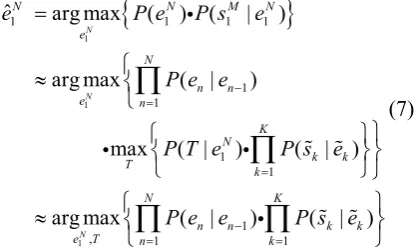
k kUsing a bigram language model and assuming Bayes decision rule, we finally obtain the follow-ing search criterion for equation (1).
{
1
1
1
1 1 1
1
1
,
ˆ arg max ( ) (
arg max ( |
max ( | )
arg max ( | | )
N
N
N
N N N
e N n n e n N k k T
n n k k
e T
e P e
P e e
P T e e
P e e e
= = ≈ ≈
∏
i (7) The alignment process given in equation (8) is different from that of normalization given in equation (7) in that, here we have an aligned in-put sentence pair,
s
and . The alignment process is just to find the alignment segmentation,
ˆ
s ek ks e
k,
γ
< >=<
( , )k k
P s e
between the two sen-tences that maximizes the joint probability. Therefore, in step (2) of the EM algorithm given at Figure 1, only the joint probabilities
are involved and updated.
For the above equation, we assume the seg-mentation probability ( |P T e to be constant.
Finally, the SMS normalization model consists of two sub-models: a word-based language model
(LM), characterized byP e e( |n n−1)
) k
and a phrase-based lexical mapping model (channel model), characterized by ( |P s ek
) k e ) k e . , ˆ
arg m
s ek k 1
ax
K( ,
kk
P s
=
∏
γ< >
1 M 1 N e 1, k
>
k= K4.3
Training Issues
For the phrase-based model training, the sen-tence-aligned SMS corpus needs to be aligned first at the phrase level. The maximum likelihood approach, through EM algorithm and Viterbi search (Dempster et al., 1977) is employed to infer such an alignment. Here, we make a rea-sonable assumption on the alignment unit that a single SMS word can be mapped to a sequence of contiguous English words, but not vice verse. The EM algorithm for phrase alignment is illus-trated in Figure 1 and is formulated by equation (8).
The Expectation-Maximization Algorithm
(1) Bootstrap initial alignment using ortho-graphic similarities
(2) Expectation: Update the joint probabili-ties P s( ,k
(3) Maximization: Apply the joint probabili-ties to get new alignment using Viterbi search algorithm
( ,k
P s
(4) Repeat (2) to (3) until alignment con-verges
[image:5.595.83.292.608.733.2](5) Derive normalization pairs from final alignment
Figure 1. Phrase Alignment Using EM Algorithm
, 1
ˆ
k k|
M,
N)
s e
e s e
kγ
< >=
1 (8)or-thographic similarities captured by edit distance and a SMS lingo dictionary3 which contains the commonly used short-forms are first used to es-tablish phrase mapping boundary candidates. Heuristics are then exploited to match tokens within the pairs of boundary candidates by trying to combine consecutive tokens within the bound-ary candidates if the numbers of tokens do not agree.
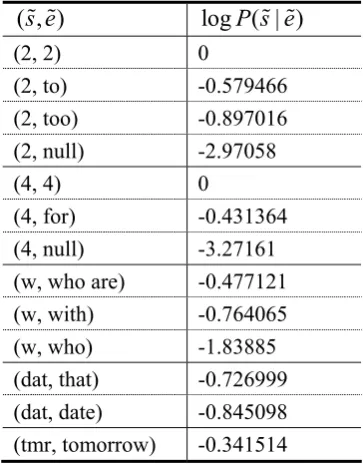
Finally, a filtering process is carried out to manually remove the low-frequency noisy alignment pairs. Table 4 shows some of the ex-tracted normalization pairs. As can be seen from the table, our algorithm discovers ambiguous mappings automatically that are otherwise miss-ing from most of the lmiss-ingo dictionary.
( , )
s e
log ( | )
P s e
(2, 2) 0
(2, to) -0.579466 (2, too) -0.897016 (2, null) -2.97058
(4, 4) 0
(4, for) -0.431364 (4, null) -3.27161 (w, who are) -0.477121 (w, with) -0.764065 (w, who) -1.83885 (dat, that) -0.726999 (dat, date) -0.845098 (tmr, tomorrow) -0.341514
Table 4. Examples of normalization pairs Given the phrase-aligned SMS corpus, the lexical mapping model, characterized by
( | )k k
P s e , is easily to be trained using equation (6). Our n-gram LM P e e( |n n−1) is trained on English Gigaword provided by LDC using SRILM language modeling toolkit (Stolcke, 2002). Backoff smoothing (Jelinek, 1991) is used to adjust and assign a non-zero probability to the unseen words to address data sparseness.
4.4 Monotone Search
Given an input , the search, characterized in equation (7), is to find a sentence e that
maxi-s
mizes using the normalization model. In this paper, the maximization problem in equation (7) is solved using a monotone search, implemented as a Viterbi search through dy-namic programming.
( | ) ( )
P s e P e
i
5
Experiments
The aim of our experiment is to verify the effec-tiveness of the proposed statistical model for SMS normalization and the impact of SMS nor-malization on MT.
A set of 5000 parallel SMS messages, which consists of raw (un-normalized) SMS messages and reference messages manually prepared by two project members with inter-normalization agreement checked, was prepared for training and testing. For evaluation, we use IBM’s BLEU score (Papineni et al., 2002) to measure the per-formance of the SMS normalization. BLEU score measures the similarity between two sentences using n-gram statistics with a penalty for too short sentences, which is already widely-used in MT evaluation.
Setup BLEU score (3-gram)
Raw SMS without
Normalization 0.5784 Dictionary Look-up
plus Frequency 0.6958 Bi-gram Language
[image:6.595.90.272.283.516.2]Model Only 0.7086
Table 5. Performance of different set-ups of the baseline experiments on the
5000 parallel SMS messages
5.1 Baseline Experiments: Simple SMS
Lingo Dictionary Look-up and Using Language Model Only
The baseline experiment is to moderate the texts using a lingo dictionary comprises 142 normali-zation pairs, which is also used in bootstrapping the phrase alignment learning process.
Table 5 compares the performance of the dif-ferent setups of the baseline experiments. We first measure the complexity of the SMS nor-malization task by directly computing the simi-larity between the raw SMS text and the normalized English text. The 1st row of Table 5 reports the similarity as 0.5784 in BLEU score, which implies that there are quite a number of English word 3-gram that are common in the raw and normalized messages. The 2nd experiment is carried out using only simple dictionary look-up.
3 The entries are collected from various websites such as
Lexical ambiguity is addressed by selecting the highest-frequency normalization candidate, i.e., only unigram LM is used. The performance of the 2nd experiment is 0.6958 in BLEU score. It suggests that the lingo dictionary plus the uni-gram LM is very useful for SMS normalization. Finally we carry out the 3rd experiment using dictionary look-up plus bi-gram LM. Only a slight improvement of 0.0128 (0.7086-0.6958) is obtained. This is largely because the English words in the lingo dictionary are mostly high-frequency and commonly-used. Thus bi-gram does not show much more discriminative ability than unigram without the help of the phrase-based lexical mapping model.
Experimental result analysis reveals that the strength of our model is in its ability to disam-biguate mapping as in “2” to “two” or “to” and “w” to “with” or “who”. Error analysis shows that the challenge of the model lies in the proper insertion of subject pronoun and auxiliary or copula verb, which serves to give further seman-tic information about the main verb, however this requires significant context understanding. For example, a message such as “u smart” gives little clues on whether it should be normalized to “Are you smart?” or “You are smart.” unless the full conversation is studied.
Takako w r u?
Takako who are you?
Im in ns, lik soccer, clubbin hangin w frenz! Wat bout u mee?
I'm in ns, like soccer, clubbing hanging with friends! What about you?
fancy getting excited w others' boredom
Fancy getting excited with others' boredom
If u ask me b4 he ask me then i'll go out w u all lor. N u still can act so real.
If you ask me before he asked me then I'll go out with you all. And you still can act so real.
Doing nothing, then u not having dinner w us?
Doing nothing, then you do not having dinner with us?
Aiyar sorry lor forgot 2 tell u... Mtg at 2 pm.
Sorry forgot to tell you... Meeting at two pm.
tat's y I said it's bad dat all e gals know u... Wat u doing now?
That's why I said it's bad that all the girls know you... What you doing now?
5.2 Using Phrase-based Model
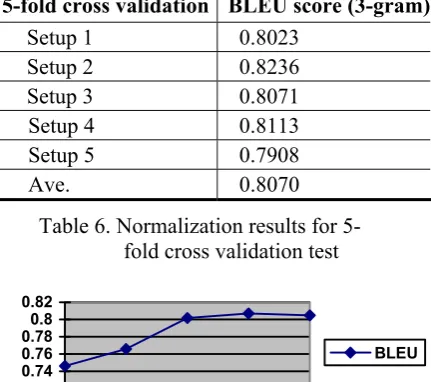
We then conducted the experiment using the pro-posed method (Bi-gram LM plus a phrase-based lexical mapping model) through a five-fold cross validation on the 5000 parallel SMS messages. Table 6 shows the results. An average score of 0.8070 is obtained. Compared with the baseline performance in Table 5, the improvement is very significant. It suggests that the phrase-based lexical mapping model is very useful and our method is effective for SMS text normalization. Figure 2 is the learning curve. It shows that our algorithm converges when training data is increased to 3000 SMS parallel messages. This suggests that our collected corpus is representa-tive and enough for training our model. Table 7 illustrates some examples of the normalization results.
5-fold cross validation BLEU score (3-gram)
Setup 1 0.8023
Setup 2 0.8236
Setup 3 0.8071
Setup 4 0.8113
Setup 5 0.7908
Ave. 0.8070
Table 7. Examples of Normalization Results
5.3 Effect on English-Chinese MT
[image:7.595.74.290.519.710.2]An experiment was also conducted to study the effect of normalization on MT using 402 mes-sages randomly selected from the text corpus. We compare three types of SMS message: raw SMS messages, normalized messages using sim-ple dictionary look-up and normalized messages using our method. The messages are passed to two different English-to-Chinese translation sys-tems provided by Systran4 and Institute for Info-comm Research5(I2R) separately to produce three sets of translation output. The translation quality is measured using 3-gram cumulative BLEU score against two reference messages. 3-gram is Table 6. Normalization results for
5-fold cross validation test
0.7 0.72 0.74 0.76 0.780.8 0.82
1000 2000 3000 4000 5000
BLEU
Figure 2. Learning Curve
used as most of the messages are short with aver-age length of seven words. Table 8 shows the details of the BLEU scores. We obtain an aver-age of 0.3770 BLEU score for normalized mes-sages against 0.1926 for raw mesmes-sages. The significant performance improvement suggests that preprocessing of normalizing SMS text us-ing our method before MT is an effective way to adapt a general MT system to SMS domain.
I2R Systran Ave.
Raw Message 0.2633 0.1219 0.1926 Dict Lookup 0.3485 0.1690 0.2588 Normalization 0.4423 0.3116 0.3770
Table 8. SMS Translation BLEU score with or without SMS normalization
6
Conclusion
In this paper, we study the differences among SMS normalization, general text normalization, spelling check and text paraphrasing, and inves-tigate the different phenomena of SMS messages. We propose a phrase-based statistical method to normalize SMS messages. The method produces messages that collate well with manually normal-ized messages, achieving 0.8070 BLEU score against 0.6958 baseline score. It also signifi-cantly improves SMS translation accuracy from 0.1926 to 0.3770 in BLEU score without adjust-ing the MT model.
This experiment results provide us with a good indication on the feasibility of using this method in performing the normalization task. We plan to extend the model to incorporate mechanism to handle missing punctuation (which potentially affect MT output and are not being taken care at the moment), and making use of pronunciation information to handle OOV caused by the use of phonetic spelling. A bigger data set will also be used to test the robustness of the system leading to a more accurate alignment and normalization.
References
A.T. Aw, M. Zhang, Z.Z. Fan, P.K. Yeo and J. Su. 2005. Input Normalization for an English-to-Chinese SMS Translation System. MT Summit-2005
S. Bangalore, V. Murdock and G. Riccardi. 2002.
Bootstrapping Bilingual Data using Consensus Translation for a Multilingual Instant Messaging System. COLING-2002
R. Barzilay and K. R. McKeown. 2001. Extracting paraphrases from a parallel corpus. ACL-2001
E. Brill and R. C. Moore. 2000. An Improved Error Model for Noisy Channel Spelling Correction.
ACL-2000
P. F. Brown, S. D. Pietra, V. D. Pietra and R. Mercer. 1993. The Mathematics of Statistical Machine Translation: Parameter Estimation. Computational Linguistics: 19(2)
A. Clark. 2003. Pre-processing very noisy text. In Proceedings of Workshop on Shallow Processing of Large Corpora, Lancaster, 2003
F. J. Damerau. 1964. A technique for computer detec-tion and correcdetec-tion of spelling errors. Communica-tions ACM 7, 171-176
A.P. Dempster, N.M. Laird and D.B. Rubin. 1977.
Maximum likelihood from incomplete data via the EM algorithm, Journal of the Royal Statistical So-ciety, Series B, Vol. 39, 1-38
A. Golding and D. Roth. 1999. A Winnow-Based Ap-proach to Spelling Correction. Machine Learning 34: 107-130
F. Jelinek. 1991. Self-organized language modeling for speech recognition. In A. Waibel and K.F. Lee, editors, Readings in Speech Recognition, pages 450-506. Morgan Kaufmann, 1991
M. D. Kernighan, K Church and W. Gale. 1990. A spelling correction program based on a noisy channel model. COLING-1990
K. Kukich. 1992. Techniques for automatically cor-recting words in text. ACM Computing Surveys, 24(4):377-439
K. A. Papineni, S. Roukos, T. Ward and W. J. Zhu. 2002. BLEU : a Method for Automatic Evaluation of Machine Translation. ACL-2002
P. Koehn, F.J. Och and D. Marcu. 2003. Statistical Phrase-Based Translation. HLT-NAACL-2003 C. Shannon. 1948. A mathematical theory of
commu-nication. Bell System Technical Journal 27(3): 379-423
M. Shimohata and E. Sumita 2002. Automatic Para-phrasing Based on Parallel Corpus for Normaliza-tion. LREC-2002
R. Sproat, A. Black, S. Chen, S. Kumar, M. Ostendorf and C. Richards. 2001. Normalization of Non-Standard Words. Computer Speech and Language, 15(3):287-333
A. Stolcke. 2002. SRILM – An extensible language modeling toolkit. ICSLP-2002
K. Toutanova and R. C. Moore. 2002. Pronunciation Modeling for Improved Spelling Correction. ACL-2002