framework for longitudinal research
RIDLEY-DUFF, Rory <http://orcid.org/0000-0002-5560-6312> and PONTON, Alistair
Available from Sheffield Hallam University Research Archive (SHURA) at: http://shura.shu.ac.uk/6551/
This document is the author deposited version. You are advised to consult the publisher's version if you wish to cite from it.
Published version
RIDLEY-DUFF, Rory and PONTON, Alistair (2012). Workforce Participation:
developing a theoretical framework for longitudinal research. In: UK Society for Co-operative Studies Conference 2012, Lincoln University, 2-3 Sep 2012. (Unpublished)
Copyright and re-use policy
See http://shura.shu.ac.uk/information.html
framework for longitudinal research
Paper / Submission to:
Society for Co-operative Studies Conference
Lincoln, 2nd-3rd September 2012
Abstract
This paper describes an action research methodology and theoretical framework developed
during a pilot study into workforce participation at Viewpoint Research CIC. The study suggests a
set of protocols for generating case studies that describe the framing, operationalisation and
evaluation of workforce participation in organisations. In the paper's conclusions, the authors argue
that the concept of workplace democracy needs reframing to takes account of the level of alignment
between the systems of participations that are desired by workforce members and those designed by
the organisation's managers.
Rory Ridley-Duff: Senior Lecturer, Sheffield Business School
Alistair Ponton: Managing Director, Viewpoint Research CIC
Introduction
The need for research to inform policy and practice on workforce participation is growing, not only
because of international interest in social enterprise (Borzaga and Defouny, 2001; Kerlin, 2009;
Teasdale, 2012), but also because of a renaissance of the co-operative movement internationally and
locally (Amin, 2009; Co-operatives UK, 2010, 2011). In a UK context, there are ministerial
aspirations for 1 million public sector workers to transfer to mutual and co-operative enterprises by
2015 (Ainsworth, 2011). Furthermore, UK CEOs from both the private and co-operative sectors
have been participating in a wide-ranging review of ownership and participation strategies to reduce
the vulnerability of all types of business to future financial crises (Michie, 2010). The recent
announcement by the UK Government that it will introduce a Co-operatives Act before the end of
this parliament (Mier, 2012) adds to the case for knowledge development that supports comparison
and evaluation of different models of enterprise, and problematises the perceived connection
between workforce participation and effectiveness.
This paper develops a theoretical framework for research on workforce participation by
reviewing the findings of a pilot study undertaken at Viewpoint Research CIC in 2011 (Ridley-Duff
and Ponton, 2011). This pilot was funded by Business Link Innovation Voucher to create
intellectual property that Viewpoint Research CIC could use to extend its range of research
products/services. The pilot study raised the following question:
“How do members of co-operative, social and private enterprises frame, operationalise and evaluate the benefits of workforce participation?”
This overarching question requires detailed investigation of three sub-questions:
RQ1 (Framing) What assumptionsinform attitudes to workforce participation?
RQ2 (Operationalisation) How do assumptions about participation shape management practices?
This paper does not answer the above questions. Instead, it examines the case for asking them,
the concepts needed to facilitate study of them, and a research design for answering them. It is
divided into five sections. In the first section, we review the literature to make the case for studying
workforce participation. We examine the evidence base that underpins the social economy
assumption that significant or majority ownership of an enterprise by the workforce can address
issues of economic volatility and sustainability in a modern economy. The second section outlines
the philosophical perspective of the researchers and the impact this has on methodology. Section
three provides an account of the creation and testing of a theoretical framework, including a critical
review of the changes made to the framework after the pilot study. The final section reviews the
efficacy of the methodology and theoretical framework for further study of the questions above.
The Case for Studying Workforce Participation
There is now a large body of evidence that workforce participation in management and ownership
impacts on organisation performance and survival. Sustained research into this question started
with the publication of seminal works by Ward (1958) and Vanek (1970). Ward and Vanek
suggested a reformulation of socio-economic thinking to view workforce participation in ownership
and governance as a political rather than property right. This reformulation was grounded in works
that highlight how capitalist production constructs the workforce as a 'cost' rather than a
'beneficiary' of economic activity. For Vanek, viewing the workforce as a 'cost' creates the business
culture within which entrepreneurs and managers learn to distance themselves from production
workers. This reinforces working practices that reduce job security, dehumanized both productive
and managerial work, with the results that exploitation increases and widens social and economy
inequalities. Yanek’s (1970) study of the Yugoslav economy presented the labour-managed firm as
a strategy for re-constructing the workforce as a ‘beneficiary’, ending destructive relationships
between owners, managers and workers, and re-framing business activity as the route to improved
Some evidence on efficiency changes has been produced by Pérotin and Robinson (2004) in a
set of studies that evaluate the relative performance of investor-led and labour-managed firms.
Building on earlier work by Kruse and Blasi (1997) and Gates (1998), Park et al. (2004) found that
even a 5% ownership stake by the workforce reduces the likelihood of enterprise failure by as much
as 25%. Pérotin (2004) examined survival rates in different contexts and found that
labour-managed firms have strikingly different development characteristics. Unlike investor-led firms,
where survival rates are low in the first year and rise thereafter, labour-managed firms have high
survival rates in years 1 and 2 which then fall in years 3–5 but rise again thereafter. Of significance
is a theoretical conclusion that differences can be accounted for by understanding the maturation of
management systems over time, and the culture of ownership amongst members of the workforce.
These studies, however, were conducted using samples in France, Spain and the transition
economies emerging in Eastern Europe. Evidence from Anglo-American settings is more limited.
Matrix Evidence (2010), however, drew similar conclusions from a review of 58 studies that
compared performance in investor-owned and employee-owned firms. They found that
performance measures were stronger in enterprises with high levels of workforce participation
(irrespective of ownership), and highest of all when workforce participation was combined with
worker-ownership. A further recent study by Lampel et al. (2010) collected primary and secondary
data from nearly 100 employee-owned businesses (EOBs) and compared them to 200 investor-led
firms. They too found different patterns of development, particularly during periods of recession
when EOBs continued to grow while investor-led firms saw no overall growth or contraction. As a
result, critiques of investor-led models of ownership and control, and the alternatives based on
mutuality and employee-ownership, are growing in influence (Spear, 1999; Cook and Deakin, 2002;
Turnbull, 2002; Davies, 2009; Lekhi and Blaug, 2010; Michie and Llewellyn, 2010; Ridley-Duff
and Bull, 2011).
The politics of workforce participation has been theorised in the employee relations literature
employee participation schemes as a defensive strategy by management groups seeking to avoid
mass-protests and trade union action during periods of neo-liberal austerity. Share schemes that
individualise ownership, combined with soft-HRM policies, aim to induce ‘high-commitment’ that
undermines collective action to overturn the investor-led model of enterprise (Marchington, 2005).
Recent financial crises, however, have highlighted the robustness of mutual and labour-managed
firms over time (Erdal, 2011). For the first time in living memory, influential practitioners in the
employee-ownership and co-operative movements report that politicians from all parties are
interested in mutual and co-operative models (Couchman, 2010; Green, 2010).
To contribute knowledge to the field of workforce participation, it is necessary to develop
familiarity with the concepts of involvement and participation. A good summary of their
development have been provided by Hyman and Mason (1995). Involvement is typically passive,
task based, individualised, uni-directional, established by management action, and does not result in
employees acquiring meaningful influence over decision-making. Participation, on the other hand
tends to be active, power-based, established by workforce or government action, is bi-directional,
and involves the mutual shaping of management systems through the interactions of stakeholder
groups (see Vinten, 2001; Harley et al., 2005).
As Hollinshead et al. (2003) point out, practices may be individualised or collectivised, and will
vary in the strategic, operational and financial management issues they cover. Furthermore, as
McKersie et al. (2004, 2008) argue, there is also a theoretical distinction between ‘distributive
bargaining’ in which stakeholders negotiate how benefits produced by an enterprise are distributed,
and ‘integrative bargaining’ in which the values and systems that underpin enterprise development
are embedded in management practices (see Ridley-Duff and Bennett, 2011).
Existing literature suggests, therefore, that investor-led and labour-led firms have different
workforce participation strategies that stem directly from the management values and principles that
are practised. At the same time, there is no common theoretical framework for mapping
examines the contribution of the pilot study to the development of a theoretical framework for
future research into workforce participation.
Research Philosophy and Methodology
The philosophy that informs this research is communitarian pluralism (Ridley-Duff, 2007).
Communitarian philosophy regards individuality and consciousness as a product of community
relationships that are socially constructed (and reconstructed) over time (Tam, 1999). This being
the case, there is noneutral or impartial way to judge them against a normative standard because
consciousness is viewed as the realisation of throught in a particular socio-historical context.
Pluralism embraces the perspective that diversity in personal, family, community and class interests
will lead to a lack of alignment between the interests of business owners, managers and workforce
members (Fox, 1966; Watson, 1994). The research challenge this creates is how to capture
evidence of divergent interests and their influence on management practices that inhibit or enable
workforce participation.
For this reason, participatory action research (Gill, 1986; Burns, 2007; Gill and Johnson,
2010) was selected as an appropriate approach. It “involves all relevant parties actively examining
together current action…in order to change and improve it” (Wadsworth, 1998: online).
Researchers are not regarded as outsiders – they become a part of the research setting and can be
co-contributors to the reframing of knowledge that informs action (Gill, 1986). They cannot,
therefore, adopt positivist assumptions regarding neutrality, or deploy standardised research
protocols to establish ‘valid’ ‘generalizable’ and ‘reliable’ findings (Guba and Lincoln, 1994).
Participatory action research is best assessed using criteria applied in critical management studies
(Alvesson and Deetz, 2000; Johnson et al., 2006). It can be assessed in terms of the depth of insight
gained after critical reflection with research participants on the value of a research intervention.
The concept of ‘catalytic validity’ has been advanced to assess the extent to which the intervention
the concepts validity, reliability and generalisability are replaced by an evaluation of the
plausibility, authenticity and insightfulness of the findings (Johnson et al, 2006:147).
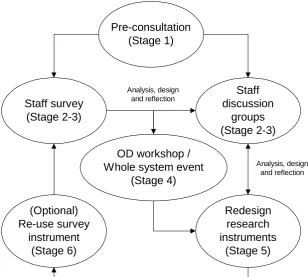
The researchers proceeded on the basis that a case study using participatory action research
would generate plausible, authentic and insightful findings (Guba and Lincoln, 1994) sufficient to
build a theoretical framework for further research into workforce participation. The methods
deployed were:
a) a series of discussions amongst board members to identify questions that they believed would stimulate discussion on workforce participation (Stage 1);
b) a ‘draft’ diagnostic survey to collect responses to the questions (Stage 2 or 3). c) focus groups to discuss the questions asked (Stage 2 or 3);
d) presentation and discussion of the survey and focus group findings to review the questions and their underlying assumptions (Stage 4); and
e) a critical review of the survey research instrument (Stage 5)
In the pilot study, Stage 5 included a critique by two researchers from Sheffield Business
School: Dr Antony Bennett, a Senior Lecturer specialising in Employment Relations and Dr Tracey
Chadwick-Coule, a Senior Research Fellow, specialising in governance in third-sector
organisations. They each offered comments on the design and likely uses to which the research
Figure 1 - Action Research Methodology
Pre-consultation (Stage 1)
Staff survey (Stage 2-3)
Staff discussion
groups (Stage 2-3)
OD workshop / Whole system event
(Stage 4)
(Optional) Re-use survey
instrument (Stage 6)
Redesign research instruments
(Stage 5)
Analysis, design and reflection
Analysis, design and reflection
Research Context and Limitations
The researchers in this case are also the directors of the case study company. Viewpoint Research
CIC, established by Alistair Ponton, is a social firm that specialises in survey-based research. Most
income is derived from surveys of housing tenants to assess their satisfaction with housing repairs,
maintenance and management services (see www.viewpoint-research.co.uk). As a social firm,
Viewpoint has a specific commitment to finding and using techniques that enhance the involvement
and participation of people disadvantaged in the labour market. The pilot project, therefore, served
both social and commercial interests: firstly, it provided an opportunity to develop management
systems that could be used to assist staff development at Viewpoint; secondly, it provided an
opportunity to create IP capable of underpinning Viewpoint’s research services.
The next section provides an account of the findings presented in three parts. Firstly, there
are findings on the creation of the research instruments. Secondly, there are findings on the testing
the pilot project, including changes to workforce participation that can be traced back to the pilot
study.
Creating the Research Instruments
The drafting of the workforce participation survey was influenced by board level discussion of
academic theories on employee relations (see Hyman and Mason, 1995; Hollinshead et al. 2003).
Hyman and Mason distinguish between involvement and participation, and argue that participation
is an integral component of industrial democracy. Hollinshead et al. (2003), on the other hand,
draws attention to different types of participation: staff might participate financially (through share
ownership), operationally (through consultation and bargaining agreements on working practices),
and in strategy development (through positions on, and influence over, thegoverning bodies).
Discussions initially focussed on the range of ways in which participation might be developed over
time and the length of time this might take (see Morrison, 1991). After three board level
discussions, the following areas for developing a participation strategy had been identified: a) skill
development; b) staff development; c) governance; d) setting terms and conditions of employment;
e) wealth sharing; f) product development, and; g) market development (Ridley-Duff and Ponton,
2011, p. 7). The board formulated the following questions to stimulate further discussion:
1. How should we go about developing staff skills? (Skill Development)
2. How should we go about inducting and appraising staff? (Staff Development)
3. How should we go about making strategic and operational decisions within the company? (Governance)
4. How should we go about setting wages, hours and holiday entitlements? (Terms and Condition)
5. How should we plan and make decisions on bonuses and share dividends within the company?(Wealth Sharing)
6. How should we go about developing the organisation's products and services?(Product Development)
7. How should we go about making plans to develop the market for products and services? (Market Development)
The design of the research instruments proceeded from an assumptions that insights could
be developed by presenting the questions in focus groups and a workforce survey, and reviewing
theoretical assumptions after use. To provide a basis for making interventions, the survey
instrument needed to do more than describe perceptions of participation – it needed to elicit the
direction of change that people individually and collectively wanted to make. These discussions
were informed by Cornforth et al’s (1988) work on member participation in worker co-operatives as
well as findings from an earlier study of co-operative governance (Ridley-Duff, 2009). Cornforth’s
study noted that desires for participation vary widely and staff can be committed to different types
of participation. Only a minority of members may want to participate in governing bodies, whereas
nearly all members want to participate in decisions on local working practices. Ridley-Duff (2009)
also suggests that a distinction can be made between ‘managed participation’ where participatory
practices are facilitated and controlled by professional managers and ‘democratic participation’
where any member can initiate and organise action to take a decision on a members’ proposal.
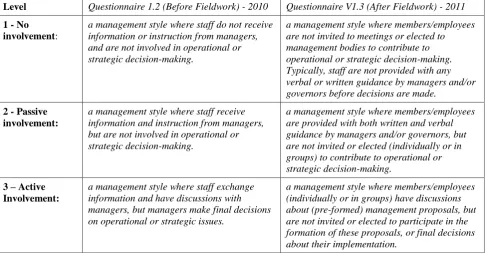
Table 1 shows how descriptions of five levels of involvement and participation changed
[image:11.595.59.548.524.777.2]over the course of the project.
Table 1 – Pre / Post Pilot Descriptions of Levels of Participation
Level Questionnaire 1.2 (Before Fieldwork) - 2010 Questionnaire V1.3 (After Fieldwork) - 2011
1 - No involvement:
a management style where staff do not receive information or instruction from managers, and are not involved in operational or strategic decision-making.
a management style where members/employees are not invited to meetings or elected to management bodies to contribute to operational or strategic decision-making. Typically, staff are not provided with any verbal or written guidance by managers and/or governors before decisions are made.
2 - Passive involvement:
a management style where staff receive information and instruction from managers, but are not involved in operational or strategic decision-making.
a managementstyle where members/employees are provided with both written and verbal guidance by managers and/or governors, but are not invited or elected (individually or in groups) to contribute to operational or strategic decision-making.
3 – Active Involvement:
a management style where staff exchange information and have discussions with managers, but managers make final decisions on operational or strategic issues.
Level Questionnaire 1.2 (Before Fieldwork) - 2010 Questionnaire V1.3 (After Fieldwork) - 2011
4 - Managed Participation:
a management style where ideas are
developed by staff and managers together, and where the managers focus on coaching staff rather than evaluating their proposals (managers may be empowered to veto poor proposals).
a management style where members/employees (individually or in groups) can participate in the development of ideas, and where the managers focus on coaching
members/employees to develop their ideas into proposals, and support them during
implementation. Managers retain some powers to screen-out weak proposals.
5 - Democratic Participation:
a management style where any person (or group of people) can initiate discussions on operational or strategic issues, arrange and participate in meetings to develop ideas, and exercise their voice/vote when decisions are needed.
a management style where any
member/employee (individually or in groups) can initiate discussions on operational or strategic issues, arrange and participate in meetings to develop proposals, and exercise both voice and voting power when decisions are made about implementation.
Ridley-Duff and Ponton (2010, p. 3; 2011, p. 5)
The final stage of drafting the survey instrument involved the development of a matrix in which
the five levels of participation were applied to each of the questions about participation.
Furthermore, if the questions were framed to assess the current situation and identify desired
changes, both focus groups and survey instruments would contribute to establishing priorities for
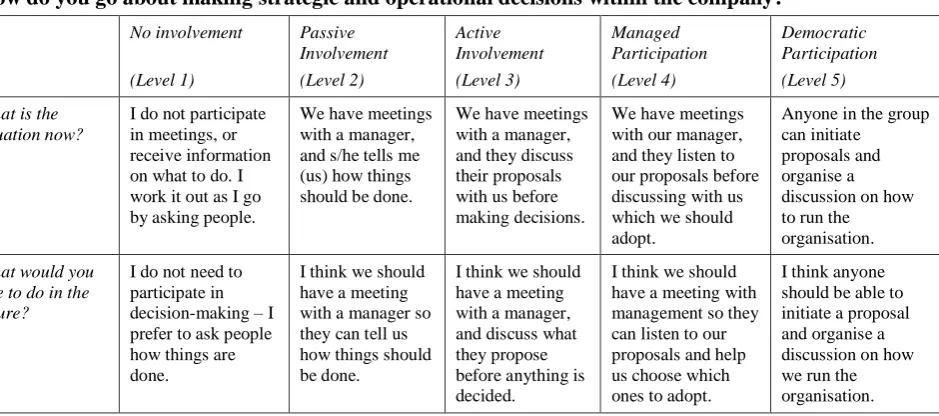
management action. Each question was asked in two ways: the first form asked participants to give
a view on current practices and levels of participation; the second asked what practices and levels of
participation they desired in the future.
The questions that are asked, and the responses that are developed for them, provide insights
into the ‘framing system’ that an organisation develops to manage involvement and participation
practices. This can be illustrated by showing one of the sample questions from the Viewpoint
survey instrument (see Figure 2). The draft member-employee survey followed this format for all
seven questions with the question order and order of responses randomised to prevent primacy
effects. The survey was completed online by all 14 members of the workforce (100% response) and
a focus group was held at each office (in Sheffield and Leeds) to critically appraise the questions
Figure 2 – A Sample Question From the Pilot Questionnaire
How do you go about making strategic and operational decisions within the company?
No involvement (Level 1) Passive Involvement (Level 2) Active Involvement (Level 3) Managed Participation (Level 4) Democratic Participation (Level 5)
What is the situation now?
I do not participate in meetings, or receive information on what to do. I work it out as I go by asking people.
We have meetings with a manager, and s/he tells me (us) how things should be done.
We have meetings with a manager, and they discuss their proposals with us before making decisions.
We have meetings with our manager, and they listen to our proposals before discussing with us which we should adopt.
Anyone in the group can initiate
proposals and organise a discussion on how to run the organisation.
What would you like to do in the future?
I do not need to participate in decision-making – I prefer to ask people how things are done.
I think we should have a meeting with a manager so they can tell us how things should be done.
I think we should have a meeting with a manager, and discuss what they propose before anything is decided.
I think we should have a meeting with management so they can listen to our proposals and help us choose which ones to adopt.
I think anyone should be able to initiate a proposal and organise a discussion on how we run the organisation.
Testing and Revising the Research Instruments
An issue for the researchers at the outset of the project was how to devise a methodology that would
enable the workforce to determine which issues should be given priority. To achieve this, the
results were analysed to assess existing and desired levels of involvement and participation for each
question asked. Figures 3 and 4 show how the responses for existing and desired level of
participation were prepared for discussion at an organisation development (OD) workshop.
Figure 3 suggests that the workforce believed that the organisation operated, or was moving
towards, a consultative management style in 5 of the 7 aspects evaluated. There was a perception
that there was no involvement and participation in decisions on wealth sharing, and only passive
Figure 3 - Existing Levels of Participation
Level 1 Level 2 Level 3 Level 4 Level 5
No
Involvement
Passive Involvement
Active Involvement
Managed Participation
Democratic Participation
Skill Development 2.5
Induction and Appraisal 3.4
Governance 2.6
Terms and Conditions 1.9
Wealth Sharing 1.0
Product Development 2.6
Market Development 3.0
[image:14.595.49.541.409.653.2]Ridley_Duff and Ponton (2011, p. 7)
Figure 4 – Desired Levels of Participation
Level 1 Level 2 Level 3 Level 4 Level 5
No
Involvement
Passive Involvement
Active Involvement
Managed Participation
Democratic Participation
Skill Development 3.5 (+1.0)
Induction and Appraisal 2.8 (-0.6)
Governance 3.4 (+0.8)
Terms and Conditions 2.8 (+0.9)
Wealth Sharing 2.5 (+1.5)
Product Development 3.2 (+0.6)
Market Development 2.9 (-0.1)
Ridley_Duff and Ponton (2011, p. 8)
Group level responses on the desiredlevel of participation in Figure 4 provided a description of
the changes that people sought for each type of participation. Based on these results, a 'democracy
participation from desired levels of participation. This was reported back to participants to indicate
where more or less participation was desired:
Wealth Sharing (+1.5)
Skill Development (+ 1.0)
Setting Terms and Conditions of Employment (+ 0.9)
Governance (+ 0.8)
Product Development (+0.6)
Market development (-0.1)
Induction and appraisal (-0.6)
At focus group discussions, five key issues emerged with the potential to affect the usefulness of
the survey instrument:
1. There was not always a 'correct' answer, and sometimes parts of different answers might have been combined to provide a better answer.
2. Questions could be 'narrow and specific' to the point where they did not seem to relate the situations in which they found themselves at Viewpoint Research CIC.
3. Questions appeared to be more relevant to a co-operative style company than to Viewpoint.
4. Questions may need to be different for people in different roles.
5. Questions may need to be tailored to meet company specific requirements.
These issues were carried forward to the organisation development (OD) workshop and
discussed further. Based on these discussions, the researchers made the following responses in the
final report (Ridley-Duff and Ponton, 2011):
1. Answers could be ranked 1 - 5 (with 1 indicating the most common experience, and 5 indicating the least common), with weightings 40%, 30%, 20%, 10%, 0% to maintain the integrity of the scoring system.
2. No questionnaire instrument can fully cover the range of experiences in a company (this is an inherent weakness of questionnaires and a justification for focus groups). However, free text boxes can be added to enable staff to elaborate / qualify their answers.
3. The five-level responses cover all styles of management from extreme authoritarian approaches to egalitarian cooperative approaches. Including this range of responses was not just for data collection purposes, but also to stimulate thought about the range of participatory practices that can occur in organisations.
different job roles. The researchers (directors) do not want to arbitrarily reinforce existing social distinctions in the way questions are asked.
5. Questions (and responses) may need to be tailored to a specific company. Indeed, the methodology works most effectively where the introduction of the survey instrument triggers attempts to redefine and update both questions and responses. Where this occurs, it indicates that the action research methodology is increasing the theoretical and practical knowledge of staff members on involvement and participation.
The internal review of the research instruments led to recommendations that variable use of ‘I’
and ‘We’ should be replaced by ‘In my workgroup’, to ensure that each respondent is commenting
on their own, and their immediate colleagues, work experience. For example, the follow text
change was made to the Level 1 response to the question ‘How do you go about developing staff
skills?’
Level 1
(No Involvement)
Questionnaire V1.2 (Pre-Pilot) Questionnaire V1.3 (Post-Pilot)
What is the situation now?
I do not participate in meetings, or receive information on what to do. I work it out as I go by asking people.
In my work group no internal training or external courses are provided. We have to learn as best we can while doing the job.
What would you like to do in the future?
In my work group no internal training or external courses are provided. We have to learn as best we can while doing the job.
I think my colleagues and I prefer to learn on the job. No formal training is required.
External review by researchers from Sheffield Business School led to a recommendation that
questions to replace the phrase 'should we' with 'would you like'. Below is an example from the
1. How should we go about developing staff skills? (Skill Development)
Change to: How would you like to go about developing staff skills?
2. How should we go about inducting and appraising staff? (Induction and Appraisal)
Change to: How would you like to induct / appraise staff?
The rationale behind the (re)wording is two-fold: firstly, that the new wording is more open to
use with both individuals and groups as it can be directed in a group context to either individuals or
the whole group; secondly, the previous wording implies that the response should be framed
collectively ('we') to the exclusion of individual needs/views. The rewording of the questions gives
tacit permission for individual narratives to become part of the debate.
To better interpret variations in the responses, external researchers recommended that
demographic information be collected about respondents' work group / department / position /
gender and ethnicity. It could then be used to explore (and map) patterns of discrimination and
contribute to research on equality of opportunity. However, the collection of this information
remains contingent on the philosophy that guides use of the survey instrument. If the survey
instrument is being used as a heuristic (learning) device for personal development, no demographic
information need be recorded. Only where the survey instrument is used for monitoring and policy
development is demographic information needed.
Secondly, it was recommended that the guidance notes (particularly for focus groups) are
updated to stress that the methodology seeks to understand: what is happening; why it is happening;
what (if anything) members / employees would like to do about what is happening. This matches
the survey instrument questions on ‘what is happening now?’ and ‘what would you like to do in the
future?’
The internal and external review also resulted in three new questions: internal review suggested
splitting questions about induction and appraisal, given that some respondents expressed different
desires in these two areas. Secondly, external review suggested that operational and strategic
Lastly, internal review suggested that there should be something about ‘atmosphere’ to explore
cultural norms that influence workforce members capacity to ask questions about working practices.
These final suggestions resulted in the following 10 questions:
1. Skill Development - “How do you develop staff skills?”
2. Working Atmosphere - “How would you describe the working environment?”
3. Induction Processes - “How do you induct newly appointed (elected) staff?”
4. Staff Appraisal - “How do you approach staff appraisal?”
5. Strategic Management - “How do you plan for the medium and long-term?”
6. Operational Management - “How do you make operational decisions?”
7. Terms and Conditions - “How do you set wages, hours and leave entitlements?”
8. Wealth Sharing - “How are surpluses (profits) and deficits (losses) allocated?”
9. Product/Service Development - “How do you design new products and services?”
10.Market/Business Development – “How do you access and develop markets?”
(Ridley-Duff and Ponton, 2011, p. 15-16)
Medium Term Impacts
In the months following the pilot study, a paper was developed for discussion by the board and
presented for discussion at the company’s annual review in 20th October 2011. Prior to the annual
review, Viewpoint had a single owner-manager (the founder, Alistair Ponton) and a two-person
board (the authors). The paper offered a choice of three options to guide governance practices for
the future:
1) No change
2) A Work’s Council to meet quarterly with an expanded management team. 3) Full membership for staff with elected employee representatives on the board.
In January 2012, staff voted as follows:
Option 1 - 3 Votes Option 2 - 5 Votes Option 3 - 4 Votes
With a total of nine votes to increase involvement and participation in governance, the board
eliminated the ‘no change’ option. But with only a minority of the workforce backing ‘full
implemented in 2012. The presence of a 'no change' option was considered important to check the
authenticity of the desire for change, and to prevent the imposition of an executive agenda. This
compares with instances where the introduction of employee-ownership has been made without
workforce approval (see Paton, 1989; Erdal, 2009).
Discussion
The findings of the pilot study were reviewed as part of a new proposal for more extensive study of
workforce participation in co-operative, social and private enterprises. This provided an incentive
to identify the key theoretical contributions of the pilot study for future research projects.
Counter-intuitively, it was found that participants believed there was no obvious correlation
between the level of participation and workplace democracy (compare Johnson, 2006). Where high
participation levels were not desired by the workforce, the workforce did not regard those practices
as democratic. Workplace democracy, therefore, was framed (by Viewpoint Research CIC in late
2010) as the extent to which workforce members could shape management systems to reflect the
level of participation they desired. High levels of participation might be viewed as democratic or
undemocratic depending on whether participation (or non-participation) was desired by the
workforce or imposed by executive decision (compare Pateman, 1970).
This lends some support to Cornforth et al’s (1988) argument that staff may want to reduce as
well as increase participation in specific areas. Given the results of the vote on changing
governance practice at Viewpoint Research CIC, a conundrum regarding the nature of democratic
decision-making is brought into sharp focus. Is ‘democratic participation’ a question of maximising
participation in decision-making, or respecting wishes of an electorate to limit their own
participation? If Viewpoint directors had introduced full company membership and elections to the
company board, would this have been more democratic than implementing the option which
received most votes? If a notional concept of ‘democratic participation’ is imposed, does it cease to
These questions echo long-standing concerns expressed in Paton’s (1989) study of ‘reluctant
entrepreneurs’ about the decision-making processes that lead to employee-owned business. The
practices described in Erdal’s (2009) account of the transition to employee ownership at Loch Fyne
Oysters can be contrasted with accounts of transitions in the Mondragon network of worker
co-operatives (see Ridley-Duff and Bull, 2011). At Loch Fyne, the decision to create an employee
trust was taken without the knowledge of the workforce. Only after securing ownership of the
company were the workforce told they were the new owners. In contrast, transitions to co-operative
ownership at Mondragon are taken only after the establishment of shadow democratic bodies that
organise a vote on the transition to co-operative ownership and control.
Erdal (2009, 2011) defends the practice of hiding the initial decision-making process from staff
on the basis of pragmatism (to increase opportunities to transfer control of companies to employee
trusts) as well as the results that are achieved. He argues that staff participation increases as the
ownership structure gradually enables staff to realise benefits from ownership, and notes that this
often takes a period of several years. Paton (1989), however, questions whether survival rates are
linked to democratic participation in the decision to transfer ownership.
The option of 'no change' in this case is, therefore, consistent with concerns that a positive vote
for no change may be important for authenticating the level of democratic support for a course of
action. It certainly led to deep reflection on the part of the authors as a 'no' vote could easily be
interpreted as failure in a managerialist culture. However, irrespective of the outcome of the vote,
the act of taking a collective decision on such a pivotal matter is itself a step change towards
workplace democracy. Indeed, it might be argued that a 'no change' option is necessary.
The research instruments developed during the pilot study open up a theoretical perspective on
workplace democracy based on the alignment of members’ wishes and participatory practices,
rather than practices that maximise participation or management change. The survey instrument –
through the creation of a ‘democracy index’ for each type of participation – can support the
of democratic desires’, (local) managers and governing bodies can use findings to increase and
decrease participation in specific areas of company operation.
By reorganising the 10 questions in the survey instrument, they can be related to themes in the
employee relations literature about different types of participation, and key differences between
‘integrative bargaining’ and ‘distributive bargaining’ (Hollinshead et al., 2003; McKersie, 2004,
2008). Integrative bargaining relates to the integration of values and principles in the internal
operations of the company, while ‘distributive bargaining’ relates to decisions about the allocation
[image:21.595.43.540.330.555.2]of resources and wealth to organisation development activities and stakeholders.
Figure 5 – Relating Findings Back to Literatures on Participation
Questions First Level Grouping Second Level Grouping
Skill Development (Q1)
Culture Development
‘Integrative Bargaining’
(Values and principles applied to management practices) Working Atmosphere (Q2, Q7, Q8)
Staff Appraisal (Q4)
Operational Management (Q6, Q7) Operational Management Induction Processes (Q1, Q3, Q4)
Staff Recruitment and Development Strategic Management (Q5)
Business Strategies ‘Distributive Bargaining’
(Allocation of power and benefits to organisational stakeholders) Product/Service Development (Q9)
Market/Business Development (Q10) Terms and Conditions (Q7)
Wealth Sharing Strategies Wealth Sharing (Q8)
If the relationship between ‘democracy’ and ‘participation’ is more complex, and the link
between them cannot be taken for granted, the label ‘democratic participation’ to describe Level 5
characteristics needs rethinking. A more fitting label might be ‘autonomous participation’ in that
the power to participate belongs to the member and is not ‘managed’ by one or more professional
managers. How, then, should we regard the situations described by Erdal (2009, 2011) in which
owners and/or managers make arrangements for the transfer of ownership to employee trusts? Can
these be unambiguously theorised as examples of ‘no involvement’ in strategic management (at
managed and/or autonomous participation? Questions like these can be explored more fully if a
framework is developed that enables the mapping of experiences over time. Indeed, the framework
makes possible further testing of Erdal’s assumption that ‘no involvement’ in employee transfer
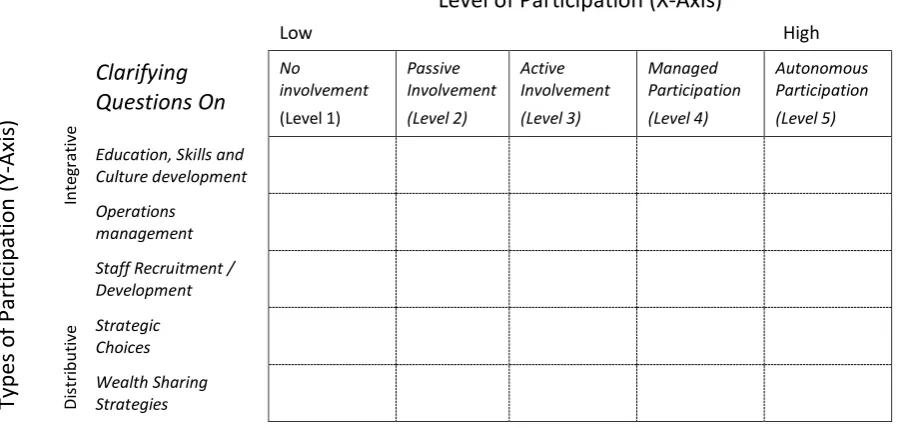
[image:22.595.64.516.231.445.2]decisions might accelerate the introduction of workforce participation in the business community.
Figure 6 – Theoretical Framework for Future Research
Typ e s o f Pa rtic ip atio n (Y -A xi s) D is tr ib u ti ve In te gr ati ve
Level of Participation (X-Axis)
Low High
Clarifying Questions On No involvement (Level 1) Passive Involvement (Level 2) Active Involvement (Level 3) Managed Participation (Level 4) Autonomous Participation (Level 5)
Education, Skills and Culture development
Operations management
Staff Recruitment / Development
Strategic Choices
Wealth Sharing Strategies
This discussion has identified a number of concepts that will be useful to future research on
workforce participation. Firstly, it maintains the distinction between ‘involvement’ and
‘participation’ on the basis that ‘involvement’ tends to be management led while ‘participation’ is
workforce or member led. Secondly, a distinction is made between ‘integrative bargaining’ on the
value and principles that inform management practices and the ‘distributive bargaining’ that
influences the allocation of wealth created by an enterprise. Lastly, it clarifies the distinction
between ‘participation’ and ‘democracy’, recognising that there may be a democratic mandate to
both increase and decrease specific types of participation. Figure 6 shows a theoretical framework
that can guide research activity, within which ‘democratic management’ is understood as the
propensity and capacity of management systems to respond to members’ wishes regarding their
different levels of participation. The Y-Axis, on the other hand, accommodates categories of
questions that are advanced to learn about workforce participation. The questions will vary from
organisation to organisation, but some level of comparison can be made by classifying the questions
on the basis of the concepts introduced to the workforce (see Figure 5). In the conclusions of the
paper, we review the potential of the methodology summarised in Figure 1 and the theoretical
framework presented in Figure 6 for further case study research.
Conclusions
Can this methodology and framework help to answer the questions posed at the start of the paper?
1) What assumptionsinform attitudes to workforce participation?
2) How do assumptions about participation shape management practices? 3) How is workforce participation reviewed by governing bodies?
Yin (2002) asserts that producing a series of case studies is a good strategy for developing and
testing theoretical assumptions. The pilot study, therefore, represents a starting point but not an end
point. The methodology developed protocols for case study work on the above questions:
Collecting qualitative data (via focus groups) to solicit workforce perspectives on the types of participation that occur in a given workplace.
Collecting qualitative data (via interviews with board members and/or managers) to understand the assumptions that frame management attitudes to workforce participation.
Use of the above to develop a range of questions and responses to draft a survey instrument that gathers descriptive statistics on existing and desired levels of participation.
Sharing and debating the draft survey instrument and diagnostic survey results (via OD workshops) to develop theoretical knowledge on workforce participation strategies.
This approach will generate empirical data that makes it possible to answer each research
question. The initial focus groups and interviews permit exploration of the assumptions that frame
attitudes to workforce participation (RQ1). The creation of questions and responses for a diagnostic
survey produces documentary evidence of the way members of the workforce frame the relationship
between management practices and workforce participation (RQ2). Lastly, the analysis and sharing
of results in OD workshops stimulates reflection and management action to develop and update
a diagnostic questionnaire (and qualitative data) that summarises the findings from each case study.
The survey instruments created provide the research data for further theory development on
workforce participation. Data collection at each stage (as well as the final result) directly assists the
answering of each research question, and it does so through deployment of a robust inductive mode
of naturalistic inquiry that is of direct benefit to research participants (Bloor, 1978; Lincoln and
Guba, 1986).
Future research can explore whether co-operative, social and private enterprises put forward
different questions to learn more about the framing systems that guide workforce participation
strategies. For example, it may be expected that co-operative, social and private enterprises may
propose different questions for the Y-Axis (in Figure 6), and that the balance between questions on
integrative and distributive bargaining may vary substantially. The results can be used locally or in
policy development bodies, to explore theoretical assumptions regarding participation strategies and
economic performance. Do co-operatives (or specific types of co-operatives) report higher levels /
or higher aspirations on the X-Axis compared to social and private enterprises? Are performance
differences correlated to particular configurations of participatory management? These are
questions that successful development of the theoretical framework will make it more possible to
answer.
Acknowledgements
References
Ainsworth, D. (2011) “Francis Maude: one million workers could move to mutuals”, Third Sector Online , 24th February 2011, http://www.thirdsector.co.uk/news/Article/1056943/Francis-Maude-one-million-public-sector-workers-move-mutuals/, accessed 25th May 2011.
Amin, A. (2009) The Social Economy: International Perspectives on Economic Solidarity, London: ZedBooks.
Alvesson, M. and Deetz, S. (2000) Doing Critical Management Research, London: Sage Publications.
Bloor, M. (1978) “On the analysis of observational data: a discussion of the worth and uses of inductive techniques and respondent validation”, Sociology, 10: 43-61.
Borzaga, C. and Defourny, J. (2001) The Emergence of Social Enterprise, London: Routledge. Burns, D. (2007) Systemic Action Research: A strategy for whole system change, Bristol:
The Policy Press.
Cook, J., Deakin, S. & Hughes, A. (2002) “Mutuality and corporate governance: the evolution of building societies following deregulation”, Journal of Corporate Law Studies, 2(1): 110-138.
Co-operatives UK (2010) The UK Co-operative Economy: A Review of Co-operative Enterprise, Manchester: Co-operatives UK.
Co-operatives UK (2011) The UK Co-operative Economy: Britain’s Return to Co-operation, Manchester: Co-operatives UK.
Cornforth, C. J., Thomas, A., Spear, R. G., Lewis, J. M. (1988) Developing Successful Worker Co-ops, London: Sage Publications.
Cornforth, C. (2004) “The Governance of Co-operatives and Mutual Associations: A Paradox Perspective”, Annals of Public and Co-operative Economics, 75(1): 11-32.
Couchman, P. (2010) Keynote Speech: Futures North Conference, 11th September, Boddington Hall, Leeds University. Peter Couchman – CEO, Plunkett Foundation.
Davies, W. (2009) Reinventing the Firm, London: Demos.
Erdal, D. (2009) Local Heroes: How Loch Fyne Oysters Embraced Employee Ownership and Business Success, London: Penguin.
Erdal, D. (2011) Beyond the Corporation: Humanity Working, London: The Bodley Head.
Fox, A. (1966) Industrial Sociology and Industrial Relations, Research Paper 3, Royal Commission on Trade Unions and Employers Associations. London: HMSO.
Gates, J. (1998) The Ownership Solution, London: Penguin.
Gill, J. (1986) “Research as action: an experiment in utilising social sciences”, in Heller, F. (ed) The Use and Abuse of Social Science, London: Sage.
Gill, J. and Johnson, P. (2010) Research Methods for Managers (Third Edition), London: Sage Publications.
Green, P. (2010) Keynote Speech, Futures North Conference, 11th September, Bodington Hall, Leeds University. Pauline Green is president of the International Co-operative Alliance. http://futures-north.coop/?page_id=231
Guba, E. and Lincoln, Y. S. (1994) “Competing Paradigms in Qualitative Research”, in Denzin, N. K. and Lincoln, Y. S. (eds) Handbook of Qualitative Research, Newbury Park: Sage
Publications.
Hollinshead, G. Nicholls, P. and Tailby, S. (2003) Employee Relations (2nd Edition), London: FT Prentice Hall.
Hyman, J. and Mason, B. (1995) Managing Employee Involvement and Participation, London: Sage Publications.
Johnson, P. (2006) “Whence democracy? A review and critique of the conceptual dimensions and implications of the business case for organizational democracy”,Organization, 13(2): 245-274.
Johnson, P., Buehring, A., Cassell, C. and Symon, G. (2006) “Evaluting Qualitative Management Research: Towards a Contingent Criteriology”, International Journal of Management Reviews, 8(3): 131-156.
Kerlin, J. (2009) Social Enterprise: A Global Comparison, Lebanon: University Press of New England.
Kruse, D. and Blasi. J. (1997) “Employee ownership, employee attitudes, and firm performance: a review of the evidence”, in D. Mitchell, D. Lewin and M. Zaidi (Eds), Handbook of Human Resource Management (pp. 113-151). Greewich, CT: JAI Press
Lampel, J. Bhalla, A and Jha, P. (2010) Model Growth: Do Employee-owned Businesses Deliver Sustainable Performance?, John Lewis Partnership,
http://www.johnlewispartnership.co.uk/Display.aspx?MasterId=53505afb-6ed5-4f19-923e-30b06cd31a9a&NavigationId=0, accessed 25th May 2011.
Lekhi, R. and Blaug, R. (2010) Ownership and Good Work, The Good Work Commission: Provocation Paper 6, London: The Work Foundation.
Lincoln, Y. and Guba, E. (1986) “But is it rigorous? Trustworthiness and authenticity in naturalistic evaluation”, New Directions for Evaluation, 34: 73-84.
Marchington, M. (2005) “Employee involvement: patterns and explanations”, in B. Harley, J. Hyman and P. Thompson (eds), Participation and Democracy at Work, Basingstoke: Palgrave Macmillan.
Matrix Evidence (2010) The Employee Ownership Effect: A Review of the Evidence, London: Employee Ownership Association. http://www.employeeownership.co.uk/publications/the-employee-ownership-effect-a-review-of-the-evidence/, accessed 25th May 2011.
McKersie, R., S. Eatron and T. Kochan (2004), ‘Kaiser Permanents: using interest-based
negotiations to craft a new collective bargaining agreement’, Negotiation Journal, 20(1): 13–35.
McKersie, R., T. Sharpe, T. Kochan, A. Eaton, G. Strauss and M. Morgenstern (2008), ‘Bargaining theory meets interest-based negotiations: a case study’, Industrial Relations: A Journal of Economy and Society, 47(1): 66–96.
Michie, J. (2010) "Commission on ownership", presentation to the Skoll 2010 Research Colloquium, Oxford, Oxford University, 24th June.
Michie, J. and Llewelyn, D. (2010) “Converting failed financial institutions into mutual organisations”, Journal of Social Entrepreneurship, 1(1): 146-170.
Mier, V. (2012) "David Cameron announces Co-operatives Bill", www.civilsociety.co.uk, 20th January 2012.
Morrison, R. (1991) We Build the Road as We Travel, New Society Publishers: Gabriola Island, BC.
Murray, R. (2010) Co-operation in the Age of Google, Manchester: Co-operatives UK. [Draft for discussion by co-operative movement members], available from
Park, R., Kruse, D. and Sesil, J. (2004) “Does Employee Ownership Enhance Firm Survival?”, in V. Perotin and A. Robinson (eds), Employee Participation, Firm Performance and Survival, Oxford: Elsevier, 3-33.
Pateman, C. (1970) Participation and Democratic Theory, Cambridge: Cambridge University Press.
Paton, R. (1989). Reluctant Entrepreneurs: The Extent, Achievements and Significance of Worker Takeovers in Europe. Milton Keynes: The Open University Press.
Perotin, V. (2004) “Early Cooperative Survival: The Liability of Adolescence”, in V. Perotin and A. Robinson (eds), Employee Participation, Firm Performance and Survival, Oxford: Elsevier, pp. 67-86
Perotin, V. and Robinson, A. (2004) Employee Participation, Firm Performance and Survival: Advances in the Economic Analysis of Participatory and Labor-Managed Firms, Volume 8, Oxford Elsevier.
Ridley-Duff, R. J. (2007) “Communitarian Perspectives on Social Enterprise”, Corporate Governance: An International Review, 15(2): 382-392.
Ridley-Duff, R. J. (2009) "Cooperative Social Enterprises: Company Rules, Access to Finance and Management Practice", Social Enterprise Journal, 5(1), 50-68.
Ridley-Duff, R. J. and Bennett, A. (2011) “Towards mediation: developing a theoretical framework for understanding alternative dispute resolution”, Industrial Relations Journal, 42(2): 106-123.
Ridley-Duff, R. J. and Bull, M. (2011) Understanding Social Enterprise: Theory and Practice, London: Sage.
Ridley-Duff, R. J. and Ponton. A. (2011) Member – Employee Engagement Model (Final Report), Sheffield: Viewpoint Research CIC, http://shura.shu.ac.uk/5574 accessed 23rd October 2012. Ridley-Duff, R. J. (2012) “New Frontiers in Democratic Self-Management”, in The Co-operative
Model in Practice, Glasgow: Co-operative Education Trust, pp. 99-117.
Spear, R. (1999) “Employee-owned UK bus companies”, Economic and Industrial Democracy, 20: 253-268.
Tam, H. (1999) Communitarianism, Macmillan: Basingstoke.
Teasdale, S. (2012) “What’s in a name? Making sense of social enterprise discourses”, Public Policy and Administration, 27(2): 99-119.
Turnbull, S. (2002) A New Way to Govern: Organisations and Society After Enron, London: New Economics Foundation, http://papers.ssrn.com/sol3/papers.cfm?abstract_id=319867
Vanek, Y. (1970) The General Theory of Labor-Managed Market Economies, Ithaca: Cornell University Press
Vinten, G. (2001) Shareholder versus Stakeholder – is there a governance dilemma?, Corporate Governance: An International Review, 9(1): 36-47.
Wadsworth, Y. (1998) “What is Participatory Action Research?”, Action Research International, Paper 2, http://www.scu.edu.au/schools/gcm/ar/ari/p-ywadsworth98.html, accessed 16th November 2009.
Ward, B. (1958) “The Firm in Illyria: Market Syndicalism,” American Economic Review, 48(4): 566-89.
Watson, T. (1994) In Search of Management. London: Routledge.