An Efficient Approach To Object Recognition For Mobile
Robots.
AHMED, M Shuja, SAATCHI, Reza <http://orcid.org/0000-0002-2266-0187>
and CAPARRELLI, Fabio
Available from Sheffield Hallam University Research Archive (SHURA) at:
http://shura.shu.ac.uk/13709/
This document is the author deposited version. You are advised to consult the
publisher's version if you wish to cite from it.
Published version
AHMED, M Shuja, SAATCHI, Reza and CAPARRELLI, Fabio (2013). An Efficient
Approach To Object Recognition For Mobile Robots. In: BENAVENTE-PECES,
Cesar and FILIPE, Joaquim, (eds.) Proceedings of the 3rd International Conference
on Pervasive Embedded Computing and Communication Systems. Scitepress,
60-65.
Copyright and re-use policy
See
http://shura.shu.ac.uk/information.html
AN EFFICIENT APPROACH TO OBJECT RECOGNITION FOR
MOBILE ROBOTS
M Shuja Ahmed, Reza Saatchi and Fabio Caparrelli
Materials and Engineering Research Institute, Sheffield Hallam University, Sheffield, United Kingdom m [email protected], [email protected], [email protected]
Keywords: Object Recognition, SURF, Harris Features, Multi-Robotics
Abstract: In robotics, the object recognition approaches developed so far have proved very valuable, but their high memory and processing requirements make them suitable only for robots with high processing capability or for offline processing. When it comes to small size robots, these approaches are not effective and light-weight vision processing is adopted which causes a big drop in recognition performance. In this research, a computationally expensive, but efficient appearance-based object recognition approach is considered and tested on a small robotic platform which has limited memory and processing resources. Rather than processing the high resolution images, all the times, to perform recognition, a novel idea of switching between high and low resolutions, based on the “distance to object” is adopted. It is also shown that much of the computation time can be saved by identifying the irrelevant information in the images and avoid processing them with computationally expensive approaches. This helps to bridge the gap between the computationally expensive approaches and embedded platform with limited processing resources.
1
INTRODUCTION
Object recognition, when it comes to robotics, is con-sidered an essential element since, in most robotic applications, the robots are required to look for and recognize the objects of interest in the environment to achieve the given objectives. The use of vision sensors in robotic applications has provided many solutions for object recognition. Object recognition is considered as one of the most challenging prob-lems in computer vision. It presents several chal-lenges such as, view point changes, intensity varia-tions, occlusions and background clutter. Its use in mobile robotics applications introduces an important challenge given by the constraints for execution time (i.e. computational complexity). In real world sce-narios, robots are normally equipped with high pow-ered processing systems which can fulfil the com-putational demands of the object recognition algo-rithms. For such robots the choices of object recogni-tion techniques may be diverse and computarecogni-tionally expensive object recognition techniques may be sim-ply adopted with minor changes. But when it comes to small robots with limited processing resources, the task becomes challenging because the algorithm fails to achieve real time performance.
In computer vision, many object recognition
for the implementation on embedded systems. Some researchers have used probabilistic models on the top of SURF feature based approaches to perform robot localisation and mapping (Cummins and Newman, 2010). In comparison to this, in some approaches (Chrysanthakopoulos and Shani, 2010), the authors relied on Harris features to reduce the computational time and used Partially Observable Markov Decision Process (POMDP) probabilistic methods to track the probability distribution of the robot’s where-about. In another work (Ramos et al., 2010), SURF fea-tures were further processed using Conditional Ran-dom Fields (CRF) algorithm to discard those features which do not show geometric consistency. In (Ri-cardo and Pellegrino, 2010), a detailed comparison of SIFT, PCA-SIFT and SURF feature based approaches is presented and SURF was found to be the fastest to compute features. Authors in (Juan and Gwun, 2009) used K-Nearest Neighbour (KNN) approach for fea-ture space clustering and Random Sample Consensus (RANSAC) to get rid of outliers and showed that the selection of methods to perform recognition mainly depends on the target application. In (Krose et al., 2001), linear image features extracted using Princi-pal Component Analysis (PCA) were used for ob-ject recognition. In PCA, the eigenvectors of the im-age are computed and are used as an orthogonal ba-sis for individual image representation. The motiva-tion of using eigenvectors is that only few of them are required for recognition, but this approach is very sensitive to the effect of perceptual aliasing. In an-other work, a fast gradient based feature extraction approach was used (Dillmann et al., 2007) together with PCA, to perform the recognition task. Similar to the work done by (Nayerlaan and Goedeme, 2008) and (Asanza and Wirnitzer, 2010), the feature space was quantized using a k-means algorithm. The sys-tem used for recognition was a 3GHz high powered processing system which takes 350 milli-seconds on an average to recognise the object. This seems a slow performance considering the power of the processing system. Another similar approach using SIFT fea-ture based recognition is presented by (Siegwart et al., 2010) where features were dynamically assigned dif-ferent weights, according to the uncertainty associ-ated with them and finally avoid using those features which does not show good recognition results. It is to be noted that, in most of the research where ap-pearance based object recognition is employed, a high performance system is used.
This study suggests some techniques following which, the advantages of computationally expensive algorithms can be enjoyed in small robotic systems to achieve object recognition. This study presents
an optimised implementation of SURF features based recognition approach which can show acceptable per-formance on small robotic platforms without sacri-ficing the recognition performance. We have used a group of small robots and show that how multi-ple robots look for 3D and 2D objects of interest in an unknown controlled environment. For recogni-tion purposes, all robots will be given a common vi-sual vocabulary. To help achieve this task efficiently, all robots will be sharing their knowledge with each other. Through wireless communication medium, ev-ery robot will be updating other team members about the number of objects found. This way, other team members will not search for the objects found by an-other robot.
2
METHODOLOGY
point operation by the SURF algorithm. To reduce the execution time of the SURF algorithm, code op-timisation was performed. For further performance improvement, image data elimination and use of mul-tiple resolutions were also made. These are explained in the following sub-sections.
2.1
Optimisation of SURF for the
Blackfin Processor
This section discusses the customisation of the SURF algorithm for the target Blackfin processor based em-bedded system. Processor specific code customisa-tion requires a detailed study about the architecture of the underlying embedded system. By exploring the architectural features of the embedded system, the full processor performance can be achieved through the software. For example, in this study, Blackfin pro-cessor is selected, and since this propro-cessor is a fixed point processor it is recommended to avoid floating point operation. The use of uClinux operating system on the target Blackfin processor makes the customi-sation more challenging as it allows 1.31 fixed point operations only. This restriction requires that all the data in the algorithm should be normalised at every point in the program flow in order to guarantee that data values lies within the range of -0.9 to +0.9. If values exceed these limits then unexpected results can occur.
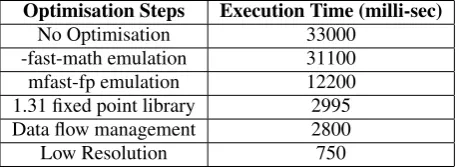
The Blackfin code optimisation can be done in three different phases which are usually followed in the following order. These phases are Compiler op-timization, System optimization and Assembly opti-mization as detailed by (Katz et al., 2005). After per-forming these optimisation steps, the improvements achieved in the algorithm’s execution performance is shown in Table 1. When no optimization was applied, the program took 33sec to process a single image frame. Compiler optimization (i.e. using fast-math and mfast-fp floating point libraries for Blackfin pro-cessor) brought the execution time to 12sec per frame. For further reduction in the execution time, the detail timing analysis for the different portions of the pro-gram was done. The parts of the propro-gram which were taking more time to execute, were identified. These parts of the program were customised by exploiting the fixed point architecture of the Blackfin processor. Therefore, 1.31 fixed point operations were adopted in the place of floating point operations. This helped in reducing the time to 3 sec per frame. The main rea-son for the significant reduction in time from 12sec to 3sec was the use of 1.31 fixed point operation libraries which are optimised for Blackfin processor and fur-ther customised in assembly language. After
[image:4.595.309.539.255.339.2]elimi-nating the routing of redundant data or by optimizing the data flow in the algorithm, the time was further re-duced to 2.8sec per frame. Further reduction in time can be achieved by using the lower resolution image. As lower resolution image provides less details of the object in the image, so SURF algorithm produce less number of features and recognition performance also drops. As shown in Table 1, the processor specific optimisation is an essential step to achieve real time performance as it significantly reduces the execution time of the algorithm. However, further reduction in the execution time is still required.
Table 1: Optimisation of SURF for the Blackfin Processor.
Optimisation Steps Execution Time (milli-sec)
No Optimisation 33000 -fast-math emulation 31100 mfast-fp emulation 12200 1.31 fixed point library 2995 Data flow management 2800 Low Resolution 750
2.2
Image Data Elimination and
Resolution Switching
In the second stage, regions in the image are identified which are redundant and does not contribute in the generation of SURF features. For example, smooth image regions and texture less surfaces in the image does not generate any reliable SURF features. So by not processing these image regions, with compu-tationally intensive SURF algorithm, can reduce the image processing load by a large factor. To eliminate these redundant image regions and identify the image pixels which represent the presence of an object in the image, many light weight feature extraction tech-niques can be applied. The use of simple edge de-tector (e.g., canny) can also be made to identify the pixels, but they also detects edges caused by straight lines. In this study, we have used Harris feature ex-traction algorithm. The reason for using Harris al-gorithm is that, Harris features detects corners in the image which provides more reliable features.
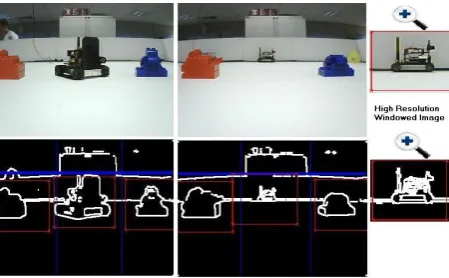
di-vided into three portions that is middle, left and right (middle, left and right portions shown are separated by the thin blue line) and features extraction is per-formed using the Harris algorithm. Extracted image features are also shown in Figure 1a and 1b. The cen-troids of the feature points were computed from the middle, left and the right portions and the windowed images were extracted. These windowed images con-tain the objects in the image. These windowed images are shown by the red boundary lines. Now SURF features are computed for these extracted windowed images. In these windowed images, while extracting SURF features, again only those pixels were consid-ered for processing which were also identified by the Harris feature detection algorithm.
Figure 1: Image data reduction and resolution switch-ing(Ahmed et al., 2012a).
The SURF feature extraction and matching tech-nique works in two stages: training stage and recog-nition stage. In the training stage, the features of the target object were extracted and kept in memory. In the case of more target objects to be recognized, a database containing the features, resulting from all the target objects, was generated and kept in memory for recognition purposes. In the case of 2D object recog-nition, only a single object image was required dur-ing traindur-ing stage for extractdur-ing SURF features. If the target object was a 3D object, then pose based fea-ture extraction was performed. That is, the images from different poses of the target object were taken and SURF features were computed for all of these images. During the recognition stage, features from all these images were compared with the features ex-tracted from the current view and the best match pro-vides the information about the object and also the direction from which the robot was heading towards the object. This pose based recognition for 3D objects increased the database size by a large factor but keep-ing the resolution low durkeep-ing the trainkeep-ing stage helped in reducing the database size.
To make the recognition technique scale invari-ant, the SURF algorithm generated the scale-space image pyramid where the input image was iteratively convolved with the Gaussian kernel and, at the same time, the image was sub-sampled iteratively (this re-duced the size of the image) (Evans, 2009). During the training stage, if the image resolution was set to 320x240 pixels and the number of times the image was sub-sampled was set to 4, then in the image pyra-mid, the sequence in which the resolution was down sampled was 320x240, 160x120, 80x60 and, finally, 40x30 pixels. As the target embedded system had a limited memory and processing resources, the train-ing was given in 320x240 pixels resolution so that the resultant features database was smaller in size and can be kept in the memory for recognition purposes. With this resolution, if the object lied a bit far from the robot then it was still recognized. But if it lied further away, then recognition was not possible as it appeared really small in the 320x240 pixels image. To overcome the problem of recognizing the objects ly-ing far from the robot, a multi-resolution analysis was performed. The distance to the objects was measured in 320x240pixels resolution. To measure the distance to the objects, a segmentation based approach was used as addressed in (Ahmed et al., 2012b), where it was originally adopted to perform obstacle avoid-ance. After measuring the distance, near lying ob-jects were processed in lower resolution and for far lying objects, their positions were determined in the higher resolution image and windowed images were extracted from the higher resolution image. This way, the number of pixels, defining the far lying object, in-creased and made the recognition possible. In other words, to increase the recognition performance, the objects detected in the image were processed in dif-ferent resolutions depending upon their distance from the robot. This concept is explained in Figure 1b. The two objects on the left and right side are placed closer to the robot vision system. The windowed im-age is extracted from the lower resolution imim-age(i.e. 320x240 pixels) for SURF features extraction and matching purposes. The object in the center of the im-age (i.e. another robot) is lying far from the robot so a higher resolution analysis is performed and windowed image is extracted from the high resolution image, as shown on the right side of Figure 1b.
3
RESULTS
[image:5.595.75.300.281.420.2]one 3D object (i.e., another robot) as shown in Fig-ure 2. During the training stage, a single image was used to extract SURF features of 2D object, whereas, for 3D object, images from 16 different poses of the robot were used. The objects’ features were provided to each robot participating in the experiment. In the current experiment, only two robots were used but the process can also scale-up to larger number of robots as long as each robot is provided the features of the target objects. The two robots were programmed to move randomly in the unknown structured environ-ment and search for the objects of interest collectively. To perform the collective operation, the robots also shared information about the number of objects found and which they were still looking for, over a wireless network. When one robot found the object of inter-est, it informed the other robot to remove this object from the search list so that redundancy of searching the same object by two robots could be avoided. The placement of the objects of interest in the test arena is shown in Figure 2. Apart from the target objects, some unknown objects can be noticed in the arena as shown in Figure 2. These objects will be treated as obstacles because the features extracted from these objects will not match with the features provided dur-ing the traindur-ing stage.
Figure 2: Position of robots and objects of interest before the experiment was performed.
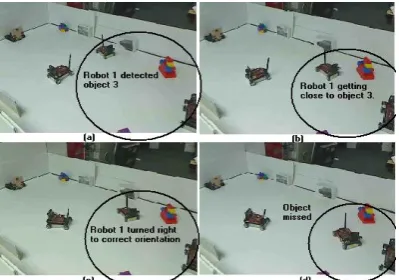
In this experiment, while collectively searching for the objects, robot 1 found the 2D object 1, object 2 and 3D object 3. Robot 2 found 2D object 4. The po-sitions of the robots, when they found the objects, are shown in Figure 3. During this experiment, robot 1 missed the 3D object in the first attempt and success-fully found it in the second attempt. The sequence of robot 1 positions when it missed object 3, are shown in Figure 4. In scene image(a), robot 1 detected ob-ject 3. Then, it was required to get closer to obob-ject 3 to confirm its presence. In scene image(b), robot 1 got closer to object 3. Object 3 was detected on its right side, so in scene image(c), robot 1 turned right. After detecting the object in scene image(c), the robot moved towards the object. But it moved a bit more in the forward direction such that it left object 3 on its
[image:6.595.316.516.309.449.2]left side undetected. Now, in scene image(d), only a small portion of the 3D object was in its field of view and it was not enough for recognition.
Figure 3: Position of the robots when they recognize the object in the environment.
Figure 4: Sequence of robot 1 positions when it detected and then missed object 3.
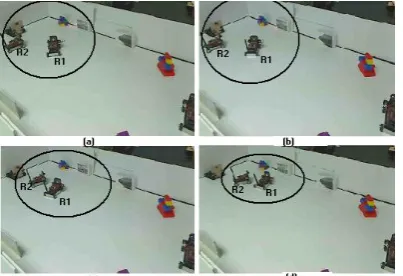
[image:6.595.80.282.408.508.2]ob-Figure 5: Sequence of robot 2 positions when it detected and then missed object 1.
ject and if at some point, the distance information is wrong then the robot misses the object.
4
CONCLUSION
In this research, an implementation of the computa-tionally expensive object recognition approach on a small robotic platform is addressed. It is concluded that information pre-processing and fully utilizing the architectural features of the target platform can make a big difference in the execution performance of the algorithm. It is shown that, the algorithm perfor-mance, to extract and match SURF features, improved from 33 seconds to 750 milli-seconds. Further im-provement in the performance can be achieved by coding critical parts of the algorithm in assembly lan-guage. It is noticed that, as the size of the visual vocabulary grows, the recognition performance may degrade. To overcome this, clustering of the feature space would be required which will make the algo-rithm suitable for embedded system implementation.
ACKNOWLEDGEMENTS
Funded by EU-FP7 research project REPLICATOR.
REFERENCES
Ahmed, M., Saatchi, R., and Caparrelli, F. (2012a). Vision based object recognition and localisation by a wireless connected distributed robotic systems. InElectronic Letters on Computer Vision and Image Analysis Vol. 11, No. 1, Pages 54-67.
Ahmed, M., Saatchi, R., and Caparrelli, F. (2012b). Vision based obstacle avoidance and odometery for swarms
of small size robots. InProceedings of 2nd Interna-tional Conference on Pervasive and Embedded Com-puting and Communication Systems, Pages 115-122. Asanza, D. and Wirnitzer, B. (2010). Improving feature
based object recognition in service robotics by dispar-ity map based segmentation. InInternational Confer-ence on Intelligent Robots and Systems (IROS). Pages 2716-2720.
Chrysanthakopoulos, G. and Shani, G. (2010). Augment-ing appearance-based localization and navigation us-ing belief update. InProceedings of AAMAS 2010, Pages 559-566.
Cummins, M. and Newman, P. (2010). Fab-map: Appearance-based place recognition and mapping us-ing a learned visual vocabulary model. In Proceed-ings of the 27th International Conference on Machine Learning (ICML-10), Vol.27 No.6 Pages 647-665. Dillmann, R., Welke, K., and Azad, P. (2007). Fast and
ro-bust feature-based recognition of multiple objects. In
6th IEEE/RAS International Conference on Humanoid Robots, Pages 264-269.
Evans, C. (2009). Notes on the opensurf li-brary. In OpenSurf, Page 25, URL: www.cs.bris.ac.uk/Publications/Papers/2000970.pdf. Juan, L. and Gwun, O. (2009). A comparison of sift, pca-sift
and surf. InInternational Journal of Image Processing (IJIP), Vol.3, No.4, Pages 143-152.
Kaehler, A. and Bradski, G. (2008.). Computer vision with the opencv library. InLearning OpenCV, Page 576. Katz, D., Lukasiak, T., and Gentile, R. (2005). Enhance
processor performance in open-source applications. In
Analog Dialogue, Vol.39.
Krose, B., Vlassis, N., Bunschoten, R., and Motomura, Y. (2001). A probabilistic model for appearance-based robot localization. InIn First European Symposium on Ambience Intelligence (EUSAI), Pages 264-274. Lowe, D. (2004). Distinctive image features from
scale-invariant keypoints. InInternational Journal of Com-puter Vision, Vol. 60. No.2 Pages 91-110.
Nayerlaan, J. and Goedeme, T. (2008). Traffic sign recog-nition with constellations of visual words. In Interna-tional conference on informatics in control, automa-tion and robotics - ICINCO.
Ramos, F., Tardos, J., Cadena, C., Lopez, D., and Neira, J. (2010). Robust place recognition with stereo cameras. InInternational Conference on Intelligent Robots and Systems (IROS), IEEE, Pages 5182-5189.
Ricardo, C. and Pellegrino, S. (2010). An experimental evaluation of algorithms for aerial image matching. InIWSSIP 17th International Conference on Systems, Signals and Image Processing.
Siegwart, R., Sabatta, D., and Scaramuzza, D. (2010). Im-proved appearance-based matching in similar and dy-namic environments using a vocabulary tree. InIEEE International Conference on Robotics and Automa-tion(ICRA), Pages 1008-1013.
[image:7.595.81.283.94.232.2]