Available from Sheffield Hallam University Research Archive (SHURA) at:
http://shura.shu.ac.uk/19328/
This document is the author deposited version. You are advised to consult the publisher's version if you wish to cite from it.
Published version
BATES, Christopher David. (2014). Message passing: How software engineers use talk. Doctoral, Sheffield Hallam University (United Kingdom)..
Copyright and re-use policy
Sheffield Hallam University
Learning and Information Services Adsetts Centre, City Campus
Sheffield S1 tWD
All rights reserved
INFORMATION TO ALL USERS
The quality of this reproduction is dependent upon the quality of the copy submitted.
In the unlikely event that the author did not send a com plete manuscript and there are missing pages, these will be noted. Also, if material had to be removed,
a note will indicate the deletion.
uest
ProQuest 10694209
Published by ProQuest LLC(2017). Copyright of the Dissertation is held by the Author.
All rights reserved.
This work is protected against unauthorized copying under Title 17, United States C ode Microform Edition © ProQuest LLC.
ProQuest LLC.
789 East Eisenhower Parkway P.O. Box 1346
Message Passing - How Software
Engineers Use Talk
Christopher David Bates
A thesis submitted in partial fulfillment of the requirements of Sheffield Hallam University
for the degree of Doctor of Philosophy
I would like to dedicate this thesis to my mother Margaret, to my late father George, to my wife Julie and our wonderful daughters
Acknowledgements
I would like to acknowledge the support and help I've had from my supervisory team.
Dr. Kathy Doherty has been an inspirational guide into the world of ethnomethodology.
Dr. Karen Grainger has given invaluable help with the nuances and minutiae of conversation analysis.
My fieldwork took place at a num ber of companies in Sheffield and Nottingham. I am immensely grateful for the access which they gave me and for the time which individual members of staff spent with me.
In this thesis I present software engineering as a social process in which pro grammers work together to create technical solutions. I propose that the social structures which developers create and within which they work provide the foundations from which they are able to collaborate to build software. In do ing so I characterise software engineering as being as much a social enterprise as it is a technical one.
Since its origins in the late 1960s, the discipline of software engineering has been one that is concerned primarily with tools, techniques and processes. Research and writing within the area, by both academics and practitioners, have been interested in developing better ways to deliver better software and, hence, better customer satisfaction. Relatively little effort has gone into under standing what it is that software developers, in particular programmers, do as they work collaboratively.
Starting from an ethnomethodological position, I present an examination of those activities of programmers which enable both sense-making and co ordination. The research examines the work of developers in teams that self- identify as adherents to the Agile Manifesto. These teams are interesting be cause of the Manifesto's commitment to a social view of software develop ment.
Three teams of professional developers are studied in their normal work ing environments as they work on commercial projects for their clients. The first is a failing team which I follow as they begin to use Scrum whilst the sec ond team has been using Scrum for a num ber of years. The final team uses a mixture of techniques from XP, TDD and Kanban to create their own way of working.
Contents
Dedication i
Acknowledgements ii
Abstract iii
Contents iv
List of Figures 1
1 Introduction 1
1.1 Software E ngineering... 4
1.2 The structure of this t h e s i s ... 7
1 Background
9
2 Software Engineering Practices 10 2.1 In tro d u ctio n ... 102.2 The difficulty of developing software ... 11
2.3 Structuring work as projects ... 16
2.4 Chandler: a project in c risis ... 20
2.5 Agile m e th o d s ... 24
2.5.1 Extreme p ro g ram m in g ... 25
2.5.2 Scrum ... 28
2.6 The Agile M anifesto... 37
2.7 Agile p ractices... 40
2.8 Software Engineering as C r a f t ... 49
2.8.1 C raftsm anship... 50
2.9 S um m ary... 52
3.1 In tro d u c tio n ... 54
3.2 E th n o g rap h y ... 55
3.3 Ethnomethodology ... 60
3.3.1 Conversation a n aly sis... 64
3.3.2 F a c e -w o rk ... 68
3.4 Negotiating d e sig n ... 69
3.5 Finding m e a n in g ... 73
3.6 The role of representation in talk about p ro g ram m in g ... 76
3.7 Communication and c o o rd in a tio n ... 80
3.7.1 Organising team w o rk ... 82
3.7.2 Communicating within development teams ... 84
3.7.3 Discussing technical is s u e s ... 87
3.7.4 Shared perspectives within te a m s ... 89
3.7.5 Being a c o m m u n ity ... 91
3.8 Empirical research into software en g in eerin g ... 93
3.8.1 Criticisms of empirical software en g in eerin g ... 96
3.9 Ethnography and Software E ngineering... 98
3.10 S u m m ary ... 101
4 M ethodology 103 4.1 In tro d u c tio n ... 103
4.2 Principles which underpin the design of the s tu d y ...104
4.3 On doing ethnography ... 106
4.3.1 Fieldwork ... 106
4.3.2 Field n o t e s ... 110
4.3.3 Writing e th n o g ra p h y ... I l l 4.4 Implementing the s tu d y ... 113
4.4.1 Finding cases... 115
4.4.2 Designing and doing the field w o r k ... 117
4.4.3 Taking n o te s ... 122
4.4.4 Transcribing the recordings... 124
4.4.5 Answering the q u e stio n s ... 125
4.5 Ethical considerations... 126
4.6 The three c a s e s ... 128
4.6.1 Z * ... 131
4.6.2 A*, c o m ... 134
4.6.3 E * ... 137
4.7 Analysing the d a ta ... 139
4.8 A mixed m ethods ap p ro ach ... 142
Contents
II Case studies
146
5 Z* 147
5.1 In tro d u ctio n ... 147
5.2 The com pany...149
5.2.1 DVD authoring so ftw a re ... 149
5.3 Measuring success...152
5.4 Negotiating access...153
5.5 The first d a y ... 157
5.6 The staff... 161
5.6.1 Project m anagem ent...162
5.6.2 The d ev elo p er...167
5.6.3 Quality au d itin g ...171
5.6.4 The product m a n a g e rs ... 174
5.7 The first S crum ... 176
5.8 The Daily Scrum M eeting... 179
5.9 D iscu ssio n ... 181
6 A*.com 185 6.1 In tro d u ctio n ... 185
6.2 The com pany... 186
6.2.1 The p r o d u c t... 187
6.2.2 Approaches to developm ent... 189
6.2.3 The staff and their working environm ent...190
6.2.4 Technologies... 192
6.3 Working p ra c tic e s... 195
6.3.1 Being a g ile ... 196
6.3.2 S kype... 198
6.4 The sta n d -u p ... 199
6.5 Managing the m eeting...201
6.5.1 Taking t u r n s ...201
6.5.2 Ending the m e e tin g ...207
6.5.3 A uthority... 208
6.6 A ccounting... 212
6.7 Humour ... 216
6.7.1 Successful h u m o u r ...217
6.7.2 Unsuccessful h u m o u r...220
6.7.3 Banter ... 223
6.8 D iscu ssio n ... 226
7.2 The c o m p an y ...233
7.3 The development team ...236
7.3.1 W orkflow ...238
7.3.2 C o d in g ...240
7.4 Gathering the d a t a ... 244
7.5 Working w ith existing c o d e ... 245
7.6 Talking about testing ...253
7.7 Implementation or d e s ig n ? ... 263
7.8 D is c u s sio n ... 271
III Discussion
275
8 Discussion 276 8.1 In tro d u c tio n ... 2768.2 Research th e m e s ...277
8.3 Contribution to k n o w le d g e ... 280
8.3.1 Negotiating shared understanding...281
8.3.2 Coordinating w o r k ... 286
8.3.3 The Agile M o v e ...291
8.3.4 Qualitative software engineering research ...295
8.4 Further w o r k ... 296
8.5 Conclusions ... 299
IV Bibliography
303
Bibliography 304
V Appendices
324
A CA Symbols 325
B Website 326
C Consent form 335
D Stand-up at A* 337
E Existing code at E* 346
List of Figures
2.1 The waterfall model, (Boehm; 1 9 8 8 )... 17
2.2 The spiral model, (Boehm; 1 9 8 8 )... 18
2.3 Structure of S crum ... 30
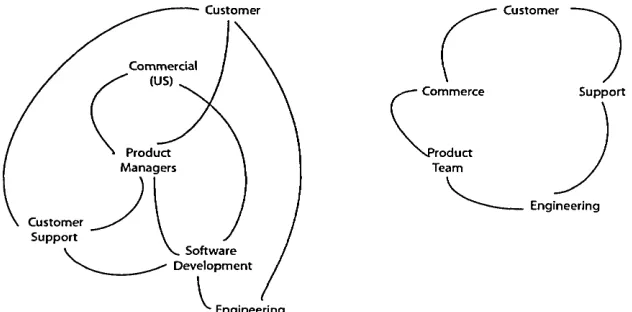
5.1 Old and new communication structures...163
7.1 The developers7 organisational structure at E*... 237
7.2 The database structure ... 248
This thesis is a study of software engineers and software engineering. The research questions which are addressed here are:
• how do software teams coordinate their work through their talk-in-interaction about that work?
• how do software development teams which use agile m ethods create and sustain an agile culture?
• how do software engineers talk about code so as to make sense of it?
In anwering these questions this thesis will reify software engineering as an activity which is both social and technical.
Chapter 1 Introduction
applications. There has been far less interest in the social relationships be tween developers as they produce code.
Whilst academics in the 1990s examined communication with users, some practitioners were bringing the communications needs of developers to the fore. The agile methods movement takes as one of its core principles that im proving communication within a team can improve the performance of that team. The Agile Manifesto, (Beck et al.; 2001), and the working practices which are used by agile teams present a challenge to established tropes of software engineering in their explicit appeal to developers. These methods privilege interactions within teams and the use of tools and techniques such as Test- Driven Development over documentation and project management.
There is evidence that agile approaches lead to a range of benefits from happier developers, (Muller and Padberg; 2004) and to more productive teams, (Benefield; 2008). DyM and Dingsoyr (2008) write that it is not clear how ag ile methods are used in practice nor are their benefits and the causes of those benefits necessarily well-defined. In particular the role of communication is under-researched and under-theorized. Are agile developers more produc tive because they are placed in situations such as Daily Scrums in which they have to talk about their work or despite this? Does pair-programming lead to better code through talk-in-interaction about code?
veal the working practices of developers, often being more interested in tools and techniques than in the work which they support. Schultze (2007) points out that much research into knowledge work has focused on the classification of knowledge rather than on the work of producing it which has meant an interest in what people know rather than in how they come to know.
This thesis grew from an interest in what programming is and in what pro
grammers do when they program. Software development in general and pro
gramming in particular, are situated in "work" whether that is seen through the abstractions of project and team or seen as simply another type of white- collar office work. This research shows how programmers work together to create software and how the ways in which they talk about their work and the software which they are making frame and formulate that work.
1.1 Software Engineering
1.1 Software Engineering
The development of software is a multi-faceted activity which includes both the technical and the social. It is heterogeneous engineering, (Law; 1987), in which technologies arise through the negotiation of a complex network of so cial and technical factors mediated through conflict. Law is aware that en gineers are as much products of a mix of factors as the artefacts which they create are. The engineer and client both bring complex ideas, experiences and requirements to the negotiation of a product. In a sense this has been known since the formulation of Conway's Law which states that "[a]ny organization which designs a system (defined more broadly here than just information sys tems) will inevitably produce a design whose structure is a copy of the or ganization's communication structure", (Conway; 1968). Any examination of engineering practices which omits these wider contexts is, Law argues, in dan ger of over-simplifying the activity.
The IEEE has defined software engineering in (Abran et al.; 2004) as:
(1) The application of a systematic, disciplined, quantifiable ap proach to the development, operation, and maintenance of soft ware; that is, the application of engineering to software. (2) The study of approaches as in (1).
relatively few people have heard of software engineers everyone has heard of
computer programmers even if they have no idea what a computer programmer
actually does.
The Association of Computing Machinery write in (ACM; 2012) that:
Software engineering is concerned with developing and maintain ing software systems that behave reliably and efficiently, are af fordable to develop and maintain, and satisfy all the requirements that customers have defined for them. It is important because of the impact of large, expensive software systems and the role of software in safety-critical applications. It integrates significant mathematics, computer science and practices whose origins are in engineering.
(Sommerville; 2004), a popular introduction to Software Engineering, widely used on University courses, states that:
Software engineering is an engineering discipline that is concerned with all aspects of software production from the early stages of system specification to maintaining the system after it has gone into use.
Those definitions all include notions of:
• Disciplined processes.
• Lifecycles running from the specification of a system through develop ment and on to maintenance.
1.1 Software Engineering
But the notion of programming, of writing and developing code is not a core part of them. Programming is implicit in terms such as "development", "maintenance" or "production", yet, surely, writing code is software engineer ing. The authors of those definitions place the design and creation of high- quality code as neither more nor less important than requirements gathering, project management or the writing of a specification.
The idea that software can be "engineered" is fundamental to contempo rary understanding of the software development process. Professionals across IT take engineering to mean the application of rigour and of numerical analy sis and the creation of controlled and reproducible processes, (Brechner; 2007). Engineers from other fields have more nuanced ideas of what engineering can mean. Florman (1976) writes that engineering is "the art or science of making practical application of the knowledge of pure sciences" and that engineers "solve problems of practical interest.. .by the process we call creative design". Engineering "has as its principle object not the given world but the world that engineers themselves create", (Petroski; 1992).
Yet software engineering's vision of engineering as rigorous and process driven differs from the engineer-authors who see it as a practical and creative activity in which there is continuous learning. Counter movements such as Agile, see Section 2.6, and Craftsmanship, Section 2.8, whilst not rejecting the software engineering agenda have started to re-formulate software develop ment as something which is more akin to the design-led ideas of engineering.
1.2 The structure of this thesis
This thesis is divided into three parts.
In the first part, Chapter 2 introduces software engineering as a discipline in which the delivery of product can be problematic. A case study shows why producing software can be so difficult. The Chapter then examines alternative approaches to team working and looks at the role of the skills of individual developers in the production of software.
Chapter 3 studies the importance of talk as a method for the production of understanding and coordination. Finally in this part, Chapter 4 includes a discussion of relevant research methods and the design of the research used in this work.
The second part contains the three case studies which were undertaken. The first case study, Chapter 5 follows a software house as they introduce the agile method Scrum into a project. It shows their working practices before they started to use Scrum, discusses the problems managers in the company identified as drivers for the move to Scrum and, finally, shows how the team applied some of Scrum's methods.
1.2 The structure of this thesis
long time. In this Chapter a single event, one of their daily stand-up meetings, is analysed in detail. The analysis reveals how their social interactions within the meeting enable the coordination of work, the sharing of technical detail and strengthen the personal relationships within the team.
The final case study is a detailed analysis of the sense-making in which two developers are engaged as they work in a "pair" to understand existing code and write more code based upon it. This case study is presented as a conversation analysis of a series of interactions which took place in a period of three weeks.
2.1 Introduction
This Chapter gives an introduction to the professional activities of software engineers, specifically those activities which help them when they write, test or understand code. The practices of software engineers are the main topic of interest within their discipline, a discipline which arose from a perceived need to identify and codify practices which helped improve the delivery and quality of software. Software engineering is a diverse activity which changes as technologies change and as our expectations of the capabilities of software and systems change.
In the last decade an important, and radical, change has revolutionised
2.2 The difficulty of developing software
Communication is a core idea in the agile community and is central to the ways in which many agile practices are implemented. This Chapter in troduces those agile practices which are concerned with communication but looks specifically at a subset which were found in the fieldwork for this thesis. Examining agile communication as seen in the commercial development of software and provides a context within which to read the later empirical and analytical Chapters.
2.2 The difficulty of developing software
We have been programming computers since the 1940s and for most of that time there has been talk of a crisis in software development. That crisis stems from the perception that most IT systems are delivered late, over budget and with less functionality than was originally specified. The situation became so bad that in 1968 NATO convened a conference of 50 experts to examine the situation and suggest a way forward. Much of the discussion of this event in Naur and Randell (1968) remains pertinent today, indeed we often repeat the same discussions with the technologies simply updated. This conference pop ularised the use of the term Software Engineering and set its basic parameters. The new discipline was based on study of methodologies, how programs are designed and written, and tool support for development.
is still too much of an artistic endeavour. We need a more substantial basis...". This view prevailed in 1968 and continues to dominate today. The idealised "software engineer" who rises from the Garmisch conference regards engi neering as an activity which is essentially rigorous because the mathematical certainty of "engineering" brings repeatability and "measurability" to soft ware development, (Brechner; 2007). By constituting the creation of software
as a process which can be measured and managed the process became an ob
jective reality. The formulation of this reality happened so quickly that by the time that NATO reconvened its conference in Rome in 1969, Brian Randall no ticed that participants talked of "software engineering" as an established fact, (Rosenberg; 2007).
The 1968 NATO conference was convened because of widespread percep tions that there was a crisis in software development. At the time the most infamous example of a failed project was IBM's development of its O S/360 op erating system. The OS/360 project had gone disastrously wrong: the system was delivered over a year late, required 5,000 person-years effort, cost $500 million (four times the original estimated cost) and was full of bugs which would take years to track down and fix. Projects like OS/360 were failures along both technical and managerial dimensions. Other projects were failing because the needs of users were not considered deeply enough so that time and money were being spent to build systems which weren't needed or which didn't perform as their users expected or required.
2.2 The difficulty of developing software
two of the Garmisch participants talking about the ways in which they saw systems being developed.
Kinslow: The design process is an iterative one. I will tell you one thing which can go wrong with it if you are not in the laboratory. In my terms design consists of:
• Flowchart until you think you understand the problem. • Write code until you realize that you don't.
• Go back and re-do the flowchart.
• Write some more code and iterate to what you feel is the cor rect solution.
If you are in a large production project, trying to build a big sys tem, you have a deadline to write the specifications and for some one else to write the code. Unless you have been through this be fore you unconsciously skip over some specifications, saying to yourself: I will fill that in later. You know you are going to iter ate, so you don't do a complete job the first time. Unfortunately, what happens is that 200 people start writing code. Now you start through the second iteration, with a better understanding of the problem, and it is too late.
gradually. Understanding requirements then designing software to imple ment a solution to those requirements necessarily has to be an iterative pro cess. But systems are large and complex. In the 1960s software was intimately tied to hardware with operating system, application software and, sometimes, the hardware itself being built concurrently. Project teams quickly became large and their members became specialists in particular aspects of the so lution. Once an approach had been determined and the team had started to implement it changing course was very difficult. Projects tended not to iterate, they tended to build the thing which they first defined.
Another participant agreed that requirements presented a problem.
The most deadly thing in software is the concept, which almost universally seems to be followed, that you are going to specify what you are going to do, and then do it. And that is where most of our troubles come from. The projects that are called successful, have met their specifications. But those specifications were based upon the designers' ignorance before they started the job.
2.2 The difficulty of developing software
The best way to understand the failure of projects may be to look at lots of them. Consultants DeMarco and Lister have studied and worked on many software projects over the last forty years. Every year from the late 1970s through to the end of the twentieth century they surveyed project teams about their results. In examining over five hundred projects they found "15 per cent... came to naught" because they were, for some reason, cancelled or never used. "25 percent of projects that lasted twenty-five work years or more failed to complete". For those failed projects the "overwhelming majority" had "not a single technological issue to explain the failure". The most common reason given for project failure was "politics". When they unpicked the idea of poli tics they found that the term was used to cover a host of people-related issues such as communication or staffing problems, difficulties with the client or a lack of motivation within the team, (DeMarco and Lister; 1999).
When projects fail because of organisational politics or culture, improving those things, or at least recognising that they have become problems and re sponding accordingly, ought to bring more successful development. Chapter 5 examines exactly this situation.
true today that software engineers have not been able to put together a co herent engineering design method for the systematic production of software, specifically for large, complex, ill-defined systems", (Diaz-Herrera; 2009).
An intangible product rather than a lack of rigour in its development might be the reason we have a software crisis. In some ways, perhaps, the software crisis exists because it is so widely talked about. It could be that "[o]ur basic problem is simply the success of modern computer science. History has shown that this truth is very hard to believe. Apparently we are trained to expect
a software crisis, and to ascribe to software failures all the ills of society: the
collapse of the dot.com bubble, the bankruptcy of Enron, and the millennial end of the world", (Noble and Biddle; 2002).
2.3 Structuring work as projects
Software is developed by teams of people whose work is generally structured as projects. Much of the discipline's focus is on improving the industry's ap proach to managing different types of project using a variety of structures. Or ganisations such as the Software Engineering Institute have developed models of best-practice for project teams and organisations which are widely followed, (Software Engineering Institute; 2010). Most people have some commonsense understanding of what a project is, but what is a software engineering project? How is the term understood by practising software developers?
2.3 Structuring work as projects
documented and specifies the product to be delivered or implemented, the resources and funds used, the work to be done, and a schedule for doing the work. A project can be composed of projects", (CMMI Product Team; 2001). That definition is self-explanatory and is probably not too dissimilar to the commonsense definitions which most people would give.
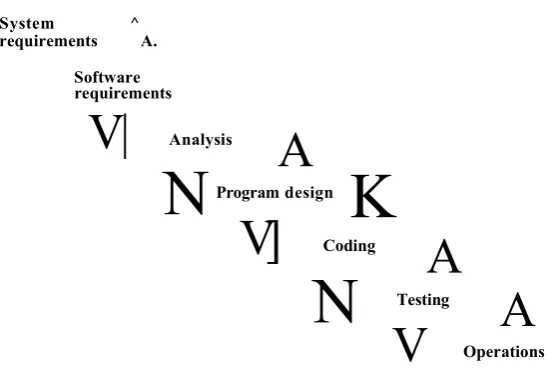
System ^ requirements A.
Software requirements
V|
AnalysisA
N
Program designK
V]
CodingA
N
TestingA
[image:28.613.144.420.165.353.2]V
OperationsFigure 2.1: The waterfall model, (Boehm; 1988)
Although projects can be ad-hoc and free-form, the conventional approach to development is plan-driven, (Boehm and Turner; 2004). These projects move naturally through a num ber of distinct phases from initial requirements-gathering towards a deployed solution. This approach to software development has, in theory, a num ber of benefits for developers and their employers, not least that resourcing needs, costs and due dates can be agreed upon at the start of a project. The best known approach to plan-driven development is the water fall model which is shown in figure 2.1.
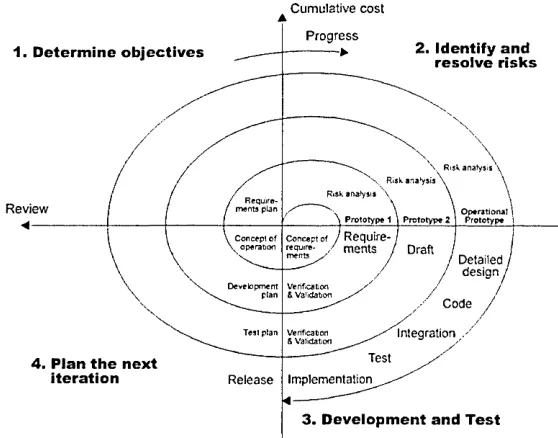
architectural documents, designs, models and implementation plans, (Som- merville; 2004). Of course reality is never this straightforward which is why the waterfall model is often criticised for its simplicity. (McBreen; 2001) writes that with waterfall "it is easy to consume half the available time before any thing can be demonstrated to the users". The problem is that the project struc ture is heavily front-loaded so that effort is put into the definition of require ments and the design of the software rather than into implementation. Few projects are either so straightforward or so heavily resourced that a perfect set of documentation can be produced such that it will naturally lead on to devel opment, testing and deployment. Over the years a number of variants have appeared which maintain a well-structured project but which allow for more flexibility during the lifetime of the project. The spiral model, for example, describes a more realistic project structure, Figure 2.2 shows how it works.
Cumulative cost Progress
2. Identify and resolve risks 1. D eterm ine objectives
Review
P ro to ty p e 1 \ P ro to ty p e 2 | P rototype j C oncept of
Draft
Detailed design ,
Development
Code Integration
Test plan
Test
4. Plan th e n ext
iteratio n Release Implementation
[image:29.614.142.421.362.581.2]3. D evelopm ent and T est
2.3 Structuring work as projects
mg to use, a structured approach in which the structure and functionality of the product is understood relatively early in the development cycle. In a sig nificant proportion of projects understanding of the functionality which will appear in the completed product is not developed until well into the develop ment process and project structures can act to restrict understanding within teams, (Banker et al.; 1998). Iterative development is a successful answer to the problems of incomplete requirements and limited understanding of the necessary path to a completed implementation, (McBreen; 2001, Harper et al.; 2013).
In iterative development the team adds new functionality as and when it is needed. The project continually cycles through requirements definition,de sign and implementation phases. Usually the developers agree the function ality which they will implement in the next cycle with the customer, or their proxy, and determine the length of the cycle and the resources which are re quired to complete it, (Deemer et al.; 2010). Often the "new" requirements in clude the need to modify functionality which has already been implemented. Studies such as Hanssen et al. (2009) which look at changes made to code bases show that the same sections of code or the same parts of a product are repeat edly reworked. However repeatedly changing programs leads to "code en tropy" in which the source code becomes so complex, or varies so much from its original form, that errors begin to appear within it. The developers then risk misunderstandings which "lead to a fear of changing the code, both for adding new features and for refactoring", (Hanssen et al.; 2009).
within a small team whose discussion focuses on difficulties each of them has with their code. Chapter 7 follows two programmers as they work together to understand some existing code as they write code which uses it. Chapter 5 follows a small software house as they introduce agile processes in response to their customers' ever-changing needs.
2.4 Chandler: a project in crisis
Rosenberg (2007) gives a detailed journalistic account of a long-running project
to create an information management system called Chandler. The Chandler
project was initiated and funded by Mitch Kapor who made his money from the creation of the seminal spreadsheet application Lotus 1-2-3. Kapor and his team wanted to build an application which competed with Microsoft's Ex change Server and Outlook email client but with some fundamental differ ences in technology and approach:
• Chandler was an Open Source project with a core team of paid devel opers and a wider volunteer community contributing code, bug fixes, design ideas and documentation.
• Chandler was to be built using a peer-to-peer architecture rather than a more conventional client-server one.
• The application was to be programmed in the language Python.
com-2.4 Chandler: a project in crisis
munity of volunteers. Often these developers are employees of companies such as IBM, Apple or RedHat who are paid to work on external Open Source projects. The team at Chandler was reasonably large, twenty seven develop ers at its peak, but never managed to build a supportive community effort. Instead almost all of the development work was done in-house.
The first prototype of Chandler was written by programmer Andy Hertzfeld using the platform-independent language Python. One of the benefits of Python is that it has a really simple syntax which means that programmers using it can be very productive, making it ideal for prototyping early version of appli cations. Python doesn't have its own GUI toolkit but there are bindings to an number of alternatives. Hertzfeld used a toolkit called WxWidgets, at the time called WxWindows, in his prototype. At the time of the Chandler prototype WxWidgets was still in heavy development with new features being added all the time and existing features changing in the way that they worked.
Because of the choice of technologies, building Chandler was always go ing to be a struggle. The peer-to-peer architecture was different to the archi tecture of other email and calendaring applications which use a centralised server. The changing GUI toolkit meant that Chandler's code was always in flux but that the rate of change was, in part, being determined by another project. Rosenberg gives many examples of the problems which this created for the team but one illustrates many of their difficulties.
product called ZODB which is written in Python. Learning to use such com plex technologies immediately slowed development at a time when they were trying to produce the first release of their software.
Rosenberg describes a team meeting at which they argued about whether to ditch ZODB and instead write their own wrapper around Berkeley DB. Pro gramming large systems often comes to a choice between re-using code and wiring together components or building things from the ground up. There is a constant debate between those who want to re-use and those who think software development is easier if you build just those parts which you need to complete your project. "Modularity, and interchangeable modular compo nents are a key component of the modernist approach in software, as in archi tecture, marketing, production, and elsewhere", (Noble and Biddle; 2002).
This Utopian vision has been written about and discussed for at least twenty years but has never really come to fruition. This is because re-using code is hard, (Glass; 2001). Re-use in the small is easy, that problem was solved in the 1950s when programmers "built huge, useful collections of mathematical and data-processing library routines". We still do that in every software shop today. However when we try to re-use large amounts of code it "is and always has been an unsolved problem. In spite of the enthusiasm of the components crowd, finding in a library of components the precise one that will solve your problem at hand is nearly an impossible task". The major difficulty in re-using code is, Glass argues, "the variability in the problems we solve, and in the so lutions we create".
2.4 Chandler: a project in crisis
As they moved through beta versions new functionality was constantly being added to the application. Some of the new functionality had major impacts upon the architecture of the application. For example between release 0.3 and 0.4 they abandoned the peer-to-peer architecture in favour of one which sup ported the, then new, WebDAV standard for collaboration over HTTP connec tions. Whilst the WebDAV standard would become more widely supported at the time there were no Free implementations and the Chandler team found themselves having to write their own server.
Constant changes of functionality, implementation strategy or technology are enough to de-rail any project. Fred Brookes' inspiration for The Mythical
Man-month was the failures he saw developing IBM's System/360 software.
The team building Chandler knew about Brookes' work and about the many other failures of large development projects yet they repeated as many of those mistakes as they could. The Chandler project was doomed to failure from the start because neither its objectives nor its technologies were clearly defined.
The project continues today at h t t p : //ch an d lerp ro j e c t . org/. The most recent version at the time of writing is 1.0.3 which was released in April 2009.
2.5 Agile methods
Software development throws up many examples of failing projects. The ques tion for the profession is how to address the causes of failure so as to improve both process and product.
The introduction of structured project and team management techniques through the 1980s and 1990s promised improved oversight and control of de velopment teams. The efforts of the Software Engineering Institute, the pro fessional bodies and others meant that by the end of the Twentieth century practitioners and academics knew how to manage a software development project. Yet projects such as the computerisation of patient records in the NHS continue to fail to this day. The complexity of projects and the size of the teams involved in implementing them is one reason that projects fail. Large projects cannot be specified accurately from the outset and it is, according to Brian Randall, "far better to employ evolutionary acquisition, i.e. to specify, imple ment, deploy and evaluate a sequence of ever more complete IT systems, in a process that was controlled by the stakeholders", (Flinders; 2011). James Mar tin, quoted by Flinders says "I've also seen 'best practice' lead to 'worst result' projects far too often and I believe that's the root cause of the problem: process has greater emphasis than outcome and that's not going to get a project over the line".
2.5 Agile methods
all development process, and a lack of a well-established management frame work", (Jiang et al.; 2004).
Developers knew all of this a long time ago: iterative and incremental de velopment was being discussed as long ago as 1957, (Larman and Basili; 2003, Abbas et al.; 2008), and the 1968 NATO conference was, in part, an attempt to find ways of avoiding problems in project management. For whatever rea son the "software crisis" continued and as it did so the search for alternatives grew. Abbas et al. (2008) list numerous studies which argued that linear mod els of development, and modifications such as Rational Unified Process and the V-model, were failing to address the realities of modem software devel opment.
2.5.1 Extreme programming
In the early 1990s Kent Beck and his colleagues at Chrysler began to codify a way of working which came to be called Extreme Programming, (Beck; 2000). They were building a payroll system using traditional approaches. The project was failing so badly that two months before it was due to go into production it still didn't "compute the right answers". With the agreement of senior man agement the project started again using a small team and a radical approach to development. Using three week long iterations, user stories and a local do main expert the team was able to turn the project round.
velopers' managers rather than by the requirements of either the developers themselves or their customers and end-users.
Extreme Programming is built from four values which are deliberately dif ferent to those which are normally found in business. A fully-functioning XP team places value on communication, simplicity, feedback and courage.
The XP values are not meant to be merely abstract concepts, they imply a common-sense understanding of four ideas. Communication is any type of communication between people who are involved in the project using any ap propriate medium. Simplicity means to do the simplest thing possible. Feed back means that developers require immediate feedback on the state of the system which they are building, usually this comes from automated build and testing tools. Courage requires that individuals are empowered to speak out about the state of their own work and that of their colleagues.
Courage, feedback and simplicity are important values but they can only become meaningful to a team if members are able to communicate with each other. When members communicate they must be able to exchange both for mal and informal information. Communicating like this requires trust, (Holm- strom et al.; 2006), and mutual respect, (Beck; 2000).
2.5 Agile methods
quickly.
Problems have less impact if the code and design are as simple as possible. Beck writes that "it is better to do a simple thing today and pay a little more tomorrow to change if it needs it than to do a more complex thing today that may never be used". It is easier to estimate the effort required to complete a simple task than to do so for a large, complex series of tasks. But learning to value simplicity is difficult for programmers who by training and inclination enjoy complexity. The final XP value is courage which means having the abil ity, as teams or as individuals, to do the right thing even if it is more difficult than not doing so. For example, work may need to be discarded even after a major investment in it.
Whilst the four values of XP are linked, they do not make a development approach on their own. XP builds a set of less abstract principles on top of ts values. The principles are implemented using XP's practices such as unit test ing, pair-programming and small releases. All the values, principles and prac tices of XP combine into a flexible, iterative and cyclical approach to the devel opment of software and systems. Chong (2005) found that the XP approach "provides a framework for standardizing the work of software development and making this work more effortlessly visible and accessible to members of a software development team".
In a longitudinal ethnographic study of an XP team by Sharp and Robinson (2006), working practices were seen to evolve from those of a waterfall team to suit the requirements of the XP approach:
Rhythm of the iteration : Pre-planning —> planning game —> daily rhythm —)• retrospective
These rhythms are important to the team and their continued pro ductivity. These rhythms are sometimes referred to as the heart beat of XP".
In practice XP is an approach which might not suit every team. Sharp and Woodman noted that developers found pairing to be "intense and tiring" and th a t"... continual interactions between developers and the 'customer', i.e. the person who represents the business domain and end user of the product" could lead to "clashes of culture between the two roles". When pair program ming developers can work unusually closely for long periods of time. This can become "like a marriage", (Robinson et al.; 2007).
The values and practices of XP, and other agile approaches, "are created and sustained by practice", (Sharp and Robinson; 2003), and may be "consti tute a community of practice with mutual engagement, joint enterprise and a shared repertoire". Section 3.7.5 will discuss the creation of culture and com munity through shared ideas and experiences in detail.
2.5.2 Scrum
When most programmers think of Agile Methods today, what they envisage is likely to be Scrum. This method was developed by Jeff Sutherland and Ken Schwaber along with a large number of collaborators from industry and academia, (Sutherland and Schwaber; 2007).
2.5 Agile methods
development team but all of them place flexibility at the heart of their ap proach. Developers work through a number of core activities regardless of the process they use to create their software and manage their work. Instead of gathering all of the requirements of a project at the beginning before design ing then testing and finally deploying the entire product, agile teams work on smaller pieces. An agile team will gather sufficient requirements for a short burst of work lasting from a couple of weeks to a few months. The project team will repeatedly rim short cycles with new requirements driving each iteration through incremental change until the entire product has been deployed.
Proponents of iterative software development sometimes claim that it can only happen successfully if a number of conditions are met, (Rising and Janoff; 2000). These include placing individual developers and their skills at the heart of the process, collaborating with customers throughout development, treat ing working code as the major artefact of the project and reacting to change instead of blindly following a plan.
Scrum projects are organised around small closely knit teams working on rapid iterations of a develop-release cycle. Development takes place in tightly focused sprints which last just a few weeks. At the start of each sprint goals are set including the functionality to be included in the next release and a hard deadline is set at which time the software should be released. During the sprint, brief daily meetings are held to ensure that the team remains on-track.
Product Backlog Sprint Backlog Sprint Working increm ent of the software
Figure 2.3: Structure of Scrum
subset of the backlog is selected to be worked on in the next iteration, aka
sprint, which typically lasts for three weeks. Within the sprint their is a cyclical
structure of daily meetings and at the end of the sprint a new version of the software may be released.
How Scrum works
The rationale behind, and use of, Scrum are thoroughly documented in Schwaber (1995), Rising and Janoff (2000), Sutherland and Schwaber (2007), Deemer et al. (2010) amongst many others. It is w orth discussing briefly the key parts of the m ethod because some of them will be interrogated in detail in later empirical Chapters.
2.5 Agile methods
includes a number of roles which should be filled. The key ones are Product
Owner, Team and Scrum Master. Analogues of these roles don't really exist in
a waterfall project where there will be layers of management, developers and customers with whom there isn't usually a structured relationship.
The Product Owner helps identify those features of the product which need to be worked on, assigns a value to each and helps prioritise them. The Product Owner sits outside the Scrum team but interacts frequently with them. The Team is the group of developers who are working on the project. Teams are typically around seven members strong. Ideally each member will be multi-skilled and the Team should be, or become, capable of self-organisation so that interference from external management is kept to a minimum. The key role is the Scrum Master who works with the Team and Product Owner to achieve their goals but, crucially, is not their manager. Scrum Masters facil itate the development and act as a bulwark against external forces which may move the Team off track.
Scrum is structured around a number of meetings. The main ones being the daily scrums, planning meetings and retrospectives.
Daily Scrum Meetings are probably the method's best-known feature. Each day the development team gathers for a short meeting and discusses their work. The meeting is lead by the Scrum Master. Each team member is asked three questions: what have they done since the last meeting; what are they planning to do next; and what impediments they face.
members find impediments those are noted so that they can be solved outside the meeting often through discussion with the Scrum Master. The stand-up gives the team "the context in which expertise can emerge through interac tion", (Faraj and Sproull; 2000). "Recognizing when and where expertise is needed is at the heart of heedful interrelating" according to Faraj and Sproull. The meeting demonstrates to the whole team where information, expertise or help is needed - these can be provided once the meeting concludes.
Daily Scrum Meetings have the potential to be socially awkward situations, particularly when there are difficulties with the development. Alternatively they can work to bond a team together through success or adversity. Chapter 6 examines the detail of one such event.
Each Sprint is defined at a planning meeting which is lead by the Product Owner. The team works with a Product Backlog, a list of tasks which need to be completed, to decided how much work they can achieve during the next sprint. The backlog is an organic list which grows and shrinks as the project progresses, often it is linked to bug-tracking software and includes some no tion of priority, or relative importance, of the tasks. Teams choose tasks for a Sprint based on those factors which they feel matter most. These may in clude the customers' needs, the priority assigned to bugs or the amount of work which they can manage in a single iteration. The amount of work they can complete is estimated based on person-hours or on story points.
2.5 Agile methods
on feedback, in repeating cycles", (Deemer et al.; 2010). The review is an op portunity to learn whether one's estimates were accurate and for the Scrum Master to determine if the work is "done". Anything which is not deemed to be done goes back into the backlog from where it may be selected by the Product Owner for the next iteration.
The final ceremony used in Scrum is the Retrospective. These are not al ways used but when they are undertaken retrospectives give the team a chance to examine and modify their process.
Research into Scrum
A number of authors have written about the use of Scrum in their own organ isations. Kniberg (2007) provides a details discussion of his experiences using Scrum from managing the team to arranging the room in which they work. His book was written to help beginners, "[o]ne of the most valuable sources of information, however, was actual war stories. The war stories turn Prin ciples and Practices into... well... How Do You Actually Do It". Pikkarainen et al. (2012) surveyed developers and managers and discovered the importance of management buy-in and of tailoring Scrum to the needs of specific teams. The idea that Scrum should be both adaptable and adapted has influenced
a change in terminology from one of its originators who once wrote of pro
cess, (Schwaber; 1995), but now writes of framework, (Sutherland and Schwaber;
2007).
Scrum, using its lightweight framework to create highly collaborative self- organising teams that could effectively deliver better products faster". The reasons given for Yahoo's choice of agile methods which are expressed here provide some possible metrics against which the success of the approach might be measured: collaboration; self-organisation; product quality; and speed of delivery. These metrics are, themselves, difficult to define and measure be cause they are subjective, but through carefully constructed questionnaires or interviews some meaningful data can be generated.
Perhaps surprisingly Yahoo did not have an engineering process until 2002 when they implemented a "globally mandated waterfall process called the Product Development Process (PDP). Unfortunately, many teams simply ig nored the process or, where they couldn't ignore it, paid lip service and made it look like they had adhered to the steps retroactively. The teams that did follow the PDP found that it was heavy, slowed them down, and added little real value". A number of teams had run unofficial agile projects but the first formal trial of Scrum at Yahoo took place early in 2005. Teams which took part in the trial had to commit:
1. to complete comprehensive Scrum training (which translated into Cer tified Scrum Master training for most members of the team);
2. to work with outside Scrum coaches during the first several Sprints; 3. to use all the standard Scrum practices described in Ken Schwaber's "Ag
ile Project Management with Scrum"; and 4. to complete at least one Sprint.
2.5 Agile methods
coaching and training from agile leaders including Ken Schwaber, Paul Hod- getts, Mike Cohn, and Esther Derby. The organisational infrastructure around the Scrum teams was modified to remove impediments: "working with facili ties to secure meeting rooms and take down cube walls, removing governance gates where processes were overly bureaucratic, and changing the way we con ducted resource planning and portfolio management".
At the end of the trial period reactions were overwhelmingly positive. Bene field surveyed those involved and found:
• 74% saw some improvement in productivity across a 30-day period. • 80% said their team's goals were clearer.
• 89% said that collaboration and communication improved within their team.
• 64% felt their team produced more value. • 68% saw a reduction in waste.
• 77% felt positively toward scrum at the end of the trial.
Only one measure was more evenly balanced. 54% of those surveyed felt that the quality of their product improved during the experiment. 5% thought quality was reduced with the remainder feeling that the new way of working made no difference to the quality of their outputs.
Rising and Janoff (2000) report on their experience using Scrum with small
teams at AG Communications Systems, AGCS, who build and install telecommu
way to live with this reality. Rising and Janoff talked to the more successful development teams at AGCS and found that reasons they gave for their suc cess included:
• We did the first piece and then re-estimated - learn as you go!
• We held a short, daily meeting. Only those who had a need attended. • The requirements document was high-level and open to interpretation,
but we could always meet with the systems engineer when we needed help.
These indicators look like a high-level view of Scrum. The match between practices which worked for some of their teams and an established software development methodology encouraged AGCS to experiment with Scrum. Three teams, working on different products, trialled Scrum. Each team found its own way of using Scrum, and whilst none of them followed all of the practices re ligiously, all found benefits from the approach.
2.6 The Agile Manifesto
(Perlow and Weeks; 2002). Even when the team structure is a flattened hier archy and the team runs as a democracy it can still fail. Jurison (1999) reports that egoless teams are ineffective in software development "because people, particularly highly talented software developers, do have egos". It is not clear that agile methods have solved this problem, there is talk of shared ownership and egoless teams but the reality within teams may be different. This area is currently under-researched, Chapter 6 shows how ego and personality impact upon the conduct of a daily stand-up in one Scrum team.
At AGCS one team suffered from changing requirements and a change in the organisational context for their product. Daily meetings and the use of a backlog, held in a spreadsheet, helped them prioritise their work because in "the daily meetings, the Scrum Master would call attention to backlog-item priority". Another team had a heavy testing schedule but found that regular meetings were an efficient way to share information so that "[t]he group as a whole decided the kind of testing to perform in the next test time, not just the tester who worked that test time".
Rising and Janoff conclude that although Scrum's practices are not new, it is basically "incremental time-boxed development" with added daily meet ings, Scrum is appropriate for those projects which have ill-defined require ments or which exist within chaotic and changing conditions.
2.6 The Agile Manifesto
The originators of a number of agile methods and advanced software devel opment techniques came together at the turn of the Century to write a state
Manifesto, (Beck et al.; 2001), and was aimed at the whole industry as. The Manifesto has four values which are based on twelve principles. It states that signatories value:
• Individuals and interactions over processes and tools. • Working software over comprehensive documentation. • Customer collaboration over contract negotiation. • Responding to change over following a plan.
Each of these values can be applied to any agile method and most teams who use agile methods would agree with all four statements. The first and third values express the importance of the people on a project, including cus tomers and end-users; the second and fourth values have more technical foci. The Manifesto has had an impact which is far wider than its own values. It has created a new culture of software development which modifies the traditional engineering approach through the deconstruction of monolithic projects into small iterations.
2.6 The Agile Manifesto
It is often assumed that the Agile Manifesto grew out of the failures of the software industry. Hazzan et al show that, at least in part, "technological forces fostered cultural changes". The Agile Manifesto came at a time when many developers were working on smaller Web-based projects, when time-
to-market was reduced from months or years to periods measured in internet
time. Developers were beginning to have more interaction with customers and
those customers often knew more about what they wanted from their systems than had been true ten years before. The Manifesto has been signed by hun dreds of people. It clearly spoke, and speaks, to many working programmers. The values of the Agile Manifesto appeal to developers who work within the context of changing requirements, short development timescales and multi disciplinary teams. Part of its appeal is that it captures the daily realities of the working lives of many modern programmers.
Recent discussions on forums and email lists show that tensions between project managers and agile developers remain today. Project managers fear that agile methods empower developers who do not understand the "complex realities of organisational change management, governance, financial controls and longer horizon planning activities". Whilst agile developers think that status and ego play a more significant role: "the Project Manager is the project's hero and the Plan is sound (reality is wrong - when it doesn't conform, cor rective action is taken). In agile, the project manager is a team member like any other, and reality always trumps the plan (so when they don't match, the plans are revised)", (Elssamadisy; 2010).
2.7 Agile practices
All agile methods share some common features based on the Manifesto's core values. They structure projects through iteration, they strongly emphasise the need to communicate with the customer and within the development team and they value the delivery of working software most highly. Each agile method takes its own approach to meeting the goals of the Agile Manifesto through the selection of a set of practices. Developers can choose from a wide range of practices: the methods tend not to be rigorous or prescriptive. Thus one can find Scrum teams using Kanban boards or XP projects without on-site customers or with optional pair-programming. Any agile practice may be adopted by any team because developers believe that they "have the expe rience needed to define and adapt their processes appropriately", (Turk and France; 2002).
2.7 Agile practices
developers are largely the same as those of developers on non-agile projects. However, those experiences are found within structures which are created to enable software development rather than to simplify project management. Such experiences will be revealed by the developers' talk in the case studies in this work.
About Daily Scrum Meetings
The Daily Scrum Meeting provides a space for co-ordination and communica tion across the whole Scrum team. Agile approaches tend to share the belief that "a team can be more effective if
• the cost of moving or sharing information is reduced
• the time between making a decision and seeing its effects is reduced", (Cockburn and Highsmith; 2001).
Developers talk about their work in front of their colleagues in relatively general terms. The Scrum Master should work to avoid the meeting becoming becalmed in technical detail whilst letting each developer share information about their work.
In the meeting's context "communication" is being conceptualised as the sharing of information. It tends to be a one-way channel in which the devel oper explains their work to the Scrum Master with no expectation of further detailed discussion. Other team members who are present at the meeting re ceive the information as a side-effect. Whitworth and Biddle (2007) found that team meetings "provide high levels of social accountability and support, and awareness of activity in a project, such as provided by information radiators, was seen to increase feelings of security and control in the team environment"
One of the side-effects of a stand-up meeting is that the shared informa tion leads naturally to other talk outside the meeting. Because each of the developers knows what their colleagues are working on they are able to talk about to each other about the work of the entire team. Nothing is hidden from colleagues..
Teams do not have to adopt Scrum or use stand-ups to gain some of these benefits. Sawyer et al. (1997) examined a company in which teams were given access to a computer-supported team room. Teams would use the room to examine and discuss designs and code. Use of the room meant that group discussions became easier, "[t]he direct effect is to make it easier for develop ers to work together; enabling the production aspects. So, software develop ment improvements at this site have emerged without increased engineering. Rather, they have emerged due to increased discussion".
Distributed meetings
2.7 Agile practices
velopers have experienced working in multinational and multicultural teams as sections of projects are outsourced and offshored. The day-to-day manage ment of these projects becomes more complex because of the team's distribu tion. Holding meetings is difficult when members are at multiple sites and when the morning meeting at one site is actually the mid-afternoon meeting at another.
Successful collaboration relies upon the sharing of knowledge and, more importantly, the creation of social relationships, (Layman et al.; 2006). Mem bers of successful teams trust each other but trust is "more likely to be built if personal contact, frequent interactions and socializing between teams and individuals are facilitated", (Kotlarsky and Oshri; 2005). Distribution of teams "challenge[s] project processes such as communication, coordination, and con trol", (Holmstrom et al.; 2006).
An important, but often unacknowledged, problem for developers on dis tributed projects is simply knowing who talk to at other sites. Holmstrom et al note that staff on distributed projects have the same requirements of each other as if they were physically together but that servicing those needs can be difficult: "[ajlthough the need for informal conversation is extensive, peo ple find it far more difficult to identify distant colleagues and communicate effectively with them".
tween team members drops off sharply as distance between them increases. Engineers with offices just thirty metres apart communicate as infrequently as those who work twenty-seven miles apart. "In organizations with rapidly changing environments and unstable projects, informal communication is par ticularly important", a situation for which agile approaches are designed. In formal communication is especially important to developers. In distributed teams "[t]he nearly complete lack of informal, water cooler conversation ap pears to have the consequence that people know much less about what distant colleagues are doing, who has expertise in what area, what the current status of plans is, and so on. In general, it seems that there is relatively little un derstanding of the overall context or background information at distant sites", (Herbsleb and Mockus; 2003).
Communication builds relationships. Where team members have strong relationships they trust each other more and are able to work together more ef fectively, (Kotlarsky and Oshri; 2005). Good communications leads to shared understanding so that "when team members have familiarity with their ap plication domain and shared knowledge of the task and each other they are more coordinated and perform better", (Espinosa et al.; 2002).
2.7 Agile practices
avoided when their is greater rapport between the members of the team but
"[l]ittle is known about creating rapport between globally distributed teams", (Kotlarsky and Oshri; 2005).
There are many examples of successful distributed projects. Sutherland et al. (2006) report on a Scrum-based project which was distributed between teams in the USA and USSR. Distributed Scrum teams usually follow a best- practice in which each site runs daily stand-ups which are brought together for a "scrum of scrums" which act a synchronisation point between sites. Suther land et al. (2006) saw developers who, whilst physically located at a particular site, could be on any of the project's teams. In effect each team was distributed which increased the managerial effort required to run the project. The devel opers could work in any combination which helped them acquire collective knowledge of the project. Collective knowledge is "elements of knowledge that are common to all members of an organization... Collective knowledge is defined as a knowledge of the unspoken, of the invisible structure of a situa tion, a certain wisdom", (Kotlarsky and Oshri; 2005).
cally close to each other and collaboration and co-operation arise directly from that informal talk, (Kraut et al.; 1988).
Distributed teams rarely have the chance to replicate the ad-hoc sharing of programmers waiting for punch cards of copier technicians waiting for pan cakes. Instead their opportunities for talk tend to be limited to email, chat or online meetings. Layman et al. (2006) show that simple information-sharing strategies such as responding immediately to emails or supplying continuous access to data about processes and products can help form a united team.
Pair programming
Pair programming is one of the defining practices of Extreme Programming, see Section 2.5.1. In pair programming "two people program with one key board, one mouse and one monitor", (Beck; 2000). Because the two program mers only have one machine they must divide their work so that both think about the code which they are creating but only one types the code and con trols the PC. The person doing the typing is sometimes called the driver, the other member is then called the navigator. The navigator must think about the problem and the solution and try to contribute ideas and alternatives.
2.7 Agile practices
across the pair: some individuals drive more than others. Additionally, the effort of a pair is not totally focussed on the computer because they "spend on average a third of the session without any computer interaction focusing mainly on communication", (Plonka et al.; 2011).
Using pair programming requires a commitment from both the program mers and their managers. Developers tend to change partners frequently, sometimes twice each day which means they all become familiar with the whole of the codebase. It also means that any piece of code that a developer writes may well be read by all of their colleagues at some point. This has a ten dency to encourage simpler, more readable code which is self-documenting and strongly encourages the use of good test cases. Weaker programmers build skills more quickly in a pairing environment because they are exposed to the knowledge, ideas and problem-solving strategies of all of their colleagues. Sometimes new or inexperienced team members struggle because they do not know who to approach for help with their problems. Studies have shown "that knowing where expertise resided in their teams had a positive effect on per formance", (Espinosa et al.; 2002).
When developers pair, especially when they switch partners regularly, ex pertise spreads across the team. This might seem obvious, that the weaker pro grammer will learn from the stronger but within a pair a "significant amount of talk is at an intermediate level of abstraction", (Plonka et al.; 2011).
developers working independently but that seems not to be the case. Pairs, Beck argues, produce better code which requires less re-working and which has lower life-cycle maintenance costs.
Hannay et al. (2009) looked at a number of studies of pair-programming to examine whether common-sense understandings, such as Beck's, of the ap proach stand up to rigorous enquiry. Studies tend to look at simple measures such as the productivity of paired programmers, the time they take to com plete task or the quality of the code which they write. Hannay et al. performed a meta-analysis of a number of studies which shows that the measurable ben efits of pair-programming are contestable. There is evidence that better solu tions are created for complex problems and that simple tasks are solved more quickly. However, the former requires much more effort and the latter tends to lower the quality of the solution.
More rigorous studies are needed before we can say that we really under stand pair programming. "Only by understanding what makes pairs work and what makes them less efficient can we take steps to provide beneficial work conditions, to avoid detrimental conditions, and to avoid pairing alto gether when conditions are detrimental", (DyM et al.; 2007).
2.8 Software Engineering as Craft
and Padberg (2004) found that a "feelgood factor" exists for pairs. The per formance of a pair does