Evaluating the Impact of Alternative Dependency Graph Encodings on
Solving Event Extraction Tasks
Ekaterina Buyko and Udo Hahn
Jena University Language & Information Engineering (JULIE) Lab Friedrich-Schiller-Universit¨at Jena
F¨urstengraben 30, 07743 Jena, Germany
{ekaterina.buyko|udo.hahn}@uni-jena.de
Abstract
In state-of-the-art approaches to information extraction (IE), dependency graphs constitute the fundamental data structure for syntactic structuring and subsequent knowledge elicita-tion from natural language documents. The top-performing systems in the BioNLP 2009 Shared Task on Event Extraction all shared the idea to use dependency structures generated by a variety of parsers — either directly or in some converted manner — and optionally modified their output to fit the special needs of IE. As there are systematic differences tween various dependency representations be-ing used in this competition, we scrutinize on different encoding styles for dependency in-formation and their possible impact on solv-ing several IE tasks. After assessing more or less established dependency representations such as the Stanford and CoNLL-X dependen-cies, we will then focus on trimming opera-tions that pave the way to more effective IE. Our evaluation study covers data from a num-ber of constituency- and dependency-based parsers and provides experimental evidence which dependency representations are partic-ularly beneficial for the event extraction task. Based on empirical findings from our study we were able to achieve the performance of 57.2% F-score on the development data set of the BioNLP Shared Task 2009.
1 Introduction
Relation and event extraction are among the most demanding semantics-oriented NLP challenge tasks
(both in the newspaper domain such as for ACE1, as well as in the biological domain such as for BioCre-ative2or the BioNLP Shared Task3), comparable in terms of analytical complexity with recent efforts di-rected at opinion mining (e.g., NTCIR-74 or TREC Blog tracks5) or the recognition of textual entail-ment.6 The most recent BioNLP 2009 Shared Task
on Event Extraction (Kim et al., 2009) required, for
a sample of 260 MEDLINE abstracts, to determine all mentioned events — to be chosen from a given set of nine event types, including “Localization”,
“Binding”, “Gene Expression”, “Transcription”, “Protein Catabolism”, “Phosphorylation”, “Posi-tive Regulation”, “Nega“Posi-tive Regulation”, and
(un-specified) “Regulation” — and link them appropri-ately with a priori supplied protein annotations. The demands on text analytics to deal with the complex-ity of this Shared Task in terms of relation diverscomplex-ity and specificity are unmatched by former challenges. For relation extraction in the biomedical domain (the focus of our work), a stunning convergence towards dependency-based syntactic representation structures is witnessed by the performance results of the top-performing systems in the BioNLP’09
1
http://papers.ldc.upenn.edu/LREC2004/ ACE.pdf
2
http://biocreative.sourceforge.net/ 3
www-tsujii.is.s.u-tokyo.ac.jp/GENIA/ SharedTask/
4
http://research.nii.ac.jp/ntcir/ workshop/OnlineProceedings7/pdf/revise/ 01-NTCIR-OV-MOAT-SekiY-revised-20081216. pdf
5
http://trec.nist.gov/data/blog08.html 6
http://pascallin.ecs.soton.ac.uk/ Challenges/RTE/
Shared Task on Event Extraction.7 Regarding the fact that dependency representations were always viewed as a vehicle to represent fundamental seman-tic relationships already at the syntacseman-tic level, this is not a great surprise. Yet, dependency grammar is not a monolithic, consensually shaped and well-defined linguistic theory. Accordingly, associated parsers tend to vary in terms of dependency pairing or structuring (which pairs of words join in a depen-dency relation?) and dependepen-dency typing (how are dependency relations for a particular pair labelled?). Depending on the type of dependency theory or parser being used, various representations emerge (Miyao et al., 2007). In this paper, we explore these different representations of the dependency graphs and try, first, to pinpoint their effects on solving the overall event extraction task and, second, to further enhance the potential of JREX, a high-performance relation and event extractor developed at the JULIE
Lab (Buyko et al., 2009).
2 Related Work
In the biomedical domain, the focus has largely been on binary relations, in particular protein-protein interactions (PPIs). Accordingly, the biomedi-cal NLP community has developed various PPI-annotated corpora (e.g., LLL (N´edellec, 2005), AIMED(Bunescu et al., 2005), BIOINFER(Pyysalo
et al., 2007)). PPI extraction does clearly not count as a solved problem, and a deeper look at its bio-logical and representational intricacies is certainly worthwhile. The GENIA event corpus (Kim et al., 2008) and the BioNLP 2009 Shared Task data (Kim et al., 2009) contain such detailed annotations of PPIs (amongst others).
The BioNLP Shared Task was a first step towards the extraction of specific pathways with precise in-formation about the molecular events involved. In that task, 42 teams participated and 24 of them sub-mitted final results. The winner system, TURKU
(Bj¨orne et al., 2009), achieved with 51.95% F-score the milestone result in that competition followed by the JULIELab system (Buyko et al., 2009) which peaked at 46.7% F-score. Only recently, an ex-tension of the TURKUsystem, the TOKYO system,
7
www-tsujii.is.s.u-tokyo.ac.jp/GENIA/ SharedTask/results/results-master.html
has been realized (Miwa et al., 2010). TOKYO sys-tem’s event extraction capabilities are based on the TURKUsystem, yet TURKU’s manually crafted rule
system for post-processing and the combination of extracted trigger-argument relations is replaced by a machine learning approach in which rich features collected from classification steps for triggers and arguments are re-combined. TOKYO achieves an overall F-score of 53.29% on the test data, thus out-performing TURKUby 1.34 percentage points.
The three now top-performing systems, TOKYO, TURKU and JULIELab, all rely on dependency graphs for solving the event extraction tasks. While the TURKUsystem exploits the Stanford dependen-cies from the McClosky-Charniak parser (Charniak and Johnson, 2005), and the JULIELab system uses
the CoNLL-like dependencies from the GDep parser (Sagae and Tsujii, 2007),8 the TOKYOsystem over-lays the Shared Task data with two parsing represen-tations, viz. Enju PAS structure (Miyao and Tsujii, 2002) and GDep parser dependencies. Obviously, one might raise the question as to what extent the performance of these systems depends on the choice of the parser and its output representations. Miyao et al. (2008) already assessed the impact of different parsers for the task of biomedical relation extraction (PPI). Here we perform a similar study for the task of event extraction and focus, in particular, on the impact of various dependency representations such as Stanford and CoNLL’X dependencies and addi-tional trimming procedures.
For the experiments on which we report here, we performed experiments with the JULIELab system. Our main goal is to investigate into the crucial role of proper representation structures for dependency graphs so that the performance gap from Shared Task results between the best-performing TOKYO
system and the JULIELab system be narrowed.
3 Event Extraction
3.1 Objective
Event extraction is a complex task that can be sub-divided into a number of subtasks depending on
8
whether the focus is on the event itself or on the ar-guments involved:
Event trigger identification deals with the large
variety of alternative verbalizations of the same event type, e.g., whether the event is expressed in a verbal or in a nominalized form (“A is expressed” as well as “the expression of A” both refer to the same event type, viz. Expression(A)). Since the same trigger may stand for more than one event type, event trigger ambiguity has to be resolved as well.
Event trigger disambiguation selects the correct
event name from the set of alternative event triggers.
Argument identification is concerned with
find-ing all necessary participants in an event, i.e., the arguments of the relation.
Argument ordering assigns each identified
par-ticipant its functional role within the event, mostly
AgentandP atient.
3.2 JULIELab System
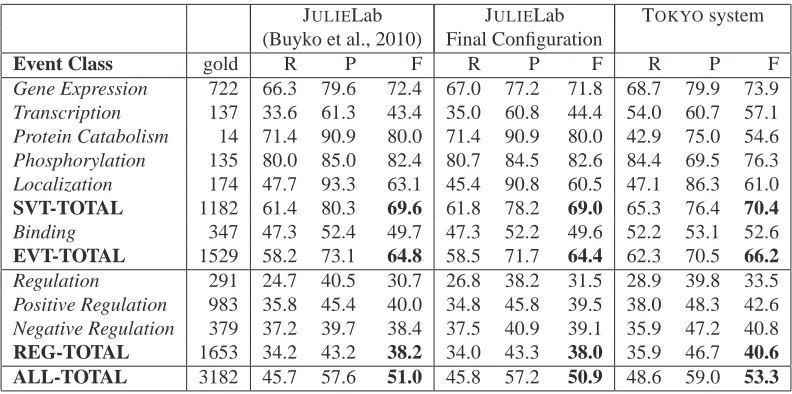
The JULIELab solution can best be characterized as a single-step learning approach for event detection as the system does not separate the overall learn-ing task into independent event trigger and event argument learning subtasks.9 The JULIELab sys-tem incorporates manually curated dictionaries and machine learning (ML) methodologies to sort out associated event triggers and arguments on depen-dency graph structures. For argument extraction, the JULIELab system uses two ML-based approaches, a feature-based and a kernel-based one. Given that methodological framework, the JULIELab team scored on 2nd rank among 24 competing teams, with 45.8% precision, 47.5% recall and 46.7% F-score on all 3,182 events. After the competition, this system was updated and achieved 57.6% precision, 45.7% recall and 51.0% F-score (Buyko et al., 2010) using modified dependency representations from the MST parser (McDonald et al., 2005). In this study, we perform event extraction experiments with various dependency representations that allow us to measure their effects on the event extraction task and to in-crease the overall JULIELab system performance in terms of F-score.
9
The JULIELab system considers all relevant lexical items as potential event triggers which might represent an event. Only those event triggers that can eventually be connected to argu-ments, finally, represent a true event.
4 Dependency Graph Representations
In this section, we focus on representation formats of dependency graphs. In Section 4.1, we introduce fundamental notions underlying dependency pars-ing and consider established representation formats for dependency structures as generated by various parsers. In Section 4.2, we account for selected trim-ming operations for dependency graphs to ease IE.
4.1 Dependency Structures: Representation Issues
Dependency parsing, in the past years, has increas-ingly been recognized as an alternative to long-prevailing constituency-based parsing approaches, particularly in semantically-oriented application scenarios such as information extraction. Yet even under purely methodologically premises, it has gained wide-spread attention as witnessed by recent activities performed as part of the “CoNLL Shared Tasks on Multilingual Dependency Parsing” (Buch-holz and Marsi, 2006).
In a nutshell, in dependency graphs of sentences, nodes represent single words and edges account for head-modifier relations between single words. De-spite this common understanding, concrete syntactic representations often differ markedly from one de-pendency theory/parser to the other. The differences fall into two main categories: dependency pairing or structuring (which pairs of words join in a depen-dency relation?) and dependepen-dency typing (how are dependency relations for a particular pair labelled?). The CoNLL’X dependencies, for example, are defined by 54 relation types,10 while the Stanford scheme (de Marneffe et al., 2006) incorporates 48 types (so called grammatical relations or Stanford dependencies). The Link Grammar Parser (Sleator and Temperley, 1991) employs a particularly fine-grained repertoire of dependency relations adding up to 106 types, whereas the well-known MINIPAR
parser (Lin, 1998) relies on 59 types. Differences in dependency structure are at least as common as dif-ferences in dependency relation typing (see below).
10
Figure 1: Example of CoNLL 2008 dependencies, as used in most of the native dependency parsers.
Figure 2: Stanford dependencies, basic conversion from Penn Treebank.
In general, dependency graphs can be generated by syntactic parsers in two ways. First, native pendency parsers output CoNLL’X or Stanford de-pendencies dependent on which representation for-mat they have been trained on.11 Second, in a deriva-tive dependency mode, the output of constituency-based parsers, e.g., phrase structure representations, is subsequently converted either into CoNLL’X or Stanford dependencies using Treebank conversion scripts (see below). In the following, we provide a short description of these two established depen-dency graph representations:
• CoNLL’X dependencies (CD). This
depen-dency tree format was used in the CoNLL’X Shared Tasks on multi-lingual dependency parsing (see Figure 1). It has been adopted by most native dependency parsers and was originally obtained from Penn Treebank (PTB) trees using constituent-to-dependency conver-sion (Johansson and Nugues, 2007). It differs slightly in the number and types of dependen-cies being used from various CoNLL rounds (e.g., CoNLL’08 provided a dependency type for representing appositions).12
• Stanford dependencies (SD). This format was
proposed by de Marneffe et al. (2006) for
11We disregard in this study other dependency
representa-tions such as MINIPARand LINKGRAMMARrepresentations. 12For the differences between CoNLL’07 and CoNLL’08
rep-resentations, cf. http://nlp.cs.lth.se/software/ treebank_converter/
semantics-sensitive applications using depen-dency representations, and can be obtained us-ing the Stanford tools13 from PTB trees. The Stanford format is widely used in the biomed-ical domain (e.g., by Miyao et al. (2008) or Clegg and Shepherd (2005)).
There are systematic differences between CoNLL’X and Stanford dependencies, e.g., as far as the representation of passive constructions, the position of auxiliary and modal verbs, or coordi-nation representation is concerned. In particular, the representation of the passive construction and the role of the auxiliary verb therein may have considerable effects for semantics-sensitive tasks. While in SD the subject of the passive construction is represented by a special nsubj dependency label, in CD we find the same subject label as for active constructions SUB(J). On CoNLL’08 data, the logical subject is marked by the LGS depen-dency edge that connects the passive-indicating preposition “by” with the logical subject of the sentence.
The representation of active constructions are similar in CD and SD though besides the role of auxiliary and modal verbs. In the Stanford de-pendency representation scheme, rather than taking auxiliaries to be the heads in passive or tense con-structions, main verbs are assigned this grammatical function (see Figure 2). The CoNLL’X
represen-13
[image:4.612.117.495.161.226.2]Figure 3: Noun phrase representation in CoNLL’X dependency trees.
Figure 4: Trimming procedure noun phrase on CoNLL’X dependency trees.
tation scheme is completely different in that auxil-iaries – much in common with standard dependency theory – are chosen to occupy the role of the gov-ernor (see Figure 1). From the perspective of rela-tion extracrela-tion, however, the Stanford scheme is cer-tainly closer to the desired predicate-argument struc-ture representations than the CoNLL scheme.
4.2 Dependency Graph Modifications in Detail
Linguistic intuition suggests that the closer a depen-dency representation is to the format of the targeted semantic representation, the more likely will it sup-port the semantic application. This idea is directly reflected in the Stanford dependencies which narrow the distance between nodes in the dependency graph by collapsing procedures (the so-called collapsed mode of phrase structure conversion). An example of collapsing is the conversion of “expression−−−→nmod
in−−−→pmod cells” to “expression−−−−→prep in cells”. An
ex-tension of collapsing is the re-structuring of coor-dinations with sharing the dependency relations of conjuncts (the so-called ccprocessed mode of phrase structure conversion).
According to the Stanford scheme, Buyko et al. (2009) proposed collapsing scenarios on CoNLL’X dependency graphs. Their so-called trimming op-erations treat three syntactic phenomena, viz. coor-dinations (coords), auxiliaries/modals (auxiliaries), and prepositions (preps). For coordinations, they propagate the dependency relation of the first con-junct to all the other concon-juncts within the coordi-nation. For auxiliaries/modals, they prune the aux-iliaries/modals as governors from the dependency graph and propagate the dependency relations of these nodes to the main verbs. Finally, for preposi-tions, they collapse a pair of typed dependencies into a single typed dependency (as illustrated above).
For the following experiments, we extended the trimming procedures and propose the re-structuring
of noun phrases with action adjectives to make the dependency representation even more compact for semantic interpretation. The original dependency representation of the noun phrase selects the right-most noun as the head of the NP and thus all re-maining elements are its dependents (see Figure 3). For the noun phrases containing action adjectives (mostly verb derivations) this representation does not reflect the true semantic relations between the elements. For example, in “IL-10 mediated
expres-sion” it is “IL-10” that mediates the expression.
Therefore, we re-structure the dependency graph by changing the head of “IL-10” from “expression” to “mediated”. Our re-coding heuristics selects, first, all the noun phrases containing action adjec-tives ending with “-ed”, “-ing”, “-ible” suffixes and with words such as “dependent”, “specific”, “like”. In the second step, we re-structure the noun phrase by encoding the adjective as the head of all the nouns preceding this adjective in the noun phrase under scrutiny (see Figure 4).
5 Experiments and Results
In this section, we describe the experiments and results related to event extraction tasks based on alternative dependency graph representations. For our experiments, we selected the following top-performing parsers — the first three phrase structure based and thus the origin of derivative dependency structures, the last three fully dependency based for making native dependency structures available:
• C+J, Charniak and Johnson’s reranking parser
(Charniak and Johnson, 2005), with the WSJ-trained parsing model.
• M+C, Charniak and Johnson’s reranking parser
[image:5.612.333.497.60.110.2]• Bikel, Bikel’s parser (Bikel, 2004) with the
WSJ-trained parsing model.
• GDep (Sagae and Tsujii, 2007), a native
depen-dency parser.
• MST (McDonald et al., 2005), another native
dependency parser.
• MALT (Nivre et al., 2007), yet another native
dependency parser.
The native dependency parsers were re-trained on the GENIA Treebank (Tateisi et al., 2005) conver-sions.14 These conversions,15 i.e., Stanford basic, CoNLL’07 and CoNLL’08 were produced with the currently available conversion scripts. For the Stan-ford dependency conversion, we used the StanStan-ford parser tool,16for CoNLL’07 and CoNLL’08 we used the treebank-to-CoNLL conversion scripts17 avail-able from the CoNLL’X Shared Task organizers.
The phrase structure based parsers were applied with already available models, i.e., the Bikel and C+J parsers as trained on the WSJ corpus, and M+C as trained on the GENIA Treebank corpus. For our experiments, we converted the prediction results of the phrase structure based parsers into five dependency graph representations, viz. Stanford
basic, Stanford collapsed, Stanford ccprocessed,
CoNLL’07 and CoNLL’08, using the same scripts as for the conversion of the GENIATreebank.
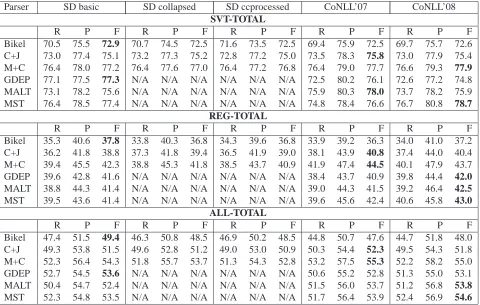
The JULIELab event extraction system was re-trained on the Shared Task data enriched with differ-ent outputs of syntactic parsers as described above. The results for the event extraction task are repre-sented in Table 1. Due to the space limitation of this paper we provide the summarized results of im-portant event extraction sub-tasks only, i.e., results for basic events (Gene Expression, Transcription,
Localization, Protein Catabolism) are summarized
14
For the training of dependency parsers, we used from the available Stanford conversion variants only Stanford basic. The
collapsed and ccprocessed variants do not provide dependency
trees and are not recommended for training native dependency parsers.
15We used the G
ENIATreebank version 1.0, available from www-tsujii.is.s.u-tokyo.ac.jp
16http://nlp.stanford.edu/software/
lex-parser.shtml 17
http://nlp.cs.lth.se/software/treebank_ converter/
under SVT-TOTAL; regulatory events are summa-rized under REG-TOTAL; the overall extraction re-sults are listed in ALL-TOTAL (see Table 1).
Obviously, the event extraction system trained on various dependency representations indeed produces truly different results. The differences in terms of F-score come up to 2.4 percentage points for the SVT-TOTAL events (cf. the MALT parser, difference between SD basic (75.6% F-score) and CoNLL’07 (78.0% F-score)), up to 3.6 points for REG-TOTAL (cf. the M+C parser, difference between SD
ccpro-cessed (40.9% score) and CoNLL’07 (44.5%
F-score)) and up to 2.5 points for ALL-TOTAL (cf. the M+C parser, difference between SD ccprocessed (52.8% F-score) and CoNLL’07 (55.3% F-score)).
The top three event extraction results on the de-velopment data based on different syntactic parsers results are achieved with M+C parser – CoNLL’07 representation (55.3% F-score), MST parser – CoNLL’08 representation (54.6% F-score) and MALT parser – CoNLL’08 representation (53.8% F-score) (see Table 1, ALL-TOTAL). Surprisingly, both the CoNLL’08 and CoNLL’07 formats clearly outperform Stanford representations on all event ex-traction tasks. Stanford dependencies seem to be useful here only in the basic mode. The collapsed and ccprocessed modes produce even worse results for the event extraction tasks.
Our second experiment focused on trimming op-erations on CoNLL’X dependency graphs. Here we performed event extraction after the trimming of the dependency trees as described in Section 4.2 in different modes: coords – re-structuring coordina-tions; preps – collapsing of preposicoordina-tions; auxiliaries – propagating dependency relations of auxiliars and modals to main verbs; noun phrase – re-structuring noun phrases containing action adjectives. Our sec-ond experiment showed that the extraction of se-lected events can profit in particular from the trim-ming procedures coords and auxiliaries, but there is no evidence for a general trimming configuration for the overall event extraction task.
Parser SD basic SD collapsed SD ccprocessed CoNLL’07 CoNLL’08
SVT-TOTAL
R P F R P F R P F R P F R P F
Bikel 70.5 75.5 72.9 70.7 74.5 72.5 71.6 73.5 72.5 69.4 75.9 72.5 69.7 75.7 72.6 C+J 73.0 77.4 75.1 73.2 77.3 75.2 72.8 77.2 75.0 73.5 78.3 75.8 73.0 77.9 75.4 M+C 76.4 78.0 77.2 76.4 77.6 77.0 76.4 77.2 76.8 76.4 79.0 77.7 76.6 79.3 77.9
GDEP 77.1 77.5 77.3 N/A N/A N/A N/A N/A N/A 72.5 80.2 76.1 72.6 77.2 74.8 MALT 73.1 78.2 75.6 N/A N/A N/A N/A N/A N/A 75.9 80.3 78.0 73.7 78.2 75.9 MST 76.4 78.5 77.4 N/A N/A N/A N/A N/A N/A 74.8 78.4 76.6 76.7 80.8 78.7
REG-TOTAL
R P F R P F R P F R P F R P F
Bikel 35.3 40.6 37.8 33.8 40.3 36.8 34.3 39.6 36.8 33.9 39.2 36.3 34.0 41.0 37.2 C+J 36.2 41.8 38.8 37.3 41.8 39.4 36.5 41.9 39.0 38.1 43.9 40.8 37.4 44.0 40.4 M+C 39.4 45.5 42.3 38.8 45.3 41.8 38.5 43.7 40.9 41.9 47.4 44.5 40.1 47.9 43.7 GDEP 39.6 42.8 41.6 N/A N/A N/A N/A N/A N/A 38.4 43.7 40.9 39.8 44.4 42.0
MALT 38.8 44.3 41.4 N/A N/A N/A N/A N/A N/A 39.0 44.3 41.5 39.2 46.4 42.5
MST 39.5 43.6 41.4 N/A N/A N/A N/A N/A N/A 39.6 45.6 42.4 40.6 45.8 43.0 ALL-TOTAL
R P F R P F R P F R P F R P F
Bikel 47.4 51.5 49.4 46.3 50.8 48.5 46.9 50.2 48.5 44.8 50.7 47.6 44.7 51.8 48.0 C+J 49.3 53.8 51.5 49.6 52.8 51.2 49.0 53.0 50.9 50.3 54.4 52.3 49.5 54.3 51.8 M+C 52.3 56.4 54.3 51.8 55.7 53.7 51.3 54.3 52.8 53.2 57.5 55.3 52.2 58.2 55.0 GDEP 52.7 54.5 53.6 N/A N/A N/A N/A N/A N/A 50.6 55.2 52.8 51.3 55.0 53.1 MALT 50.4 54.7 52.4 N/A N/A N/A N/A N/A N/A 51.5 56.0 53.7 51.2 56.8 53.8
[image:7.612.74.554.62.367.2]MST 52.3 54.8 53.5 N/A N/A N/A N/A N/A N/A 51.7 56.4 53.9 52.4 56.9 54.6
Table 1: Results on the Shared Task development data for Event Extraction Task. Approximate Span Match-ing/Approximate Recursive Matching.
[image:7.612.92.522.431.554.2]Event Class Best Parser Best Configuration R P F Gene Expression MST CoNLL’08, auxiliaries, coords 79.5 81.8 80.6 Transcription MALT CoNLL’07, auxiliaries, coords 67.1 75.3 71.0 Protein Catabolism MST CoNLL’08, preps 85.7 100 92.3 Phosphorylation MALT CoNLL’08 80.9 88.4 84.4 Localization MST CoNLL’08, auxiliaries 81.1 87.8 84.3 Binding MST CoNLL’07, auxiliaries, coords, noun phrase 51.2 51.0 51.1 Regulation MALT CoNLL’07, auxiliaries, coords 30.8 49.5 38.0 Positive Regulation M+C CoNLL’07 43.0 49.9 46.1 Negative Regulation M+C CoNLL’07 49.5 45.3 47.3
Table 2: Best Configurations for Dependency Representations for Event Extraction Task on the development data.
Binding R P F
CoNLL’07 47.3 46.8 47.0
CoNLL’07 auxiliaries, coords 46.8 48.1 47.4 CoNLL’07 auxiliaries, coords, noun phrase 51.2 51.0 51.1
[image:7.612.153.460.597.653.2]JULIELab JULIELab TOKYOSystem (M+C, CoNLL’08) Final Configuration
Event Class gold R P F R P F R P F
Gene Expression 356 79.2 80.3 79.8 79.5 81.8 80.6 78.7 79.5 79.1 Transcription 82 59.8 72.0 65.3 67.1 75.3 71.0 65.9 71.1 68.4 Protein Catabolism 21 76.2 88.9 82.0 85.7 100 92.3 95.2 90.9 93.0 Phosphorylation 47 83.0 81.2 82.1 80.9 88.4 84.4 85.1 69.0 76.2 Localization 53 77.4 74.6 75.9 81.1 87.8 84.3 71.7 82.6 76.8 SVT-TOTAL 559 76.4 79.0 77.7 78.2 82.6 80.3 77.3 77.9 77.6
Binding 248 45.6 45.9 45.8 51.2 51.0 51.1 50.8 47.6 49.1 EVT-TOTAL 807 66.9 68.7 67.8 69.9 72.5 71.2 69.1 68.1 68.6
Regulation 169 32.5 46.2 38.2 30.8 49.5 38.0 36.7 46.6 41.1 Positive regulation 617 42.3 49.0 45.4 43.0 49.9 46.1 43.9 51.9 47.6 Negative regulation 196 48.5 44.0 46.1 49.5 45.3 47.3 38.8 43.9 41.2 REG-TOTAL 982 41.9 47.4 44.5 42.2 48.7 45.2 41.7 49.4 45.2
[image:8.612.110.504.98.296.2]ALL-TOTAL 1789 53.2 57.5 55.3 54.7 60.0 57.2 54.1 58.7 56.3
Table 4: Results on the Shared Task development data. Approximate Span Matching/Approximate Recursive Match-ing.
JULIELab JULIELab TOKYOsystem (Buyko et al., 2010) Final Configuration
Event Class gold R P F R P F R P F
Gene Expression 722 66.3 79.6 72.4 67.0 77.2 71.8 68.7 79.9 73.9 Transcription 137 33.6 61.3 43.4 35.0 60.8 44.4 54.0 60.7 57.1 Protein Catabolism 14 71.4 90.9 80.0 71.4 90.9 80.0 42.9 75.0 54.6 Phosphorylation 135 80.0 85.0 82.4 80.7 84.5 82.6 84.4 69.5 76.3 Localization 174 47.7 93.3 63.1 45.4 90.8 60.5 47.1 86.3 61.0
SVT-TOTAL 1182 61.4 80.3 69.6 61.8 78.2 69.0 65.3 76.4 70.4
Binding 347 47.3 52.4 49.7 47.3 52.2 49.6 52.2 53.1 52.6
EVT-TOTAL 1529 58.2 73.1 64.8 58.5 71.7 64.4 62.3 70.5 66.2
Regulation 291 24.7 40.5 30.7 26.8 38.2 31.5 28.9 39.8 33.5 Positive Regulation 983 35.8 45.4 40.0 34.8 45.8 39.5 38.0 48.3 42.6 Negative Regulation 379 37.2 39.7 38.4 37.5 40.9 39.1 35.9 47.2 40.8
REG-TOTAL 1653 34.2 43.2 38.2 34.0 43.3 38.0 35.9 46.7 40.6
ALL-TOTAL 3182 45.7 57.6 51.0 45.8 57.2 50.9 48.6 59.0 53.3
[image:8.612.108.504.426.623.2]only one event profits from trimming of prepositions (Protein Catabolism). Only the Binding event prof-its significantly from noun phrase modifications (see Table 3). The increase in F-score for trimming pro-cedures is 4.1 percentage points for Binding events.
In our final experiment we connected the best con-figurations for each of the BioNLP’09 events as psented in Table 2. The overall event extraction re-sults of this final configuration are presented in Ta-bles 4 and 5. We achieved an increase of 1.9 per-centage points F-score in the overall event extrac-tion compared to the best-performing single parser configuration (M+C, CoNLL’07) (see Table 4, ALL-TOTAL). The reported results on the development data outperform the results of the TOKYOsystem by
2.6 percentage points F-score for all basic events in-cluding Binding events (see Table 4, EVT-TOTAL) and by 0.9 percentage points in the overall event ex-traction task (see Table 4, ALL-TOTAL).
On the test data we achieved an F-score similar to the current JULIELab system trained on modified
CoNLL’07 dependencies from the MST parser (see Table 5, ALL-TOTAL).18 The results on the offi-cial test data reveal that the performance differences between various parsers may play a much smaller role than the proper choice of dependency represen-tations.19 Our empirical findings that the best per-formance results could only be achieved by event-specific dependency graph configurations reveal that the syntactic representations of different semantic events vary considerably at the level of dependency graph complexity and that the automatic prediction of such syntactic structures can vary from one de-pendency parser to the other.
6 Discussion
The evaluation results from Table 1 show that an in-creased F-score is basically due to a better perfor-mance in terms of precision. For example, the M+C evaluation results in the Stanford basic mode pro-vide an increased precision by 2 percentage points compared to the Stanford ccprocessed mode. There-fore, we focus here on the analysis of false positives
18The current J
ULIELab system uses event-specific trimming procedures on CoNLL’07 dependencies determined on the de-velopment data set (see Buyko et al. (2010)).
19
Trimmed CoNLL dependencies are used in both system configurations.
that the JULIELab system extracts in various modes. For the first analysis we took the outputs of the systems based on the M+C parsing results. We scrutinized on the Stanford basic and ccprocessed false positives (fps) and we compared the occur-rences of dependency labels in two data sets, namely the intersection of false positives from both sys-tem modes (set A) and the false positives produced only by the system with a worse performance (set
B, ccprocessed mode). About 70% of all fps are
contained in set A. Our analysis revealed that some dependency labels have a higher occurrence in set
B, e.g., nsubjpass, prep on, prep with, prep in, prep for, prep as. Some depen-dency labels occur only in set B such as agent,
prep unlike, prep upon. It seems that col-lapsing some prepositions, such as “with”, “in”,
“for”, “as”, “on”, “unlike”, “upon”, does not have
a positive effect on the extraction of argument struc-tures. In a second step, we compared the Stan-ford basic and CoNLL’07 false positive sets. The fps of both systems have an intersection of about 70%. We also compared the intersection of fps between two outputs (set A) and the set of addi-tional fps of the system with worse results (Stan-ford basic mode, set B). The dependency labels such asabbrev, dep, nsubj, nsubjpass have a higher occurrence in set B than in set A. This anal-ysis renders evidence that the distinction ofnsubj
andnsubjpassdoes not seem to have been prop-erly learned for event extraction.
For the second analysis round we took the out-puts of the MST parsing results. As in the previ-ous experiments, we compared false positives from two mode outputs, here the CoNLL’07 mode and the CoNLL’07 modified for auxiliaries and
coor-dinations mode. The fps have an intersection of
75%. The dependency labels such asVC, SUBJ, COORD, andIOBJoccur more frequently in the ad-ditional false positives from the CoNLL’07 mode than in the intersection of false positives from both system outputs. Obviously, the trimming of auxil-iary and coordination structures has a direct positive effect on the argument extraction reducing false pos-itive numbers especially with corresponding depen-dency labels in shortest dependepen-dency paths.
abbreviation labels, as well as collapsing preposi-tions in the Stanford dependencies, could not have been properly learned, which consequently leads to an increased rate of false positives. The trimming of auxiliary structures and the subsequent coordina-tion collapsing on CoNLL’07 dependencies has in-deed event-specific positive effects on the event ex-traction.
The main focus of this work has been on the eval-uation of effects of different dependency graph rep-resentations on the IE task achievement (here the task of event extraction). But we also targeted the task-oriented evaluation of top-performing syntactic parsers. The results of this work indicate that the GENIA-trained parsers, i.e., M+C parser, the MST, MALT and GDep, are a reasonable basis for achiev-ing state-of-the art performance in biomedical event extraction.
But the choice of the most suitable parser should also take into account its performance in terms of parsing time. Cer et al. (2010) and Miyao et al. (2008) showed in their experiments that native de-pendency parsers are faster than constituency-based parsers. When it comes to scaling event extraction to huge biomedical document collections, such as MEDLINE, the selection of a parser is mainly
in-fluenced by its run-time performance. MST, MALT and GDep parsers or the M+C parser with reduced reranking (Cer et al., 2010) would thus be an appro-priate choice for large-scale event extraction under these constraints.20
7 Conclusion
In this paper, we investigated the role different de-pendency representations may have on the accom-plishment of the event extraction task as exemplified by biological events. Different representation for-mats (mainly, Stanford vs. CoNLL) were then ex-perimentally compared employing different parsers (Bikel, Charniak+Johnson, GDep, MST, MALT), both constituency based (for the derivative depen-dency mode) as well as dependepen-dency based (for the native dependency mode), considering different training scenarios (newspaper vs. biology domain).
From our experiments we draw the conclusion
20
For large-scale experiments an evaluation of the M+C with reduced reranking should be provided.
that the dependency graph representation has a cru-cial impact on the level of achievement of IE task requirements. Surprisingly, the CoNLL’X depen-dencies outperform the Stanford dependepen-dencies for four from six parsers. With additionally trimmed CoNLL’X dependencies we could achieve an score of 50.9% on the official test data and an F-score of 57.2% on the official development data of the BioNLP Shared Task on Event Extraction (see Table 5, ALL-TOTAL).
Acknowledgements
This research was partially funded by the BOOT-STREP project under grant FP6-028099 within the 6th Framework Programme (EC), by the CALBC project under grant FP7-231727 within the 7th Framework Programme (EC), and by the JENAGE
project under grant 0315581D from the German Ministry of Education and Research (BMBF) as part of the GERONTOSYS funding initiative. We also want to thank Kenji Sagae (Institute for Creative Technologies, University of Southern California) for kindly providing the models of the GDEPparser.
References
Daniel M. Bikel. 2004. Intricacies of Collins’ parsing model. Computational Linguistics, 30(4):479–511. Jari Bj¨orne, Juho Heimonen, Filip Ginter, Antti Airola,
Tapio Pahikkala, and Tapio Salakoski. 2009. Extract-ing complex biological events with rich graph-based feature sets. In Proceedings BioNLP 2009. Compan-ion Volume: Shared Task on Event ExtractCompan-ion, pages 10–18. Boulder, Colorado, USA, June 4-5, 2009. Sabine Buchholz and Erwin Marsi. 2006.
CoNLL-X Shared Task on multilingual dependency parsing. In CoNLL-X – Proceedings of the 10th Conference on Computational Natural Language Learning, pages 149–164, New York City, N.Y., June 8-9, 2006. Razvan Bunescu, Ruifang Ge, Rohit J. Kate, Edward M.
Marcotte, Raymond J. Mooney, Arun K. Ramani, and Yuk Wah Wong. 2005. Comparative experiments on learning information extractors for proteins and their interactions. Artificial Intelligence in Medicine, 33(2):139–155.
Extrac-tion, pages 19–27. Boulder, Colorado, USA, June 4-5, 2009.
Ekaterina Buyko, Erik Faessler, Joachim Wermter, and Udo Hahn. 2010. Syntactic simplification and se-mantic enrichment - Trimming dependency graphs for event extraction. Computational Intelligence, 26(4). Daniel Cer, Marie-Catherine de Marneffe, Dan Jurafsky,
and Chris Manning. 2010. Parsing to Stanford De-pendencies: Trade-offs between speed and accuracy. In LREC’2010 – Proceedings of the 7th International Conference on Language Resources and Evaluation, pages 1628–1632. Valletta, Malta, May 19-21, 2010. Eugene Charniak and Mark Johnson. 2005.
Coarse-to-fine n-best parsing and MaxEnt discriminative rerank-ing. In ACL’05 – Proceedings of the 43rd Annual Meeting of the Association for Computational Linguis-tics, pages 173–180. Ann Arbor, MI, USA, 25-30, June, 2005.
Andrew B. Clegg and Adrian J. Shepherd. 2005. Evalu-ating and integrEvalu-ating Treebank parsers on a biomedical corpus. In Proceedings of the ACL 2005 Workshop on Software, pages 14–33. Ann Arbor, MI, USA, June 30, 2005.
Marie-Catherine de Marneffe, Bill MacCartney, and Christopher D. Manning. 2006. Generating typed dependency parses from phrase structure parses. In LREC’2006 – Proceedings of the 5th International Conference on Language Resources and Evaluation, pages 449–454. Genoa, Italy, 24-26 May 2006. Richard Johansson and Pierre Nugues. 2007. Extended
constituent-to-dependency conversion for English. In NODALIDA 2007 – Proceedings of the 16th Nordic Conference of Computational Linguistics, pages 105– 112. Tartu, Estonia, May 24-25, 2007.
Jin-Dong Kim, Tomoko Ohta, and Jun’ichi Tsujii. 2008. Corpus annotation for mining biomedical events from literature. BMC Bioinformatics, 9(10).
Jin-Dong Kim, Tomoko Ohta, Sampo Pyysalo, Yoshi-nobu Kano, and Jun’ichi Tsujii. 2009. Overview of BioNLP’09 Shared Task on Event Extraction. In Pro-ceedings BioNLP 2009. Companion Volume: Shared Task on Event Extraction, pages 1–9. Boulder, Col-orado, USA, June 4-5, 2009.
Dekang Lin. 1998. Dependency-based evaluation of MINIPAR. In Proceedings of the LREC’98 Workshop on the Evaluation of Parsing Systems, pages 48–56. Granada, Spain, 28-30 May 1998.
David McClosky. 2010. Any Domain Parsing: Auto-matic Domain Adaptation for Natural Language Pars-ing. Ph.D. thesis, Department of Computer Science, Brown University.
Ryan T. McDonald, Fernando Pereira, Kiril Ribarov, and Jan Hajic. 2005. Non-projective dependency pars-ing uspars-ing spannpars-ing tree algorithms. In HLT/EMNLP
2005 – Proceedings of the Human Language Tech-nology Conference and the Conference on Empirical Methods in Natural Language Processing, pages 523– 530. Vancouver, B.C., Canada, October 6-8, 2005. Makoto Miwa, Rune Sætre, Jin-Dong Kim, and Jun’ichi
Tsujii. 2010. Event extraction with complex event classification using rich features. Journal of Bioinfor-matics and Computational Biology, 8:131–146. Yusuke Miyao and Jun’ichi Tsujii. 2002. Maximum
en-tropy estimation for feature forests. In HLT 2002 – Proceedings of the 2nd International Conference on Human Language Technology Research, pages 292– 297. San Diego, CA, USA, March 24-27, 2002. Yusuke Miyao, Kenji Sagae, and Jun’ichi Tsujii. 2007.
Towards framework-independent evaluation of deep linguistic parsers. In Proceedings of the GEAF 2007 Workshop, CSLI Studies in Computational Linguistics Online, page 21 pages.
Yusuke Miyao, Rune Sætre, Kenji Sagae, Takuya Mat-suzaki, and Jun’ichi Tsujii. 2008. Task-oriented eval-uation of syntactic parsers and their representations. In ACL 2008 – Proceedings of the 46th Annual Meeting of the Association for Computational Linguistics: Hu-man Language Technologies, pages 46–54. Columbus, Ohio, USA, June 15-20, 2008.
Claire N´edellec. 2005. Learning Language in Logic: Genic interaction extraction challenge. In Proceedings LLL-2005 – 4th Learning Language in Logic Work-shop, pages 31–37. Bonn, Germany, August 7, 2005. Joakim Nivre, Johan Hall, and Jens Nilsson. 2007.
MALTPARSER: A language-independent system for data-driven dependency parsing. Natural Language Engineering, 13(2):95–135.
Sampo Pyysalo, Filip Ginter, Juho Heimonen, Jari Bj¨orne, Jorma Boberg, Jouni Jarvinen, and Tapio Salakoski. 2007. BIOINFER: A corpus for informa-tion extracinforma-tion in the biomedical domain. BMC Bioin-formatics, 8(50).
Kenji Sagae and Jun’ichi Tsujii. 2007. Dependency pars-ing and domain adaptation with LR models and parser ensembles. In EMNLP-CoNLL 2007 – Proceedings of the Conference on Empirical Methods in Natural Lan-guage Processing and the Conference on Computa-tional Natural Language Learning, pages 1044–1050, Prague, Czech Republic, June 28-30, 2007.
Daniel Sleator and Davy Temperley. 1991. Parsing En-glish with a link grammar. Technical report, Depart-ment of Computer Science, CMU.