
Proceedings of the 2011 Conference on Empirical Methods in Natural Language Processing, pages 970–979,
Enhancing Chinese Word Segmentation Using Unlabeled Data
Weiwei Sun†‡ and Jia Xu‡
†Department of Computational Linguistics, Saarland University ‡German Research Center for Artificial Intelligence (DFKI)
D-66123, Saarbr¨ucken, Germany
[email protected],[email protected]
Abstract
This paper investigates improving supervised word segmentation accuracy with unlabeled data. Both large-scale in-domain data and small-scale document text are considered. We present a unified solution to include features derived from unlabeled data to a discrimina-tive learning model. For the large-scale data, we derive string statistics from Gigaword to assist a character-based segmenter. In addi-tion, we introduce the idea about transductive, document-level segmentation, which is de-signed to improve the system recall for out-of-vocabulary (OOV) words which appear more than once inside a document. Novel features1 result in relative error reductions of 13.8% and 15.4% in terms of F-score and the recall of OOV words respectively.
1 Introduction
Chinese sentences are written in continuous se-quence of characters without explicit delimiters such as space characters. To find the basic language units, i.e. words, segmentation is a necessary initial step for Chinese language processing. Previous research shows that word segmentation models trained on la-beled data are reasonably accurate. In this paper, we investigate improving supervised word segmen-tation with unlabeled data.
We distinguish three types of unlabeled data, namely large-scale in-domain data, out-of-domain data and small-scale document text. Both large-scale
1You can download our derived features at http://www.coli.uni-saarland.de/˜wsun/ semi-cws-feats-emnlp11.tgz.
in-domain and out-of-domain data is popular for en-hancing NLP tasks. Learning from these two types of unlabeled data normally involves semi-supervised learning. The difference between them is that out-of-domain data is usually used for domain adapta-tion. For a number of NLP tasks, there are relatively large amounts of labeled training data. In this sit-uation, supervised learning can provide competitive results, and it is difficult to improve them any further by using extra unlabeled data. Chinese word seg-mentation is one of this kind of tasks, since several large-scale manually annotated corpora are publicly available. In this work, we first exploit unlabeled in-domain data to improve strong supervised models. We leave domain adaptation for our future work.
We introduce the third type of unlabeled data with atransductive learning,document-levelview. Many applications of word segmentation involve process-ing a whole document, such as information retrieval. In this situation, the text of the current document can provide additional useful information to seg-ment a sentence. Take the word “氨纶丝/elastane”
for example2. As a translated terminology word, it
lacks compositionality. Moreover, this word appears rarely in general texts. As a result, if it does not ap-pear in the training data, it is very hard for statis-tical models to recognize this word. Nevertheless, when we deal with an article discussing an elastane company, this word may appear more than once in this article, and the document information can help recognize this word. This idea is closely related to transductive learning in the sense that the segmen-tation model knows something about the problem it
2This example is from an article indexed as chtb 0041 in the Penn Chinese Treebank corpus.
is going to resolve. In this work, we are also con-cerned with enhancing word segmentation with the document information.
We present a unified “feature engineering” ap-proach for learning segmentation models from both labeled and unlabeled data. Our method is a simple two-stage process. First, we use unannotated corpus to extract string and document information, and then we use these information to construct new statistics-based and document-statistics-based feature mapping for a discriminative word segmenter. We are relying on the ability of discriminative learning method to iden-tify and explore informative features, which play central role to boost the segmentation performance. This simple solution has been shown effective for named entity recognition (Miller et al., 2004) and dependency parsing (Koo et al.,2008). In their im-plementations, word clusters derived from unlabeled data are imported as features to discriminative learn-ing approaches.
To demonstrate the effectiveness of our approach, we conduct experiments on the Penn Chinese Tree-bank (CTB) data. CTB is a collection of docu-ments which are separately annotated. This anno-tation style allows us to evaluate our transductive segmentation method. Our experiments show that both statistics-based and document-based features are effective in the word segmentation application. In general, the use of unlabeled data can be moti-vated by two concerns: First, given a fixed amount of labeled data, we might wish to leverage unla-beled data to improve the performance of a super-vised model. Second, given a fixed target perfor-mance level, we might wish to use unlabeled data to reduce the amount of annotated data necessary to reach this target. We show that our approach yields improvements for fixed data sets, even when large-scale labeled data is available. The new fea-tures result in relative error reductions of 13.8% and 15.4% in terms of the balanced F-score and the re-call of out-of-vocabulary (OOV) words respectively. By conducting experiments on data sets of varying sizes, we demonstrate that for fixed levels of perfor-mance, the new features derived from unlabeled data can significantly reduce the need of labeled data.
The remaining part of the paper is organized as follows. Section2 describes the details of our sys-tem, especially the design of the derived features.
B Current character is the start of a word con-sisting of more than one character.
E Current character is the end of a word con-sisting of more than one character.
I Current character is a middle of a word con-sisting of more than two characters.
S Current character is a word consisting of only one character.
Table 1: The start/end representation.
Section 3 presents experimental results and empir-ical analysis. Section 4 reviews the related work. Section5concludes the paper.
2 Method
2.1 Discriminative Character-based Word Segmentation
The Character-based approach is a dominant word segmentation solution for Chinese text process-ing. This approach treats word segmentation as a sequence tagging problem, assigning labels to the characters indicating whether a character locates at the beginning of, inside or at the end of a word. This character-by-character method was first proposed by (Xue, 2003), and a number of discriminative sequential learning algorithms have been exploited, including structured perceptron (Jiang et al.,2009), the Passive-Aggressive algorithm (Sun, 2010), conditional random fields (CRFs) (Tseng et al.,
2005), and latent variable CRFs (Sun et al., 2009). In this work, we use theStart/Endrepresentation to express the position information of every character. Table 2.1 shows the meaning of each character label. For example, the target label representation of the book title “赵紫阳总理的秘密日记/The
Se-cret Journal of Premier Zhao Ziyang” is as follows.
赵 紫 阳 总 理 的 秘 密 日 记
B I E B E S B E B E
that uses information encoded in the surrounding text.
2.2 Baseline Features
In this work, to train a good traditional supervised segmenter, our baseline feature templates includes the ones described in (Sun et al.,2009;Sun,2010). These features are divided into two types: char-acter features and word type features. Note that the word type features are indicator functions that fire when the local character sequence matches a word uni-gram or bi-gram. Dictionary containing word uni-grams and bi-grams is collected from the training data. To conveniently illustrate, we de-note a candidate character token ci with a context ...ci−1cici+1.... We usec[s:e]to express a string that
starts at the position s and ends at the positione.
For example, c[i:i+1] expresses a character bi-gram cici+1. The character features are listed below.
• Character uni-grams:cs(i−3< s < i+ 3)
• Character bi-grams:cscs+1(i−3< s < i+3)
• Whethercsandcs+1areidentical, fori−2< s < i+ 2.
• Whethercsandcs+2areidentical, fori−4< s < i+ 2.
The word type features are listed as follows.
• Theidentityof the stringc[s:i](i−6< s < i),
if it matches a word from the list of uni-gram words;
• Theidentityof the stringc[i:e](i < e < i+ 6),
if it matches a word; multiple features could be generated.
• Theidentityof the bi-gramc[s:i−1]c[i:e](i−6< s, e < i+ 6), if it matches a word bi-gram from the list of uni-gram words.
• Theidentityof the bi-gramc[s:i]c[i+1:e](i−6< s, e < i+ 6), if it matches a word bi-gram;
multiple features could be generated.
Idiom In linguistics, idioms are usually presumed to be figures of speech contradicting the principle of compositionality. As a result, it is very hard to rec-ognize out-of-vocabulary idioms for word segmen-tation. Nonetheless, the lexicon of idioms can be taken as a close set, which helps resolve the problem well. In our previous work (Sun,2011), we collect 12992 idioms from several free online Chinese dic-tionaries. This linguistic resource is publicly avail-able3. In this paper, we use this idiom dictionary to
derive the following feature.
• Does ci locate at the beginning of, inside or
at the end of an idiom? If the string c[s:i]
(s < i) matches an item from the idiom
lexi-con, the feature template receives a string value “E-IDIOM”. Similarly, we can define when this feature ought to be set to “B-IDIOM” or “I-IDIOM”. Note that all idioms are larger than one character, so there is no “S-IDIOM” fea-ture here.
2.3 Statistics-based Features
In order to distill information from unlabeled data, we borrow ideas from some previous research on unsupervised word segmentation. The statistical in-formation acquired from a relatively large amount of unlabeled data are designed as features correlated with the position where a character locates in a word token. These features are based on three widely used criteria.
2.3.1 Mutual Information
Empirical mutual information is widely used in NLP. Informally, mutual information compares the probability of observing x andy together with the probabilities of observingxandyindependently. If
there is a genuine association betweenx andy, the I(x, y) = logp(x)p(y)p(x,y) should be greater than 0.
Some previous work claimed that the larger the mutual information between two consecutive strings, the higher the possibility of the two strings being combined together. We adopt this idea in our character-based segmentation model. The empiri-cal mutual information between two character bi-grams is computed by counting how often they ap-pear in the large-scale unlabeled corpus. Given a
Chinese character stringc[i−2:i+1], the mutual
infor-mation between substrings c[i−2:i−1] and c[i:i+1] is computed as:
M I(c[i−2:i−1], c[i:i+1]) = log p(c[i−2:i+1]) p(c[i−2:i−1])p(c[i:i+1])
For each characterci, we incorporate the MI of the
character bi-grams into our model. They include,
• M I(c[i−2:i−1], c[i:i+1]),
• M I(c[i−1:i], c[i+1:i+2]).
2.3.2 Accessor Variety
When a string appears under different linguistic environments, it may carry a meaning. This prin-ciple is introduced as theaccessor varietycriterion for identifying meaningful Chinese words in (Feng et al.,2004). This criterion evaluates how indepen-dently a string is used, and thus how likely it is that the string can be a word. Given a string s, which
consists of l (l ≥ 2) characters, we define theleft accessor varietyofLlav(s)as the number of distinct
characters that precedesin a corpus. Similarly, the right accessor varietyRl
av(s)is defined as the
num-ber of distinct characters that succeeds.
We first extract all strings whose length are be-tween 2 and 4 from the unlabeled data, and calculate their accessor variety values. For each characterci,
we then incorporate the following information into our model,
• Accessor variety of strings with length 4: L4av(c[i:i+3]), L4av(c[i+1:i+4]), R4av(c[i−3:i]), R4av(c[i−4:i−1]);
• Accessor variety of strings with length 3:
L3av(c[i:i+2]), L3av(c[i+1:i+3]), R3av(c[i−2:i]), R3
av(c[i−3:i−1]);
• Accessor variety of strings with length 2: L2
av(c[i:i+1]), L2av(c[i+1:i+2]), R2av(c[i−1:i]), R2av(c[i−2:i−1]).
2.3.3 Punctuation as Anchor Words
Punctuation marks are symbols that indicate the structure and organization of written language, as well as intonation and pauses to be observed when reading aloud. Punctuation marks can be taken as
perfect word delimiters, and can be used as anchor words to harvest lexical knowledge. The preced-ing and succeedpreced-ing strpreced-ings of punctuations carry ad-ditional wordbreak information, since punctuations should be segmented as a word. Note that such in-formation is biased because not all words can appear before or after punctuations. For example, punctua-tions can not be followed by particles, such as “了”,
“着” and “过” which are indicators of aspects.
Nev-ertheless, our experiments will show this kind of in-formation is still useful for word segmentation.
When a string appears many times preceding or succeeding punctuations, there tends to be word-breaks succeeding or preceding that string. To uti-lize the wordbreak information provided by punctu-ations, we extract all strings with lengthl(2 ≤ l ≤ 4)which precede or succeed punctuations in the
un-labeled data. We define theleft punctuation variety
ofLlpv(s)as the number of times a punctuation
pre-cedes s in a corpus. Similarly, the right punctua-tion varietyRl
pv(s)is defined as the number of how
many times a punctuation succeeds s. These two
variables evaluate how likely a string can be sepa-rated at its start or end positions.
We first gather all strings surrounding punctua-tions in the unlabeled data, and calculate their punc-tuation variety values. The length of each string is also restricted between 2 and 4. For each charac-terci, we import the following information into our
model,
• Punctuation variety of strings with length 4:
L4pv(c[i:i+3]),R4pv(c[i−3:i]);
• Punctuation variety of strings with length 3:
L3
pv(c[i:i+2]),R3pv(c[i−2:i]);
• Punctuation variety of strings with length 2: L2
pv(c[i:i+1]),R2pv(c[i−1:i]).
2.3.4 Binary or Numeric Features
The derived information introduced above is all expressed as real values. The natural way to in-corporate these statistics into a discriminative learn-ing model is to directly use them as numeric fea-tures. However, our experiments show that this sim-ple choice does not work well. The reason is that these statistics actually behave non-linearly to pre-dict character labels. For each type of statistics, one weight alone cannot capture the relation between its value and the possibility that a string forms a word. Instead, we represent these statistics as discrete fea-tures.
For the mutual information, this is done by round-ing down decimal number. The integer part of each MI value is used as a string feature. For the ac-cessor variety and punctuation variety information, since their values are integer, we can directly use them as string features. The accessor variety and punctuation variety could be very large, so we set thresholds to cut off large values to deal with the data sparse problem. Specially, if an accessor va-riety value is greater than 50, it is incorporated as a feature “> 50”; if the value is greater than 30 but not greater than 50, it is incorporated as a fea-ture “30 −50”; else the value is individually
in-corporated as a string feature. For example, if the left accessory variety of a character bi-gramc[i:i+1]
is 29, the binary feature “L2av(c[i:i+1])=29” will be
set to 1, while other related binary features such as “L2av(c[i:i+1]) = 15” or “L2av(c[i:i+1]) > 50” will
be set to 0. Similarly, we can discretize the punc-tuation variety features. However, we only set one threshold, 30, for this value. These thresholds can be tuned by using held-out data.
2.4 Document-based Features
It is meaningless to derive statistics of a document and use it for word segmentation, since most doc-uments are relatively short, and values are statisti-cally unreliable. Our experiments confirm this idea. Instead, we propose the following binary features which are based on thestring countin the given doc-ument that is simply the number of times a given string appears in that document. For each character
ci, our document-based features include,
• Whether the string count ofc[s:i]is equal to that
ofc[s:i+1] (i−3 ≤ s ≤ i). Multiple features
are generated for different string length.
• Whether the string count ofc[i:e]is equal to that
ofc[i−1:e] (i ≤ e ≤ i+ 3). Multiple features
are generated for different string length.
The intuition is as follows. The string counts of
c[s:i] andc[s:i+1]being equal means that whenc[s:i]
appears, it appears insidec[s:i+1]. In this case,c[s:i]
is not independently used in this document, and this feature suggests the segmenter not assign a “S” or “E” label to the character ci. Similarly, the string
counts ofc[i:e]and c[i−1:e] being equal meansc[i:e]
is not independently used in this document, and this feature suggests segmenter not assign a “S” or “B” label toci. We do not directly use the string counts
to prevent a bias towards longer documents.
3 Experiments 3.1 Setting
The SIGHAN Bakeoffs provide several large-scale labeled data for the research on Chinese word seg-mentation. Although these data sets are labeled on continuous run texts, they do not contain the docu-ment boundary information. CTB is a segdocu-mented, part-of-speech tagged, and fully bracketed corpus in the constituency formalism. It is also an popu-lar data set to evaluate word segmentation methods, such as (Jiang et al., 2009; Sun, 2011). CTB is a collection of documents which are separately anno-tated. This annotation style allows us to calculate the so-called document-based features and to further evaluate our approach. In this paper, we use CTB 6.0 as our main corpus and define the training, develop-ment and test sets according to the Chinese sub-task of the CoNLL 2009 shared task4. Table2shows the
statistics of our experimental settings.
Data set # of sent. # of words # of char.
Training 22277 609060 1004266
Devel. 1763 49646 83710
Test 2557 73152 121008
Table 2: Training, development and test data on CTB 6.0
Chinese Gigaword is a comprehensive archive of newswire text data that has been acquired over several years by the Linguistic Data Consortium (LDC). The large-scale unlabeled data we use in our experiments comes from the Chinese Gigaword (LDC2005T14). We choose the Mandarin news text, i.e. Xinhua newswire. This data covers all news published by Xinhua News Agency (the largest news agency in China) from 1991 to 2004, which contains over 473 million characters.
F-score is used as the accuracy measure. Define precisionpas the percentage of words in the decoder
output that are segmented correctly, and recall r as
the percentage of gold standard output words that are correctly segmented by the decoder. The (balanced) F-score is2pr/(p+r). We also report the recall of
OOV words. Note that, all idioms in our extra idiom lexicon are added into the in-vocabulary word list.
CRFsuite (Okazaki, 2007) is an implementation of Conditional Random Fields (CRFs) (Lafferty et al., 2001) for labeling sequential data. It is a speed-oriented implementation, which is written in pure C. In our experiments, we use this toolkit to learn global linear models for segmentation. We use the stochastic gradient descent algorithm to resolve the optimization problem, and set default values for other learning parameters.
3.2 Main Results
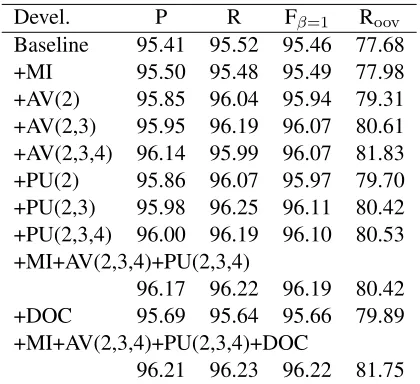
Table3summarizes the segmentation results on the development data with different configurations, rep-resenting a few choices between baseline, statistics-based and document-statistics-based feature sets. In this table, the symbol “+” means features of current configura-tion contains both the baseline features and new fea-tures for semi-supervised or transductive learning. From this table, we can clearly see the impact of fea-tures derived from the large-scale unlabeled data and the current document. Comparison between the per-formance of the baseline and “+MI” shows that the widely used mutual information is not helpful. Both good segmentation techniques and valuable labeled corpora have been developed, and pure supervised systems can provide strong performance. It is not a trial to design new features to enhance supervised models.
There are significant increases when accessor va-riety features and punctuation vava-riety features are
Devel. P R Fβ=1 Roov
Baseline 95.41 95.52 95.46 77.68
+MI 95.50 95.48 95.49 77.98
+AV(2) 95.85 96.04 95.94 79.31
+AV(2,3) 95.95 96.19 96.07 80.61
+AV(2,3,4) 96.14 95.99 96.07 81.83
+PU(2) 95.86 96.07 95.97 79.70
+PU(2,3) 95.98 96.25 96.11 80.42
+PU(2,3,4) 96.00 96.19 96.10 80.53 +MI+AV(2,3,4)+PU(2,3,4)
96.17 96.22 96.19 80.42
+DOC 95.69 95.64 95.66 79.89
+MI+AV(2,3,4)+PU(2,3,4)+DOC
[image:6.612.322.532.70.262.2]96.21 96.23 96.22 81.75
Table 3: Segmentation performance with different feature sets on the development data. Abbreviations: MI=mutual information; AV=accessor variety; PU=punctuation va-riety; DOC=document features. The numbers in each bracket pair are the lengths of strings. For example, PU(2,3) means punctuation variety features of character bi-grams and tri-grams are added.
separately added. Extending the length of neigh-boring string helps a little from 2 to 3. Al-though the OOV recall increases when the length is extended from 3 to 4, there is no
improve-ment of the overall balanced F-score. The
line “+MI+AV(2,3,4)+PU(2,3,4)” shows the perfor-mance when all statistics-based features are added. The combination of the “AV” and “PU” features gives further helps. This system can be seen as a pure semi-supervised system. The line “+DOC” is the result when document-based features are added. In spite of its simplicity, the document-based fea-tures can help the task. However, when we combine statistics-based features with document-based fea-tures, we cannot get further improvement in terms of F-score.
Table 4 shows the segmentation
perfor-mance on the test data set. The final
87 88 89 90 91 92 93 94 95 96 97
100 200 300 400 500 600 700 800 900 1000
F-score
Training data size (thousands of characters) Baseline features +Statistics-based features +Document-based features All features 68 70 72 74 76 78 80 82 84
100 200 300 400 500 600 700 800 900 1000
OOV Recall (%)
[image:7.612.90.305.84.240.2]Training data size (thousands of characters) Baseline features +Statistics-based features +Document-based features All features
Figure 1: The learning curves of different models.
-15 -10 -5 0 5 10 15 20 25
5 10 15 20 25 30
Score Feature value Label ’B’ -20 -15 -10 -5 0 5 10 15 20
5 10 15 20 25 30
Score Feature value Label ’I’ -30 -25 -20 -15 -10 -5 0 5 10
5 10 15 20 25 30
Score Feature value Label ’E’ -15 -10 -5 0 5 10 15
5 10 15 20 25 30
Score Feature value Label ’S’ -14 -12 -10 -8 -6 -4 -2 0 2 4
5 10 15 20 25 30
Score Feature value Label ’B’ -10 -5 0 5 10 15 20 25 30
5 10 15 20 25 30
Score Feature value Label ’I’ -5 0 5 10 15 20 25
5 10 15 20 25 30
Score Feature value Label ’E’ -25 -20 -15 -10 -5 0 5 10
5 10 15 20 25 30
Score
[image:7.612.274.528.85.236.2]Feature value Label ’S’
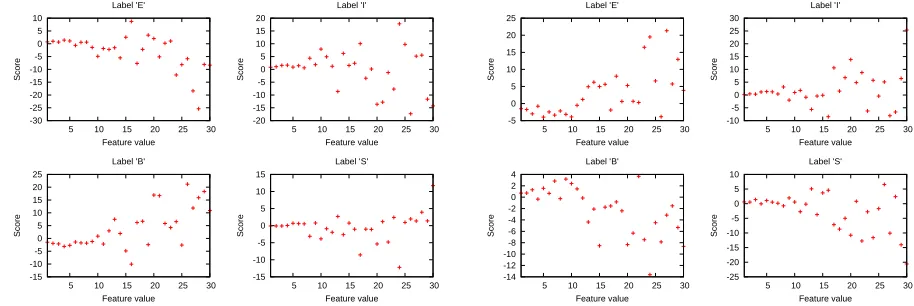
Figure 2: Scatter plot of feature score against feature value. The left side shows isL2
pv(c[i:i+1]feature while the right
side is theR2
pv(c[i:i+1]feature.
Test P R Fβ=1 Roov
Baseline 95.21 94.90 95.06 75.52
Final 95.86 95.62 95.74 79.28
Table 4: Segmentation performance on the test data.
3.3 Learning Curves
We performed additional experiments to evaluate the effect of the derived features as the amount of train-ing data is varied. Figure 1 displays the F-score and the OOV recall of systems with different feature sets when trained on smaller portions of the labeled data. Note that there is no change in the configura-tion of the unlabeled data. We can clearly see that the derived features obtain consistent gains regard-less of the size of the training set. The improvement
is more significant when little labeled data is ap-plied. Both statistics-based features and document-based features can help improve the overall perfor-mance. Especially, they can help to recognize more unknown words, which is important for many appli-cations. The F-score of semi-supervised models, i.e. models trained with statistics-based features, does not achieve further improvement when document-based features are added. Nonetheless, the OOV re-call obtains slightly improvements.
[image:7.612.79.536.283.436.2]is slightly higher than the performance of the model with only baseline features trained on the whole la-beled data.
3.4 Feature Analysis
We discussed the choice of using binary or numeric features in Section 2.3.4. In our experiment, when the accessor variety and punctuation variety infor-mation are integrated as numeric features, they do not contribute. To show the non-linear way that these features contribute to the prediction problem, we present the scatter plots of the score of each feature (i.e. the weight multiply the feature value) against the value of the feature. Figure 2 shows the relation between the score and the value of the punctuation variety features. For example, the weight of the binary feature “L2
pu(c[i:i+1]) = 26
combined with the label “B” learned by the final model is 0.815141, so the score of this combina-tion is 0.815141 ×26 = 21.193666 and a point
(26,21.193666) is drawn. These plots indicate the
punctuation variety features contribute to the final model in a very complicated way. It is impossible to use one weight to capture it. The accessor va-riety features affect the model in the same way, so we do not give detailed discussions. We only show the same scatter plot of theL2av(c[i:i+1])feature
tem-plate in Figure3.
-20 -15 -10 -5 0 5 10
5 10 15 20 25 30
Score
Feature value Label ’B’
-10 -8 -6 -4 -2 0 2 4 6 8 10
5 10 15 20 25 30
Score
Feature value Label ’I’
-10 -8 -6 -4 -2 0 2 4 6 8
5 10 15 20 25 30
Score
Feature value Label ’E’
-5 0 5 10 15 20
5 10 15 20 25 30
Score
[image:8.612.79.294.468.619.2]Feature value Label ’S’
Figure 3: Scatter plot of feature score against feature value forL2
av(c[i:i+1]).
4 Related Work
Xu et al. (2008) presented a Bayesian semi-supervised approach to derive task-oriented word
segmentation for machine translation (MT). This method learns new word types and word distribu-tions on unlabeled data by considering segmentation as a hidden variable in MT. Different from their con-cern, our focus is general word segmentation.
The “feature-engineering” semi-supervised ap-proach has been successfully applied to named en-tity recognition (Miller et al., 2004) and depen-dency parsing (Koo et al.,2008). These two papers demonstrated the effectiveness of using word clus-ters as features in discriminative learning. More-over, Turian et al.(2010) compared different word clustering algorithms and evaluated their effect on both named entity recognition and text chunking.
As mentioned earlier, the feature design is in-spired by some previous research on word segmen-tation. The accessor variety criterion is proposed to extract word types, i.e. the list of possible words, in (Feng et al., 2004). Different from their work, our method resolves the segmentation problem of running texts, in which this criterion is used to de-fine features correlated with the character position labels.Li and Sun(2009) observed that punctuations are perfect delimiters which provide useful informa-tion for segmentainforma-tion. Their method can be viewed as a self-training procedure, in which extra punctu-ation informpunctu-ation is incorporated to filter out auto-matically predicted samples. We use the punctua-tion informapunctua-tion in a different way. In our method, the counts of the preceding and succeeding strings of punctuations are incorporated directly as features into a supervised model.
5 Conclusion and Future Work
In this paper, we have presented a simple yet effec-tive approach to explore unlabeled data for Chinese word segmentation. We are concerned with large-scale in-domain data and the document text. Ex-periments show that our approach achieves substan-tial improvement over a competitive baseline. Es-pecially, the informative features derived from un-labeled data lead to significant improvement of the recall of unknown words. Our immediate concern for future work is to exploit the out-of-domain data to improve the robustness of current word segmen-tation systems. The idea would be to extract do-main information from unlabeled data and define them as features in our unified approach. The word-based approach is an alternative for word segmenta-tion. This kind of segmenters sequentially predicts whether the local sequence of characters make up a word. A natural avenue for future work is the exten-sion of our method to the word-based approach. The word segmentation task is similar to constituency parsing, in the sense of finding boundaries of lan-guage units. Another interesting question is whether our method can be adapted to resolve constituency parsing.
Acknowledgments
The work is supported by the project TAKE (Tech-nologies for Advanced Knowledge Extraction), funded under contract 01IW08003 by the German Federal Ministry of Education and Research. The author is also funded by German Academic Ex-change Service (DAAD).
References
Haodi Feng, Kang Chen, Xiaotie Deng, and Weimin Zheng. 2004. Accessor variety criteria for Chi-nese word extraction. Comput. Linguist., 30:75– 93.
Wenbin Jiang, Liang Huang, and Qun Liu. 2009. Automatic adaptation of annotation standards: Chinese word segmentation and pos tagging – a case study. In Proceedings of the Joint Confer-ence of the 47th Annual Meeting of the ACL and the 4th International Joint Conference on Natural Language Processing of the AFNLP, pages 522–
530. Association for Computational Linguistics, Suntec, Singapore.
Terry Koo, Xavier Carreras, and Michael Collins. 2008. Simple semi-supervised dependency pars-ing. InProceedings of ACL-08: HLT, pages 595– 603. Association for Computational Linguistics, Columbus, Ohio.
John D. Lafferty, Andrew McCallum, and Fernando C. N. Pereira. 2001. Conditional random fields: Probabilistic models for segmenting and labeling sequence data. In ICML ’01: Proceedings of the Eighteenth International Conference on Ma-chine Learning, pages 282–289. Morgan Kauf-mann Publishers Inc., San Francisco, CA, USA. Zhongguo Li and Maosong Sun. 2009. Punctuation
as implicit annotations for Chinese word segmen-tation. Comput. Linguist., 35:505–512.
Scott Miller, Jethran Guinness, and Alex Zamanian. 2004. Name tagging with word clusters and dis-criminative training. In Daniel Marcu Susan
Du-mais and Salim Roukos, editors, HLT-NAACL
2004: Main Proceedings, pages 337–342. As-sociation for Computational Linguistics, Boston, Massachusetts, USA.
Naoaki Okazaki. 2007. Crfsuite: a fast implementa-tion of condiimplementa-tional random fields (crfs).
Valentin I. Spitkovsky, Daniel Jurafsky, and Hiyan Alshawi. 2010. Profiting from mark-up: Hyper-text annotations for guided parsing. In Proceed-ings of the 48th Annual Meeting of the Associa-tion for ComputaAssocia-tional Linguistics, pages 1278– 1287. Association for Computational Linguistics, Uppsala, Sweden.
Weiwei Sun. 2010. Word-based and
character-based word segmentation models: Comparison and combination. InColing 2010: Posters, pages 1211–1219. Coling 2010 Organizing Committee, Beijing, China.
Weiwei Sun. 2011. A stacked sub-word model for joint Chinese word segmentation and part-of-speech tagging. InProceedings of the ACL 2011 Conference. Association for Computational Lin-guistics, Portland, Oregon, United States.
discriminative latent variable Chinese segmenter with hybrid word/character information. In Pro-ceedings of Human Language Technologies: The 2009 Annual Conference of the North American Chapter of the Association for Computational Linguistics, pages 56–64. Association for Com-putational Linguistics, Boulder, Colorado. Huihsin Tseng, Pichuan Chang, Galen Andrew,
Daniel Jurafsky, and Christopher Manning. 2005. A conditional random field word segmenter. InIn Fourth SIGHAN Workshop on Chinese Language Processing.
Joseph Turian, Lev-Arie Ratinov, and Yoshua Ben-gio. 2010. Word representations: A simple and general method for semi-supervised learning. In
Proceedings of the 48th Annual Meeting of the Association for Computational Linguistics, pages 384–394. Association for Computational Linguis-tics, Uppsala, Sweden.
Jia Xu, Jianfeng Gao, Kristina Toutanova, and Her-mann Ney. 2008. Bayesian semi-supervised Chi-nese word segmentation for statistical machine translation. In Proceedings of the 22nd Interna-tional Conference on ComputaInterna-tional Linguistics (Coling 2008), pages 1017–1024. Coling 2008 Organizing Committee, Manchester, UK.
![Figure 3: Scatter plot of feature score against featurevalue for L2av(c[i:i+1]).](https://thumb-us.123doks.com/thumbv2/123dok_us/1370667.670436/8.612.79.294.468.619/figure-scatter-plot-feature-score-featurevalue-l-av.webp)