Proceedings of the 2019 Conference on Empirical Methods in Natural Language Processing 2976
A Regularization Approach for Incorporating Event Knowledge and
Coreference Relations into Neural Discourse Parsing
Zeyu Dai, Ruihong Huang
Department of Computer Science and Engineering Texas A&M University
{jzdaizeyu, huangrh}@tamu.edu
Abstract
We argue that external commonsense knowl-edge and linguistic constraints need to be in-corporated into neural network models for mit-igating data sparsity issues and further improv-ing the performance of discourse parsimprov-ing. Re-alizing that external knowledge and linguis-tic constraints may not always apply in un-derstanding a particular context, we propose a regularization approach that tightlyintegrates these constraints with contexts for deriving word representations. Meanwhile, it bal-ancesattentions over contexts and constraints through adding a regularization term into the objective function. Experiments show that our knowledge regularization approach out-performs all previous systems on the bench-mark dataset PDTB for discourse parsing.
1 Introduction
Discourse parsing and identifying rhetorical course relations between two text spans (i.e., dis-course units, either clauses or sentences) is crucial and beneficial for a wide variety of downstream tasks and applications such as machine transla-tion (Webber et al.,2017), text generation (Mann, 1984;Bosselut et al.,2018) and text summariza-tion (Gerani et al.,2014).
In the PDTB-style discourse parsing (Prasad et al., 2008), we commonly distinguish implicit discourse relations from explicit relations, de-pending on whether a discourse connective (e.g., “because”, “however”) appears between two course units. In general, recognizing implicit dis-course relations is more challenging due to the lack of connective, which has recently drawn sig-nificant attention from the NLP researchers.
Recent research for implicit discourse rela-tion classificarela-tion has mostly focused on apply-ing powerful neural network models (Qin et al., 2016a,b; Liu and Li, 2016; Lei et al., 2017;
Bai and Zhao, 2018) for modeling compositional meanings and word-level interactions of two dis-course units. More recent research has also ex-ploited utilizing broader contexts (Dai and Huang, 2018) as well as leveraging external training data (Xu et al.,2018). Although progress has been made, the performance of implicit discourse rela-tion identificarela-tion remains low (macro F1<50%).
We believe that the low performance is mainly due to the data sparsity issue (Braud and Denis, 2015), which hinders data-thirsty neural network models from making further improvements. Con-sidering the following example from PDTB with two discourse units (DUs):
DU1: The editorial of the WHO notes that to-bacco consumption andlung-cancer mortal-ity rates are rising in developing countries. DU2: “No smokingshould be established as the
norm of social behavior” around the world, the editorial says, through the enactment of laws that limit advertising and promote anti-smoking education.
Discourse Relation: Implicit Contingency.Cause
Humans can easily recognize this discourse re-lation as “Cause” because we know that “smok-ing” is the key causal factor for “lung-cancer”, but it is extremely difficult for neural network mod-els trained with limited amount of data to detect it considering the keyword “lung-cancer” only ap-pears few times in the whole PDTB data.
events (situations in general) as described in two discourse units. As shown in the above example, the “Cause” discourse relation between the two DUs depends on the relation between two events
“smoking”and“lung-cancer” with one event in each DU.Second, we consider entity coreference relations as a useful form of linguistic constraints in inferring discourse relations. This is motivated by prior work (Rutherford and Xue,2014;Ji and Eisenstein,2015) showing that coreference based features can improve entity mention representa-tions within a DU, which facilitates recognizing coherence and discourse relations between DUs.
In this paper, we investigate how to incorpo-rate external event knowledge and entity corefer-ence relation based linguistic constraints into neu-ral network models for discourse parsing. One key difficulty we want to address is that external knowledge derived event relations or hard linguis-tic constraints may not always apply for interpret-ing a particular context, and may hurt performance if used blindly (Kishimoto et al.,2018). Therefore, we propose to tightly integrate these constraints into the discourse relation inference process by manipulating hidden word representations to re-flect relations between words, and meanwhile bal-anceattentions to contexts and constraints through adding a knowledge regularization term in the fi-nal objective function.
Specifically, we choose the paragraph-level model we proposed (Dai and Huang,2018) as the base model, which exploits wider paragraph-level contexts and has been shown effective for PDTB-style discourse parsing. The model mainly con-sists of a two-level hierarchical BiLSTMs (Schus-ter and Paliwal, 1997) for modeling both word-level and DU-word-level inter-dependencies (with a brief description in section 3.1). To implement the knowledge guided regularization for discourse parsing, wefirstinsert a new knowledge layer be-tween the word-level BiLSTM and DU-level BiL-STM layer. This knowledge layer modifies hid-den representations of words that participate in an event or coreference relation, by applying a re-lation type specific feedforward neural network.
Then, we compose a knowledge regularizer based on word representation outputs of the knowledge layer, by adapting a classic knowledge embedding method TransE (Bordes et al.,2013). The regular-ization term is added to the overall objective func-tion and minimized during model training.
The experiments on PDTB v2.0 demonstrate that our proposed knowledge regularization ap-proach can effectively utilize several types of externally obtained event knowledge and entity coreference relations1, and improves the
perfor-mance of both implicit and explicit discourse re-lation recognition compared to all previous work.
2 Related Work
2.1 Discourse Parsing on PDTB
With the release of Penn Discourse Treebank (PDTB) (Prasad et al., 2008), the task of dis-course parsing, especially implicit disdis-course re-lation recognition, has received a lot of attention from the NLP community and researchers (Pitler and Nenkova, 2009; Lin et al., 2014;Xue et al., 2015;Rutherford and Xue, 2016). A large num-ber of previous work attempted to model the se-mantic meanings of two discourse units using lat-est and advanced neural network models (Chen et al.,2016;Ji et al.,2016;Rutherford et al.,2017; Qin et al., 2017;Guo et al.,2018;Bai and Zhao, 2018). Paragraph-wide contexts were considered for building better discourse unit representations inDai and Huang(2018). Another research direc-tion for improving implicit discourse reladirec-tion clas-sification is to expand the training data by leverag-ing explicit relations (Liu et al.,2016;Lan et al., 2017) or discourse connective informed unlabeled data (Rutherford and Xue,2015;Xu et al.,2018).
2.2 Incorporate Knowledge into Discourse Parsing
line. We interpret this negative result as the con-sequence of using irrelevant (noisy) knowledge types blindly without proper regularization.
There are also recent work (Yang and Mitchell, 2017;Xu et al.,2017;Zhou et al., 2018) that in-corporate external knowledge into neural network models for improving several other NLP tasks, including information extraction and conversa-tion generaconversa-tion, which mostly followed the two-stepapproach that first obtained representations of knowledge (with triplet format) from knowledge base using knowledge graph embedding methods such as TransE (Bordes et al., 2013), and then utilized attention mechanism (or added gates in a RNN cell (Ma et al.,2018)) to integrate knowledge representations with hidden word vectors. This approach has two main drawbacks: (1) Knowl-edge representations learned from the first step are fixed without considering the influences of con-texts, which may be suboptimal when used for un-derstanding a particular context. (2) With no fil-tering or regularization, it is difficult for attention mechanisms to explicitly select and attend to the relevant knowledge. In contrast, our proposed reg-ularization approach can be regarded as an end-to-endjoint-learning framework for discourse pars-ing and knowledge representation learnpars-ing, which not only considers both knowledge and contexts in knowledge-aware word representation learning, but also naturally balances attentions on both con-texts and knowledge through regularization.
3 Model
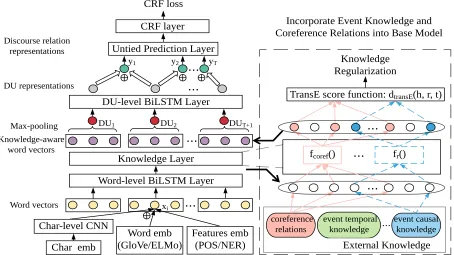
Figure1illustrates the overall architecture of our model, which implements our knowledge regular-ization approach (the right part) on top of an exist-ing model as the base model (the left part). There are only two modifications we made to the base model: (1) we insert a novel knowledge layer be-tween the two BiLSTM layers of the base mode; (2) we add a regularizer into the overall objective function. We will first briefly describe the base model, a replication2 of our recently proposed
paragraph-level discourse parsing model (Dai and Huang, 2018). We will then explain the knowl-edge layer and knowlknowl-edge regularizer we added.
2In our re-implementation, we made several minor mod-ifications to the original base model by using character-level features as well as supporting both traditional fixed word em-beddings (300D GloVe (Pennington et al.,2014)) and latest context-dependent word embeddings (1024D ELMo (Peters et al.,2018)) for word embedding initialization.
3.1 Base Model
The base model processes a paragraph containing a sequence of discourse units each time, and pre-dicts a sequence of discourse relations (both im-plicit and exim-plicit relations) with one relation be-tween each pair of adjacent discourse units (DU). The base model utilizes a hierarchical BiLSTM to calculate both word-level and DU-level rep-resentations, followed by a prediction layer and Conditional Random Field (CRF) layer (Lafferty et al., 2001) for jointly predicting a sequence of discourse relations within a paragraph. The base model consists of the following layers:
Character-level CNN Layer: The character-level features, such as the prefix or suffix of a word, can help alleviate the out-of-vocabulary (OOV) problem and improve the word represen-tation in neural nets (Santos and Zadrozny,2014). In our base model, we use one layer of CNN3with
max-pooling to extract character-level representa-tionwchari for thei-th word of the input paragraph. Word-level BiLSTM Layer: Given a words sequenceX = (x1, x2, ..., xL) as the input
para-graph, for each word xi, we construct the
ex-panded word vector by concatenating its word em-beddingwword
i with its character-level
representa-tion and extra word-level features4as:
wi = [wwordi ;wichar;wf eaturesi ]
The word-level BiLSTM layer will pro-cess the sequence of expanded word vectors (w1,w2, ...,wL)and compute the wordxi’s
hid-den representation at each word indexi:
hxi =BiLST M(w1,w2, ...,wL) DU-level BiLSTM Layer: Given the output of word-level BiLSTM (hx1,hx2, ...,hxL), we
calculate the raw DU representation by applying max-pooling operation (Conneau et al.,2017) over the sequence of word representations for all words within a discourse unit:h0DUj = maxxi2DUjhxi
Then, the DU-level BiLSTM will process the sequence of raw DU representations and obtain the refined DU representationhDUj for thej-th
dis-course unit in a paragraph:
hDUj =BiLST M(h0DU1,h0DU2, ...,h0DUT+1)
Max-pooling
Char emb Char-level CNN
Word emb (GloVe/ELMo)
Features emb (POS/NER) Word-level BiLSTM Layer
coreference relations
event temporal knowledge ...
External Knowledge
event causal knowledge
...
DU2 DUT+1
...
DU1
Knowledge Layer fcoref()
...
fr()
...
...
CRF layer
DU-level BiLSTM Layer
...
...
CRF loss
TransE score function: dtransE(h, r, t) Knowledge
Regularization
Knowledge-aware word vectors
Word vectors DU representations Discourse relation
representations
y1 y2 yT
xi
Untied Prediction Layer
[image:4.595.74.528.63.318.2]Incorporate Event Knowledge and Coreference Relations into Base Model
Figure 1: Model Architecture for Paragraph-level Discourse Parsing. The left part is the base model. The right part with colored arrows and neurons show how to incorporate coreference and event knowledge into base model.
Untied (Explicit vs. Implicit) Prediction Layer: Considering the different natures of ex-plicit and imex-plicit discourse relations (Pitler et al., 2009;Lin et al.,2009), the base model trains two independent linear layers with untied parameters for predicting explicit or implicit discourse rela-tions between each two adjacent DUs respectively:
hyt =
(
Wexp[hDUt;hDUt+1] +bexp, ifyt2exp Wimp[hDUt;hDUt+1] +bimp, ifyt2imp CRF Layer for Discourse Relation Sequence Labeling: A CRF layer (Biran and McKeown, 2015) is added on top of the prediction layer to fine-tune the predicted sequence of discourse re-lations by capturing continuity and transition pat-terns (e.g., a temporal relation is likely to follow another temporal relation).
Given the hidden discourse relation represen-tations H(i) = (h(i)
y1,h(y2i), ...,h(yiT)) and the
tar-get discourse relation label sequence y(i) = (y1(i), y2(i), ..., y(Ti)) for the i-th training instance,
we minimize the following CRF loss function dur-ing model traindur-ing:
LCRF =
X
i
logp(y(i)|H(i))
During testing, the Viterbi algorithm is used to search for the optimal label sequencey⇤that
max-imizes the conditional probabilityp(y|H).
3.2 Knowledge Layer
We simply insert a knowledge layer between the word-level and DU-level BiLSTM layers of the base model, as shown in Figure1, for incorporat-ing external knowledge and lincorporat-inguistic constraints. Although the knowledge layer can be easily ex-tended to support other types of knowledge, we only consider event knowledge and coreference relations in this paper and leave the exploration of other knowledge types in the future work.
Since there are some notable differences be-tween event relations and entity coreference re-lations, we model event and coreference con-straints in different ways considering their speci-ficities. For example, (1) an event relation can be represented as the triple format ((h, r, t) or (head, relation, tail) where head and tail are
two event words,relationindicates the
relation-ship between two eventshead andtail.) while a
coreference relation can have more than two coref-erential entity mentions; (2) event relations are di-rected while coreference relations are undidi-rected.
Event Knowledge: As the input of our knowl-edge layer, E = (E1,E2, ...,EM) denotes the
relationr (eithertemporal, causalorsubeventin this work) between the head eventxh at the
posi-tionhand tail eventxtat the positiont.
For each tripletEm = (h, r, t), we use a
feed-forward neural network5f
r()to update the hidden
word representations of head and tail events:
fr(hxh);fr(hxt) = tanh(Wr[hxh;hxt] +br)
whereWrandbrare relation-specific weights and
bias learned for each type of event relationronly.
Coreference Relations: Our system assumes that coreference relations in each paragraph are given in the form of coreference clusters, which are generated by running an existing coreference resolver (Clark and Manning,2016) from the lat-est version (3.9.2) of Stanford CoreNLP toolkit.
Let C = (C1,C2, ...,CK) denote coreference
clusters in one paragraph, where Ck contains the
word indices with corresponding words referring to the same entity. Similar as above, we use one feedforward neural networkfcoref()to update the
hidden word representationhxi for words within
each coreference cluster. Specifically, the output word vector has the following form:
fcoref(hxi)
=
(
tanh(Wcoref[hxi;hCk] +bcoref), ifxi 2Ck
hxi, otherwise
whereWcoref andbcoref are the weights and bias, hCk is a coreference vector calculated by apply-ing max-poolapply-ing to all word representations in one cluster: hCk = maxxi2Ckhxi.The role of
coref-erence vector is similar to “context vector” uti-lized in soft attention mechanism (Bahdanau et al., 2015), but we use simple max-pooling instead of computing weights6for different word vectors.
3.3 Knowledge Regularization
Inspired by the success of TransE (Bordes et al.,2013) approach in knowledge representation learning, we adapt the key assumption of TransE (i.e., we want h+r ⇡ t when (h, r, t) holds.) to our framework and hypothesize that the hid-den representation of tailtshould be close to the
5We also tried to use more complicated neural nets in-cluding neural tensor networks (Socher et al.,2013) and self-attentions mechanism (Vaswani et al., 2017), but none of them performed better than straightforward feedforward neu-ral network. We even tried to not update (identical function) hidden word vectors, but it performed significantly worse.
6We tried to employ weights with soft-attention mecha-nism, but it did not show improvement in our experiments.
hidden representation of headhplus the relation-specific vectorhrin vector space if(h, r, t)holds.
To guide the knowledge-aware word represen-tation learning of the knowledge layer, we pro-pose a knowledge regularizer based on TransE7
score function dtransE()and apply it to the
out-put word vectors of the knowledge layer. The re-sulting regularization term is also minimized as a part of the objective function during model train-ing. In other words, the knowledge regulariza-tion will smoothly penalize constraint depending on whether this constraint can be applied for inter-preting relevant relation in a particular context.
Specifically, we use cosine similarity8 to
mea-sure the similarity of two vectors, so the score function for triplet(h, r, t)has the following form:
dtransE(h, r, t) = 1 cos(fr(hxh) +hr, fr(hxt))
wherehris the relation-specific vector which will
be updated as parameters during model training. The event knowledge regularization term is:
Revent=
X
Em=(h,r,t)2E
dtransE(h, r, t)
For coreference relations, we create a special triplet (h, coref, t) for each two entity mentions
h and t in one coreference cluster, and fix the relation-specific vectorhcoref to be a zero vector
representing the relation of being “identical”. The coreference relation regularization term is:
Rcoref =
X
Ck2C
X
(h,t)2Ck
dtransE(h, coref, t)
Hence, the overall loss function for our model is:
L=LCRF+ event⇤Revent+ coref⇤Rcoref 4 Experiments
4.1 Dataset and Preprocessing
Dataset: We evaluate our model on PDTB v2.0 (Prasad et al.,2008), which is the largest an-notated dataset containing 19K explicit discourse relations and 17K implicit discourse relations. To make our experimental results directly compara-ble with previous work, we adopted the most-used dataset splitting “PDTB-Ji” (Ji and Eisen-stein,2015) that uses sections 2-20, 0-1, and 21-22 7We also tried TransD (Ji et al.,2015) and TransR (Lin
et al.,2015) for knowledge regularization, but none of them showed clear improvement over TransE in our experiments.
Relation Type Source # Discourse Coreference CoreNLP 19,819 Exp & Cont Event Temporal Yao et al. 18,515 Temp Event Causal ConceptNet 947 Cont Event Subevent ConceptNet 626 Exp & Temp
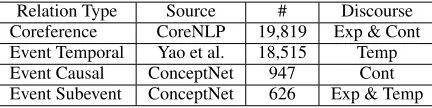
Table 1: Overview of relation types. # is the number of matched triplets (clusters for coreference). The last column summarizes relevant discourse relation classes each knowledge type may potentially help identify.
as train, dev and test sets respectively. To recover the paragraph contexts and gold discourse units, we directly ran the source code9ofDai and Huang
(2018), and obtained 12,037/1222/1050 paragraph instances in train/dev/test sets respectively.
Knowledge Preprocessing: Table 1 gives an overview of the relation types used in our exper-iments and the number of triplets (clusters) identi-fied in the PDTB dataset. Specifically, for corefer-ence relations, we utilized the Stanford CoreNLP coreference resolver to identify coreference clus-ters in each paragraph. For event knowledge, we considered three major event relation types includ-ing temporal, causal and subevent. We obtained event temporal knowledge from a previous work (Yao and Huang,2018)10and we retrieved the
lat-ter two types of event knowledge from Concept-Net11(Speer and Havasi,2012), which is a
widely-used commonsense knowledge base.
4.2 Experiment Setting
Evaluation Setting:Annotated discourse relation labels in PDTB v2.0 are organized in a three-level hierarchy. The top-level coarse-grained discourse relation classes include Comparison (Comp), Con-tingency (Cont), Expansion (Exp) and Tempo-ral (Temp), which are further split into 16 fine-grained classes at the second-level. To compare with previous work, we report the macro-average F1-score and accuracy12 on the top-level
multi-9Available at https://github.com/ZeyuDai/
paragraph_implicit_discourse_relations. Relations (0.5%) between non-adjacent DUs were discarded.
10We also tried to use VerbOcean (Chklovski and Pantel,
2004) which performed worse than our choices.
11Available at http://conceptnet.io. To extract event causal knowledge, we merged the relations [‘Causes’, ‘CausesDesire’, ‘Entails’] defined in ConceptNet. To ex-tract subevent knowledge, we merged the relations [‘Has-Subevent’, ‘HasFirst[‘Has-Subevent’, ‘HasLastSubevent’]. For simplicity, we removed relations containing multi-word events or non-event words (e.g., function words).
12Note that 3% discourse relations in PDTB were anno-tated with more than one label. Following previous work (Dai and Huang,2018;Bai and Zhao,2018), we considered a pre-diction as correct if it matches one of the gold labels.
class classification setting. Note that the macro-average F1-score is normally treated as the main evaluation metric in most previous work consid-ering the imbalanced distribution of discourse re-lations. In addition, we report class-wise F1-scores for the top-level implicit discourse rela-tions. But different from many previous work that report class-wise F1-scores obtained by us-ing the one-versus-all binary classification settus-ing, we instead report class-wise F1-scores using the 4-way multi-class classification setting, follow-ingDai and Huang(2018) which pointed out that compared to the one-versus-all binary classifica-tion setting where all binary classifiers may pre-dict a positive label for one instance, the multi-class multi-classification setting is more appropriate in evaluating a practical end-to-end discourse parser without the need of prediction conflict resolution. We additionally evaluate our models at the second-level using the 11-way13multi-class classification.
Training Setting: To make it easy for model tuning, we only chose corefand eventfrom [0.1,
0.5, 1.0] and tuned them based on the best perfor-mance on the dev set. All the BiLSTM layers and our knowledge layer used the hidden state size of 512, so the dimension of all hidden vectors (h⇤, fcoref(h⇤)andfr(h⇤)) is 512. To prevent
gradi-ent exploding problem of LSTMs, we clipped the gradient L2-norm with threshold 5.0 and used L2 regularization with coefficient10 8. We applied
dropout with probability 0.5 on the input/output of BiLSTMs to alleviate overfitting. For the opti-mizer, we used the SGD with momentum 0.9 and batch size of 64, and we set the initial learning rate as 0.015 which will decay by 5% after each epoch. To diminish the effects of randomness in neural network model training, we ran all our proposed model, its variants as well as our own base model 3 times using different random seeds and reported the average performance over 3 runs. For fair com-parison, we implemented all our models with Py-torch and tested them on a Nvidia 1080Ti GPU.
4.3 Models for Comparison
We compare our proposed regularization models with the following base model, our own baselines and recent published discourse parsing systems:
• (Dai and Huang, 2018): the original model
Implicit Explicit
Model Macro Acc Comp Cont Exp Temp Macro Acc
Previous work with the same evaluation setting
(Rutherford and Xue,2015) 40.50 57.10 - - - -(Liu et al.,2016) 44.98 57.25 - - - -(Liu and Li,2016) 46.29 57.57 - - - -(Lan et al.,2017) 47.80 57.39 - - - -(Dai and Huang,2018) 48.82 57.44 37.72 49.39 67.45 40.70 93.21 93.98 (Bai and Zhao,2018) (ELMo) 51.06 - - -
-Our models using GloVe word embeddings
Base Model 48.96 56.42 41.29 47.77 66.16 40.60 93.78 94.64
Base Model + Coreference (C) 49.42 57.15 41.39 49.26 66.89 40.14 93.73 94.62 Base Model + Event Temporal 49.58 57.31 41.52 46.49 67.50 42.83 93.87 94.72 Base Model + Event (E) 50.02 58.22 40.20 48.06 68.35 43.45 93.63 94.46 Full Model (Base Model + C&E) 50.49 58.32 39.61 49.29 68.23 44.83 94.32 95.07
Our own baselines with knowledge features using GloVe word embeddings
Base Model + Word Features 49.22 57.33 41.72 48.30 67.01 39.88 94.05 94.88 Base Model + DU Features 49.27 57.55 41.72 48.01 67.36 39.98 93.98 94.82 Base Model + two-step approach 49.63 57.52 41.41 45.57 68.08 43.46 93.88 94.71
Our models using ELMo16word embeddings
Base Model 50.83 56.50 47.00 46.42 65.58 44.21 94.35 95.12
[image:7.595.100.498.60.290.2]Full Model (Base Model + C&E) 52.89 59.66 45.34 51.80 68.50 45.93 94.84 95.39
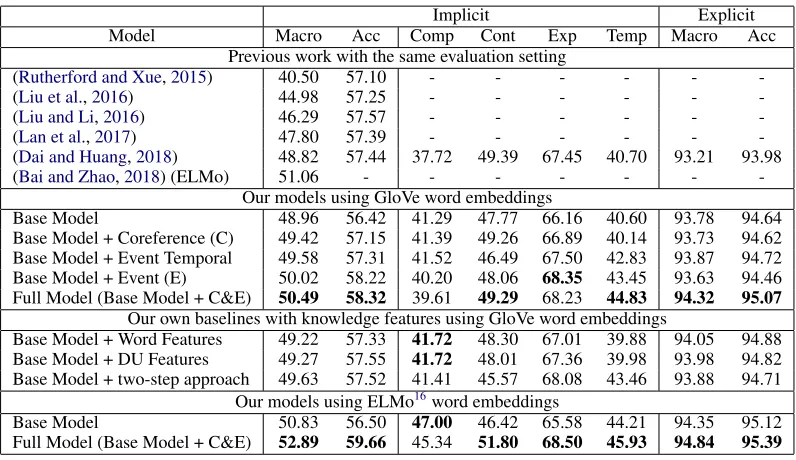
Table 2: Top-level Multi-class Classification Results on PDTB. We report macro-average F1-score (Macro), accu-racy (Acc) and F1-score on each class (Comparison, Contingency, Expansion and Temporal). Note thatBai and Zhao(2018) used ELMo word embeddings, so this result is only comparable with the last section.
• Base Model: our replicated model of (Dai and Huang, 2018) for paragraph-level dis-course parsing.
• Base Model + Word Features: our own base-line that creates discrete features for each word. We create one feature for each type of relations, including three types of event rela-tions and coreference relarela-tions, which counts the number of relation triplets that contain a word. We concatenate these word features with the input word vectorwi.
• Base Model + DU Features: our own base-line that creates discrete features for each DU
DUj. We create two features for each type
of relations: one counts relation triplets that have both nodes withinDUj; and the other
counts relation triplets that have one node in
DUj and the other node in an adjacent DU.
We concatenate these DU features with the hidden DU representationhDUj. Adding
ei-ther word features or DU features is to imi-tate traditional feature-based approaches and incorporate event knowledge and coreference relation constraints as features.
• Base Model + two-step approach: our own baseline that follows the two-step approach for incorporating relational constraints, in-cluding both event relations and coreference relations. We re-implement the inference model proposed by Chen et al. (2018)14,
14We followed Chen et al. (2018) to tune the
hyper-which first employs TransE to obtain rela-tion representarela-tions, and then uses attenrela-tion mechanism to incorporate relations and build knowledge-enhanced DU representations.
• (Rutherford and Xue,2015): a feature-based classifier that utilizes explicit discourse con-nectives for creating more implicit relations.
• (Liu et al.,2016): CNN based multi-task joint learning model that leverages both PDTB and RST (Carlson et al.,2003) datasets.
• (Liu and Li, 2016): a hierarchical
attention-over-attention neural network model for im-plicit discourse relation recognition.
• (Lan et al.,2017): multi-task attention-based
model for predicting implicit discourse rela-tions that leverages both explicit discourse re-lations of PDTB and unlabeled data.
• (Bai and Zhao,2018): a complex deep
resid-ual bi-attention based neural network model for implicit discourse relation classification which improves the hidden representations at character, subword, word and DU levels.
4.4 Experiment Results
Implicit Explicit
Model Macro Acc Macro Acc
Our models using GloVe word embeddings Base Model 28.59 43.88 63.40 86.02 + Word Features 30.83 44.17 65.47 86.60 + DU Features 31.78 44.65 66.06 86.51 Full Model 32.13 46.03 69.24 87.25
[image:8.595.321.512.61.147.2]Our models using ELMo word embeddings Base Model 31.05 45.98 70.01 87.83 Full Model 33.41 48.23 70.48 88.08
Table 3: Second-level Multi-class Classification Re-sults on PDTB. We report macro-average F1-score (Macro) and accuracy (Acc).
cause that many previous publications chose to re-port the class-wise implicit relation prediction per-formance using the one-versus-all binary classifi-cation setting, which are not directly comparable with our class-wise results using the multi-class classification setting following our previous work Dai and Huang(2018). In addition, we also report the explicit relation results.
In the second section, the replicated model (Base Model) achieves an overall similar perfor-mance15 compared to the original model of Dai
and Huang(2018). By incorporating coreference relations (+ Coreference) into the base model us-ing our regularization approach, implicit discourse relation prediction performance was improved for two classes, Contingency and Expansion. Adding event temporal knowledge (+ Event Temporal) into the base model significantly boosts the perfor-mance of Temporal discourse relation identifica-tion. Furthermore, adding the additional two types of event knowledge (+ Event), causal and subevent relations, yields clear performance gains in pre-dicting another two classes of implicit discourse relations: Contingency and Expansion. These per-formance gains meet our expectations that event relations are correlated with discourse relations and event relational knowledge facilitates predict-ing correspondpredict-ing discourse relations, with cor-respondences listed in Table 1. The full model considering both event knowledge and corefer-ence relations (+ C&E) achieves further improve-ments on implicit relation prediction, and out-performs the base model by 1.5 and 1.9 points on macro-average F1-score and accuracy respec-tively. Meanwhile, our full model obtains the best 16We downloaded the pretrained ELMo embedding (5.5B version) from AllenAI’s website (https://allennlp. org/elmo) and froze its parameters during model training. 15The performance changes on individual categories are due to minor modifications we made in replication, such as adding char-level CNN and replacing word2vec with GloVe.
Implicit Explicit
Model Macro Acc Macro Acc
Our models using GloVe word embeddings Full Model 50.49 58.32 94.32 95.07 w/o Reg 44.28 55.43 92.56 93.59
Our models using ELMo word embeddings Full Model 52.89 59.66 94.84 95.39 w/o Reg 48.55 56.45 93.77 94.65
Table 4: Impact of the Knowledge Regularization. We report the top-level performance when knowledge reg-ularizer was removed (w/o Reg) from full model.
results for explicit relation prediction as well. Shown in the third section, our own baselines which incorporate relational constraints either as features or via the two-step approach only perform slightly better than the base model, but clearly worse than the full model using the regulariza-tion approach. The first two baselines incorpo-rate constraints as additional discrete features and may suffer from feature sparsity issues, while the two-step approach may fail to balance attentions to contexts and knowledge constraints.
The last section presents the performance when using ELMo word embeddings. Our full model outperforms the base model on three out of four (except Comp) implicit discourse relations and improves both macro-average F1-score and accu-racy by 2.1 and 3.2 points respectively. Further-more, our full model outperforms the previous best system (Bai and Zhao,2018) using ELMo by over 1.8 points of macro-average F1-score.
5 Analysis
5.1 Second-level Multi-class Classification
Table3reports the performance of our models for predicting second-level fine-grained discourse re-lations. Same as top-level, our full model consis-tently outperforms the base model and its variants using either word-level or DU-level features.
5.2 Impact of the Knowledge Regularization
To study the necessity of the knowledge regular-ization in our full model, we removed the reg-ularization terms from the objective function by setting coref and event to be 0, which
[image:8.595.76.287.61.165.2]Model # of errors
Base Model 217
[image:9.595.122.241.62.105.2]Full Model 193
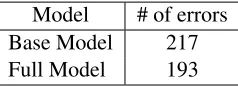
Table 5: Number of errors made by both models for predicting implicit discourse relations with constraints.
blindly can hurt the performance. We conclude that the knowledge regularizer plays a key role in achieving the state-of-the-art performance and the knowledge layer must be used together with knowledge regularization in our framework.
5.3 Qualitative Analysis
To better understand the strengths and weaknesses of the regularization approach, we analyzed im-plicit discourse relation predictions made by our base model and full model on the dev set. In to-tal, there are 507 implicit discourse relations that match with at least one event or coreference con-straint across two DUs, while the remaining 717 instances do not involve those constraints. It turns out that both the full model and base model per-formed comparably on recognizing implicit dis-course relations without event or coreference con-straints, with 407 vs. 402 discourse relations cor-rectly predicted by the full model and the base model respectively. Therefore, the overall perfor-mance gains achieved by the full model are mainly from better resolving implicit discourse relations with constraints, and as shown in Table5, the full model made 24 less errors than base model for pre-dicting such implicit discourse relations.
We further compared predictions made by the two models for implicit discourse relations with constraints. We found that 96 predictions in total have been changed by the full model, with clearly more corrections (60, i.e., the full model corrected predictions that were made wrongly by the base model.) than false reversions (36, i.e., the correct predictions made by the base model were wrongly reverted by the full model.). Here is one example from the 60 corrections made by the full model: DU1: Steve and his firm stillwortha lot of money. DU2: A package of creditsupportwas put together
includ-ing the assets of Steve and his firm. Gold Discourse Relation: Implicit Contingency Base Model’s prediction: Implicit Expansion Full Model’s prediction: Implicit Contingency
The event causal relation between “worth” and “support” identified using external event knowl-edge has enabled the full model to correctly rec-ognize this Contingency discourse relation.
We further examined the 36 wrong reversions of decisions. Around one third of these errors were due to either noise of event relation knowledge or incorrect coreference relations produced by the external CoreNLP coreference resolver we used. The remaining errors came from over-reliance of the full model on constraints in general. Consider-ing the followConsider-ing example from the 36 reversions: DU1: Another analyst thought that India may havepulled
backbecause of the concern over the stock market. DU2: India may have felt that if there was a severedropin
the stock market and it affected sugar, it could buy at lower prices.
Gold Discourse Relation: Implicit Expansion Base Model’s prediction: Implicit Expansion Full Model’s prediction: Implicit Temporal
The full model could have relied on the event tem-poral relation between “pulled back” and “drop” and made the wrong discourse relation prediction.
6 Conclusion and Future Work
We have presented an effective regularization ap-proach for incorporating external event knowledge and system predicted coreference relations into an existing paragraph-level neural network model for discourse parsing. Our approach tightly integrates knowledge and linguistic constraints with contexts for deriving knowledge-aware word vectors and meanwhile balances attentions over context and constraints through regularization, which robustly improves both implicit and explicit discourse rela-tion classificarela-tion performance on the benchmark PDTB corpus. In the future, we will identify new types of commonsense knowledge for further im-proving the performance of discourse parsing. For example, antonyms (e.g.,warm vs. cold) can di-rectly indicate a contrast relation between two sit-uations, and this type of knowledge has potential to further improve the performance on Compari-sondiscourse relations.
Acknowledgments
We gratefully acknowledge support from National Science Foundation via the award IIS-1755943 and support from Institute of Education Sciences via the award R305A180319.
References
Hongxiao Bai and Hai Zhao. 2018. Deep enhanced representation for implicit discourse relation recog-nition. InCOLING, pages 571–583.
Or Biran and Kathleen McKeown. 2013. Aggregated word pair features for implicit discourse relation dis-ambiguation. InACL, volume 2, pages 69–73.
Or Biran and Kathleen McKeown. 2015. Pdtb dis-course parsing as a tagging task: The two taggers approach. InProceedings of the 16th Annual Meet-ing of the Special Interest Group on Discourse and Dialogue, pages 96–104.
Antoine Bordes, Nicolas Usunier, Alberto Garcia-Duran, Jason Weston, and Oksana Yakhnenko. 2013. Translating embeddings for modeling multi-relational data. InNeurIPS, pages 2787–2795.
Antoine Bosselut, Asli Celikyilmaz, Xiaodong He, Jianfeng Gao, Po-Sen Huang, and Yejin Choi. 2018. Discourse-aware neural rewards for coherent text generation. InNAACL-HLT, pages 173–184.
Chlo´e Braud and Pascal Denis. 2015. Comparing word representations for implicit discourse relation classi-fication. InEMNLP, pages 2201–2211.
Lynn Carlson, Daniel Marcu, and Mary Ellen Okurowski. 2003. Building a discourse-tagged cor-pus in the framework of rhetorical structure theory. InCurrent and new directions in discourse and dia-logue, pages 85–112. Springer.
Jifan Chen, Qi Zhang, Pengfei Liu, Xipeng Qiu, and Xuanjing Huang. 2016. Implicit discourse relation detection via a deep architecture with gated rele-vance network. InACL.
Qian Chen, Xiaodan Zhu, Zhen-Hua Ling, Diana Inkpen, and Si Wei. 2018. Neural natural language inference models enhanced with external knowl-edge. InACL, pages 2406–2417.
Timothy Chklovski and Patrick Pantel. 2004. Verbo-cean: Mining the web for fine-grained semantic verb relations. InEMNLP.
Kevin Clark and Christopher D Manning. 2016. Im-proving coreference resolution by learning entity-level distributed representations. InACL, volume 1, pages 643–653.
Alexis Conneau, Douwe Kiela, Holger Schwenk, Lo¨ıc Barrault, and Antoine Bordes. 2017. Supervised learning of universal sentence representations from natural language inference data. InEMNLP, pages 681–691.
Zeyu Dai and Ruihong Huang. 2018. Improving im-plicit discourse relation classification by modeling inter-dependencies of discourse units in a paragraph. InNAACL, volume 1, pages 141–151.
Bhuwan Dhingra, Zhilin Yang, William W Cohen, and Ruslan Salakhutdinov. 2017. Linguistic knowledge as memory for recurrent neural networks. arXiv preprint arXiv:1703.02620.
Shima Gerani, Yashar Mehdad, Giuseppe Carenini, Raymond T Ng, and Bita Nejat. 2014. Abstractive summarization of product reviews using discourse structure. InEMNLP, pages 1602–1613.
Fengyu Guo, Ruifang He, Di Jin, Jianwu Dang, Long-biao Wang, and Xiangang Li. 2018. Implicit dis-course relation recognition using neural tensor net-work with interactive attention and sparse learning. InCOLING.
Guoliang Ji, Shizhu He, Liheng Xu, Kang Liu, and Jun Zhao. 2015. Knowledge graph embedding via dy-namic mapping matrix. In ACL, volume 1, pages 687–696.
Yangfeng Ji and Jacob Eisenstein. 2015. One vector is not enough: Entity-augmented distributed semantics for discourse relations.TACL, pages 329–344.
Yangfeng Ji, Gholamreza Haffari, and Jacob Eisen-stein. 2016. A latent variable recurrent neural net-work for discourse relation language models. In NAACL-HLT, pages 332–342.
Yudai Kishimoto, Yugo Murawaki, and Sadao Kuro-hashi. 2018. A knowledge-augmented neural net-work model for implicit discourse relation classifi-cation. InCOLING, pages 584–595.
John Lafferty, Andrew McCallum, and Fernando CN Pereira. 2001. Conditional random fields: Prob-abilistic models for segmenting and labeling se-quence data. InICML, 2001, pages 282–289.
Man Lan, Jianxiang Wang, Yuanbin Wu, Zheng-Yu Niu, and Haifeng Wang. 2017. Multi-task attention-based neural networks for implicit discourse re-lationship representation and identification. In EMNLP, pages 1310–1319.
Wenqiang Lei, Xuancong Wang, Meichun Liu, Ilija Ilievski, Xiangnan He, and Min-Yen Kan. 2017. Swim: A simple word interaction model for im-plicit discourse relation recognition. InIJCAI, pages 4026–4032.
Wenqiang Lei, Yuanxin Xiang, Yuwei Wang, Qian Zhong, Meichun Liu, and Min-Yen Kan. 2018. Lin-guistic properties matter for implicit discourse re-lation recognition: Combining semantic interaction, topic continuity and attribution. InAAAI.
Beth Levin. 1993. English verb classes and alterna-tions: A preliminary investigation. University of Chicago press.
Ziheng Lin, Min-Yen Kan, and Hwee Tou Ng. 2009. Recognizing implicit discourse relations in the penn discourse treebank. InEMNLP, pages 343–351. Ziheng Lin, Hwee Tou Ng, and Min-Yen Kan. 2014.
A pdtb-styled end-to-end discourse parser. Natural Language Engineering, 20(2):151–184.
Yang Liu and Sujian Li. 2016. Recognizing implicit discourse relations via repeated reading: Neural net-works with multi-level attention. InEMNLP, pages 1224–1233.
Yang Liu, Sujian Li, Xiaodong Zhang, and Zhifang Sui. 2016. Implicit discourse relation classification via multi-task neural networks. In AAAI, pages 2750– 2756.
Yukun Ma, Haiyun Peng, and Erik Cambria. 2018. Targeted aspect-based sentiment analysis via em-bedding commonsense knowledge into an attentive lstm. InAAAI.
William C Mann. 1984. Discourse structures for text generation. In 10th International Conference on Computational Linguistics and 22nd Annual Meet-ing of the Association for Computational LMeet-inguis- Linguis-tics.
Christopher D. Manning, Mihai Surdeanu, John Bauer, Jenny Finkel, Steven J. Bethard, and David Mc-Closky. 2014. The Stanford CoreNLP natural lan-guage processing toolkit. InACL System Demon-strations, pages 55–60.
Joonsuk Park and Claire Cardie. 2012. Improving im-plicit discourse relation recognition through feature set optimization. InProceedings of the 13th Annual Meeting of the Special Interest Group on Discourse and Dialogue, pages 108–112.
Jeffrey Pennington, Richard Socher, and Christopher Manning. 2014. Glove: Global vectors for word representation. InEMNLP, pages 1532–1543. Matthew Peters, Mark Neumann, Mohit Iyyer, Matt
Gardner, Christopher Clark, Kenton Lee, and Luke Zettlemoyer. 2018. Deep contextualized word repre-sentations. InNAACL-HLT, volume 1, pages 2227– 2237.
Emily Pitler, Annie Louis, and Ani Nenkova. 2009. Automatic sense prediction for implicit discourse re-lations in text. InACL, pages 683–691.
Emily Pitler and Ani Nenkova. 2009. Using syntax to disambiguate explicit discourse connectives in text. InACL-IJCNLP, pages 13–16.
R. Prasad, N. Dinesh, Lee A., E. Miltsakaki, L. Robaldo, Joshi A., and B. Webber. 2008. The Penn Discourse Treebank 2.0. Inlrec2008.
Lianhui Qin, Zhisong Zhang, and Hai Zhao. 2016a. Implicit discourse relation recognition with context-aware character-enhanced embeddings. In COL-ING, pages 1914–1924.
Lianhui Qin, Zhisong Zhang, and Hai Zhao. 2016b. A stacking gated neural architecture for implicit dis-course relation classification. In EMNLP, pages 2263–2270.
Lianhui Qin, Zhisong Zhang, Hai Zhao, Zhiting Hu, and Eric P. Xing. 2017. Adversarial connective-exploiting networks for implicit discourse relation classification. InACL, pages 1006–1017.
Attapol Rutherford, Vera Demberg, and Nianwen Xue. 2017. A systematic study of neural discourse mod-els for implicit discourse relation. InEACL, pages 281–291.
Attapol Rutherford and Nianwen Xue. 2014. Discover-ing implicit discourse relations through brown clus-ter pair representation and coreference patclus-terns. In EACL, pages 645–654.
Attapol Rutherford and Nianwen Xue. 2015. Im-proving the inference of implicit discourse relations via classifying explicit discourse connectives. In NAACL-HLT, pages 799–808.
Attapol T Rutherford and Nianwen Xue. 2016. Robust non-explicit neural discourse parser in english and chinese.ACL, page 55.
Cicero D Santos and Bianca Zadrozny. 2014. Learning character-level representations for part-of-speech tagging. InICML, pages 1818–1826.
Mike Schuster and Kuldip K Paliwal. 1997. Bidirec-tional recurrent neural networks. IEEE Transactions on Signal Processing, 45(11):2673–2681.
Richard Socher, Danqi Chen, Christopher D Manning, and Andrew Ng. 2013. Reasoning with neural ten-sor networks for knowledge base completion. In NeurIPS, pages 926–934.
Robert Speer and Catherine Havasi. 2012. Represent-ing general relational knowledge in conceptnet 5. In LREC, pages 3679–3686.
Ashish Vaswani, Noam Shazeer, Niki Parmar, Jakob Uszkoreit, Llion Jones, Aidan N Gomez, Łukasz Kaiser, and Illia Polosukhin. 2017. Attention is all you need. InNeurIPS, pages 5998–6008.
Bonnie Webber, Andrei Popescu-Belis, and J¨org Tiede-mann. 2017. Proceedings of the third workshop on discourse in machine translation. InProceedings of the Third Workshop on Discourse in Machine Trans-lation.
Yang Xu, Yu Hong, Huibin Ruan, Jianmin Yao, Min Zhang, and Guodong Zhou. 2018. Using active learning to expand training data for implicit dis-course relation recognition. InEMNLP, pages 725– 731.
Nianwen Xue, Hwee Tou Ng, Sameer Pradhan, Rashmi PrasadO Christopher Bryant, and Attapol T Ruther-ford. 2015. The conll-2015 shared task on shallow discourse parsing.CoNLL, page 1.
Bishan Yang and Tom Mitchell. 2017. Leveraging knowledge bases in lstms for improving machine reading. InACL, volume 1, pages 1436–1446.
Wenlin Yao and Ruihong Huang. 2018. Temporal event knowledge acquisition via identifying narra-tives. InACL, volume 1, pages 537–547.