Proceedings of the 2019 Conference on Empirical Methods in Natural Language Processing
2012
Image Captioning with Very Scarce Supervised Data:
Adversarial Semi-Supervised Learning Approach
Dong-Jin Kim1 Jinsoo Choi1 Tae-Hyun Oh2 In So Kweon1
1KAIST, South Korea. 2MIT CSAIL, Cambridge, MA.
1{djnjusa,jinsc37,iskweon77}@kaist.ac.kr 2[email protected]
Abstract
Constructing an organized dataset comprised of a large number of images and several cap-tions for each image is a laborious task, which requires vast human effort. On the other hand, collecting a large number of images and sentences separately may be immensely eas-ier. In this paper, we develop a novel data-efficientsemi-supervisedframework for train-ing an image captiontrain-ing model. We leverage massiveunpaired image and caption data by learning to associate them. To this end, our proposed semi-supervised learning method as-signs pseudo-labels to unpaired samples via Generative Adversarial Networks to learn the joint distribution of image and caption. To evaluate, we construct scarcely-paired COCO dataset, a modified version of MS COCO cap-tion dataset. The empirical results show the ef-fectiveness of our method compared to several strong baselines, especially when the amount of the paired samples are scarce.
1 Introduction
Image captioning is a task of automatically gener-ating a natural language description of a given im-age. It is a highly useful task, in that 1) it extracts the essence from an image into a self-descriptive form of representation, and 2) the output format is a natural language, which exhibits free-form and manageable characteristics useful to applica-tions such as language based image or region
re-trieval [Johnson et al., 2016; Karpathy and
Fei-Fei, 2015; Kim et al., 2019], video
summariza-tion [Choi et al., 2018], navigation [Wanget al.,
2018a], vehicle control [Kim et al., 2018b]. Im-age captioning exhibits free-form characteristics, since it is not confined to a few number of pre-defined classes. This enables descriptive analysis of a given image.
Recent research on image captioning has made
impressive progress [Anderson et al., 2018;
Vinyals et al., 2015]. Despite this progress, the
Paired Data (𝑫𝒑) Unpaired Image Data (𝑫𝒖𝒙) Unpaired Text Data (𝑫𝒖 𝒚
)
A pizza with basil leaves served on a plate. A woman cutting a large cake with one lit candle. A piece of cake and coffee are on an outdoor table. A white dog has a purple Frisbee in it’s mouth.
[image:1.595.309.524.205.284.2]A chocolate cake and a fork ready to be eat. A woman cutting a pizza with a fork and knife.
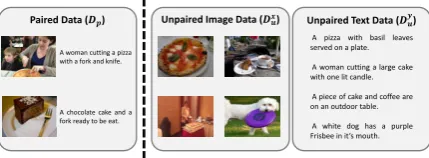
Figure 1: The proposed data setup utilizes both “paired” and “unpaired” image-caption data. We de-note paired data asDp, and unpaired image and caption
datasets asDx uandD
y
urespectively.
majority of works are trained via supervised learn-ing that requires a large corpus of caption labeled
images such as the MS COCO caption dataset [Lin
et al., 2014]. Specifically, the dataset is con-structed with 1.2M images that were asked the annotators to provide five grammatically plausi-ble sentences for each image. Constructing such human-labeled datasets are an immensely labori-ous task and time-consuming. This is a challenge of image captioning, because the task heavily
re-quires large data,i.e., data hungry task.
In this work, we present a novel way of
leverag-ingunpairedimage and caption data to train data
hungry image captioning neural networks. We
consider a scenario in which we have a small scale paired image-caption data of a specific domain. We are motivated by the fact that images can be easily obtained from the web and captions can be easily augmented and synthesized by replacing or adding different words for given sentences as done in [Zhang et al., 2015]. Moreover, given a suf-ficient amount of descriptive captions, it is easy
to crawlcorresponding but noisy images through
Google or Flickr image databases [Thomeeet al.,
2016] to build an image corpus. In this way, we
can easily construct a scalableunpaireddataset of
images and captions, which requires no (or at least minimal) human effort.
conven-tional supervision loss can no longer be used di-rectly. We propose to algorithmically assign
su-pervision labels, termed aspseudo-labels, to make
unpaired data paired. The pseudo-label is used
as a learned supervision label. To develop the
mechanism of pseudo-labeling, we use generative
adversarial network (GAN) [Goodfellow et al.,
2014], for searching pseudo-labels for unpaired
data. That is, in order to find the appropriate
pseudo-labels for unpaired samples, we utilize an adversarial training method for training a discrim-inator model. Thereby, the discrimdiscrim-inator learns to distinguish between real and fake image-caption pairs and to retrieve pseudo labels as well as to enrich the captioner training.
Our main contributions are summarized as fol-lows. (1) We propose a novel framework for train-ing an image captioner with the unpaired image-caption data and a small amount of paired data. (2) In order to facilitate training with unpaired data, we devise a new semi-supervised learning approach by the novel usage of the GAN
dis-criminator. (3) We construct our scarcely-paired
COCO dataset, which is the modified version of
the MS COCO dataset without pairing informa-tion. On this dataset, we show the effectiveness of our method in various challenging setups, com-pared to strong competing methods.
2 Related Work
The goal of our work is to deal with unpaired image-caption data for image captioning. There-fore, we mainly focus on image captioning and unpaired data handling literature.
Data Issues in Image Captioning. Since the
introduction of large-scale datasets such as MS
COCO data [Lin et al., 2014], image captioning
has been extensively studied in vision and
lan-guage society [Anderson et al., 2018; Rennie et
al.,2017;Vinyalset al.,2015;Xuet al.,2015] by virtue of the advancement of deep convolutional
neural networks [Krizhevskyet al.,2012]. As
neu-ral network architectures become more advanced, they require much larger dataset scale for
gener-alization [Shalev-Shwartz and Ben-David,2014].
Despite the extensive study on better network ar-chitectures, the data issues for image captioning, such as noisy data, partially missing data, and un-paired data have been relatively barely studied.
Unpaired image-caption data has been just
re-cently discussed. Gu et al. [2018] introduce
a third modal information, Chinese captions, for
language pivoting [Utiyama and Isahara, 2007;
Wu and Wang,2007]. Fenget al. [2019] propose an unpaired captioning framework which trains a model without image or sentence labels via learn-ing a visual concept detector with external data,
OpenImage dataset [Krasinet al.,2017]. Chenet
al. [2017] approach image captioning as a domain
adaptation by utilizing large paired MS COCO data as the source domain and adapting on a sep-arate unpaired image or caption dataset as the
tar-get domain. Liuet al. [2018] use self-retrieval for
captioning to facilitate training a model with par-tially labeled data, where the self-retrieval mod-ule tries to retrieve corresponding images based
on the generated captions. As a separate line
of work, there are novel object captioning
meth-ods [Anne Hendrickset al.,2016;Venugopalanet
al.,2017] that additionally exploit unpaired image
and caption data corresponding to a novel word.
Most of aforementioned works [Guet al.,2018;
Anne Hendrickset al.,2016;Venugopalanet al.,
2017; Feng et al., 2019] exploit large auxiliary supervised data which is often beyond image-caption data. To the best of our knowledge, we are the first to study how to handle unpaired im-age and caption data for imim-age captioning without any auxiliary information but by leveraging scarce
paired image-caption data only. Although [Chen
et al., 2017] does not use auxiliary information as well, it requires large amounts of paired source data, of which data regime is different from ours. [Liuet al.,2018] is also this case, where they use the full paired MS COCO caption dataset with an additional large unlabeled image set. Our method lies on a very scarce paired source data regime, of
which scale is only1%of the COCO dataset.
Multi-modality in Unpaired Data Handling.By
virtue of the advancement on generative modeling
techniques, e.g., GAN [Goodfellowet al.,2014],
multi-modal translation recently emerged as a popular field. Among many possible modalities, image-to-image translation between two different (and unpaired) domains has been mostly explored. To tackle this issue, the cycle-consistency con-straint between unpaired data is exploited in
Cy-cleGAN [Zhuet al.,2017] and DiscoGAN [Kimet
al.,2017], and it is further improved in UNIT [Liu
et al.,2017].
motivation to the unpaired image-to-image
trans-lation [Zhu et al., 2017], and unsupervised
ma-chine translation [Artetxe et al., 2018;Lample et
al., 2018a,b] works or machine translation with
monolingual data [Zhanget al.,2018]. However,
we show that the cycle-consistency does not work on our problem setup due to a significant modal-ity gap. Instead, our results suggest that the tra-ditional label propagation based semi-supervised
framework [Zhou et al., 2004] is more effective
for our task.
Semi-supervised Learning. Our method is
mo-tivated by the generative model based
semi-supervised learning [Chongxuanet al.,2017;Gan
et al., 2017;Kingmaet al., 2014], which mostly deals with classification labels. In contrast, we leverage caption data and devise a novel model to train the captioning model.
3 Proposed Framework
In this section, we first brief the standard image caption learning, and describe how we can lever-age the unpaired dataset. Then, we introduce an adversarial learning method for obtaining a GAN model that is used for assigning pseudo-labels and encouraging to match the distribution of latent fea-tures of images and captions. Lastly, we describe a connection to CycleGAN.
3.1 Model
Let us denote a dataset with Np image-caption
pairs asDp ={(xi, yi)}Ni=1p. A typical image
cap-tioning task is defined as follows: given an
im-agexi, we want a model to generate a captionyi
that best describe the image. Traditionally, a cap-tioning model is trained on a large paired dataset
(x, y)∈ Dp,e.g., MS COCO dataset, by
minimiz-ing the negative log likelihood against the ground truth caption as follows:
min
θ
X
(x,y)∈Dp
LCE(y,x;θ), (1)
whereLCE = −logqθ(y|x)denotes the cross
en-tropy loss, θ the set of learnable parameters, and
q(·) the probability output of the model.
Moti-vated by encoder-decoder based neural machine
translation literature [Cho et al., 2014],
tradi-tional captioning frameworks are typically
imple-mented as a encoder-decoder architecture [Vinyals
et al., 2015], i.e., CNN-RNN. The CNN encoder
F(x;θenc) produces a latent feature vector zx
from a given input imagex, and the RNN decoder
H(zx;θdec)is followed to generate a captiony in
a natural language form from zx, as depicted in
Fig. 2. The term q(·) in Eq. (1) is typically
im-plemented by the sum of the cross entropy of each
word token. For simplicity, we omitθfrom here if
deducible,e.g.,H(zx).
Learning with Unpaired Data. Our problem
deals with unpaired data samples, where the image
and caption sets Dx
u={xi}Ni=0x and D
y u={yi}
Ny
i=0
are not paired. Given the unpaired datasets, due to
the missing supervision, the loss in Eq. (1) cannot
be directly computed. Motivated by the nearest
neighbor aware semi-supervised framework [Shi
et al.,2018], we artificially generatepseudo-labels for respective unpaired datasets.
Specifically, we retrieve a best match caption ˜
yi in Dyu given a query image xi, and assign it
as a pseudo-label, and vice versa (x˜i foryi). We
abuse the pseudo-label as a function for
simplic-ity, e.g., y˜i = ˜y(xi). To retrieve a semantically
meaningful match, we need a measure to assess matches. We use a discriminator network to de-termine real or fake pairs by GAN, which we will describe later. With the retrieved pseudo-labels,
now we can compute Eq. (1) by modifying it as:
min
θ λx
X
x∈Dx u
LCE(˜y(x),x;θ) +λy X y∈Dyu
LCE(y,x˜(y);θ),
(2)
whereλ{·}denote the balance parameters.
Discriminator Learning by Unpaired Feature
Matching. We train the criterion to find a
se-mantically meaningful match, so that pseudo-labels for each modality are effectively retrieved. We learn a discriminator for that by using a small amount of paired supervised dataset.
We adopt a caption encoder, G(y;θcap), which
embeds the captionyinto a featurezy. This is
im-plemented with a single layer LSTM, and we take the output of the last time step as the caption
rep-resentation zy. Likewise, given an imagex, we
obtainzxby the image encoderF(x;θenc). Now,
we have a comparable feature space ofzxandzy.
We utilize the discriminator to distinguish whether
the pair(zx,zy)from true paired data(x, y)∈ D
p,
i.e., the pair belongs to the real distributionp(x, y)
or not. We could use random pairs of (x, y)
CNN( )
(shared)
𝑫𝑫
(shared) Paired
LSTM(𝐺𝐺)
(shared)
LSTM(𝐻𝐻) 𝑻𝑻𝒄𝒄→𝒗𝒗
𝑻𝑻𝒗𝒗→𝒄𝒄 LSTM(𝐺𝐺)
(shared) Ca pti on f ea t ( 𝑧𝑧 𝑦𝑦) Imag e f ea t ( 𝑧𝑧 𝑥𝑥) Ca pti on f ea t ( 𝑧𝑧 𝑦𝑦) Imag e f ea t ( 𝑧𝑧 𝑥𝑥) Unpaired Caption (𝐷𝐷𝑢𝑢𝑦𝑦)
Paired Data (𝐷𝐷𝑝𝑝)
Unpaired Image (𝐷𝐷𝑢𝑢𝑥𝑥)
Unpaired/Paired
Unpaired/Paired
𝑫𝑫
(shared)
𝑫𝑫
(shared)
Prediction (�𝑦𝑦)
Pseudo-label (�𝑦𝑦) Pseudo-label Search Module
𝑧𝑧𝑥𝑥 𝑧𝑧1𝑦𝑦 𝑧𝑧2𝑦𝑦 𝑧𝑧3𝑦𝑦 𝑧𝑧4𝑦𝑦
1 2 3 4 3 1 4 2
Scores Ranked Scores 𝑫𝑫
𝑦𝑦3 CNN( )
(shared)
Pseudo-label Search Module
𝑳𝑳𝑪𝑪𝑪𝑪 Caption (𝑦𝑦)
Caption (𝑦𝑦) Image (𝑥𝑥)
Image (𝑥𝑥)
[image:4.595.118.480.62.266.2]: Forward : Back-prop (𝐷𝐷) : Back-prop (θ, {T})
Figure 2: Description of the proposed method. Dotted arrows denote the path of the gradients via back-propagation. Given any image and caption pair, CNN and RNN (LSTM) encoders encode input image and caption into the respective feature spaces. A discriminator (D) is trained to discriminate whether the given feature pairs are real or fake, while the encoders are trained to fool the discriminator. The learned discriminator is also used to assign the most likely pseudo-labels to unpaired samples through the pseudo-label search module.
synthesizezxorzy, to form a synthesized pair that
appears to be as realistic as possible. We use the
feature transformer networks ˜zy=Tv→c(zx) and
˜
zx=Tc→v(zy), where v→cdenotes the mapping
from visual data to caption data and vice versa, and ˜
z denotes the conditionally synthesized feature.
{T}are implemented with multi-layer-perceptron
with four FC layers with ReLU nonlinearity.
The discriminator D(·,·) learns to distinguish
features, real or not. At the same time, the other
associated networksF,G,T{·}are learned to fool
the discriminator by matching the distribution of
paired and unpaired data. Motivated by [
Chongx-uanet al.,2017], the formulation of this adversar-ial training is as follows:
min
θ,{T}maxD (zxE,zy) ∼(F,G)◦Dp
[log(D(zx,zy)) +Lreg(zx,zy,{T})]
+1 2
E
x∼p(x)
[log(1−D(F(x), Tv→c(F(x))))]
+ E
y∼p(y)
[log(1−D(Tc→v(G(y)), G(y)))]
,
(3)
where Lreg(zx,zy,{T})=
λreg(k T
v→c(z
x)−zyk2
F +kzx− T c→v(z
y)k2
F),
and we use the distribution notation p(·) to
flex-ibly refer to any type of the dataset regardless
of Dp and Du. Note that the first log term is
not used for updating any learnable parameters
related to θ,{T}, but only used for updatingD.
Through alternating training of the discriminator
(D) and generator (θ,{T}) similar to [Kim et
al., 2018a], the latent feature distribution of paired and unpaired data should be close to
each other, i.e., p(zx,zy) = p(zx, Tv→c(zx)) =
p(Tc→v(zy),zy)(refer to the proof in [Chongxuan
et al., 2017]). In addition, as the generator is trained, the decision boundary of the discriminator tightens. If the unpaired datasets are sufficiently large such that semantically meaningful matches exist between the different modality datasets, and
if the discriminator D is plausibly learned, we
can useDto retrieve a proper pseudo-label. Our
architecture is illustrated in Fig.2.
Pseudo-label Assignment. Given an imagex∈
Dx
u, we retrieve a caption in the unpaired dataset,
i.e.,y˜∈ Dyu, that has the highest score obtained by
the discriminator,i.e., the most likely caption to be
paired with the given image as
˜
yi = ˜y(xi) = argmax y∈Dyu
D(F(xi), G(y)), (4)
vice versa for unpaired captions:
˜
xi = ˜x(yi) = argmax x∈Dx
u
D(F(x), G(yi)). (5)
By this retrieval process over all the unpaired
dataset, we have image-caption pairs {(xi, yi)}
from the paired data and the pairs with
data. However, these pseudo-labels are not noise-free, thus treating them equally with the paired ones is detrimental. Motivated by learning with
noisy labels [Leeet al.,2018;Wanget al.,2018b],
we define a confidence score for each of the as-signed pseudo-labels. We use the output score from the discriminator, as the confidence score,
i.e., αxi= ˆD(xi,y˜i) and αyi= ˆD(˜xi, yi), where we
denoteDˆ(x, y) =D(F(x), G(y)), andα ∈ [0,1]
due to the sigmoid function of the final layer of the discriminator. Therefore, we utilize the confidence scores to assign weights to the unpaired samples. We compute the weighted loss as follows:
min θ
P
(x,y)∈Dp
LCE(y,x;θ) +λx P
x∈Dx u
αx
iLCE(˜y(x),x;θ)
+λy P
y∈Dyu
αyiLCE(y,˜x(y);θ). (6)
We jointly train the model on both paired and unpaired data. To ease the training further, we add an additional triplet loss function:
X
(xp,yp)∈Dp,
xu∈Dxu,yu∈Dyu
logpθ(yp|xp) pθ(yp|xu)
+ logpθ(yp|xp) pθ(yu|xp)
, (7)
by regarding random unpaired samples as nega-tive. This slightly improves the performance.
3.2 Connection with CycleGAN
As a representative fully unpaired method,
Cy-cleGAN [Zhu et al., 2017] would be the strong
baseline at this point, which has been popularly
used for unpaired distribution matching. Since
it is designed for image-to-image translation, we describe the modifications to it to fit our task, so as to understand relative performance of our method over the CycleGAN baseline. When ap-plying the cycle-consistency on matching between images and captions, since the input modalities are totally different, we modify it to a translation prob-lem over feature spaces as follows:
min
θ,{T}Dmax{x,y}Lcycle({T})
+ E
x∼p(x)
[log(Dx(F(x))) + log(1−Dx(Tv→c(F(x))))]
+ E
y∼p(y)
[log(Dy(G(y))) + log(1−Dy(Tc→v(G(y))))],
(8)
where{T}andD{x,y}denotes the feature
transla-tors and the discriminatransla-tors for image domain and caption domain, and
Lcycle({T}) =Ex∼p(x)[kTc→v(Tv→c(F(x)))−F(x)k2]
+Ey∼p(y)[kTv→c(Tc→v(G(y)))−G(y)k2]. (9)
The discriminator D is learned to distinguish
whether the latent features is from the image or the caption distribution. This is different with our
method, in that we distinguish the correct
seman-tic match of pairs. We experimented with
Cycle-GAN purely on unpaired datasets, but we were not able to train it; hence, we add the supervised loss
(Eq. (1)) with the paired data, which is a fair
set-ting with ours.
4 Experiments
In this section, we describe the experimental setups, competing methods and provide perfor-mance evaluations of unpaired captioning with both quantitative and qualitative results.
4.1 Implementation Details
We implement our neural networks by PyTorch
li-brary [Paszkeet al.,2017]. We use ResNet101 [He
et al., 2016] model as a backbone CNN encoder for image input, and initialize with weights
pre-trained on ImageNet [Russakovsky et al., 2015].
Each region is represented as 2,048-dimensional output from the last residual block of this network.
For NIC model [Vinyalset al., 2015] and Att2in
model [Rennieet al.,2017] in Table3, we use
vi-sual features with size 2048×7×7 . For
Up-Down [Andersonet al.,2018] and the model in
Ta-ble3, we use Faster R-CNN [Renet al.,2015]
pre-trained on Visual Genome [Krishna et al., 2017]
object dataset, thereby we extract visual features for 10 to 100 regions.
We set the channel size of the hidden layers of LSTMs to be 1024, 512 for the attention layer, and 1024 for the word embeddings. For inference stage, we empirically choose the beam size to be 3 when generating a description, which shows the best performance.
We use a minibatch size of 100, the Adam [Ba
and Kingma,2015] optimizer for training
(learn-ing ratelr=5e−4,b1=0.9,b2=0.999). For
hyper-parameters, we empirically choose λx and λy to
be equal to 0.1. The total loss function for training our model is as follows:
L=Lcap+ 0.1LGAN + 0.1Ltriplet, (10)
whereLcapdenotes the captioning loss defined in
Eq. (6),LGAN the loss for adversarial training
de-fined in Eq. (3), andLtripletthe triplet loss defined
(A) (B) (C) BLEU1 BLEU4 METEOR CIDEr
Fully paired (100%) 72.5 29.4 25.0 95.7
Paired only (1%) 58.1 13.4 15.9 36.0
CycleGAN (Zhuet al. ) 58.7 14.1 16.2 37.7
Ours ver1 X 60.1 15.7 16.5 45.3
Ours ver2 X X 61.3 17.1 19.1 51.7
Ours (final) X X X 63.0 18.7 20.7 55.2
[image:6.595.342.494.59.188.2][Guet al.,2018] 46.2 5.4 13.2 17.7 [Fenget al.,2019] 58.9 18.6 17.9 54.9
Table 1: Captioning performance comparison on MS COCO testset. The “Paired only” baseline is trained only with 1% of paired data from ourscarcely-paired COCOdataset, while CycleGAN and Ours{ver1, ver2, final}, are trained with our scarcely-paired COCO
dataset (1% of paired data and unpaired image and cap-tion datasets). We indicate the ablacap-tion study by: (A) the usage of the proposed GAN that distinguishes real or fake image-caption pairs, (B) pseudo-labeling, and (C) noise handling by sample re-weighting. We also compare with [Guet al.,2018] and [Fenget al.,2019], which are trained with unpaired datasets.
4.2 Experimental Setups
We utilize MS COCO caption [Lin et al., 2014]
as our target dataset, which contains 123k images with 5 caption labels per image. To validate our
model, we follow Karpathy splits [Karpathy and
Fei-Fei, 2015], which have been broadly used in image captioning literature. The Karpathy splits contain 113k training, 5k validation, and 5k test images in total. In our experiments, in order to simulate the scenario that both paired and unpaired data exist, we use two different data setups: 1) the proposed scarcely-paired COCO, and 2) partially
labeled COCO [Liuet al.,2018] setup.
For the scarcely-paired COCO setup, we
re-move the pairing information of the MS COCO dataset, while leaving a small fraction of pairs un-altered. We randomly select only one percent of
the total data, i.e., 1,133 training images for the
paired data, and remove the pairing information of the rest to obtain unpaired data. We call the
small fraction of samples given as pairs aspaired
data (Dp) and call the samples without pairing
in-formation as unpaired data (Du). We study the
effects of other ratios of paired data used for
train-ing (in Figs.4and3). This dataset allows
evalu-ating the proposed framework to measure whether such small paired data can be leveraged to learn plausible pseudo-label assignment, and what per-formance can be achieved compared to the fully supervised case.
For partially labeled COCO setup, we follow
[Liu et al., 2018] and use the whole MS COCO
data (paired) and add the “Unlabeled-COCO”
0.1 0.2 0.3 0.4 0.5 0.6 0.7 0.8 0.9 1 Ratio of paired data.
78 80 82 84 86 88 90 92 94 96 98
CIDEr
[image:6.595.71.293.61.138.2]Baseline Ours Reference
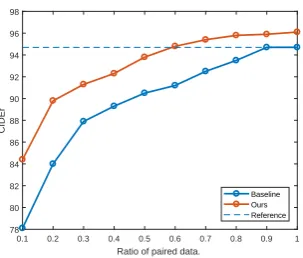
Figure 3: Performance w.r.t. amount of paired data for training. Baseline denotes our Paired Only baseline, Ours is our final model, and Reference isPaired Only
trained with full paired data.
split of the officially MS-COCO [Linet al.,2014]
for unpaired images, which involves 123k images without any caption label. To compute the cross entropy loss, we use the pseudo-label assignment for the Unlabeled-COCO images.
For evaluation, we use the following met-rics conventionally used in image
caption-ing: BLEU [Papineni et al., 2002],
ROUGUE-L [Lin, 2004], SPICE [Anderson et al., 2016],
METEOR [Denkowski and Lavie, 2014], and
CIDEr [Vedantamet al.,2015]. All the evaluation
is done on MS COCO testset.
In order to avoid high time complexity of the pseudo-labeling process, we do not search the pseudo-labels from the whole unpaired data. Pseudo-label retrieval is done on a subset of one-hundredth of the unpaired data (yielding 1000 samples). Thus, the complexity of each minibatch
becomesO(B×N ×0.01),whereBdenotes the
minibatch size,N denotes the size of the unpaired
dataset. Since we also apply label-noise handling, a plausible pseudo-label assignment is sufficient in helping the learning process. We can improve performance by using a larger subset or by using a fast approximate nearest neighbor search.
4.3 Evaluation on Scarcely-paired COCO
We follow the same setting with [Vinyalset al.,
2015], if not mentioned. Table 1 shows the
re-sults on the scarcely-paired COCO dataset. We
compare with several baselines: Paired Only; we
train our model only on the small fraction (1%)
of the paired data,CycleGAN; we train our model
with the cycle-consistency loss [Zhu et al.,2017]
(as in Eq. (8)). Additionally, we train variants of
our model denoted as Ours (ver1, ver2, and
Baseline (1%): a player playing a swinging on her long. Baseline (10%): a woman playing tennis on
a court with a racket.
Baseline (100%): a woman is playing tennis
on a court.
Ours (1%) : a man with a tennis racket on a court. Baseline (1%) : a black bear wearing skis with
a chain on the trees.
Baseline (10%) : a black bear is standing in the grass. Baseline (100%) : a black bear is walking through a field. Ours (1%) : a black bear walking through
the grass near the forest.
Baseline (1%): a bunch of children white skis on. Baseline (10%): a group of people standing on
top of a snow covered slope.
Baseline (100%): a group of people standing on
top of a snow covered slope.
Ours (1%) : a group of people standing on
a snow covered slope.
Baseline (1%) : a baseball player playing with out a red. Baseline (10%) : a baseball player is getting ready
to hit a ball.
Baseline (100%) : a group of people playing
a game of Frisbee.
Ours (1%) : a baseball player playing is swinging a bat at a ball.
Baseline (1%) : a train rolling down tracks at the track. Baseline (10%) : a train on track near a station. Baseline (100%) : a train is traveling down the tracks
in a city.
Ours (1%) : a train traveling down the tracks in front of a train station.
Baseline (1%): a little girl skier markers on to
snow the slope.
Baseline (10%): a person skiing down a snowy slope. Baseline (100%): a man riding skis down
a snow covered slope.
Ours (1%) : a person standing on skis
in a snow covered field.
Baseline (1%): a zebra standing over ledge in
a French together.
Baseline (10%): a zebra standing on top of
a lush green field.
Baseline (100%): a zebra standing in a field with
a tree in the background.
Ours (1%) : a zebra standing on a grassy filed. Baseline (1%) : a bunch of sheep in front of
the zoo standing.
Baseline (10%) : a group of sheep standing next to
each other.
Baseline (100%) : a herd of sheep standing on top of
a lush green field.
[image:7.595.71.527.60.303.2]Ours (1%) a group of sheep standing next to a fence.
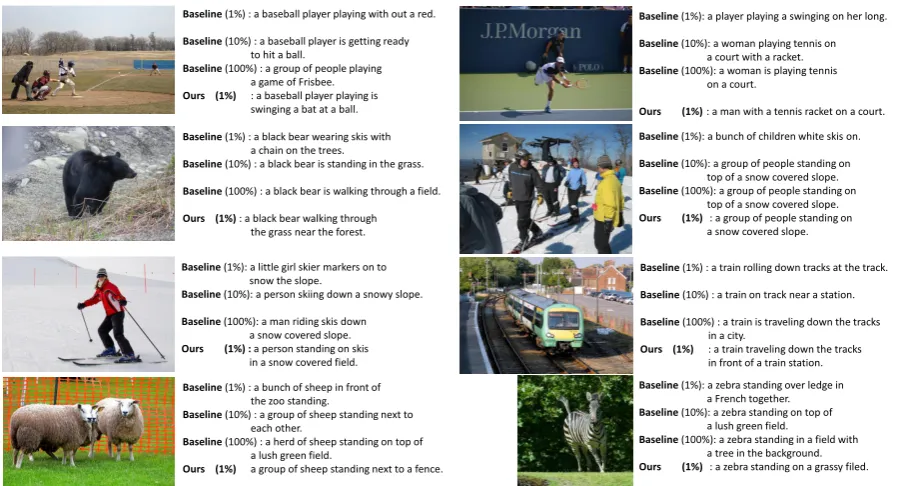
Figure 4: Sampled qualitative results of our model. We compare with the baseline models trained only onN%of paired samples out of the full MS COCO. Despite the use of only 1% paired data, our model generates plausible captions similar to that of the baseline models trained with more data (10% and above).
via our GAN model (Eq. (3)) that distinguishes
real or fake image-caption pairs. ForOur ver2, we
add training with pseudo-labels for unpaired data
with Eq. (6) while setting the confidence scores
αx=αy=1for all training samples. For our final
model denoted asOur (final), we apply the noise
handling technique by the confidence scores αx
andαy computed by Eq. (6) and re-weighting the
loss for each sample. We present the performance
of the fully supervised (Fully paired) model using
100% of the COCO training data for reference.
As shown in Table 1, in a scarce data regime,
utilizing the unpaired data improves the captioning performance in terms of all metrics by noticeable margins. Also, our models show favorable perfor-mance compared to the CycleGAN model in all metrics. Our final model with pseudo-labels and noise handling achieves the best performance in all metrics across all the competitor, hereafter ref-ered to this model as our model.
We also compare the recent unpaired image
captioning methods [Gu et al.,2018;Fenget al.,
2019] in Table1. Both of the methods are
eval-uated on MS COCO testset. In the case of Gu et
al., AIC-ICC image-to-Chinese dataset [Wuet al.,
2017] is used as unpaired images Dx
u and
tions from MS COCO are used as unpaired
cap-tionsDuy. Note that this is not a fair comparison to
our method but they have more advantages, in that
Guet al. use large amounts of additional labeled
data (10M Chinese-English parallel sentences of
AIC-MT dataset [Wu et al., 2017]) and Feng et
al. use 36M samples of additional OpenImages
dataset, whereas our model only uses a small amount of paired samples (1k) and 122k unpaired data. Despite far lower reliance on paired data, our model shows favorable performance against recent unpaired captioning works.
We study our final model against our Paired
Only baseline according to varying amounts of
paired training data in Fig.3, so that we can see
how much information can be gained from the un-paired data. From 100% to 10%, as the amount of paired samples decreases, the fluency and the ac-curacy of the descriptions get worse. In particular, we observed that most of the captions generated
from thePaired Onlybaseline trained with 10% of
paired data (11,329 pairs) show erroneous gram-matical structure. In contrast, by leveraging un-paired data, our method can generate more fluent
and accurate captions, compared to Paired Only
trained on the same amount of paired data. It is worthwhile to note that our model trained with 60% of paired data (67,972 pairs) achieves similar
performance to the Paired Only baseline trained
sig-BLEU1 BLEU2 BLEU3 BLEU4 ROUGE-L SPICE METEOR CIDEr Self-Retrieval [Liuet al.,2018] (w/o unlabeled) 79.8 62.3 47.1 34.9 56.6 20.5 27.5 114.6 Self-Retrieval [Liuet al.,2018] (with unlabeled) 80.1 63.1 48.0 35.8 57.0 21.0 27.4 117.1 Baseline (w/o unlabeled) 77.7 61.6 46.9 36.2 56.8 20.0 26.7 114.2 Ours(w/o unlabeled) 80.8 65.3 49.9 37.6 58.7 22.7 28.4 122.6 Ours(with unlabeled) 81.2 66.0 50.9 39.1 59.4 23.8 29.4 125.5
Table 2: Comparison with the semi-supervised image captioning method, “Self-Retrieval” [Liuet al.,2018]. Our method shows improved performance even without Unlabeled-COCO data (denoted asw/o unlabeled) as well as with Unlabeled-COCO (with unlabeled), although our model is not originally proposed for such scenario.
a bus is parked on a street.
a large bear standing on a grass. a motorcycle parked on a street.
Figure 5: Examples of the pseudo-labels (captions) as-signed to the unpaired images. Our model is able to sufficiently assign image-caption pairs through the pro-posed adversarial training.
nifies that our method is able to savenear half of
the human labeling effort of constructing a dataset. We also show qualitative samples of our results
in Fig.4. Paired Only baseline trained with 1%
paired data produces erroneous captions, and the baseline with 10% paired data starts to produce
plausible captions. It is based onten times more
paired samples, compared to our model that uses only 1% of them. We highlight that, in the two
ex-amples on the top row of Fig.4, our model
gener-ates more accurate captions than the Paired Only
baseline trained on the 100% paired data (“base-ball” to “Frisbee” on the top-left, and “man” to “woman” on the top-right). This suggests that un-paired data with our method effectively boosts the performance especially when paired data is scarce. In order to demonstrate the meaningfulness of our label assignment, we show the pseudo-labels assigned to the unpaired samples. We show the pseudo-labels (captions) assigned to unlabeled
images from Unlabeled-COCO images in Fig.5.
As shown in the figure, despite not knowing the real pairs of these images, the pseudo labels are sufficiently assigned by the model. Note that even though there is no ground truth caption for unla-beled images in the searching pool, the model is able to find the most likely (semantically corre-lated) image-caption pair for the given images.
Fig. 6 highlights interesting result samples of
our caption generation, where the results con-tain words that do not exist in the paired data of the scarcely-paired COCO dataset. The semantic meaning of the words such as “growling,”
“grow-Two bears growling in the water.
A broccoli grows on a green plant.
[image:8.595.78.285.180.236.2]Cows being herded by a fence in a field.
Figure 6: Example captions containing words that do not exist in the paired datasetDp. The novel words that
are not inDpbut inDyuare highlighted in bold.
ing,” and “herded,” which involve in the unpaired caption data but not in the paired data, may have been learned properly via pseudo-label assignment during training. These examples suggest that our method is capable to infer the semantic meaning of unpaired words to some extent, which would have been unable to be learned with only little paired data. This would be an evidence that our frame-work is capable to align abstract semantic spaces
between two modalities,i.e., visual and caption.
4.4 Evaluation on Partially Labeled COCO
For a more realistic setup, we compare with the recent semi-supervised image captioning method,
called Self-Retrieval [Liu et al., 2018], on their
problem regime, i.e., “partially labeled” COCO
setup, where the full amount of the paired MS COCO (113k) plus 123k uncaptioned images of the Unlabeled-COCO set are used (no additional unpaired caption is used). While their regime is not our direct scope, but we show the effectiveness of our method in the regime. Then, we extend our framework by replacing our backbone architecture with recent advanced image caption architectures.
In this setup, a separateunpairedcaption dataDuy
does not exist, thus we use captions from paired
COCO dataDp as pseudo-labels.
Table 2 shows the comparison with
Self-Retrieval. For a fair comparison with them,
we replace the cross entropy loss from our loss
with the policy gradient method [Rennie et al.,
2017] to directly optimize our model with CIDEr
[image:8.595.305.527.182.249.2]BLEU1 BLEU2 BLEU3 BLEU4 ROUGE-L SPICE METEOR CIDEr NIC [Vinyalset al.,2015] 72.5 55.1 40.4 29.4 52.7 18.2 25.0 95.7 NIC+Ours 74.2 56.9 42.0 31.0 54.1 19.4 28.8 97.8 Att2in [Rennieet al.,2017] 74.5 58.1 44.0 33.1 54.6 19.4 26.2 104.3 Att2in+Ours 75.5 58.8 45.0 34.3 55.4 20.0 26.8 105.3 Up-Down [Andersonet al.,2018] 76.7 60.7 47.1 36.4 56.6 20.6 27.6 113.6 Up-Down+Ours 77.3 64.1 47.6 37.0 57.1 21.0 27.8 114.6
Table 3: Evaluation of our method with different backbone architectures. All models are reproduced and trained with the cross entropy loss. By adding Unlabeled-COCO images, our training method was applied in a semi-supervised way, which shows consistent improvement in all the metrics.
model (denoted as Baseline), we train a model
only with policy gradient method without the pro-posed GAN model. When only using the 100%
paired MS COCO dataset (denoted as w/o
unla-beled), our model already shows improved
per-formance over Self-Retrieval. Moreover, when
adding Unlabeled-COCO images (denoted aswith
unlabeled), our model performs favorably against
Self-Retrieval in all the metrics. The results sug-gest that our method is also advantageous in the semi-supervised setup.
To further validate our method in the semi-supervised setup, we compare different backbone
architectures [Anderson et al., 2018; Rennie et
al., 2017; Vinyals et al., 2015] in our frame-work, where their methods are developed for fully-supervised methods. We use the same data setup
with the above, but we replace CNN (F) and
LSTM (H) from our framework with the image encoder and the caption decoder from their im-age captioning models. Then, these models can be trained in our framework as it is by alternat-ing between the discriminator update and
pseudo-labeling. Table3shows the comparison. Training
with the additional Unlabeled-COCO data viaour
training scheme consistently improves all base-lines in all metrics.
4.5 Captioning with Web-Crawled Data
To simulate a scenario involving crawled data from the web, we use the setup suggested by
Fenget al. [2019]. They collect a sentence
cor-pus by crawling the image descriptions from
Shut-terstock1 as unpaired caption data Duy, whereby
2.2M sentences are collected. For unpaired
im-age data Dx
u, they use only the images from the
MS COCO data, while the captions are not used for training. For training our method, we lever-age from 0.5% to 1% of paired MS COCO data
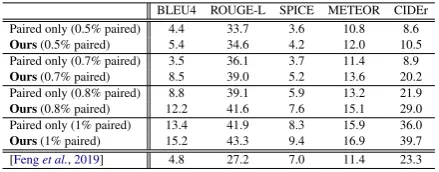
as our paired data Dp. The results are shown in
Table4with the performance obtained by Fenget
1https://www.shutterstock.com
BLEU4 ROUGE-L SPICE METEOR CIDEr
Paired only (0.5% paired) 4.4 33.7 3.6 10.8 8.6
Ours(0.5% paired) 5.4 34.6 4.2 12.0 10.5
Paired only (0.7% paired) 3.5 36.1 3.7 11.4 8.9
Ours(0.7% paired) 8.5 39.0 5.2 13.6 20.2
Paired only (0.8% paired) 8.8 39.1 5.9 13.2 21.9
Ours(0.8% paired) 12.2 41.6 7.6 15.1 29.0
Paired only (1% paired) 13.4 41.9 8.3 15.9 36.0
Ours(1% paired) 15.2 43.3 9.4 16.9 39.7
[Fenget al.,2019] 4.8 27.2 7.0 11.4 23.3
Table 4: Performance comparison with web-crawled data (Shutterstock). On top of unpaired image and cap-tion data, our method is trained with 0.5 – 1% of paired data, while Fenget al. use 36M additional images of the OpenImage dataset.
al. Note again that Feng et al. exploits external
large-scale data,i.e., 36M images in the
OpenIm-ages dataset. With 0.5% of paired only data (566 pairs), our baseline shows lower scores in terms
of BLEU4 and METEOR than Feng et al., while
our proposed model shows comparable or favor-able performance in BLEU4, ROUGE-L and ME-TEOR. Our method starts to have higher scores in all metrics from 0.8% of paired data (906 pairs), even without additional 36M images.
5 Conclusion
We introduce a method to train an image cap-tioning model with a large scale unpaired image and caption data, given a small amount of paired data. Our framework achieves favorable perfor-mance compared to various methods and setups. Unpaired captions and images are the data that can be easily collected from the web. It can facilitate application specific captioning models, where la-beled data is scarce.
Acknowledgements. This work was supported
[image:9.595.306.526.190.276.2]References
Peter Anderson, Basura Fernando, Mark Johnson, and Stephen Gould. Spice: Semantic propositional im-age caption evaluation. InEuropean Conference on Computer Vision (ECCV). Springer, 2016.
Peter Anderson, Xiaodong He, Chris Buehler, Damien Teney, Mark Johnson, Stephen Gould, and Lei Zhang. Bottom-up and top-down attention for im-age captioning and vqa. In IEEE Conference on Computer Vision and Pattern Recognition (CVPR), 2018.
Lisa Anne Hendricks, Subhashini Venugopalan, Mar-cus Rohrbach, Raymond Mooney, Kate Saenko, and Trevor Darrell. Deep compositional captioning: De-scribing novel object categories without paired train-ing data. InIEEE Conference on Computer Vision and Pattern Recognition (CVPR), 2016.
Mikel Artetxe, Gorka Labaka, Eneko Agirre, and Kyunghyun Cho. Unsupervised neural machine translation. In International Conference on Learn-ing Representations (ICLR), 2018.
Jimmy Ba and Diederik Kingma. Adam: A method for stochastic optimization. In International Con-ference on Learning Representations (ICLR), 2015.
Tseng-Hung Chen, Yuan-Hong Liao, Ching-Yao Chuang, Wan-Ting Hsu, Jianlong Fu, and Min Sun. Show, adapt and tell: Adversarial training of cross-domain image captioner. In IEEE International Conference on Computer Vision (ICCV), 2017.
Kyunghyun Cho, Bart Van Merri¨enboer, Caglar Gul-cehre, Dzmitry Bahdanau, Fethi Bougares, Holger Schwenk, and Yoshua Bengio. Learning phrase rep-resentations using rnn encoder-decoder for statis-tical machine translation. In Conference on Em-pirical Methods in Natural Language Processing (EMNLP), 2014.
Jinsoo Choi, Tae-Hyun Oh, and In So Kweon. Contex-tually customized video summaries via natural lan-guage. InIEEE Winter Conference on Applications of Computer Vision (WACV), 2018.
LI Chongxuan, Taufik Xu, Jun Zhu, and Bo Zhang. Triple generative adversarial nets. In Advances in Neural Information Processing Systems (NIPS), 2017.
Michael Denkowski and Alon Lavie. Meteor univer-sal: Language specific translation evaluation for any target language. InThe workshop on statistical ma-chine translation, 2014.
Yang Feng, Lin Ma, Wei Liu, and Jiebo Luo. Unsu-pervised image captioning. InIEEE Conference on Computer Vision and Pattern Recognition (CVPR), 2019.
Zhe Gan, Liqun Chen, Weiyao Wang, Yuchen Pu, Yizhe Zhang, Hao Liu, Chunyuan Li, and Lawrence
Carin. Triangle generative adversarial networks. In
Advances in Neural Information Processing Systems (NIPS), 2017.
Ian Goodfellow, Jean Pouget-Abadie, Mehdi Mirza, Bing Xu, David Warde-Farley, Sherjil Ozair, Aaron Courville, and Yoshua Bengio. Generative adver-sarial nets. InAdvances in Neural Information Pro-cessing Systems (NIPS), 2014.
Jiuxiang Gu, Shafiq Joty, Jianfei Cai, and Gang Wang. Unpaired image captioning by language pivoting. In
European Conference on Computer Vision (ECCV), 2018.
Kaiming He, Xiangyu Zhang, Shaoqing Ren, and Jian Sun. Deep residual learning for image recognition. InIEEE Conference on Computer Vision and Pattern Recognition (CVPR), 2016.
Justin Johnson, Andrej Karpathy, and Li Fei-Fei. Densecap: Fully convolutional localization net-works for dense captioning. InIEEE Conference on Computer Vision and Pattern Recognition (CVPR), 2016.
Andrej Karpathy and Li Fei-Fei. Deep visual-semantic alignments for generating image descriptions. In
IEEE Conference on Computer Vision and Pattern Recognition (CVPR), 2015.
Taeksoo Kim, Moonsu Cha, Hyunsoo Kim, Jung Kwon Lee, and Jiwon Kim. Learning to discover cross-domain relations with generative adversarial net-works. In International Conference on Machine Learning (ICML), 2017.
Dong-Jin Kim, Jinsoo Choi, Tae-Hyun Oh, Youngjin Yoon, and In So Kweon. Disjoint multi-task learn-ing between heterogeneous human-centric tasks. In
IEEE Winter Conference on Applications of Com-puter Vision (WACV). IEEE, 2018.
Jinkyu Kim, Anna Rohrbach, Trevor Darrell, John Canny, and Zeynep Akata. Textual explanations for self-driving vehicles. In European Conference on Computer Vision (ECCV), 2018.
Dong-Jin Kim, Jinsoo Choi, Tae-Hyun Oh, and In So Kweon. Dense relational captioning: Triple-stream networks for relationship-based captioning. InIEEE Conference on Computer Vision and Pattern Recog-nition (CVPR), 2019.
Durk P Kingma, Shakir Mohamed, Danilo Jimenez Rezende, and Max Welling. Semi-supervised learn-ing with deep generative models. In Advances in neural information processing systems, pages 3581– 3589, 2014.
Ranjay Krishna, Yuke Zhu, Oliver Groth, Justin John-son, Kenji Hata, Joshua Kravitz, Stephanie Chen, Yannis Kalantidis, Li-Jia Li, David A Shamma, et al. Visual genome: Connecting language and vi-sion using crowdsourced dense image annotations.
International Journal of Computer Vision (IJCV), 123(1):32–73, 2017.
Alex Krizhevsky, Ilya Sutskever, and Geoffrey E Hin-ton. Imagenet classification with deep convolutional neural networks. InAdvances in Neural Information Processing Systems (NIPS), 2012.
Guillaume Lample, Alexis Conneau, Ludovic Denoyer, and Marc’Aurelio Ranzato. Unsupervised machine translation using monolingual corpora only. In
International Conference on Learning Representa-tions (ICLR), 2018.
Guillaume Lample, Myle Ott, Alexis Conneau, Lu-dovic Denoyer, et al. Phrase-based & neural un-supervised machine translation. InConference on Empirical Methods in Natural Language Processing (EMNLP), 2018.
Kuang-Huei Lee, Xiaodong He, Lei Zhang, and Lin-jun Yang. Cleannet: Transfer learning for scalable image classifier training with label noise. InIEEE Conference on Computer Vision and Pattern Recog-nition (CVPR), 2018.
Tsung-Yi Lin, Michael Maire, Serge Belongie, James Hays, Pietro Perona, Deva Ramanan, Piotr Doll´ar, and C Lawrence Zitnick. Microsoft coco: Com-mon objects in context. InEuropean Conference on Computer Vision (ECCV). Springer, 2014.
Chin-Yew Lin. Rouge: A package for automatic eval-uation of summaries. Text Summarization Branches Out, 2004.
Ming-Yu Liu, Thomas Breuel, and Jan Kautz. Unsu-pervised image-to-image translation networks. In
Advances in Neural Information Processing Systems (NIPS), 2017.
Xihui Liu, Hongsheng Li, Jing Shao, Dapeng Chen, and Xiaogang Wang. Show, tell and discriminate: Image captioning by self-retrieval with partially la-beled data. InEuropean Conference on Computer Vision (ECCV), 2018.
Kishore Papineni, Salim Roukos, Todd Ward, and Wei-Jing Zhu. Bleu: a method for automatic evaluation of machine translation. InAssociation for Compu-tational Linguistics (ACL). Association for Compu-tational Linguistics, 2002.
Adam Paszke, Sam Gross, Soumith Chintala, Gre-gory Chanan, Edward Yang, Zachary DeVito, Zem-ing Lin, Alban Desmaison, Luca Antiga, and Adam Lerer. Automatic differentiation in pytorch. In
NIPS-W, 2017.
Shaoqing Ren, Kaiming He, Ross Girshick, and Jian Sun. Faster R-CNN: Towards real-time object de-tection with region proposal networks. InAdvances in Neural Information Processing Systems (NIPS), 2015.
Steven J Rennie, Etienne Marcheret, Youssef Mroueh, Jarret Ross, and Vaibhava Goel. Self-critical se-quence training for image captioning. InIEEE Con-ference on Computer Vision and Pattern Recognition (CVPR), 2017.
Olga Russakovsky, Jia Deng, Hao Su, Jonathan Krause, Sanjeev Satheesh, Sean Ma, Zhiheng Huang, Andrej Karpathy, Aditya Khosla, Michael Bernstein, et al. Imagenet large scale visual recognition challenge.
International Journal of Computer Vision (IJCV), 115(3):211–252, 2015.
Shai Shalev-Shwartz and Shai Ben-David. Under-standing machine learning: From theory to algo-rithms. Cambridge university press, 2014.
Weiwei Shi, Yihong Gong, Chris Ding, Zhiheng MaX-iaoyu Tao, and Nanning Zheng. Transductive semi-supervised deep learning using min-max features. In
European Conference on Computer Vision (ECCV), 2018.
Bart Thomee, David A Shamma, Gerald Fried-land, Benjamin Elizalde, Karl Ni, Douglas PoFried-land, Damian Borth, and Li-Jia Li. Yfcc100m: the new data in multimedia research. Communications of the ACM, 59(2):64–73, 2016.
Masao Utiyama and Hitoshi Isahara. A comparison of pivot methods for phrase-based statistical machine translation. In Conference of the North American Chapter of the Association for Computational Lin-guistics: Human Language Technologies (NAACL-HLT), 2007.
Ramakrishna Vedantam, C Lawrence Zitnick, and Devi Parikh. Cider: Consensus-based image description evaluation. InIEEE Conference on Computer Vision and Pattern Recognition (CVPR), 2015.
Subhashini Venugopalan, Lisa Anne Hendricks, Mar-cus Rohrbach, Raymond Mooney, Trevor Darrell, and Kate Saenko. Captioning images with diverse objects. In IEEE Conference on Computer Vision and Pattern Recognition (CVPR), 2017.
Oriol Vinyals, Alexander Toshev, Samy Bengio, and Dumitru Erhan. Show and tell: A neural image cap-tion generator. In IEEE Conference on Computer Vision and Pattern Recognition (CVPR), 2015.
Yisen Wang, Weiyang Liu, Xingjun Ma, James Bailey, Hongyuan Zha, Le Song, and Shu-Tao Xia. Itera-tive learning with open-set noisy labels. In IEEE Conference on Computer Vision and Pattern Recog-nition (CVPR), 2018.
Hua Wu and Haifeng Wang. Pivot language ap-proach for phrase-based statistical machine transla-tion. Machine Translation, 21(3):165–181, 2007.
Jiahong Wu, He Zheng, Bo Zhao, Yixin Li, Baoming Yan, Rui Liang, Wenjia Wang, Shipei Zhou, Gu-osen Lin, Yanwei Fu, et al. Ai challenger: A large-scale dataset for going deeper in image understand-ing. arXiv preprint arXiv:1711.06475, 2017.
Kelvin Xu, Jimmy Ba, Ryan Kiros, Kyunghyun Cho, Aaron Courville, Ruslan Salakhudinov, Rich Zemel, and Yoshua Bengio. Show, attend and tell: Neu-ral image caption generation with visual attention. In International Conference on Machine Learning (ICML), 2015.
Xiang Zhang, Junbo Zhao, and Yann LeCun. Character-level convolutional networks for text clas-sification. InAdvances in Neural Information Pro-cessing Systems (NIPS), 2015.
Zhirui Zhang, Shujie Liu, Mu Li, Ming Zhou, and En-hong Chen. Joint training for neural machine trans-lation models with monolingual data. InAAAI Con-ference on Artificial Intelligence (AAAI), 2018.
Dengyong Zhou, Olivier Bousquet, Thomas N Lal, Ja-son Weston, and Bernhard Sch¨olkopf. Learning with local and global consistency. In Advances in Neural Information Processing Systems (NIPS), 2004.

![Table 2: Comparison with the semi-supervised image captioning method, “Self-Retrieval” [Liuwith Unlabeled-COCO ( et al., 2018]](https://thumb-us.123doks.com/thumbv2/123dok_us/1339135.665414/8.595.78.285.180.236/table-comparison-supervised-captioning-method-retrieval-liuwith-unlabeled.webp)