Proceedings of the 2019 Conference on Empirical Methods in Natural Language Processing
1423
A Regularization-based Framework for Bilingual Grammar Induction
∗Yong Jiang, Wenjuan Han†, Kewei Tu†
†School of Information Science and Technology, ShanghaiTech University, Shanghai, China
Alibaba Group
[email protected] {hanwj,tukw}@shanghaitech.edu.cn
Abstract
Grammar induction aims to discover syntac-tic structures from unannotated sentences. In this paper, we propose a framework in which the learning process of the grammar model of one language is influenced by knowledge from the model of another language. Unlike previ-ous work on multilingual grammar induction, our approach does not rely on any external re-sources, such as parallel corpora, word align-ments or linguistic phylogenetic trees. We pro-pose three regularization methods that encour-age similarity between model parameters, de-pendency edge scores, and parse trees respec-tively. We deploy our methods on a state-of-the-art unsupervised discriminative parser and evaluate it on both transfer grammar induction and bilingual grammar induction. Empirical results on multiple languages show that our methods outperform strong baselines.
1 Introduction
Syntactic parsing is an important task in natural language processing. Supervised parsing requires manual labeling of gold parse trees, which is a very labor-intensive task. On the other hand, unsu-pervised parsing (a.k.a. grammar induction) does not require labeled data and can make use of large amounts of unlabeled data that are freely available. However, grammar induction is very challenging and its accuracy is still far below that of supervised parsing. To compensate the lack of supervision in grammar induction, some previous work consid-ers multilingual grammar induction, i.e., simulta-neously learning grammars of multiple languages (Snyder et al., 2009;Berg-Kirkpatrick and Klein, 2010;Liu et al.,2013). Existing multilingual ap-proaches require external resources such as paral-lel corpora, word alignments, and linguistic phy-logenetic trees.
∗
Yong Jiang contributed to this work when at Shang-haiTech University. Kewei Tu is the corresponding author.
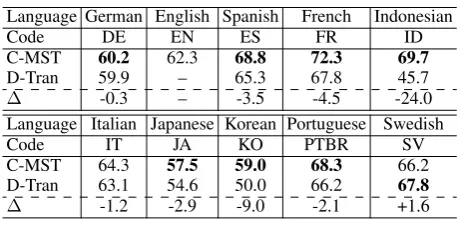
Language German English Spanish French Indonesian Code DE EN ES FR ID C-MST 60.2 62.3 68.8 72.3 69.7
D-Tran 59.9 – 65.3 67.8 45.7
∆ -0.3 – -3.5 -4.5 -24.0 Language Italian Japanese Korean Portuguese Swedish Code IT JA KO PTBR SV C-MST 64.3 57.5 59.0 68.3 66.2 D-Tran 63.1 54.6 50.0 66.2 67.8
[image:1.595.306.536.219.333.2]∆ -1.2 -2.9 -9.0 -2.1 +1.6
Table 1: Directed dependency accuracy (DDA) on the universal treebanks with universal POS tags, on sen-tences of length ≤ 10. C-MST denotes the original Convex-MST model. D-Tran denotes direct transfer. ∆refers to the difference between C-MST and D-Tran.
In this paper, we aim at bilingual grammar in-duction without external resource. We are moti-vated by our observation that learning the unsu-pervised Convex-MST model (Grave and Elhadad, 2015) on the English corpus and then directly ap-plying it to parse other languages produces sur-prisingly good results (Table1). From the table, we can see that even with this simplistic method (which we call direct transfer), the dependency accuracy on each language is often very close to the accuracy of the model specifically trained on the corpus of that language. For the Swedish lan-guage, the accuracy of direct transfer is even bet-ter than that of the specifically trained model. This surprising result suggests that grammars of differ-ent languages, even those from differdiffer-ent language families (e.g., English and Japanese), may have non-trivial similarity that can be helpful in bilin-gual grammar induction.
and propose three regularization terms that en-courage similarity between model parameters, edge scores, and parse trees respectively. We test our methods on ten languages on the tasks of trans-fer grammar induction and bilingual grammar in-duction and show that our methods can achieve a significant boost over strong baselines.
2 Background
2.1 Unsupervised Dependency Parsing
Dependency parsing is the task of mapping an in-put sentence x = x1, x2, ..., xnof lengthnto an output dependency structurey. A dummy rootx0 is typically added at the beginning of the sentence to denote the head of the dependency tree. There are several approaches to represent the parse tree
y. In transition based dependency parsers, the de-pendency tree can be regarded as a sequence of actions. In graph based dependency parsers, the dependency tree can be represented as a spanning tree in the graph. In chart based parsers (a.k.a., grammar based parsers), the dependency tree is denoted as a set of grammar rules. In unsuper-vised graph based dependency parsers, since gold trees are not available, carefully designed models and objective functions are required for learning a dependency parser. Regardless of model archi-tectures, current unsupervised dependency models usually use the following form of objective func-tion,
J(w;X) = X
x∈X
O
y∈Y(x)
D(w,x,y) +R(w)
whereYis the set of all possible dependency tree,
w is the model parameter, X is the unlabeled training corpus, D is the measurement between the parse y and model prediction on sentencex, R(w) is the regularization term of parameterw,
O
∈ {min,P} is an operator. Table 2 shows the choices of
O, D
andRfor several widely used models.2.2 Graph based Dependency Parsing
In this paper, we focus on graph based dependency parsers, though we believe that our approaches can be generalized to other types of parsers. Pre-vious work on unsupervised graph based depen-dency parsing utilizes the autoencoder structure (Cai et al.,2017) or the discriminative clustering techniques (Grave and Elhadad,2015).
Following (McDonald et al.,2005), we can use a discriminative model for dependency parsing with first order factorization such that the score of a dependency tree y is the sum of the scores of its dependency edges. The score of an edge from wordhto wordm,sw(x, h, m), can be computed
as the inner product of a feature vectorf(x, h, m) and a parameter vector w. The optimal depen-dency tree for sentencexbe discovered in polyno-mial time (Eisner,1996;McDonald et al.,2005).
3 Bilingual Knowledge Sharing
Given non-parallel corpora of two languages Xs andXt, our goal is to learn two models with pa-rameters ws andwt for the two languages. The simplest learning objective function is,
J(ws,wt;Xs,Xt) =J(ws;Xs) +J(wt;Xt)
which contains no interaction between the two models.
As suggested by our empirical observation in Table1, the model of one language may provide a useful inductive bias in learning the model of another language. Note that given a sentence, a graph-based dependency parser has three levels of representations: the model parameters, the scores of dependency edges computed from the param-eters, and the parse tree computed from the edge scores. Therefore, we propose three different reg-ularization terms to effectively encourage similar-ity of the two models. An example is shown in Figure1.
Regularization of Weight Parameters (W-Reg)
Motivated by the approach of Berg-Kirkpatrick and Klein(2010), we encourage the similarity be-tween the two weight parameterswsandwt mea-sured by l2 norm distance:
J(ws,wt;Xs,Xt) =
J(ws;Xs) +J(wt;Xt) +λ||ws−wt||22
in whichλis a hyper-parameter.
Parsers
O
D RDMV (Klein and Manning,2004) P
negative log likelihood
-Convex-MST (Grave and Elhadad,2015) min `2 distance `2 norm
LC-DMV (Noji et al.,2016) P
negative log likelihood `2 norm
NDMV (Jiang et al.,2016) P
,min negative log likelihood
-CRFAE (Cai et al.,2017) min negative conditional log likelihood `1 norm
D-NDMV (Han et al.,2019) P
,min negative (conditional) log likelihood
-Table 2: Notations of several widely used models.
each sentence, which can be seen as a soft version of weight regularization.
J(ws,wt;Xs,Xt) =J(ws;Xs) +J(wt;Xt)+
λ X
x∈X0 X
(h,m)∈G(x)
||sws(x, h, m)−swt(x, h, m)|| 2 2
whereX0 =X
s∪ Xt.G(x)is the weighted depen-dency graph of sentencex.
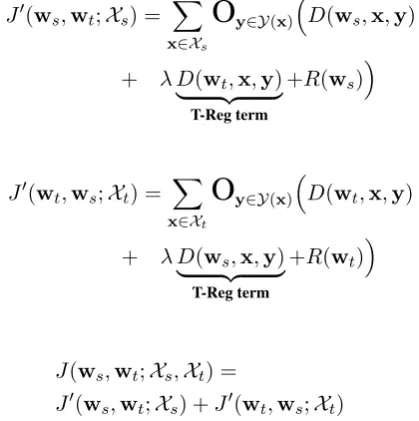
Regularization on Parse Trees (T-Reg) An-other alternative is to encourage similarity be-tween the parse trees predicted by the two mod-els. Motivated by the idea of knowledge distilla-tion (Kim and Rush,2016), in the learning objec-tive of each model, we add a fourth term to en-courage the parse tree to be close to the prediction of the other model. Below we show the objective function forws.
J0(ws,wt;Xs) = X
x∈Xs
O
y∈Y(x)
D(ws,x,y)
+ λ D(wt,x,y) | {z }
T-Reg term
+R(ws)
J0(wt,ws;Xt) = X
x∈Xt
O
y∈Y(x)
D(wt,x,y)
+ λ D(ws,x,y) | {z }
T-Reg term
+R(wt)
J(ws,wt;Xs,Xt) =
J0(ws,wt;Xs) +J0(wt,ws;Xt)
We apply these regularization method to the
Convex-MST model (Grave and Elhadad, 2015).
Our three objective functions can be optimized with coordinate descent in a similar way to Convex-MST. In each iteration, we first fix parse
I
eat
sushi
with
Mary
y
[image:3.595.81.291.478.689.2]s(eat!with) =wTf(eat!with)
Figure 1: Three levels of representations of the parser: the parameterw, the edge scores, and the parsey.
yfor each training sentence and update parameters
wsandwtby stochastic gradient descent; then we fix ws andwtand updatey of each sentence by the Frank-Wolfe algorithm.
While our three methods are applicable to any pair of languages, intuitively one may use weight regularization only for similar languages, and use edge regularization and tree regularization for an arbitrary language pair.
4 Experiments
To enable direct comparison with the Convex-MST model, we use the dataset used in their pa-per (Grave and Elhadad,2015), the universal tree-banks version 2.01, introduced byMcDonald et al. (2013). The dataset contains ten different lan-guages, which belong to five diverse families. In additional, we test our methods on twelve lan-guages from the more recent UD Treebank 1.42, which is also used in previous grammar induction work (Jiang et al.,2017;Li et al.,2019). Follow-ing previous work, we train all the models on the gold POS tags of sentences no longer than ten. We tune hyper-parameters on the development dataset and report the DDA on sentences no longer than ten and all the sentences in the test dataset. As our goal is to investigate the benefits of our regulariza-tion methods, the two hyper-parametersµ andβ
1
https://github.com/ryanmcd/
uni-dep-tb. The version is not consistent with re-cent releases of UD Treebanks.
CODE C-MST D-TRAN W-REG E-REG T-REG DE 60.2 -0.3 -0.2 +0.2 -0.2 ES 68.8 -3.5 -3.5 +0.8 +0.3 FR 72.3 -4.5 -3.8 +0.3 +0.3
ID 69.7 -24.0 -21.4 -0.6 -1.2 IT 64.3 -1.2 -0.4 +0.3 +1.2
JA 57.5 -2.9 -3.4 +0.9 +2.3
KO 59.0 -9.0 -9.5 +1.3 +1.9
PTBR 68.3 -2.1 -2.1 +0.2 +0.3
SV 66.2 +1.6 +1.6 +2.7 +2.6 Avg 65.14 -5.10 -4.74 +0.68 +0.83
Avg-All 56.16 -4.63 -4.29 +0.47 +0.56
[image:4.595.78.287.62.201.2]UD 1.4∗ 52.83 -0.30 -1.92 +1.06 +1.37
Table 3: Transfer grammar induction from English to the other languages. We show accuracies on the test sentences of length ≤ 10 (except the Avg-All row which shows the average accuracies on all the sen-tences). *: for the UD 1.4 dataset we show the average results.
of Convex-MST are tuned on the English develop-ment dataset and then fixed (µ= 0.1, β = 0.001) while λ is selected from {10,5,1,5e− 1,1e − 1,5e−2,1e−2,5e−3,1e−3,1e−4}for each language pair.
4.1 Experiments on Transfer Grammar Induction
In transfer grammar induction, we train the first model on the first language independent of the sec-ond language; then, with the first model fixed, we optimize our knowledge sharing objective with re-spect to the second model; finally, we evaluate the second model on the test set of the second lan-guage. In this way, we want to test whether our methods can transfer useful linguistic knowledge from the first language to the second language. We report the results of transfer grammar induction from English to the other nine languages in Table 3. Our edge regularization and tree regularization methods outperform the Convex-MST baseline in almost all the cases. The weight regularization method achieves worse results than Convex-MST except for the Swedish language, which demon-strates that directly regularizing weight parameters may not work well in the transfer grammar induc-tion task. For the Swedish language, although di-rect transfer already achieves better performance than Convex-MST, our regularization methods can further boost the performance by a large mar-gin. The Indonesian language is the only language for which transfer grammar induction provides no benefit, possibly because of its significant syntac-tic difference from the English language. Our ad-ditional experimental results on UD treebank 1.4
PAIR CODE BASE COMB W-REG E-REG T-REG
EN-DE EN 62.3 +0 +0.5 +0.1 +0.2 DE 60.2 +0.1 -0.8 +0.5 +0.4
EN-ES EN 62.3 +0.2 +0.7 +0.4 +0.7 ES 68.8 -1.8 +1.4 +1.1 +0.8
EN-FR EN 62.3 +0.4 +0.5 +0.1 +0.1 FR 72.3 -3.6 -0.6 +1.4 +1.4
EN-ID EN 62.3 +0.7 +1.3 +0.1 +0.7 ID 69.7 -19.2 -2.1 +0.5 +0.9
EN-IT EN 62.3 +0.7 +0.1 +0.6 +1.0 IT 64.3 +0.7 +1.8 +0.4 +0.8
EN-JA EN 62.3 +1.0 +0.9 -0.1 -0.2 JA 57.5 -4.3 -0.2 +2.7 +2.4
EN-KO EN 62.3 +0.3 +1.4 +0.5 +1.1 KO 59.0 -3.8 +0.1 +1.0 +0.4
EN-PTBR EN 62.3 +1.0 +0.8 +0.6 +0.7 PT-BR 68.3 -0.9 +1.4 +1.4 +1.2
EN-SV EN 62.3 -0.5 -0.9 +0.1 +0.1 SV 66.2 +1.7 +1.9 +1.0 +1.1
Avg EN 62.30 +0.42 +0.58 +0.23 +0.49 Other 65.14 -3.46 +0.32 +1.11 +1.04
Avg-All EN 52.10 -0.48 -0.40 +0.11 +0.42 Other 56.16 -3.05 +0.64 +1.55 +1.21
UD 1.4∗ EN 53.50 -0.76 -0.09 + 0 +0.71 Other 52.83 -0.09 +0.58 +1.92 +1.52
Table 4: Results of bilingual grammar induction on test sentences no longer than 10 (except the Avg-All row which shows the average accuracies on all the sen-tences). BASE refers to the individually trained base-line. COMBrefers to learning a single model from the combined training set of the two languages. *: for the UD 1.4 dataset we show the average results.
show a similar trend.
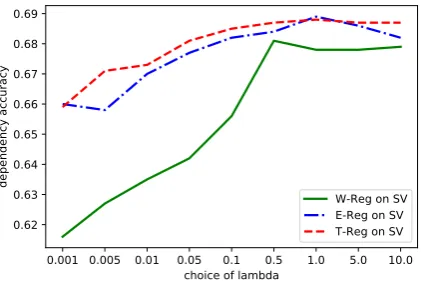
We perform transfer grammar induction from English to Swedish with different values ofλand show the results in Figure2. We can see that the impact of different hyper-parameter values on the accuracy generally follows the same tendency for our three methods.
4.2 Experiments on Bilingual Grammar Induction
0.001 0.005 0.01 0.05 0.1 0.5 1.0 5.0 10.0 choice of lambda
0.62 0.63 0.64 0.65 0.66 0.67 0.68 0.69
dependency accuracy
[image:5.595.77.288.64.205.2]W-Reg on SV E-Reg on SV T-Reg on SV
Figure 2: Transfer grammar induction on the SV lan-guage with different hyper-parameter values for the three regularization methods
5 Related Work
Our work is related to many previous work.
Unsupervised Transfer Learning There has been previous work aiming at solving an unsu-pervised learning task of a target domain with the help of knowledge learned from a source domain (Dai et al.,2008;Wang et al.,2008;Pan and Yang, 2010). There is no labeled data in both the source and the target domains during training. Our trans-fer grammar induction setting can be seen as an instance of unsupervised transfer learning.
Cross-lingual Supervised Dependency Parsing
This task focuses on learning a parser with unla-beled training data and additional launla-beled training data of a second language (McDonald et al.,2011; Naseem et al.,2012;Guo et al.,2015). The main difference between our approach and theirs is that our approach is fully unsupervised. and do not uti-lize external information like word alignments or cross-lingual word embeddings.
Other Approaches to Multilingual Grammar Induction To the best of our knowledge, this task is first proposed by Kuhn (2004). They as-sume that the syntax trees induced from paral-lel sentences share structured regularities and uti-lize the word alignments to guide parsing. From then on, many approaches are proposed on both constituency grammar induction and dependency grammar induction (Snyder et al., 2009; Berg-Kirkpatrick and Klein, 2010). We differ from these approaches in that we do not make use of any external rules or knowledge.
6 Conclusion
In this paper, we propose three regularization-based knowledge sharing methods to bilingual grammar induction problems. We test our meth-ods on transfer grammar induction and bilingual grammar induction and show that our methods achieve better performance than the baselines. In future work, we plan to investigate the effective-ness of our approach in other types of induction tasks.
Acknowledgments
This work was supported by the Major Program of Science and Technology Commission Shanghai Municipal (17JC1404102).
References
Taylor Berg-Kirkpatrick and Dan Klein. 2010. Phylo-genetic grammar induction. InProceedings of the 48th Annual Meeting of the Association for Com-putational Linguistics, pages 1288–1297, Uppsala, Sweden. Association for Computational Linguistics.
Jiong Cai, Yong Jiang, and Kewei Tu. 2017. Crf autoencoder for unsupervised dependency parsing. In Proceedings of the 2017 Conference on Empiri-cal Methods in Natural Language Processing, pages 1638–1643, Copenhagen, Denmark. Association for Computational Linguistics.
Wenyuan Dai, Qiang Yang, Gui-Rong Xue, and Yong Yu. 2008. Self-taught clustering. InProceedings of the 25th international conference on Machine learn-ing, pages 200–207. ACM.
Jason M Eisner. 1996. Three new probabilistic models for dependency parsing: An exploration. In Pro-ceedings of the 16th conference on Computational linguistics-Volume 1, pages 340–345. Association for Computational Linguistics.
Edouard Grave and No´emie Elhadad. 2015. A con-vex and feature-rich discriminative approach to de-pendency grammar induction. InProceedings of the 53rd Annual Meeting of the Association for Compu-tational Linguistics and the 7th International Joint Conference on Natural Language Processing (Vol-ume 1: Long Papers), pages 1375–1384, Beijing, China. Association for Computational Linguistics.
Wenjuan Han, Yong Jiang, and Kewei Tu. 2019. En-hancing unsupervised generative dependency parser with contextual information. InProceedings of the 57th Annual Meeting of the Association for Com-putational Linguistics, pages 5315–5325, Florence, Italy. Association for Computational Linguistics.
Yong Jiang, Wenjuan Han, and Kewei Tu. 2016. Un-supervised neural dependency parsing. In Proceed-ings of the 2016 Conference on Empirical Methods in Natural Language Processing, pages 763–771, Austin, Texas. Association for Computational Lin-guistics.
Yong Jiang, Wenjuan Han, and Kewei Tu. 2017. Com-bining generative and discriminative approaches to unsupervised dependency parsing via dual decom-position. InProceedings of the 2017 Conference on Empirical Methods in Natural Language Process-ing, Copenhagen, Denmark. Association for Com-putational Linguistics.
Yoon Kim and Alexander M. Rush. 2016. Sequence-level knowledge distillation. InProceedings of the 2016 Conference on Empirical Methods in Natu-ral Language Processing, pages 1317–1327, Austin, Texas. Association for Computational Linguistics.
Dan Klein and Christopher D Manning. 2004. Corpus-based induction of syntactic structure: Models of de-pendency and constituency. In Proceedings of the 42nd Annual Meeting on Association for Computa-tional Linguistics, page 478. Association for Com-putational Linguistics.
Jonas Kuhn. 2004. Experiments in parallel-text based grammar induction. InProceedings of the 42nd An-nual Meeting on Association for Computational Lin-guistics, page 470. Association for Computational Linguistics.
Bowen Li, Jianpeng Cheng, Yang Liu, and Frank Keller. 2019. Dependency grammar induction with a neural variational transition-based parser. InAAAI 2019.
Kai Liu, Yajuan L¨u, Wenbin Jiang, and Qun Liu. 2013.
Bilingually-guided monolingual dependency gram-mar induction. In Proceedings of the 51st Annual Meeting of the Association for Computational Lin-guistics (Volume 1: Long Papers), pages 1063– 1072, Sofia, Bulgaria. Association for Computa-tional Linguistics.
Ryan McDonald, Koby Crammer, and Fernando Pereira. 2005. Online large-margin training of de-pendency parsers. In Proceedings of the 43rd an-nual meeting on association for computational lin-guistics, pages 91–98. Association for Computa-tional Linguistics.
Ryan McDonald, Joakim Nivre, Yvonne Quirmbach-Brundage, Yoav Goldberg, Dipanjan Das, Kuzman Ganchev, Keith Hall, Slav Petrov, Hao Zhang, Os-car T¨ackstr¨om, et al. 2013. Universal dependency
annotation for multilingual parsing. In Proceed-ings of the 51st Annual Meeting of the Association for Computational Linguistics (Volume 2: Short Pa-pers), volume 2, pages 92–97.
Ryan McDonald, Slav Petrov, and Keith Hall. 2011. Multi-source transfer of delexicalized dependency parsers. InProceedings of the conference on empir-ical methods in natural language processing, pages 62–72. Association for Computational Linguistics.
Tahira Naseem, Regina Barzilay, and Amir Globerson. 2012. Selective sharing for multilingual dependency parsing. InProceedings of the 50th Annual Meet-ing of the Association for Computational LMeet-inguis- Linguis-tics: Long Papers-Volume 1, pages 629–637. Asso-ciation for Computational Linguistics.
Hiroshi Noji, Yusuke Miyao, and Mark Johnson. 2016.
Using left-corner parsing to encode universal struc-tural constraints in grammar induction. In Proceed-ings of the 2016 Conference on Empirical Meth-ods in Natural Language Processing, pages 33–43, Austin, Texas. Association for Computational Lin-guistics.
Sinno Jialin Pan and Qiang Yang. 2010. A survey on transfer learning. IEEE Transactions on knowledge and data engineering, 22(10):1345–1359.
Benjamin Snyder, Tahira Naseem, and Regina Barzi-lay. 2009. Unsupervised multilingual grammar in-duction. InProceedings of the Joint Conference of the 47th Annual Meeting of the ACL and the 4th In-ternational Joint Conference on Natural Language Processing of the AFNLP, pages 73–81, Suntec, Sin-gapore. Association for Computational Linguistics.
Zheng Wang, Yangqiu Song, and Changshui Zhang. 2008. Transferred dimensionality reduction. In