Proceedings of the 2019 Conference on Empirical Methods in Natural Language Processing
1342
Vecalign: Improved Sentence Alignment in Linear Time and Space
Brian Thompson
Johns Hopkins University
Philipp Koehn
Johns Hopkins University
Abstract
We introduce Vecalign, a novel bilingual sen-tence alignment method which is linear in time and space with respect to the number of sen-tences being aligned and which requires only bilingual sentence embeddings. On a standard German–French test set, Vecalign outperforms the previous state-of-the-art method (which has quadratic time complexity and requires a machine translation system) by 5 F1 points.
It substantially outperforms the popular Hun-align toolkit at recovering Bible verse Hun- align-ments in medium- to low-resource language pairs, and it improves downstream MT qual-ity by 1.7 and 1.6 BLEU in Sinhala→English and Nepali→English, respectively, compared to the Hunalign-based Paracrawl pipeline.
1 Introduction
Sentence alignment is the task of taking parallel documents, which have been split into sentences, and finding a bipartite graph which matches min-imal groups of sentences that are translations of each other (seeFigure 1). Following prior work, we assume non-crossing alignments but allow lo-cal sentence reordering within an alignment.
Sentence-aligned bitext is used to train nearly all machine translation (MT) systems. Alignment errors have been noted to have a small effect on statistical MT performance (Goutte et al., 2012). However, misaligned sentences have been shown to be much more detrimental to neural MT (NMT) (Khayrallah and Koehn,2018).
Sentence alignment was a popular research topic in the early days of statistical MT, but received less attention once standard sentence-aligned parallel corpora became available. Inter-est in low-resource MT has led to a resurgence in data gathering methods (Buck and Koehn, 2016;
[image:1.595.307.527.220.305.2]Zweigenbaum et al.,2018;Koehn et al.,2019), but
Figure 1: Sentence alignment takes sentencese1,...,eN andf1,...,fM and locates minimal groups of sentences which are translations of each other, in this case (e1
)-(f1,f2), (e2)-(f3), (e3,e4)-(f4), and (e5)-(f6).
we find limited recent work on bilingual sentence alignment.
Automatic sentence alignment can be roughly decomposed into two parts:
1. A score function which takes one or more ad-jacent source sentences and one or more adja-cent target sentences and returns a score indi-cating the likelihood that they are translations of each other;
2. An alignment algorithm which, using the score function above, takes in two documents and returns a hypothesis alignment.
We improve both parts, presenting (1) a novel scoring function based on normalized cosine dis-tance between multilingual sentence embeddings, in conjunction with (2) a novel application of a dy-namic programming approximation (Salvador and Chan, 2007) which makes our algorithm linear in time and space complexity with respect to the number of sentences being aligned. We release a toolkit containing our implementation.1
Our method outperforms previous state-of-the-art, which has quadratic complexity, indicating that our proposed score function outperforms prior work and the approximations we make in align-ment are sufficiently accurate.
2 Related Work
Early sentence aligners (Brown et al.,1991;Gale and Church, 1993) use scoring functions based only on the number of words or characters in each sentence and alignment algorithms based on dy-namic programming (DP;Bellman,1953). DP is O(N M) time complexity, where N and M are the number of sentences in the source and tar-get documents. Later work added lexical features and heuristics to speed up search, such as limiting the search space to be near the diagonal (Moore,
2002;Varga et al.,2007). More recent work intro-duced scoring methods that use MT to get both documents into the same language (Bleualign;
Sennrich and Volk, 2010) or use pruned phrase tables from a statistical MT system (Coverage-Based;Gomes and Lopes, 2016). Both methods “anchor” high-probability 1–1 alignments in the search space and then fill in and refine alignments. Locating anchors isO(N M)time complexity.
3 Method
We propose a novel sentence alignment scoring function based on the similarity of bilingual sen-tence embeddings. A distinct but non-obvious advantage of sentence embeddings is that blocks of sentences can be represented as the average of their sentence embeddings. The size of the resulting vector is not dependent on the num-ber of sentence embeddings being averaged, thus the time/space cost of comparing the similarity of blocks of sentencesdoes not depend on the num-ber of sentences being compared. We show em-pirically (see§ 4.2) that average embeddings for blocks of sentences are sufficient to produce ap-proximate alignments, even in low-resource lan-guages. This enables us to approximate DP in O(N+M) in time and space.
3.1 Bilingual Sentence Embeddings
We propose to use the similarity between sentence embeddings as the scoring function for sentence alignment. Sentence embedding similarity has been shown effective at filtering out non-parallel sentences (Hassan et al., 2018; Chaudhary et al.,
2019) and locating parallel sentences in compara-ble corpora (Guo et al., 2018). We use the pub-licly available LASER multilingual sentence em-bedding method (Artetxe and Schwenk,2018) and model, which is pretrained on 93 languages. How-ever, our method is not specific to LASER.
3.2 Scoring Function
Cosine similarity is an obvious choice for com-paring embeddings but has been noted to be glob-ally inconsistent due to “hubness” (Radovanovi´c et al., 2010; Lazaridou et al., 2015). Guo et al.
(2018) proposed a supervised training approach for calibration, andArtetxe and Schwenk (2019) proposed normalization using nearest neighbors. We propose normalizing instead with randomly selected embeddings as it has linear complexity. Sentence alignment seeks minimal parallel units, but we find that DP with cosine similarity favors many-to-many alignments (e.g. reporting a 3–3 alignment when it should report three 1–1 align-ments). To remedy this issue, we scale the cost by the number of source and target sentences be-ing considered in a given alignment. Our resultbe-ing scoring cost function is:
c(x,y) =(1−cos(x,y)) nSents(x) nSents(y)
S
P
s=1
1−cos(x,ys) + S
P
s=1
1−cos(xs,y)
where x, y denote one or more sequential sen-tences from the source/target document;cos(x,y)
is the cosine similarity between embeddings2 of x,y;nSents(x),nSents(y)denote the number of sentences inx,y; andx1,...,xS,y1,...,ySare
sam-pled uniformly from the given document.
Following standard practice, we model inser-tions and deleinser-tions in DP using a skip costcskip. The raw value of cskip is only meaningful when compared to other costs, thus we do not expect it to generalize across different languages, normal-izations, or resolutions. We propose specifying in-stead a parameterβskipwhich defines the skip cost in terms of the distribution of 1–1 alignment costs at alignment time:cskip= CDF−1(βskip).CDFis an estimate of the cumulative distribution function of 1–1 alignments obtained by computing costs of randomly selected source/target sentences pairs.
3.3 Recursive DP Approximation
Instead of searching all possible sentence align-ments via DP, consider first averaging adjacent pairs of sentence embeddings in both the source and target documents, halving the number of em-beddings for each document. Aligning these vec-tors via DP (each of which are averages of 2 sen-tence embeddings) produces anapproximate
sen-2If multiple sentences are considered on one side, they are
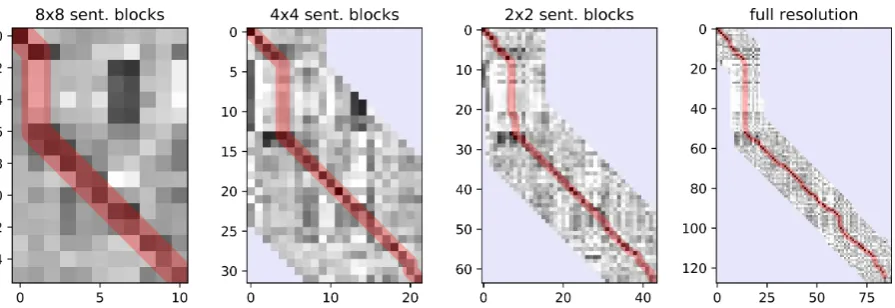
Figure 2: 1–1 alignment costs (darker = lower) for the first 88 De lines (x-axis) and 128 Fr lines (y-axis) at 4 different resolutions. The red highlight denotes alignment found by DP. The algorithm only searches near the path found at previous resolutions; light blue regions are excluded. The vertical part of the path in the top left of each plot is due to 36 extra lines being present in the Fr document. Window size is increased for visualization purposes.
tence alignment, at a cost of N2 M 2
compar-isons. We can then refine this approximate align-ment using the original sentence vectors, con-straining ourselves to a small window around the approximate alignment. At a minimum, we must search a window sizewlarge enough to consider all paths covered by the lower-resolution align-ment path, butwcan also be increased to allow re-covery from small errors in the approximate align-ment.3 The length of the refinement path to search is at mostN+M (all deletions/insertions), so re-fining the path requires at most(N+M)w com-parisons. Thus the fullN M comparisons can be approximated by(N+M)w+ N2 M
2
compar-isons. Applied recursively,4 we can approximate our quadraticN M cost with a sum of linear costs:
(N+M)w+
N
2 +
M
2
w+
N
4 +
M
4
w+...
= X
k=0,1,2,...
(N+M)w
2k = 2(N+M)w
SeeFigure 2for an illustration of this method. We consider only insertions, deletions, and 1–1 align-ments in all but the final search. Recursive down sampling and refining of DP was proposed for dy-namic time warping inSalvador and Chan(2007), but has not previously been applied to sentence alignment. We direct the reader to that work for a more formal analysis showing the time/space com-plexity is linear.
3We usew= 10for all experiments in this work. 4
In practice, we compute the full DP alignment once the down sampled sizes are below an acceptably small constant. We also find vectors for large blocks of sentences become correlated with each other, so we center them around~0.
4 Experiments & Results
4.1 Text+Berg Alignment Accuracy
We evaluate sentence alignment accuracy using the development/test split released with Bleualign, consisting of manually aligned yearbook articles published in both German and French by the Swiss Alpine Club from the Text+Berg corpus (Volk et al.,2010). Hyperparameters were chosen to op-timize F1 on the development set. We consider
alignments of up to 6 total sentences; that is we allow alignments of sizeQ–RwhereQ+R≤6.
We compare toGale and Church(1993),Moore
(2002), Hunalign (Varga et al., 2007), Bleualign (Sennrich and Volk,2010), Gargantua (Braune and Fraser, 2010), and Coverage-Based (Gomes and Lopes,2016). We run Hunalign in both bootstrap-ping mode as well as using a publically available De–Fr lexicon from OPUS (Tiedemann, 2012)5 created from Europarl (Koehn, 2005). Since Bleualign depends on the quality of MT output, we re-run it with a modern NMT system.6
Our proposed method outperforms the next best method (Coverage-Based) by 5F1points: see
Ta-ble 1. Gargantua and bootstrapped Hunalign have both been reported to perform well (Abdul-Rauf et al.,2012); this dataset may be too small to boot-strap good lexical features.7 Bleualign improves by 3F1points by using an NMT system.
5
https://object.pouta.csc.fi/ OPUS-Europarl/v7/dic/de-fr.dic.gz
6https://docs.microsoft.com/en-us/
azure/cognitive-services/translator/
7We run only on the test/development articles, not the full
Algorithm O( ) P R F1
Gargantua N2 0.48 0.54 0.51
Hunalign w/o lexicon N 0.59 0.70 0.64 Hunalign w/ lexicon N 0.61 0.73 0.66
Gale and Church(1993)† N2 0.71 0.72 0.72
Moore(2002)† ‡ 0.86 0.71 0.78
Bleualign† N2 0.83 0.78 0.81
Bleualign-NMT N2 0.85 0.83 0.84
Coverage-Based* N2 0.85 0.84 0.85
[image:4.595.342.489.62.196.2]Vecalign N 0.89 0.90 0.90
Table 1: De–Fr test precision (P), recall (R), andF1.
*best reported inGomes and Lopes(2016). †Best
re-ported inSennrich and Volk(2010). ‡O( ) is data
de-pendent. We assumeN=M for simplicity.
Language ISO Bible LASER
639-1 # Sents # Train Lines
Arabic Ar 45980 8.2M
Turkish Tr 48492 5.7M
Somali So 37413 85k
Afrikaans Af 37081 67k
Tagalog Tl 34207 36k
[image:4.595.74.289.64.180.2]Norwegian No 37064 0*
Table 2: Bible statistics. *LASER was not trained on Norwegian but appears to generalize to it.
4.2 Bible Alignment Accuracy
We are unaware of a multilingual, low resource, parallel dataset with human sentence-level anno-tations. As a substitute for gold standard sentence alignment, we use Bible verse alignment and sen-tence split each verse.8
The Bible has a number of properties which make it appealing for sentence alignment evalua-tion: It is much larger than existing sentence align-ment test sets, and it is multi-way parallel in a large number of languages. Bibles are not aligned at the sentence level, but contain verse marking denoting segments typically on the scale of a par-tial sentence to a few sentences. This creates two potential issues for sentence alignment evaluation: First, a single sentence may span more than one verse. Inspecting the English Bible suggests that this is rare, and sentence aligners should be able to handle occasional over-segmentation of sentences as in practice they are run on errorful automatic sentence segmentation. Second, a verse may con-tain more than one sentence. This is problematic
8
There is no clear choice for sentence seg-mentation in low-resource languages. We use
https://github.com/berkmancenter/
mediacloud-sentence-splitter, falling back on English for unsupported languages.
Verse-levelF1
Languages Vecalign Hunalign
Af–Ar 0.863 0.339
Af–Tl 0.922 0.775
Ar–No 0.787 0.406
Ar–So 0.634 0.067
Tr–So 0.533 0.331
No–So 0.697 0.687
So–Af 0.782 0.738
Tl–No 0.874 0.764
Tr–Af 0.703 0.401
Tr–Tl 0.647 0.247
Table 3: Bible verse alignment results.
when it happens on both languages being aligned, since the true sentence alignment cannot be deter-mined (e.g., a verse which is two sentences in each language could be two 1–1 alignments or one 2–2 alignment). To evaluate with verse-level annota-tions, we propose converting the sentence align-ment output into verse alignalign-ments by combining any consecutive sentence alignments for which all sentences in the alignments, on both the source and target side, came from the same verse. We re-portF1compared to the gold-standard verse
align-ments, denoting it asverse-levelF1to distinguish
it fromF1computed at the sentence level.
We select six languages for which
Christodouloupoulos and Steedman (2015) contains a full Bible: see Table 2. Languages were chosen to provide a range of amounts of training data used in LASER.9 From those six languages, we randomly select 10 language pairs for testing. All parameters are kept the same as
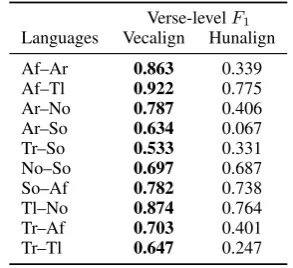
§ 4.1except we only consider alignments of up to 4 total sentences. We compare to Hunalign, run in bootstrap mode, as it is the only toolkit we tried which was robust enough to run on documents of this size. Results are shown inTable 3.
On average, we see an improvement of 28 verse-level F1 points over Hunalign. In manual
analysis of the alignments we find large stretches where the Hunalign alignments are nowhere near the gold alignment in the language pairs with verse-level F1<0.35. By contrast, errors in the
proposed method are predominately local, indicat-ing success of Vecalign’s recursive DP approxima-tion even for very long documents in low-resource languages.
9Data amounts are all between the given language and
[image:4.595.89.274.251.342.2]4.3 Improvements to Downstream MT
One of the primary applications of sentence align-ment is creating bitext for training MT systems. To test Vecalign’s impact on downstream MT quality, we re-align noisy, web-crawled data in two low-resource language pairs: Sinhala–English and Nepali–English. The data is collected via Paracrawl10 and is very similar to that released in the WMT 2019 sentence filtering task (Koehn et al., 2019), but some new data has been col-lected and a small amount of data was lost due to a hard disk failure. Our baseline is the standard Paracrawl pipeline using Hunalign in conjunction with a dictionary extracted from the clean data re-leased in the shared task.
We filter the output of Vecalign and Hunalign following (Chaudhary et al.,2019), including fil-tering out sentences with the wrong languages and sentences with high token overlap, as this was the best performing method from the shared task.11 We train and evaluate NMT models following the procedure/hyperparameters from the shared task.
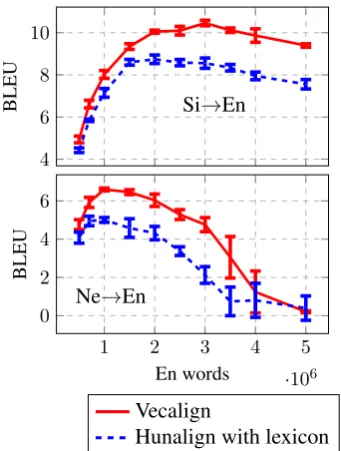
Results are shown in Figure 3. Using Ve-calign, we see improvements of 1.7 and 1.6 BLEU for the best data sizes in Sinhala→English and Nepali→English, respectively, compared to the systems trained on Hunalign output.
4 6 8 10
BLEU Si→En
1 2 3 4 5
·106 0
2 4 6
En words
BLEU
Ne→En
Vecalign
[image:5.595.334.494.105.281.2]Hunalign with lexicon
Figure 3: sacreBLEU scores (mean +/- standard devia-tion for 5 training runs) on FLoRes test sets for systems trained on data aligned with Vecalign vs Hunalign.
10
https://paracrawl.eu/
11We use the publicly available multilingual LASER
model, which is not trained on Nepali.
5 Empirical Runtime Analysis
101 102 103 104 105
10−1 100 101 102 103 104
Document Size (# Sentences)
Runtime
(s)
[image:5.595.95.266.445.671.2]Gargantua Bleualign Vecalign Hunalign
Figure 4: Time required to align various portions of En→Hu Bibles, for various systems. Plot is logarith-mic in both runtime and number of sentences, thus a slope of one (i.e. runtime doubles each time the number of sentences doubles) indicatesO(N), while a slope of two (i.e. runtime quadruples each time the number of sentences doubles) indicatesO(N2).
Time required to align documents of various sizes are shown for Vecalign, Bleualign, Gartan-tua, and Hunalign in see Figure 4. As expected, Vecalign has approximately linear runtime char-acteristics. We use truncated portions of Hu– En Bibles in order to use the dictionary provided with Hunalign. Bleualign is run on NMT out-put. Vecalign settings match§ 4.2. Experiments are run on a Thinkpad T480 with 32GB RAM. Times do not include translation (Bleualign), lex-icon building (Hunalign), or sentence embedding (Vecalign). For reference, producing embeddings for 32k sentences, including overlaps, in each lan-guage took ~120 s on a GeForce RTX 2080 Ti GPU. Bleualign and Gargantua run out of mem-ory on 32k sentences. Hunalign and Vecalign use ~1GB and are both very fast, aligning 32k sen-tences in ~30 s.
6 Conclusions
Acknowledgments
Brian Thompson is supported through the Na-tional Defense Science and Engineering Graduate (NDSEG) Fellowship Program.
References
Sadaf Abdul-Rauf, Mark Fishel, Patrik Lambert, San-dra Noubours, and Rico Sennrich. 2012. Extrinsic evaluation of sentence alignment systems. Work-shop on Creating Cross-language Resources for Disconnected Languages and Styles, pages 6–10.
Mikel Artetxe and Holger Schwenk. 2018. Mas-sively multilingual sentence embeddings for zero-shot cross-lingual transfer and beyond. arXiv preprint arXiv:1812.10464.
Mikel Artetxe and Holger Schwenk. 2019. Margin-based parallel corpus mining with multilingual sen-tence embeddings. In Proceedings of the 57th An-nual Meeting of the Association for Computational Linguistics, pages 3197–3203, Florence, Italy. Asso-ciation for Computational Linguistics.
Richard Bellman. 1953. An introduction to the theory of dynamic programming. Technical report, RAND Corporation, Santa Monica, CA.
Fabienne Braune and Alexander Fraser. 2010. Im-proved unsupervised sentence alignment for sym-metrical and asymsym-metrical parallel corpora. In Col-ing 2010: Posters, pages 81–89, BeijCol-ing, China. Coling 2010 Organizing Committee.
Peter F. Brown, Jennifer C. Lai, and Robert L. Mer-cer. 1991. Aligning sentences in parallel corpora. In Proceedings of the 29th Annual Meeting on As-sociation for Computational Linguistics, ACL ’91, pages 169–176, Stroudsburg, PA, USA. Association for Computational Linguistics.
Christian Buck and Philipp Koehn. 2016. Findings of the WMT 2016 bilingual document alignment shared task. InProceedings of the First Conference on Machine Translation: Volume 2, Shared Task Pa-pers, pages 554–563, Berlin, Germany. Association for Computational Linguistics.
Vishrav Chaudhary, Yuqing Tang, Francisco Guzmn, Holger Schwenk, and Philipp Koehn. 2019. Low-resource corpus filtering using multilingual sentence embeddings. In Proceedings of the Fourth Con-ference on Machine Translation (Volume 3: Shared Task Papers, Day 2), pages 263–268, Florence, Italy. Association for Computational Linguistics.
Christos Christodouloupoulos and Mark Steedman. 2015. A massively parallel corpus: the Bible in 100 languages. Language resources and evaluation, 49(2):375–395.
William A Gale and Kenneth W Church. 1993. A program for aligning sentences in bilingual corpora. Computational linguistics, 19(1):75–102.
Lu´ıs Gomes and Gabriel Pereira Lopes. 2016. First steps towards coverage-based sentence alignment. In Proceedings of the Tenth International Confer-ence on Language Resources and Evaluation (LREC 2016), pages 2228–2231, Portoroˇz, Slovenia. Euro-pean Language Resources Association (ELRA).
Cyril Goutte, Marine Carpuat, and George Foster. 2012. The impact of sentence alignment errors on phrase-based machine translation performance. In The Tenth Biennial Conference of the Association for Machine Translation in the Americas (AMTA 2012).
Mandy Guo, Qinlan Shen, Yinfei Yang, Heming Ge, Daniel Cer, Gustavo Hernandez Abrego, Keith Stevens, Noah Constant, Yun-Hsuan Sung, Brian Strope, and Ray Kurzweil. 2018. Effective parallel corpus mining using bilingual sentence embeddings. InProceedings of the Third Conference on Machine Translation: Research Papers, pages 165–176, Bel-gium, Brussels. Association for Computational Lin-guistics.
Hany Hassan, Anthony Aue, Chang Chen, Vishal Chowdhary, Jonathan Clark, Christian Feder-mann, Xuedong Huang, Marcin Junczys-Dowmunt, William Lewis, Mu Li, et al. 2018. Achieving hu-man parity on automatic Chinese to English news translation.arXiv preprint arXiv:1803.05567.
Huda Khayrallah and Philipp Koehn. 2018. On the impact of various types of noise on neural machine translation. InProceedings of the 2nd Workshop on Neural Machine Translation and Generation, pages 74–83, Melbourne, Australia. Association for Com-putational Linguistics.
Philipp Koehn. 2005. Europarl: A parallel corpus for statistical machine translation. InMachine Transla-tion summit, volume 5, pages 79–86.
Philipp Koehn, Francisco Guzmn, Vishrav Chaud-hary, and Juan Pino. 2019. Findings of the WMT 2019 shared task on parallel corpus filtering for low-resource conditions. In Proceedings of the Fourth Conference on Machine Translation (Volume 3: Shared Task Papers, Day 2), pages 56–74, Flo-rence, Italy. Association for Computational Linguis-tics.
Robert C Moore. 2002. Fast and accurate sentence alignment of bilingual corpora. InConference of the Association for Machine Translation in the Ameri-cas, pages 135–144. Springer.
Miloˇs Radovanovi´c, Alexandros Nanopoulos, and Mir-jana Ivanovi´c. 2010. Hubs in space: Popular nearest neighbors in high-dimensional data. Journal of Ma-chine Learning Research, 11(Sep):2487–2531.
Stan Salvador and Philip Chan. 2007. Toward accu-rate dynamic time warping in linear time and space. Intelligent Data Analysis, 11(5):561–580.
Rico Sennrich and Martin Volk. 2010. MT-based sen-tence alignment for OCR-generated parallel texts. InThe Ninth Conference of the Association for Ma-chine Translation in the Americas (AMTA 2010).
J¨org Tiedemann. 2012. Parallel data, tools and inter-faces in OPUS. In Proceedings of the Eighth In-ternational Conference on Language Resources and Evaluation (LREC-2012), pages 2214–2218, Istan-bul, Turkey. European Languages Resources Asso-ciation (ELRA).
D´aniel Varga, P´eter Hal´acsy, Andr´as Kornai, Viktor Nagy, L´aszl´o N´emeth, and Viktor Tr´on. 2007. Par-allel corpora for medium density languages. Ams-terdam Studies In The Theory And History Of Lin-guistic Science Series 4, 292:247.
Martin Volk, Noah Bubenhofer, Adrian Althaus, Maya Bangerter, Lenz Furrer, and Beni Ruef. 2010. Chal-lenges in building a multilingual alpine heritage cor-pus. In Proceedings of the Seventh conference on International Language Resources and Evaluation (LREC’10), Valletta, Malta. European Languages Resources Association (ELRA).