Proceedings of the 2019 Conference on Empirical Methods in Natural Language Processing 5195
Human-grounded Evaluations of Explanation Methods
for Text Classification
Piyawat LertvittayakumjornandFrancesca Toni Department of Computing
Imperial College London, UK
{pl1515, ft}@imperial.ac.uk
Abstract
Due to the black-box nature of deep learn-ing models, methods for explainlearn-ing the mod-els’ results are crucial to gain trust from hu-mans and support collaboration between AIs and humans. In this paper, we consider sev-eral model-agnostic and model-specific expla-nation methods for CNNs for text classifica-tion and conduct three human-grounded eval-uations, focusing on different purposes of ex-planations: (1)revealing model behavior,(2)
justifying model predictions, and (3) help-ing humans investigate uncertain predictions. The results highlight dissimilar qualities of the various explanation methods we consider and show the degree to which these methods could serve for each purpose.
1 Introduction
Explainable Artificial Intelligence (XAI) is aimed at providing explanations for decisions made by AI systems. The explanations are useful for sup-porting collaboration between AIs and humans in many cases (Samek et al.,2018). Firstly, if an AI outperforms humans in a certain task (e.g., Al-phaGo (Silver et al., 2016)), humans can learn and distill knowledge from the given explanations. Secondly, if an AI’s performance is close to hu-man intelligence, the explanations can increase humans’ confidence and trust in the AI ( Symeoni-dis et al., 2009). Lastly, if an AI is duller than humans, the explanations help humans verify the decisions made by the AI and also improve the AI (Biran and McKeown,2017).
One of the challenges in XAI is to explain prediction results given by deep learning mod-els, which sacrifice transparency for high predic-tion performance. This type of explanapredic-tions is calledlocal explanations as they explain individ-ual predictions (in contrast toglobal explanations which explain the trained model independently of
any specific prediction). There have been several methods proposed to produce local explanations. Some of them are model-agnostic, applicable to any machine learning model (Ribeiro et al.,2016;
Lundberg and Lee,2017). Others are applicable to a class of models such as neural networks (Bach et al., 2015a; Dimopoulos et al., 1995) or to a specific model such as Convolutional Neural Net-works (CNNs) (Zhou et al.,2016).
With so many explanation methods available, the next challenge is how to evaluate them so as to choose the right methods for different settings. In this paper, we focus on human-grounded evalu-ations of local explanation methods for text classi-fication. Particularly, we propose three evaluation tasks which target different purposes of explana-tions for text classification –(1) revealing model behavior to human users,(2)justifying the predic-tions, and (3) helping humans investigate uncer-tain predictions. We then use the proposed tasks to evaluate nine explanation methods working on a standard CNN for text classification. These ex-planation methods are different in several aspects. For example, regarding granularity, four expla-nation methods select words from the input text as explanations, whereas the other five select n-grams as explanations. In terms of generality, one of the explanation methods is model-agnostic, two are random baselines, another two (newly pro-posed in this paper) are specific to 1D CNNs for text classification, and the rest are applicable to neural networks in general. Overall, the contribu-tions of our work can be summarized as follows.
• We propose three human-grounded evalua-tion tasks to assess the quality of explanaevalua-tion methods with respect to different purposes of usage for text classification. (Section3)
CNNs for text classification. One is based on gradient-based analysis (Grad-CAM-Text). The other is based on model extraction using
decision trees. (Section4.3.1-4.3.2)
• We evaluate both new methods as well as random baselines and well-known existing methods using the three evaluation tasks pro-posed. The results highlight dissimilar quali-ties of the explanation methods and show the degree to which these methods could serve for each purpose. (Section5)
1.1 Terminology Used
We use the following terms throughout the paper. (1) Model: a deep learning classifier we want to explain, e.g., a CNN. (2) Explanation: an or-dered list of text fragments (words or n-grams) in the input text which are most relevant to a predic-tion. Explanations for and against the predicted class are called evidence and counter-evidence, respectively. (3)(Local) explanation method: a method producing an explanation for a model and an input text. (4)Evaluation method: a process to quantitatively assign to explanations scores which reflect the quality of the explanation method.
2 Background and Related Work
This section discusses recent advances of explana-tion methods and evaluaexplana-tion for text classificaexplana-tion as well as background knowledge about 1D CNNs – the model used in the experiments.
2.1 Local Explanation Methods
Generally, there are several ways to explain a re-sult given by a deep learning model, such as ex-plaining by examples (Kim et al.,2014) and gen-erating textual explanations (Liu et al.,2019). For text classification in particular, most of the exist-ing explanation methods identify parts of the in-put text which contribute most towards the pre-dicted class (so calledattribution methods or
rel-evance methods) by exploiting various techniques
such as input perturbation (Li et al.,2016), gradi-ent analysis (Dimopoulos et al., 1995), and rele-vance propagation (Arras et al.,2017b). Besides, there are other explanation methods designed for specific deep learning architectures such as atten-tion mechanism (Ghaeini et al.,2018) and extrac-tive rationale generation (Lei et al.,2016).
We select some well-known explanation meth-ods (which are applicable to CNNs for text
classi-fication) and evaluate them together with two new explanation methods proposed in this paper.
2.2 Evaluation Methods
Focusing on text classification, early works eval-uated explanation methods by word deletion – gradually deleting words from the input text in the order of their relevance and checking how the prediction confidence drops (Arras et al.,
2016; Nguyen, 2018). Arras et al. (2017a) and
Xiong et al. (2018) used relevance scores gen-erated by explanation methods to construct doc-ument vectors by weighted-averaging word vec-tors and checked how well traditional machine learning techniques manage these document vec-tors.Poerner et al.(2018) proposed two evaluation paradigms – hybrid documents and morphosyntac-tic agreements. Both check whether an explana-tion method correctly points to the (known) root cause of the prediction. Note that all of the afore-mentioned evaluation methods are conducted with no humans involved.
For human-grounded evaluation, Mohseni and Ragan(2018) proposed a benchmark which con-tains a list of relevant words for the actual class of each input text, identified by human experts. How-ever, comparing human explanations with the ex-planations given by the tested method may be in-appropriate since the mismatches could be due to not only the poor explanation method but also the inaccuracy of the model or the model reasoning differently from humans. Nguyen (2018) asked humans to guess the output of a text classifier, given an input text with the highest relevant words highlighted by the tested explanation method. In-formative (and discriminative) explanations will lead to humans’ correct guesses. Ribeiro et al.
(2016) asked humans to choose a model which can generalize better by considering their local expla-nations. Also, they let humans remove irrelevant words, existing in the explanations, from the cor-pus to improve the prediction performance. Com-pared to previous work, our work is more compre-hensive in terms of the various human-grounded evaluation tasks proposed and the number and di-mensions of explanation methods being evaluated.
2.3 CNNs for Text Classification
Embedding Convolution Max Pooling Fully-connected Layers
Feature Extraction Classification
W
pc1
c2
cK
v
Prediction Probability (after softmax) one
[image:3.595.76.287.64.165.2]wild difference between the two printers :
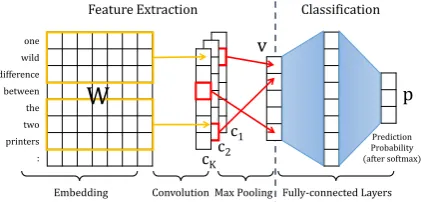
Figure 1: CNN for text classification.
for text classification which consists of four main steps: (i) embedding an input text into an embed-ded matrix W; (ii)applying K fixed-size convo-lution filters to W to find n-grams that possibly discriminate one class from the others;(iii) pool-ing only the maximum value found by each filter, corresponding to the most relevant n-gram in text, to construct a filter-based feature vector,v, of the input; and(iv)using fully-connected layers (F C) to predict the results, and applying a softmax func-tion to the outputs to obtain predicted probability of the classes (p), i.e., p = sof tmax(F C(v)). While the original version of this model uses only one linear layer asF C (Kim,2014), more hidden layers can be added to increase the model capacity for prediction. Also, more than one filter size can be used to detect n-grams with short- and long-span relations (Conneau et al.,2017).
3 Human-grounded Evaluation Methods
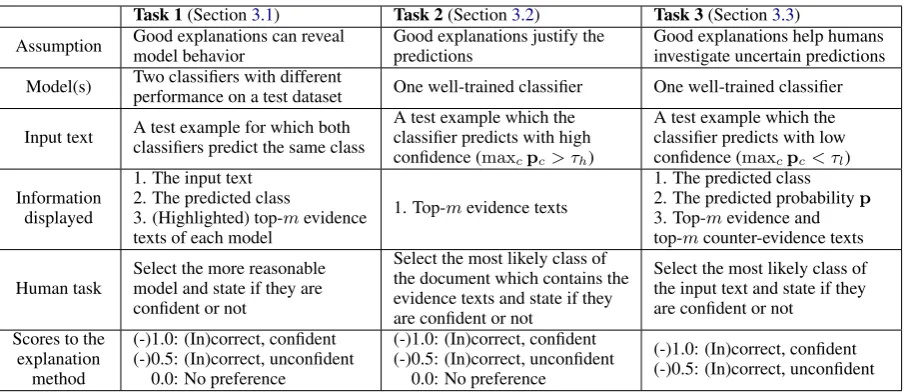
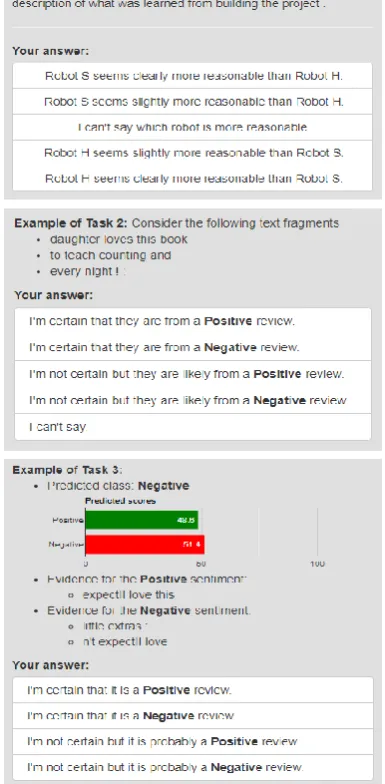
We propose three human tasks to evaluate expla-nation methods for text classification as summa-rized in Table1. Figure2gives an example ques-tion for each task, discussed next.
3.1 Revealing the Model Behavior
Task 1 evaluates whether explanations can expose irrational behavior of a poor model. This property of explanation methods is very useful when we do not have a labelled dataset to evaluate the model quantitatively. To set up the task, firstly, we train two models to make them have different perfor-mance on classifying testing examples (i.e., differ-ent capability to generalize to unseen data). Then we use these models to classify an input text and apply the explanation method of interest to explain the predictions – highlighting top-mevidence text fragments on the text for each model. Next, we ask humans, based on the highlighted texts from the two models, which model is more reasonable?
If the performance of the two models is clearly different, good explanation methods should en-able humans to notice the poor model, which is more likely to decide based on non-discriminative words, even though both models predict the same class for an input text.
Additionally, there are some important points to note for this task. First, the chosen input texts must be classified into the same class by both mod-els so the humans make decisions based only on the different explanations. However, it is worth to consider both the cases where both models cor-rectly classify and where they misclassify. Sec-ond, we provide the choices for the two models along with confidence levels for the humans to se-lect. If they select the right model with high con-fidence, the explanation method will get a higher positive score. In contrast, a confident but incor-rect answer results in a large negative score. Also, the humans have the option to state no preference, for which the explanation method will get a zero score (See the last row of Table1).
3.2 Justifying the Predictions
Explanations are sometimes used by humans as the reasons for the predicted class. This task tests whether the evidence texts are truly related to the predicted class and can distinguish it from the other classes, so calledclass-discriminative ( Sel-varaju et al., 2017). To set up the task, we use a well-trained model and select an input exam-ple classified by this model with high confidence
(maxcpc > τh whereτh is a threshold
Task 1(Section3.1) Task 2(Section3.2) Task 3(Section3.3)
Assumption Good explanations can reveal model behavior
Good explanations justify the predictions
Good explanations help humans investigate uncertain predictions
Model(s) Two classifiers with different
performance on a test dataset One well-trained classifier One well-trained classifier
Input text A test example for which both classifiers predict the same class
A test example which the classifier predicts with high confidence (maxcpc> τh)
A test example which the classifier predicts with low confidence (maxcpc< τl)
Information displayed
1. The input text 2. The predicted class
3. (Highlighted) top-mevidence texts of each model
1. Top-mevidence texts
1. The predicted class 2. The predicted probabilityp 3. Top-mevidence and top-mcounter-evidence texts
Human task
Select the more reasonable model and state if they are confident or not
Select the most likely class of the document which contains the evidence texts and state if they are confident or not
Select the most likely class of the input text and state if they are confident or not
Scores to the explanation
method
(-)1.0: (In)correct, confident (-)0.5: (In)correct, unconfident
0.0: No preference
(-)1.0: (In)correct, confident (-)0.5: (In)correct, unconfident
0.0: No preference
[image:4.595.74.529.60.256.2](-)1.0: (In)correct, confident (-)0.5: (In)correct, unconfident
Table 1: A summary of the proposed human-grounded evaluation tasks.
model’s weakness and create additional fixing ex-amples to retrain and improve the model.
3.3 Investigating Uncertain Predictions
If an AI system makes a prediction with low con-fidence, it may need to raise the case with humans and let them decide, but with the analyzed results as additional information. This task aims to check if the explanations can help humans comprehend the situation and correctly classify the input text or not. To set up, we use a well-trained model and an input text classified by this model with low confidence (maxcpc < τl where τl is a
thresh-old parameter). Then we apply the explanation method of interest to find top-mevidence and
top-m counter-evidence texts of the predicted class. We present both types of evidence to humans1 to-gether with the predicted class and probability p
and ask the humans to use all the information to guess the actual class of the input text, without seeing the input text itself. The scoring criteria of this task are similar to the previous tasks except that we do not provide the “no preference” option as the humans can still rely on the predicted scores when all the explanations are unhelpful.
4 Experimental Setup
4.1 Datasets
We used two English textual datasets for the three tasks.
(1)AmazonReview Polarity is a sentiment anal-ysis dataset with positive and negative classes
1We present counter-evidence as evidence for the other
classes to simplify the task questions.
(Zhang et al.,2015). We randomly selected 100K, 50K, and 100K examples for training, validating, and testing the CNN models, respectively.
(2)ArXiv Abstract is a text classification dataset we created by collecting abstracts of scientific arti-cles publicly available on ArXiv2. Particularly, we collected abstracts from the “Computer Science (CS)”, “Mathematics (MA)”, and “Physics (PH)” categories, which are the three main categories on ArXiv. We then created a dataset with three dis-joint classes removing the abstracts which belong to more than one of the three categories. In the experiments, we randomly selected 6K, 1.5K, and 10K examples for training, validating, and testing the CNN model, respectively.
4.2 Classification Models: 1D CNNs
As for the classifiers, we used 1D CNNs with the same structures for all the tasks and datasets. Specifically, we used 200-dim GloVe vectors as non-trainable weights in the embedding layer (Pennington et al., 2014). The convolution layer had three filter sizes [2, 3, 4] with 50 filters for each size, while the intermediate fully-connected layer had 150 units. The activation functions of the filters and the fully-connected layers are ReLU (except the softmax at the output layer). The models were implemented using Keras and trained with Adam optimizer. The macro-average F1 are 0.90 and 0.94 for the Amazon and the ArXiv datasets, respectively. Overall, the ArXiv appears to be an easier task as it is likely solvable by look-ing at individual keywords. In contrast, the
Figure 2: Example questions and user interfaces.
zon sentiment analysis is not quite easy. Many re-views mention both pros and cons of the products, so a classifier needs to analyze several parts of the input to reach a conclusion. However, this is still manageable by the CNN architecture we used.
Also, in task 1, we need another model which performs worse than the well-trained model. In this experiment, we trained the second CNNs (i.e., the worse models) for the two datasets in dif-ferent ways to examine the capability of expla-nation methods in two different scenarios. For
Method Name Approach Granularity
Random (W) Random
Baselines
Words
Random (N) N-grams
LIME Perturbation Words
LRP (W)
Relevance Propagation
Words
LRP (N) N-grams
DeepLIFT (W) Words
DeepLIFT (N) N-grams
Grad-CAM-Text Gradient N-grams
Decision Trees (DTs)
Model
Extraction N-grams
Table 2: Nine explanation methods evaluated.
the Amazon dataset, while the first (well-trained) CNN needed eight epochs until the validation loss converges, we trained the second CNN for only one epoch to make it underfitting. For the ArXiv dataset, we trained the second CNN using the same number of examples as the first model but with more specific topics. To explain, we ran-domly selected only examples from the subclass ‘Computation and Language’, ‘Dynamical Sys-tems’, and ‘Quantum Physics’ as training and vali-dation examples for the class ‘Computer Science’, ‘Mathematics’, and ‘Physics’, respectively. In other words, the training and testing data of the worse CNN came from different distributions. As a result, the macro-average F1 of the worse CNNs are 0.81 and 0.85 for the Amazon and the ArXiv datasets, respectively.
4.3 Explanation Methods
We evaluated nine explanation methods as sum-marized in Table2. First, we used Random (W) and Random (N) as two baselines selecting words and non-overlapping n-grams randomly from the input text as evidence and counter-evidence. For the n-gram random baseline (and other n-gram based explanation methods in this paper), n is one of the CNN filter sizes [2, 3, 4].
Second, we selected LIME which is a well-known model-agnostic perturbation-based method (Ribeiro et al.,2016). It trains a linear model using samples (5,000 samples in this paper) around the input text to explain the importance of each word towards the prediction. The importance scores can be either positive (for the predicted class) or nega-tive (against the predicted class).
Third, we selected layer-wise relevance prop-agation (LRP), specifically -LRP (Bach et al.,
[image:5.595.85.278.170.563.2]evalua-tions using proxy tasks (Xiong et al., 2018; Po-erner et al., 2018). LRP propagates the output of the target class (before softmax) back through lay-ers to find attributing words, while DeepLIFT does the same but propagates the difference between the output and the predicted output of the refer-ence input (i.e., all-zero embeddings in this pa-per). These two methods assign relevance scores to every word in the input text. Words with the highest and the lowest scores are selected as ev-idence for and counter-evev-idence against the pre-dicted class, respectively. Also, we extended LRP and DeepLIFT to generate explanations at an n-gram level. We considered all possible n-n-grams in the input text where n is one of the CNN filter sizes. Then the explanations are generated based on the relevance score of each n-gram, i.e., the sum of relevance scores of all words in the n-gram. Next, we searched for model-specific explana-tion methods which target 1D CNNs for text clas-sification. We found thatJacovi et al.(2018) pro-posed one: listing only n-grams corresponding to feature values inv(see Figure1) that pass thresh-olds for their filters. Each of the threshthresh-olds is set subject to sufficient purity of the classification re-sults above it. However, their method is applicable to CNNs with only one linear layer asF C, while our CNNs have an additional hidden layer (with ReLU activation). So, we could not compare with their method in this work. To increase diversity in the experiments, we therefore propose two ad-ditional model-specific methods applicable to 1D CNNs with multiple layers inF C, presented next.
4.3.1 Grad-CAM-Text
We adapt Grad-CAM (Selvaraju et al.,2017), orig-inally devised for explaining 2D CNNs, to find the most relevant n-grams for text classification. Since each value in the feature vectorvcorresponds to an n-gram selected by a filter, we useEj,kto show
the effect of an n-gram selected by the kth filter towards the prediction of classj:
Ej,k =|max(∂F C∂v(kv)j,0)| ×vk. (1)
The partial derivative term shows how much the prediction of classjchanges if the value from the
kth filter slightly changes. As we are finding the evidence for the target classj, we consider only the positive value of the derivative. Then Ej,k
combines this term with the strength ofvkto show
the overall effect of thekthfilter for the input text. Next, we calculate the effect of each wordwi in
the input text by aggregating the effects of all the
n-grams containingwi.
Ej,wi =
P
k(Ej,k×I[wi ∈Nk])
whereNk is an n-gram detected by thekth filter.
Lastly, we select, as the evidence, non-overlapping n-grams which are detected by at least one of the filters and have the highest sums of the effects of all the words they contain. For example, to de-cide whether we will select the n-gram Nk as an
evidence text or not, we considerP
wi∈NkEj,wi.
Note that we can find counter-evidence by chang-ing, in equation (1), frommaxtomin.
4.3.2 Decision Trees
This explanation method is based on model extrac-tion (Bastani et al., 2017). We create a decision tree (DT) which mimics the behavior of the classi-fication part (fully-connected layers) of the trained CNN. Given a filter-based feature vectorv, the DT needs to predict the same class as predicted by the CNN. Formally, we want
DT(v) = argmax
j
pj = argmax j
F C(v)j.
For multi-class classification, we construct one DT for each class (one vs. rest classification). We em-ploy CART with Gini index for learning DTs (Leo et al.,1984). All the training examples are gener-ated by the trained CNN using a training dataset, whereas a validation dataset is used to prune the DTs to prevent overfitting.
Also, for each featurevj inv, we calculate the
Pearson’s correlation betweenvjand the output of
each class (before softmax) in F C(v) using the training dataset, so we know which class is usually predicted given a high score ofvj (i.e., correlated
most to this feature). We usecj denoting the most
correlated class of the featurevj.
We can consider the DTs as a global explana-tion of the model as it explains the CNN in gen-eral. To create a local explanation, we use the DT of the predicted class to classify the input. At each decision node, we collect associated n-grams passing the nodes’ thresholds to be evidence for (or counter-evidence against) the predicted class (depending on the most correlated class of each splitting feature). For example, an input text X
is classified to classa, so we use the DT of class
ato predict the input. If a decision node checks whether featurevjof this input is greater than 0.25
and assume it is true for this input, the n-gram cor-responding tovj will be evidence if the most
cor-related class ofvj is classa(i.e.,cj =a).
An example from the Amazon dataset, Actual: Pos, Predicted: Pos, (Predicted scores: Pos 0.514, Neg 0.486):
“OK but not what I wanted: These would be ok but I didn’t realize just how big they are. I wanted something I could actually cook with. They are a full 12” long. The handles didn’t fit comfortably in my hand and the silicon tips are hard, not rubbery texture like I’d imagined. The tips open to about 6” between them. Hope this helps someone else know ...”
Method Top-3 evidence texts Top-3 counter-evidence texts
LIME (W) comfortably / wanted / helps not / else / someone
LRP (W) are / not / 6 : / tips / open
LRP (N) are hard , not / about 6” between / not what I wanted . The tips open / : These would / in my hand and
Grad-CAM-Text (N)
comfortably in my hand / I wanted : These / . The tips open
not what I wanted / not rubbery texture like / Hope this helps someone
[image:7.595.75.522.114.191.2]DTs (N) imagined . The tips ’d imagined . / are . I wanted / would be ok
Table 3: Examples of evidence and counter-evidence texts generated by some of the explanation methods.
4.4 Implementations3
We used public libraries of LIME4, LRP (Alber et al.,2018), and DeepLIFT5 in our experiments. Besides, the code for computing Grad-CAM-Text was adapted from keras-vis6, whereas we used scikit-learn (Pedregosa et al., 2011) for decision tree construction. All the DTs achieved over 80% macro-F1 in mimicking the CNNs’ predictions.
For the task parameters, we setm= 3,τh= 0.9,
andτl = 0.7. For each task and dataset, we used
100 input texts, half of which were classified cor-rectly by the model(s) and the rest were misclas-sified. So, with nine explanation methods being evaluated, each task had 900 questions per dataset for human participants to answer. Examples of questions for each task are given in Figure2.
For the Amazon dataset, we posted our tasks on Amazon Mechanical Turk (MTurk). To ensure the quality of crowdsourcing, each question was answered by three workers and the scores were averaged. For the ArXiv dataset which requires background knowledge of the related subjects, we recruited graduates and post-graduate students in Computer Science, Mathematics, Physics, and En-gineering to perform the tasks, and each question was answered by one participant. In total, we had 367 and 121 participants for the Amazon and the ArXiv datasets, respectively.
5 Results and Discussion
Examples of the generated explanations are shown in Table3and a separate appendix. Table4shows the average scores of each explanation method for each task and dataset, while Figure3displays
3The code and datasets of this paper are available at
https://github.com/plkumjorn/CNNAnalysis 4
https://github.com/marcotcr/lime 5
https://github.com/kundajelab/deeplift 6https://github.com/raghakot/keras-vis
the distributions of individual scores for all three tasks. We do not show the distributions of tasks 2 and 3 of the Amazon dataset as they look similar to the associated ones of the ArXiv dataset.
5.1 Task 1
For the Amazon dataset, though Grad-CAM-Text achieved the highest overall score, the perfor-mance was not significantly different from other methods including the random baselines. Also, the inter-rater agreement for this task was quite poor. It suggests that existing explanation methods can-not apparently reveal irrational behavior of the un-derfitting CNN to lay human users. So, the scores of most explanation methods distribute symmetri-cally around zero, as shown in Figure3(a).
For the ArXiv dataset, LRP (N) and DeepLIFT (N) got the highest scores when both CNNs pre-dicted correctly. Hence, they can help humans identify the poor model to some extent. However, there was no clear winner when both CNNs pre-dicted wrongly. One plausible reason is that evi-dence for an incorrect prediction, even by a well-trained CNN, is usually not convincing unless we set a (high) lower bound of the confidence of the predictions (as we did in task 2).
Additionally, we found that psychological fac-tors fairly affect this task. Based on the results, for two explanations with comparable semantic quality, humans prefer the explanation with more evidence texts and select it as more reasonable. This is consistent with the findings byZemla et al.
Explanation Method
Task 1 Task 2 Task 3
Amazon ArXiv Amazon ArXiv Amazon ArXiv
A 4 8 A 4 8 A 4 8 A 4 8 A 4 8 A 4 8
Random (W) .02 .00 .04 -.11 -.05 -.17 .06 .10 .02 .07 .09 .04 .05 .53 -.43 .01 .32 -.30 Random (N) .02 .02 .02 -.12 -.16 -.07 .12 .13 .12 .29 .32 .25 -.01 .54 -.55 .02 .29 -.25
LIME (W) -.02 .02 -.06 .03 .02 .03 .69 .74 .64 .70 .75 .64 .02 .50 -.45 -.02 .31 -.34 LRP (W) .00 -.01 .02 -.03 -.01 -.05 .13 .26 -.01 .26 .36 .16 -.02 .50 -.54 -.06 .33 -.44 LRP (N) -.07 -.04 -.09 .12 .24 -.01 .26 .45 .08 .44 .49 .39 .08 .60 -.43 .17 .60 -.26 DeepLIFT (W) .04 .03 .04 .07 .13 .00 .21 .37 .04 .26 .35 .16 -.03 .47 -.53 -.08 .28 -.44 DeepLIFT (N) .06 .06 .05 .06 .22 -.10 .23 .47 -.01 .38 .47 .28 .05 .59 -.49 .02 .33 -.30 Grad-CAM-T (N) .07 .11 .03 -.03 -.04 -.01 .65 .64 .66 .53 .65 .41 .05 .51 -.42 .06 .56 -.45 DTs (N) -.05 -.02 -.08 -.13 -.22 -.03 .64 .68 .59 .51 .69 .32 .10 .60 -.40 -.11 .29 -.50
[image:8.595.73.526.61.198.2]Fleissκ(Amazon) 0.050 / 0.054 N/A 0.274 / 0.371 N/A 0.212 / 0.499 N/A
Table 4: The average scores of the three evaluation tasks. The score range is [-1,1] in which 1 is better. A,4, and8are for all, correctly classified, and misclassified input texts, respectively. Boldface numbers are the highest average scores in the columns. A number is underlined when there is no statistically significant difference between the scores of the corresponding method and the best method in the same column (at a significance level of 0.05). The last row reports inter-rater agreement measures (Fleiss’ kappa) in the format of α/ β where αconsiders answers with human confidence levels (5 categories for task 1-2 and 4 categories for task 3) and β considers answers regardless of the human confidence levels (3 categories for task 1-2 and 2 categories for task 3).
1.0 0.5 0.0 0.5 1.0 scores
0 10 20 30 40 50
percentage of the scores
(a) Task: 1, Dataset: Amazon
1.0 0.5 0.0 0.5 1.0 scores
0 10 20 30 40
50 (b) Task: 1, Dataset: ArXiv
1.0 0.5 0.0 0.5 1.0 scores
0 10 20 30 40 50 60
70 (c) Task: 2, Dataset: ArXiv
1.0 0.5 0.5 1.0
scores 0
10 20 30 40
50 (d) Task: 3, Dataset: ArXiv
LIME (W) LRP (W) LRP (N) DeepLIFT (W) DeepLIFT (N) Grad-CAM-T (N) DTs (N)
Figure 3: Score distributions from task 1 of the Amazon dataset and from all the tasks of the ArXiv dataset.
text which is highlighted in a strange way, such as “... greedy algorithm. In this paper, we ...”. Hence, in real applications, syntax integrity should be taken into account to generate explanations.
5.2 Task 2
LIME clearly achieved the best results in task 2 followed by Grad-CAM-Text and DTs. These methods are class discriminative, being able to find good evidence for the predicted class regard-less of whether the prediction is correct.
We believe that LIME performed well because it tests that the missing of evidence words from the input text greatly reduces the probability of the predicted class, so these words are semantically related to the predicted class (given that the model is accurate). Meanwhile, the DTs method selects evidence based on the most correlated class of the splitting features. So, the evidence n-grams are more likely related to the predicted class than the other classes. However, they may be less relevant than LIME’s as the evidence is generated from a global explanation of the model (DTs). Besides,
Grad-CAM-Text worked relatively well here prob-ably because it preserves the class discriminative property of Grad-CAM (Selvaraju et al.,2017).
By contrast, LRP and DeepLIFT generated ac-ceptable evidence only for the correct predictions. Also, LRP (N) and DeepLIFT (N) performed bet-ter than LRP (W) and DeepLIFT (W) in both datasets. This might be because one evidence n-gram contains more information than one evidence word. Nevertheless, even the Random (N) method surpasses the LRP (W) and the DeepLIFT (W) for the ArXiv dataset. Thereby, whenever we use LRP and DeepLIFT, we should present to humans the most relevant words together with their contexts.
5.3 Task 3
The negative scores under the8columns of task 3 show that using explanations to rectify the predic-tions is not easy. Hence, the overall average scores of many explanation methods stay close to zero.
[image:8.595.75.523.302.399.2]for the Amazon and ArXiv datasets, respectively. Also, the reported n-grams could be repetitive and overlapping. This reduced the amount of useful information displayed, and it may be insufficient for humans to choose one of the CS, MA, and PH categories, which are more similar to one another than the positive and negative sentiments.
Meanwhile, LRP (N) performed consistently well on both datasets. This is reasonable consid-ering our discussions in task 2. First, LRP (N) generates good evidence for correct predictions, so it can gain high scores in the 4columns. On the other hand, the evidence for incorrect predic-tions (8) is usually not convincing, so the counter-evidence (which is likely to be the counter-evidence of the correct class) can attract humans’ attention. Fur-thermore, the fact that LRP is not class discrimi-native does not harm it in this task as humans can recognize an evidence text even if it is selected by the LRP (N) as counter-evidence (and vice versa). For example, in the ArXiv dataset, we found a case in which the predicted class is PH (score = 0.48) but the correct class is CS (score = 0.07). LRP (N) selected ‘armed bandit settings with’, ‘the Wasserstein distance’, and ‘derive pol-icy gradients’ as evidence for the class PH. These n-grams, however, are not truly related to PH. Rather, they revealed the true class of this text and made a human choose the CS option with high confidence despite the low predicted score.
Regarding LIME, the situation is reversed as LIME can find both good evidence and counter-evidence. These make humans be indecisive and, possibly, select a wrong option as the explanation is presented at a word level (without any contexts).
5.4 Model Complexity
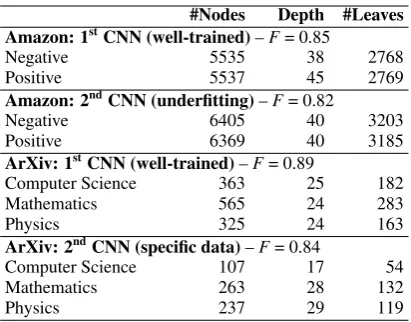
Apart from the results of the three tasks, it is worth to discuss the size of the DTs which mimic the four CNNs in our experiments. As shown in Table
5, the size of the DTs can reflect the complexity of the CNNs. Although the well-trained CNN of the Amazon dataset got 0.9 F1 score, the DTs of this CNN needed more than 5,500 nodes to achieve 85% fidelity (compared to only hundreds of nodes required for the ArXiv dataset). This illustrates the high complexity of the Amazon task compared to the ArXiv task even though both tasks were man-aged effectively by the same CNN architecture.
For the ArXiv dataset, the DTs of the poor CNN are smaller than the ones of the well-trained CNN.
#Nodes Depth #Leaves Amazon: 1stCNN (well-trained)–F= 0.85
Negative 5535 38 2768
Positive 5537 45 2769
Amazon: 2ndCNN (underfitting)–
F= 0.82
Negative 6405 40 3203
Positive 6369 40 3185
ArXiv: 1stCNN (well-trained)
–F= 0.89
Computer Science 363 25 182
Mathematics 565 24 283
Physics 325 24 163
ArXiv: 2ndCNN (specific data)–F= 0.84
Computer Science 107 17 54
Mathematics 263 28 132
[image:9.595.314.520.60.221.2]Physics 237 29 119
Table 5: Metadata of the DTs in the experiments. F
refers to fidelity of the DTs (macro-average F1).
This is likely because the poor CNN was trained on a specific dataset (i.e., selected subtopics of the main categories), so it had to deal with fewer dis-criminative patterns in texts compared to the first CNN trained using texts from all subtopics.
Further studies of this quality of the DTs would be useful for some applications, e.g., measuring model complexity (Bianchini and Scarselli,2014) and model compression (Cheng et al.,2018).
6 Conclusion
We proposed three human tasks to evaluate local explanation methods for text classification. Us-ing the tasks in this paper, we experimented on 1D CNNs and found that (i) LIME is the most class discriminative method, justifying predictions with relevant evidence;(ii)LRP (N) works fairly well in helping humans investigate uncertain pre-dictions; (iii)using explanations to reveal model behavior is challenging, and none of the methods achieved impressive results; (iv) whenever using LRP and DeepLIFT, we should present to humans the most relevant words together with their con-texts and(v)the size of the DTs can also reflect the model complexity. Lastly, we consider evaluating on other datasets and other advanced architectures beneficial future work as it may reveal further in-teresting qualities of the explanation methods.
Acknowledgments
References
Maximilian Alber, Sebastian Lapuschkin, Philipp Seegerer, Miriam H¨agele, Kristof T Sch¨utt, Gr´egoire Montavon, Wojciech Samek, Klaus-Robert M¨uller, Sven D¨ahne, and Pieter-Jan Kindermans. 2018. innvestigate neural networks! arXiv preprint
arXiv:1808.04260.
Leila Arras, Franziska Horn, Gr´egoire Montavon, Klaus-Robert M¨uller, and Wojciech Samek. 2016. Explaining predictions of non-linear classifiers in nlp. InProceedings of the 1st Workshop on
Repre-sentation Learning for NLP, pages 1–7. Association
for Computational Linguistics.
Leila Arras, Franziska Horn, Gr´egoire Montavon, Klaus-Robert M¨uller, and Wojciech Samek. 2017a. ” what is relevant in a text document?”: An in-terpretable machine learning approach. PloS one, 12(8):e0181142.
Leila Arras, Gr´egoire Montavon, Klaus-Robert M¨uller, and Wojciech Samek. 2017b. Explaining recurrent neural network predictions in sentiment analysis. In
Proceedings of the EMNLP’17 Workshop on Com-putational Approaches to Subjectivity, Sentiment &
Social Media Analysis (WASSA), pages 159–168.
Association for Computational Linguistics.
Sebastian Bach, Alexander Binder, Gr´egoire Mon-tavon, Frederick Klauschen, Klaus-Robert M¨uller, and Wojciech Samek. 2015a. On pixel-wise ex-planations for non-linear classifier decisions by layer-wise relevance propagation. PLoS ONE, 10(7):e0130140.
Sebastian Bach, Alexander Binder, Gr´egoire Mon-tavon, Frederick Klauschen, Klaus-Robert M¨uller, and Wojciech Samek. 2015b. On pixel-wise ex-planations for non-linear classifier decisions by layer-wise relevance propagation. PloS one, 10(7):e0130140.
Osbert Bastani, Carolyn Kim, and Hamsa Bastani. 2017. Interpretability via model extraction. CoRR, abs/1706.09773.
Monica Bianchini and Franco Scarselli. 2014. On the complexity of neural network classifiers: A compar-ison between shallow and deep architectures. IEEE Transactions on Neural Networks and Learning Sys-tems, 25(8):1553–1565.
Or Biran and Kathleen R McKeown. 2017. Human-centric justification of machine learning predictions.
InIJCAI, pages 1461–1467.
Yu Cheng, Duo Wang, Pan Zhou, and Tao Zhang. 2018.
Model compression and acceleration for deep neural networks: The principles, progress, and challenges.
IEEE Signal Processing Magazine, 35(1):126–136.
Alexis Conneau, Holger Schwenk, Lo¨ıc Barrault, and Yann Lecun. 2017. Very deep convolutional net-works for text classification. InProceedings of the
15th Conference of the European Chapter of the Association for Computational Linguistics: Volume
1, Long Papers, pages 1107–1116. Association for
Computational Linguistics.
Yannis Dimopoulos, Paul Bourret, and Sovan Lek. 1995. Use of some sensitivity criteria for choosing networks with good generalization ability. Neural
Processing Letters, 2(6):1–4.
Bj¨orn Gamb¨ack and Utpal Kumar Sikdar. 2017. Us-ing convolutional neural networks to classify hate-speech. InProceedings of the First Workshop on
Abusive Language Online, pages 85–90. Association
for Computational Linguistics.
Reza Ghaeini, Xiaoli Fern, and Prasad Tadepalli. 2018.
Interpreting recurrent and attention-based neural models: a case study on natural language
infer-ence. In Proceedings of the 2018 Conference on
Empirical Methods in Natural Language Process-ing, pages 4952–4957, Brussels, Belgium. Associ-ation for ComputAssoci-ational Linguistics.
Alon Jacovi, Oren Sar Shalom, and Yoav Goldberg. 2018.Understanding convolutional neural networks for text classification. InProceedings of the 2018 EMNLP Workshop BlackboxNLP: Analyzing and
In-terpreting Neural Networks for NLP, pages 56–65.
Association for Computational Linguistics.
Rie Johnson and Tong Zhang. 2015. Effective use of word order for text categorization with convolu-tional neural networks. InProceedings of the 2015 Conference of the North American Chapter of the Association for Computational Linguistics: Human
Language Technologies, pages 103–112.
Associa-tion for ComputaAssocia-tional Linguistics.
Been Kim, Cynthia Rudin, and Julie Shah. 2014. The bayesian case model: A generative approach for case-based reasoning and prototype classification.
In Proceedings of the 27th International
Conference on Neural Information Processing Systems
-Volume 2, NIPS’14, pages 1952–1960, Cambridge,
MA, USA. MIT Press.
Yoon Kim. 2014. Convolutional neural networks for sentence classification. In Proceedings of the 2014 Conference on Empirical Methods in Natural
Lan-guage Processing (EMNLP), pages 1746–1751.
As-sociation for Computational Linguistics.
Tao Lei, Regina Barzilay, and Tommi Jaakkola. 2016.
Rationalizing neural predictions. InProceedings of the 2016 Conference on Empirical Methods in
Nat-ural Language Processing, pages 107–117.
Associ-ation for ComputAssoci-ational Linguistics.
Breiman Leo, Jerome H Friedman, Richard A Olshen, and Charles J Stone. 1984. Classification and re-gression trees. Wadsworth International Group.
Hui Liu, Qingyu Yin, and William Yang Wang. 2019.
Towards explainable NLP: A generative explanation framework for text classification. InProceedings of the 57th Annual Meeting of the Association for
Com-putational Linguistics, pages 5570–5581.
Associa-tion for ComputaAssocia-tional Linguistics.
Scott M Lundberg and Su-In Lee. 2017. A unified approach to interpreting model predictions. In
Ad-vances in Neural Information Processing Systems,
pages 4765–4774.
Sina Mohseni and Eric D Ragan. 2018. A human-grounded evaluation benchmark for local expla-nations of machine learning. arXiv preprint
arXiv:1801.05075.
Dong Nguyen. 2018. Comparing automatic and hu-man evaluation of local explanations for text clas-sification. In Proceedings of the 2018 Conference of the North American Chapter of the Association for Computational Linguistics: Human Language
Technologies, Volume 1 (Long Papers), pages 1069–
1078.
F. Pedregosa, G. Varoquaux, A. Gramfort, V. Michel, B. Thirion, O. Grisel, M. Blondel, P. Pretten-hofer, R. Weiss, V. Dubourg, J. Vanderplas, A. Pas-sos, D. Cournapeau, M. Brucher, M. Perrot, and E. Duchesnay. 2011. Scikit-learn: Machine learning in Python. Journal of Machine Learning Research, 12:2825–2830.
Jeffrey Pennington, Richard Socher, and Christo-pher D. Manning. 2014. Glove: Global vectors for word representation. InEmpirical Methods in
Nat-ural Language Processing (EMNLP), pages 1532–
1543.
Nina Poerner, Hinrich Sch¨utze, and Benjamin Roth. 2018. Evaluating neural network explanation meth-ods using hybrid documents and morphosyntactic agreement. InProceedings of the 56th Annual Meet-ing of the Association for Computational LMeet-inguistics
(Volume 1: Long Papers), pages 340–350.
Marco Tulio Ribeiro, Sameer Singh, and Carlos Guestrin. 2016. ”why should i trust you?”: Explain-ing the predictions of any classifier. In Proceed-ings of the 22Nd ACM SIGKDD International
Con-ference on Knowledge Discovery and Data Mining,
KDD ’16, pages 1135–1144, New York, NY, USA. ACM.
Wojciech Samek, Thomas Wiegand, and Klaus-Robert M¨uller. 2018. Explainable artificial intelligence: Understanding, visualizing and interpreting deep learning models. ITU Journal: ICT Discoveries - Special Issue 1 - The Impact of Artificial Intel-ligence (AI) on Communication Networks and
Ser-vices, 1(1):39–48.
Ramprasaath R Selvaraju, Michael Cogswell, Ab-hishek Das, Ramakrishna Vedantam, Devi Parikh,
and Dhruv Batra. 2017. Grad-cam: Visual explana-tions from deep networks via gradient-based local-ization. In Proceedings of the IEEE International
Conference on Computer Vision, pages 618–626.
Avanti Shrikumar, Peyton Greenside, and Anshul Kun-daje. 2017. Learning important features through propagating activation differences. InProceedings of the 34th International Conference on Machine
Learning, volume 70 of Proceedings of Machine
Learning Research, pages 3145–3153, International
Convention Centre, Sydney, Australia. PMLR.
David Silver, Aja Huang, Christopher J. Maddison, Arthur Guez, Laurent Sifre, George van den Driess-che, Julian Schrittwieser, Ioannis Antonoglou, Veda Panneershelvam, Marc Lanctot, Sander Dieleman, Dominik Grewe, John Nham, Nal Kalchbrenner, Ilya Sutskever, Timothy Lillicrap, Madeleine Leach, Koray Kavukcuoglu, Thore Graepel, and Demis Hassabis. 2016.Mastering the game of go with deep neural networks and tree search. Nature, 529:484– 503.
Panagiotis Symeonidis, Alexandros Nanopoulos, and Yannis Manolopoulos. 2009. Moviexplain: a recommender system with explanations. RecSys, 9:317–320.
Wenting Xiong, Iftitahu Ni’mah, Juan MG Huesca, Werner van Ipenburg, Jan Veldsink, and Mykola Pechenizkiy. 2018. Looking deeper into deep learning model: Attribution-based explanations of textcnn.arXiv preprint arXiv:1811.03970.
Jeffrey C Zemla, Steven Sloman, Christos Bechlivani-dis, and David A Lagnado. 2017. Evaluating every-day explanations. Psychonomic bulletin & review, 24(5):1488–1500.
Jingqing Zhang, Piyawat Lertvittayakumjorn, and Yike Guo. 2019. Integrating semantic knowledge to tackle zero-shot text classification. In Proceed-ings of the 2019 Conference of the North American Chapter of the Association for Computational Lin-guistics: Human Language Technologies, Volume 1
(Long and Short Papers), pages 1031–1040.
Associ-ation for ComputAssoci-ational Linguistics.
Xiang Zhang, Junbo Zhao, and Yann LeCun. 2015.
Character-level convolutional networks for text clas-sification. InProceedings of the 28th International Conference on Neural Information Processing
Sys-tems - Volume 1, NIPS’15, pages 649–657,
Cam-bridge, MA, USA. MIT Press.
Bolei Zhou, Aditya Khosla, Agata Lapedriza, Aude Oliva, and Antonio Torralba. 2016. Learning deep features for discriminative localization. In Proceed-ings of the IEEE conference on computer vision and

![Table 4: The average scores of the three evaluation tasks. The score range is [-1,1] in which 1 is better](https://thumb-us.123doks.com/thumbv2/123dok_us/1341357.665739/8.595.75.523.302.399/table-average-scores-evaluation-tasks-score-range-better.webp)