Proceedings of the 2018 EMNLP Workshop SCAI: The 2nd Int’l Workshop on Search-Oriented Conversational AI, pages 24–32 2018 Association for Computational Linguistics
24
A Methodology for Evaluating Interaction Strategies of Task-Oriented
Conversational Agents
Marco Guerin1, 2, Sara Falcone1, Bernardo Magnini1 1Fondazione Bruno Kessler, Via Sommarive 18, Povo, Trento — Italy
2AdeptMind Scholar, Canada
{guerini,sfalcone,magnini}@fbk.eu
Abstract
In task-oriented conversational agents, more attention has been usually devoted to assess-ing task effectiveness, rather than tohow the task is achieved. However, conversational agents are moving towards more complex and human-like interaction capabilities (e.g. the ability to use a formal/informal register, to show an empathetic behavior), for which stan-dard evaluation methodologies may not suf-fice. In this paper, we provide a novel method-ology to assess - in a completely controlled way - the impact on the quality of experi-ence of agent’s interaction strategies. The methodology is based on a within subject de-sign, where two slightly different transcripts of the same interaction with a conversational agent are presented to the user. Through a series of pilot experiments we prove that this methodology allows fast and cheap experi-mentation/evaluation, focusing on aspects that are overlooked by current methods.
1 Introduction
The evaluation of task-oriented conversational agents is usually focused on measuring their ef-fectiveness, either at the single turn level - see for example (Wen et al.,2015;Frampton and Lemon, 2006; Chen et al., 2013) - or at the level of the whole interaction - e.g success rate (Dybkjaer et al., 2004). Still, as conversational agents are becoming more complex and human-like ( Bow-den et al.,2017;Romero et al.,2017;Cercas Curry et al.,2017), these evaluation methodologies may not suffice. In this paper, we present a framework for evaluating interaction strategies of conversa-tional agents during their development phase. Our approach combines in a novel way methodolo-gies already tested and validated, and is based on
Proceedings of the 2018 EMNLP Workshop SCAI: The 2nd International Workshop on Search-Oriented Conversa-tional AI, 978-1-948087-75-9
a pairwise comparison of manually curated tran-scripts of possible interactions.
On the one hand, our methodology is inspired by the Human-Computer-Interaction (HCI) litera-ture by dividing the evaluation of a system in the Quality of Service (QoS) and Quality of Experi-ence(QoE) dimensions (Moller et al.,2009). The former corresponds to the efficiency of the sys-tem, while the latter refers to the way in which the system accomplishes the task. In dialogue sys-tems evaluation the traditional focus is on the QoS, while in this work we deal also with the QoE. On the other hand, we take advantage of crowdsourc-ing methodologies, a fast and cheap way we use to evaluate interactions while maintaining complete control over experimental conditions – by using a design similar to A/B testing, but in a ‘within sub-ject’ condition. In this setting two slightly differ-ent versions of the same interaction with a conver-sational agent are presented to the user for a pair-wise comparison (e.g. the same interaction using a formal/informal register). Unlike standard Wiz-ard of Oz (WoZ) or lab experiments, the user does not directly interact with the system, rather s/he reads the manually curated transcript, so to elimi-nate confounding variables and make data collec-tion much faster.
The paper is structured as follows: in Section 2 we discuss some of the main approaches used in the evaluation of conversational agents. In Sec-tion 3 and4 we present our framework and pro-vide some pilot experiments respectively. Finally in Section5we discuss the advantages of the ap-proach in light of the results of the experiments.
2 Related Works
followed different criteria taken from other re-search fields, such as machine translation (Wen et al., 2016), human-computer interaction (Allen et al.,2001), user experience and interfaces design (Skantze, 2005). The fact that these methodolo-gies are not designed to evaluate dialogue system, can affect the results - for example, machine trans-lation metrics do not correlate well with human judgments (Liu et al., 2016). Another common aspect of these approaches is that they rely on a complete implementation of the system to evalu-ate aspects such as efficiency (Raux et al.,2006), quality (Shawar and Atwell,2007) or both ( Silver-varg and J¨onsson,2011), while in the case of our interaction strategies it would be useful to have a simulation approach that allows to predict the pos-sible impact of such strategies. In the following we first discuss standard methodologies for imple-mented systems, then methodologies using simu-lation, and finally evaluation in related fields that inspired our approach.
Evaluation of implemented systems. Among the metrics used for evaluating specific compo-nents of a system we can briefly mention: (i) flu-ency/grammaticalityof the generated sentences in the NLG step of the interaction, that can be done either manually (Wen et al., 2015) or in a semi-automatic way, as in (Riezler et al., 2003); (ii) slots correctly realized, an automatic evaluation of the NLG component (Scheffler and Young,2002; Frampton and Lemon,2006); (iii)slots correctly recognized, an automatic technique used to eval-uate the NLU component (Levin and Pieraccini, 1997;Chen et al.,2013).
Among the metrics used for evaluating whole interactions there issuccess rate. It can be based on objective automatic measures or on a subjec-tive evaluation made by users evaluating the sys-tem according to guidelines provided by the exper-imenter (Dybkjaer et al.,2004).
Finally, a framework worth mentioning is PAR-ADISE (Walker et al., 1997) that is specifically devoted to spoken dialogue systems (while in our work we consider text based interactions only). This work focuses on metrics such as task success rate and dialogue cost (e.g. dialogue time, number of utterances, agent response delay) to evaluate the quality of a system. With regard to spoken dia-logue systems, the use of crowdsourcing for col-lecting preference judgments has already been ex-plored, for example in (Trippas et al.,2017;
Chuk-lin et al.,2018;Alfonseca,2017)
Evaluation through simulation. If the sys-tem is still at an early stage of development, a vi-able solution is to useWoZ experiments(Dahlb¨ack et al., 1993; Paek, 2001; Raux et al., 2006), in which the interaction is simulated and users are prepared on how to behave. Still, this approach suffers of some main drawbacks: (i) the need for conducting several time-consuming interactions to get stable results; (ii) the possible measured im-provements of the system can still be biased by confounding variables; (iii) it is difficult for wiz-ards to provide consistent responses across ses-sions; (iv) ‘behavior instructions’ should be pre-pared and given to the wizard and possibly to each single user1 (v) these ’behavior instructions’ can-not describe every single reaction, but must try to control typical situations.
Evaluation in related fields. Our design lever-ages in a novel way elements used in several fields. Two variants testing with controlled stimulus material. In the MT field, the work by ( Gra-ham et al., 2013) used a ‘within subject’ design where each evaluator was sometimes presented with a small random textual variation (control con-dition) of a translation they were already exposed to (experimental condition). This methodology was used to evaluate the quality of raters’ judg-ments. Closely to our approach, the MT evaluation campaign presented in (Bojar et al.,2016) used ex-pert annotators for pairwise system comparisons denoting whether a system A was judged better than, worse than, or equivalent to another system B. In this case the two conditions were presented simultaneously, side by side, rather than in a ran-dom sequential order as in (Graham et al.,2013). Other seminal approaches - using direct compar-ison of stimulus materials via pairwise compari-son - is presented in the realm of affective NLG (Van Der Sluis and Mellish,2010), and in the do-main of persuasive NLP (Tan et al., 2014). Still, both works used this procedure just for the vali-dation of stimulus material and made resort to tra-ditional evaluation procedures for the final eval-uation. Finally, in the realm of persuasive NLG a crowdsourced approach based on A/B testing
1
and focused on ecological validity is presented in (Guerini et al., 2012). This approach, however, uses a between-subject design, where subjects are presented with just one stimulus material.
Transcripts and ‘third party’ evaluation. Two approaches that use transcripts of the conversa-tion, instead of a direct interaction with the agent, are presented in (Jurˇc´ıˇcek et al.,2011;Yang et al., 2010). These works compared lab experiments with crowdsourced ones - in the scenario of spo-ken dialogue systems - showing that the results in the former (direct interaction with the system) are comparable with the results in the latter (third party users reading transcriptions). Similarly, in (Pragst et al.,2017), the authors focus on a WoZ evaluation of the interaction strategies of an em-bodied conversational agents. Users were pre-sented with the video of an embodied conversa-tional agent interacting with a human user (the agent was guided by a Wizard and the user was an instructed actor). The subjects have to evalu-ate the interactions answering to a survey using a Likert scale. In this experiment, as in the previous one, the subject is third-party evaluator who did not directly entered the interaction.
3 Proposed Solution
Starting from the advantages and limitations of the previous approaches, we designed a new frame-work to evaluate a task-oriented dialogue system from the point of view of the strategies of inter-action. In our framework the dependent variables are QoS and QoE aspects instantiated in a ques-tionnaire to be evaluated by the subjects, while the independent variables are the interaction strategies that are instantiated in the stimulus material.
In particular, we propose a methodology in which the transcripts of two versions of the inter-action with a conversational agent (e.g. one using a formal language and one using an informal one, one being empathetic and one not) are presented to the user, to see if one version is preferred over the other. The core idea of the approach is that, differ-ently from WoZ studies, the subjects mustreadthe transcripts of the interaction rather than directly interactingwith the agent. This is required in or-der to grant complete control over the experiment (transcripts can be manually curated so to meet stringent control criteria). The two versions must maintain all aspects and wording of the interaction the same (apart from those affected by the
modal-ity being tested), including the outcome (e.g. suc-cess of the interaction) so that, if one version is preferred over the other, we can conclude that the effect of preference is solely due to the variable of interest (e.g. the “formality level” of the language, the empathy of the agent) and not to other factors. The procedure for setting up an experiment is:
1. Control conditions. Create one or more con-trol conditions for each interaction strategy to be tested: either a transcript of a real inter-action with an existing system or a possible interaction with the planned one.
2. Experimental conditions. Create an exper-imental condition that is the manually cu-rated counterpart of the control condition. As stated, changes in the wording should be minimal and must always reflect the interac-tion strategy to be tested. Changes can be of two types: (a)substitution of portions of system’s utterances with new coherent por-tions that represent the experimental condi-tion (e.g. change an informal greeting with a formal one) or (b)insertion of new portions of text in system’s utterances.
3. Questionnaire. Prepare a questionnaire that includes questions about the Qos and QoE di-mensions of interest.
4. Crowdsource. Built a task on a crowdsourc-ing platform with a pairwise comparison de-sign and the questionnaire subministered af-ter each comparison.
Many interaction strategies can be analysed to test our approach. We decided to focus on five of them, those we deemed most interesting and impactful on the pragmatics of the dialogue and for which an effect should be detected (Radziwill and Benton,2017), so to test if our methodology is able to capture such effect.
4 Experiments
4.1 Interaction Strategies
Five strategies, together with their linguistic pa-rameters, were analyzed. The transcripts of the experimental condition were realized by two ex-pert linguists, following the substitution/insertion instructions described in Section3.
Empathycan be defined as the ability of a con-versational agent to adapt to the user feelings and also to provide flexible emotionally-coloured responses for different purposes (Callejas et al., 2011). There exist many different ways in which emotions are defined, represented and managed within dialogue systems (Meira and Canuto,2015; Barrett et al., 2007). Usually, the recognition is based on the manifestation of the user emo-tion, which can be processed considering linguis-tic (Balahur et al., 2014) and paralinguistic cues (Schuller et al.,2013).
Formalityin linguistics is expressed through the choice of lexical expressions. According to the context, the speaker can use a specific linguis-tic register, style and lexicon (Heylighen and De-waele, 1999). In order to detect the formality of a text there exist different strategies. One is to de-tect the average of deixis for each grammatical cat-egory of words (Heylighen and Dewaele, 1999); another is to use words length and latinate affix (Brooke et al.,2010).
Facingis the ability to tackle situations in which the conversational agent has not a proper or pre-set answer (Morrissey and Kirakowski,2013). We can observe two kinds of facing for unexpected users’ input: (i) the agent is not able to recognize the intention and makes resort to a default answer, e.g. “Sorry I do not understand, could you re-peat?”; (ii) the agent is able to recognize the inten-tion and it provides a suitable/contextual answer even if it is not endowed with the skills to solve it. Vocabulary Extension concerns agent’s ability to learn new words during the conversation and use them appropriately in the ongoing (Riccardi and Hakkani-Tur,2005). For example, CH1 needs to know a huge variety of food names (from spe-cific names such as ‘seitan’ to complex recipies such as ‘plantain coated sea bass with mango wine sauce’) to calculate meals carbohydrates. There-fore, since covering all possible combinations of ingredients and recipes is almost impossible, the ability to learn new food names during the inter-action improves user experience.
Linguistic Alignment corresponds to the
con-versational agent functionality of adapting its lan-guage to that of the user. The agent will start using the user’s frequent expressions in order to align its lexicon. For example, it should align its linguistic register or reuse the same words used by the user in the generation of the following turn (Branigan et al.,2010;Duplessis et al.,2017).
In Table1we give, as an example, the transcript used as stimulus material for theempathyvariable.
4.2 Dependent Variables
The variables that we adopted in our framework for evaluating QoS and QoE are: (i)utility: if the user found the system useful to achieve the task and obtained all the information s/he needed; (ii) ease of use: if the system was intuitive in the usage and the user could use it without effort; (iii) sat-isfaction: if the user had a good experience and would use the system again; (iv) interaction: if the user appreciated the manner of interacting of the system. The evaluation of these variables has been obtained asking the subjects to choose the in-teraction that better matched each of the four ques-tions under each interaction pair. According to the kind of system that has to be evaluated, different or more fine grained dependent variables can be cho-sen. For example, thecognitive workloadoreffort perceived by the user, theappealof the interface design or the communication channel.
4.3 Experiment description
In this section we describe the main characteristics of our evaluation experiment.
Subjects: 143 subjects from the US were re-cruited using the CrowdFlower platform: 93 male and 50 female. 36 were between 18-24 years old, 58 were between 25-34 years old, 31 were be-tween 35-49 years old, 18 were 50 or more aged.
Design: The design was completely within-subject, i.e. each subject was presented with one of the control and experimental transcripts for the 5 variables. Transcripts order among variables and between control/experimental conditions was ran-domized in order to avoid any framing effect or stimulus order effect (Kessler and Meier,2014).
CH1: Hello Andrea! What did you eat for your last meal? CH1: Hello Andrea! What did you eat for your last meal? User: I ate a plate of spaghetti with tomato User: I ate a plate of spaghetti with tomato
CH1: How much spaghetti with tomato did you eat? CH1: How much spaghetti with tomato did you eat? User: Unfortunately I messed up, it was a generous
help-ing...
User: Unfortunately I messed up, it was a generous help-ing...
CH1: Your meal consisting of a generous plate (200g) of spaghetti with tomato corresponds to 30.85 g of carbohydrates. I hope I have been helpful! See you soon!
CH1: Don’t worry about it, everyone messes up
[image:5.595.74.523.64.183.2]some-times!Anyway, your meal consisting of a generous plate (200g) of spaghetti with tomato corresponds to 30.85 g of carbohydrates. I hope I have been helpful! See you soon!
Table 1: Control (on the left) and experimental (on the right) transcript for theempathyindependent variable. Portions of CH1 utterances that were changed in order to realize the variable are in bold.
Ease Satisf. Util. Inter. Marginal
alignment 0.60 0.61 0.67 0.65 0.63
empathy 0.73 0.78 0.73 0.76 0.75
facing 0.64 0.71 0.70 0.66 0.68
formal 0.74 0.80 0.73 0.66 0.73
vocabulary 0.74 0.71 0.73 0.77 0.74
Table 2: Ratio of subjects that preferred the experimen-tal over the control condition.
Judgments collected: the total number of judg-ments collected is 2860: 143 subjects that an-swered four questions for each of the 5 indepen-dent variables.
Cost: Overall, the experiment cost was51.48$ resulting in a cost of roughly 10$ for evaluating each variable. The duration of the experiment was about 12 hours. As a side note, the experiment got a high feedback in terms of contributor satisfaction (an overall evaluation of 4.8/5).
4.4 Results
In this section we briefly discuss the results, re-ported in Table 2, of our pilot experiments. We focus on the ability of our framework to elicit in users’ responses a difference between the two lev-els of each independent variable in terms of per-ceived QoS and QoE. Results were in line with our expectations: the methodology was able to capture the effect of each modality and strategy of interac-tion in the experimental condiinterac-tion.
Results shows, indeed, that the contributors ex-pressed a preference for the experimental condi-tion, resulting in a consistent trend with respect to the variables2. All results are statistically signifi-cant,χ2test used. Moreover, the independent vari-ables have different magnitude effects (i.e. some
2Actually, for the formal/informal dimension the
prefer-ence went to the control condition (formal register). Still, for comparability purposes we report results for the control con-dition in Table2
FEMALE MALE
alignment 0.68 0.61
empathy 0.77 0.74
facing 0.76 0.64
formal 0.76 0.72
[image:5.595.350.486.233.295.2]vocabulary 0.72 0.75
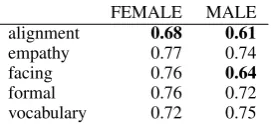
Table 3: Marginals for the interaction variables accord-ing to gender.
modalities of interaction were appreciated more). In particular, considering marginals,empathy, for-malityandvocabularywere the most appreciated variations of CH1 (with no statistical significant difference among them) whilealignment and fac-ingwere less appreciated. Interestingly, an analy-sis at the gender level (see Table3), revealed that on the two latter variables there was a clear dis-crepancy in the marginals between male and fe-male: this difference in the case of alignment is 0.68 for female vs. 0.61 for male - and both ac-count for the difference in overall results with re-gard to other independent variables. Instead, for facing, the difference in marginals with regard to other independent variables was due to the male group alone, since for female the results are in line with other variables (0.64 vs. 0.76).
Turning to dependent variables we can see that the effect is quite different: alignmenthas a main impact on utility and interaction,empathyon satis-faction and interaction,facingon satisfaction and utility, formality on satisfaction and ease of use, vocabularyon naturalness and ease of use. Inter-estingly each of the independent variables had a main effect on one QoS and one QoE dimension -in l-ine with the f-ind-ings of (Jurˇc´ıˇcek et al.,2011).
4.5 Comparison with WoZ
[image:5.595.75.291.233.295.2]and stimuli creation require in both cases almost the same time (for example the stimulus material for our setting was used as an example of pos-sible interaction for the Wizard instructions), the implementation of our framework is much faster. Indeed, the WoZ experiment requires the imple-mentation of a graphical user interface, but even if we use a pre-set one, we still need to instruct Wizard(s) and find a relevant number of partici-pants in case a crowdsourcing methodology is not used. But even if we do not consider the afore-mentioned time consuming preparatory activities, each WoZ session that replicate our experiment, required 30 minutes and two participants, as com-pared to the 3 minutes and one participant required by our framework. This is explained by the fact that while in our framework the subject just need to read the transcript of the interaction, in the WoZ experiment the user needs to read instructions for each interaction, think and digit the input at each turn and read the corresponding wizard response; at the same time the Wizard needs to do the same.
5 Advantages
With the initial evidence, provided by the experi-ments, we can reasonably state that the framework we are proposing has some important advantages: Cheap and Fast. The evaluation can be ob-tained using platform such as CrowdFlower or AMT, choosing high level and possibly native speaker contributors. Crowdsourcing approaches make it quick and cheap to run evaluation experi-ments as compared to ecological ones, see for ex-ample what reported in (Reiter,2011).
Flexibility. The framework gives the possibil-ity to define the dependent and independent vari-ables that better match the strategies and modali-ties of interaction that need to be evaluated. More-over, using crowdsourcing approaches together with hand curated transcripts we can easily exper-iment several variables/versions of the conversa-tional agents or control for multiple mixed effects (e.g. linguistic style * empathy). We can also test different levels of a strategy, for example to find the optimal formality level.
Experiment design. the adoption of a pair-wise comparison of the two versions of the system makes the evaluation of the interaction strategies faster and more direct. It also halves the number of judgments required with respect to traditional evaluation designs in which each stimulus
mate-rial is served separatedly, bringing to an approxi-mative halving of the price.
Control over the variables being tested. Pro-viding transcripts of the conversation to the sub-jects gives the possibility to control one variable at a time isolating its effect (and to the best of our knowledge no previous work ever tried this ap-proach). This allow us, for example, to build tran-scripts with an almost equal number of tokens and turns of interactions, in order to avoid phenomena such as length effect (Koizumi,2012).
Judgement Elicitation. Forcing a choice be-tween control and experimental condition allows eliciting possible differences between the two in-teractions, for how small this difference could be.
Effort Reduction. Since the subjects of the ex-periment are not meant to interact directly with the conversational agent, we can create an off-line ex-periment to test conversational agents characteris-tics in advance, rather than having a post-process analysis. This saves implementation or data col-lection effort, since there might be aspects of the interaction that annoy the user or, on the contrary, that have a positive impact and that are easy to im-plement. Finally, we can avoid the risk that the user could miss some passages of the interaction useful to highlight the strategies that we are ana-lyzing, as could happen in WoZ studies.
6 Conclusion and Future Works
In our view, the proposed framework, based on a pairwise comparison of manually curated and con-trolled transcripts, represents a step forward in the evaluation of dialogue systems. This methodology allows evaluating the strategies and the interac-tion modalities of a conversainterac-tional agent before its implementation, ensuring the advantages reported above. We believe that this methodology is suit-able not only for rule-based systems, but also for data-driven ones. In this latter case the methodol-ogy can be used, for example, to define the con-straints for data collection.
References
Enrique Alfonseca. 2017. Evaluation of speech for the google assistant.
https://ai.googleblog.com/2017/12/evaluation-of-speech-for-google.html.
James F Allen, Donna K Byron, Myroslava Dzikovska, George Ferguson, Lucian Galescu, and Amanda Stent. 2001. Toward conversational human-computer interaction. AI magazine, 22(4):27.
Alexandra Balahur, Rada Mihalcea, and Andr´es Mon-toyo. 2014. Computational approaches to subjectiv-ity and sentiment analysis: Present and envisaged methods and applications.
Lisa Feldman Barrett, Kristen A Lindquist, and Maria Gendron. 2007. Language as context for the per-ception of emotion. Trends in cognitive sciences, 11(8):327–332.
Ondrej Bojar, Rajen Chatterjee, Christian Federmann, Yvette Graham, Barry Haddow, Matthias Huck, An-tonio Jimeno Yepes, Philipp Koehn, Varvara Lo-gacheva, Christof Monz, et al. 2016. Findings of the 2016 conference on machine translation. In
ACL 2016 FIRST CONFERENCE ON MACHINE TRANSLATION (WMT16), pages 131–198. The As-sociation for Computational Linguistics.
Kevin K Bowden, Shereen Oraby, Amita Misra, Ji-aqi Wu, and Stephanie Lukin. 2017. Data-driven dialogue systems for social agents. arXiv preprint arXiv:1709.03190.
Holly P Branigan, Martin J Pickering, Jamie Pearson, and Janet F McLean. 2010. Linguistic alignment be-tween people and computers. Journal of Pragmat-ics, 42(9):2355–2368.
Julian Brooke, Tong Wang, and Graeme Hirst. 2010. Automatic acquisition of lexical formality. In Pro-ceedings of the 23rd International Conference on Computational Linguistics: Posters, pages 90–98. Association for Computational Linguistics.
Zoraida Callejas, David Griol, and Ram´on L´opez-C´ozar. 2011. Predicting user mental states in spoken dialogue systems. EURASIP Journal on Advances in Signal Processing, 2011(1):6.
Amanda Cercas Curry, Helen Hastie, and Verena Rieser. 2017. A review of evaluation tech-niques for social dialogue systems. arXiv preprint arXiv:1709.04409.
Yun-Nung Chen, William Yang Wang, and Alexander I Rudnicky. 2013. Unsupervised induction and fill-ing of semantic slots for spoken dialogue systems using frame-semantic parsing. InAutomatic Speech Recognition and Understanding (ASRU), 2013 IEEE Workshop on, pages 120–125. IEEE.
Aleksandr Chuklin, Aliaksei Severyn, Johanne Trip-pas, Enrique Alfonseca, Hanna Silen, and Damiano
Spina. 2018. Prosody modifications for question-answering in voice-only settings. arXiv preprint arXiv:1806.03957.
Nils Dahlb¨ack, Arne J¨onsson, and Lars Ahrenberg. 1993. Wizard of oz studies - why and how.
Knowledge-based systems, 6(4):258–266.
Guillaume Dubuisson Duplessis, Chlo´e Clavel, and Fr´ed´eric Landragin. 2017. Automatic measures to characterise verbal alignment in human-agent inter-action. In18th Annual Meeting of the Special Inter-est Group on Discourse and Dialogue (SIGDIAL), pages 71–81.
Laila Dybkjaer, Niels Ole Bernsen, and Wolfgang Minker. 2004. Evaluation and usability of multi-modal spoken language dialogue systems. Speech Communication, 43(1-2):33–54.
Matthew Frampton and Oliver Lemon. 2006. Learning more effective dialogue strategies using limited dia-logue move features. InProceedings of the 21st In-ternational Conference on Computational Linguis-tics and the 44th annual meeting of the Association for Computational Linguistics, pages 185–192. As-sociation for Computational Linguistics.
Yvette Graham, Timothy Baldwin, Alistair Moffat, and Justin Zobel. 2013. Continuous measurement scales in human evaluation of machine translation. In Pro-ceedings of the 7th Linguistic Annotation Workshop and Interoperability with Discourse, pages 33–41.
Marco Guerini, Carlo Strapparava, and Oliviero Stock. 2012. Ecological evaluation of persuasive messages using google adwords. InProceedings of the 50th Annual Meeting of the Association for Computa-tional Linguistics: Long Papers-Volume 1, pages 988–996. Association for Computational Linguis-tics.
Francis Heylighen and Jean-Marc Dewaele. 1999. For-mality of language: definition, measurement and be-havioral determinants.
Filip Jurˇc´ıˇcek, Simon Keizer, Milica Gaˇsi´c, Fran-cois Mairesse, Blaise Thomson, Kai Yu, and Steve Young. 2011. Real user evaluation of spoken dialogue systems using amazon mechanical turk. In Twelfth Annual Conference of the International Speech Communication Association.
Judd B Kessler and Stephan Meier. 2014. Learning from (failed) replications: Cognitive load manipu-lations and charitable giving. Journal of Economic Behavior & Organization, 102:10–13.
Rie Koizumi. 2012. Relationships between text length and lexical diversity measures: Can we use short texts of less than 100 tokens. Vocabulary Learning and Instruction, 1(1):60–69.
Chia-Wei Liu, Ryan Lowe, Iulian V Serban, Michael Noseworthy, Laurent Charlin, and Joelle Pineau. 2016. How not to evaluate your dialogue system: An empirical study of unsupervised evaluation met-rics for dialogue response generation. arXiv preprint arXiv:1603.08023.
MO Meira and AMP Canuto. 2015. Evaluation of emotional agents’ architectures: an approach based on quality metrics and the influence of emotions on users. InProceedings of the World Congress on En-gineering, volume 1.
Sebastian Moller, Klaus-Peter Engelbrecht, Christine Kuhnel, Ina Wechsung, and Benjamin Weiss. 2009. A taxonomy of quality of service and quality of experience of multimodal human-machine interac-tion. In Quality of Multimedia Experience, 2009. QoMEx 2009. International Workshop on, pages 7– 12. IEEE.
Kellie Morrissey and Jurek Kirakowski. 2013. In In-ternational Conference on Human-Computer Inter-action, pages 87–96. Springer.
Tim Paek. 2001. Empirical methods for evaluating dialog systems. In Proceedings of the workshop on Evaluation for Language and Dialogue Systems-Volume 9, page 2. Association for Computational Linguistics.
Louisa Pragst, Wolfgang Minker, and Stefan Ultes. 2017. Exploring the applicability of elaborateness and indirectness in dialogue management.
Nicole M Radziwill and Morgan C Benton. 2017. Evaluating quality of chatbots and in-telligent conversational agents. arXiv preprint arXiv:1704.04579.
Antoine Raux, Dan Bohus, Brian Langner, Alan W Black, and Maxine Eskenazi. 2006. Doing research on a deployed spoken dialogue system: One year of let’s go! experience. InNinth International Confer-ence on Spoken Language Processing.
Ehud Reiter. 2011. Task-based evaluation of nlg sys-tems: Control vs real-world context. InProceedings of the UCNLG+ Eval: Language Generation and Evaluation Workshop, pages 28–32. Association for Computational Linguistics.
Giuseppe Riccardi and Dilek Hakkani-Tur. 2005. Ac-tive learning: Theory and applications to automatic speech recognition. IEEE transactions on speech and audio processing, 13(4):504–511.
Stefan Riezler, Tracy H King, Richard Crouch, and Annie Zaenen. 2003. Statistical sentence condensa-tion using ambiguity packing and stochastic disam-biguation methods for lexical-functional grammar. InProceedings of the 2003 Conference of the North American Chapter of the Association for Computa-tional Linguistics on Human Language Technology-Volume 1, pages 118–125. Association for Compu-tational Linguistics.
Oscar J Romero, Ran Zhao, and Justine Cassell. 2017. Cognitive-inspired conversational-strategy reasoner for socially-aware agents. In Proceedings of the 26th International Joint Conference on Artificial In-telligence, pages 3807–3813. AAAI Press.
Konrad Scheffler and Steve Young. 2002. Automatic learning of dialogue strategy using dialogue simula-tion and reinforcement learning. InProceedings of the second international conference on Human Lan-guage Technology Research, pages 12–19. Morgan Kaufmann Publishers Inc.
Bj¨orn Schuller, Stefan Steidl, Anton Batliner, Alessan-dro Vinciarelli, Klaus Scherer, Fabien Ringeval, Mo-hamed Chetouani, Felix Weninger, Florian Eyben, Erik Marchi, et al. 2013. The interspeech 2013 com-putational paralinguistics challenge: social signals, conflict, emotion, autism. InProceedings INTER-SPEECH 2013, 14th Annual Conference of the Inter-national Speech Communication Association, Lyon, France.
Bayan Abu Shawar and Eric Atwell. 2007. Differ-ent measuremDiffer-ents metrics to evaluate a chatbot sys-tem. InProceedings of the workshop on bridging the gap: Academic and industrial research in dialog technologies, pages 89–96. Association for Compu-tational Linguistics.
Annika Silvervarg and Arne J¨onsson. 2011. Subjective and objective evaluation of conversational agents in learning environments for young teenagers. In Pro-ceedings of the 7th IJCAI Workshop on Knowledge and Reasoning in Practical Dialogue Systems.
Gabriel Skantze. 2005. Exploring human error recov-ery strategies: Implications for spoken dialogue sys-tems. Speech Communication, 45(3):325–341.
Chenhao Tan, Lillian Lee, and Bo Pang. 2014. The effect of wording on message propagation: Topic-and author-controlled natural experiments on twitter.
arXiv preprint arXiv:1405.1438.
Johanne R Trippas, Damiano Spina, Lawrence Cave-don, and Mark Sanderson. 2017. Crowdsourcing user preferences and ery judgments for speech-only search. In1st SIGIR Workshop on Conversational Approaches to Information Retrieval (CAIR’17).
Ielka Van Der Sluis and Chris Mellish. 2010. Towards empirical evaluation of affective tactical nlg. In
Empirical methods in natural language generation, pages 242–263. Springer.
Tsung-Hsien Wen, Milica Gasic, Nikola Mrksic, Pei-Hao Su, David Vandyke, and Steve Young. 2015. Semantically conditioned lstm-based natural lan-guage generation for spoken dialogue systems.
arXiv preprint arXiv:1508.01745.
Tsung-Hsien Wen, David Vandyke, Nikola Mrksic, Milica Gasic, Lina M Rojas-Barahona, Pei-Hao Su, Stefan Ultes, and Steve Young. 2016. A network-based end-to-end trainable task-oriented dialogue system. arXiv preprint arXiv:1604.04562.