A Japanese Predicate Argument Structure Analysis using Decision Lists
Hirotoshi Taira, Sanae Fujita, Masaaki Nagata NTT Communication Science Laboratories
2-4, Hikaridai, Seika-cho, Keihanna Science City, Kyoto 619-0237, Japan
{{taira,sanae}@cslab.kecl, nagata.masaaki@lab}.ntt.co.jp
Abstract
This paper describes a new automatic method for Japanese predicate argument structure analysis. The method learns relevant features to assign case roles to the argument of the tar-get predicate using the features of the words located closest to the target predicate under various constraints such as dependency types, words, semantic categories, parts of speech, functional words and predicate voices. We constructed decision lists in which these fea-tures were sorted by their learned weights. Us-ing our method, we integrated the tasks of se-mantic role labeling and zero-pronoun iden-tification, and achieved a 17% improvement compared with a baseline method in a sen-tence level performance analysis.
1 Introduction
Recently, predicate argument structure analysis has attracted the attention of researchers because this information can increase the precision of text pro-cessing tasks, such as machine translation, informa-tion extracinforma-tion (Hirschman et al., 1999), quesinforma-tion answering (Narayanan and Harabagiu, 2004) (Shen and Lapata, 2007), and summarization (Melli et al., 2005). In English predicate argument structure analysis, large corpora such as FrameNet (Fillmore et al., 2001), PropBank (Palmer et al., 2005) and NomBank (Meyers et al., 2004) have been created and utilized. Recently, the GDA Corpus (Hashida, 2005), Kyoto Text Corpus Ver.4.0 (Kawahara et al., 2002) and NAIST Text Corpus (Iida et al., 2007) were constructed in Japanese, and these corpora
have become the target of an automatic Japanese predicate argument structure analysis system. We conducted Japanese predicate argument structure (PAS) analysis for the NAIST Text Corpus, which is the largest of these three corpora, and, as far as we know, this is the first time PAS analysis has been conducted for whole articles of the corpus.
The NAIST Text Corpus has the following char-acteristics, i) semantic roles for both predicates and event nouns are annotated in the corpus, ii) three ma-jor case roles,1 namely the ga, wo and ni-cases in
Japanese are annotated for the base form of pred-icates and event nouns, iii) both the case roles in sentences containing the target predicates and those outside the sentences (zero-pronouns) are annotated, and iv) coreference relations are also annotated.
As regards i), recently there has been an increase in the number of papers dealing with nominalized predicates (Pradhan et al., 2004) (Jiang and Ng, 2006) (Xue, 2006) (Liu and Ng, 2007). For exam-ple, ‘trip’ in the sentence “During my trip to Italy, I met him.” refers not only to the event “I met him” but also to the event “I traveled to Italy.” As in this example, nouns sometimes have argument structures referring to an event. Such nouns are called event nouns (Komachi et al., 2007) in the NAIST Text Corpus. At the same time, the problems related to compound nouns are also important. In Japanese, a compound noun sometimes simultaneously contains both an event noun and its arguments. For example, the compound noun, ‘企業買収(corporate buyout)’
contains an event noun ‘買収(buyout)’ and its
ac-cusative, ‘企業(corporate).’ However, compound
nouns provide no information about syntactic de-pendency or about case markers, so it is difficult to specify the predicate-argument structure. Komachi et al. investigated the argument structure of event nouns using the co-occurrence of target nouns and their case roles in the same sentence (Komachi et al., 2007). In these approaches, predicates and event nouns are dealt with separately. Here, we try to unify these different argument structures using de-cision lists.
As regards ii), for example, in the causative sen-tence, ‘メアリーはトムに夕食を作らせる(Mary
makes Tom fix dinner),’ the basic form of the causative verb, ‘作らせる(make fix)’ is ‘作る(fix),’
and its nominative is ‘トム (Tom)’ and the
ac-cusative case role (wo-case) is ‘夕食 (dinner),’
al-though the surface case particle is ni (dative). We must deal with syntactic transformations in passive, causative, and benefactive constructions when ana-lyzing the corpus.
As regards iii) and iv), in Japanese, zero pronouns often occur, especially when the argument has al-ready been mentioned in previous sentences. There have been many studies of zero-pronoun identifica-tion (Walker et al., 1994) (Nakaiwa, 1997) (Iida et al., 2006).
In this paper, we present a general procedure for handling both the case role assignment of predicates and event nouns, and zero-pronoun identification. We use the decision list learning of rules to find the closest words with various constraints, because with decision lists the readability of learned lists is high and the learning is fast.
The rest of this paper is organized as follows. We describe the NAIST Text Corpus, which is our tar-get corpus in Section 2. We describe our proposed method in Section 3. The result of experiments us-ing the NAIST Text Corpus and our method are re-ported in Section 4 and our conclusions are provided in Section 5.
2 NAIST Text Corpus
In the NAIST Text Corpus, three major obligatory Japanese case roles are annotated, namely the ga-case (nominative or subjective ga-case), the wo-ga-case (accusative or direct object) and the ni-case (da-tive or in-direct object). The NAIST Text Corpus
is based on the Kyoto Text Corpus Ver. 3.0, which contains 38,384 sentences in 2,929 texts taken from news articles and editorials in a Japanese newspaper, the ‘Mainichi Shinbun’.
We divided these case roles into four types by lo-cation in the article as in (Iida et al., 2006), i) the case role depends on the predicate or the predicate depends on the case role in the intra-sentence (‘pendency relations’), ii) the case role does not pend on the predicate and the predicate does not de-pend on the case role in the intra-sentence (‘zero-anaphoric (intra-sentential)’), iii) the case role is not in the sentence containing the predicate (‘zero-anaphoric (inter-sentential)’), and iv) the case role and the predicate are in the same phrase (‘in same phrase’). Here, we do not deal with exophora.
We show the distribution of the above four types in test samples in our split of the NAIST Text Corpus in Tables 1 and 2. In predicates, the ‘dependency relations’ type in the wo-case and the ni-case occur frequently. In event nouns, the anaphoric (intra-sentential)’ and ‘zero-anaphoric (inter-sentential)’ types in the ga-case oc-cur frequently. With respect to the ‘in same phrase’ type, the wo-case occurs frequently.
3 Predicate Argument Structure Analysis using Features of Closest Words
In this section, we describe our algorithm. In the algorithm, we used various constraints when search-ing for the words located closest to the target predi-cate. We described these constraints as features with the direct products of dependency types (ic, oc, ga c, wo c, ni c, sc, nc, fw and bw), generalization levels (words, semantic categories, parts of speech), func-tional words and voices.
3.1 Dependency Types
Table 1: Distribution of case roles for predicates (Test Data) predicate
ga (Nominative) wo (Accusative) ni (Dative)
all 15,996 (100.00%) 8,348 (100.00%) 4,871 (100.00%)
dependency relations 9,591 ( 59.96%) 7,184 ( 86.06%) 4,276 ( 87.78%) zero-anaphoric (intra-sentential) 3,856 ( 24.11%) 870 ( 10.42%) 360 ( 7.39%) zero-anaphoric (inter-sentential) 2,496 ( 15.60%) 225 ( 2.70%) 132 ( 2.71%)
[image:3.612.101.514.80.170.2]in same phrase 53 ( 0.33%) 69 ( 0.83%) 103 ( 2.11%)
Table 2: Distribution of case roles for event nouns (Test Data) event noun
ga (Nominative) wo (Accusative) ni (Dative)
all 4,099 (100.00%) 2,314 (100.00%) 423 (100.00%)
[image:3.612.108.511.203.291.2]dependency relations 977 (23.84%) 648 (28.00%) 105 (24.82%) zero-anaphoric (intra-sentential) 1,672 (40.79%) 348 (15.04%) 135 (31.91%) zero-anaphoric (inter-sentential) 1,040 (25.37%) 165 (7.13%) 44 (10.40%) in same phrase 410 (10.00%) 1,153 (49.83%) 139 (32.86%)
Figure 1: Type ic
3.1.1 Incoming Connection Type (ic)
With this type, the target case role is the head-word of a bunsetsu phrase and the case role phrase depends on the target predicate phrase (Figure 1).
3.1.2 Outgoing Connection Type (oc)
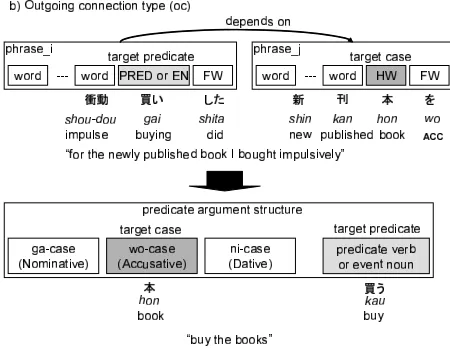
With this type, the target case role is the headword of a phrase and a phrase containing a target predicate or event noun depends on the case role phrase (Fig-ure 2).
[image:3.612.313.538.404.579.2]Figure 3: Type sc
Figure 4: Type ga c, wo c, ni c
3.1.3 ‘Within the Same Phrase’ Type (sc)
With this type, the target case role and the target predicate or event noun are in the same phrase (Fig-ure 3).
3.1.4 ‘Connection into Other Case role Types (ga c, wo c, ni c)
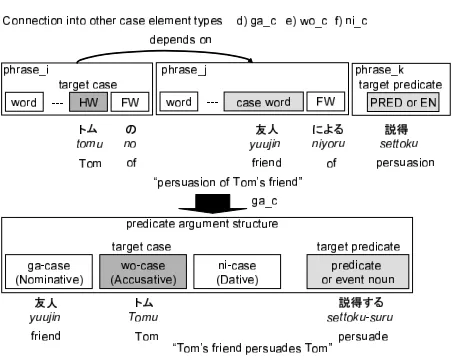
[image:4.612.73.299.284.465.2]With these types, a phrase containing the target case role depends on a phrase containing another predetermined case role (Figure 4). We use the terms ‘ga c’, ‘wo c’ and ‘ni c’ when the predetermined case roles are the ga-case, wo-case and ni-case, re-spectively.
Figure 5: Type nc
3.1.5 Non-connection Type (nc)
With this type, a phrase containing the target case role and a phrase containing the target predicate or event noun are in the same article, but these phrases do not depend on each other (Figure 5).
3.1.6 Optional Type (fw and bw)
Type fw and bw stand for ‘forward’ and ‘back-ward’ types, respectively. Type fw means the word located closest to the target predicate or event noun without considering functional words or voices. With fw, the word is located between the top of the article containing the target predicate and the target predicate or event noun. Similarly, type bw means the word located closest to the target predicate or noun, which is located between the targeted predi-cate or event noun, and the tail of the article con-taining the predicate.
3.2 Generalization Levels
Figure 6: Top 3 levels of the Japanese thesaurus, ‘Ni-hongo Goi Taikei’
the third level, and partly the fourth level, which are similar to semantic roles. We show the top three lev-els of the Nihongo Goi Taikei common noun the-saurus in Figure 6. We annotated the words with their semantic category by hand.
3.3 Functional Word and Voice
We used a functional word in the phrase containing the target case role and active and passive voices for the predicate as base features.
3.4 Training Algorithm
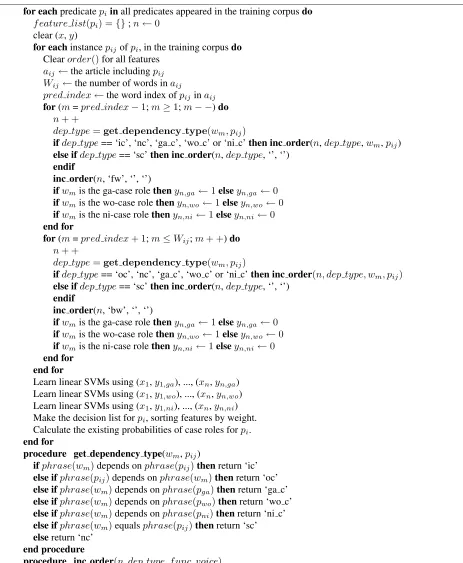
The training algorithm used for our method is shown in Figure 7. First, the algorithm constructs features that search for the words located closest to the tar-get predicate under various constraints. Next, the algorithm learns by using linear Support Vector Ma-chines (SVMs) (Vapnik, 1995). SVMs learn effec-tive features by the one vs. rest method for every case role. We used TinySVM2 as an SVM
imple-mentation. Moreover, we construct decision lists sorted by weight from linear SVMs. Finally, the al-gorithm calculates the existing probabilities of case roles for every predicate or event noun. This step
2http://chasen.org/˜taku/software/TinySVM/
produces the criterion that decides whether or not we will determine the case roles when there is no in-terdependency between the case role candidate and the predicate.
Our split of the NAIST Text Corpus has only 62,264 training samples for 2,874 predicates, and we predict that there will be a shortage of training sam-ples when adopting traditional learning algorithms, such as learning algorithms using entropy. So, we used SVMs with a high generalization capability to learn the decision lists.
3.5 Test Algorithm
The test algorithm of our method is shown in Fig-ure 8. In the test phase, we analyzed test samples using decision lists and the existing probabilities of case roles learned in the training phase. In step 1, we determined case roles using a decision list consisting of features exhibiting case role and predicate inter-dependency, that is, ic, oc, ga c, wo c, and ni c. This is because there are many cases in Japanese where the syntactic constraint is stronger than the seman-tic constraint when we determine the case roles. In step 2, we determined case roles using a decision list of sc (‘in same phrase’) for the case roles that were not determined in step 1. This step was mainly for event nouns. Japanese event nouns frequently form compound nouns that contain case roles. In step 3, we decided whether or not to proceed to the next step by using the existing probabilities of case roles. If the probability was less than a certain threshold (50%), then the algorithm stopped. In step 4, we de-termined case roles using a decision list of the fea-tures that have no interdependency, that is, nc, fw and bw. This step will be executed when the target case role is syntactically necessary and determined by the co-occurrence of the case roles and predicate or event noun without syntactic clues, such as de-pendency, functional words and voices.
4 Experimental Results
4.1 Experimental Setting
ex-for eachpredicatepiinall predicates appeared in the training corpusdo f eature list(pi) ={};n←0
clear (x,y)
for eachinstancepijofpi, in the training corpusdo
Clearorder()for all features
aij←the article includingpij Wij←the number of words inaij
pred index←the word index ofpij inaij for(m=pred index−1;m≥1;m− −)do
n+ +
dep type=get dependency type(wm, pij)
ifdep type== ‘ic’, ‘nc’, ‘ga c’, ‘wo c’ or ‘ni c’then inc order(n,dep type,wm,pij) else ifdep type== ‘sc’then inc order(n,dep type, ‘’, ‘’)
endif
inc order(n, ‘fw’, ‘’, ‘’)
ifwmis the ga-case rolethenyn,ga←1elseyn,ga←0 ifwmis the wo-case rolethenyn,wo←1elseyn,wo←0 ifwmis the ni-case rolethenyn,ni←1elseyn,ni←0 end for
for(m=pred index+ 1;m≤Wij;m+ +)do n+ +
dep type=get dependency type(wm, pij)
ifdep type== ‘oc’, ‘nc’, ‘ga c’, ‘wo c’ or ‘ni c’then inc order(n, dep type, wm, pij) else ifdep type== ‘sc’then inc order(n,dep type, ‘’, ‘’)
endif
inc order(n, ‘bw’, ‘’, ‘’)
ifwmis the ga-case rolethenyn,ga←1elseyn,ga←0
ifwmis the wo-case rolethenyn,wo←1elseyn,wo←0
ifwmis the ni-case rolethenyn,ni←1elseyn,ni←0
end for end for
Learn linear SVMs using (x1,y1,ga), ..., (xn,yn,ga)
Learn linear SVMs using (x1,y1,wo), ..., (xn,yn,wo)
Learn linear SVMs using (x1,y1,ni), ..., (xn,yn,ni)
Make the decision list forpi, sorting features by weight.
Calculate the existing probabilities of case roles forpi. end for
procedure get dependency type(wm,pij)
ifphrase(wm)depends onphrase(pij)thenreturn ‘ic’ else ifphrase(pij)depends onphrase(wm)thenreturn ‘oc’ else ifphrase(wm)depends onphrase(pga)thenreturn ‘ga c’ else ifphrase(wm)depends onphrase(pwo)thenreturn ‘wo c’ else ifphrase(wm)depends onphrase(pni)thenreturn ‘ni c’ else ifphrase(wm)equalsphrase(pij)thenreturn ‘sc’ elsereturn ‘nc’
end procedure
procedure inc order(n, dep type, f unc, voice)
Set a featurefw= (wm, dep type, f unc, voice);order(fw)++ ;iforder(fw)== 1thenxn,fw ←1
Set a featurefs= (sem(wm), dep type, f unc, voice);order(fs)++ ;iforder(fs)== 1thenxn,fs ←1
Set a featurefp= (pos(wm), dep type, f unc, voice);order(fp)++ ;iforder(fp)== 1thenxn,fp ←1
[image:6.612.74.537.54.617.2]Step 1. Determine case roles using a decision list concerning ic, oc, ga c, wo c and ni c. Step 2. Determine case roles using a decision list concerning sc for undetermined case roles in Step.1.
Step 3. If the existing probability of case roles<50% then the program ends. Step 4. Determine case roles using a decision list concerning nc, fw and bw types.
Figure 8: Test algorithm
amples. We used 11,023 predicates and 3,161 event nouns from articles published on January 12th and 13th and the September editorials as development examples. And we used 19,501 predicate and 5,276 event nouns from articles dated January 14th to 17th and editorials dated October to December as test ex-amples. This is a typical way to split the data.
We used the annotations in the Kyoto Text Corpus as the interdependency of bunsetsu phrases. We used both individual and multiple words as case roles. We used the phrase boundaries annotated in the NAIST Text Corpus in the training phase, and used those annotated automatically by our system using POSs and simple rules in the test phase. The accuracy of the automatic annotation is about 90%.
4.2 Baseline Method
To evaluate our algorithm, we conducted experi-ments using a baseline method. With the method, we used only nouns that depended on predicates or event nouns as case role candidates. If the functional word (post-positional case) in the phrase is ‘ga’,‘wo’ and ‘ni’, we determined the ga-case, wo-case, or ni-case for the candidates. Next, as regards event nouns in compound nouns, if there was another word in a compound noun containing an event noun and it co-occurred with the event noun as a case role with a higher probability in the training samples, then the word was selected for the case role.
4.3 Entropy Method
[image:7.612.313.539.207.280.2]The conventional approach for making decision lists utilizes the entropy of samples selected by the rules (Yarowsky, 1994) (Goodman, 2002). We per-formed comparative experiments using Yarowsky’s entropy algorithm (Yarowsky, 1994).
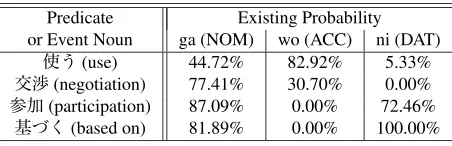
Table 3: Existing probabilities of case roles for predicates and event nouns
Predicate Existing Probability or Event Noun ga (NOM) wo (ACC) ni (DAT)
使う(use) 44.72% 82.92% 5.33%
交渉(negotiation) 77.41% 30.70% 0.00% 参加(participation) 87.09% 0.00% 72.46%
基づく(based on) 81.89% 0.00% 100.00%
4.4 Overall Results
The overall results are shown in Table 7. Here, ‘en-tropy’ indicates Yarowsky’s algorithm, which uses entropy (Yarowsky, 1994). Throughout the test data, the F-measure (%) of our method exceeded that of the baseline system and the ‘entropy’ system. With the ga-case (nominative) in particular, the F-measure increased 9 points.
Table 3 shows some examples of the existing probabilities of case roles for predicates or event nouns. When the probabilities are extreme values such as the ni-case (dative) of交渉(negotiation), the
wo-case (accusative) of参加(participation), and the
wo-case and ni-base of基づく(based on), we can decide to fill the targeted case role or not with high precision. However, it is difficult to decide to fill the targeted case role or not when the probability is close to 50 percent as in the ga-case of使う(use).
We show the learned decision list of the ic type (the case role depends on the predicate or event noun), sc type (in the same phrase) and the other types for event noun交渉(negotiation) in Tables 4, 5
Table 4: Decision list for ic type of event noun交渉(negotiation)
order case dep type level head word functional voice weight
word
1 ga ic word 北朝鮮人民共和国(North Korea) の(of) active 0.9820
2 ga ic sem 地域(REGION) の(of) active 0.6381
3 ga ic word 日米両国(both Japan and U.S.) の(of) active 0.5502
4 wo ic word 合弁会社設立(establishment of joint ventures) の(of) active 0.5288 5 wo ic word 電気通信分野(telecommunications) の(of) active 0.4142 6 wo ic word 北朝鮮人民共和国(North Korea) との(for) active 0.3168
7 wo ic word 行為(ACTION) の(of) active 0.3083
8 ga ic sem 未分類語(OOV NOUN) の(of) active 0.2939
9 wo ic word 自動車・同部品分野(car and auto parts sector) の(of) active 0.2775
[image:8.612.84.533.271.408.2]10 wo ic sem 場(LOCATION) の(of) active 0.2471
Table 5: Decision list for sc type of event noun交渉(negotiation)
order case dep type level head word weight
1 wo sc sem 事象(EVENT) 1.1738
2 wo sc word 協定(arrangement) 1.0000
3 ga sc word 日中航空(airline of Japan and China) 0.9392
4 wo sc sem 思考(MENTAL STATE) 0.8958
5 ga sc word 日米金融サービス分野(financial services of Japan and U.S.) 0.8371
6 wo sc word 契約更改(contract extension) 0.7870
7 wo sc word 合弁(joint venture) 0.7865
8 wo sc word 知的所有権(intellectual property rights) 0.7224
9 wo sc word 自動車・同部品(car and auto parts) 0.7196
10 ga sc word 日朝(Japan and North Korea) 0.6771
Table 6: Decision list for other types of event noun交渉(negotiation)
order case dep type level head word functional word voice weight
1 ga fw word 日米(Japan and U.S.) 1.9954
2 ga fw word 台湾(Taiwan) 1.9952
3 ga fw word 米朝(U.S. and North Korea) 1.4979
4 ga fw word 英中(U.K. and China) 1.1773
5 ga nc word 両国(both nations) は(TOP) active 1.1379
6 wo fw word 国交正常化(diplomatic normalization) 1.0000
7 ga bw word 米朝(U.S. and North Korea) 1.0000
8 ga fw word 労使(capital and labor) 1.0000
9 wo fw word 自動車分野(automotive area) 1.0000
10 ga nc word 双方(both sides) は(TOP) active 1.0000
Table 7: Overall results for NAIST Text Corpus (F-measure(%))
training data test data
sentence ga (NOM) wo (ACC) ni (DAT) sentence ga (NOM) wo (ACC) ni (DAT)
baseline 25.32 32.58 74.51 82.70 21.34 30.08 69.48 76.62
entropy 73.46 89.53 92.72 91.09 33.10 45.67 73.28 77.77
[image:8.612.64.543.453.592.2] [image:8.612.77.542.634.701.2]Table 8: Results for predicates in test sets (F-measure(%)) baseline / our method
ga (Nominative) wo (Accusative) ni (Dative)
all 34.44 / 57.40 77.00 / 79.50 79.83 / 83.15
dependency relations 51.96 / 75.53 85.42 / 88.20 81.83 / 89.51
zero-anaphoric (intra-sentential) 0.00 / 30.15 0.00 / 11.41 0.00 / 3.66
zero-anaphoric (inter-sentential) 1.85 / 23.45 3.00 / 9.32 0.00 / 11.76
in same phrase 0.00 / 75.00 0.00 / 51.78 0.00 / 84.65
Table 9: Results for event nouns (F-measure(%)) baseline / our method
ga (Nominative) wo (Accusative) ni (Dative)
all 11.05 / 45.64 32.30 / 61.80 20.85 / 38.88
dependency relations 12.98 / 68.01 25.00 / 62.46 40.00 / 56.05
zero-anaphoric (intra-sentential) 0.00 / 36.19 0.00 / 20.46 0.00 / 6.62
zero-anaphoric (inter-sentential) 1.40 / 23.25 1.06 / 10.37 0.00 / 3.51
in same phrase 58.76 / 78.93 47.44 / 77.96 28.91 / 58.13
form. This means local knowledge of relations be-tween case roles and predicates or event nouns in the word level is more important than semantic level knowledge.
4.5 Results for Predicates in Test Sets
We show the results we obtained for predicates in Table 8. The results reveal that our method is supe-rior to the baseline system. Our algorithm is partic-ularly effective in the ga-case.
4.6 Results for Event Nouns in Test Sets
We show the results we obtained for event nouns in Table 9. This also shows that our method is superior to the baseline system. The precision with sc type is high and our method is effective as regards event nouns.
5 Conclusion
We presented a new method for Japanese automatic predicate argument structure analysis using deci-sion lists based on the features of the words located closest to the target predicate under various con-straints. The method learns the relative weights of these different features for case roles and ranks them using decision lists. Using our method, we inte-grated the knowledge of case role determination and zero-pronoun identification, and generally achieved a high precision in Japanese PAS analysis. In
par-ticular, we can extract knowledge at various levels from the corpus for event nouns. In future, we will use richer constraints and research better ways of distinguishing whether or not cases are obligatory.
Acknowledgments
We thank Ryu Iida and Yuji Matsumoto of NAIST for the definitions of the case roles in the NAIST Text Corpus and functional words, and Franklin Chang for valuable comments.
References
Charles J. Fillmore, Charles Wooters, and Collin F. Baker. 2001. Building a large lexical databank which provides deep semantics. InProc. of the Pacific Asian Conference on Language, Information and Computa-tion (PACLING).
Joshua Goodman. 2002. An incremental decision list learner. In Proc. of the ACL-02 Conference on Empirical Methods in Natural Language Process-ing(EMNLP02), pages 17–24.
Kouichi Hashida. 2005. Global document annotation (GDA) manual. http://i-content.org/GDA/.
Confer-ence on Computational Linguistics and 44th Annual Meeting of the ACL, pages 625–632.
Ryu Iida, Mamoru Komachi, Kentaro Inui, and Yuji Mat-sumoto. 2007. Annotating a Japanese text corpus with predicate-argument and coreference relations. In
Proc. of ACL 2007 Workshop on Linguistic Annota-tion, pages 132–139.
Satoru Ikehara, Masahiro Miyazaki, Satoshi Shirai, Akio Yokoo, Hiromi Nakaiwa, Kentaro Ogura, Yoshifumi Ooyama, and Yoshihiko Hayashi. 1997. Nihongo Goi Taikei, A Japanese Lexicon. Iwanami Shoten, Tokyo. Zheng Ping Jiang and Hwee Tou Ng. 2006. Semantic
role labeling of NomBank: A maximum entropy ap-proach. InProc. of the Conference on Empirical Meth-ods in Natural Language Processing.
Daisuke Kawahara, Sadao Kurohashi, and Koichi Hashida. 2002. Construction of a Japanese relevance-tagged corpus (in Japanese). Proc. of the 8th Annual Meeting of the Association for Natural Language Pro-cessing, pages 495–498.
Mamoru Komachi, Ryu Iida, Kentaro Inui, and Yuji Mat-sumoto. 2007. Learning-based argument structure analysis of event-nouns in Japanese. In Proc. of the Conference of the Pacific Association for Computa-tional Linguistics (PACLING), pages 120–128. Chang Liu and Hwee Tou Ng. 2007. Learning predictive
structures for semantic role labeling of NomBank. In
Proc. of the 45th Annual Meeting of the Association for Computational Linguistics (ACL), pages 208–215. Gabor Melli, Yang Wang, Yudong Liu, Mehdi M. Kashani, Zhongmin Shi, Baohua Gu, Anoop Sarkar, and Fred Popowich. 2005. Description of SQUASH, the SFU question answering summary handler for the DUC-2005 summarization task. In Proc. of DUC 2005.
Adam Meyers, Ruth Reeves, Catherine Macleod, Rachel Szekely, Veronika Zielinska, Brian Young, and Ralph Grishman. 2004. The NomBank project: An interim report. In Proc. of HLT-NAACL 2004 Workshop on Frontiers in Corpus Annotation.
Hiromi Nakaiwa. 1997. Automatic identification of zero pronouns and their antecedents within aligned sen-tence pairs. In Proc. of the 3rd Annual Meeting of the Association for Natural Language Processing (in Japanese).
Srini Narayanan and Sanda Harabagiu. 2004. Question answering based on semantic structures. InProc. of the 20th International Conference on Computational Linguistics (COLING).
M. Palmer, P. Kingsbury, and D. Gildea. 2005. The proposition bank: An annotated corpus of semantic roles. Computational Linguistics, 31(1):71–106.
Sameer Pradhan, Waybe Ward, Kadri Hacioglu, James Martin, and Dan Jurafsky. 2004. Shallow seman-tic parsing using support vector machines. In Proc. of the Human Language Technology Conference/North American Chapter of the Association of Computa-tional Linguistics HLT/NAACL 2004.
Dan Shen and Mirella Lapata. 2007. Using semantic roles to improve question answering. InProc. of the 2007 Joint Conference on Empirical Methods in Natu-ral Language Processing and Computational NatuNatu-ral Language Learning (EMNLP/CoNLL), pages 12–21. V. Vapnik. 1995.The Nature of Statistical Learning
The-ory. Springer-Verlag, New York.
M. Walker, M. Iida, and S. Cote. 1994. Japanese dis-course and the process of centering. Computational Linguistics, 20(2):193–233.
Nianwen Xue. 2006. Semantic role labeling of nomi-nalized predicates in Chinese. In Proc. of the HLT-NAACL, pages 431–438.