Maximum Entropy based Rule Selection Model for
Syntax-based Statistical Machine Translation
Qun Liu1
and Zhongjun He1,2
and Yang Liu1
and Shouxun Lin1 1
Key Laboratory of Intelligent Information Processing Institute of Computing Technology, Chinese Academy of Sciences
Beijing, 100190, China 2
Graduate University of Chinese Academy of Sciences Beijing, 100049, China
{liuqun,zjhe,yliu,sxlin}@ict.ac.cn
Abstract
This paper proposes a novel maximum en-tropy based rule selection (MERS) model for syntax-based statistical machine transla-tion (SMT). The MERS model combines lo-cal contextual information around rules and information of sub-trees covered by variables in rules. Therefore, our model allows the de-coder to perform context-dependent rule se-lection during decoding. We incorporate the MERS model into a state-of-the-art linguis-tically syntax-based SMT model, the tree-to-string alignment template model. Experi-ments show that our approach achieves signif-icant improvements over the baseline system.
1 Introduction
Syntax-based statistical machine translation (SMT) models (Liu et al., 2006; Galley et al., 2006; Huang et al., 2006) capture long distance reorderings by us-ing rules with structural and lus-inguistical information as translation knowledge. Typically, a translation rule consists of a source-side and a target-side. How-ever, the source-side of a rule usually corresponds to multiple target-sides in multiple rules. Therefore, during decoding, the decoder should select a correct target-side for a source-side. We call thisrule selec-tion.
Rule selection is of great importance to syntax-based SMT systems. Comparing with word selec-tion in word-based SMT and phrase selecselec-tion in phrase-based SMT, rule selection is more generic and important. This is because that a rule not only contains terminals (words or phrases), but also
con-NP
DNP
NP
X1 DEG
NPB
NN
X2 NN
NP
DNP
NP
X1 DEG
NPB
NN
X2 NN
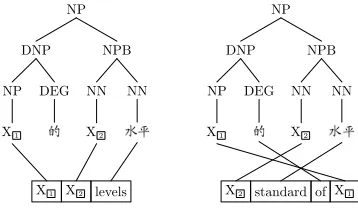
[image:1.612.336.515.240.344.2]X1 X2 levels X2 standard of X1
Figure 1: Example of translation rules
tains nonterminals and structural information. Ter-minals indicate lexical translations, while nontermi-nals and structural information can capture short or long distance reorderings. See rules in Figure 1 for illustration. These two rules share the same syntactic tree on the source side. However, on the target side, either the translations for terminals or the phrase re-orderings for nonterminals are quite different. Dur-ing decodDur-ing, when a rule is selected and applied to a source text, both lexical translations (for terminals) and reorderings (for nonterminals) are determined. Therefore, rule selection affects both lexical transla-tion and phrase reordering.
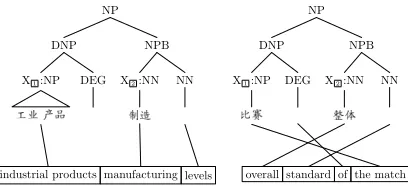
However, most of the current syntax-based sys-tems ignore contextual information when they se-lecting rules during decoding, especially the infor-mation of sub-trees covered by nonterminals. For example, the information of X1 and X2 is not recorded when the rules in Figure 1 extracted from the training examples in Figure 2. This makes the decoder hardly distinguish the two rules. Intuitively, information of sub-trees covered by nonterminals as well as contextual information of rules are believed
NP
DNP
X1:NP DEG
NPB
X2:NN NN
NP
DNP
X1:NP DEG
NPB
X2:NN NN
[image:2.612.84.288.55.148.2]industrial products manufacturing levels overall standard of the match
Figure 2: Training examples for rules in Figure 1
to be helpful for rule selection.
Recent research showed that contextual infor-mation can help perform word or phrase selec-tion. Carpuat and Wu (2007b) and Chan et al. (2007) showed improvents by integrating word-sense-disambiguation (WSD) system into a based (Koehn, 2004) and a hierarchical phrase-based (Chiang, 2005) SMT system, respectively. Similar to WSD, Carpuat and Wu (2007a) used con-textual information to solve the ambiguity prob-lem for phrases. They integrated a phrase-sense-disambiguation (PSD) model into a phrase-based SMT system and achieved improvements.
In this paper, we propose a novel solution for rule selection for syntax-based SMT. We use the maximum entropy approach to combine rich con-textual information around a rule and the informa-tion of sub-trees covered by nonterminals in a rule. For each ambiguous source-side of translation rules, a maximum entropy based rule selection (MERS) model is built. Thus the MERS models can help the decoder to perform a context-dependent rule selec-tion.
Comparing with WSD (or PSD), there are some advantages of our approach:
• Our approach resolves ambiguity for rules with multi-level syntactic structure, while WSD re-solves ambiguity for strings that have no struc-tures;
• Our approach can help the decoder perform both lexical selection and phrase reorderings, while WSD can help the decoder only perform lexical selection;
• Our method takes WSD as a special case, since a rule may only consists of terminals.
In our previous work (He et al., 2008), we re-ported improvements by integrating a MERS model into a formally syntax-based SMT model, the hier-archical phrase-based model (Chiang, 2005). In this paper, we incorporate the MERS model into a state-of-the-art linguistically syntax-based SMT model, the tree-to-string alignment template (TAT) model (Liu et al., 2006). The basic differences are:
• The MERS model here combines rich informa-tion of source syntactic tree as features since the translation model is linguistically syntax-based. He et al. (2008) did not use this in-formation.
• In this paper, we build MERS models for all ambiguous source-sides, including lexicalized (source-side which only contains terminals), partially lexicalized (source-side which con-tains both terminals and nonterminals), and un-lexicalized (source-side which only contains nonterminals). He et al. (2008) only built MERS models for partially lexicalized source-sides.
In the TAT model, a TAT can be considered as a translation rule which describes correspondence be-tween source syntactic tree and target string. TAT can capture linguistically motivated reorderings at short or long distance. Experiments show that by incorporating MERS model, the baseline system achieves statistically significant improvement.
This paper is organized as follows: Section 2 reviews the TAT model; Section 3 introduces the MERS model and describes feature definitions; Sec-tion 4 demonstrates a method to incorporate the MERS model into the translation model; Section 5 reports and analyzes experimental results; Section 6 gives conclusions.
2 Baseline System
Our baseline system is Lynx (Liu et al., 2006), which is a linguistically syntax-based SMT system. For translating a source sentencef1J =f1...fj...fJ,
Lynx firstly employs a parser to produce a source syntactic tree T(f1J), and then uses the source
!
eI1=argmaxe!I
1P r(e
I
1|f1J)
(1)
=argmaxe!I
1P r(T(f
J
1)|f1J)P r(eI1|T(f1J))
In doing this, Lynx uses tree-to-string alignment template to build relationship between source syn-tactic tree and target string. A TAT is actually a translation rule: the source-side is a parser tree with leaves consisting of words and nonterminals, the target-side is a target string consisting of words and nonterminals.
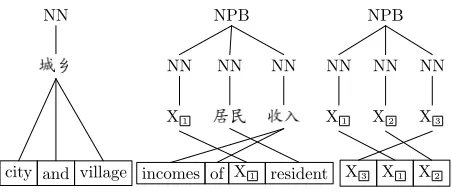
TAT can be learned from word-aligned, source-parsed parallel corpus. Figure 4 shows three types of TATs extracted from the training example in Fig-ure 3: lexicalized (the left), partially lexicalized (the middle), unlexicalized (the right). Lexicalized TAT contains only terminals, which is similar to phrase-to-phrase translation in phrase-based model except that it is constrained by a syntactic tree on the source-side. Partially lexicalized TAT contains both terminals and non-terminals, which can be used for both lexical translation and phrase reordering. Un-lexicalized TAT contains only nonterminals and can only be used for phrase reordering.
Lynx builds translation model in a log-linear framework (Och and Ney, 2002):
P(eI1|T(f1J)) =
(2)
exp["mλmhm(eI1, T(f1J))] "
e!exp[ "
mλmhm(eI1, T(f1J))]
Following features are used:
• Translation probabilities:P(e!|T!)andP(T!|e!);
• Lexical weights:Pw(e!|T!)andPw(T!|!e);
• TAT penalty: exp(1), which is analogous to phrase penalty in phrase-based model;
• Language modelPlm(eI1);
• Word penaltyI.
In Lynx, rule selection mainly depends on trans-lation probabilities and lexical weights. These four scores describe how well a source tree links to a tar-get string, which are estimated on the training cor-pus according to occurrence times of!eandT!. There
IP
NPB
NN NN NN
VP
VV VPB
VV
[image:3.612.315.537.56.177.2]The incomes of city and village resident continued to grow
Figure 3: Word-aligned, source-parsed training example.
NN NPB
NN
X1
NN NN
NPB
NN
X1
NN
X2
NN
X3
city and village incomes of X1 resident X3 X1 X2
Figure 4: TATs learned from the training example in Fig-ure 3.
are no features in Lynx that can capture contextual information during decoding, except for then-gram language model which considers the left and right neighboringn-1 target words. But this information it very limited.
3 The Maximum Entropy based Rule Selection Model
3.1 The model
In this paper, we focus on using contextual infor-mation to help the TAT model perform context-dependent rule selection. We consider the rule se-lection task as a multi-class classification task: for a source syntactic treeT!, each corresponding target string e!is a label. Thus during decoding, when a TAT!T ,! e!!" is selected,T! is classified into labele!!,
actually.
A good way to solve the classification problem is the maximum entropy approach:
Prs(e!|T , T! (Xk)) =
(3)
exp["iλihi(e, C! (T!), T(Xk))]
" !
e!exp[ "
[image:3.612.314.540.216.312.2]whereT!and!eare the source tree and target string of a TAT, respectively. hiis a binary feature functions
andλiis the feature weight ofhi.C(T!)defines local
contextual information ofT!.Xkis a nonterminal in
the source treeT!, wherekis an index.T(Xk)is the
source sub-tree covered byXk.
The advantage of the MERS model is that it uses rich contextual information to compute posterior probability for e! given T!. However, the transla-tion probabilities and lexical weights in Lynx ignore these information.
Note that for each ambiguous source tree, we build a MERS model. That means, if there are N source trees extracted from the training corpus are ambiguous (the source tree which corresponds to multiple translations), thus for each ambiguous source tree Ti (i = 1, ..., N), a MERS model Mi
(i = 1, ..., N) is built. Since a source tree may cor-respond to several hundreds of target translations at most, the feature space of a MERS model is not pro-hibitively large. Thus the complexity for training a MERS model is low.
3.2 Feature Definition
Let !T ,! e!" be a translation rule in the TAT model. We usef(T!)to represent the source phrase covered byT!. To build a MERS model for the source treeT!, we explore various features listed below.
1. Lexical Features (LF)
These features are defined on source words. Specifically, there are two kinds of lexical fea-tures: external features f−1 and f+1, which
are the source words immediately to the left and right of f(T!), respectively; internal fea-tures fL(T(Xk)) and fR(T(Xk)), which are
the left most and right most boundary words of the source phrase covered byT(Xk),
respec-tively.
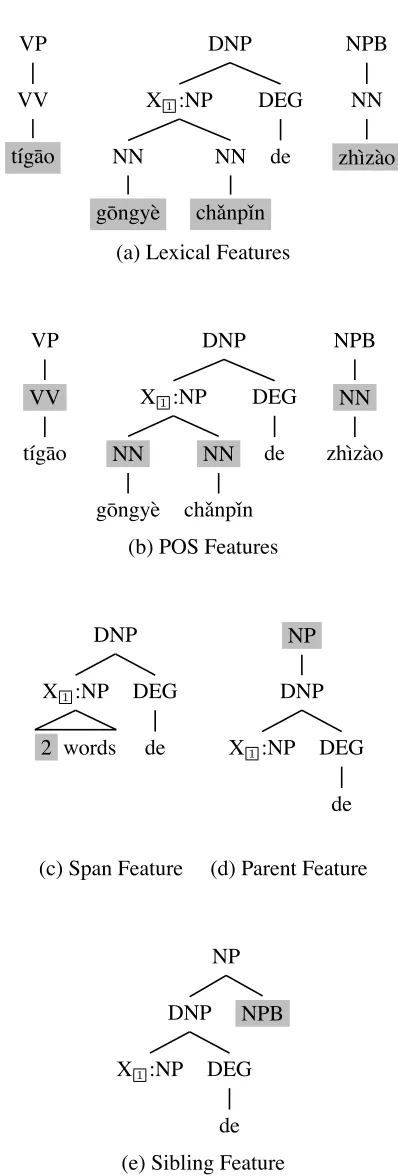
See Figure 5 (a) for illustration. In this example, f−1=t´ıg¯ao, f+1=zh`ız`ao,
fL(T(X1))=g¯ongy`e,fR(T(X1))=chˇanpˇın.
2. Parts-of-speech (POS) Features (POSF) These features are the POS tags of the source words defined in the lexical features: P−1,
P+1, PL(T(Xk)), PR(T(Xk)) are the POS
tags off−1, f+1,fL(T(Xk)),fR(T(Xk)),
re-VP
VV
t´ıg¯ao
DNP
X1:NP
NN
g¯ongy`e
NN
chˇanpˇın DEG
de
NPB
NN
zh`ız`ao
(a) Lexical Features
VP
VV
t´ıg¯ao
DNP
X1:NP
NN
g¯ongy`e
NN
chˇanpˇın DEG
de
NPB
NN
zh`ız`ao
(b) POS Features
DNP
X1:NP
2 words DEG
de
NP
DNP
X1:NP DEG
de
(c) Span Feature (d) Parent Feature
NP
DNP
X1:NP DEG
de NPB
[image:4.612.325.524.42.630.2](e) Sibling Feature
Figure 5: Illustration of features of the MERS model. The source tree of the TAT is !DNP(NP X1) (DEG de)".
spectively. POS tags can generalize over all training examples.
Figure 5 (b) shows POS features. P−1=VV,
P+1=NN,PL(T(X1))=NN,PR(T(X1))=NN.
3. Span Features (SPF)
These features are the length of the source phrasef(T(Xk))covered byT(Xk). In Liu’s
TAT model, the knowledge learned from a short span can be used for a larger span. This is not reliable. Thus we use span features to allow the MERS model to learn a preference for short or large span.
In Figure 5 (c), the span of X1 is 2.
4. Parent Feature (PF)
The parent node ofT! in the parser tree of the source sentence. The same source sub-tree may have different parent nodes in different training examples. Therefore, this feature may provide information for distinguishing source sub-trees.
Figure 5 (d) shows that the parent is aNPnode.
5. Sibling Features (SBF)
The siblings of the root ofT!. This feature con-siders neighboring nodes which share the same parent node.
In Figure 5 (e), the source tree has one sibling nodeNPB.
Those features make use of rich information around a rule, including the contextual information of a rule and the information of sub-trees covered by nonterminals. They are never used in Liu’s TAT model.
Figure 5 shows features for a partially lexicalized source tree. Furthermore, we also build MERS mod-els for lexicalized and unlexicalized source trees. Note that for lexicalized tree, features do not include the information of sub-trees since there is no nonter-minals.
The features can be easily obtained by modify-ing the TAT extraction algorithm described in (Liu et al., 2006). When a TAT is extracted from a word-aligned, source-parsed parallel sentence, we just record the contextual features and the features of the sub-trees. Then we use the toolkit implemented
by Zhang (2004) to train MERS models for the am-biguous source syntactic trees separately. We set the iteration number to 100 and Gaussian prior to 1.
4 Integrating the MERS Models into the Translation Model
We integrate the MERS models into the TAT model during the translation of each source sentence. Thus the MERS models can help the decoder perform context-dependent rule selection during decoding.
For integration, we add two new features into the log-linear translation model:
• Prs(e!|T , T! (Xk)). This feature is computed by
the MERS model according to equation (3), which gives a probability that the model select-ing a target-sidee!given an ambiguous source-side T!, considering rich contextual informa-tion.
• Pap = exp(1). During decoding, if a source
tree has multiple translations, this feature is set toexp(1), otherwise it is set to exp(0). Since the MERS models are only built for ambiguous source trees, the first featurePrs(!e|T , T! (Xk))
for non-ambiguous source tree will be set to 1.0. Therefore, the decoder will prefer to use non-ambiguous TATs. However, non-ambiguous TATs usually occur only once in the training corpus, which are not reliable. Thus we use this feature to reward ambiguous TATs.
The advantage of our integration is that we need not change the main decoding algorithm of Lynx. Furthermore, the weights of the new features can be trained together with other features of the translation model.
5 Experiments
5.1 Corpus
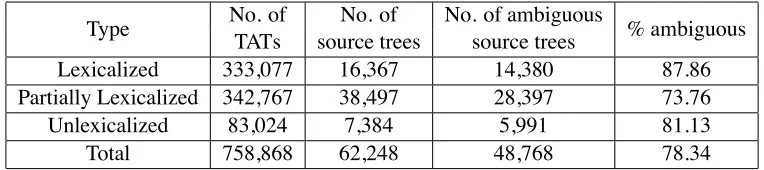
No. of No. of No. of ambiguous Type
TATs source trees source trees % ambiguous
Lexicalized 333,077 16,367 14,380 87.86
Partially Lexicalized 342,767 38,497 28,397 73.76
Unlexicalized 83,024 7,384 5,991 81.13
[image:6.612.115.497.57.142.2]Total 758,868 62,248 48,768 78.34
Table 1: Statistical information of TATs filtered by test sets of NIST MT 2003 and 2005.
System Features
P(e!|T!) P(T!|e!) Pw(e!|T!) Pw(T!|e!) lm1 lm2 TP WP Prs AP
Lynx 0.210 0.016 0.081 0.051 0.171 0.013 -0.055 0.403 -
-+MERS 0.031 0.008 0.020 0.080 0.152 0.014 0.027 0.270 0.194 0.207
Table 2: Feature weights obtained by minimum error rate training on the development set. The first 8 features are used by Lynx. TP=TAT penalty, WP=word penalty, AP=ambiguous TAT penalty. Note that in fact, the positive weight for WP and AP indicate a reward.
the training corpus and the Xinhua portion of the Gi-gaword corpus, respectively. NIST MT 2002 test set is used as the development set. NIST MT 2003 and NIST MT 2005 test sets are used as the test sets. The translation quality is evaluated by BLEU met-ric (Papineni et al., 2002), as calculated by mteval-v11b.pl with case-insensitive matching ofn-grams, wheren= 4.
5.2 Training
To train the translation model, we first run GIZA++ (Och and Ney, 2000) to obtain word alignment in both translation directions. Then the word alignment is refined by performing “grow-diag-final” method (Koehn et al., 2003). We use a Chinese parser de-veloped by Deyi Xiong (Xiong et al., 2005) to parse the Chinese sentences of the training corpus.
Our TAT extraction algorithm is similar to Liu et al. (2006), except that we make some tiny modifica-tions to extract contextual features for MERS mod-els. To extract TAT, we set the maximum height of the source sub-tree toh= 3, the maximum number of direct descendants of a node of sub-tree toc= 5. See (Liu et al., 2006) for specific definitions of these parameters.
Table 1 shows statistical information of TATs which are filtered by the two test sets. For each type (lexicalized, partially lexicalized, unlexicalized) of TATs, a great portion of the source trees are am-biguous. The number of ambiguous source trees
ac-counts for 78.34% of the total source trees. This in-dicates that the TAT model faces serious rule selec-tion problem during decoding.
5.3 Results
We use Lynx as the baseline system. Then the MERS models are incorporated into Lynx, and the system is called Lynx+MERS. To run the decoder, Lynx and Lynx+MERS share the same settings: tatTable-limit=30, tatTable-threshold=0, stack-limit=100, stack-threshold=0.00001. The meanings of the pruning parameters are the same to Liu et al. (2006).
Test Set System BLEU-4 Individual n-gram precisions
1 2 3 4
NIST03 Lynx 26.15 71.62 35.64 18.64 9.82 +MERS 27.05 72.00 36.72 19.51 10.37
[image:7.612.161.455.57.139.2]NIST05 Lynx 26.09 70.39 35.12 18.53 10.11 +MERS 27.28 71.16 36.19 19.62 10.95
Table 3: BLEU-4 scores (case-insensitive) on the test sets.
5.4 Analysis
The baseline system only uses four features for rule selection: the translation probabilities P(!e|T!)
and P(T!|e!); and the lexical weights Pw(e!|T!) and
Pw(T!|e!). These features are estimated on the
train-ing corpus by the maximum likelihood approach, which does not allow the decoder to perform a con-text dependent rule selection. Although Lynx uses language model as feature, the n-gram language model only considers the left and right n-1 neigh-boring target words.
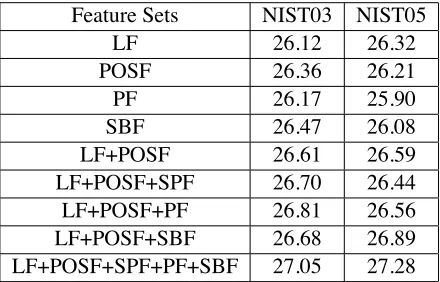
The MERS models combines rich contextual in-formation as features to help the decoder perform rule selection. Table 4 shows the effect of different feature sets. We test two classes of feature sets: the single feature (the top four rows of Table 4) and the combination of features (the bottom five rows of Ta-ble 4). For the single feature set, the POS tags are the most useful and stable features. Using this fea-ture, Lynx+MERS achieves improvements on both the test sets. The reason is that POS tags can be gen-eralized over all training examples, which can alle-viate the data sparseness problem.
Although we find that some single features may hurt the BLEU score, they are useful in combina-tion of features. This is because one of the strengths of the maximum entropy model is that it can in-corporate various features to perform classification. Therefore, using all features defined in Section 3.2, we obtain statistically significant improvements (the last row of Table 4). In order to know how the MERS models improve translation quality, we in-spect the 1-best outputs of Lynx and Lynx+MERS. We find that the first way that the MERS models help the decoder is that they can perform better selection for words or phrases, similar to the effect of WSD or PSD. This is because that lexicalized and partially lexicalized TAT contains terminals. Considering the
Feature Sets NIST03 NIST05
LF 26.12 26.32
POSF 26.36 26.21
PF 26.17 25.90
SBF 26.47 26.08
LF+POSF 26.61 26.59
LF+POSF+SPF 26.70 26.44
LF+POSF+PF 26.81 26.56
LF+POSF+SBF 26.68 26.89
LF+POSF+SPF+PF+SBF 27.05 27.28
Table 4: BLEU-4 scores on different feature sets.
following examples:
• Source:
• Reference: Malta is located in southern Eu-rope
• Lynx: Malta in southern Europe
• Lynx+MERS: Malta is located in southern Eu-rope
Here the Chinese word “ ” is incor-rectly translated into “in” by the baseline system. Lynx+MERS produces the correct translation “is lo-cated in”. That is because, the MERS model consid-ers more contextual information for rule selection. In the MERS model,Prs(in| ) = 0.09, which is
smaller thanPrs(is located in| ) = 0.14.
There-fore, the MERS model prefers the translation “is lo-cated in”. Note that here the source tree (VV ) is lexicalized, and the role of the MERS model is actually the same as WSD.
[image:7.612.317.537.184.325.2]• Source: [ ]1 [ ]2
...
• Reference: According to its [development strategy]2[in the Chinese market]1...
• Lynx: Accordance with [the Chinese market]1
[development strategy]2...
• Lynx+MERS: According to the [development strategy]2[in the Chinese market]1
The syntactic tree of the Chinese phrase “
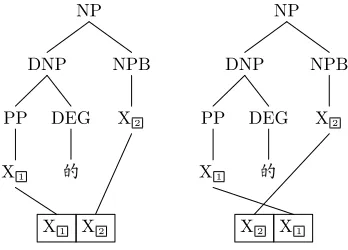
” is shown in Figure 6. How-ever, there are two TATs which can be applied to the source tree, as shown in Figure 7. The baseline sys-tem selects the left TAT and produces a monotone translation of the subtrees “X1:PP” and “X2:NPB”. However, Lynx+MERS uses the right TAT and per-forms correct phrase reordering by swapping the two source phrases. Here the source tree is partially lex-icalized, and both the contextual information and the information of sub-trees covered by nontermi-nals are considered by the MERS model.
6 Conclusion
In this paper, we propose a maximum entropy based rule selection model for syntax-based SMT. We use two kinds information as features: the local-contextual information of a rule, the information of sub-trees matched by nonterminals in a rule. During decoding, these features allow the decoder to per-form a context-dependent rule selection. However, this information is never used in most of the current syntax-based SMT models.
The advantage of the MERS model is that it can help the decoder not only perform lexical selection, but also phrase reorderings. We demonstrate one way to incorporate the MERS models into a state-of-the-art linguistically syntax-based SMT model, the tree-to-string alignment model. Experiments show that by incorporating the MERS models, the baseline system achieves statistically significant im-provements.
We find that rich contextual information can im-prove translation quality for a syntax-based SMT system. In future, we will explore more sophisti-cated features for the MERS model. Moreover, we will test the performance of the MERS model on large scale corpus.
NP
DNP
PP DEG
NPB
in Chinese market of
[image:8.612.315.539.55.178.2]development strategy
Figure 6: Syntactic tree of the source phrase “ ”.
NP
DNP
PP
X1
DEG NPB
X2
NP
DNP
PP
X1
DEG NPB
X2
X1 X2 X2 X1
Figure 7: TATs which can be used for the source phrase
“ ”.
Acknowledgements
We would like to thank Yajuan Lv for her valuable suggestions. This work was supported by the Na-tional Natural Science Foundation of China (NO. 60573188 and 60736014), and the High Technology Research and Development Program of China (NO. 2006AA010108).
References
Marine Carpuat and Dekai Wu. 2007a. How phrase sense disambiguation outperforms word sense disam-biguation for statistical machine translation. In11th Conference on Theoretical and Methodological Issues in Machine Translation, pages 43–52.
Marine Carpuat and Dekai Wu. 2007b. Improving sta-tistical machine translation using word sense disam-biguation. In Proceedings of EMNLP-CoNLL 2007, pages 61–72.
[image:8.612.339.513.229.354.2]Meeting of the Association for Computational Linguis-tics, pages 33–40.
Stanley F. Chen and Joshua Goodman. 1998. An empir-ical study of smoothing techniques for language mod-eling. Technical Report TR-10-98, Harvard University Center for Research in Computing Technology. David Chiang. 2005. A hierarchical phrase-based model
for statistical machine translation. In Proceedings of the 43rd Annual Meeting of the Association for Com-putational Linguistics, pages 263–270.
M. Collins, P. Koehn, and I. Kucerova. 2005. Clause re-structuring for statistical machine translation. InProc. of ACL05, pages 531–540.
Michel Galley, Jonathan Graehl, Kevin Knight, Daniel Marcu, Steve DeNeefe, Wei Wang, and Ignacio Thayer. 2006. Scalable inference and training of context-rich syntactic translation models. In Proceed-ings of COLING-ACL 2006, pages 961–968.
Zhongjun He, Qun Liu, and Shouxun Lin. 2008. Im-proving statistical machine translation using lexical-ized rule selection. In Proceedings of the 22nd In-ternational Conference on Computational Linguistics (Coling 2008), pages 321–328.
Liang Huang, Kevin Knight, and Aravind Joshi. 2006. Statistical syntax-directed translation with extended domain of locality. InProceedings of the 7th Biennial Conference of the Association for Machine Translation in the Americas.
Philipp Koehn, Franz J. Och, and Daniel Marcu. 2003. Statistical phrase-based translation. InProceedings of HLT-NAACL 2003, pages 127–133.
Philipp Koehn. 2004. Pharaoh: a beam search decoder for phrase-based statistical machine translation mod-els. In Proceedings of the Sixth Conference of the Association for Machine Translation in the Americas, pages 115–124.
Yang Liu, Qun Liu, and Shouxun Lin. 2006. Tree-to-string alignment template for statistical machine trans-lation. InProceedings of the 44th Annual Meeting of the Association for Computational Linguistics, pages 609–616.
Franz Josef Och and Hermann Ney. 2000. Improved sta-tistical alignment models. InProceedings of the 38th Annual Meeting of the Association for Computational Linguistics, pages 440–447.
Franz Josef Och and Hermann Ney. 2002. Discrimina-tive training and maximum entropy models for statis-tical machine translation. InProceedings of the 40th Annual Meeting of the Association for Computational Linguistics, pages 295–302.
Franz Josef Och. 2003. Minimum error rate training in statistical machine translation. InProceedings of the 41st Annual Meeting of the Association for Computa-tional Linguistics, pages 160–167.
K. Papineni, S. Roukos, T. Ward, and W.-J. Zhu. 2002. Bleu: a method for automatic evaluation of machine translation. InProceedings of the 40th Annual Meet-ing of the Association for Computational LMeet-inguistics, pages 311–318.
Andreas Stolcke. 2002. Srilm – an extensible lan-guage modeling toolkit. InProceedings of the Inter-national Conference on Spoken language Processing, volume 2, pages 901–904.
Deyi Xiong, Shuanglong Li, Qun Liu, Shouxun Lin, and Yueliang Qian. 2005. Parsing the penn chinese tree-bank with semantic knowledge. In Proceedings of IJCNLP 2005, pages 70–81.