The Feature Subspace Method for SMT System Combination
Nan Duan
1, Mu Li
2, Tong Xiao
3, Ming Zhou
2 1Tianjin University
2Microsoft Research Asia
3Northeastern University
Tianjin, China Beijing, China Shenyang, China
{v-naduan,muli,v-toxiao,mingzhou}@microsoft.com
Abstract
Recently system combination has been shown to be an effective way to improve translation quality over single machine translation sys-tems. In this paper, we present a simple and ef-fective method to systematically derive an en-semble of SMT systems from one baseline li-near SMT model for use in system combina-tion. Each system in the resulting ensemble is based on a feature set derived from the fea-tures of the baseline model (typically a subset of it). We will discuss the principles to deter-mine the feature sets for derived systems, and present in detail the system combination mod-el used in our work. Evaluation is performed on the data sets for NIST 2004 and NIST 2005 Chinese-to-English machine translation tasks. Experimental results show that our method can bring significant improvements to baseline systems with state-of-the-art performance.
1
Introduction
Research on Statistical Machine Translation (SMT) has shown substantial progress in recent years. Since the success of phrase-based methods (Och and Ney, 2004; Koehn, 2004), models based on formal syntax (Chiang, 2005) or lin-guistic syntax (Liu et al., 2006; Marcu et al., 2006) have also achieved state-of-the-art perfor-mance. As a result of the increasing numbers of available machine translation systems, studies on system combination have been drawing more and more attention in SMT research.
There have been many successful attempts to combine outputs from multiple machine transla-tion systems to further improve translatransla-tion quali-ty. A system combination model usually takes n -best translations of single systems as input, and depending on the combination strategy, different methods can be used. Sentence-level combina-tion methods directly select hypotheses from original outputs of single SMT systems (Sim et al., 2007; Hildebrand and Vogel, 2008), while phrase-level or word–level combination methods
are more complicated and could produce new translations different from any translations in the input (Bangalore et al., 2001; Jayaraman and La-vie, 2005; Matusov et al., 2006; Sim et al., 2007).
Among all the factors contributing to the suc-cess of system combination, there is no doubt that the availability of multiple machine transla-tion systems is an indispensable premise. Al-though various approaches to SMT system com-bination have been explored, including enhanced combination model structure (Rosti et al., 2007), better word alignment between translations (Ayan et al., 2008; He et al., 2008) and improved confusion network construction (Rosti et al., 2008), most previous work simply used the en-semble of SMT systems based on different mod-els and paradigms at hand and did not tackle the issue of how to obtain the ensemble in a prin-cipled way. To our knowledge the only work discussed this problem is Macherey and Och (2007), in which they experimented with build-ing different SMT systems by varybuild-ing one or more sub-models (i.e. translation model or dis-tortion model) of an existing SMT system, and observed that changes in early-stage model train-ing introduced most diversities in translation outputs.
In this paper, we address the problem of build-ing an ensemble of diversified machine transla-tion systems from a single translatransla-tion engine for system combination. In particular, we propose a novel Feature Subspace method for the ensemble construction based on any baseline SMT model which can be formulated as a standard linear function. Each system within the ensemble is based on a group of features directly derived from the baseline model with minimal efforts (which is typically a subset of the features used in the baseline model), and the resulting system is optimized in the derived feature space accor-dingly.
We evaluated our method on the test sets for NIST 2004 and NIST 2005 Chinese-to-English
machine translation tasks using two baseline SMT systems with state-of-the-art performance. Experimental results show that the feature sub-space method can bring significant improve-ments to both baseline systems.
The rest of the paper is organized as follows. The motivation of our work is described on Sec-tion 2. In SecSec-tion 3, we first give a detailed de-scription about feature subspace method, includ-ing the principle to select subspaces from all possible options, and then an n-gram consensus – based sentence-level system combination method is presented. Experimental results are given in Section 4. Section 5 discusses some related is-sues and concludes the paper.
2
Motivation
Our motivations for this work can be described in the following two aspects.
The first aspect is related to the cost of build-ing sbuild-ingle systems for system combination. In previous work, the SMT systems used in combi-nation differ mostly in two ways. One is the un-derlying models adopted by individual systems. For example, using an ensemble of systems re-spectively based on phrase-based models, hierar-chical models or even syntax-based models is a common practice. The other is the methods used for feature function estimation such as using dif-ferent word alignment models, language models or distortion models. For the first solution, build-ing a new SMT system with different methodol-ogy is by no means an easy task even for an ex-perienced SMT researcher, because it requires not only considerable effects to develop but also plenty of time to accumulate enough experiences to fine tune the system. For the second alterna-tive, usually it requires time-consuming re-training for word alignment or language models. Also some of the feature tweaking in this solu-tion is system or language specific, thus for any new systems or language pairs, human engineer-ing has to be involved. For example, usengineer-ing dif-ferent word segmentation methods for Chinese can generate different word alignment results, and based on which a new SMT system can be built. Although this may be useful to combina-tion of Chinese-to-English translacombina-tion, it is not applicable to most of other language pairs. Therefore it will be very helpful if there is a light-weight method that enables the SMT sys-tem ensemble to be syssys-tematically constructed based on an existing SMT system.
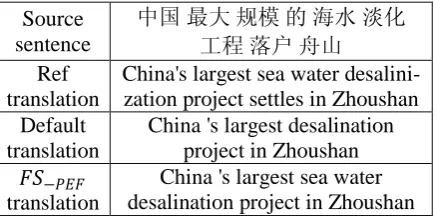
Source sentence
中国最大规模的海水淡化
工程落户舟山
Ref translation
China's largest sea water desalini-zation project settles in Zhoushan Default
translation
China 's largest desalination project in Zhoushan
𝐹𝑆−𝑃𝐸𝐹
translation
China 's largest sea water desalination project in Zhoushan
Table 1: An example of translations generated from the same decoder but with different feature settings.
Chinese English 𝑝 𝑒 𝑓 1 海水淡化 desalination 0.4000 2 海水 sea water 0.1748 3 淡化 desalination 0.0923
Table 2: Parameters of related phrases for exam-ples in Table 1.
The second aspect motivating our work comes from the subspace learning method in machine learning literature (Ho, 1998), in which an en-semble of classifiers are trained on subspaces of the full feature space, and final classification re-sults are based on the vote of all classifiers in the ensemble. Lopez and Resnik (2006) also showed that feature engineering could be used to over-come deficiencies of poor alignment. To illu-strate the usefulness of feature subspace in the SMT task, we start with the example shown in Table 1. In the example, the Chinese source sen-tence is translated with two settings of a hierar-chical phrase-based system (Chiang, 2005). In the default setting all the features are used as usual in the decoder, and we find that the transla-tion of the Chinese word 海水 (sea water) is missing in the output. This can be explained with the data shown in Table 2. Because of noises and word alignment errors in the parallel training data, the inaccurate translation phrase
海水淡化⇒ 𝑑𝑒𝑠𝑎𝑙𝑖𝑛𝑎𝑡𝑖𝑜𝑛 is assigned with a high value of the phrase translation probability feature 𝑝(𝑒|𝑓). Although the correct translation can also be composed by two phrases 海水⇒
[image:2.595.308.526.70.178.2]this way the bad estimation of 𝑝(𝑒|𝑓) for this phrase is avoided.
This example gives us the hint that building decoders based on subspaces of a standard model could help with working around some negative impacts of inaccurate estimations of feature val-ues for some input sentences. The subspace-based systems are expected to work similarly to statistical classifiers trained on subspaces of a full feature space – though the overall accuracy of baseline system might be better than any indi-vidual systems, for a specific sentence some in-dividual systems could generate better transla-tions. It is expected that employing an ensemble of subspace-based systems and making use of consensus between them will outperform the baseline system.
3
Feature Subspace Method for SMT
System Ensemble Construction
In this section, we will present in detail the me-thod for systematically deriving SMT systems from a standard linear SMT model based on fea-ture subspaces for system combination.
3.1 SMT System Ensemble Generation
Nowadays most of the state-of-the-art SMT sys-tems are based on linear models as proposed in Och and Ney (2002). Let 𝑚(𝑓, 𝑒) be a feature
function, and 𝜆𝑚 be its weight, an SMT model 𝐷 can be formally written as:
𝑒∗= argmax
𝑒 𝜆𝑚𝑚(𝑓, 𝑒) 𝑚
(1)
Noticing that Equation (1) is a general formu-lation independent of any specific features, tech-nically for any subset of features used in 𝐷, a new SMT system can be constructed based on it, which we call a sub-system.
Next we will use Ω to denote the full feature space defined by the entire set of features used in 𝐷, and 𝑠 ⊆ Ω is a feature subset that belongs to 𝜌(Ω), the power set of Ω. The derived sub-system based on subset 𝑠 ⊆ Ω is denoted by 𝑑𝑠.
Although in theory we can use all the sub-systems derived from every feature subset in 𝜌(Ω), it is still desirable to use only some of them in practice. The reasons for this are two-fold. First, the number of possible sub-systems (2 Ω ) is exponential to the size of Ω. Even when the number of features in Ω is relatively small, i.e. 10, there will be up to 1024 sub-systems in total, which is a large number for combination task. Larger feature sets will make the system
combination practically infeasible. Second, not every sub-system could contribute to the system combination. For example, feature subsets only containing very small number of features will lead to sub-systems with very poor performance; and the language model feature is too important to be ignored for a sub-system to achieve reason-ably good performance.
In our work, we only consider feature sub-spaces with only one difference from the features in Ω. For each non- language model feature 𝑖, a
sub-system 𝑑𝑖 is built by removing 𝑖 from Ω. Allowing for the importance of the language model (LM) feature to an SMT model, we do not remove any LM feature from any sub-system. Instead, we try to weaken the strength of a LM feature by lowering its n-gram order. For exam-ple, if a 4-gram language model is used in the baseline system 𝐷, then a trigram model can be used in one sub-system, and a bigram model can be used in another. In this way more than one sub-system can be derived based on one LM fea-ture. When varying a language model feature, the
one-feature difference principle is still kept: if we lower the order of a language model feature, no other features are removed or changed.
The remaining issue of using weakened LM features is that the resulting ensemble is no long-er strictly based on subspace of Ω. However, this theoretical imperfection can be remedied by in-troducing Ω′, a super-space of Ω to include all lower-order LM features. In this way, an aug-mented baseline system 𝐷′ can be built based on Ω′, and the baseline system 𝐷 itself can also be viewed as a sub-system of 𝐷′. We will show in the experimental section that 𝐷′ actually per-forms even slightly better than the original base-line system 𝐷, but results of sub-system combi-nation are significantly better that both 𝐷 and 𝐷′. After the sub-system ensemble is constructed, each sub-system tunes its feature weights inde-pendently to optimize the evaluation metrics on the development set.
Let 𝒟 = {𝑑1, … , 𝑑𝑛} be the set of sub-systems obtained by either removing one non-LM feature or changing the order of a LM feature, and ℋ𝑖 be
the n-best list produced by 𝑑𝑖. Then ℋ(𝒟), the translation candidate pool to the system combi-nation model can be written as:
ℋ(𝒟) = ℋ𝑖 𝑖
(2)
perspective, all the sub-systems share a common decoder, with minimal extensions to the baseline systems to support the use of specified subset of feature functions to compute the overall score for translation hypotheses. From the model training perspective, all the non-LM feature functions can be estimated once for all sub-systems. The only exception is the language model feature, which may be of different values across multiple sub-systems. However, since lower-order models have already been contained in higher-order model for the purpose of smoothing in almost all statistical language model implementations, there is also no extra training cost.
3.2 System Combination Scheme
In our work, we use a sentence-level system combination model to select best translation hy-pothesis from the candidate pool ℋ(𝒟). This method can also be viewed to be a hypotheses re-ranking model since we only use the existing translations instead of performing decoding over a confusion network as done in the word-level combination method (Rosti et al., 2007).
The score function in our combination model is formulated as follows:
𝑒∗= 𝑎𝑟𝑔𝑚𝑎𝑥
𝑒∈ℋ 𝒟 𝜆𝐿𝑀𝐿𝑀 𝑒 + 𝜆𝑙𝐿 + 𝜓(𝑒, ℋ(𝒟))
(3) where 𝐿𝑀 𝑒 is the language model score for 𝑒,
𝐿 is the length of 𝑒, and 𝜓(𝑒, ℋ(𝒟)) is a transla-tion consensus –based scoring functransla-tion. The computation of 𝜓(𝑒, ℋ(𝒟)) is further decom-posed into weighted linear combination of a set of n-gram consensus –based features, which are defined in terms of the order of n-gram to be matched between current candidate and other translation in ℋ(𝒟).
Given a translation candidate 𝑒, the n-gram agreement feature between 𝑒 and other transla-tions in the candidate pool is defined as:
𝑛+(𝑒, ℋ 𝒟 ) = 𝐺𝑛 𝑒, 𝑒′
𝑒′∈ℋ 𝒟 ,𝑒′≠𝑒 (4)
where the function 𝐺𝑛 𝑒, 𝑒′ counts the
occur-rences of n-grams of 𝑒 in 𝑒′:
𝐺𝑛 𝑒, 𝑒′ = 𝛿(𝑒
𝑖𝑖+𝑛−1, 𝑒′) 𝑒 −𝑛+1
𝑖=1 (5)
Here 𝛿(∙,∙) is the indicator function -
𝛿 𝑒𝑖𝑖+𝑛−1, 𝑒′ is 1 when the n-gram 𝑒𝑖𝑖+𝑛−1
ap-pears in 𝑒′, otherwise it is 0.
In order to give the combination model an op-portunity to penalize long but inaccurate
transla-tions, we also introduce a set of n-gram disa-greement features in the combination model:
𝑛−(𝑒, ℋ 𝒟 ) = ( 𝑒 − 𝑛 + 1 − 𝐺𝑛(𝑒, 𝑒′)) 𝑒′∈ℋ 𝒟 ,𝑒′≠𝑒
(6)
Because each order of n-gram match introduc-es two featurintroduc-es, the total number of featurintroduc-es in the combination model will be 2𝑚 + 2 if 𝑚 or-ders of n-gram are to be matched in computing
𝜓(𝑒, ℋ(𝒟)). Since we also adopt a linear scor-ing function in Equation (3), the feature weights of our combination model can also be tuned on a development data set to optimize the specified evaluation metrics using the standard Minimum Error Rate Training (MERT) algorithm (Och 2003).
Our method is similar to the work proposed by Hildebrand and Vogel (2008). However, except the language model and translation length, we only use intra-hypothesis n-gram agreement fea-tures as Hildebrand and Vogel did and use addi-tional intra-hypothesis n-gram disagreement fea-tures as Li et al. (2009) did in their co-decoding method.
4
Experiments
4.1 Data
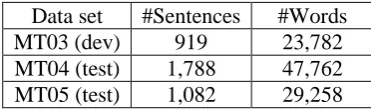
Experiments were conducted on the NIST evalu-ation sets of 2004 (MT04) and 2005 (MT05) for Chinese-to-English translation tasks. Both corpo-ra provide 4 reference tcorpo-ranslations per source sentence. Parameters were tuned with MERT algorithm (Och, 2003) on the NIST evaluation set of 2003 (MT03) for both the baseline systems and the system combination model. Translation performance was measured in terms of case-insensitive NIST version of BLEU score which computes the brevity penalty using the shortest reference translation for each segment, and all the results will be reported in percentage num-bers. Statistical significance is computed using the bootstrap re-sampling method proposed by Koehn (2004). Statistics of the data sets are summarized in Table 3.
[image:4.595.321.507.673.728.2]Data set #Sentences #Words MT03 (dev) 919 23,782 MT04 (test) 1,788 47,762 MT05 (test) 1,082 29,258
We use the parallel data available for the NIST 2008 constrained track of Chinese-to-English machine translation task as bilingual training data, which contains 5.1M sentence pairs, 128M Chinese words and 147M English words after pre-processing. GIZA++ toolkit (Och and Ney, 2003) is used to perform word align-ment in both directions with default settings, and the intersect-diag-grow method is used to gener-ate symmetric word alignment refinement. The language model used for all systems is a 5-gram model trained with the English part of bilingual data and Xinhua portion of LDC English Giga-word corpus version 3. In experiments, multiple language model features with the order ranging from 2 to 5 can be easily obtained from the 5-gram one without retraining.
4.2 System Description
Theoretically our method is applicable to all li-near model –based SMT systems. In our experi-ments, two in-house developed systems are used to validate our method. The first one (SYS1) is a system based on the hierarchical phrase-based model as proposed in (Chiang, 2005). Phrasal rules are extracted from all bilingual sentence pairs, while hierarchical rules with variables are extracted from selected data sets including LDC2003E14, LDC2003E07, LDC2005T06 and LDC2005T10, which contain around 350,000 sentence pairs, 8.8M Chinese words and 10.3M English words. The second one (SYS2) is a re-implementation of a phrase-based decoder with lexicalized reordering model based on maximum entropy principle proposed by Xiong et al. (2006). All bilingual data are used to extract phrases up to length 3 on the source side.
In following experiments, we only consider removing common features shared by both base-line systems for feature subspace generation. Rule penalty feature and lexicalized reordering feature, which are particular to SYS1 and SYS2, are not used. We list the features in consideration as follows:
PEF and PFE: phrase translation probabili-ties 𝑝 𝑒 𝑓 and 𝑝 𝑓 𝑒
PEFLEX and PFELEX: lexical weights
𝑝𝑙𝑒𝑥 𝑒 𝑓 and 𝑝𝑙𝑒𝑥 𝑓 𝑒 PP: phrase penalty
WP: word penalty
BLP: bi-lexicon pair counting how many entries of a conventional lexicon co-occurring in a given translation pair
LM-n: language model with order n
Based on the principle described in Section 3.1, we generate a number of feature subspaces for each baseline system as follows:
For non-LM features (PEF, PFE, PEFLEX, PFELEX, PP, WP and BLP), we remove one of them from the full feature space each time. Thus 7 feature subspaces are generated, which are denoted as 𝐹𝑆−𝑃𝐸𝐹 , 𝐹𝑆−𝑃𝐹𝐸 ,
𝐹𝑆−𝑃𝐸𝐹𝐿𝐸𝑋, 𝐹𝑆−𝑃𝐹𝐸𝐿𝐸𝑋, 𝐹𝑆−𝑃𝑃, 𝐹𝑆−𝑊𝑃 and
𝐹𝑆−𝐵𝐿𝑃 respectively. The 5-gram LM feature is used in each of them.
For LM features (LM-n), we change the or-der from 2 to 5 with all the other non-LM features present. Thus 4 LM-related feature subspaces are generated, which are denoted as 𝐹𝑆𝐿𝑀−2, 𝐹𝑆𝐿𝑀−3, 𝐹𝑆𝐿𝑀−4 and 𝐹𝑆𝐿𝑀−5 re-spectively. 𝐹𝑆𝐿𝑀−5 is essentially the full
fea-ture space of baseline system.
For each baseline system, we construct a total of 11 systems by using above feature sub-spaces. The baseline system is also contained within them because of using 𝐹𝑆𝐿𝑀−5. We call
all sub-systems are non-baseline sub-systems
except the one derived by using 𝐹𝑆𝐿𝑀−5.
By default, the beam size of 60 is used for all systems in our experiments. The size of n-best list is set to 20 for each sub-system, and for base-line systems, this size is set to 220, which equals to the size of the combined n-best list generated by total 11 sub-systems. The order of n-gram agreement and disagreement features used in sentence-level combination model ranges from unigram to 4-gram.
4.3 Evaluation of Oracle Translations
We first evaluate the oracle performance on the
n-best lists of baseline systems and on the com-bined n-best lists of sub-systems generated from each baseline system.
The oracle translations are obtained by using the metric of sentence-level BLEU score (Ye et al., 2007). Table 4 shows the evaluation results, in which Baseline stands for baseline system with a 5-gram LM feature, and FS stands for 11 sub-systems derived from the baseline system.
SYS1 SYS2
BLEU/TER BLEU/TER
MT04 Baseline 49.68/0.6411 49.50/0.6349
FS 51.05/0.6089 50.53/0.6056
MT05 Baseline 48.89/0.5946 48.37/0.5944
FS 50.69/0.5695 49.81/0.5684
For both SYS1 and SYS2, feature subspace method achieves higher oracle BLEU and lower TER scores on both MT04 and MT05 test sets, which gives the feature subspace method more potential to achieve higher performance than the baseline systems.
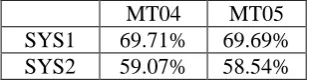
We then investigate the ratio of translation candidates in the combined n-best lists of non-baseline sub-systems that are not included in the baseline’s n-best list. Table 5 shows the statistics.
MT04 MT05 SYS1 69.71% 69.69% SYS2 59.07% 58.54%
Table 5: Ratio of unique translation candidates from non-baseline sub-systems.
From Table 5 we can see that only less than half of the translation candidates of sub-systems overlap with those the of baseline systems. This result, together with the oracle BLEU and TER score estimation, helps eliminate the concern that no diversities or better translation candidates can be obtained by using sub-systems.
4.4 Feature Subspace Method on Single SMT System
Next we validate the effect of feature subspace method on single SMT systems.
[image:6.595.103.258.210.251.2]Figure 1 shows the evaluation results of dif-ferent systems on the MT05 test set. From the figure we can see that the overall accuracy of baseline systems is better than any of their de-rived sub-systems, and except the sub-system derived by using 𝐹𝑆𝐿𝑀−2, the performance of all the systems are fairly similar.
Figure 1: Performances of different systems.
We then evaluate the system combination me-thod proposed in Section 3.2 with all the sub-systems for each baseline system. Table 6 shows the results on both MT04 and MT05 data sets, in
which FS-Comb denotes the system combination using 11 sub-systems.
From Table 6 we can see that by using FS-Comb we obtain about 1.1~1.3 points of BLEU gains over baseline systems. We also include in Table 6 the results for Baseline+mLM, which stands for the augmented baseline system as de-scribed in Section 3.1 using a bunch of LM fea-tures from bigram to 5-gram. It can be seen that both augmented baseline systems outperform their corresponding baseline systems slightly but consistently on both data sets.
MT04 MT05
SYS1
Baseline 39.07 38.72
Baseline+mLM 39.34+ 39.14+
FS-Comb 40.43++ 39.79++
SYS2
Baseline 38.84 38.30
Baseline+mLM 38.95* 38.63+
FS-Comb 39.92++ 39.49++
Table 6: Translation results of Baseline, Base-line+mLM and FS-Comb (+: significant better than baseline system with 𝑝 < 0.05; ++: signifi-cant better than baseline system with 𝑝 < 0.01; *: no significant improvement).
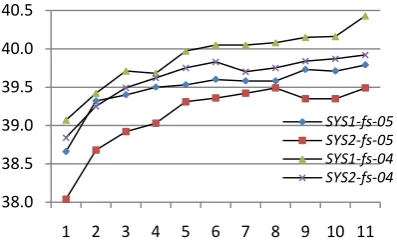
We also investigate the results when we in-crementally add the n-best list of each sub-system into a candidate pool to see the effects when different numbers of sub-systems are used in combination. In order to decide the sequence of sub-systems to add, we first evaluate the per-formance of pair-wise combinations between each sub-system and its baseline system on the development set. That is, for each sub-system, we combine its n-best list with the n-best list of its baseline system and perform system combina-tion for MT03 data set. Then we rank the sub-systems by the pair-wise combination perfor-mance from high to low, and use this ranking as the sequence to add n-best lists of sub-systems. Each time when a new n-best list is added, the combination performance based on the enlarged candidate pool is evaluated. Figure 2 shows the results on both MT04 and MT05 test sets, in which SYS1-fs and SYS2-fs denote the sub-systems derived from SYS1 and SYS2 respec-tively, and X-axis is the number of sub-systems used for combination each time and Y-axis is the BLEU score. From the figure we can see that although in some cases the performance slightly drops when a new sub-system is added, generally using more sub-systems always leads to better results.
31 32 33 34 35 36 37 38 39
SYS1 SYS2
[image:6.595.303.528.236.332.2] [image:6.595.77.294.551.669.2]Next we examine the performance of baseline systems when different beam sizes are used in decoding. The results on MT05 test set are shown in Figure3, where X-axis is the beam size. In Figure 3, SYS1+mLM and SYS2+mLM de-note augmented baseline systems of SYS1 and SYS2 with multiple LM features.
From Figure 3 we can see that augmented baseline systems (with multiple LM features) outperform the baseline systems (with only one LM feature) for all beam sizes ranging from 20 to 220. In this experiment we did not observe any significant performance improvements when us-ing larger beam sizes than the default settus-ing, but using more sub-systems in combination almost always bring improvements.
[image:7.595.313.523.282.385.2]Figure 2: Performances on different numbers of sub-systems.
Figure 3: Performances on different beam sizes.
MT04 MT05
SYS1-fs 44.63% 46.12%
SYS2-fs 47.54% 44.73%
Table 7: Ratio of final translations coming from non-baseline sub-systems.
Finally, we investigate the ratio of final trans-lations coming from the n-best lists of non-baseline sub-systems only. Table 7 shows the results on both MT04 and MT05 test sets, which
indicate that almost half of the final translations are contributed by the non-baseline sub-systems.
4.5 The Impact of n-best List Size
In order to find the optimal size of n-best list for combination, we compare the combination re-sults of using list sizes from 10-best up to 500-best for each sub-system.
In this experiment, system combination was performed on the combined n-best list from total 11 sub-systems with different list size each time. Figure 4 shows the results on the MT03 dev set and the MT04 and MT05 test sets for both SYS1 and SYS2. X-axis is the n-best list size of each sub-system.
Figure 4: Performances on different n-best sizes.
We can see from the figure that for all data sets the optimal n-best list size is around 50, but the improvements are not significant over the results when 20-best translations are used. The reason for the small optimal n-best list size could be that the low-rank hypotheses might introduce more noises into the combined translation candi-date pool for sentence-level combination (Hasan et al., 2007; Hildebrand and Vogel, 2008).
4.6 Feature Subspace Method on Multiple SMT Systems
In the last experiment, we investigate the effect of feature subspace method when multiple SMT systems are used in system combination.
Evaluation results are reported in Table 8. The system combination method described in Section 3.2 is used to combine outputs from two baseline systems (with only one 5-gram LM feature) and sub-systems generated from both baseline sys-tems (22 in total), with their results denoted as Baseline Comb (both) and FS Comb (both) spectively. We also include the combination re-sults of sub-systems based on one baseline sys-tem for reference in the table.
38.0 38.5 39.0 39.5 40.0 40.5
1 2 3 4 5 6 7 8 9 10 11
SYS1-fs-05 SYS2-fs-05 SYS1-fs-04 SYS2-fs-04
38.0 38.5 39.0 39.5
20 40 60 80 100 120 140 160 180 200 220
SYS1 SYS2 SYS1-mLM SYS2-mLM
39.0 39.5 40.0 40.5 41.0 41.5 42.0
10 20 50 100 200 500
[image:7.595.79.278.287.409.2] [image:7.595.79.290.464.578.2] [image:7.595.84.274.617.660.2]On both MT04 and MT05 test sets, the results of system combination based on sub-systems are significantly better than those of baseline sys-tems, which show that our method can also help with system combination when more than one system are used. We can also see that using mul-tiple systems based on different SMT models and using our subspace based method can help each other: the best performance can only be achieved when both are employed.
MT04 MT05
Baseline Comb (both) 39.98 39.43
FS-Comb (SYS1) 40.43 39.79
FS-Comb (SYS2) 39.92 39.49
FS Comb (both) 40.96 40.38
Table 8: Performances of sentence-level combi-nation on multiple SMT systems.
5
Conclusion
In this paper, we have presented a novel and ef-fective Feature Subspace method for the con-struction of an ensemble of machine translation systems based on a baseline SMT model which can be formulated as a standard linear function. Each system within the ensemble is based on a subset of features derived from the baseline model, and the resulting ensemble can be used in system combination to improve translation quali-ty. Experimental results on NIST Chinese-to-English translation tasks show that our method can bring significant improvements to two base-line systems with state-of-the-art performance, and it is expected that our method can be em-ployed to improve any linear model -based SMT systems. There is still much room for improve-ments in the current work. For example, we still use a simple one-feature difference principle for feature subspace generation. In the future, we will explore more possibilities for feature sub-spaces selection and experiment with our method in a word-level system combination model.
References
Necip Fazil Ayan, Jing Zheng, and Wen Wang. 2008. Improving alignments for better confusion net-works for combining machine translation systems.
In Proc. COLING, pages 33-40.
Srinivas Bangalore, German Bordel, and Giuseppe Riccardi. 2001. Computing consensus translation from multiple machine translation systems. In
Proc. ASRU, pages 351-354.
David Chiang. 2005. A hierarchical phrase-based model for statistical machine translation. In Proc. ACL, pages 263-270.
Xiaodong He, Mei Yang, Jianfeng Gao, Patrick Nguyen, and Robert Moore. 2008. Indirect-hmm-based hypothesis for combining outputs from ma-chine translation systems. In Proc. EMNLP, pages 98-107.
Almut Silja Hildebrand and Stephan Vogel. 2008. Combination of machine translation systems via hypothesis selection from combined n-best lists. In
8th AMTA conference, pages 254-261.
Tin Kam Ho. 1998. The random subspace method for constructing decision forests. In IEEE Transactions
on Pattern Analysis and Machine Intelligence,
pages 832-844.
Sasa Hasan, Richard Zens, and Hermann Ney. 2007. Are very large n-best lists useful for SMT? In
Proc. NAACL, Short paper, pages 57-60.
S. Jayaraman and A. Lavie. 2005. Multi-Engine Ma-chine Translation Guided by Explicit Word Match-ing. In 10th EAMT conference, pages 143-152.
Philipp Koehn. 2004. Statistical significance tests for machine translation evaluation. In Proc. EMNLP, pages 388-395.
Philipp Koehn. 2004. Phrase-based Model for SMT.
In Computational Linguistics, 28(1): pages
114-133.
Mu Li, Nan Duan, Dongdong Zhang, Chi-Ho Li, and Ming Zhou. 2009. Collaborative Decoding: Partial Hypothesis Re-Ranking Using Translation Consen-sus between Decoders. In Proc. ACL-IJCNLP.
Adam Lopez and Philip Resnik. 2006. Word-Based Alignment, Phrase-Based Translation: What’s the link? In 7th AMTA conference, pages 90-99.
Yang Liu, Qun Liu, and Shouxun Lin. 2006. Tree-to-String Alignment Template for Statistical Machine Translation. In Proc. ACL, pages 609-616.
Daniel Marcu, Wei Wang, Abdessamad Echihabi, and Kevin Knight. 2006. SPMT: Statistical machine translation with syntactified target language phras-es. In Proc. EMNLP, pages 44-52.
Wolfgang Macherey and Franz Och. 2007. An Empir-ical Study on Computing Consensus Translations from Multiple Machine Translation Systems. In
Proc. EMNLP, pages 986-995.
Evgeny Matusov, Nicola Ueffi ng, and Hermann Ney. 2006. Computing consensus translation from mul-tiple machine translation systems using enhanced hypotheses alignment. In Proc. EACL, pages 33-40.
statis-tical machine translation. In Proc. ACL, pages 295-302.
Franz Och. 2003. Minimum error rate training in sta-tistical machine translation. In Proc. ACL, pages 160-167.
Franz Och and Hermann Ney. 2003. A systematic comparison of various statistical alignment models.
Computational Linguistics, 29(1): pages 19-51.
Franz Och and Hermann Ney. 2004. The alignment template approach to statistical machine transla-tion. Computational Linguistics, 30(4): pages 417-449.
Antti-Veikko Rosti, Necip Fazil Ayan, Bing Xiang, Spyros Matsoukas, Richard Schwartz, and Bonnie Dorr. 2007. Combining outputs from multiple ma-chine translation systems. In Proc. NAACL, pages 228-235.
Antti-Veikko Rosti, Spyros Matsoukas, and Richard Schwartz. 2007. Improved Word-Level System Combination for Machine Translation. In Proc. ACL, pages 312-319.
Antti-Veikko Rosti, Bing Zhang, Spyros Matsoukas, and Richard Schwartz. 2008. Incremental hypothe-sis alignment for building confusion networks with application to machine translation system combina-tion. In Proc. Of the Third ACL Workshop on
Sta-tistical Machine Translation, pages 183-186.
K.C. Sim, W. Byrne, M. Gales, H. Sahbi, and P. Woodland. 2007. Consensus network decoding for statistical machine translation system combination.
In ICASSP, pages 105-108.
Deyi Xiong, Qun Liu, and Shouxun Lin. 2006. Max-imum entropy based phrase reordering model for statistical machine translation. In Proc. ACL, pages 521-528.
Yang Ye, Ming Zhou, and Chin-Yew Lin. 2007. Sen-tence level Machine Translation Evaluation as a Ranking Problem: One step aside from BLEU. In Proc. Of the Second ACL Workshop on Statistical