Supervised Learning of a Probabilistic Lexicon of Verb Semantic Classes
Yusuke Miyao
University of Tokyo
Hongo 7-3-1, Bunkyo-ku, Tokyo, Japan
Jun’ichi Tsujii
University of Tokyo University of Manchester National Center for Text Mining Hongo 7-3-1, Bunkyo-ku, Tokyo, Japan
Abstract
The work presented in this paper explores a supervised method for learning a prob-abilistic model of a lexicon of VerbNet classes. We intend for the probabilis-tic model to provide a probability dis-tribution of verb-class associations, over known and unknown verbs, including pol-ysemous words. In our approach, train-ing instances are obtained from an ex-isting lexicon and/or from an annotated corpus, while the features, which repre-sent syntactic frames, semantic similarity, and selectional preferences, are extracted from unannotated corpora. Our model is evaluated in type-level verb classifica-tion tasks: we measure the predicclassifica-tion ac-curacy of VerbNet classes for unknown verbs, and also measure the dissimilarity between the learned and observed proba-bility distributions. We empirically com-pare several settings for model learning, while we vary the use of features, source corpora for feature extraction, and disam-biguated corpora. In the task of verb clas-sification into all VerbNet classes, our best model achieved a 10.69% error reduction in the classification accuracy, over the pre-viously proposed model.
1 Introduction
Lexicons are invaluable resources for semantic processing. In many cases, lexicons are neces-sary to restrict a set of semantic classes to be as-signed to a word. In fact, a considerable number of works on semantic processing implicitly or explic-itly presupposes the availability of a lexicon, such as in word sense disambiguation (WSD) (Mc-Carthy et al., 2004), and in token-level verb class disambiguation (Lapata and Brew, 2004; Girju et
al., 2005; Li and Brew, 2007; Abend et al., 2008). In other words, those methods are heavily de-pendent on the availability of a semantic lexicon. Therefore, recent research efforts have invested in developing semantic resources, such as WordNet (Fellbaum, 1998), FrameNet (Baker et al., 1998), and VerbNet (Kipper et al., 2000; Kipper-Schuler, 2005), which greatly advanced research in seman-tic processing. However, the construction of such resources is expensive, and it is unrealistic to pre-suppose the availability of full-coverage lexicons; this is the case because unknown words always ap-pear in real texts, and word-semantics associations may vary (Abend et al., 2008).
This paper explores a method for the supervised learning of a probabilistic model for the VerbNet lexicon. We target the automatic classification of arbitrary verbs, including polysemous verbs, into all VerbNet classes; further, we target the esti-mation of a probabilistic model, which represents the saliences of verb-class associations for polyse-mous verbs. In our approach, an existing lexicon and/or an annotated corpus are used as the training data. Since VerbNet classes are designed to rep-resent the distinctions in the syntactic frames that verbs can take, features, representing the statistics of syntactic frames, are extracted from the unan-notated corpora. Additionally, as the classes rep-resent semantic commonalities, semantically in-spired features, like distributionally similar words, are used. These features can be considered as a generalized representation of verbs, and we ex-pect that the obtained probabilistic model predicts VerbNet classes of the unknown words.
Our model is evaluated in two tasks of type-level verb classification: one is the classification of monosemous verbs into a small subset of the classes, which was studied in some previous works (Joanis and Stevenson, 2003; Joanis et al., 2008). The other task is the classification of all verbs into the full set of VerbNet classes, which has not yet
been attempted. In the experiments, training in-stances are obtained from VerbNet and/or Sem-Link (Loper et al., 2007), while features are ex-tracted from the British National Corpus or from Wall Street Journal. We empirically compare sev-eral settings for model learning by varying the set of features, the source domain and the size of a corpus for feature extraction, and the use of the token-level statistics obtained from a manually disambiguated corpus. We also provide the anal-ysis of the remaining errors, which will lead us to further improve the supervised learning of a prob-abilistic semantic lexicon.
Supervised methods for automatic verb classifi-cation have been extensively investigated (Steven-son et al., 1999; Steven(Steven-son and Merlo, 1999; Merlo and Stevenson, 2001; Stevenson and Joa-nis, 2003; Joanis and Stevenson, 2003; Joanis et al., 2008). However, their focus has been ited to a small subset of verb classes, and a lim-ited number of monosemous verbs. The main con-tributions of the present work are: i) to provide empirical results for the automatic classification of all verbs, including polysemous ones, into all VerbNet classes, and ii) to empirically explore the effective settings for the supervised learning of a probabilistic lexicon of verb semantic classes.
2 Background
2.1 Verb lexicon
Levin’s (1993) work on verb classification has broadened the field of computational research that concerns the relationships between the syntactic and semantic structures of verbs. The principal idea behind the work is that the meanings of verbs can be identified by observing possible syntactic frames that the verbs can take. In other words, with the knowledge of syntactic frames, verbs can be semantically classified. This idea provided the computational linguistics community with crite-ria for the definition and the classification of verb semantics; it has subsequently resulted in the re-search of the induction of verb classes (Korhonen and Briscoe, 2004), and the construction of a verb lexicon based on Levin’s criteria.
VerbNet (Kipper et al., 2000; Kipper-Schuler, 2005) is a lexicon of verbs organized into classes that share the same syntactic behaviors and seman-tics. The design of classes originates from Levin (1993), though the design has been considerably reorganized and extends beyond the original
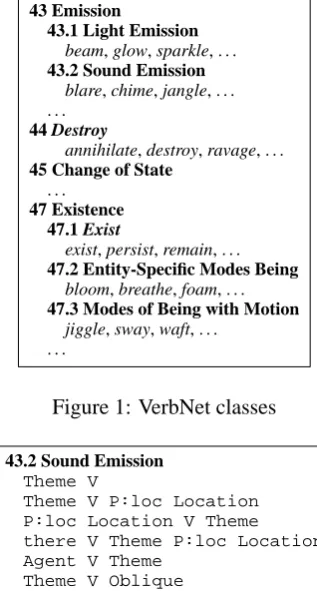
clas-43 Emission
43.1 Light Emission
beam, glow, sparkle, . . .
43.2 Sound Emission
blare, chime, jangle, . . .
. . . 44 Destroy
annihilate, destroy, ravage, . . .
45 Change of State . . .
47 Existence 47.1 Exist
exist, persist, remain, . . .
47.2 Entity-Specific Modes Being
bloom, breathe, foam, . . .
47.3 Modes of Being with Motion
jiggle, sway, waft, . . .
[image:2.595.334.493.65.361.2]. . .
Figure 1: VerbNet classes
43.2 Sound Emission Theme V
Theme V P:loc Location P:loc Location V Theme there V Theme P:loc Location Agent V Theme
Theme V Oblique Location V with Theme
47.3 Modes of Being with Motion Theme V
Theme V P:loc Location P:loc Location V Theme there V Theme
Agent V Theme
Figure 2: Syntactic frames for VerbNet classes
sification. The classes therefore cover more En-glish verbs, and the classification should be more consistent (Korhonen and Briscoe, 2004; Kipper et al., 2006).
The current version of VerbNet includes 270 classes.1 Figure 1 shows a part of the classes of VerbNet. The top-level categories, e.g.
Emis-sion and Destroy, represent a coarse
classifica-tion of verb semantics. They are further classi-fied into verb classes, each of which expresses a group of verbs sharing syntactic frames. Fig-ure 2 shows an excerpt from VerbNet, which rep-resents the possible syntactic frames for the Sound
Emission class, including “chime” and “jangle,”
and the Modes of Being with Motion class, in-cluding “jiggle” and “waft.” In this figure, each line represents a syntactic frame, where Agent,
1Throughout this paper, we refer to VerbNet 2.3.
. . . the walls still shook;VN=47.3and an evacuation alarm blared;VN=43.2outside.
Suddenly the woman begins;VN=55.1 swaying ;VN=47.3and then . . .
Figure 3: An excerpt from SemLink
Theme, and Location indicate the thematic roles, Vdenotes a verb, and P specifies a prepo-sition. P:loc defines locative prepositions such as: “in” and “at.” For example, the second syn-tactic frame of Sound Emission, i.e., Theme V P:loc Location, corresponds to the follow-ing sentence:
1. The coins jangled in my pocket.
Themecorresponds to “the coins,”Vto “jangled,”
P:locto “in,” andLocationto “my pocket.” While VerbNet provides associations between verbs and semantic classes, SemLink (Loper et al., 2007) additionally provides mappings among VerbNet, FrameNet (Baker et al., 1998), PropBank (Palmer et al., 2005), and WordNet (Fellbaum, 1998). Since FrameNet and PropBank include an-notated instances of sentences, SemLink can be considered as a corpus annotated with VerbNet classes. Figure 3 presents some annotated sen-tences obtained from SemLink. For example, the annotation “blared;VN=43.2” indicates that the occurrence of “blare” in this context is classified as Sound Emission.
2.2 Related work
There has been much research effort invested in the automatic classification of verbs into lexical semantic classes, in a supervised or unsupervised way. The present work inherits the spirit of the su-pervised approaches to verb classification (Steven-son et al., 1999; Steven(Steven-son and Merlo, 1999; Merlo and Stevenson, 2001; Stevenson and Joanis, 2003; Joanis and Stevenson, 2003; Joanis et al., 2008). Our learning framework basically follows the above listed works: features are obtained from an unannotated (automatically parsed) corpus, and gold verb-class associations are used as training instances for machine learning classifiers, such as decision trees and support vector machines. How-ever, those works targeted a small subset of Levin classes, and a limited number of monosemous verbs; for example, Merlo and Stevenson (2001) studied three classes and 59 verbs, and Joanis et al.
(2008) focused on 14 classes and 835 verbs. Al-though these works provided a theoretical frame-work for supervised verb classification, their re-sults were not readily available for practical ap-plications, because of the limitation in the cover-age of the targeted classes/verbs on real texts. On the contrary, we target the classification of arbi-trary verbs, including polysemous verbs, into all VerbNet classes (270 in total). In this realistic sit-uation, we will empirically compare settings for model learning, in order to explore effective con-ditions to obtain better models.
Another difference from the aforementioned works is that we aim at obtaining a probabilis-tic model, which represents saliences of classes of polysemous verbs. Lapata and Brew (2004) and Li and Brew (2007) focused on this issue, and described methods for inducing probabilities of verb-class associations. The obtained proba-bilistic model was intended to be incorporated into a token-level disambiguation model. Their meth-ods claimed to be unsupervised, meaning that the induction of a probabilistic lexicon did not re-quire any hand-annotated corpora. In fact, how-ever, their methods relied on the existence of a full-coverage lexicon, both in training and running time. In their methods, a lexicon was necessary for restricting possible classes to which each word belongs. Since most verbs are associated with only a couple of classes, such a restriction signif-icantly reduces the search space, and the problem becomes much easier to solve. This presupposi-tion is implicitly or explicitly used in other seman-tic disambiguation tasks (McCarthy et al., 2004), but it is unrealistic for practical applications.
time advances, more stable classifications will be-come available.
The problem focused in this work has a close re-lationship with automatic thesaurus/ontology ex-pansion. In fact, we evaluate our method in the task of automatic verb classification, which can be considered as lexicon expansion. The most prominent difference of the present work from the-saurus/ontology expansion is that the number of classes is much smaller in our problem, and the set of verb classes can be assumed to be fixed. These characteristics indicate that our problem is easier and more well-defined than is the case for auto-matic thesaurus/ontology expansion.
Supervised approaches to token-level verb class disambiguation have recently been addressed (Girju et al., 2005; Abend et al., 2008), largely ow-ing to SemLink. Their approaches fundamentally follow traditional supervised WSD methods: ex-tracting features representing the context in which the target word appears, and training a classifica-tion model with an annotated corpus. While those works achieved an impressive accuracy (more than 95%), the results may not necessarily indicate the method’s effectiveness; rather, it may imply the importance of a lexicon. In fact, these works re-strict their target to verb tokens, in which the cor-rect class exists in a given lexicon, and they only consider candidate classes that are registered in the lexicon. This setting reduces the ambiguity signif-icantly, and the problem becomes much easier to handle; for example, approximately half of verb tokens are monosemous in their setting. Thus, a simple baseline achieves very high accuracy fig-ures. However, in our preliminary experiment on token-level verb classification with unknown verbs, we found that the accuracy for unknown verbs (i.e., lemmas not included in the VerbNet lexicon) is catastrophically low. This indicates that VerbNet and SemLink are insufficient for un-known verbs, and that we cannot expect the avail-ability of a full-coverage lexicon in the real world. Instead of a static lexicon, our probabilistic model is intended to be used as a prior distribution for the token-level disambiguation, as in Lapata and Brew (2004)’s model.
3 A probabilistic model for verb semantic classes
In this work, supervised learning is applied to the probabilistic modeling of a lexicon of verb
seman-tic classes. We do not presuppose the existence of a full-coverage lexicon; instead, we use an existing lexicon for the training data. Combined with fea-tures extracted from unannotated corpora, a proba-bilistic model is learned from the existing lexicon. Like other supervised learning applications, our probabilistic lexicon can predict classes for words that are not included in the original lexicon.
Our model is defined in the following way. We assume that the set, C, of verb classes is fixed, while a set of verbs is unfixed. With this assump-tion, probabilistic modeling can be reduced to a classification problem. Specifically, the goal is to obtain a probability distribution, p(c|v), of verb class c ∈ C for a given verb (lemma) v. We can therefore apply well-known supervised learn-ing methods to estimatep(c|v).
This probability is modeled in the form of a log-linear model.
p(c|v) = Z1 exp X i
λifi(c, v)
!
,
where fi(c, v) are features that represent charac-teristics ofc andv, and λi are model parameters that express weights of the corresponding features. Model parameters can be estimated when
train-ing instances, i.e., pairs hc, vi, and features,
fi(c, v), for each instance are given. Therefore, what we have to do is to prepare the training in-stances hc, vi, and effective featuresfi(c, v) that contribute to the better estimation of probabili-ties. In token tagging tasks, both training instances and features are extracted from annotated corpora. However, since our goal is the probabilistic mod-eling of a lexicon, we have to determine how to derive the training instances and features for lexi-con entries, to be discussed in the next section.
For the parameter estimation of log-linear mod-els, we applied the stochastic gradient descent method. A hyperparameter for l2-regularization was tuned to minimize the KL-divergence (see Section 4.4) for the development set.
4 Experiment design
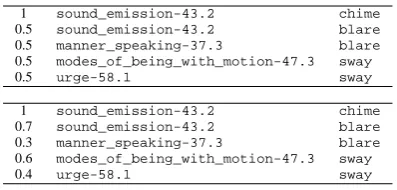
1 sound_emission-43.2 chime
0.5 sound_emission-43.2 blare
0.5 manner_speaking-37.3 blare
0.5 modes_of_being_with_motion-47.3 sway
0.5 urge-58.1 sway
1 sound_emission-43.2 chime
0.7 sound_emission-43.2 blare
0.3 manner_speaking-37.3 blare
0.6 modes_of_being_with_motion-47.3 sway
[image:5.595.82.281.60.155.2]0.4 urge-58.1 sway
Figure 4: Training instances obtained from Verb-Net (upper) and VerbVerb-Net+SemLink (lower)
4.1 Data
As our goal is the supervised learning of a lexicon of verb semantic classes, VerbNet is used as the training/test data. In addition, since we aim at rep-resenting the saliences of verb-class associations with probabilities, the gold probabilities are nec-essary. For this purpose, we count the occurrences of each verb-class association in the VerbNet-PropBank token mappings in the subset of the SemLink corresponding to sections 2 through 21 of Penn Treebank (Marcus et al., 1994). Fre-quency counts are normalized for each lemma, with the Laplace smoothing (the parameter is 0.5). In this work, we compare the two settings for creating training instances. By comparing the re-sults of these settings, we evaluate the necessity of an annotated corpus for learning a probabilistic lexicon of verb semantic classes.
VerbNet We collect all hc, vi pairs registered in
VerbNet. For each v, all of the associated classes are assigned equal weights (see the upper part of Figure 4).
VerbNet+SemLink Each pair hc, vi in VerbNet
is weighted by the normalized frequency ob-tained from SemLink (see the lower part of Figure 4).
Because VerbNet classes represent groups of syntactic frames, and it is impossible to guess the verb class by referring to only one occurrence in a text, it is necessary to have statistics over a suf-ficient amount of a corpus. Hence, features are extracted from a large unannotated corpus. In this paper, we use the following two corpora:
WSJ Wall Street Journal newspaper articles
(around 40 million words).
BNC British National Corpus, which is a
bal-anced corpus of around 100 million words.
In addition to the variance of the corpus domains, we vary the size of the corpus to observe the ef-fect of increasing the corpus size. These corpora are automatically parsed by Enju 2.3.1 (Miyao and Tsujii, 2008), and the features are extracted from the parsing results.
4.2 Features
Levin-like classes, including VerbNet, are de-signed to represent distinctions in syntactic frames and alternations. Hence, if we were given the per-fect knowledge of the possible syntactic frames, verbs can be classified into the correct classes al-most perfectly (Dorr and Jones, 1996). Previ-ous works thus proposed features that express the corpus statistics of syntactic frames. However, class boundaries are subtle in some cases; several classes share syntactic frames with each other to a large extent.
For example, the classes shown in Figure 2 have very similar syntactic frames. The difference is in-dicated in the last two frames of Sound Emission, although they appear much less frequently in real texts. Therefore, it is difficult to accurately capture the distinctions between these classes, if we are only provided with the statistics of the syntactic frames that appear in real texts. In this case, how-ever, it is easy to observe that the verbs of these classes have different selectional preferences; that is, the Theme of Sound Emission verbs would be objects that make sounds, while theThemeof
Modes of Being with Motion is likely to be
ob-jects that move.2 Although Levin’s classification initially focused on syntactic alternations, the re-sulting classes represent some semantic common-alities. Hence, it would be reasonable to design features that capture such semantic characteristics. In this work, we re-implemented the following features proposed by Joanis et al. (2008) as the starting point.
Syntactic slot Features to count the occurrences
of each syntactic slot, such as subject, ob-ject, and prepositional phrases. For the sub-ject slot, we also count its transitive and in-transitive usages separately. Additionally, we count the appearances of reflexive pronouns and semantically empty constituents (it and
2Syntactic frames in VerbNet include specifications of
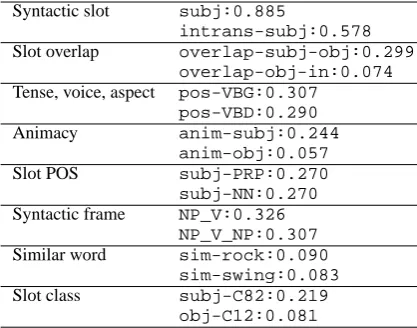
Syntactic slot subj:0.885
intrans-subj:0.578 Slot overlap overlap-subj-obj:0.299
overlap-obj-in:0.074 Tense, voice, aspect pos-VBG:0.307
pos-VBD:0.290 Animacy anim-subj:0.244
anim-obj:0.057 Slot POS subj-PRP:0.270 subj-NN:0.270 Syntactic frame NP_V:0.326
NP_V_NP:0.307 Similar word sim-rock:0.090
sim-swing:0.083 Slot class subj-C82:0.219
[image:6.595.74.283.62.226.2]obj-C12:0.081
Figure 5: Example of features for “sway”
there). Differently from Joanis et al. (2008),
we consider non-nominal arguments, such as sentential and adjectival complements.
Slot overlap Features to measure the overlap in
words (lemmas) between two syntactic slots of the verb. They are intended to approxi-mate argument alternations, such as the erga-tive alternation. For example, for the alter-nation “The sky cleared”/“The clouds cleared
from the sky,” a feature to indicate the overlap
between the subject slot and the from slot is added (Joanis et al., 2008). The value of this feature is computed by the method of Merlo and Stevenson (2001).
Tense, voice, aspect Features to approximate the
tendency of the tense, voice, and aspect of the target verb. The Penn Treebank POS tags for verbs (VB, VBP, VBZ, VBG, VBD, and VBN) are counted. In addition, included are the frequency of the co-occurrences with an adverb or an auxiliary verb, and the count of usages as a noun or an adjective.
Animacy Features to measure the frequency of
animate arguments for each syntactic slot. Personal pronouns except it are counted as animate, following Joanis et al. (2008), while named entity recognition was not used.
Examples of these features are shown in Figure 5. For details, refer to Joanis et al. (2008).
The above features mainly represent syntactic behaviors of target verbs. Since our target classes are broader than in the previous works, we further enhance the syntactic features. Additionally, as discussed above, semantically motivated features
may present strong clues to distinguish among syntactically similar classes. We therefore include the following four types of feature; the first two are syntactic, while the other two are intended to capture semantic characteristics:
Slot POS In addition to the syntactic slot
fea-tures, we add features that represent a com-bination of a syntactic slot and the POS of its head word. Since VerbNet includes ex-tended classes that take verbal and adjecti-val arguments, the POSs of arguments would provide a strong clue to discriminate among these syntactic frames.
Syntactic frame The number of arguments and
their syntactic categories. This feature was mentioned as a baseline in Joanis et al. (2008), but we include it in our model.
Similar word Similar words (lemmas) to the
tar-get verb. Similar words are automatically obtained from a corpus (the same corpus as used for feature extraction) by Lin (1998)’s method. This feature is motivated by the hypothesis that distributionally similar words tend to be classified into the same class. Be-cause Lin’s method is based on the similar-ity of words in syntactic slots, the obtained similar words are expected to represent a verb class that share selectional preferences.
Slot class Semantic classes of the head words of
the arguments. This feature is also intended to approximate selectional preferences. The semantic classes are obtained by clustering nouns, verbs, and adjectives into 200, 100, and 50 classes respectively, by using the k -medoid method with Lin (1998)’s similarity.
Figure 5 shows an example of the features for “sway,” extracted from the BNC corpus.3 Feature values are defined as relative frequencies for each lemma; while, for similar word features, feature values are weighted by Lin’s similarity measure.
4.3 Tasks
We evaluate our model in the tasks of auto-matic verb classification (a.k.a. lexicon expan-sion): given gold verb-class associations for some set of verbs, we predict the classes for unknown
3“C82” and “C12” are automatically assigned cluster
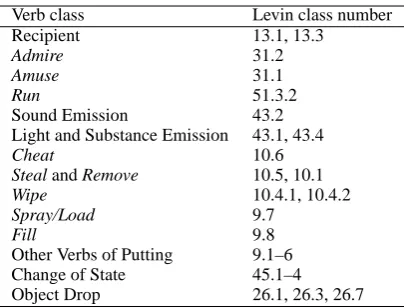
Verb class Levin class number Recipient 13.1, 13.3
Admire 31.2
Amuse 31.1
Run 51.3.2
Sound Emission 43.2 Light and Substance Emission 43.1, 43.4
Cheat 10.6
Steal and Remove 10.5, 10.1
Wipe 10.4.1, 10.4.2
Spray/Load 9.7
Fill 9.8
[image:7.595.80.286.60.214.2]Other Verbs of Putting 9.1–6 Change of State 45.1–4 Object Drop 26.1, 26.3, 26.7
Table 1: 14 classes used in Joanis et al. (2008) and their corresponding Levin class numbers
verbs. While our main target is the full set of Verb-Net classes, we also show results for the task stud-ied in the previous work.
14-class task The task to classify (almost)
monosemous verbs into 14 classes. Refer to Table 1 for the definition of the 14 classes. Following Joanis et al. (2008)’s task def-inition, we removed verbs that belong to multiple classes in these 14 classes, and also removed overly polysemous verbs (in our experiment, verb-class associations that have the relative frequency that is less than 0.5 in SemLink are removed). For each class, member verbs are randomly split into 50% (training), 25% (development), and 25% (final test) sets.
All-class task The task to classify all target verbs
into 268 classes.4 Any verbs that did not occur at least 100 times in the BNC cor-pus were removed.5 The remaining verbs (2517 words) are randomly split into 80% (training), 10% (development), and 10% (fi-nal test) sets, under the constraint that at least one instance for each class is included in the training set.6
4.4 Evaluation measures
For the 14-class task, we simply measure the clas-sification accuracy. However, the evaluation in the
4
Two classes (Being Dressed and Debone) are not used in the experiments because no lemmas belonged to these classes after filtering by the frequency in BNC.
5
This is the same preprocessing as Joanis et al. (2008), although we use VerbNet, while Joanis et al. (2008) used the original Levin classifications.
6Because polysemous verbs belong to multiple classes,
the class-wise data split was not adopted for the all-class task.
all-class task is not trivial, because verbs may be assigned multiple classes.
Since our purpose is to obtain a probabilistic model rather than to classify monosemous verbs, the evaluation criterion should be sensitive to the probabilistic distribution on the test data. In this paper, we adopt two evaluation measures. One is the top-N weighted accuracy; we count the
number of correct pairshc, vi in the N-best out-puts from the model (where N is the number of gold classes for each lemma), where each count is weighted by the relative frequency (i.e., the counts in SemLink) of the pair in the test set. For exam-ple, in the case for “blare” in Figure 4, if the model states that Sound Emission has the largest prob-ability, we get 0.7 points. If Manner Speaking has the largest probability, we instead obtain 0.3 points. Intuitively, the score is higher when the model presents larger probabilities to classes with higher relative frequencies. This measure is simi-lar to the top-N precision in information retrieval; it evaluates the ranked output by the model. It is intuitively interpretable, but is insufficient for evaluating the quality of probability distributions.
The other measure is KL-divergence, which is popularly used for measuring the dissimilarity be-tween two probability distributions. This is de-fined as follows:
KL(p||q) =X
x p(x) log(p(x))−p(x) log(q(x)).
In the experiments, this measure is applied, with the assumption that p is the relative frequency of hc, vi in the test set, and that q is the esti-mated probability distribution. Although the KL-divergence is not a true distance metric, it is suf-ficient for measuring the fitting of the estimated model to the true distribution. We report the KL-divergence averaged over all verbs in the test set. Since this measure indicates a dissimilarity, a smaller value is better. Whenpandqare equiva-lent,KL(p||q) = 0.
5 Experimental results
Accuracy Baseline (random) 7.14 Baseline (majority) 26.47 Joanis et al.’s features/WSJ 56.86 Joanis et al.’s features/BNC 64.22 All features/WSJ 60.29 All features/BNC 68.14
Table 2: Accuracy for the 14-class task
[image:8.595.99.263.61.135.2]Accuracy KL Baseline (random) 0.37 — Baseline (majority) 8.69 — Joanis et al.’s features/WSJ 30.26 3.65 Joanis et al.’s features/BNC 35.66 3.32 All features/WSJ 34.07 3.37 All features/BNC 42.54 2.99
Table 3: Accuracy and KL-divergence for the all-class task (the VerbNet+SemLink setting)
that the majority class (i.e., the class that has the largest number of member verbs) is output to every lemma. While these figures cannot be compared directly to the previous works due to the difference in the preprocessing, Joanis et al. (2008) achieved 58.4% accuracy for the 14-class task. Table 3 and 4 present the results for the all-class task. Table 3 gives the accuracy and KL-divergence achieved by the model trained with the VerbNet+SemLink training instances, while Table 4 presents the same measures by the training instances created from VerbNet only.
Our models performed substantially better on both tasks than the baseline models. The results also proved that the features we proposed in this paper contributed to the further improvement of the model from Joanis et al. (2008). In the all-class task with the VerbNet+SemLink setting, our fea-tures achieved 10.69% error reduction in the accu-racy over Joanis et al. (2008)’s features. Another interesting fact is that the model with BNC con-sistently outperformed the model with WSJ. This outcome is somewhat surprising, provided that the relative frequencies in the training/test sets are cre-ated from the WSJ portion of SemLink. The rea-son for this is independent of the corpus size, as will be shown below. When comparing Table 3 and 4, we can see that using SemLink statistics resulted in a slightly better model. This result is predictable, because the evaluation measures are sensitive to the relative frequencies estimated from SemLink. However, the difference remained small. In both of the tasks and the evaluation mea-sures, the best model was achieved when we use
[image:8.595.86.273.172.245.2]Accuracy KL Baseline (random) 0.37 — Baseline (majority) 8.69 — Joanis et al.’s features/WSJ 29.65 3.67 Joanis et al.’s features/BNC 35.78 3.34 All features/WSJ 34.53 3.40 All features/BNC 42.38 3.02
Table 4: Accuracy and KL-divergence for the all-class task (the VerbNet only setting)
0 10 20 30 40 50
0 20 40 60 80 100
Accuracy
Corpus size (M words)
Accuracy (Joanis et al.’s features, WSJ) Accuracy (Joanis et al.’s features, BNC) Accuracy (all features, WSJ) Accuracy (all features, BNC)
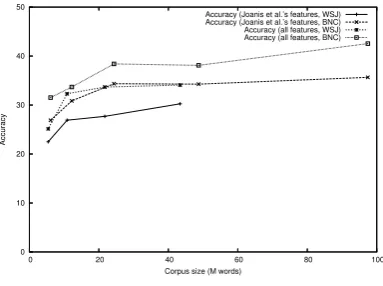
Figure 6: Corpus size vs. accuracy
all the features extracted from BNC, and create training instances from VerbNet+SemLink.
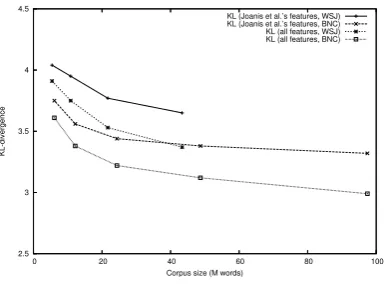
Figure 6 and 7 plot the accuracy and KL-divergence against the size of the unannotated cor-pus used for feature extraction. The result clearly indicates that the learning curve still grows at the corpus size with 100 million words (especially for the all features + BNC setting), which indicates that better models are obtained by increasing the size of the unannotated corpora.
Therefore, we can claim that the differences be-tween the domains and the size of the unannotated corpora are more influential than the availability of the annotated corpora. This indicates that learning only from a lexicon would be a viable solution, when a token-disambiguated corpus like SemLink is unavailable.
[image:8.595.320.512.190.333.2]2.5 3 3.5 4 4.5
0 20 40 60 80 100
KL-divergence
Corpus size (M words)
KL (Joanis et al.’s features, WSJ) KL (Joanis et al.’s features, BNC) KL (all features, WSJ) KL (all features, BNC)
Figure 7: Corpus size vs. KL-divergence
14-classes All classes Accuracy Accuracy KL Baseline (random) 7.14 0.37 — Baseline (majority) 26.47 8.69 — Joanis et al.’s features 64.22 35.66 3.32
[image:9.595.85.280.63.205.2]+ Slot POS 66.67 38.77 3.18 + Syntactic frame 64.71 35.99 3.29 + Similar word 68.14 37.88 3.10 + Slot class 64.71 36.51 3.26 All features 68.14 42.54 2.99
Table 5: Contribution of features
sified into the same class. Slot classes also con-tributed to a slight improvement, indicating that selectional preferences are effective clues for pre-dicting VerbNet classes. The result of the “All fea-tures” model for the all-class task attests that these features worked collaboratively, and using them all resulted in a considerably better model.
From the analysis of the confusion matrix for the outputs by our best model, we identified sev-eral reasons for the remaining misclassification er-rors. A major portion of the errors were caused by confusing the classes that take the same preposi-tions. Examples of these errors include:
• Other Change of State verbs were
misclas-sified into the Butter class: “embalm,” “lam-inate.” (they take “with” phrases)
• Judgement verbs were misclassified into the
Characterize class: “acclaim,” “hail.” (they
take “as” phrases)
Since prepositions are strong features for auto-matic verb classification (Joanis et al., 2008), the classes that take the same prepositions remained confusing. The discovery of the features to dis-criminate among these classes would be crucial for further improvement.
Another major error is in classifying verbs into
Other Change of State. Examples include:
• Amuse verbs: “impair,” “recharge.” • Herd verbs: “aggregate,” “mass.”
Because Other Change of State is one of the biggest classes, supervised learning tends to place a high probability to this class. Therefore, when strong clues do not exist, verbs tend to be mis-classified into this class. In addition, this class is not syntactically/semantically homogeneous, and is likely to introduce noise in the machine learn-ing classifier. A possible solution to this problem would be to exclude this class from the classifica-tion, and to process the class separately.
6 Conclusions
We presented a method for the supervised learn-ing of a probabilistic model for a lexicon of Verb-Net classes. By combining verb-class associa-tions from VerbNet and SemLink, and features ex-tracted from a large unannotated corpus, we could successfully train a log-linear model in a super-vised way. The experimental results attested to our success that features proposed in this paper worked effectively in obtaining a better probabil-ity distribution. Not only syntactic features, but also semantic features were shown to be effective. While each of these features could increase the ac-curacy, they collaboratively contributed to a large improvement. In the all-class task, we obtained 10.69% error reduction in the classification accu-racy over Joanis et al. (2008)’s model. We also ob-served the trend that a larger corpus for feature ex-traction led to a better model, indicating that a bet-ter model will be obtained by increasing the size of an unannotated corpus.
We could identify the effective features and set-tings for this problem, but the classification into all VerbNet classes remained challenging. One possible direction for this research topic would be to use our model for the semi-automatic construc-tion of verb lexicons, with the help of human cura-tion. However, there is also a demand for explor-ing other types of features that can discriminate among confusing classes.
Acknowledgments
References
Omri Abend, Roi Reichart, and Ari Rappoport. 2008. A supervised algorithm for verb disambiguation into VerbNet classes. In Proceedings of COLING 2008, pages 9–16.
Collin F. Baker, Charles J. Fillmore, and John B. Lowe. 1998. The Berkeley FrameNet project. In Proceed-ings of COLING-ACL 1998.
Bonnie J. Dorr and Doug Jones. 1996. Role of word sense disambiguation in lexical acquisition: Predict-ing semantics from syntactic cues. In ProceedPredict-ings of COLING-96, pages 322–327.
Christiane Fellbaum, editor. 1998. WordNet: An Elec-tronic Lexical Database. MIT Press, Cambridge, Massachusetts.
Roxana Girju, Dan Roth, and Mark Sammons. 2005. Token-level disambiguation of VerbNet classes. In The Interdisciplinary Workshop on Verb Features and Verb Classes.
Eric Joanis and Suzanne Stevenson. 2003. A general feature space for automatic verb classification. In Proceedings of EACL 2003, pages 163–170.
Eric Joanis, Suzanne Stevenson, and David James. 2008. A general feature space for automatic verb classification. Natural Language Engineering, 14(3):337–367.
Karin Kipper, Hoa Trang Dang, and Martha Palmer. 2000. Class-based construction of a verb lexicon. In Proceedings of 17th National Conference on Ar-tificial Intelligence.
Karin Kipper, Anna Korhonen, Neville Ryant, and Martha Palmer. 2006. Extending VerbNet with novel verb classes. In Proceedings of LREC 2006.
Karin Kipper-Schuler. 2005. VerbNet: A broad-coverage, comprehensive verb lexicon. Ph.D. the-sis, Computer and Information Science Department, University of Pennsylvania.
Anna Korhonen and Ted Briscoe. 2004. Extended lexical-semantic classification of English verbs. In Proceedings of the HLT/NAACL Workshop on Com-putational Lexical Semantics.
Anna Korhonen, Yuval Krymolowski, and Zvika Marx. 2003. Clustering polysemic subcategoriza-tion frame distribusubcategoriza-tions semantically. In Proceed-ings of ACL 2003.
Anna Korhonen. 2002. Semantically motivated subcategorization acquisition. In Proceedings of the Workshop on Unsupervised Lexical Acquisition, pages 51–58.
Mirella Lapata and Chris Brew. 2004. Verb class disambiguation using informative priors. Computa-tional Linguistics, 30(1):45–75.
Beth Levin. 1993. English Verb Classes and Alter-nations: A Preliminary Investigation. University of Chicago Press, Chicago.
Juanguo Li and Chris Brew. 2007. Disambiguating Levin verbs using untagged data. In Proceedings of RANLP 2007.
Dekang Lin. 1998. Automatic retrieval and clustering of similar words. In Proceedings of COLING-ACL 1998.
Edward Loper, Szu ting Yi, and Martha Palmer. 2007. Combining lexical resources: Mapping between PropBank and VerbNet. In Proceedings of the 7th International Workshop on Computational Linguis-tics, Tilburg, the Netherlands.
Mitchell Marcus, Beatrice Santorini, and Mary Ann Marcinkiewicz. 1994. Building a large annotated corpus of English: The Penn Treebank. Computa-tional Linguistics, 19(2):313–330.
Diana McCarthy, Rob Koeling, Julie Weeds, and John Carroll. 2004. Finding predominant senses in un-tagged text. In Proceedings of ACL 2004.
Diana McCarthy. 2001. Lexical Acquisition at the Syntax-Semantics Interface: Diathesis Alternations, Subcategorization Frames and Selectional Prefer-ences. Ph.D. thesis, University of Sussex.
Paola Merlo and Suzanne Stevenson. 2001. Auto-matic verb-classification based on statistical distri-bution of argument structure. Computational Lin-guistics, 27(3):373–408.
Yusuke Miyao and Jun’ichi Tsujii. 2008. Feature for-est models for probabilistic HPSG parsing. Compu-tational Linguistics, 34(1):35–80.
Martha Palmer, Daniel Gildea, and Paul Kingsbury. 2005. The proposition bank: An annotated corpus of semantic roles. Computational Linguistics, 31(1).
Sabine Schulte im Walde. 2000. Clustering verbs se-mantically according to their alternation behavior. In Proceedings of COLING 2000, pages 747–753.
Sabine Schulte im Walde. 2003. Experiments on the choice of features for learning verb classes. In Pro-ceedings of EACL 2003, pages 315–322.
Suzanne Stevenson and Eric Joanis. 2003. Semi-supervised verb class discovery using noisy features. In Proceedings of CoNLL 2003, pages 71–78.
Suzanne Stevenson and Paola Merlo. 1999. Automatic verb classification using grammatical features. In Proceedings of EACL 1999, pages 45–52.