Studying the recursive behaviour of adjectival modification
with compositional distributional semantics
Eva Maria Vecchi and Roberto Zamparelli and Marco Baroni Center for Mind/Brain Sciences (University of Trento, Italy)
(evamaria.vecchi|roberto.zamparelli|marco.baroni)@unitn.it
Abstract
In this study, we use compositional distribu-tional semantic methods to investigate restric-tions in adjective ordering. Specifically, we focus on properties distinguishing Adjective-Adjective-Noun phrases in which there is flex-ibility in the adjective ordering from those bound to a rigid order. We explore a number of measures extracted from the distributional representation of AAN phrases which may in-dicate a word order restriction. We find that we are able to distinguish the relevant classes and the correct order based primarily on the degree of modification of the adjectives. Our results offer fresh insight into the semantic properties that determine adjective ordering, building a bridge between syntax and distri-butional semantics.
1 Introduction
A prominent approach for representing the meaning of a word in Natural Language Processing (NLP) is to treat it as a numerical vector that codes the pat-tern of co-occurrence of that word with other ex-pressions in a large corpus of language (Sahlgren, 2006; Turney and Pantel, 2010). This approach to
semantics (sometimes called distributional
seman-tics) scales well to large lexicons and does not
re-quire words to be manually disambiguated (Sch¨utze,
1997). Until recently, however, this method had
been almost exclusively limited to the level of sin-gle content words (nouns, adjectives, verbs), and had
not directly addressed the problem of
composition-ality(Frege, 1892; Montague, 1970; Partee, 2004),
the crucial property of natural language which al-lows speakers to derive the meaning of a complex linguistic constituent from the meaning of its imme-diate syntactic subconstituents.
Several recent proposals have strived to ex-tend distributional semantics with a component that also generates vectors for complex linguistic con-stituents, using compositional operations in the vec-tor space (Baroni and Zamparelli, 2010; Guevara, 2010; Mitchell and Lapata, 2010; Grefenstette and
Sadrzadeh, 2011; Socher et al., 2012). All of
these approaches construct distributional represen-tations for novel phrases starting from the corpus-derived vectors for their lexical constituents and exploiting the geometric quality of the representa-tion. Such methods are able to capture complex se-mantic information of adjective-noun (AN) phrases, such as characterizing modification (Boleda et al., 2012; Boleda et al., 2013), and can detect seman-tic deviance in novel phrases (Vecchi et al., 2011). Furthermore, these methods are naturally recursive: they can derive a representation not only for, e.g., red car, but also fornew red car, fast new red car, etc. This aspect is appealing since trying to extract meaningful representations for all recursive phrases directly from a corpus will result in a problem of sparsity, since most large phrases will never occur in any finite sample.
Once we start seriously looking into recursive modification, however, the issue of modifier order-ing restrictions naturally arises. Such restrictions have often been discussed in the theoretical linguis-tic literature (Sproat and Shih, 1990; Crisma, 1991; Scott, 2002), and have become one of the key
gredients of the ‘cartographic’ approach to syntax (Cinque, 2002). In this paradigm, the ordering is derived by assigning semantically different classes of modifiers to the specifiers of distinct functional projections, whose sequence is hard-wired. While it is accepted that in different languages movement can lead to a principled rearrangement of the linear order of the modifiers (Cinque, 2010; Steddy and Samek-Lodovici, 2011), one key assumption of the cartographic literature is that exactly one intonation-ally unmarked order for stacked adjectives should be possible in languages like English. The possi-bility of alternative orders, when discussed at all,
is attributed to the presence of idioms (high
Amer-ican building, but American high officer), to
asyn-detic conjunctive meanings (e.g. new creative idea
parsed as [new & creative] idea, rather than [new
[creative idea]]), or to semantic category ambiguity for any adjective which appears in different orders (see Cinque (2004) for discussion).
In this study, we show that the existence of both rigid and flexible order cases is robustly attested at least for adjectival modification, and that flexible or-dering is unlikely to reduce to idioms, coordination or ambiguity. Moreover, we show that at least for some recursively constructed adjective-adjective-noun phrases (AANs) we can extract meaning-ful representations from the corpus, approximating them reasonably well by means of compositional distributional semantic models, and that the seman-tic information contained in these models
character-izes which AA will have rigid order (as withrapid
social changevs. *social rapid change), or flexible
order (e.g.total estimated population vs.estimated
total population). In the former case, we find that the same distributional semantic cues discriminate between correct and wrong orders.
To achieve these goals, we consider various properties of the distributional representation of AANs (both corpus-extracted and compositionally-derived), and explore their correlation with restric-tions in adjective ordering. We conclude that mea-sures that quantify the degree to which the modifiers have an impact on the distributional meaning of the AAN can be good predictors of ordering restrictions in AANs.
2 Materials and methods
2.1 Semantic space
Our initial step was to construct asemantic spacefor
our experiments, consisting of a matrix where each row represents the meaning of an adjective, noun, AN or AAN as a distributional vector, each column a semantic dimension of meaning. We first introduce the source corpus, then the vocabulary of words and phrases that we represent in the space, and finally the procedure adopted to build the vectors representing the vocabulary items from corpus statistics, and ob-tain the semantic space matrix. We work here with a traditional, window-based semantic space, since our focus is on the effect of different composition meth-ods given a common semantic space. In addition, Blacoe and Lapata (2012) found that a vanilla space of this sort performed best in their composition ex-periments, when compared to a syntax-aware space and to neural language model vectors such as those used for composition by Socher et al. (2011).
Source corpus We use as our source corpus the concatenation of the Web-derived ukWaC corpus, a mid-2009 dump of the English Wikipedia and the
British National Corpus1. The corpus has been
tok-enized, POS-tagged and lemmatized with the Tree-Tagger (Schmid, 1995), and it contains about 2.8 bil-lion tokens. We extract all statistics at the lemma level, meaning that we consider only the canonical form of each word ignoring inflectional information, such as pluralization and verb inflection.
Semantic space vocabulary The words/phrases in the semantic space must of course include the items that we need for our experiments (adjectives, nouns, ANs and AANs used for model training, as input to composition and for evaluation). Therefore, we first populate our semantic space with a core vo-cabulary containing the 8K most frequent nouns and the 4K most frequent adjectives from the corpus.
The ANs included in the semantic space are com-posed of adjectives with very high frequency in the corpus so that they are generally able to combine with many classes of nouns. They are composed of the 700 most frequent adjectives and 4K most frequent nouns in the corpus, which were manually
1http://wacky.sslmit.unibo.it, http://en.
controlled for problematic cases – excluding
adjec-tives such as above, less, or very, and nouns such
ascant,mph, oryours– often due to tagging errors. We generated the set of ANs by crossing the filtered 663 adjectives and 3,910 nouns. We include those ANs that occur at least 100 times in the corpus in our vocabulary, which amounted to a total of 128K ANs.
Finally, we created a set of AAN phrases com-posed of the adjectives and nouns used to gener-ate the ANs. Additional preprocessing of the
gen-erated AxAyNs includes: (i) control that both AxN
and AyN are attested in the corpus; (ii) discard any
AxAyN in which AxN or AyN are among the top
200 most frequent ANs in the source corpus (as in this case, order will be affected by the fact that such phrases are almost certainly highly lexicalized); and (iii) discard AANs seen as part of a conjunction in the source corpus (i.e., where the two adjectives
ap-pear separated by comma,and, oror; this addresses
the objection that a flexible order AAN might be a hidden A(&)A conjunction: we would expect that such a conjunction should also appear overtly else-where). The set of AANs thus generated is then di-vided into two types of adjective ordering:
1. Flexible Order (FO): phrases whereboth
or-ders, AxAyN and AyAxN, are attested (f>10
in both orders).
2. Rigid Order (RO): phrases with one order,
AxAyN, attested (20<f<200)2 and AyAxN
unattested.
All AANs that did not meet either condition were excluded from our semantic space vocabulary. The preserved set resulted in 1,438 AANs: 621 flexible order and 817 rigid order. Note that there are almost as many flexible as rigid order cases; this speaks against the idea that free order is a marginal phe-nomenon, due to occasional ambiguities that reas-sign the adjective to a different semantic class. The existence of freely ordered stacked adjectives is a ro-bust phenomenon, which needs to be addressed.
2The upper threshold was included as an additional filter
against potential multiword expressions. Of course, the bound-ary between phrases that are at least partially compositional and those that are fully lexicalized is not sharp, and we leave it to further work to explore the interplay between the semantic fac-tors we study here and patterns of lexicalization.
Model ρ M&L
CORP 0.41 0.43
W.ADD 0.41 0.44
F.ADD 0.40 –
MULT 0.33 0.46
[image:3.612.356.499.56.133.2]LFM 0.40 –
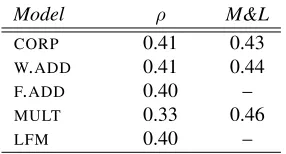
Table 1: Correlation scores (Spearman’s ρ, all signif-icant atp <0.001) between cosines of corpus-extracted or model-generated AN vectors and phrase similarity rat-ings collected in Mitchell and Lapata (2010), as well as best reported results from Mitchell & Lapata (M&L).
Semantic vector construction For each of the items in our vocabulary, we first build
10K-dimensional vectors by recording the item’s
sentence-internal co-occurrence with the top 10K most frequent content lemmas (nouns, adjectives, verbs or adverbs) in the corpus. We built a rank of these co-occurrence counts, and excluded as stop words from the dimensions any element of any POS whose rank was from 0 to 300. The raw co-occurrence counts were then transformed into (positive) Pointwise Mutual Information (pPMI) scores (Church and Hanks, 1990). Next, we reduce the full co-occurrence matrix to 300 dimensions applying the Non-negative Matrix Factorization (NMF) operation (Lin, 2007). We did not tune the semantic vector construction parameters, since we found them to work best in a number of independent earlier experiments.
Corpus-extracted vectors (corp) were computed
for the ANs and for the flexible order and attested rigid order AANs, and then mapped onto the 300-dimension NMF-reduced semantic space. As a san-ity check, the first row of Table 1 reports the corre-lation between the AN phrase similarity ratings col-lected in Mitchell and Lapata (2010) and the cosines of corpus-extracted vectors in our space, for the same ANs. For the AAN vectors, which are sparser, we used human judgements to build a reliable sub-set to serve as our gold standard, as detailed in Sec-tion 2.4.
2.2 Composition models
We focus on four composition functions proposed in recent literature with high performance in a
num-ber of semantic tasks. We first consider
which the model-generated vectors are simply ob-tained through component-wise operations on the
constituent vectors. Given input vectors~uand~v, the
multiplicative model (MULT) computes a composed
vector by component-wise multiplication () of the
constituent vectors, where thei-th component of the
composed vector is given bypi = uivi.3 Given an
AxAyN phrase, this model extends naturally to the
recursive setting of this experiment, as seen in Equa-tion (1).
~
p=~ax~ay~n (1)
This composition method is order-insensitive, the formula above corresponding to the representation
of both AxAyN and AyAxN.
In the weighted additive model (W.ADD), we ob-tain the composed vector as a weighted sum of the
two component vectors:~p=α~u+β~v, whereαand
β are scalars. Again, we can easily apply this
func-tion recursively, as in Equafunc-tion (2).
~
p=α~ax+β(α~ay+β~n) =α~ax+αβ~ay+β2~n
(2)
We also consider the full extension of the addi-tive model (F.ADD), presented in Guevara (2010) and Zanzotto et al. (2010), such that the component vectors are pre-multiplied by weight matrices before
being added: ~p = W1~u +W2~v. Similarly to the
W.ADDmodel, Equation (3) describes how we apply this function recursively.
~
p=W1~ax+W2(W1~ay+W2~n) (3)
=W1~ax+W2W1~ay+W22~n
Finally, we consider the lexical function model (LFM), first introduced in Baroni and Zamparelli (2010), in which attributive adjectives are treated as functions from noun meanings to noun meanings. This is a standard approach in Montague semantics (Thomason, 1974), except noun meanings here are distributional vectors, not denotations, and adjec-tives are (linear) functions learned from a large cor-pus. In this model, predicted vectors are generated
3We conjecture that the different performance of our
multi-plicative model and M&L’s (cf. Table 1) is due to the fact that we use log-transformed pPMI scores, making their multiplica-tive model more akin to our addimultiplica-tive approach.
by multiplying a function matrixU with a
compo-nent vector:~p=U~v. Given a weight matrix,A, for
each adjective in the phrase, we apply the functions in sequence recursively as shown in Equation (4).
~
p=Ax(Ay~n) (4)
Composition model estimation Parameters for W.ADD, F.ADD and LFM were estimated following the strategy proposed by Guevara (2010) and Ba-roni and Zamparelli (2010), recently extended to all composition models by Dinu et al. (2013b). Specif-ically, we learn parameter values that optimize the mapping from the noun to the AN as seen in ex-amples of corpextracted N-AN vector pairs, us-ing least-squares methods. All parameter estima-tions and phrase composiestima-tions were implemented
using the DISSECT toolkit4 (Dinu et al., 2013a),
with a training set of 74,767 corpus-extracted N-AN vector pairs, ranging from 100 to over 1K items across the 663 adjectives. Importantly, while below we report experimental results on capturing various properties of recursive AAN constructions, no AAN was seen during training, which was based entirely on mapping from N to AN. Table 1 reports the re-sults attained by our model implementations on the Mitchell and Lapata AN similarity data set.
2.3 Measures of adjective ordering
Our general goal is to determine which
linguistically-motivated factors distinguish the
two types of adjective ordering. We hypothesize that in cases of flexible order, the two adjectives will have a similarly strong effect on the noun, thus transforming the meaning of the noun equivalently in the direction of both adjectives and component
ANs. For example, in the phrasecreative new idea,
the idea is both new and creative, so we would
expect a similar impact of modification by both adjectives.
On the other hand, we predict that in rigid order cases, one adjective, the one closer to the noun, will dominate the meaning of the phrase, distorting the meaning of the noun by a significant amount. For
example, the phrasedifferent architectural style
in-tuitively describes anarchitectural stylethat is
dif-4http://clic.cimec.unitn.it/composes/
ferent, rather than astylethat is to the same extent architecturalanddifferent.
We consider a number of measures that could cap-ture our intuitions and quantify this difference, ex-ploring the distance relationship between the AAN vectors and each of the AAN subparts. First, we examine how the similarity of an AAN to its com-ponent adjectives affects the ordering, using the
co-sine between the AxAyN vector and each of the
component A vectors as an expression of similarity
(we abbreviate this ascosAxandcosAyfor the first
and second adjective, respectively).5 Our
hypothe-sis predicts that flexible order AANs should remain similarly close to both component As, while rigid order AANs should remain systematically closer to
their Aythan to their Ax.
Next, we consider the similarity between the
AxAyN vector and its component N vector (cosN).
This measure is aimed at verifying if the degree to which the meaning of the head noun is distorted could be a property that distinguishes the two types of adjective ordering. Again, vectors for flexible or-der AANs should remain closer to their component nouns in the semantic space, while rigid order AANs should distort the meaning of the head noun more notably.
We also inspect how the similarity of the AAN to its component AN vectors affects the type of
ad-jective ordering (cosAxN and cosAyN).
Consid-ering the examples above, we predict that the
flex-ible order AAN creative new ideawill share many
properties with bothcreative ideaandnew idea, as
represented in our semantic space, while rigid
or-der AANs, likedifferent architectural style, should
remain quite similar to the AyN, i.e., architectural
style, and relatively distant from the AxN, i.e., dif-ferent style.
Finally, we consider a measure that does not ex-ploit distributional semantic representations, namely
the difference in PMI between AxN and AyN
(∆PMI). Based on our hypothesis described for the other measures, we expect the association in the
cor-pus of AyN to be much greater than AxN for rigid
order AANs, resulting in a large negative∆PMI
val-ues. While flexible order AANs should have similar
5
In the case ofLFM, we compare the similarity of the AAN with the AN centroids for each adjective, since the model does not make use of A vectors (Baroni and Zamparelli, 2010).
association strengths for both AxN and AyN, thus
we expect∆PMIto be closer to 0 than for rigid
or-der AANs.
2.4 Gold standard
To our knowledge, this is the first study to use distributional representations of recursive modifi-cation; therefore we must first determine if the composed AAN vector representations are seman-tically coherent objects. Thus, for vector analysis, agold standardof 320 corpus-extracted AAN vec-tors were selected and their quality was established by inspecting their nearest neighbors. In order to create the gold standard, we ran a crowdsourcing
experiment on CrowdFlower6 (Callison-Burch and
Dredze, 2010; Munro et al., 2010), as follows. First, we gathered a randomly selected set of 600 corpus-extracted AANs, containing 300 flexible or-der and 300 attested rigid oror-der AANs. We then extracted the top 3 nearest neighbors to the corpus-extracted AAN vectors as represented in the
seman-tic space7. Each AAN was then presented with each
of the nearest neighbors, and participants were asked to judge “how strongly related are the two phrases?”
on a scale of 1-7. The rationale was that if we
obtained a good distributional representation of the AAN, its nearest neighbors should be closely related words and phrases. Each pair was judged 10 times,
and we calculated arelatednessscore for the AAN
by taking the average of the 30 judgments (10 for each of the three neighbors).
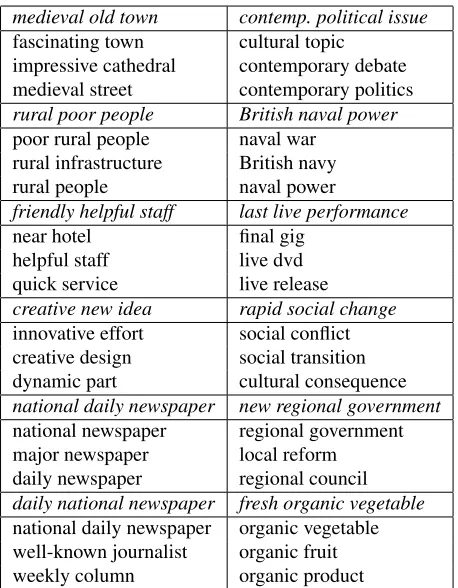
The final set for the gold standard contains the 320 AANs (152 flexible order and 168 attested rigid or-der) which had a relatedness score over the median-split (3.9). Table 2 shows examples of gold stan-dard AANs and their nearest neighbors. As these example indicate, the gold standard AANs reside in semantic neighborhoods that are populated by in-tuitively strongly related expressions, which makes them a sensible target for the compositional models to approximate.
We also find that the neighbors for the AANs rep-resent an interesting variety of types of semantic
6http://www.crowdflower.com
7The top 3 neighbors included adjectives, nouns, ANs and
medieval old town contemp. political issue fascinating town cultural topic
impressive cathedral contemporary debate medieval street contemporary politics rural poor people British naval power poor rural people naval war
rural infrastructure British navy rural people naval power
friendly helpful staff last live performance near hotel final gig
helpful staff live dvd quick service live release
[image:6.612.72.301.55.349.2]creative new idea rapid social change innovative effort social conflict creative design social transition dynamic part cultural consequence national daily newspaper new regional government national newspaper regional government major newspaper local reform daily newspaper regional council daily national newspaper fresh organic vegetable national daily newspaper organic vegetable well-known journalist organic fruit weekly column organic product
Table 2: Examples of the nearest neighbors of the gold standard, both flexible order (left column) and rigid order (right column) AANs.
similarity. For example, the nearest neighbors to the
corpus-extracted vectors formedieval old townand
rapid social changeinclude phrases which describe quite complex associations, cf. Table 2. In addition, we find that the nearest neighbors for flexible order AAN vectors are not necessarily the same for both adjective orders, as seen in the difference in
neigh-bors ofnational daily newspaperanddaily national
newspaper. We can expect that the change in or-der, when acceptable and frequent, does not neces-sarily yield synonymous phrases, and that corpus-extracted vector representations capture subtle dif-ferences in meaning.
3 Results
3.1 Quality of model-generated AAN vectors
Our nearest neighbor analysis suggests that the corpus-extracted AAN vectors in the gold standard are meaningful, semantically coherent objects. We can thus assess the quality of AANs recursively gen-erated by composition models by how closely they
Gold FO RO
W.ADD 0.565 0.572 0.558
F.ADD 0.618 0.622 0.614
MULT 0.424 0.468 0.384
LFM 0.655 0.675 0.637
Table 3: Mean cosine similarities between the corpus-extracted and model-generated gold AAN vectors. All pairwise differences between models are significant ac-cording to Bonferroni-corrected pairedt-tests (p<0.001). ForMULTandLFM, the difference between mean flexible order (FO) and rigid order (RO) cosines is also signifi-cant.
approximate these vectors. We find that the perfor-mances of most composition models in approximat-ing the vectors for the gold AANs is quite satisfac-tory (cf. Table 3). To put this evaluation into
per-spective, note that 99% of the simulated
distribu-tion of pairwise cosines of corpus-extracted AANs is below the mean cosine of the worst-performing model (MULT), that is, a cosine of 0.424 is very sig-nificantly above what is expected by chance for two random corpus-extracted AAN vectors. Also, ob-serve that the two more parameter-rich models are
better than W.ADD, and that LFMalso significantly
outperformsF.ADD.
Further, the results show that the models are able to approximate flexible order AAN vectors better
than rigid order AANs, significantly so forLFMand
MULT. This result is quite interesting because it sug-gests that flexible order AANs express a more lit-eral (or intersective) modification by both adjectives, which is what we would expect to be better captured by compositional models. Clearly, a more complex modification process is occurring in the case of rigid order AANs, as we predicted to be the case.
3.2 Distinguishing flexible vs. rigid order
In the results reported below, we test how both our
baseline ∆PMI measure and the distance from the
AAN and its component parts changes depending on the type of adjective ordering to which the AAN be-longs. From this point forward, we only use gold standard items, where we are sure of the quality of the corpus-extracted vectors. The first block of
Ta-ble 4 reports the t-normalized difference between
[image:6.612.354.502.57.121.2]Measure t sig.
CORP
cosAx 2.478
cosAy -4.348 * RO>FO
cosN 4.656 * FO>RO cosAxN 5.913 * FO>RO
cosAyN 1.970
W.ADD
cosAx 4.805 * FO>RO
cosAy -1.109
cosN 1.140 cosAxN 1.059
cosAyN 0.584
F.ADD
cosAx 2.050
cosAy -1.451
cosN 4.493 * FO>RO cosAxN -0.445
cosAyN 2.300
MULT
cosAx 3.830 * FO>RO
cosAy -0.503
cosN 5.090 * FO>RO cosAxN 4.435 * FO>RO
cosAyN 3.900 * FO>RO
LFM
cosAx -1.649
cosAy -1.272
cosN 5.539 * FO>RO cosAxN 3.336 * FO>RO
cosAyN 4.215 * FO>RO
[image:7.612.87.284.62.386.2]∆PMI 8.701 * FO>RO
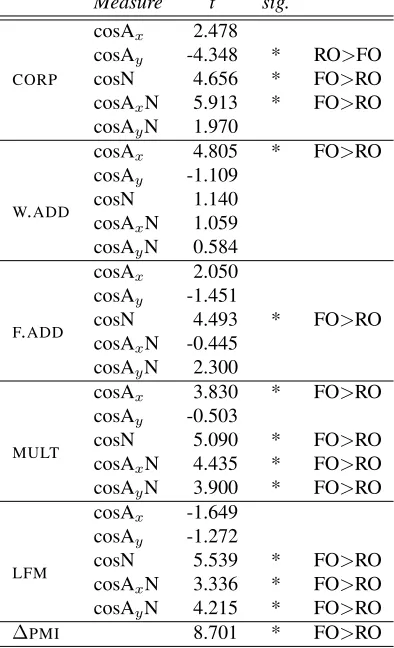
Table 4: Flexible vs. Rigid Order AANs. t-normalized differences between flexible order (FO) and rigid order (FO) mean cosines (or mean ∆PMIvalues) for corpus-extracted and model-generated vectors. For significant differences (p<0.05 after Bonferroni correction), the last column reports whether mean cosine (or∆PMI) is larger for flexible order (FO) or rigid order (RO) class.
These results show, in accordance with our con-siderations in Section 2.3 above: (i) flexible
or-der AxAyNs are closer to AxN and the component
N than rigid order AxAyNs, and (ii) rigid order
AxAyNs are closer to their Ay (flexible order AANs
are also closer to Ax but the effect does not reach
significance).8 The results imply that the degree of
modification of the Ay on the noun is a significant
indicator of the type of ordering present.
8
As an aside, the fact that mean cosines are significantly larger for the flexible order class in two cases but for the rigid or-der class in another addresses the concern, raised by a reviewer, that the words and phrases in one of the two classes might sys-tematically inhabit denser regions of the space than those of the other class, thus distorting results based on comparing mean cosines.
In particular, rigid order AxAyNs are heavily
modified by Ay, distorting the meaning of the head
noun in the direction of the closest adjective quite drastically, and only undergoing a slight
modifica-tion when the Ax is added. In other words, in rigid
order phrases, for examplerapid social change, the
AyN expresses a single concept (probably a “kind”,
in the terminology of formal semantics), strongly
re-lated tosocial, social change, which is then
mod-ified by the Ax. Thus, the change is not both
so-cialandrapid, rather, thesocial changeisrapid. On the other hand, flexible order AANs maintain the se-mantic value of the head noun while being modi-fied only slightly by both adjectives, almost
equiv-alently. For example, in the phrase friendly
help-ful staff, one is saying that thestaff is bothfriendly andhelpful. Most importantly, the corpus-extracted distributional representations are able to model this phenomenon inherently and can significantly distin-guish the two adjective orders.
The results of the composition models (cf. Ta-ble 4) show that for all models at least some prop-erties do distinguish flexible and rigid order AANs,
although onlyMULTandLFMcapture the two
prop-erties that show the largest effect for the corpus-extracted vectors, namely the asymmetry in
similar-ity to the noun and the AxN (flexible order AANs
being more similar to both).
It is worth remarking thatMULTapproximated the
patterns observed in the corpus vectors quite well, despite producing order-insensitive representations of recursive structures. For flexible order AANs, or-der is indeed only slightly affecting the meaning, so
it stands to reason thatMULThas no problems
mod-eling this class. For rigid order AANs, where we consider here the attested-order only, evidently the
order-insensitive MULT representation is sufficient
to capture their relations to their constituents.
Finally, we see that the∆PMImeasure is the best
at distinguishing between the two classes of AAN ordering. This confirms our hypothesis that a lot has
to do with how integrated Ay and N are. While it
is somewhat disappointing that ∆PMI outperforms
all distributional semantic cues, note that this mea-sure conflates semantic and lexical factors, as the
high PMI of AyN in at least some rigid order AANs
is unlikely that our filtering strategies sifted out all
multiword expressions). Moreover, ∆PMIdoes not
produce a semantic representation of the phrase (see how composed distributional vectors approximate of high quality AAN vectors in Table 3). Finally, this measure will not scale up to cases where the ANs are not attested, whereas measures based on compo-sition only need corpus-harvested representations of adjectives and nouns.
3.3 Properties of the correct adjective order
Having shown that flexible order and rigid order AANs are significantly distinguished by various properties, we proceed now to test whether those same properties also allow us to distinguish between correct (corpus-attested) and wrong (unattested) ad-jective ordering in rigid AANs (recall that we are working with cases where the attested-order occurs more than 20 times in the corpus, and both adjec-tives modify the nouns at least 10 times, so we are confident that there is a true asymmetry).
We expect that the fundamental property that dis-tinguishes the orders is again found in the degree of modification of both component adjectives. We
predict that the single concept created by the AyN
in attested-order rigid AANs, such as legal status
informal legal status, is an effect of the
modifica-tion strength of the Ay on the head noun, and when
seen in the incorrect ordering, i.e.,?legal formal
sta-tus, the strong modification oflegalwill still
domi-nate the meaning of the AAN. Composition models should be able to capture this effect based on the dis-tance from both the component adjectives and ANs. Clearly, we cannot run these analyses on corpus-extracted vectors since the unattested order, by def-inition, is not seen in our corpus, and therefore we cannot collect co-occurrence statistics for the AAN phrase. Thus, we test our measures of adjective or-dering on the model-generated AAN vectors, for all gold rigid order AANs in both orders.
We also consider the ∆PMI measure which was
so effective in distinguishing flexible vs. rigid or-der AANs. We expect that the greater association
with AyN for attested-order AANs will again lead
to large, negative differences in PMI scores, while the expectation that unattested-order AANs will be
highly associated with their AxN will correspond to
large, positive differences in PMI.
Measure t sig.
W.ADD
cosAx -7.840 * U>A
cosAy 7.924 * A>U
cosN 2.394
cosAxN -5.462 * U>A
cosAyN 3.627 * A>U
F.ADD
cosAx -8.418 * U>A
cosAy 6.534 * A>U
cosN -1.927
cosAxN -3.583 * U>A
cosAyN -2.185
MULT
cosAx -5.100 * U>A
cosAy 5.100 * A>U
cosN 0.000 cosAxN -0.598
cosAyN 0.598
LFM
cosAx -7.498 * U>A
cosAy 7.227 * A>U
cosN -2.172
cosAxN -5.792 * U>A
cosAyN 0.774
[image:8.612.331.524.56.324.2]∆PMI -11.448 * U>A
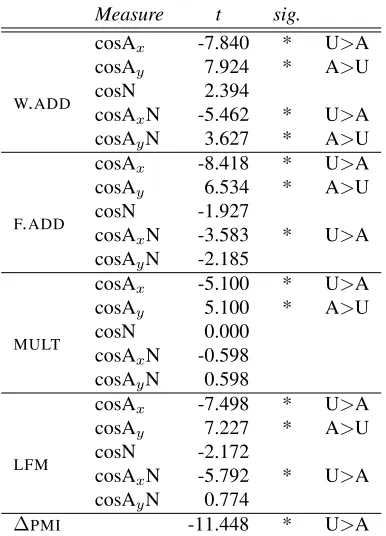
Table 5: Attested- vs. unattested-order rigid order AANs. t-normalized mean paired cosine (or∆PMI) dif-ferences between attested (A) and unattested (U) AANs with their components. For significant differences (paired
t-test p<0.05 after Bonferroni correction), last column reports whether cosines (or∆PMI) are on average larger for A or U.
Across all composition models, we find that the distance between the model-generated AAN and its
component adjectives, Axand Ay, are significant
in-dicators of attested vs. unattested adjective ordering (cf. Table 5). Specifically, we find that rigid order
AANs in the correct order are closest to their Ay,
while we can detect the unattested order when the
rigid order AAN is closer to its Ax. This finding
is quite interesting, since it shows that the order in which the composition functions are applied does not alter the fact that the modification of one
ad-jective in rigid order AANs (the Ay in the case of
attested-order rigid order AANs) is much stronger than the other. Unlike the measures that differenti-ated flexible and rigid order AANs, here we see that the distance from the component N is not an indi-cator of the correct adjective ordering (trivially so forMULT, where attested and unattested AANs are identical).
the distance from the component AxN is a strong
indicator of attested- vs. unattested-order rigid order AANs. Specifically, attested-order AANs are further
from their AxN than unattested-order AANs. This
finding is in line with our predictions and follows the findings of the impact of the distance from the component adjectives.
∆PMI, as seen in the ability to distinguish flexi-ble vs. rigid order AANs, is the strongest indicator of correct vs wrong adjective ordering. This mea-sure confirms that the association of one adjective
(the Ay in attested-order AANs) with the head noun
is indeed the most significant factor distinguishing these two classes. However, as we mentioned be-fore, this measure has its limitations and is likely not to be entirely sufficient for future steps in modeling recursive modification.
4 Conclusion
While AN constructions have been extensively stud-ied within the framework of compositional distri-butional semantics (Baroni and Zamparelli, 2010; Boleda et al., 2012; Boleda et al., 2013; Guevara, 2010; Mitchell and Lapata, 2010; Turney, 2012; Vecchi et al., 2011), for the first time, we extended the investigation to recursively built AAN phrases.
First, we showed that composition functions ap-plied recursively can approximate corpus-extracted AAN vectors that we know to be of high semantic quality.
Next, we looked at some properties of the same high-quality corpus-extracted AAN vectors, finding that the distinction between “flexible” AANs, where the adjective order can be flipped, and “rigid” ones, where the order is fixed, is reflected in distributional cues. These results all derive from the intuition that the most embedded adjective in a rigid AAN has a very strong effect on the distributional semantic rep-resentation of the AAN. Most compositional models were able to capture at least some of the same cues that emerged in the analysis of the corpus-extracted vectors.
Finally, similar cues were also shown to distin-guish (compositional) representations of rigid AANs in the “correct” (corpus-attested) and “wrong” (unattested) orders, again pointing to the degree to which the (attested-order) closest adjective affects
the overall AAN meaning as an important factor. Comparing the composition functions, we find
that the linguistically motivated LFMapproach has
the most consistent performance across all our tests. This model significantly outperformed all others in approximating high-quality corpus-extracted AAN vectors, it provided the closest approximation to the corpus-observed patterns when distinguishing flexi-ble and rigid AANs, and it was one of the models with the strongest cues distinguishing attested and unattested orders of rigid AANs.
From an applied point of view, a natural next step would be to use the cues we proposed as features to train a classifier to predict the preferred order of ad-jectives, to be tested also in cases where neither or-der is found in the corpus, so direct corpus evidence cannot help. For a full account of adjectival order-ing, non-semantic factors should also be taken into account. As shown by the effectiveness in our ex-periments of PMI, which is a classic measure used to harvest idioms and other multiword expressions (Church and Hanks, 1990), ordering is affected by arbitrary lexicalization patterns. Metrical effects are also likely to play a role, like they do in the
well-studied case of “binomials” such as salt and
pep-per(Benor and Levy, 2006; Copestake and
Herbe-lot, 2011). In a pilot study, we found that indeed word length (roughly quantified by number of let-ters) is a significant factor in predicting adjective ordering (the shorter adjective being more likely to occur first), but its effect is not nearly as strong as that of the semantic measures we considered here. In our future work, we would like to develop an or-der model that exploits semantic, metrical and lexi-calization features jointly for maximal classification accuracy.
Adjectival ordering information could be useful in parsing: in English, it could tell whether an AANN sequence should be parsed as A[[AN]N] or A[A[NN]]; in languages with pre- and post-N adjectives, like Italian or Spanish, it could tell whether ANA sequences should be parsed as A[NA] or [AN]A. The ability to detect ordering restric-tions could also help Natural Language Generation tasks (Malouf, 2000), especially for the generation of unattested combinations of As and Ns.
the difference between new and creative idea and new creative idea?). Additionally, we could go more granular, looking at whether compositional models can help us to understand why certain classes of ad-jectives are more likely to precede or follow others (why is size more likely to take scope over color,
so thatbig red carsounds more natural thanred big
car?) or studying the behaviour of specific adjectives
(can our approach capture the fact thatstrong
alco-holic drink is preferable to alcoholic strong drink
because strong pertains to the alcoholic properties
of the drink?).
In the meantime, we hope that the results we re-ported here provide convincing evidence of the use-fulness of compositional distributional semantics in tackling topics, such as recursive adjectival modifi-cation, that have been of traditional interest to theo-retical linguists from a new perspective.
Acknowledgments
We would like to thank the anonymous reviewers, Fabio Massimo Zanzotto, Yao-Zhong Zhang and the members of the COMPOSES team. This research was supported by the ERC 2011 Starting Indepen-dent Research Grant n. 283554 (COMPOSES).
References
Marco Baroni and Roberto Zamparelli. 2010. Nouns are vectors, adjectives are matrices: Representing adjective-noun constructions in semantic space. In Proceedings of EMNLP, pages 1183–1193, Boston, MA.
Sarah Bunin Benor and Roger Levy. 2006. The chicken or the egg? A probabilistic analysis of english binomi-als. Language, pages 233–278.
William Blacoe and Mirella Lapata. 2012. A comparison of vector-based representations for semantic composi-tion. InProceedings of the 2012 Joint Conference on EMNLP and CoNLL, pages 546–556, Jeju Island, Ko-rea.
Gemma Boleda, Eva Maria Vecchi, Miquel Cornudella, and Louise McNally. 2012. First-order vs. higher-order modification in distributional semantics. In Pro-ceedings of the 2012 Joint Conference on EMNLP and CoNLL, pages 1223–1233, Jeju Island, Korea. Gemma Boleda, Marco Baroni, Louise McNally, and
Nghia Pham. 2013. Intensionality was only alleged: On adjective-noun composition in distributional
se-mantics. InProceedings of IWCS, pages 35–46, Pots-dam, Germany.
Chris Callison-Burch and Mark Dredze. 2010. Creating speech and language data with amazon’s mechanical turk. InProceedings of the NAACL HLT 2010 Work-shop on Creating Speech and Language Data with Amazon’s Mechanical Turk, pages 1–12, Los Angeles, CA.
Kenneth Church and Peter Hanks. 1990. Word asso-ciation norms, mutual information, and lexicography. Computational Linguistics, 16(1):22–29.
Guglielmo Cinque, editor. 2002.Functional Structure in DP and IP - The Carthography of Syntactic Structures, volume 1. Oxford University Press.
Guglielmo Cinque. 2004. Issues in adverbial syntax. Lingua, 114:683–710.
Guglielmo Cinque. 2010. The syntax of adjectives: a comparative study. MIT Press.
Ann Copestake and Aur´elie Herbelot. 2011. Exciting and interesting: issues in the generation of binomials. InProceedings of the UCNLG+ Eval: Language Gen-eration and Evaluation Workshop, pages 45–53, Edin-burgh, UK.
Paola Crisma. 1991. Functional categories inside the noun phrase: A study on the distribution of nominal modifiers. “Tesi di Laurea”, University of Venice. Georgiana Dinu, Nghia The Pham, and Marco Baroni.
2013a. DISSECT: DIStributional SEmantics Compo-sition Toolkit. InProceedings of the System Demon-strations of ACL 2013, East Stroudsburg, PA.
Georgiana Dinu, Nghia The Pham, and Marco Baroni. 2013b. General estimation and evaluation of compo-sitional distributional semantic models. In Proceed-ings of the ACL 2013 Workshop on Continuous Vec-tor Space Models and their Compositionality (CVSC 2013), East Stroudsburg, PA.
Gottlob Frege. 1892. Uber sinn und bedeutung.¨ Zeitschrift fuer Philosophie un philosophische Kritik, 100.
Edward Grefenstette and Mehrnoosh Sadrzadeh. 2011. Experimental support for a categorical compositional distributional model of meaning. In Proceedings of EMNLP, Edinburgh, UK.
Emiliano Guevara. 2010. A regression model of adjective-noun compositionality in distributional se-mantics. InProceedings of the ACL GEMS Workshop, pages 33–37, Uppsala, Sweden.
Chih-Jen Lin. 2007. Projected gradient methods for Nonnegative Matrix Factorization. Neural Computa-tion, 19(10):2756–2779.
Jeff Mitchell and Mirella Lapata. 2010. Composition in distributional models of semantics. Cognitive Science, 34(8):1388–1429.
Richard Montague. 1970. Universal Grammar. Theoria, 36:373–398.
Robert Munro, Steven Bethard, Victor Kuperman, Vicky Tzuyin Lai, Robin Melnick, Christopher Potts, Tyler Schnoebelen, and Harry Tily. 2010. Crowd-sourcing and language studies: the new generation of linguistic data. In Proceedings of the NAACL HLT 2010 Workshop on Creating Speech and Language Data with Amazon’s Mechanical Turk, pages 122–130, Los Angeles, CA.
Barbara Partee. 2004. Compositionality. In Compo-sitionality in Formal Semantics: Selected Papers by Barbara H. Partee. Blackwell, Oxford.
Magnus Sahlgren. 2006. The Word-Space Model. Dis-sertation, Stockholm University.
Helmut Schmid. 1995. Improvements in part-of-speech tagging with an application to German. In Proceed-ings of the EACL-SIGDAT Workshop, Dublin, Ireland. Hinrich Sch¨utze. 1997.Ambiguity Resolution in Natural
Language Learning. CSLI, Stanford, CA.
Gary-John Scott. 2002. Stacked adjectival modification and the structure of nominal phrases. In Guglielmo Cinque, editor,Functional Structure in DP and IP. The Carthography of Syntactic Structures, volume 1. Ox-ford University Press.
Richard Socher, E.H. Huang, J. Pennington, Andrew Y. Ng, and C.D. Manning. 2011. Dynamic pooling and unfolding recursive autoencoders for paraphrase de-tection. Advances in Neural Information Processing Systems, 24:801–809.
Richard Socher, Brody Huval, Christopher D. Manning, and Andrew Y. Ng. 2012. Semantic compositionality through recursive matrix-vector spaces. In Proceed-ings of EMNLP, pages 1201–1211, Edinburgh, UK. Richard Sproat and Chilin Shih. 1990. The
cross-linguistics distribution of adjective ordering restric-tions. In C. Georgopoulos and Ishihara R., editors, Interdisciplinary approaches to language: essays in honor of Yuki Kuroda, pages 565–593. Kluver, Dor-drecht.
Sam Steddy and Vieri Samek-Lodovici. 2011. On the ungrammaticality of remnant movement in the deriva-tion of greenberg’s universal 20. Linguistic Inquiry, 42(3):445–469.
Richmond H. Thomason, editor. 1974. Formal Philoso-phy: Selected Papers of Richard Montague. Yale Uni-versity Press, New York.
Peter Turney and Patrick Pantel. 2010. From frequency to meaning: Vector space models of semantics. Jour-nal of Artificial Intelligence Research, 37:141–188.
Peter Turney. 2012. Domain and function: A dual-space model of semantic relations and compositions. Jour-nal of Artificial Intelligence Research, 44:533–585. Eva Maria Vecchi, Marco Baroni, and Roberto
Zampar-elli. 2011. (Linear) maps of the impossible: Cap-turing semantic anomalies in distributional space. In Proceedings of the ACL Workshop on Distributional Semantics and Compositionality, pages 1–9, Portland, OR.