4545
Multi-Task Label Embedding for Text Classification
Honglun Zhang1, Liqiang Xiao1, Wenqing Chen1, Yongkun Wang2, Yaohui Jin1
1State Key Lab of Advanced Optical Communication System and Network
MoE Key Lab of Artificial Intelligence, AI Institute, Shanghai Jiao Tong University
2Network and Information Center, Shanghai Jiao Tong University
{jinyh}@sjtu.edu.cn
Abstract
Multi-task learning in text classification lever-ages implicit correlations among related tasks to extract common features and yield perfor-mance gains. However, a large body of pre-vious work treats labels of each task as in-dependent and meaningless one-hot vectors, which cause a loss of potential label informa-tion. In this paper, we propose Multi-Task Label Embedding to convert labels in text classification into semantic vectors, thereby turning the original tasks into vector match-ing tasks. Our model utilizes semantic corre-lations among tasks and makes it convenient to scale or transfer when new tasks are in-volved. Extensive experiments on five bench-mark datasets for text classification show that our model can effectively improve the perfor-mances of related tasks with semantic repre-sentations of labels and additional information from each other.
1 Introduction
Text classification is a commonNatural Language Processing(NLP) issue that tries to infer the most appropriate label for a given sentence or docu-ment, for example, sentiment analysis, topic clas-sification and so on. With the developments and prosperities ofDeep Learning (Bengio et al., 2013), many neural network based models have been exploited by a large body of literature and achieved inspiring performance gains on various text classification tasks. These models are robust at feature engineering and can represent word se-quences as fixed-length vectors with rich seman-tic information, which are notably ideal for subse-quent NLP tasks.
Due to numerous parameters to train, neu-ral network based models rely heavily on ade-quate amounts of annotated corpora, which can-not always be met as constructions of large-scale
high-quality labeled datasets are extremely time-consuming and labor-intensive.Multi-Task Learn-ing (MTL) solves this problem by jointly train-ing multiple related tasks and leveragtrain-ing poten-tial correlations among them to increase corpora size implicitly, extract common features and yield performance gains. Inspired by (Caruana,1997), there is a large body of research dedicated to MTL with neural network based models (Collobert and Weston,2008;Liu et al.,2015b, 2016a,b; Zhang et al.,2017). These models usually contain a pre-trained lookup layer that map words into dense, low-dimension and real-value vectors with seman-tic implications, namely known asWord Embed-ding (Mikolov et al., 2013b), and utilize some lower layers to capture common features that are further fed to follow-up task-specific layers. How-ever, many existing models may have at least one of the following three disadvantages:
• Lack of Label Information. Labels of each task are represented by independent and meaningless one-hot vectors, for example,
positive and negative in sentiment analysis encoded as[1,0]and[0,1], which may cause a loss of potential label information.
• Inability to Scale. Network structures are elaborately designed to model various corre-lations for MTL, but many of them are struc-turally fixed and some can only deal with in-teractions between two tasks, namely pair-wise interactions. When new tasks are in-volved, the network structures have to be modified and all networks have to be trained again.
ofTransfer Learning(Ling et al.,2008). As discussed above, the network structures of many previous models are fixed and there are no layers specially designed for unannotated new tasks.
In this paper, we proposed Multi-Task Label Embedding(MTLE) to map labels of each task into semantic vectors, similar to how Word Em-bedding deals with word sequences, thereby turn-ing the original tasks into vector matchturn-ing tasks. The idea of embedding label is not new and is primarily designed to improve general neural text classification models (Bengio et al.,2010;Norouzi et al.,2013;Ma et al.,2016), but here we mainly focus on integrating label embedding to enhance MTL. MTLE utilizes semantic correlations among tasks and effectively solves the problems of scal-ing and transferrscal-ing when new tasks are involved. We conduct extensive experiments on five benchmark datasets for text classification. Com-pared to learning separately, jointly learning mul-tiple related tasks based on MTLE demonstrates significant performance gains for each task.
Our contributions are four-fold:
• Our model efficiently leverages label infor-mation of each task by mapping labels into dense, low-dimension and real-value vectors with semantic implications.
• It is particularly convenient for our model to scale for new tasks. The network structures need no modifications and only samples from the new tasks require training.
• After training on several related tasks, our model can also naturally transfer to deal with new tasks without anymore training, while still achieving appreciable performances.
• We consider different scenarios of MTL and demonstrate strong results on several bench-mark datasets for text classification. Our model outperforms most of the state-of-the-art baselines.
2 Problem Statements
2.1 Single-Task Learning
For a text classification task, theInputis a word sequence x = {x1, x2, ..., xT}, where T is the
sequence length and we need to output the most appropriate Label from the set {y1, y2, ..., yC},
or their one-hot representation {y1,y2, ...,yC},
where C is the number of classes. In the super-vised case, we have the Annotation, that is, the corresponding ground truth labely˜ for each input, while in the unsupervised case, we only know the label set but lack the specific annotations.
A pre-trained lookup layer is used to get the embedding vector xt ∈ Rd for each word xt.
A text classification model f is trained to pro-duce the predicted distribution yˆ for each x =
{x1,x2, ...,xT}.
f(x1,x2, ...,xT) = ˆy (1)
and the learning objective is to minimize the over-all cross-entropy on the training set.
l=−
N
∑
i=1 C
∑
j=1
˜
yijlog ˆyij (2)
whereN denotes the number of training samples.
2.2 Multi-Task Learning
Given K supervised text classification tasks,
T1, T2, ..., TK, a multi-task learning model F is
trained to transform eachx(k) fromTk into
mul-tiple predicted distributions{yˆ(1), ...,yˆ(K)}.
F(x(1k), ...,x(Tk)) ={yˆ(1), ...,yˆ(K)} (3)
where onlyyˆ(k)is used for loss computation. The overall training loss is a weighted combination of costs for each task.
L=−
K
∑
k=1
λk Nk
∑
i=1 Ck
∑
j=1
˜
y(ijk)log ˆy(ijk) (4)
whereλk,NkandCkdenote the weight, the
num-ber of training samples and the numnum-ber of classes for each taskTk.
2.3 Ability to Scale
When new tasks are involved, for ex-ample, given K′ more supervised tasks
TK+1, TK+2, ..., TK+K′, the MTL model F,
which has been trained on the oldKtasks, should be able to scale with few structural modifications.
F(x(1k), ...,x(Tk)) ={yˆ(1), ...,yˆ(K+K′)} (5)
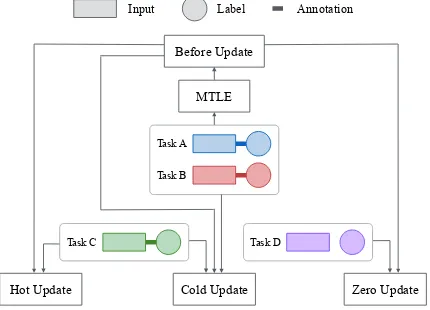
There are mainly two scaling methods forF to deal with the new tasks. We can continue training
F and further tune the model parameters based on samples from the new tasks, which we define as
Hot Update, or re-trainF again based on training samples from all tasks, which is defined as Cold Update.
2.4 Ability to Transfer
GivenK′′more completely unannotated new tasks
TK◦+1, TK◦+2, ..., TK◦+K′′, F should be able to
transfer what it learned from the old tasks, which is defined as Zero Update, as no more training samples are available and the model parameters are not updated anymore.
For eachx(k)from theK′′tasks,Fshould
pro-duce the corresponding predicted distributions for the new tasks, even if the annotations of these new tasks are not provided at all.
F(x(1k), ...,x(Tk)) ={yˆ(K+1), ...,yˆ(K+K′′)} (6)
which requires thatFshould be able to understand the meanings of each label from the new tasks and infer the most appropriate one.
3 Methodology
In text classification tasks, labels can be single-word or double-single-word, for example, positive and
negative in binary sentiment classification, very positive,positive, neutral,negativeandvery neg-ative in 5-category sentiment classification, but there are few labels that contain three words or more. Inspired by Word Embedding, we pro-poseMulti-Task Label Embedding (MTLE) to convert labels of each task of MTL into dense, low-dimension and real-value vectors with seman-tic implications, thereby disclosing potential intra-task and inter-intra-task correlations from both texts and labels.
3.1 Architecture
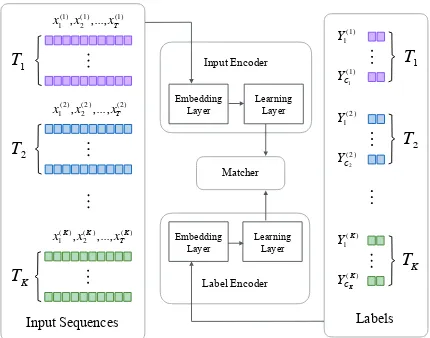
Figure 1 illustrates the general idea of MTLE, which mainly consists of three parts, the Input Encoder, theLabel Encoderand theMatcher.
In the Input Encoder, each input sequencex(k)
fromTk is transformed into embedding
represen-tationx(k) ={x(1k),x(2k), ...,x(Tk)}by the Embed-ding Layer (EI). The Learning Layer (LI) is
ap-plied to recurrently comprehendx(k)and generate a fixed-length vectorX(k), which can be regarded
Label Encoder T1
x1 (1),x
2 (1),...,x
T (1)
T2
x1(2) ,x2(2)
,...,xT (2)
TK
x1 (K),x
2 (K),...,x
T (K)
Input Sequences
T1
YC1 (1)
T2
TK
Labels
Y1 (1)
YC 2
(2)
Y1 (2)
YCK (K) Y1
(K)
Matcher Input Encoder
Embedding
Layer Learning Layer
Embedding
[image:3.595.309.524.62.231.2]Layer Learning Layer
Figure 1: General Architecture of MTLE
as an overall representation of the original input sequencex(k).
In the Label Encoder, there areCklabels inTk,
where each yj(k)(1 ≤ j ≤ Ck) consists of one
word or two words, and is mapped into the vector representationy(jk)by the Embedding Layer (EL).
The Learning Layer (LL) absorbsy(jk)to generate
a fixed-length vectorY(jk), which can be utilized as an overall semantic representation of the origi-nal labelyj(k).
In order to classify a sample x(k) fromTk, the
Matcher obtains the correspondingX(k) from the Input Encoder, all Yj(k)(1 ≤ j ≤ Ck) from the
Label Encoder, and conducts vector matching to select the most appropriate class label.
In MTLE,EI andELobtain understandings of
words from texts and labels respectively, whileLI
andLL achieve representation abilities of vector
sequences. All these four modules are learned within and shared among tasks.
3.2 Implementation Details
We can explore different embedding methods and neural networks to achieveEI, ELandLI, LL
re-spectively, but here we choose to implement them in an easier way and spend more efforts to investi-gate the effectiveness of MTLE.
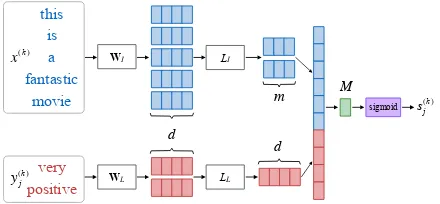
The implementation details of MTLE are illus-trated in Figure 2. LI and LL are both
fully-connection layers with the weights WI andWL
of|V| ×d, where|V|denotes the vocabulary size and dis the embedding size. We can get a pre-trained lookup table based on open domain cor-pora to initializeWI,WL and further tune them
x(k)
yj(k) this
is a fantastic
movie
very positive
WI
WL
d LI
LL
m M2m×1
sigmoid sj
(k)
[image:4.595.72.292.63.165.2]d
Figure 2: Implementation Details of MTLE
LI andLLshould be trainable models that can
transform a vector sequence of arbitrary length into a fixed-length vector, which can be im-plemented by a Bi-directional Long Short-Term Memory Network(BiLSTM) that can recurrently process vector sequences and learn long-term de-pendencies.
While there are numerous variants of the stan-dard LSTM (Hochreiter and Schmidhuber,1997), here we follow the implementation of (Graves, 2013). At each time step t, states of the LSTM can be fully described by five vectors in Rm, an input gate it, a forget gate ft, an output gate ot,
the hidden statehtand the memory cellct, which
adhere to the following transition equations.
it=σ(Wixt+Uiht−1+Vict−1+bi) (7)
ft=σ(Wfxt+Ufht−1+Vfct−1+bf) (8)
ot=σ(Woxt+Uoht−1+Voct−1+bo) (9)
˜
ct= tanh(Wcxt+Ucht−1) (10)
ct=ft⊙ct−1+it⊙˜ct (11)
ht=ot⊙tanh(ct) (12)
where xt is the current input, σ denotes
logis-tic sigmoid function and⊙denotes element-wise multiplication.
A BiLSTM consists of two LSTM layers that process the input sequences in original and re-versed orders, and its output is the concatenation of hidden states from the forward and backward LSTM at each time step.
ht=−→ht⊕←h−t (13)
where⊕denotes vector concatenation.
We apply the above equations to implementLI
with hidden sizem. However, it is inappropriate to apply a BiLSTM forLL, as most labels contain
only one or two words. Instead, LL accepts the
embedding vectors of each word from a label and calculate the average.
For an input samplex(k) and allC
klabelsyj(k)
from Tk, the corresponding X(k) ∈ R2m and
Yj(k) ∈Rdare calculated as follows.
X(k)=LI(WI(x(k))) (14)
Yj(k)=LL(WL(yj(k))) (15)
In this paper, we mainly focus on the idea and effects of MTLE, so rather than exploring some useful mechanisms like gating, external mem-ory or attention for stronger abilities of sequence learning, we choose the vanilla BiLSTM for quick implementations and spend most of our efforts on investigating the effectiveness of MTLE.
We concatenate X(k),Y(jk) and apply another fully-connection layer with only one neuron, de-noted byM, to implement the Matcher, which ac-cepts outputs fromLI andLLto produce a score
of matching. Given the matching scores of each label, we refer to the idea of cross-entropy and cal-culate the loss function for a samplex(k)fromTk
as follows.
s(jk)=σ(M(X(k)⊕Y(jk))) (16)
ˆ
y(jk)= exp(s
(k) j )
∑Ck c=1exp(s
(k) c )
(17)
l(k)=−
Ck
∑
j=1
˜
yj(k)log ˆy(jk) (18)
The overall training objective is to minimize the weighted linear combination of costs for each task.
L=−
K
∑
k=1
λk Nk
∑
i=1
l(ik) (19)
MTLE provides an easy and intuitive way to re-alize MTL, where input texts and class labels from different tasks are jointly learned and compactly fused. During training,EIandELlearn better
un-derstanding of word semantics for different tasks,
LI and LL obtain stronger abilities of sequence
representation, while M produces more accurate scores for vector matching.
3.3 Scaling and Transferring
their vector representationsX(k)andY(k) j ,
calcu-late the matching scores and find the most appro-priate label.
MTLE
Task A
Task B
Task C Task D
Before Update
Hot Update Cold Update Zero Update
Label
[image:5.595.75.290.120.275.2]Input Annotation
Figure 3: Three different updating methods
If the new tasks are annotated, we can apply Hot Update or Cold Update for scaling and better tune the parameters. If the new tasks are completely unannotated, we can use Zero Update for transfer-ring and produce reasonable predictions.
The differences among Hot Update, Cold Up-date and Zero UpUp-date are illustrated in Figure 3, whereBefore Updatedenotes the state of MTLE trained on the old tasks before the new tasks are in-troduced. We will further compare these updating methods in the Experiment Section.
4 Experiment
In this section, we design extensive experiments with multi-task learning based on five benchmark datasets for text classification. We investigate the empirical performances of MTLE and compare them with existing state-of-the-art baselines.
4.1 Datasets
As Table 1 shows, we select five benchmark datasets for text classification, which are com-monly used in a large body of research on MTL. We design three experiment scenarios to evaluate the performances of MTLE. Larger text classifica-tion datasets (Zhang et al.,2015) are not chosen as there are already enough samples to train and MTL may increase computation workloads. We use the accuracy for evaluations as samples from these datasets are mostly well balanced.
• Multi-Cardinality Movie review datasets with different average lengths and class
num-bers, including SST-1 (Socher et al., 2013),
SST-2,IMDB(Maas et al.,2011).
• Multi-Domain Product review datasets on different domains fromMulti-Domain Senti-ment Dataset(Blitzer et al.,2007).
• Multi-Objective Text classification datasets with different objectives, including IMDB,
RN (Apt´e et al., 1994), QC (Li and Roth, 2002).
4.2 Hyperparameters and Training
Training of MTLE is conducted through back propagation with batch gradient descent (Amari, 1993). We obtain a pre-trained lookup table by applyingWord2Vec(Mikolov et al.,2013a) on the Google News corpus, which contains more than 100B words with a vocabulary size of about 3M. During each epoch, we randomly divide training samples from different tasks into batches of fixed size. For each iteration, we randomly select one task and choose an untrained batch, calculate the gradient and update the parameters accordingly.
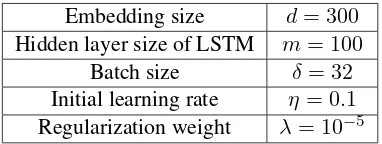
Parameters of the neural layers are randomly initialized with the Xavier initializer (Glorot and Bengio,2010). We apply 10-fold cross-validation and different combinations of hyperparameters are investigated, of which the best one is described in Table2.
4.3 Results of MTLE vs. Single Task
In Table 3, we compare the performances of MTLE with single-task learning, where only a BiLSTM layer is applied.
MTLE achieves significant performance gains with label information and additional correla-tions from related tasks. Domain, Multi-Cardinality and Multi-Objective benefit from MTLE with average improvements of 5.5%, 2.7% and 1.2%, as they contain increasingly weaker rel-evance among tasks. The result of IMDB in Cardinality is slightly better than that in Multi-Objective (91.3 against 90.9), as SST-1 and SST-2 share more semantically useful information with IMDB than RN and QC.
4.4 Abilities to Scale and Transfer
In order to investigate the abilities of MTLE to scale and transfer, we use A +B → C to de-note the case where MTLE is trained on task A
Table 1: Five benchmark text classification datasets
Dataset Description Type Average Length Class Objective
SST
Movie reviews in Stan-ford Sentiment Treebank includingSST-1andSST-2
Sentence 19 / 19 5 / 2 Sentiment
IMDB Internet Movie Database Document 279 2 Sentiment
MDSD
Product reviews on books, DVDs, electronics and kitchen (BDEK)
Document 176 / 189 / 115 / 97 2 Sentiment
RN Reuters Newswire topics
classification Document 146 46 Topics
QC Question Classification Sentence 10 6 Question Types
Table 2: Hyperparameter settings
Embedding size d= 300
Hidden layer size of LSTM m= 100
Batch size δ= 32
Initial learning rate η= 0.1
Regularization weight λ= 10−5
compare the influences of Hot Update, Cold Up-date, Zero Update on each task.
• Case 1SST-1+SST-2→IMDB. • Case 2B+D+E→K.
• Case 3RN+QC→IMDB.
where in Zero Update, we ignore the training set ofCand just evaluate our model on the testing set. As Table 4 shows, Before Update denotes the model trained on the old tasks before the new tasks are involved, so only evaluations on the old tasks are conducted.
Cold Update re-trains the model of Before Up-date with both the old tasks and the new tasks, thus achieving similar performances with the last line in Table3. Different from Cold Update, Hot Up-date resumes training only on the new tasks, re-quires much less training time, while still obtains competitive results for all tasks. The new tasks like IMDB and Kitchen benefit more from Hot Update than the old tasks, as the parameters are further tuned according to annotations from these new tasks.
Zero Update provides inspiring possibilities for completely unannotated tasks. There are no more annotations for additional training from the new tasks, so we just apply the model of Before Update
for evaluations on the testing sets of the new tasks. Zero Update achieves competitive performances in Case 1 (90.9 for IMDB) and Case 2 (86.7 for Kitchen), as tasks from these two cases all be-long to sentiment datasets of different cardinalities or domains that contain rich semantic correlations with each other. However, the result for IMDB in Case 3 is only 74.2, as sentiment shares less rel-evance with topic and question type, thus leading to poor transferring performances.
4.5 Multi-Task or Label Embedding
MTLE mainly employs two mechanisms, label embedding and multi-task learning, so both im-plicit information from labels and potential cor-relations from other tasks make differences. In this section, we conduct experiments to explore the contributions of label embedding and multi-task learning respectively.
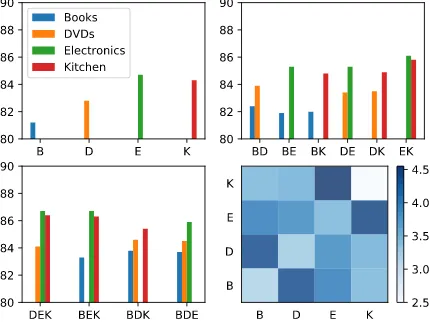
We choose the four tasks from Multi-Domain scenario and train MTLE on each task separately, so their performances are only influenced by label embedding. Then we re-train MTLE from scratch for every two tasks, every three tasks from them and record the performances of each task in differ-ent cases, where both label embedding and multi-task learning matter.
[image:6.595.86.277.280.352.2]Table 3: Results of MTLE on different scenarios
Model Multi-Cardinality Multi-Domain Multi-Objective Avg∆
SST-1 SST-2 IMDB B D E K IMDB RN QC
[image:7.595.86.514.176.264.2]Single Task 46.2 86.1 88.9 78.3 79.8 81.5 82.3 89.0 84.2 92.7 -MTLE 49.8 88.4 91.3 84.5 85.2 87.3 86.9 90.9 85.5 93.2 +3.4
Table 4: Results of Hot Update, Cold Update and Zero Update in different cases
Model Case 1 Case 2 Case 3
SST-1 SST-2 IMDB B D E K RN QC IMDB
Before Update 48.6 87.6 - 83.7 84.5 85.9 - 84.8 93.4 -Cold Update 49.8 88.5 91.2 84.4 85.2 87.2 86.9 85.5 93.2 91.0
Hot Update 49.6 88.1 91.4 84.2 84.9 87.0 87.1 85.2 92.9 91.1
Zero Update - - 90.9 - - - 86.7 - - 74.2
be concluded that both information from labels as well as correlations from other tasks account for considerable parts of contributions.
In the last graph, diagonal cells denote improve-ments of every one task, while off-diagonal cells denote average improvements of every two tasks, so an off-diagonal cell of darker color indicates stronger correlation between the two tasks. An interesting finding is that Books is more related with DVDs and Electronics is more relevant to Kitchen. A possible reason may be that Books and DVDs are products targeted for reading or watch-ing, while customers care more about appearances and functionalities when talking about Electronics and Kitchen.
Figure 4: Performance gains of each task in differ-ent cases
4.6 Comparisons with State-of-the-art Models
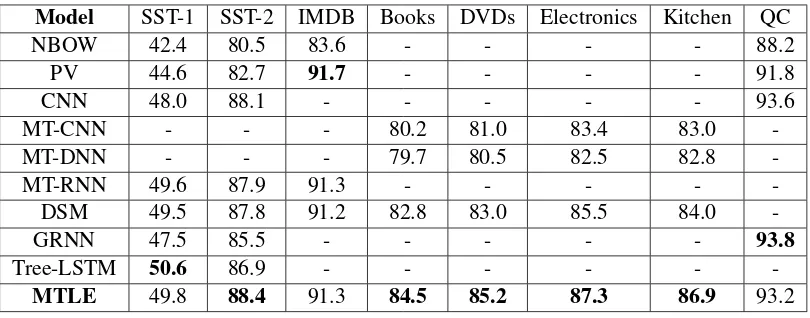
We compare MTLE against the following models.
• NBOW Neural Bag-of-Words that sums up embedding vectors of all words and applies a non-linearity followed by a softmax layer.
• PV Paragraph Vectors followed by logistic regression (Le and Mikolov,2014).
• CNN Convolutional Neural Networks for Sentence Classification (Kim,2014).
• MT-CNN Multi-Task learning with Convo-lutional Neural Networks (Collobert and We-ston,2008) where lookup tables are partially shared.
• MT-DNN Multi-Task learning with Deep Neural Networks (Liu et al.,2015b) that uti-lizes bag-of-word representations and a hid-den shared layer.
• MT-RNN Multi-Task learning with Re-current Neural Networks with a shared-layer (Liu et al.,2016b).
• DSM Deep multi-task learning with Shared Memory (Liu et al., 2016a) where a exter-nal memory and a reading/writing mecha-nism are introduced.
• GRNN Gated Recursive Neural Network for sentence modeling and text classifica-tion (Chen et al.,2015).
• Tree-LSTM A generalization of LSTMs to tree-structured network topologies (Tai et al., 2015).
[image:7.595.74.289.497.658.2]Table 5: Comparisons of MTLE against state-of-the-art models
Model SST-1 SST-2 IMDB Books DVDs Electronics Kitchen QC
NBOW 42.4 80.5 83.6 - - - - 88.2
PV 44.6 82.7 91.7 - - - - 91.8
CNN 48.0 88.1 - - - 93.6
MT-CNN - - - 80.2 81.0 83.4 83.0
-MT-DNN - - - 79.7 80.5 82.5 82.8
-MT-RNN 49.6 87.9 91.3 - - - -
-DSM 49.5 87.8 91.2 82.8 83.0 85.5 84.0
-GRNN 47.5 85.5 - - - 93.8
Tree-LSTM 50.6 86.9 - - -
-MTLE 49.8 88.4 91.3 84.5 85.2 87.3 86.9 93.2
for QC, as it contains less correlations with other tasks. Tree-LSTM outperforms our model on SST-1 (50.6 against 49.8), but it requires an exter-nal parser to get the sentence topological struc-ture and utilizes treebank annotations. PV slightly surpasses MTLE on IMDB (91.7 against 91.3), as sentences from IMDB are much longer than SST and MDSD, which require stronger abilities of long-term dependency learning.
In this paper, we mainly focus the idea and ef-fects of integrating label embedding to enhance multi-task learning, so we apply the BiLSTM to realize LI, which can be further implemented
by other more powerful sequence learning mod-els (Liu et al.,2015a;Chen et al.,2015;Tai et al., 2015) and produce better performances. Explo-rations of other embedding layers and learning layers may be appreciated, but due to limited pages we choose to research these contents in fu-ture work.
5 Related Work
There is a large body of literature related to multi-task learning with neural networks in NLP ( Col-lobert and Weston, 2008; Liu et al., 2015b, 2016a,b;Zhang et al.,2017).
(Collobert and Weston, 2008) use a shared lookup layer for common features, followed by task-specific layers for several traditional NLP tasks including part-of-speech tagging and seman-tic parsing. They use a fix-size window to solve the problem of variable-length input sequences, which can be better addressed by RNN.
(Liu et al.,2015b,2016a,b;Zhang et al.,2017) all investigate MTL for text classification. (Liu et al., 2015b) apply bag-of-word representation, but information on word order is lost. (Liu et al.,
2016a) introduce an external memory for informa-tion sharing with a reading/writing mechanism for communications. (Liu et al.,2016b) propose three different models for MTL with RNN and (Zhang et al.,2017) constructs a generalized architecture for RNN based MTL. However, models of these papers ignore essential information of labels and mostly can only address pairwise interactions be-tween two tasks. Their network structures are also fixed, thereby failing to scale or transfer when new tasks are involved.
Different from the above work, MTLE maps la-bels of text classification tasks into semantic vec-tors and provide a more intuitive way to realize MTL with the abilities to scale and transfer. In-put sequences from three or more tasks are jointly learned together with their labels, benefitting from each other and obtaining better sequence represen-tations.
6 Conclusion and Future Work
In this paper, we propose Multi-Task Label Em-bedding to map labels of text classification tasks into semantic vectors. MTLE utilizes semantic correlations among tasks and effectively solves the problems of scaling and transferring when new tasks are involved. We explore three different scenarios of MTL and MTLE can improve per-formances of most tasks with semantic represen-tations of labels and additional information from others in all scenarios.
References
Shun-ichi Amari. 1993. Backpropagation and stochas-tic gradient descent method. Neurocomputing, 5(3):185–196.
Chidanand Apt´e, Fred Damerau, and Sholom M. Weiss. 1994. Automated Learning of Decision Rules for Text Categorization. ACM Trans. Inf. Syst., 12(3):233–251.
Samy Bengio, Jason Weston, and David Grangier. 2010. Label embedding trees for large multi-class tasks. InNIPS, pages 163–171.
Yoshua Bengio, Aaron C. Courville, and Pascal Vin-cent. 2013. Representation Learning: A Review and New Perspectives. IEEE Trans. Pattern Anal. Mach. Intell., 35(8):1798–1828.
John Blitzer, Mark Dredze, and Fernando Pereira. 2007. Biographies, Bollywood, Boom-boxes and Blenders: Domain Adaptation for Sentiment Clas-sification. InACL.
Rich Caruana. 1997. Multitask Learning. Machine Learning, 28(1):41–75.
Xinchi Chen, Xipeng Qiu, Chenxi Zhu, Shiyu Wu, and Xuanjing Huang. 2015. Sentence Modeling with Gated Recursive Neural Network. InEMNLP, pages 793–798.
Ronan Collobert and Jason Weston. 2008. A unified architecture for natural language processing: deep neural networks with multitask learning. InICML, pages 160–167.
Xavier Glorot and Yoshua Bengio. 2010. Understand-ing the difficulty of trainUnderstand-ing deep feedforward neural networks. InAISTATS, pages 249–256.
Alex Graves. 2013. Generating Sequences With Re-current Neural Networks. CoRR, abs/1308.0850.
Sepp Hochreiter and J¨urgen Schmidhuber. 1997. Long Short-Term Memory. Neural Computation, 9(8):1735–1780.
Yoon Kim. 2014. Convolutional neural networks for sentence classification. In EMNLP, pages 1746– 1751.
Quoc V. Le and Tomas Mikolov. 2014. Distributed Representations of Sentences and Documents. In ICML, pages 1188–1196.
Xin Li and Dan Roth. 2002. Learning Question Classi-fiers. InCOLING.
Xiao Ling, Wenyuan Dai, Gui-Rong Xue, Qiang Yang, and Yong Yu. 2008. Spectral domain-transfer learn-ing. InACM SIGKDD, pages 488–496.
Pengfei Liu, Xipeng Qiu, Xinchi Chen, Shiyu Wu, and Xuanjing Huang. 2015a. Multi-Timescale Long Short-Term Memory Neural Network for Modelling Sentences and Documents. InEMNLP, pages 2326– 2335.
Pengfei Liu, Xipeng Qiu, and Xuanjing Huang. 2016a. Deep Multi-Task Learning with Shared Memory for Text Classification. InEMNLP, pages 118–127.
Pengfei Liu, Xipeng Qiu, and Xuanjing Huang. 2016b. Recurrent Neural Network for Text Classification with Multi-Task Learning. In IJCAI, pages 2873– 2879.
Xiaodong Liu, Jianfeng Gao, Xiaodong He, Li Deng, Kevin Duh, and Ye-Yi Wang. 2015b. Representa-tion Learning Using Multi-Task Deep Neural Net-works for Semantic Classification and Information Retrieval. InNAACL HLT, pages 912–921.
Yukun Ma, Erik Cambria, and Sa Gao. 2016. Label embedding for zero-shot fine-grained named entity typing. InCOLING, pages 171–180.
Andrew L. Maas, Raymond E. Daly, Peter T. Pham, Dan Huang, Andrew Y. Ng, and Christopher Potts. 2011. Learning Word Vectors for Sentiment Analy-sis. InNAACL HLT, pages 142–150. Association for Computational Linguistics.
Tomas Mikolov, Kai Chen, Greg Corrado, and Jeffrey Dean. 2013a. Efficient Estimation of Word Repre-sentations in Vector Space. CoRR, abs/1301.3781.
Tomas Mikolov, Ilya Sutskever, Kai Chen, Gregory S. Corrado, and Jeffrey Dean. 2013b. Distributed Rep-resentations of Words and Phrases and their Compo-sitionality. InNIPS, pages 3111–3119.
Mohammad Norouzi, Tomas Mikolov, Samy Bengio, Yoram Singer, Jonathon Shlens, Andrea Frome, Greg Corrado, and Jeffrey Dean. 2013. Zero-shot learning by convex combination of semantic embed-dings. CoRR, abs/1312.5650.
Richard Socher, Alex Perelygin, Jean Wu, Jason Chuang, Christopher D. Manning, Andrew Y. Ng, and Christopher Potts. 2013. Recursive Deep Mod-els for Semantic Compositionality Over a Sentiment Treebank. InEMNLP, pages 1631–1642, Strouds-burg, PA. Association for Computational Linguis-tics.
Kai Sheng Tai, Richard Socher, and Christopher D. Manning. 2015. Improved semantic representations from tree-structured long short-term memory net-works. InACL, pages 1556–1566.
Honglun Zhang, Liqiang Xiao, Yongkun Wang, and Yaohui Jin. 2017. A generalized recurrent neural architecture for text classification with multi-task learning. InIJCAI-17, pages 3385–3391.