4909
Sanskrit Sandhi Splitting using
seq
seq
seq
2(
2(
2(
seq
seq
seq
)
)
)
222Rahul Aralikatte
IBM Research
Neelamadhav Gantayat
IBM Research
{rahul.a.r, neelamadhav, naveen.panwar}@in.ibm.com Naveen Panwar
IBM Research
Anush Sankaran
IBM Research
Senthil Mani
IBM Research
Abstract
In Sanskrit, small words (morphemes) are combined to form compound words through a process known as Sandhi. Sandhi split-ting is the process of splitsplit-ting a given com-pound word into its constituent morphemes. Although rules governing word splitting ex-ists in the language, it is highly challenging to identify the location of the splits in a com-pound word. Though existing Sandhi splitting systems incorporate these pre-defined splitting rules, they have a low accuracy as the same compound word might be broken down in multiple ways to provide syntactically correct splits.
In this research, we propose a novel deep learning architecture called Double Decoder RNN (DD-RNN), which (i) predicts the lo-cation of the split(s) with95%accuracy, and (ii) predicts the constituent words (learning the Sandhi splitting rules) with 79.5% accuracy, outperforming the state-of-art by20%. Addi-tionally, we show the generalization capability of our deep learning model, by showing com-petitive results in the problem of Chinese word segmentation, as well.
1 Introduction
Compound word formation in Sanskrit is gov-erned by a set of deterministic rules follow-ing a well-defined structure described inP¯an. ini’s As.t.¯adhy¯ay¯ı, a seminal work on Sanskrit grammar. The process of merging two or more morphemes to form a word in Sanskrit is calledSandhiand the process of breaking a compound word into its con-stituent morphemes is calledSandhi splitting. In Japanese, Rendaku (‘sequential voicing’) is sim-ilar to Sandhi. For example, ‘origami’ consists of‘ori’ (paper) + ‘kami’(folding), where ‘kami’
[image:1.595.329.508.249.362.2]changes to‘gami’due toRendaku.
Figure 1: Different possible splits for the word paropak¯arah. and prots¯ahah., provided by a standard Sandhi splitter.
Learning the process of sandhi splitting for San-skrit could provide linguistic insights into the for-mation of words in a wide-variety of Dravidian languages. From an NLP perspective, automated learning of word formations in Sanskrit could provide a framework for learning word organiza-tion in other Indian languages, as well (Bharati et al., 2006). In literature, past works have ex-plored sandhi splitting (Gillon, 2009) (Kulkarni and Shukl,2009), as a rule based problem by ap-plying the rules fromAs.t.¯adhy¯ay¯ıin a brute force manner. Consider the example in Figure 1 illus-trating the different possible splits of a compound wordparopak¯arah.. While the correct split ispara
+upak¯arah., other forms of splits such as, para+
apa + k¯arah. are syntactically possible while se-mantically incorrect1. Thus, knowing all the rules of splitting is insufficient and it is essential to iden-tify the location(s) of split(s) in a given compound word.
In this research, we propose an approach for
au-1Different syntactic splits given by one of the
pop-ular Sandhi splitters: https://goo.gl/0M5CPS and
tomated generation of split words by first learn-ing the potential split locations in a compound word. We use a deep bi-directional character RNN encoder and two decoders with attention,
seqseqseq2(2(2(seqseqseq)))222. The accuracy of our approach on the benchmark dataset for split location prediction is
95% and for split words prediction is 79.5% re-spectively. To the best of our knowledge, this is the first research work to explore deep learning tech-niques for the problem of Sanskrit Sandhi split-ting, along with producing state-of-art results. Ad-ditionally, we show the performance of our pro-posed model for Chinese word segmentation to demonstrate the model’s generalization capability.
2 seqseqseq2(2(2(seqseqseq)))222: Model Description
In this section, we present our double decoder model to address the Sandhi splitting problem. We first outline the issues with basic deep learning ar-chitectures and conceptually highlight the advan-tages of the double decoder model.
2.1 Issues with standard architectures
Consider an example of splitting a sequence
abcdefg as abcdx + efg. The primary task is to identifydas the split location. Further, for a given locationdin the character sequence, the algorithm should take into account (i) the context of char-acter sequence abc, (ii) the immediate previous character c, (iii) the immediate succeeding char-acter e, to make an effective split. For such se-quence learning problems, RNNs have become the most popular deep learning model (Pascanu et al., 2013) (Sak et al.,2014).
A basic RNN encoder-decoder model (Cho et al., 2014) with LSTM units (Hochreiter and Schmidhuber,1997), similar to a machine transla-tion model, was trained initially. The compound word’s characters is fed as input to the encoder and is translated to a sequence of characters repre-senting the split words (‘+’ symbol acts as a sep-arator between the generated split words). How-ever, the model did not yield adequate perfor-mance as it encoded only the context of the char-acters that appeared before the potential split lo-cation(s). Though we tried making the encoder bi-directional (referred to as B-RNN), the model’s performance only improved marginally. Adding global attention (referred to as B-RNN-A) to the decoder enabled the model to attend to the charac-ters surrounding the potential split location(s) and
improved the split prediction performance, mak-ing it comparable with some of the best perform-ing tools in the literature.
2.2 Double Decoder RNN (DD-RNN) model
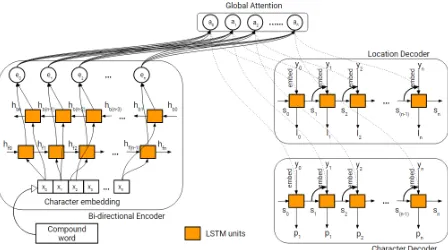
The critical part of learning to split compound words is to correctly identify the location(s) of the split(s). Therefore, we added a two decoders to our bi-directional encoder-decoder model: (i) lo-cation decoderwhich learns to predict the split lo-cations and (ii)character decoderwhich generates the split words. A compound word is fed into the encoder character by character. Each character’s embedding xi is passed to the encoders LSTM units. There are two LSTM layers which encode the word, one in forward direction and the other backward. The encoded context vectorei is then passed to a global attention layer.
In the first phase of training, only the loca-tion decoderis trained and thecharacter decoder
is frozen. The character embeddings are learned from scratch in this phase along with the attention weights and other parameters. Here, the model learns to identify the split locations. For example, if the inputs are the embeddings for the compound word prots¯ahah., the location decoder will gener-ate a binary vector[0,0,1,0,0,0,0,0,0]which in-dicates that the split occurs between the third and fourth characters. In the second phase, the loca-tion decoder is frozen and thecharacter decoder
is trained. The encoder and attention weights are allowed to be fine-tuned. This decoder learns the underlying rules of Sandhi splitting. Since the at-tention layer is already pre-trained to identify po-tential split locations in the previous phase, the
character decoder can use this context and learn to split the words more accurately. For example, for the same input wordprots¯ahah., thecharacter decoderwill generate [p, r, a, +, u, t, s, ¯a, h, a, h.]
as the output. Here the characterois split into two charactersaandu.
In both the training phases, we use negative log likelihood as the loss function. Let X be the se-quence of the input compound word’s characters andY be the binary vector which indicates the lo-cation of the split(s) in the first phase and the true target sequence of characters which form the split words in the second phase. IfY = y1, y2, ..., yn,
then the loss function is defined as:
loss=− |Y|
X
i=1
Figure 2: The bi-directional encoder and decoders with attention
We evaluate the DD-RNN and compare it with other tools and architectures in Section4.
2.3 Implementation details
The architecture of the DD-RNN is shown in Fig-ure2. We used a character embedding size of128. The bi-directional encoder and the two decoders are 2 layers deep with 512 LSTM units in each layer. A dropout layer with p = 0.3 is applied after each LSTM layer. The entire network is im-plemented in Torch2.
Of the71,747words in our benchmark dataset, we randomly sampled80%of the data for training our models. The remaining20%was used for test-ing. We used stochastic gradient descent for opti-mizing the model parameters with an initial learn-ing rate of1.0. The learning rate was decayed by a factor of0.5 if the validation perplexity did not improve after an epoch. We used a batch size of
64and trained the network for10 epochs on four Tesla K80 GPUs. This setup remains the same for all the experiments we conduct.
3 Existing Datasets and Tools
In this section, we briefly introduce various San-skirt Sandhi datasets and splitting tools available in literature. We also discuss the tools’ drawbacks
2http://torch.ch/
and the major challenges faced while creating such tools.
Datasets:TheUoH corpus, created at the Uni-versity of Hyderabad3 contains 113,913 words and their splits. This dataset is noisy with typ-ing errors and incorrect splits. The recent Sand-hiKosh corpus(Shubham Bhardwaj,2018) is a set of 13,930 annotated splits. We combine these datasets and heuristically prune them to finally get
71,747words and their splits. The pruning is done by considering a data point to be valid only if the compound word and it’s splits are present in a standard Sanskrit dictionary (Monier-Williams, 1970). We use this as our benchmark dataset and run all our experiments on it.
Tools: There exist multiple Sandhi splitters in the open domain such as (i)JNU splitter(Sachin, 2007), (ii) UoH splitter (Kumar et al., 2010) and (iii)INRIA sanskrit reader companion(Huet, 2003) (Goyal and Huet,2013). Though each tool addresses the splitting problem in a specialized way, the general principle remains constant. For a given compound word, the set of all rules are applied to every character in the word and a large potential candidate list of word splits is obtained. Then, a morpheme dictionary of Sanskrit words is used with other heuristics to remove infeasible
3Available at: http://sanskrit.uohyd.ac.in/
Figure 3: Top-1 split prediction accuracy comparison of different publicly available tools with DD-RNN
word split combinations. However, none of the approaches address the fundamental problem of identifying the location of the split before apply-ing the rules, which will significantly reduce the number of rules that can be applied, hence result-ing in more accurate splits.
4 Evaluation and Results
We evaluate the performance of our DD-RNN model by: (i) comparing thesplit prediction ac-curacy with other publicly available sandhi split-ting tools, (ii) comparing the split prediction
accuracy with other standard RNN architectures such as RNN, B-RNN, and B-RNN-A, and (iii) comparing thelocation predictionaccuracy with the RNNs used for Chinese word segmentation (as they only predict the split locations and do not learn the rules of splitting)
4.1 Comparison with publicly available tools
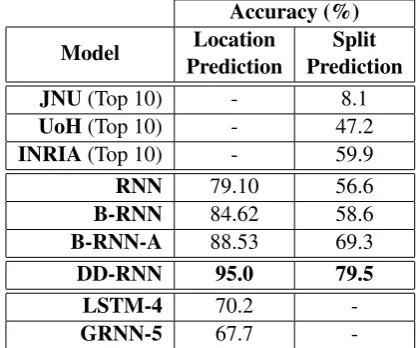
The tools discussed in Section3take a compound word as input and provide a list of all possible splits as output (UoH and INRIA splitters pro-vide weighted lists). Initially, we compared only the top prediction in each list with the true out-put. This gave a very low precision for the tools as shown in Figure3. Therefore, we relaxed this constraint and considered an output to be correct if the true split is present in the top ten predictions of the list. This increased the precision of the tools as shown in Figure4and Table1.
[image:4.595.74.284.64.225.2]Even though DD-RNN generates only one out-put for every inout-put, it clearly out-performs the other publicly available tools by a fair margin.
Figure 4: Split prediction accuracy comparison of dif-ferent publicly available tools (Top-10) with DD-RNN (Top-1)
Accuracy (%)
Model Location
Prediction
Split Prediction JNU(Top 10) - 8.1
UoH(Top 10) - 47.2
INRIA(Top 10) - 59.9
RNN 79.10 56.6
B-RNN 84.62 58.6
B-RNN-A 88.53 69.3
DD-RNN 95.0 79.5
LSTM-4 70.2
-GRNN-5 67.7
-Table 1: Location and split prediction accuracy of all the tools and models under comparison
4.2 Comparison with standard RNN architectures
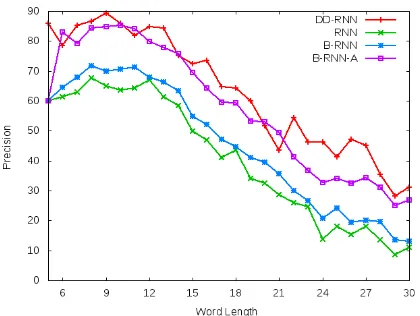
To compare the performance of DD-RNN with other standard RNN architectures, we trained the following three models to generate the split predictions on our benchmark dataset: (i) uni-directional encoder and decoder without attention (RNN), (ii) bi-directional encoder and decoder without attention (B-RNN), and (iii) bi-directional encoder and decoder with attention (B-RNN-A)
[image:4.595.311.521.288.462.2]in-Figure 5: Split prediction accuracy comparison of dif-ferent variations of RNN on words of difdif-ferent lengths
dicates that the attention mechanism of DD-RNN has learned to better identify the split location(s) due to its pre-training with thelocation decoder.
4.3 Comparison with similar works
(Reddy et al., 2018) propsed a seq2seq model using RNN with attention to tackle the Sandhi problem. Their model is similar to B-RNN-A and is outperformed by our proposed DD-RNN by ˜6.47%. We also compared our proposed DD-RNN with a uni-directional LSTM with a depth of4(Chen et al.,2015b) (LSTM-4) and a Gated Recursive Neural Network with a depth of5(Chen et al.,2015a) (GRNN-5). These models were used to get state of the art results for Chinese word segmentation and their source code is made avail-able online.4 Since these models can only predict the location(s) of the split(s) and cannot gener-ate the split words themselves, we used the loca-tion predicloca-tion accuracy as the metric. We trained these models on our benchmark dataset and the results are shown in Table 1. DD-RNN’s pre-cision is 35.3% and 40.3% better than LSTM-4 and GRNN-5 respectively. Conversely, we trained the DD-RNN for the Chinese word segmenta-tion task to test the generalizability of the model. Since there are no morphological changes during segmentation in Chinese, the character decoder is redundant and the model collapses to simple
seq2seq. We used the PKU dataset which is also used in (Chen et al.,2015b) & (Chen et al.,2015a) and obtained an accuracy of 64.25% which is com-parable to the results of other standard models.
To summarize, we have used our benchmark
4https://github.com/FudanNLP
dataset to compare the DD-RNN model with ex-isting publicly available Sandhi splitting tools, other RNN architectures and models used for Chi-nese word segmentation task. Among the exist-ing tools, the INRIA splitter gives the highest split prediction accuracy of 59.9%. Among the stan-dard RNN architectures, B-RNN-A performs the best with a split prediction accuracy of 69.3%. LSTM-4 performs the best among the Chinese word segmentation models with a location predic-tion accuracy of 70.2%. DD-RNN outperforms all the models both in location and split predictions with 95% and 79.5% accuracies, respectively.
5 Research Impact
This work can be foundational to other Sanskrit based NLP tasks. Let us consider translation as an example. In Sanskrit, arbitrary number of words can be joined together to form a compound word. Literary works, especially from the Vedic era of-ten contain words which are a concaof-tenation of three or more simpler words. Presence of such compound words will increase the vocabulary size exponentially and hinder the translation process. However, as a pre-processing step, if all the com-pound words are split before training a translation model, the number of unique words in the vocabu-lary reduces which will ease the learning process.
6 Conclusion
In this research, we propose a novel double de-coder RNN architecture with attention for Sanskrit Sandhi splitting. Learning such a model would provide further insights into the fundamental lin-guistic word formation rules of the language. A deep bi-directional encoder is used to encode the character sequence of a Sanskrit word. Using this encoded context vector, alocation decoderis first used to learn the location(s) of the split(s). Then thecharacter decoderis used to generate the split words. We evaluate the performance of the pro-posed approach on the benchmark dataset in com-parison with other publicly available tools, stan-dard RNN architectures and with prior work which tackle similar problems in other languages. As fu-ture work, we intend to tackle the harderSamasa
[image:5.595.74.284.64.222.2]References
Akshar Bharati, Amba P Kulkarni, and V Sheeba. 2006. Building a wide coverage sanskrit morpho-logical analyser: A practical approach. In The First National Symposium on Modelling and Shal-low Parsing of Indian Languages, IIT-Bombay.
Xinchi Chen, Xipeng Qiu, Chenxi Zhu, and Xuan-jing Huang. 2015a. Gated recursive neural network for chinese word segmentation. In ACL (1), pages 1744–1753.
Xinchi Chen, Xipeng Qiu, Chenxi Zhu, Pengfei Liu, and Xuanjing Huang. 2015b. Long short-term mem-ory neural networks for chinese word segmentation. InEMNLP, pages 1197–1206.
Kyunghyun Cho, Bart van Merrienboer, C¸ aglar G¨ulc¸ehre, Fethi Bougares, Holger Schwenk, and Yoshua Bengio. 2014. Learning phrase representa-tions using RNN encoder-decoder for statistical ma-chine translation. CoRR, abs/1406.1078.
Brendan S. Gillon. 2009. Tagging Classical Sanskrit Compounds. Springer Berlin Heidelberg, Berlin, Heidelberg.
Pawan Goyal and G´erard Huet. 2013. Complete-ness analysis of a sanskrit reader. In International Symposium on Sanskrit Computational Linguistics, pages 130–171.
Sepp Hochreiter and J¨urgen Schmidhuber. 1997. Long short-term memory. Neural computation, 9(8):1735–1780.
G´erard Huet. 2003. Towards computational processing of sanskrit. InInternational Conference on Natural Language Processing (ICON). Citeseer.
Amba Kulkarni and Devanand Shukl. 2009. Sanskrit morphological analyser: Some issues. Indian Lin-guistics, 70(1-4):169–177.
Anil Kumar, Vipul Mittal, and Amba Kulkarni. 2010. Sanskrit Compound Processor. Springer Berlin Hei-delberg, Berlin, Heidelberg.
Monier Monier-Williams. 1970.Sanskrit-English Dic-tionary.
Razvan Pascanu, Caglar Gulcehre, Kyunghyun Cho, and Yoshua Bengio. 2013. How to construct deep recurrent neural networks. arXiv preprint arXiv:1312.6026.
Vikas Reddy, Amrith Krishna, Vishnu Dutt Sharma, Prateek Gupta, Vineeth M. R, and Pawan Goyal. 2018. Building a word segmenter for sanskrit overnight.CoRR, abs/1802.06185.
Kumar Sachin. 2007. Sandhi splitter and analyzer for sanskrit (with reference to ac sandhi). M. Phil. de-gree at SCSS, JNU (submitted, 2007).
Hasim Sak, Andrew W Senior, and Franc¸oise Bea-ufays. 2014. Long short-term memory recurrent neural network architectures for large scale acoustic modeling. InINTERSPEECH, pages 338–342.