Bootstrapping Coreference Classifiers with
Multiple Machine Learning Algorithms
Vincent Ng and Claire Cardie
Department of Computer Science Cornell University
Ithaca, NY 14853-7501
{yung,cardie}@cs.cornell.edu
Abstract
Successful application of multi-view co-training algorithms relies on the ability to factor the available features into views that are compatible and uncorrelated. This can potentially preclude their use on problems such as coreference resolution that lack an obvious feature split. To bootstrap coref-erence classifiers, we propose and evuate a single-view weakly supervised al-gorithm that relies on two different learn-ing algorithms in lieu of the two different views required by co-training. In addition, we investigate a method for ranking un-labeled instances to be fed back into the bootstrapping loop as labeled data, aiming to alleviate the problem of performance deterioration that is commonly observed in the course of bootstrapping.
1 Introduction
Co-training (Blum and Mitchell, 1998) is a weakly supervised paradigm that learns a task from a small set of labeled data and a large pool of unlabeled data using separate, but redundant views of the data (i.e. using disjoint feature subsets to represent the data). To ensure provable performance guaran-tees, the co-training algorithm assumes as input a set of views that satisfies two fairly strict condi-tions. First, each view must be sufficient for learn-ing the target concept. Second, the views must be conditionally independent of each other given the
class. Empirical results on artificial data sets by Muslea et al. (2002) and Nigam and Ghani (2000) confirm that co-training is sensitive to these assump-tions. Indeed, although the algorithm has been ap-plied successfully to natural language processing (NLP) tasks that have a natural view factorization (e.g. web page classification (Blum and Mitchell, 1998) and named entity classification (Collins and Singer, 1999)), there has been little success, and a number of reported problems, when applying co-training to NLP data sets for which no natural fea-ture split has been found (e.g. anaphora resolution (Mueller et al., 2002)).
As a result, researchers have begun to investigate co-training procedures that do not require explicit view factorization. Goldman and Zhou (2000) and Steedman et al. (2003b) use two different learning algorithms in lieu of the multiple views required by standard co-training.1 The intuition is that the two learning algorithms can potentially substitute for the two views: different learners have different rep-resentation and search biases and can complement each other by inducing different hypotheses from the data. Despite their similarities, the principles under-lying the Goldman and Zhou and Steedman et al. co-training algorithms are fundamentally different. In particular, Goldman and Zhou rely on hypothesis testing to select new instances to add to the labeled data. On the other hand, Steedman et al. use two learning algorithms that correspond to coarsely dif-ferent features, thus retaining in spirit the advantages
1
provided by conditionally independent feature splits in the Blum and Mitchell algorithm.
The goal of this paper is two-fold. First, we propose a single-view algorithm for bootstrapping coreference classifiers. Like anaphora resolution, noun phrase coreference resolution is a problem for which a natural feature split is not readily available. In related work (Ng and Cardie, 2003), we com-pare the performance of the Blum and Mitchell co-training algorithm with that of two existing single-view bootstrapping algorithms — self-training with bagging (Banko and Brill, 2001) and EM (Nigam et al., 2000) — on coreference resolution, and show that single-view weakly supervised learners are a vi-able alternative to co-training for the task. This pa-per instead focuses on developing a single-view al-gorithm that combines aspects of each of the Gold-man and Zhou and SteedGold-man et al. algorithms.
Second, we investigate a new method that, in-spired by Steedman et al. (2003a), ranks unlabeled instances to be added to the labeled data in an at-tempt to alleviate a problem commonly observed in bootstrapping experiments — performance deterio-ration due to the degradation in the quality of the labeled data as bootstrapping progresses (Pierce and Cardie, 2001; Riloff and Jones, 1999).
In a set of baseline experiments, we first demon-strate that multi-view co-training fails to boost the performance of the coreference system under var-ious parameter settings. We then show that our single-view weakly supervised algorithm success-fully bootstraps the coreference classifiers, boost-ing the F-measure score by 9-12% on two standard coreference data sets. Finally, we present experi-mental results that suggest that our method for rank-ing instances is more resistant to performance dete-rioration in the bootstrapping process than Blum and Mitchell’s “rank-by-confidence” method.
2 Noun Phrase Coreference Resolution
Noun phrase coreference resolution refers to the problem of determining which noun phrases (NPs) refer to each real-world entity mentioned in a doc-ument.2 In this section, we give an overview of the coreference resolution system to which the
boot-2
Concrete examples of the coreference task can be found in MUC-6 (1995) and MUC-7 (1998).
strapping algorithms will be applied.
The framework underlying the coreference sys-tem is a standard combination of classification and clustering (see Ng and Cardie (2002) for details). Coreference resolution is first recast as a classifica-tion task, in which a pair of NPs is classified as co-referring or not based on constraints that are learned from an annotated corpus. A separate clustering mechanism then coordinates the possibly contradic-tory pairwise classifications and constructs a parti-tion on the set of NPs. When the system operates within the weakly supervised setting, a weakly su-pervised algorithm bootstraps the coreference classi-fier from the given labeled and unlabeled data rather than from a much larger set of labeled instances. The clustering algorithm, however, is not manipulated by the bootstrapping procedure.
3 Learning Algorithms
We employ naive Bayes and decision list learners in our single-view, multiple-learner framework for bootstrapping coreference classifiers. This section gives an overview of the two learners.
3.1 Naive Bayes
A naive Bayes (NB) classifier is a generative classi-fier that assigns to a test instanceiwith feature val-ues<x1,. . .,xm>the maximum a posteriori (MAP) labely∗, which is determined as follows:
y∗ = arg max
y P(y|i) = arg max
y P(y)P(i|y) = arg max
y P(y) m
i= 1
P(xi|y)
The first equality above follows from the definition of MAP, the second one from Bayes rule, and the last one from the conditional independence assumption of the feature values. We determine the class priors P(y) and the class densities P(xi|y) directly from the training data using add-one smoothing.
3.2 Decision Lists
Observations Justifications
Many feature-value pairs alone can de-termine the class value.3 For example,
two NPs cannot be coreferent if they differ in gender or semantic class.
Decision lists draw a decision boundary based on a single feature-value pair and can take advantage of this observation directly. On the other hand, naive Bayes classifiers make a decision based on a combination of features and thus cannot take advantage of this observation directly.
The class distributions in coreference data sets are skewed. Specifically, the fact that most NP pairs in a document are not coreferent implies that the negative in-stances grossly outnumber the positives.
Naive Bayes classifiers are fairly resistant to class skewness, which can only exert its influence on classifier prediction via the class priors. On the other hand, decision lists suffer from skewed class distributions. Elements corresponding to the negative class tend to aggregate towards the beginning of the list, causing the classifier to perform poorly on the minority class.
Many instances contain redundant in-formation as far as classification is con-cerned. For example, two NPs may
dif-fer in both gender and semantic class, but knowing one of these two differences is suf-ficient for determining the class value.
[image:3.612.85.527.70.234.2]Both naive Bayes classifiers and decision lists can take advantage of data redundancy. Frequency counts of feature-value pairs in these classifiers are updated independently, and thus a single instance can possibly contribute to the discovery of more than one useful feature-value pair. On the other hand, some classifiers such as decision trees are not able to take advantage of this redundancy because of their intrinsic nature of recursive data partitioning.
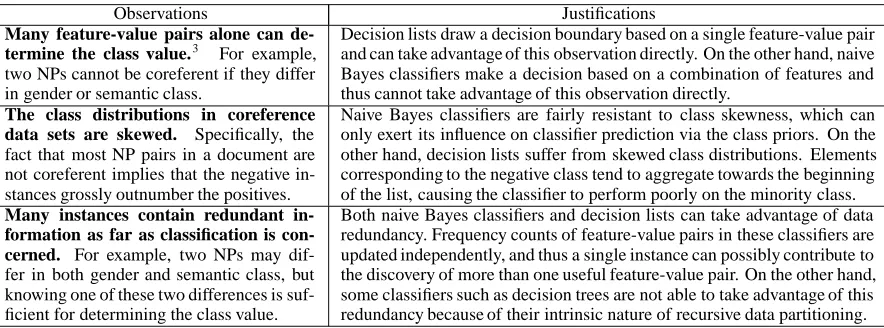
Table 1: The justifications (shown in the right column) for using naive Bayes and decision list learner as the underlying learning algorithms for bootstrapping coreference classifiers are based on the corresponding observations on the coreference task and the features used by the coreference system in the left column.
decision list for each classy. The elements in the list are sorted in decreasing order of the strength associ-ated with each element, which is defined as the con-ditional probability P(y|fi = vj) and is estimated based on the training data as follows:
P(y|fi=vj) = NN((ffi =vj, y) +α i=vj) +kα
N(x) is the frequency of event x in the training data, α a smoothing parameter, andk the number of classes. In this paper,k= 2 and we setαto 0.01. A test instance is assigned the class associated with the first element of the list whose predicate is satis-fied by the description of the instance.
While generative classifiers estimate class densi-ties, discriminative classifiers like decision lists fo-cus on approximating class boundaries. Table 1 pro-vides the justifications for choosing these two learn-ers as components in our single-view, multi-learner bootstrapping algorithm. Based on observations of the coreference task and the features employed by our coreference system, the justifications suggest that the two learners can potentially compensate for each other’s weaknesses.
4 Multi-View Co-Training
In this section, we describe the Blum and Mitchell (B&M) multi-view co-training algorithm and apply it to coreference resolution.
3
This justifies the use of a decision list as a potential classi-fier for bootstrapping. See Yarowsky (1995) for details.
4.1 The Multi-View Co-Training Algorithm
The intuition behind the B&M co-training algorithm is to train two classifiers that can help augment each other’s labeled data by exploiting two separate but redundant views of the data. Specifically, each clas-sifier is trained using one view of the labeled data and predicts labels for all instances in the data pool, which consists of a randomly chosen subset of the unlabeled data. Each then selects its most confident predictions, and adds the corresponding instances with their predicted labels to the labeled data while maintaining the class distribution in the labeled data. The number of instances to be added to the la-beled data by each classifier at each iteration is lim-ited by a pre-specified growth size to ensure that only the instances that have a high probability of be-ing assigned the correct label are incorporated. The data pool is replenished with instances from the un-labeled data and the process is repeated.
During testing, each classifier makes an indepen-dent decision for a test instance. In this paper, the decision associated with the higher confidence is taken to be the final prediction for the instance.
4.2 Experimental Setup
parame-MUC-6 MUC-7
Naive Bayes Decision List Naive Bayes Decision List
Experiments R P F R P F R P F R P F
[image:4.612.81.531.70.137.2]Baseline 50.7 52.6 51.6 17.9 72.0 28.7 40.1 40.2 40.1 32.4 78.3 45.8 Multi-view Co-Training 33.3 90.7 48.7 19.5 71.2 30.6 32.9 76.3 46.0 32.4 78.3 45.8 Single-view Bootstrapping 53.6 79.0 63.9 40.1 83.1 54.1 43.5 73.2 54.6 38.3 75.4 50.8 Self-Training 48.3 63.5 54.9 18.7 70.8 29.6 40.1 40.2 40.1 32.9 78.1 46.3
Table 2: Results of multi-view co-training, single-view bootstrapping, and self-training.Recall, Precision, and F-measure are provided. Except for the baselines, the best results (F-measure) achieved by the algorithms are shown.
ters such as the pool size and the growth size (Pierce and Cardie, 2001), we evaluate the algorithm under different parameter settings, as described below.
Evaluation. We use the 6 (1995) and MUC-7 (1998) coreference data sets for evaluation. The training set is composed of 30 “dry run” texts, from which 491659 and 482125 NP pair instances are generated for the MUC-6 and MUC-7 data sets, re-spectively. Unlike Ng and Cardie (2003) where we choose one of the dryrun texts (contributing ap-proximately 3500–3700 instances) form the labeled data set, however, here we randomly select 1000 in-stances. The remaining instances are used as un-labeled data. Testing is performed by applying the bootstrapped coreference classifier and the cluster-ing algorithm described in section 2 on the 20–30 “formal evaluation” texts for each of the MUC-6 and MUC-7 data sets.
Two sets of experiments are conducted, one using naive Bayes as the underlying supervised learning algorithm and the other the decision list learner. All results reported are averages across five runs.
Co-training parameters. The co-training param-eters are set as follows.
Views. We used three methods to generate the views from the 25 features used by the coreference system: Mueller et al.’s (2002) greedy method, ran-dom splitting of features into views, and splitting of features according to the feature type (i.e. lexico-syntactic vs. non-lexico-lexico-syntactic features).4
Pool size. We tested values of 500, 1000, 5000. Growth size. We tested values of 10, 50, 100, 200.
4.3 Results and Discussion
Results are shown in Table 2, where performance is reported in terms of recall, precision, and F-measure
4
Space limitation precludes a detailed description of these methods. See Ng and Cardie (2003) for details.
0 50 100 150 200 250 300 350 400 450 500 20
30 40 50 60 70 80 90 100
Number of Co−Training Iterations
Score
Baseline Recall Precision F−measure
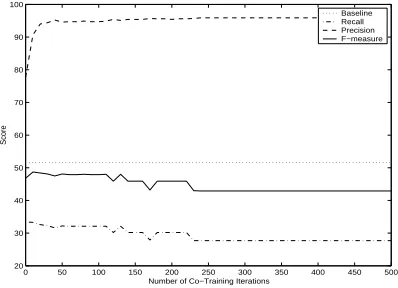
Figure 1: Learning curve for co-training (pool size = 500, growth size = 50, views formed by randomly splitting the features) for MUC-6.
using the model-theoretic MUC scoring program (Vilain et al., 1995). The baseline coreference sys-tem, which is trained only on the initially labeled data using all of the features, achieves an F-measure of 51.6 (NB) and 28.7 (DL) on the MUC-6 data set and 40.1 (NB) and 45.8 (DL) on MUC-7.
The results shown in row 2 of Table 2 correspond to the best F-measure scores achieved by co-training across all of the parameter combinations described in the previous subsection. In comparison to the baseline, co-training is able to improve system per-formance in only two of the four classifier/data set combinations: F-measure increases by 2% and 6% for MUC-6/DL and MUC-7/NB, respectively. Nev-ertheless, co-training produces high-precision clas-sifiers in all four cases (at the expense of recall). In practical applications in which precision is critical, the co-training classifiers may be preferable to the baseline classifiers despite the fact that they achieve similar F-measure scores.
[image:4.612.327.526.196.340.2]the MUC-6 data set using naive Bayes. The hor-izontal (dotted) line shows the performance of the baseline system, as described above. As co-training progresses, F-measure rises to 48.7 at iteration ten and gradually drops to and stabilizes at 42.9. We ob-serve similar performance trends for the other clas-sifier/data set combinations. The drop in F-measure is potentially due to the pollution of the labeled data by mislabeled instances (Pierce and Cardie, 2001).
5 Single-View Bootstrapping
In this section, we describe and evaluate our single-view, multi-learner bootstrapping algorithm, which combines ideas from Goldman and Zhou (2000) and Steedman et al. (2003b). We will start by giving an overview of these two co-training algorithms.
5.1 Related Work
The Goldman and Zhou (G&Z) Algorithm.
This single-view algorithm begins by training two classifiers on the initially labeled data using two different learning algorithms; it requires that each classifier partition the instance space into a set of equivalence classes (e.g. in a decision tree, each leaf node defines an equivalence class). Each classi-fier then considers each equivalence class and uses hypothesis testing to determine if adding all unla-beled instances within the equivalence class to the other classifier’s labeled data will improve the per-formance of its counterparts. The process is then repeated until no more instances can be labeled.
The Steedman et al. (Ste) Algorithm. This algo-rithm is a variation of B&M applied to two diverse statistical parsers. Initially, each parser is trained on the labeled data. Each then parses and scores all sentences in the data pool, and then adds the most confidently parsed sentences to the training data of the other parser. The parsers are retrained, and the process is repeated for several iterations.
The algorithm differs from B&M in three main respects. First, the training data of the two parsers diverge after the first co-training iteration. Second, the data pool is flushed and refilled entirely with in-stances from the unlabeled data after each iteration. This reduces the possibility of having unreliably la-beled sentences accumulating in the pool. Finally, the two parsers, each of which is assumed to hold a
unique “view” of the data, are effectively two differ-ent learning algorithms.
5.2 Our Single-View Bootstrapping Algorithm
As mentioned before, our algorithm uses two dif-ferent learning algorithms to train two classifiers on the same set of features (i.e. the full feature set). At each bootstrapping iteration, each classifier la-bels and scores all instances in the data pool. The highest scored instances labeled by one classifier are added to the training data of the other classifier and vice versa. Since the two classifiers are trained on the same view, it is important to maintain a separate training set for each classifier: this reduces the prob-ability that the two classifiers converge to the same hypothesis at an early stage and hence implicitly in-creases the ability to bootstrap. Like Ste, the entire data pool is replenished with instances drawn from the unlabeled data after each iteration, and the pro-cess is repeated. So our algorithm is effectively Ste applied to coreference resolution — instead of two parsing algorithms that correspond to different fea-tures, we use two learning algorithms, each of which relies on the same set of features as in G&Z. The similarities and differences among B&M, G&Z, Ste, and our algorithm are summarized in Table 3.
5.3 Results and Discussion
We tested different pool sizes and growth sizes as specified in section 4.2 to determine the best pa-rameter setting for our algorithm. For both data sets, the best F-measure score is achieved using a pool size of 5000 and a growth size of 50. The re-sults under this parameter setting are given in row 3 of Table 2. In comparison to the baseline, we see dramatic improvement in F-measure for both clas-sifiers and both data sets. In addition, we see si-multaneous gains in recall and precision in all cases except MUC-7/DL. Furthermore, single-view boot-strapping beats co-training (in terms of F-measure scores) by a large margin in all four cases. These results provide suggestive evidence that single-view, multi-learner bootstrapping might be a better alter-native to its multi-view, single-learner counterparts for coreference resolution.
“typi-Blum and Mitchell Goldman and Zhou Steedman et al. Ours Bootstrapping basis Use different views Use different learners Use different parsers Use different learners Number of instances
added per iteration
Fixed Variable Fixed Fixed
Training sets for the two learners/parsers
Same Different Different Different
Data pool flushed af-ter each iaf-teration
No N/A (No data pool is used)
Yes Yes
Example selection method
Highest scored in-stances
Instances in all equivalance classes that are expected to improve a classifier
Highest scored sen-tences
[image:6.612.84.530.70.183.2]Highest scored in-stances
Table 3: Summary of the major similarities and differences among four bootstrapping schemes: Blum and Mitchell, Goldman and Zhou, Steedman et al., and ours. Only the relevant dimensions are discussed here.
0 500 1000 1500 2000 2500 3000 3500 4000 40
45 50 55 60 65 70 75 80 85
Number of Co−Training Iterations
Score
Baseline Recall Precision F−measure
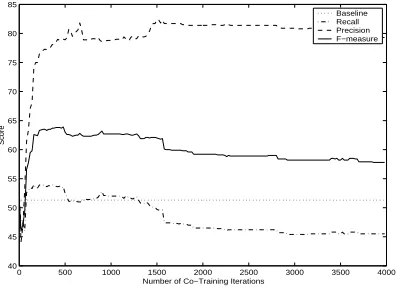
Figure 2: Learning curve for our single-view boot-strapping algorithm (pool size = 5000, growth size = 50) for MUC-6.
cal” bootstrapping curve: an initial rise in F-measure followed by a gradual deterioration. In comparison to Figure 1, the recall level achieved by co-training is much lower than that of single-view bootstrapping. This appears to indicate that each co-training view is insufficient for learning the target concept: the fea-ture split limits any interaction of feafea-tures that can produce better recall.
Finally, Figure 2 shows that performance in-creases most rapidly in the first 200 iterations. This provides indirect evidence that the two classifiers have acquired different hypotheses from the ini-tial data and are exchanging information with each other. To ensure that the classifiers are indeed bene-fiting from each other, we conducted a self-training experiment for each classifier separately: at each self-training iteration, each classifier labels all 5000 instances in the data pool using all available features and selects the most confidently labeled 50 instances
for addition to its labeled data.5 The best F-measure scores achieved by self-training are shown in the last row of Table 2. Overall, self-training only yields marginal performance gains over the baseline.
Nevertheless, self-training outperforms co-training in both cases where naive Bayes is used. While these results seem to suggest that co-training is inherently handicapped for coreference resolu-tion, there are two plausible explanations against this conclusion. First, the fact that self-training has access to all of the available features may account for its superior performance to co-training. This is again partially supported by the fact that the recall level achieved by co-training is lower than that of self-training in both cases in which self-training outperforms co-training. Second, 1000 instances may simply not be sufficient for co-training to be effective for this task: in related work (Ng and Cardie, 2003), we find that starting with 3500–3700 labeled instances instead of 1000 allows co-training to improve the baseline by 4.6% and 9.5% in F-measure using naive Bayes classifiers for the MUC-6 and MUC-7 data sets, respectively.
6 An Alternative Ranking Method
As we have seen before, F-measure scores ulti-mately decrease as bootstrapping progresses. If the drop were caused by the degradation in the quality of the bootstrapped data, then a more “conservative” instance selection method than that of B&M would help alleviate this problem. Our hypothesis is that selection methods that are based solely on the con-fidence assigned to an instance by a single classifier
5
[image:6.612.87.288.243.387.2]i1> i2if any of the following is true:
[µ(C1(i1)) =µ(C2(i1))]∧[µ(C1(i2))=µ(C2(i2))]
[µ(C1(i1)) =µ(C2(i1))]∧[µ(C1(i2)) =µ(C2(i2))]∧[|C1(i1)−C2(i1)|>|C1(i2)−C2(i2)|]
[image:7.612.329.527.230.374.2][µ(C1(i1))=µ(C2(i1))]∧[µ(C1(i2))=µ(C2(i2))]∧[max(C1(i1),1−C1(i1))>max(C1(i2),1−C1(i2))]
Figure 3: The ranking method that a binary classifierC1 uses to impose a partial ordering on the instances to be selected and added to the training set of binary classifierC2.i1 andi2are arbitrary instances, andµis a function that rounds a number to its closest integer.
may be too liberal. In particular, these methods al-low the addition of instances with opposing labels to the labeled data; this can potentially result in in-creased incompatibility between the classifiers.
Consequently, we develop a new procedure for ranking instances in the data pool. The bootstrap-ping algorithm then selects the highest ranked in-stances to add to the labeled data in each iteration. The method favors instances whose label is agreed upon by both classifiers (Preference 1). However, incorporating instances that are confidently labeled by both classifiers may reduce the probability of acquiring new information from the data. There-fore, the method imposes an additional preference for instances that are confidently labeled by one but not both (Preference 2). If none of the instances receives the same label from the classifiers, the method resorts to the “rank-by-confidence” method used by B&M (Preference 3).
More formally, define a binary classifier as a func-tion that maps an instance to a value that indicates the probability that it is labeled as positive. Now, letµbe a function that rounds a number to its near-est integer. Given two binary classifiersC1 andC2 and instancesi1andi2, the ranking method shown in Figure 3 uses the three preferences described above to impose a partial ordering on the given instances for incorporation intoC2’s labeled data. The method similarly ranks instances to be added toC1’s labeled data, with the roles ofC1andC2 reversed.
Steedman et al. (2003a) also investigate instance selection methods for co-training, but their goal is primarily to use selection methods as a means to explore the trade-off between maximizing coverage and maximizing accuracy.6 In contrast, our focus
6
McCallum and Nigam (1998) tackle this idea of balancing
0 500 1000 1500 2000 2500 3000 3500 4000 44
46 48 50 52 54 56 58 60 62 64
Number of Co−Training Iterations
F
−
measure
Baseline
Using the B&M ranking method Using our ranking method
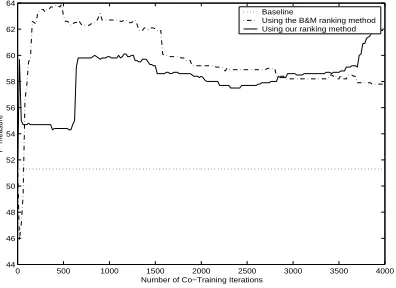
Figure 4: F-measure curves for our single-view bootstrapping algorithm with different ranking methods (pool size = 5000, growth size = 50) for MUC-6.
here is on examining whether a more conservative ranking method can alleviate the problem of perfor-mance deterioration. Nevertheless, Preference 2 is inspired by theirSint-n selection method, which se-lects an instance if it belongs to the intersection of the set of the n percent highest scoring instances of one classifier and the set of thenpercent lowest scoring instances of the other. To our knowledge, no previous work has examined a ranking method that combines the three preferences described above.
To compare our ranking procedure with B&M’s rank-by-confidence method, we repeat the boot-strapping experiment shown in Figure 2 except that we replace B&M’s ranking method with ours. The learning curves generated using the two ranking methods with naive Bayes for the MUC-6 data set are shown in Figure 4. The results are consistent with our intuition regarding the two ranking
ods. The B&M ranking method is more liberal. In particular, each classifier always selects the most confidently labeled instances to add to the other’s la-beled data at each iteration. If the underlying learn-ers have indeed induced two different hypotheses from the data, then each classifier can potentially ac-quire informative instances from the other and yield performance improvements very rapidly.
In contrast, our ranking method is more conserva-tive in that it places more emphasis on maintaining labeled data accuracy than the B&M method. As a result, the classifier learns at a slower rate when compared to that in the B&M case: it is not until iter-ation 600 that we see a sharp rise in F-measure. Due to the “liberal” nature of the B&M method, however, its performance drops dramatically as bootstrapping progresses, whereas ours just dips temporarily. This can potentially be attributed to the more rapid injec-tion of mislabeled instances into the labeled data in the B&M case. At iteration 2800, our method starts to outperform B&M’s. Overall, our ranking method does not exhibit the performance trend observed with the B&M method: except for the spike between iterations 0 and 100, F-measure does not deteriorate as bootstrapping progresses. Since it is hard to deter-mine a “good” stopping point for bootstrapping due to the paucity of labeled data in a weakly supervised setting, our ranking method can potentially serve as an alternative to the B&M method.
7 Conclusions
We have proposed a single-view, multi-learner boot-strapping algorithm for coreference resolution and shown empirically that the algorithm is a better ternative to the Blum and Mitchell co-training al-gorithm for this task for which no natural feature split has been found. In addition, we have investi-gated an example ranking method for bootstrapping that, unlike Blum and Mitchell’s rank-by-confidence method, can potentially alleviate the problem of per-formance deterioration due to the pollution of the la-beled data in the course of bootstrapping.
Acknowledgments
We thank the anonymous reviewers for their invalu-able and insightful comments. This work was sup-ported in part by NSF Grant IIS–0208028.
References
Michele Banko and Eric Brill. 2001. Scaling to very very large corpora for natural language disambiguation. In
Proceed-ings of the ACL/EACL, pages 26–33.
Avrim Blum and Tom Mitchell. 1998. Combining labeled and unlabeled data with co-training. In Proceedings of COLT, pages 92–100.
Michael Collins and Yoram Singer. 1999. Unsupervised models for named entity classification. In Proceedings of
EMNLP/VLC, pages 100–110.
Sally Goldman and Yan Zhou. 2000. Enhancing supervised learning with unlabeled data. In Proceedings of ICML, pages 327–334.
Andrew McCallum and Kamal Nigam. 1998. Employing EM and pool-based active learning for text classification. In
Pro-ceedings of ICML, pages 359–367.
MUC-6. 1995. Proceedings of the Sixth Message
Understand-ing Conference (MUC-6).
MUC-7. 1998. Proceedings of the Seventh Message
Under-standing Conference (MUC-7).
Christoph Mueller, Stefan Rapp, and Michael Strube. 2002. Applying co-training to reference resolution. In Proceedings
of the ACL, pages 352–359.
Ion Muslea, Steven Minton, and Craig Knoblock. 2002. Active + Semi-Supervised Learning = Robust Multi-View Learning. In Proceedings of ICML.
Vincent Ng and Claire Cardie. 2002. Combining sample selec-tion and error-driven pruning for machine learning of coref-erence rules. In Proceedings of EMNLP, pages 55–62. Vincent Ng and Claire Cardie. 2003. Weakly supervised
natu-ral language learning without redundant views. In
Proceed-ings of HLT-NAACL.
Kamal Nigam and Rayid Ghani. 2000. Analyzing the effec-tiveness and applicability of co-training. In Proceedings of
CIKM, pages 86–93.
Kamal Nigam, Andrew McCallum, Sabastian Thrun, and Tom Mitchell. 2000. Text classification from labeled and unlabeled documents using EM. Machine Learning,
39(2/3):103–134.
David Pierce and Claire Cardie. 2001. Limitations of co-training for natural language learning from large datasets. In
Proceedings of EMNLP, pages 1–9.
Ellen Riloff and Rosie Jones. 1999. Learning dictionaries for information extraction by multi-level bootstrapping. In
Pro-ceedings of AAAI, pages 474–479.
M. Steedman, R. Hwa, S. Clark, M. Osborne, A. Sarkar, J. Hockenmaier, P. Ruhlen, S. Baker, and J. Crim. 2003a. Example selection for bootstrapping statistical parsers. In
Proceedings of HLT-NAACL.
M. Steedman, M. Osborne, A. Sarkar, S. Clark, R. Hwa, J. Hockenmaier, P. Ruhlen, S. Baker, and J. Crim. 2003b. Bootstrapping statistical parsers from small datasets. In
Pro-ceedings of the EACL.
M. Vilain, J. Burger, J. Aberdeen, D. Connolly, and L. Hirschman. 1995. A model-theoretic coreference scoring scheme. In Proceedings of the Sixth Message Understanding
Conference (MUC-6), pages 45–52.