Improving Statistical MT through Morphological Analysis
Sharon Goldwater
Dept. of Cognitive and Linguistic Sciences
Brown University
sharon [email protected]
David McClosky
Dept. of Computer Science
Brown University
[email protected]
Abstract
In statistical machine translation, estimat-ing word-to-word alignment probabilities for the translation model can be difficult due to the problem of sparse data: most words in a given corpus occur at most a handful of times. With a highly inflected language such as Czech, this problem can be particularly severe. In addition, much of the morphological variation seen in Czech words is not reflected in either the morphol-ogy or syntax of a language like English. In this work, we show that using morphologi-cal analysis to modify the Czech input can improve a Czech-English machine transla-tion system. We investigate several differ-ent methods of incorporating morphological information, and show that a system that combines these methods yields the best re-sults. Our final system achieves a BLEU score of .333, as compared to .270 for the baseline word-to-word system.
1
Introduction
In a statistical machine translation task, the goal is to find the most probable translation of some foreign language textf into the desired languagee. That is, the system seeks to maximize P(e|f). Rather than maximizingP(e|f) directly, the standard noisy chan-nel approach to translation uses Bayes inversion to split the problem into two separate parts:
argmax e
P(e|f) = argmax e
P(e)P(f|e) (1)
where P(e) is known as the language model and P(f|e) is known as thetranslation model. The limit-ing factor in machine translation is usually the qual-ity of the translation model, since the monolingual resources needed for training the language model are
generally more available than the parallel corpora needed for training the translation model.
Due to the difficulty in obtaining large parallel cor-pora, sparse data is a serious issue when estimating the parameters of the translation model. This prob-lem is compounded when one or both of the lan-guages involved is a highly inflected language. In this paper, we present a series of experiments suggesting that morphological analysis can be used to reduce data sparseness and increase similarity between lan-guages, thus improving the quality of machine trans-lation for highly inflected languages. Our work is on a language pair in which the input language (Czech) is highly inflected, and the output language (English) is not. We discuss in Section 5 how our methods might be generalized to pairs where both languages are highly inflected.
The plan of this paper is as follows: In Section 2, we review previous work on using morphologi-cal analysis for statistimorphologi-cal machine translation. In Section 3, we describe several methods for utilizing morphological information in a statistical translation model. Section 4 presents the results of our experi-ments using these methods. Sections 5 and 6 discuss the results of our experiments and conclude the pa-per.
2
Previous Work
in-version and do-insertion in both German and En-glish. In addition, Niessen and Ney (2004) decom-pose German words into a hierarchical representa-tion using lemmas and morphological tags, and use a MaxEnt model to combine the different levels of representation in the translation model. The results from these papers indicate that on corpus sizes up to 60,000 parallel sentences, the restructuring op-erations yielded a large improvement in translation quality, but the morphological decomposition pro-vided only a slight additional benefit. However, since German is not as morphologically complex as Czech, we might expect a larger benefit from morphological analysis in Czech.
Another project utilizing morphological analysis for statistical machine translation is described by Lee (2004). Lee’s system for Arabic-English translation takes as input POS-tagged English and Arabic text, where the Arabic words have been pre-segmented into stems and affixes. The system performs an ini-tial alignment of the Arabic morphemes to the En-glish words. Based on the consistency of the EnEn-glish POS tag that each Arabic morpheme aligns to, the system determines whether to keep that morpheme as a separate item, merge it back onto the stem, or delete it altogether. In addition, multiple occur-rences of the determiner Al within a single Arabic noun phrase are deleted (i.e. only one occurrence is allowed). Using a phrase-based translation model, Lee found thatAl-deletion was more helpful than the rest of the morphological analysis. Also,Al-deletion helped for training corpora up to 3.3 million sen-tences, but the other morphological analysis helped only on the smaller corpus sizes (up to 350,000 paral-lel sentences). This result is consistent with anecdo-tal evidence suggesting that morphological analysis becomes less helpful as corpus sizes increase. How-ever, since parallel corpora of hundreds of thousands of sentences or more are often difficult to obtain, it would still be worthwhile to develop a method for improving systems trained on smaller corpora.
Previous results on Czech-English machine trans-lation suggest that morphological analysis may be quite productive for this highly inflected language where there is only a small amount of closely trans-lated material. ˇCmejrek et al. (2003), while not fo-cusing on the use of morphology, give results indicat-ing that lemmatization of the Czech input improves BLEU score relative to baseline. These results sup-port the earlier findings of Al-Onaizan et al. (1999), who used subjective scoring measures. Al-Onaizan et al. measured translation accuracy not only for lemmatized input, but for an input form they re-fer to asCzech’. Czech’ is intended to capture many
of the morphological distinctions of English, while discarding those distinctions that are Czech-specific. The Czech’ input was created by distinguishing the Czech lemmas for singular and plural nouns, differ-ent verb tenses, and various inflections on pronouns. Artificial words were also added automatically in cases where syntactic information in the Czech parse trees indicated that articles, pronouns, or preposi-tions might be expected in English. The transforma-tion to Czech’ provided a small additransforma-tional increase in translation quality over basic lemmatization.
The experiments described here are similar to those performed by Al-Onaizan et al. (1999), but there are several important differences. First, we use no syntactic analysis of the Czech input. Our intent is to determine how much can be gained by a purely morphological approach to translation. Second, we present some experiments in which we modify the translation model itself to take advantage of morpho-logical information, rather than simply transforming the input. Finally, our use of BLEU scores rather than subjective measurements allows us to perform more detailed evaluation. We examine the effects of each type of morphological information separately.
3
Morphology for MT
Morphological variations in Czech are reflected in several different ways in English. In some cases, such as verb past tenses or noun plurals, morphological distinctions found in Czech are also found in English. In other instances, English may use function words to express a meaning that occurs as a morphological variant in Czech. For example, genitive case marking can often be translated asof and instrumental case as by or with. In still other instances, morphologi-cal distinctions made in Czech are either completely absent in English (e.g. gender on common nouns) or are reflected in English syntax (e.g. many case markings). Handling these correspondences between morphology and syntax requires analysis above the lexical level and is therefore beyond the scope of this paper. However, morphological analysis of the Czech input can potentially be used to improve the trans-lation model by exploiting the other types of corre-spondences we have mentioned.
Pro/pro/RR--4---nˇekoho/nˇ ekdo/PZM-4---by/b´ yt/Vc-X---3---jej´
ı/jeho/PSZS1FS3---proveden´ı/proveden´ ı/NNNS4---A----mˇelo/m´
ıt/VpNS---XR-AA--- smysl/smysl/NNIS4---A----
././Z:---Figure 1: A sentence from the PCEDT corpus. Each token is followed by its lemma and a string giving the values of up to 15 morphological tags. Dashes indicates tags that are not applicable for a particu-lar token. This sentence corresponds to the English sentenceIt would make sense for somebody to do it.
tags. These tags provide values along several mor-phological dimensions, such as part of speech, gen-der, number, tense, and negation. There are a total of 15 dimensions along which words may be charac-terized, although most words have a number of di-mensions unspecified. An example sentence from the Czech corpus is shown in Figure 1.
In what follows, we describe four different ways that the Czech lemma and tag information can be used to modify the parameters of the translation model. The first three of these are similar to the work of Al-Onaizan et al. (1999) and involve transforma-tions to the input data only. The assumptransforma-tions un-derlying the word alignment model P(fj|ei) (where fj and ei are individual words in an aligned sen-tence pair) are maintained. The fourth method of incorporating morphological information is novel and changes the alignment model itself.
3.1 Lemmas
A very simple way to modify the input data us-ing morphological information is by replacus-ing each wordform with its associated lemma (see Figure 2). Based on previous results (Al-Onaizan et al., 1999;
ˇ
Cmejrek et al., 2003), we expected that this formation would lead to an improvement in trans-lation quality due to reduction of data sparseness. However, since lemmatization does remove some use-ful information from the Czech wordforms, we also tried two alternative lemmatization schemes. First, we tried lemmatizing only certain parts of speech, leaving other parts of speech alone. We reasoned that nouns, verbs, and pronouns all carry inflectional morphology in English, so by lemmatizing only the other parts of speech, we might retain some of the benefits of full lemmatization without losing as much information. We also tried lemmatizing all parts of speech except pronouns, which are very common and
therefore should be less affected by sparse data prob-lems.
As a second alternative to full lemmatization, we experimented with lemmatizing only the less fre-quent wordforms in the corpus. This allows the translation system to use the full wordform infor-mation from more frequent forms, where sparse data is less of a problem.
To determine whether knowledge of lemmas was actually necessary, we compared lemmatization with word truncation. We truncated each wordform in the data after a fixed number of characters, as suggested by Och (1995).
3.2 Pseudowords
As discussed earlier, much of the information en-coded in Czech morphology is enen-coded as function words in English. One way to reintroduce some of the information lost during Czech lemmatization is by using some of the morphological tags to add ex-tra “words” to the Czech input. In many cases, these pseudowords will also increase the correspon-dence of English function words to items in the Czech input. In our system, each pseudoword encodes a single morphological tag (feature/value pair), such as PER 1 (’first person’) or TEN F (’future tense’). Figure 2 shows a Czech input sentence after gener-ating pseudowords for the person feature on verbs.
We expected that the class of tags most likely to be useful as pseudowords would be the person tags, because Czech is a pro-drop language. Using the person tags as pseudowords should simulate the ex-istence of pronouns for the English pronouns to align to. We also expected that negation (which is ex-pressed on verbs in Czech) would be a useful pseu-doword, and that case markings might also be helpful since they sometimes correspond to prepositions in English, such asof, with, orto.
3.3 Modified Lemmas
mark-Words: Pro nˇekoho by jej´ı proveden´ı mˇelo smysl .
Lemmas: pro nˇekdo b´yt jeho proveden´ı m´ıt smysl .
Lemmas+Pseudowords: pro nˇekdo b´yt PER 3 jeho proveden´ı m´ıt PER X smysl .
Modified Lemmas: pro nˇekdo b´yt+PER 3 jeho proveden´ı m´ıt+PER X smysl .
Figure 2: Various transformations of the Czech sentence from Figure 1. The pseudowords and modified lemmas encode the verb person feature, with the values 3 (third person) and X (“any” person).
ing on nouns and tense marking on verbs would be the tags best treated in this way.
3.4 Morphemes
Our final set of experiments used the same input for-mat as the Modified Lemma experiments. However, in this set of experiments, we changed the model used to calculate the word-to-word alignment probabili-ties. In the standard system, the alignment model parametersP(fj|ei) are found using maximum like-lihood estimation based on the expected number of timesfj aligns toei in the parallel corpus. Our new model assumes a compositional structure for fj, so that fj = fj0. . . fjK, where fj0 is the lemma of fj, and fj1. . . fjK are morphemes generated from the tags associated with fj. We assume that every word contains exactly K morphemes, and that the kth morpheme in each word is used to encode the value for the kth class of morphological tag, where the classes (e.g. person or tense) are assigned an or-dering beforehand. fjkis assigned a null value if the value of thekth tag class is unspecified forfj.
Given this decomposition of words into phemes, and a generative model in which each mor-pheme infj is generated independently conditioned onei, we have
P(fj|ei) = K
Y
k=0
P(fjk|ei) (2)
We can now estimate P(fj|ei) using a slightly modified version of the standard EM algorithm for learning alignment probabilities. During the E step, we calculate the expected alignment counts between Czech morphemes and English words based on the current word alignments, and revise our estimate of P(fj|ei) using Equation 2. The M step of the algo-rithm remains the same.
The morpheme-based model in Equation 2 is sim-ilar to the modified lemma model in that it removes much of the differentiation between Czech word-forms, but leaves the differences that are most likely to appear as inflection on English words. However, it also performs an additional smoothing function. The model assumes that, in the absence of other in-formation, an English word that has aligned mostly
to Czech words with a particular morphological tag is more likely to align to another word with this tag than to a Czech word with a different tag. For ex-ample, an English word aligned to mostly past tense forms is more likely to align to another past tense form than to a present or future tense form.
4
Experiments
In order to evaluate the effectiveness of the tech-niques described in the previous section, we ran a number of experiments using data from the PCEDT corpus. The English portion of this corpus (used to train the language model) contains the same material as the Penn WSJ corpus, but with a different divi-sion into training, development, and test sets. About 250 sentences each for development and test were translated once into Czech and then back into En-glish by five different translators. These translations are used to calculate BLEU scores. The remainder of the corpus (about 50,000 sentences) is used for training. About 21,000 of the training sentences have been translated into Czech and morphologically an-notated for use as a parallel corpus.
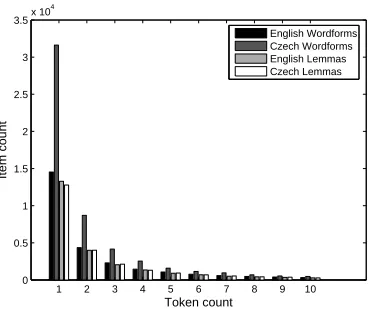
Some statistics on the parallel corpus are shown in the graph in Figure 3. This graph illustrates the sparse data problem in Czech that our morpholog-ical analysis is intended to address. Although the number of infrequently occurring lemmas is about the same in both English and Czech, the number of infrequently occurring inflected wordforms is approx-imately twice as high in Czech.1
For all of our experiments, we used the same lan-guage model, trained with the CMU Statistical Lan-guage Modelling Toolkit (Clarkson and Rosenfeld, 1997). Our translation models were trained using GIZA++ (Och and Ney, 2003), which we
modi-1Although we did not use it for the experiments in
1 2 3 4 5 6 7 8 9 10 0
0.5 1 1.5 2 2.5 3 3.5x 10
4
Token count
Item count
[image:5.612.347.507.54.141.2]English Wordforms Czech Wordforms English Lemmas Czech Lemmas
Figure 3: The number of items (full wordforms or lemmas) y appearing in the parallel corpus with a token count ofx.
fied as necessary for the morpheme-based experi-ments. We used the ISI ReWrite Decoder (Marcu and Germann, 2005) for producing translations. Be-fore beginning our experiments, we obtained a base-line BLEU score by training a standard word-to-word translation model. Our baseline results indicate that the test set for this corpus is considerably more diffi-cult than the development set: word-to-word scores were .311 (development) and .270 (test).
4.1 Lemmas
As Figure 3 shows, lemmatization of the Czech cor-pus cuts the number of unique items by more than half, and the number of items with no more than ten occurrences by nearly half. The lemmatization BLEU scores in Table 1 indicate that this has a large impact on the quality of translation. As expected, full lemmatization performed better than word-to-word translation, with an an improvement of about .04 in the development set BLEU score and .03 in the test set. (In this and the following experiments, BLEU score differences of .009 or more are signifi-cant at the .05 level.) Experiments on the develop-ment set showed that leaving certain parts of speech unlemmatized did not improve results, but lemma-tizing only low-frequency words did. A frequency cutoff of 50 worked best on the development set (i.e. only words with frequency less than 50 were lemma-tized). Despite the improvement on the development set, using this cutoff with the test set yielded only a non-significant improvement over full lemmatization. The results of these lemmatization experiments support the argument that lemmatization improves translation quality by reducing data sparseness, but also removes potentially useful information. Our
re-Dev Test
word-to-word .311 .270
lemmatize all .355 .299
except Pro .350
except Pro, V, N .346
lemmatizen <50 .370 .306
[image:5.612.90.277.57.212.2]truncate all .353 .283
Table 1: BLEU scores for the word-to-word baseline, lemmatization, and word truncation experiments.
sults suggest that lemmatizing only infrequent words may, in some cases, work better than lemmatizing all words.
As Table 1 indicates, it is possible to get some of the benefits of lemmatization without using any morphological knowledge at all. For both dev and test sets, truncating words to 6 characters (the best length on the dev set) provided a significant im-provement over word-to-word translation, but was also significantly worse than the best lemmatization scores. Changing the frequency cutoff for trunca-tion did not produce any significant differences in the BLEU score.
4.2 Pseudowords
Results for the pseudoword experiments on the devel-opment set are shown in the first column of Table 2. Note that in these (and the following) experiments, we treated all words the same way regardless of their frequency, so the effects of adding morphological in-formation are in comparison to the full lemmatiza-tion scheme. In most of our experiments, we added morphological information for only a single class of tags at a time in order to determine the effects of each class individually. The classes we used were verb person (PER), verb tense (TEN), noun number (NUM), noun case (CASE), and negation (NEG).
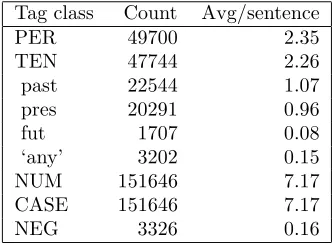
Most of the results of the pseudoword experiments confirm our expectations. Adding the verb person tags was helpful, and examination of the alignments revealed that they did indeed align to English pro-nouns with high probability. The noun number tags did not help, since plurality is expressed as an affix in English. Negation tags helped slightly, though the improvement was not significant. This is probably because negation tags are relatively infrequent, as can be seen in Table 3. The addition of pseudowords for case did not yield an improvement, probably be-cause these pseudowords were so frequent. The ad-ditional ambiguity caused by so many extra words likely overwhelmed any positive effect.
Tag type Pseudo Mod-Lem Morph
PER .365 .356 .356
TEN .365 .361 .364
PER,TEN .355 .362 .355
NUM .354 .367 .361
CASE .353 .340 .337
[image:6.612.102.268.249.371.2]NEG .357 .356 .353
Table 2: BLEU scores indicating the results of in-corporating the information from different classes of morphological tags in the the experiments us-ing pseudowords (Pseudo), modified lemmas (Mod-Lem), and morphemes (Morph). Scores are from the development set. Differences of .009 are significant (p < .05).
Tag class Count Avg/sentence
PER 49700 2.35
TEN 47744 2.26
past 22544 1.07
pres 20291 0.96
fut 1707 0.08
‘any’ 3202 0.15
NUM 151646 7.17
CASE 151646 7.17
NEG 3326 0.16
Table 3: Number of occurrences of each class of tags in the Czech training data.
verb tense tags. With the exception of future tense, English generally does not mark tense with an aux-iliary. Yet Table 3 shows that only a very small per-centage of sentences have a future tense marker, so it seems unlikely that this explains the positive ef-fects of the tense pseudowords. In fact, we tried adding only future tense pseudowords to the lem-matized Czech data, and found that the results were no better than basic lemmatization.
The other unusual behavior we see with pseu-dowords is that when verb person and tense tags are combined, they seem to cancel each other out, result-ing in a score that is no better than lemmatization alone. Examination of the alignments did not reveal any obvious reason for this effect.
4.3 Modified Lemmas
As shown in the second column of Table 2, the num-ber and tense tags yield an improvement under the modified lemma transformation, while the person tags do not. Again, this confirms our predictions based on the morphology of English.
Our results using the case tags under this model
actually decreased performance, but this is not surprising given that differentiating Czech lemmas based on case marking creates as much as a 7-way split of the data (there are seven cases in Czech), without adding much information that would be use-ful in English.
4.4 Morphemes
BLEU scores for the morpheme-based model are given in the third column of Table 2. None of the differences in scores between this model and the mod-ified lemma model are significant, although the trend for most of the tag classes is for this model to per-form slightly worse. This suggests that the type of smoothing induced by the morpheme-based model may not be as helpful as simply attempting to cre-ate Czech words that reflect the same morphological distinctions as the English words. In Section 5, we propose a generalized version of the morpheme model that might be an improvement.
4.5 Combined Model
In the experiments described so far, we used only a single method at a time of incorporating mor-phological information into the translation process. However, it is straightforward to combine the pseu-doword method with either the modified-lemma or morpheme-based methods by using pseudowords for certain tags and attaching others to the Czech lem-mas. The experiments described above allowed us to confirm our intuitions about how each class of tags should be treated under such a combined model. We then created a model using the pseudoword treat-ment of the person and negation tags, and the mod-ified lemma treatment of number and tense. We did not use the case tags in this model, since they did not seem to yield an improvement in any of the three basic morphological models.
Our combined model achieved a BLEU score of .390 (development) and .333 (test), outperforming the models in all of our previous experiments.
5
Discussion
despite the loss of information involved. Lemmatiz-ing the less frequent words in the corpus seemed to increase performance slightly, but these results were inconclusive. Word truncation, which requires no morphological information at all, was effective at in-creasing scores over the word-to-word baseline, but did not perform quite as well as lemmatization. This result conflicts with Och’s (Och, 1995), and is likely due to the much smaller size of our corpus. In any case, our results suggest that lemmatization or word truncation could yield a significant improvement in the quality of translation from a highly-inflected to a less-inflected language, even when limited morpho-logical information is available.
Our primary results concern the use of full mor-phological information. We found that certain tags were more useful when we treated them as discrete input words, while others provided a greater benefit when attached directly to their lemmas. The best choice of which method to use for each class of tags seems to correspond closely with how that class of in-formation is expressed in English (either using func-tion words or inflecfunc-tion). In a sense, the goal of the morphological analysis is to make the Czech input data more English-like by suppressing unnecessary morphological distinctions and expressing necessary distinctions in ways that are similar to English. This sort of procedure could be taken further by incorpo-rating syntactic information as well, but as we stated earlier, our goal was to determine exactly how much benefit we could derive from a strictly morphological approach.
In the work we have presented, the output lan-guage (English) is low in inflection. We therefore considered it less important to perform morphologi-cal analysis on the English data. However, we expect that the work described here could be generalized to highly inflected output languages by doing morpho-logical analysis on both the input and output lan-guages. The most promising way to do this seems to be by extending the morpheme-based translation model in Equation 2 to incorporate morphemes in both languages, so that
P(fj|ei) = K
Y
k=0
P(fjk|eik) (3)
wherefjk are the morphemes in the input language, andeik are the corresponding morphemes in the out-put language. This extended model may also prove a benefit to Czech-English translation; we are cur-rently investigating this possibility.
In this work, we used a word-based translation sys-tem due to the availability of source code that could
be modified for our morph experiments. An obvious extension to the current work would be to move to a phrase-based translation system. One advantage of phrase-based models is their ability to align phrases in one language to morphologically complex words in the other language. However, this feature still suffers from the same sparse data problems as a word-based system: if a morphologically complex word only ap-pears a handful of times in the training corpus, the system will have difficulty determining its (phrasal or word) alignment. We expect that morphological analysis would still be helpful in this situation, at the very least because it can be used to remove distinc-tions that appear in only one language.
6
Conclusion
In this paper we used morphological analysis of Czech to improve a Czech-English statistical machine translation system. We have argued that this im-provement was primarily due to a reduction of the sparse data problem caused by the highly inflected nature of Czech. An alternative method for reducing sparse data is to use a larger parallel corpus; however, it is often easier to obtain additional monolingual re-sources, such as a morphological analyzer or tagged corpus, than additional parallel data for a specific language pair. For that reason, we believe that the approach taken here is a promising one.
We have described several different ways of using morphological information for machine translation, and have shown how these can be combined to yield an improved translation model. In general, we would not expect the exact combination of techniques that yielded our best results for Czech-English to be op-timal for other language pairs. Rather, we have sug-gested that these techniques should be combined in a way that makes the input language more similar to the output language. Although this combination will need to be determined for each language pair, the general approach outlined here should provide ben-efits for any MT system involving a highly inflected language.
Acknowledgements
References
Y. Al-Onaizan, J. Cuˇrin, M. Jahr, K. Knight, J. Laf-ferty, D. Melamed, F. Och, D. Purdy, N. Smith, and D. Yarowsky. 1999. Statistical machine trans-lation. Final Report, JHU Summer Workshop 1999.
P. Clarkson and R. Rosenfeld. 1997. Sta-tistical language modeling using the CMU-Cambridge Toolkit. In Proceedings of ESCA Eurospeech. Current version available at http://mi.eng.cam.ac.uk/∼prc14/toolkit.html.
J. Hajiˇc. 1998. Building a Syntactically Anno-tated Corpus: The Prague Dependency Treebank. In Eva Hajiˇcov´a, editor, Issues of Valency and Meaning. Studies in Honor of Jarmila Panevov´a, pages 12–19. Prague Karolinum, Charles Univer-sity Press.
Y. Lee. 2004. Morphological analysis for statistical machine translation. InProceedings NAACL.
D. Marcu and U. Germann. 2005. The
ISI ReWrite Decoder 1.0.0a. Available at http://www.isi.edu/licensed-sw/rewrite-decoder/.
S. Niessen and H. Ney. 2000. Improving SMT quality with morpho-syntactic analysis. InProceedings of COLING.
S. Niessen and H. Ney. 2004. Statistical machine translation with scarce resources using morpho-syntactic analysis. Computational Linguistics, 30(2):181–204.
F. J. Och and H. Ney. 2003. A systematic compari-son of various statistical alignment models. Com-putational Linguistics, 29(1):19–51.
F. Och. 1995. Statistical machine translation: The fabulous present and future. Invited talk at the Workshop on Building and Using Parallel Texts at ACL’05.
M. ˇCmejrek, J. Cuˇr´ın, and J. Havelka. 2003. Czech-english dependency-based machine translation. In Proceedings of EACL.