Cluster-specific Named Entity Transliteration
Fei Huang
School of Computer Science
Carnegie Mellon University, Pittsburgh, PA 15213
Abstract
Existing named entity (NE) transliteration approaches often exploit a general model to transliterate NEs, regardless of their origins. As a result, both a Chinese name and a French name (assuming it is already trans-lated into Chinese) will be transtrans-lated into English using the same model, which often leads to unsatisfactory performance. In this paper we propose a cluster-specific NE transliteration framework. We group name origins into a smaller number of clusters, then train transliteration and language mod-els for each cluster under a statistical ma-chine translation framework. Given a source NE, we first select appropriate models by classifying it into the most likely cluster, then we transliterate this NE with the corre-sponding models. We also propose a phrase-based name transliteration model, which ef-fectively combines context information for transliteration. Our experiments showed substantial improvement on the translitera-tion accuracy over a state-of-the-art baseline system, significantly reducing the transliteration character error rate from 50.29% to 12.84%.
1 Introduction
Named Entity (NE) translation and transliteration are very important to many multilingual natural language processing tasks, such as machine trans-lation, crosslingual information retrieval and ques-tion answering. Although some frequently occurring NEs can be reliably translated using in-formation from existing bilingual dictionaries and parallel or monolingual corpora (Al-Onaizan and
Knight, 2002; Huang and Vogel, 2002; Lee and Chang, 2003), less frequently occurring NEs, espe-cially new names, still rely on machine translitera-tion to generate their translatranslitera-tions.
NE machine transliteration generates a phoneti-cally similar equivalent in the target language for a source NE, and transliteration patterns highly de-pend on the name’s origin, e.g., the country or the language family this name is from. For example, when transliterating names1 from Chinese into English, as shown in the following example, the same Chinese character “金” is transliterated into different English letters according to the origin of each person.
金人庆 --- Jin Renqing (China) 金大中 --- Kim Dae-jung (Korea)
丁
马 路德金 --- Martin Luther King (USA) 金丸信 --- Kanemaru Shin (Japan)
何塞 华金 布伦纳 --- Jose Joaquin Brunner (Chile)
Several approaches have been proposed for name transliteration. (Knight and Graehl, 1997) proposed a generative transliteration model to transliterate foreign names in Japanese back to English using finite state transducers. (Stalls and Knight, 1998) expanded that model to Arabic-English transliteration. (Meng et al. 2001) devel-oped an English-Chinese NE transliteration tech-nique using pronunciation lexicon and phonetic mapping rules. (Virga and Khudanpur, 2003) ap-plied statistical machine translation models to “translate” English names into Chinese characters for Mandarin spoken document retrieval. All these approaches exploit a general model for NE trans-literation, where source names from different ori-gins or language families are transliterated into the target language with the same rules or probability distributions, which fails to capture their different
1
transliteration patterns. Alternatively, (Qu and Gre-fenstette, 2004) applied language identification of name origins to select language-specific translit-erations when back-transliterating Japanese names from English to Japanese. However, they only classified names into three origins: Chinese, Japa-nese and English, and they used the Unihan data-base to obtain the mapping between kenji characters and romanji representations.
Ideally, to explicitly model these transliteration differences we should construct a transliteration model and a language model for each origin. How-ever, some origins lack enough name translation pairs for reliable model training. In this paper we propose a cluster-specific NE transliteration framework. Considering that several origins from the same language family may share similar trans-literation patterns, we group these origins into one cluster, and build cluster-specific transliteration and language models.
Starting from a list of bilingual NE translation pairs with labeled origins, we group closely related origins into clusters according to their language and transliteration model perplexities. We train cluster-specific language and transliteration models with merged name translation pairs. Given a source name, we first select appropriate models by classi-fying it into the most likely cluster, then we trans-literate the source name with the corresponding models under the statistical machine translation framework. This cluster-specific transliteration framework greatly improves the transliteration per-formance over a general transliteration model. Fur-ther more, we propose a phrase-based transliteration model, which effectively combines context information for name transliteration and achieves significant improvements over the tradi-tional character-based transliteration model.
The rest of the paper is organized as following: in section 2 we introduce the NE clustering and classification schemes, and we discuss the phrase-based NE transliteration in section 3. Experiment settings and results are given in section 4, which is followed by our conclusion.
2
Name Clustering and Classification
Provided with a list of bilingual name translation pairs whose origins are already labeled, we want to find the origin clusters where closely related
ori-gins (countries sharing similar languages or cul-tural heritages) are grouped together.
We define the similarity measure between two clusters as their LM and TM perplexities. Let
)} , {( i i
i F E
S = denote a set of name translation pairs from origini, from which modelθiis trained:
) , ,
( c(i) e(i) t(i)
i = P P P
θ . Here and are N-gram character language models (LM) for source and target languages, and is a character translation
model trained based on IBM translation model 1 (Brown et.al. 1993). The distance between origin i and origin
) (i c
P Pe(i)
) (i t
P
j can be symmetrically defined as:
) | ( log | | 1 ) | ( log | | 1 ) ,
( j i
j j i i S P S S P S j i
d =− θ − θ ,
where, assuming name pairs are generated inde-pendently, )] | ( ) ( ) | ( ) ( log[ ) | ( ) ( ) ( | | 1 ) ( ) ( t i t i j t t i j e S t t i t i j t t i j c j i E F P E P F E P F P S P i
∑
= + ∝ θWe calculate the pair-wise distances among these origins, and cluster them with group-average agglomerative clustering. The distance between clusters and is defined as the average
dis-tance between all origin pairs in each cluster. This clustering algorithm initially sets each origin as a single cluster, then recursively merges the closest cluster pair into one cluster until an optimal num-ber of clusters is formed.
i
C Cj
Among all possible cluster configurations, we select the optimal cluster number based on the model perplexity. Given a held-out data set L, a list of name translation pairs from different origins, the probability of generating L from a cluster configu-ration Θωis the product of generating each name pair from its most likely origin cluster:
∏
∏
= ∈Θ = ∈Θ
= = Θ | | 1 ) ( ) ( | | 1 ) ( ) ( ) ( max ) ( ) | , ( max ) | ( L t j t j e t j c j L t j j t t j P E P F P P E F P L P θ θ θ ω ω ω
We calculate the language model perplexity:
| | / 1 ) | ( log | | 1 ) | ( 2 ) ,
( L PL L
L P L pp − Θ − Θ = =
Θω ω
ω
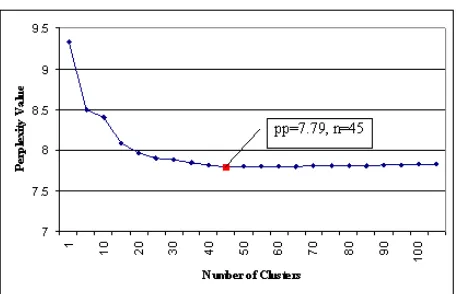
Figure 1. Perplexity value of LMs with different number of clusters
Afghanistan, Algeria, Egypt, Iran, Iraq, Jordan, Kuwait, Pakistan, Palestine,
clusters) with regard to a held-out 3K name pairs. As shown in Figure 1, the perplexity curve reaches its minimum when . This indicates that the optimal cluster number is 45.
45 =
n
Table 1 lists some typical origin clusters. One may notice that countries speaking languages from the same family are often grouped together. These countries are either geographically adjacent or his-torically affiliated. For example, in the English cluster, the Netherlands (Dutch) seems an abnor-mality. In the clustering process it was first grouped with the South Africa, which was colo-nized by the Dutch and the English in the seven-teenth century. This cluster was further grouped into the English-speaking cluster. Finally, some origins cannot be merged with any other clusters because they have very unique names and transla-tion patterns, such as China and Japan, thus they are kept as single origin clusters.
For name transliteration task, given a source name F we want to classify it into the most likely cluster, so that the appropriate cluster-specific model can be selected for transliteration. Not knowing F’s translation E, we cannot apply the translation model and the target language model for name origin classification. Instead we train a Bayesian classifier based on N-gram source char-acter language models, and assign the name to the cluster with the highest LM probability. Assuming a source name is composed of a sequence of source characters: . We want to find the
cluster such that
} ,..., ,
{f1 f2 fl F =
*
j
(1)
) ( ) ( max arg
) | ( ) ( max arg
) | ( max arg
) ( *
F P P
F P P
F P j
j c j j
j j
j j j
θ
θ θ
θ
= = =
where P(θj)is the prior probability of cluster j,
estimated based on its distribution in all the train-ing data, and is the probability of
generat-ing this source name based on cluster )
( ) ( F
Pc j
j
’s character language model.3
Phrase-Based Name Transliteration
Statistical NE transliteration is similar to the statis-tical machine translation in that an NE translation pair can be considered as a parallel sentence pair, where “words” are characters in source and target languages. Due to the nature of name translitera-tion, decoding is mostly monotone.
Arabic
Saudi Arabia, Sudan, Syria, Tunisia, Yemen, …
Spanish- Portuguese
Angola, Argentina, Bolivia, Brazil, Chile, Colombia, Cuba, Ecuador,
Mex-ico, Peru, Portugal, Spain, Venezuela, …
English Australia, Canada, Netherlands, New
Zealand, South Africa, UK, USA, …
Russian Belarus, Kazakhstan, Russia, Ukraine
East Euro-pean
Bosnia and Herzegovina, Croatia, Yugoslavia
French (African)
Benin, Burkina Faso, Cameroon, Cen-tral African Republic, Congo, Gabon,
Ivory Coast
German Austria, Germany, Switzerland
French Belgium, France, Haiti
Korean North Korea, South Korea
Danish-
Swedish Denmark, Norway, Sweden
Single Clus-ters
China Japan Indonesia
[image:3.612.76.311.54.201.2]Israel ……
NE transliteration process can be formalized as: ) ( ) | ( max arg ) | ( max arg
* PE F PF EPE
E = E = E
where E*is the most likely transliteration for the source NE F, P(F|E) is the transliteration model and P(E) is the character-based target language model. We train a transliteration model and a lan-guage model for each cluster, using the name translation pairs from that cluster.
3.1 Transliteration Model
A transliteration model provides a conditional probability distribution of target candidates for a given source transliteration unit: a single character or a character sequence, i.e., “phrase”. Given enough name translation pairs as training data, we can select appropriate source transliteration units, identify their target candidates from a character alignment path within each name pair, and estimate their transliteration probabilities based on their co-occurrence frequency.
A naive choice of source transliteration unit is a single character. However, single characters lack contextual information, and their combinations may generate too many unlikely candidates. Moti-vated by the success of phrase-based machine translation approaches (Wu 1997, Och 1999, Marcu and Wong 2002 and Vogel et. al., 2003),we select transliteration units which are long enough to capture contextual information while flexible enough to compose new names with other units. We discover such source transliteration phrases based on a character collocation likelihood ratio test (Manning and Schutze 1999). This test accepts or rejects a null hypothesis that the occurrence of one character is independent of the other, , by calculating the likelihood ratio between the inde-pendent ( ) and dependent ( ) hypotheses:
1
f f2
0
H
H1) , , ( log ) , , ( log ) , , ( log ) , , ( log ) ( ) ( log log 2 1 12 2 1 1 12 1 12 2 1 12 1 0 p c N c c L p c c L p c N c c L p c c L H L H L − − − − − − + = = λ
L is the likelihood of getting the observed character counts under each hypothesis. Assuming the char-acter occurrence frequency follows a binomial
dis-tribution, xk x n k
k n x n k
L ⎟⎟ − −
⎠ ⎞ ⎜⎜ ⎝ ⎛
= (1 ) ) , , (
,
12 2 1,c ,cc are the frequencies of , and ,
and
1
f f2 f1^f2
Nis the total number of characters. and
are defined as:
1 ,p p 2 p N c p= 2 ,
2 12 1
c c p = ,
1 12 2 2 c N c c p − − = .
We calculate the likelihood ratio for any adja-cent source character pairs, and select those pairs whose ratios are higher than a predefined threshold. Adjacent character bigrams with one character overlap can be recursively concatenated to form longer source transliteration phrases. All these phrases and single characters are combined to con-struct a cluster-specific phrase segmentation vo-cabulary list, T. For each name pair in that cluster, we
1. Segment the Chinese character sequence into a source transliteration phrase se-quence based on maximum string match-ing usmatch-ing T;
2. Convert Chinese characters into their ro-manization form, pinyin, then align the pinyin with English letters via phonetic string matching, as described in (Huang et. al., 2003);
3. Identify the initial phrase alignment path based on the character alignment path; 4. Apply a beam search around the initial
phrase alignment path, searching for the optimal alignment which minimizes the overall phrase alignment cost, defined as:
∑
∈ = A a a i A i i e f DA* argmin ( , )
.
Here is the ith source phrase in F, is its
tar-get candidate under alignment A. Their alignment cost D is defined as the linear interpolation of the phonetic transliteration cost log and semantic
translation cost log :
i f i a e trl P trans P ) | ( log ) 1 ( ) | ( log ) ,
(f e P e f P e f
D =λ trl + −λ trans
,
cluster-specific interpolation weight, reflecting the relative contributions of the transliteration cost and the translation cost. For example, most Latin language names are often phonetically translated into Chi-nese, thus the transliteration cost is usually the dominant feature. However, Japanese names are often semantically translated when they contain characters borrowed from Chinese, therefore the translation cost is more important for the Japanese model (
λ
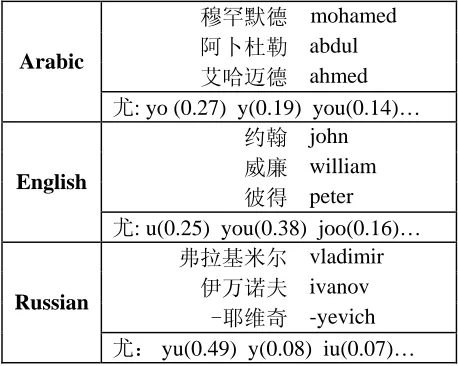
=0 in this case). We empirically select the interpolation weight for each cluster, based on their transliteration performance on held-out name pairs, and the combined model with optimal inter-polation weights achieves the best overall perform-ance.We estimate the phrase transliteration probabil-ity according to their normalized alignment fre-quencies. We also include frequent sub-name translations (first, middle and last names) in the transliteration dictionary. Table 2 shows some typical transliteration units (characters or phrases) from three clusters. They are mostly names or sub-names capturing cluster-specific transliteration patterns. It also illustrates that in different clusters the same character has different transliteration candidates with different probabilities, which justi-fies the cluster-specific transliteration modeling.
穆罕默德 mohamed
阿卜杜勒 abdul
艾哈迈德 ahmed
Arabic
尤: yo (0.27) y(0.19) you(0.14)…
约翰 john
威廉 william
彼得 peter English
尤: u(0.25) you(0.38) joo(0.16)…
弗拉基米尔 vladimir
伊万诺夫 ivanov
-耶维奇 -yevich
Russian
[image:5.612.71.300.411.594.2]尤: yu(0.49) y(0.08) iu(0.07)… Table 2. Transliteration units examples from three name clusters.
3.2 Language model and decoding
For each cluster we train a target character lan-guage model from target NEs. We use the N-gram models with standard smoothing techniques.
During monotone decoding, a source NE is segmented into a sequence of transliteration units, and each source unit is associated with a set of tar-get candidate translations with corresponding prob-abilities. A transliteration lattice is constructed to generate all transliteration hypotheses, among which the one with the minimum transliteration and language model costs is selected as the final hypothesis.
4 Experiment
Results
We selected 62K Chinese-English person name translation pairs for experiments. These origin-labeled NE translation pairs are from the name entity translation lists provided by the LDC2 (including the who’swho (china) and who’swho (international) lists), and devided into three parts: system training (90%), development (5%) and testing (5%). In the development and test data, names from each cluster followed the same distribution as in the training data.
4.1 NE Classification Evaluation
We evaluated the source name classification ac-curacy, because classification errors will lead to incorrect model selection, and result in bad transliteration performance in the next step. We trained 45 cluster-specific N-gram source character language models, and classified each source name into the most likely cluster according to formula 1. We evaluated the classification accuracy on a held-out test set with 3K NE pairs. We also experi-mented with different N values. Table 3 shows the classification accuracy, where the 3-gram model achieves the highest classification accuracy. A de-tailed analysis indicates that some classification errors are due to the inherent uncertainty of some names, e. g, “骆家辉 (Gary Locke)”, a Chinese American, was classified as a Chinese name based on its source characters while his origin was la-beled as USA.
Table 3. Source name origin classification accura-cies
2
http://www.ldc.upenn.edu
4.2 NE Transliteration Evaluation
We first evaluated transliteration results for each cluster, then evaluated the overall results on the whole test set, where a name was transliterated using the cluster-specific model in which it was classified. The evaluation metrics are:
• Top1 accuracy (Top1), the percentage that the top1 hypothesis is correct, i.e., the same as the reference translation; • Top 5 accuracy (Top5), the percentage
that the reference translation appears in the generated top 5 hypotheses;
• Character error rate (CER), the percent-age of incorrect characters (inserted, de-leted and substituted English letters) when the top 1 hypothesis is aligned to the reference translation.
Our baseline system was a character-based general transliteration model, where 56K NE pairs from all clusters were merged to train a general transliteration model and a language model (CharGen). We compare it with a character-based cluster-specific model (CharCls) and a phrase-based cluster-specific model (PhraCls). The CERs of several typical clusters are shown in Table 4.
Because more than half of the training name pairs are from Latin language clusters, the general transliteration and language models adopted the Latin name transliteration patterns. As a result, it obtained reasonable performance (20-30% CERs) on Latin language names, such as Spanish, English and French names, but strikingly high (over 70%) CERs on oriental language names such as Chinese and Japanese names, even though the Chinese cluster has the most training data.
When applying the character-based cluster-specific models, transliteration CERs consistently decreased for all clusters (ranging from 6.13% relative reduction for the English cluster to 97% for the Chinese cluster). As expected, the oriental language names obtained the most significant error reduction because the cluster-specific models were able to represent their unique transliteration patterns. When we applied the phrased-based transliteration models, CERs were further reduced by 23% ~ 51% for most clusters, because the context information were encapsulated in the transliteration phrases. An exception was the
Chinese cluster, where names were often translated according to the pinyin of single characters, thus phrase-based transliteration slightly decreased the performance.
The transliteration performance of different clusters varied a lot. The Chinese cluster achieved 96.09% top 1 accuracy and 1.69% CER with the character-based model, and other clusters had CERs ranging from 7% to 30%. This was partly because of the lack of training data (e.g, for the Japanese cluster), and partly because of unique transliteration patterns of different languages. We try to measure this difference using the average number of translations per source phrase (AvgTrans), as shown in Table 4. This feature reflected the transliteration pattern regularity, and seemed linearly correlated with the CERs. For example, compared with the English cluster, Russian names have more regular translation patterns, and its CER is only 1/3 of the English cluster, even with only half size of training data.
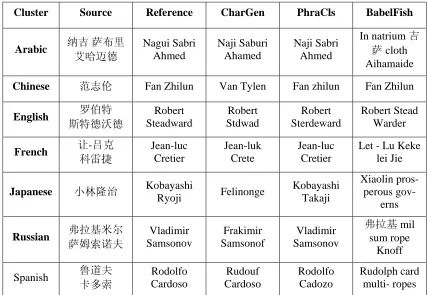
In Table 5 we compared translation examples from the baseline system (CharGen), the phrase-based cluster-specific system (PhraCls) and a online machine translation system, the BabelFish3. The CharGen system transliterated every name in the Latin romanization way, regardless of each name’s original language. The BabelFish system inappropriately translated source characters based on their semantic meanings, and the results were difficult to understand. The PhraCls model captured cluster-specific contextual information, and achieved the best results.
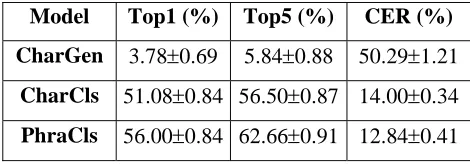
We evaluated three models’ performances on all the test data, and showed the result in Table 6. The CharGen model performed rather poorly transliterating oriental names, and the overall CER was around 50%. This result was comparable to other state-of-the-art statistical name transliteration systems (Virga and Khudanpur, 2003). The CharCls model significantly improved the top1 and top 5 transliteration accuracies from 3.78% to 51.08%, and from 5.84% to 56.50%, respectively. Consistently, the CER was also reduced from 50.29% to 14.00%. Phrase-based transliteration further increased the top 1 accuracy by 9.3%, top 5 accuracy by 10.7%, and reduced the CER by 8%, relatively. All these improvements were statistically significant.
3
Table 4. Cluster-specific transliteration comparison
Table 5. Transliteration examples from some typical clusters Cluster Training
data size
CharGen (CER)
CharCls (CER)
PhraCls
(CER) AvgTrans
Arabic 8336 22.88 18.93 14.47 4.58
Chinese 27093 76.45 1.69 1.71 3.43
English 8778 31.12 29.21 17.27 5.02
French 2328 27.66 18.81 9.07 3.51
Japanese 2161 86.94 38.65 29.60 7.57
Russian 4407 29.17 9.62 6.55 3.64
Spanish 8267 18.87 15.99 10.33 3.61
Cluster Source Reference CharGen PhraCls BabelFish
Arabic 纳吉萨布里
艾哈迈德
Nagui Sabri Ahmed
Naji Saburi Ahamed
Naji Sabri Ahmed
In natrium 吉
萨 cloth Aihamaide
Chinese 范志伦 Fan Zhilun Van Tylen Fan zhilun Fan Zhilun
English 罗伯特
斯特德沃德
Robert Steadward
Robert Stdwad
Robert Sterdeward
Robert Stead Warder
French 让-吕克
科雷捷
Jean-luc Cretier
Jean-luk Crete
Jean-luc Cretier
Let - Lu Keke lei Jie
Japanese 小林隆治 Kobayashi
Ryoji Felinonge
Kobayashi Takaji
Xiaolin pros-perous
gov-erns
Russian 弗拉基米尔
萨姆索诺夫
Vladimir Samsonov
Frakimir Samsonof
Vladimir Samsonov
弗拉基 mil sum rope
Knoff
Spanish 鲁道夫 卡多索
Rodolfo Cardoso
Rudouf Cardoso
Rodolfo Cadozo
[image:7.612.94.521.325.620.2]Model Top1 (%) Top5 (%) CER (%)
CharGen 3.78±0.69 5.84±0.88 50.29±1.21
CharCls 51.08±0.84 56.50±0.87 14.00±0.34
[image:8.612.67.302.54.137.2]PhraCls 56.00±0.84 62.66±0.91 12.84±0.41
Table 6 Transliteration result comparison
5 Conclusion
We have proposed a cluster-specific NE translit-eration framework. This framework effectively modeled the transliteration differences of source names from different origins, and has demon-strated substantial improvement over the baseline general model. Additionally, phrase-based translit-eration further improved the translittranslit-eration per-formance by a significant margin.
References
Y. Al-Onaizan and K. Knight. 2002. Translating named entities using monolingual and bilingual resources. In Proceedings of the ACL-2002, pp400-408, Philadelphia, PA, July, 2002.
F. Huang and S. Vogel. 2002. Improved Named Entity Translation and Bilingual Named Entity Extraction, Proceedings of the ICMI-2002. Pittsburgh, PA, October 2002
F. Huang, S. Vogel and A. Waibel. 2003. Auto-matic Extraction of Named Entity Translingual Equivalence Based on Multi-feature Cost Mini-mization. Proceedings of the ACL-2003, Work-shop on Multilingual and Mixed Language Named Entity Recognition. Sapporo, Japan.
K. Knight and J. Graehl. 1997. Machine Translit-eration. Proceedings of the ACL-1997. pp.128-135, Somerset, New Jersey.
C. J. Lee and J. S. Chang. 2003. Acquisition of English-Chinese Transliterated Word Pairs from Parallel-Aligned Texts using a Statistical Ma-chine Transliteration Model. HLT-NAACL 2003 Workshop: Building and Using Parallel Texts: Data Driven Machine Translation and Beyond. pp96-103, Edmonton, Alberta, Canada.
C. D. Manning and H. Schütze. 1999. Foundations of Statistical Natural Language Processing. MIT Press. Boston MA.
H. Meng, W. K. Lo, B. Chen and K. Tang. 2001. Generating Phonetic Cognates to Handle Named Entities in English-Chinese Cross-Language Spoken Document Retrieval. Proceedings of the ASRU-2001, Trento, Italy, December.2001
D. Marcu and W. Wong. A Phrase-Based, Joint Probability Model for Statistical Machine Trans-lation. Proceedings of EMNLP-2002, Philadel-phia, PA, 2002
F. J. Och, C. Tillmann, and H. Ney. Improved Alignment Models for Statistical Machine Translation. pp. 20-28; Proc. of the Joint Conf. of Empirical Methods in Natural Language Processing and Very Large Corpora; University of Maryland, College Park, MD, June 1999.
Y. Qu, and G. Grefenstette. Finding Ideographic Representations of Japanese Names Written in Latin Script via Language Identification and Corpus Validation. ACL 2004: 183-190
P. Virga and S. Khudanpur. 2003. Transliteration of Proper Names in Cross-Lingual Information Retrieval. Proceedings of the ACL-2003 Work-shop on Multi-lingual Named Entity Recognition Japan. July 2003.
S. Vogel, Y. Zhang, F. Huang, A. Tribble, A. Venogupal, B. Zhao and A. Waibel. The CMU Statistical Translation System, Proceedings of MT Summit IX New Orleans, LA, USA, Sep-tember 2003