Inferring Binary Relation Schemas for Open Information Extraction
Kangqi Luo1 and Xusheng Luo2 and Kenny Q. Zhu3 Department of Computer Science & Engineering
Shanghai Jiao Tong University, Shanghai, China
1[email protected] 2freefish [email protected] 3[email protected]
Abstract
This paper presents a framework to model the semantic representation of binary re-lations produced by open information ex-traction systems. For each binary relation, we infer a set of preferred types on the two arguments simultaneously, and gen-erate a ranked list of type pairs which we call schemas. All inferred types are drawn from the Freebase type taxonomy, which are human readable. Our system collects 171,168 binary relations from Re-Verb, and is able to produce top-ranking relation schemas with a mean reciprocal rank of 0.337.
1 Introduction
Open information extraction (or Open IE) is a task of extracting all sorts of relations between named entities or concepts from open-domain text cor-pora, without restraining itself to specific rela-tions or patterns. State-of-the-art Open IE sys-tems (Carlson et al., 2010; Fader et al., 2011; Schmitz et al., 2012; Nakashole et al., 2012) ex-tract millions of binary relations with high preci-sion from the web corpus. Each extracted relation instance is a triple of the formharg1, rel, arg2i, where the relationrelis a lexical or syntactic pat-tern, and both arguments are multi-word expres-sions representing the argument entities or con-cepts.
Whereas Open IE provides concrete relation in-stances, we are interested in generalizing these instances into more abstract semantic representa-tions. In this paper, we focus on inferring the schemas of binary relations.
For example, given the binary relation “play in”, an Open IE system extracts many triples of the form hX, play in, Yi. The following relation triples are extracted in ReVerb:
hGoel Grey, played in,Cabareti
hTom Brady, play in,National Football Leaguei
Informally, the goal of our system is to automatically infer a set of schemas such as
ht1, play in, t2i, wheret1andt2are two seman-tic types drawn from a standard knowledge base such as WordNet (Miller, 1995), Yago (Suchanek et al., 2007), Freebase (Bollacker et al., 2008), and Probase (Wu et al., 2012), and each such schema can be used to represent a set of “play in” relation instances. For the above example, two possible schemas for “play in” are:
hfilm actor, play in, filmi
hathlete, play in, sports leaguei
The schema of a binary relation is useful in-formation in NLP tasks, such as context-oriented entity recognition and open domain question an-swering. Suppose we are to recognize the enti-ties in the sentence “Granger played in the NBA”. “Granger” is a highly ambiguous term, while “the NBA” is probably a sports league. Then with the the above relation schemas for “play in”, the entity recognizer knows that “Granger” is more likely to be an athlete, which results in the correct linking to “Danny Granger”, who is an NBA player, even though the Open IE has never extracted such fact before.
One relevant technique to achieve our goal is selectional preference (SP) (Resnik, 1996; Erk, 2007; Ritter et al., 2010), which computes the most appropriate types for a specific argument of a predicate. SP is based on the idea of mutual in-formation (Erk, 2007), which tends to select types which are unique to the relation. In other words, common types which can be used for many differ-ent relations are less preferred. However, in Open IE, many relations are related or even similar, e.g., play in, take part in and be involved in. There’s no reason for these relations not to share schemas. Therefore in this paper, our problem is, given a
lation and its instances, identify the smallest types that can cover as many instances as possible. Our approach first attempts to link the arguments in the relation instances to a set of possible entities in a knowledge base, hence generate a set of he1, e2i entity pairs. Then we select a pair of typesht1, t2i that covers maximum number of entity pairs. We resolve ties by selecting the smaller (more spe-cific) types according to a type taxonomy inferred from knowledge base.
This paper makes the following contributions: i) we defined the schema inference problem for binary relations from Open IE; ii) we developed a prototype system based on Freebase and entity linking (Lin et al., 2012; Ratinov et al., 2011; Hoffart et al., 2011; Rao et al., 2013; Cai et al., 2013), which simultaneously models the type dis-tributions of two arguments for each binary rela-tion; iii) our experiment on ReVerb triples showed that the top inferred schemas receive decent mean reciprocal rank (MRR) of 0.337, with respect to the human labeled ground truth.
2 Problem Definition
A knowledge base K is a 5-tuple hE, Alist, T, P, IsAi, where:
- Eis a finite set of entitiese∈E,
- Alist(e) = {n1, n2, ...}is a function which returns a set of names (or aliases) of an entity, - T is a finite set of typest∈T,
- Pis a finite set of relation instancesp(e1, e2), wherepis a predicate inK.
- IsA is a finite set entity-type pairs (e, t), representing the isA relation between entities and types. An entity belongs to at least one type.
An Open IE triple setScontains all relation in-stances extracted by the IE system, of the form
ha1, rel, a2i, wherea1anda2 are the arguments of extracted relation pattern rel. The set of argu-ment pairs sharing the same relation patternrelis denoted bySrel.
The problem is, for each Srel, return a set of type pairs (or schemas) from T, ht1, t2i, ordered by the number of argument pairs covered inSrel. If two schemas cover the same number of argu-ment pairs fromSrel, the schema covering small-est number of entities wins.
3 System
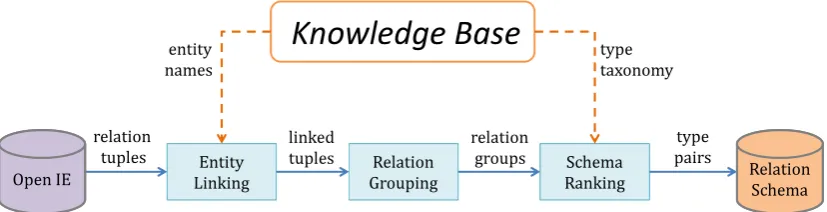
The workflow of our system is shown in Figure Figure 1. The system takes Open IE relation tu-ples as the input, then performs entity linking, re-lation grouping and schema ranking to translate them into final ranked list of schemas.
(1) Entity Linking: Relation arguments are linked to entities in the knowledge base by fuzzy string matching. Each entity in the knowledge base has a unique identifier.
(2) Relation Grouping: Linked tuples shar-ing similar relation patterns are grouped together. Besides, each group has a representative relation pattern, which is generated from all the patterns within the group.
(3) Schema Ranking: For each linked tuple in one relation group, argument entities are trans-formed into types drawn from the knowledge base. Then this procedure ranks type pairs (schemas) in terms of how much Open IE tuples a type pair can cover and how specific a type concept is.
3.1 Entity Linking
In the entity linking step, by matching arguments to entities in the knowledge base, each relation tuple is transformed into linked tuples, ltup =
he1, rel, e2i, with linking scores.
We aim to support fuzzy matching between ar-guments and entity aliases, so we take all the aliases into consideration, and build an inverted in-dex from words to aliases. Different words in one alias cannot be treated equally. Intuitively, a word is more important if it occurs in fewer aliases (n), and vice versa. Based on the inverted index, we use inverted document frequency score to approx-imately model the weight of a wordw:
idf(w) = 1/log(|{n:w∈n}|) (1) Besides, stop words are removed from aliases, treating their idf scores as 0. In order to measure the probability of fuzzy matching from an argu-ment (a) to an alias (n), we introduce the weighted overlap score:
overlap(a, n) = P
w∈Pa∩nidf(w)
w∈a∪nidf(w)
(2)
We merge all the aliases of an entity together to producing a similarity score of fuzzy matching between an entity and an argument:
sim(e, a) = max
[image:3.595.93.507.63.169.2]<ŶŽǁůĞĚŐĞĂƐĞ
Figure 1: System Architecture
In order to control the quality of candidate en-tities, for an argument havingmwords (with stop words removed), we only keep entities that have at least one alias matchingm−1words in the ar-gument, and have a similarity score larger than a threshold, τ. With similarity score computed, we generate 10 best entity candidates respectively for both the subject and the object ofrel.
Next, we model the joint similarity score (F) of the relation tuple ha1, rel, a2iwith each entity pair combination he1, e2i in two ways. One is a naive method which only considers the similarity between arguments and corresponding entities:
F(a1, e1,a2, e2, rel) =
sim(e1, a1)×sim(e2, a2). (4)
The other method takes predicate paths between e1 and e2 into consideration. Let ~w be the word vector of rel, and ~p be a path of predicates con-nectinge1 ande2 in at most 2 hops. Here we say two entities e1 and e2 are connected in 1 hop, if there exists a predicate p, such that p(e1, e2) (or p(e2, e1)) is in the knowledge base.
Similarly, e1 and e2 are connected in 2 hops, if there exists two predicates p1, p2 and a transi-tion entity e′, such that p1(e1, e′) (or p1(e′, e1)) andp2(e′, e2)(orp2(e2, e′)) are in the knowledge base.
We hence define the relatedness between~pand ~win the form of a conditional probability accord-ing to the Naive Bayes model:
P(~p|~w)≈Y
pP(p|~w)
∝Y
pP(p)
Y
wP(w|p),
(5)
and we follow the IBM alignment Model 1 (Yao and Van Durme, 2014) to calculate the conditional probability between predicates and relation words P(~p|~w). Based on the information above, we de-fine a richer joint similarity score, considering all
valid paths betweene1 ande2:
F(a1, e1, a2,e2, rel) =sim(e1, a1)× sim(e2, a2)×
X
~pP(~p|~w).
(6)
Due to the multiplications, the value ofP(~p|~w) varies a lot among different entity pair candidates. The large deviation makes P(~p|~w) the most im-portant term in Eq. (6), especially in the case when none of predicate paths are similar enough to the relation words. Therefore, we trust the factor of P(~p|~w)only when there exists a similar predicate path. In practice, we use a threshold ρto control whether to use Eq. (6) or Eq. (4). We call this an ensemble method. For each case of entity link-ing, if there exists one candidate entity pair satis-fyingP(~p|~w)> ρ, we use the ensemble method, otherwise we fall back to the naive method for the current case.
3.2 Relation Grouping
In the step of relation grouping, linked tuples with similar relation patterns form a group. Each linked tuple belongs to one unique group.
The idea is to simplify relation patterns by syn-tactic transformations. If two patterns share the same simplified pattern, we treat them as being equivalent and put them into one group. First, since adjectives, adverbs and modal verbs can hardly change the type distribution of arguments in a relation, we remove these words from a pat-tern. Second, many relations from Open IE con-tain verbs, which come in different tenses. We transform all tenses into present tense. In addi-tion, passive voice in a pattern, if any, is kept in the transformed pattern. A simple example below shows a group of relations:
hX, resign from, Yi
hX, had resigned from, Yi
All linked tuples with the same simplified pat-tern form a group. This pattern is selected as the representative pattern, like the pattern “resign from” in the above example.
3.3 Schema Ranking
Given a relation group, the step of schema rank-ing produces a ranked list of relation schemas with two constraints. Take “play in” as an example, the ideal schemas will contain the pairhactor, filmi andhathlete, sports leaguei
Each linked tuple he1, rel, e2i supports the type pairht1, t2iwhere(e1, t1), (e2, t2)∈IsAin the knowledge base. We treat these pairs equally, since it’s not trivial to tell which type is more re-lated to the argument given the relation tuple as context. Combining all tuples in one group, we de-fine the support of a type pairtpin a group (using the representative patternrto stand for the group):
supr(ht1, t2i) =
{(e1, t1)∈IsA, (e2, t2)∈IsA} (7)
A simple intuition is to rank schemas by the size of the support. Since one entity belongs to mul-tiple types, relation schemas with general types will be ranked higher. However, two different schemas may share the same support. For in-stance, given the relation “X die in Y”, suppose Open IE extractions and entity linking step returns correct results, the schema hperson, locationi and hdeceased person, locationi have identical supports. The latter one shows a more concrete representation of the relation, because deceased person covers small entities than person in the knowledge base.
Therefore, the schemas cannot be ranked by us-ing the support alone. Next, we aim to extract the subsumption relations between types in the knowl-edge base, building the taxonomy of types.
We first define all entities intas
cover(t) ={e|(e, t)∈IsA}. (8)
Intuitively, type t1 is subsumed int2, if all enti-ties in t1 also belong to t2, that is, cover(t1) ⊆ cover(t2). This uses the idea of strict set inclu-sion. For example, we can learn that the type per-son subsumes types such as actor, politician and deceased person.
However, strict set inclusion doesn’t always hold in the knowledge base. For example, enti-ties in type award winner are mostly person, but
there still has some organizations in it. The strict method fails to find the subsumption relation be-tween award winner and person, while this sub-sumption actually holds with a large confidence.
To resolve this problem, we use a relaxed set inclusion, where the setcover(t1)can be a subset of another set cover(t2) to a certain degree. We define the degree of the subsumption as the ratio between the number of entities in the two sets:
deg(t1 ⊆t2) = |cover|(covert1)∩(covert (t2)| 1)| . (9)
If deg(t1 ⊆ t2) > ǫ, then t1 is subsumed by t2, andǫis a confidence parameter determined by weight tuning. By scanning all types in the knowl-edge base, all subsumption relations with enough confidence are extracted, forming our type taxon-omy.
With a type hierarchy computed by above re-laxed set inclusion, we can define a schema
ht1, t2isubsumes another schemaht3, t4iif i)t1 subsumes t3 and t2 subsumes t4; ii)t1 subsumes t3andt2=t4; or iii)t2subsumest4andt1=t3.
If a schema (type pair) tp1 subsumes another schema tp2, and their supports (|supr(tp)|) are approximately equal, we give the more specific schematp2 a higher rank in the output list. Here two supports are roughly equal if:
|supr(tp1)| − |supr(tp2)|
max(|supr(tp1)|, |supr(tp2)|) < λ (10)
Where λis a threshold determined in the experi-ments.
4 Evaluation
Freebase (Bollacker et al., 2008) is a collabora-tively generated knowledge base, which contains more than 40 million entities, and more than 1,700 real types1. In our experiment, We use the 16 Feb. 2014 dump of Freebase as the knowledge base.
ReVerb (Fader et al., 2011) is an Open IE sys-tem which aims to extract verb based relation in-stances from web corpora. The release ReVerb dataset contains more than 14 millions of relation tuples with high quality. We observed that in Re-Verb, some argument is unlikely to be an entity in Freebase, for example:
hMetro Manila, consists of, 12 citiesi,
1Freebase types are identified by type id, for example,
where the object argument is not an entity but a type. Since types are usually represented by low-ercase common words, we remove the tuple if one argument is lowercase, or if it is made up com-pletely of common words in WordNet. In addition, because date/time such as “Jan. 16th, 1981” often occurs in the object argument while Freebase does not have any such specific dates as entities, we use SUTime (Chang and Manning, 2012) to recognize dates as an virtual entity. After cleaning, the sys-tem collects 3,234,208 tuples and 171,168 relation groups.
The following parameters are tuned using a de-velopment set: τ = 0.667, ǫ= 0.6, λ= 5%and ρ =e−50. For relation grouping, we use Stanford Parser (Klein and Manning, 2003) to perform POS tagging, lemmatizing and parsing on relations.
[image:5.595.316.512.329.442.2]We first evaluate the results of entity linking. We randomly pick 200 relation instances from Re-Verb, and manually labeled arguments with Free-base entities. For both naive and ensemble strat-egy, we evaluate the precision, recall, F1 and MRR score on the labeled set. An output entity pair is correct, if and only if both arguments are correctly linked. Experimental results are listed in Table 1.
Table 1: Entity Linking Result Strategy P R F1 MRR
Naive 0.371 0.327 0.348 0.377 Ensemble 0.386 0.340 0.361 0.381
For the evaluation of relation schema, we first randomly pick 50 binary relations with support larger than 500 from the system. For each relation, we selected top 100 type pairs with the largest sup-port, as what we evaluated. We assigned 3 human annotators to label the fitness score of type pair for the relation. The labeled score ranges from 0 to 3. Then we merge these 3 label sets, forming 50 gold standard rankings. When evaluating a rela-tion schema list from our system, we calculate the MRR score (Liu, 2009) by the top schemas in the gold rankings.
For comparison, we use Pointwise Mutual In-formation (Church and Hanks, 1990) as our base-line model, which is used in other selectional pref-erence tasks (Resnik, 1996). We define the associ-ation score between relassoci-ation and type pair as:
P MI(r, tp) =p(r, tp) logp(r,p∗(r, tp)p(∗), tp) (11)
Where p(r, tp) is the joint probability of relation
and type pair in the whole linked tuple set, and∗ stands for any relations or type pairs.
Table 2 shows the MRR scores by using both baseline model (PMI) and our approach. As the re-sult shows, our approach improves the MRR score by 10.1%.
Table 2: End-to-end Schema Inference Results Approach MRR Score
PMI Baseline 0.306 Our Approach 0.337
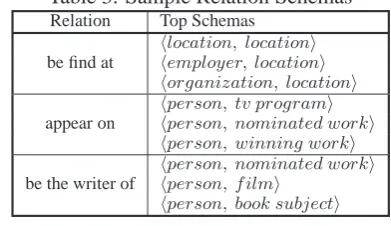
Finally, Table 3 shows some example binary re-lations, and their schemas inferred by our system. We can see that with a well-defined type hierarchy, our system is able to extract both coarse-grained and fine-grained type information from entities, resulting in a informative type lists.
Table 3: Sample Relation Schemas Relation Top Schemas
hlocation, locationi
be find at hemployer, locationi
horganization, locationi hperson, tv programi
appear on hperson, nominated worki
hperson, winning worki hperson, nominated worki
be the writer of hperson, filmi
hperson, book subjecti
5 Conclusion
In summary, our work describes a data driven ap-proach of relation schema inference. By max-imizing the support of both arguments simulta-neously, our system is able to generate human-readable type pairs for a binary relation from Open IE systems. Our experiments shows that the top ranked relation schemas for each relation are ac-curate according to human judges. The proposed framework can be integrated with future Open IE systems.
Acknowledgement
Kenny Q. Zhu is the contact author and was sup-ported by NSFC grant 61373031 and NSFC-NRF Joint Research Program No. 61411140247.
References
[image:5.595.92.272.420.467.2]human knowledge. In ACM SIGMOD, pages 1247– 1250. ACM.
Zhiyuan Cai, Kaiqi Zhao, Kenny Q. Zhu, and Haixun Wang. 2013. Wikification via link co-occurrence. In ACM CIKM’13, pages 1087–1096.
Andrew Carlson, Justin Betteridge, Bryan Kisiel, Burr Settles, Estevam R Hruschka Jr, and Tom M Mitchell. 2010. Toward an architecture for
never-ending language learning. In AAAI, volume 5,
page 3.
Angel X Chang and Christopher D Manning. 2012. Sutime: A library for recognizing and normalizing time expressions. In LREC, pages 3735–3740.
Kenneth Ward Church and Patrick Hanks. 1990. Word association norms, mutual information, and lexicog-raphy. Computational linguistics, 16(1):22–29.
Katrin Erk. 2007. A simple, similarity-based
model for selectional preferences. In
AN-NUAL MEETING-ASSOCIATION FOR COMPU-TATIONAL LINGUISTICS, page 216.
Anthony Fader, Stephen Soderland, and Oren Etzioni. 2011. Identifying relations for open information ex-traction. In EMNLP, pages 1535–1545.
Johannes Hoffart, Mohamed Amir Yosef, Ilaria Bor-dino, Hagen F¨urstenau, Manfred Pinkal, Marc Span-iol, Bilyana Taneva, Stefan Thater, and Gerhard Weikum. 2011. Robust disambiguation of named entities in text. In Proceedings of EMNLP, pages 782–792.
Dan Klein and Christopher D Manning. 2003. Accu-rate unlexicalized parsing. In ACL, pages 423–430.
Thomas Lin, Oren Etzioni, et al. 2012. Entity link-ing at web scale. In Proceedlink-ings of the Joint
Work-shop on Automatic Knowledge Base Construction and Web-scale Knowledge Extraction, pages 84–88.
Tie-Yan Liu. 2009. Learning to rank for information retrieval. Foundations and Trends in Information
Retrieval, 3(3):225–331.
George A Miller. 1995. Wordnet: a lexical
database for english. Communications of the ACM, 38(11):39–41.
Ndapandula Nakashole, Gerhard Weikum, and Fabian Suchanek. 2012. Patty: a taxonomy of relational
patterns with semantic types. In EMNLP, pages
1135–1145.
Delip Rao, Paul McNamee, and Mark Dredze. 2013. Entity linking: Finding extracted entities in a knowl-edge base. In Multi-source, multilingual
informa-tion extracinforma-tion and summarizainforma-tion, pages 93–115.
Springer.
Lev Ratinov, Dan Roth, Doug Downey, and Mike
An-derson. 2011. Local and global algorithms for
disambiguation to wikipedia. In Proceedings of
ACL:HLT, pages 1375–1384.
Philip Resnik. 1996. Selectional constraints: An
information-theoretic model and its computational realization. Cognition, 61(1):127–159.
Alan Ritter, Oren Etzioni, et al. 2010. A latent dirich-let allocation method for selectional preferences. In
ACL, pages 424–434.
Michael Schmitz, Robert Bart, Stephen Soderland, Oren Etzioni, et al. 2012. Open language learning for information extraction. In EMNLP, pages 523– 534.
Fabian M. Suchanek, Gjergji Kasneci, and Gerhard Weikum. 2007. Yago: A Core of Semantic Knowl-edge. In 16th international World Wide Web
con-ference (WWW 2007), New York, NY, USA. ACM
Press.
Wentao Wu, Hongsong Li, Haixun Wang, and
Kenny Q. Zhu. 2012. Probase: a probabilistic tax-onomy for text understanding. In SIGMOD
Confer-ence, pages 481–492.