1421
Biomedical Event Extraction Based on Knowledge-driven Tree-LSTM
Diya Li†, Lifu Huang†, Heng Ji†, Jiawei Han∗
†Computer Science Department, Rensselaer Polytechnic Institute
{lid18,huangl7,jih}@rpi.edu
∗Computer Science Department, University of Illinois at Urbana Champaign
Abstract
Event extraction for the biomedical domain is more challenging than that in the general news domain since it requires broader ac-quisition of domain-specific knowledge and deeper understanding of complex contexts. To better encode contextual information and external background knowledge, we propose a novel knowledge base (KB)-driven tree-structured long short-term memory networks (Tree-LSTM) framework, incorporating two new types of features: (1) dependency struc-tures to capture wide contexts; (2) entity prop-erties (types and category descriptions) from external ontologies via entity linking. We eval-uate our approach on the BioNLP shared task with Genia dataset and achieve a new state-of-the-art result. In addition, both quantita-tive and qualitaquantita-tive studies demonstrate the ad-vancement of the Tree-LSTM and the exter-nal knowledge representation for biomedical event extraction.
1 Introduction
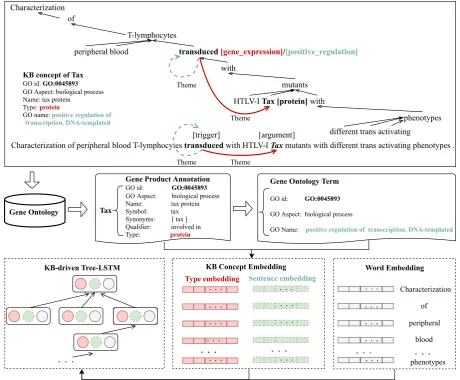
Biomedical information extraction is widely used to assist the biology community on knowledge ac-quisition and ontology construction. Biomedical events generally refer to a change of status, par-ticularly on proteins or genes. The goal of event extraction is to identify triggers and their argu-ments from biomedical text, and then assign an event type to each trigger and a role to each ar-gument. For example, in the sentence shown in Figure1, it includes agene expressionand a pos-itive regulationevent mention, both triggered by the wordtransduced. Taxis theThemeargument of the gene expression event. An event could also serve as an argument of another event, lead-ing to a nested structure. For instance, the gene expressionevent triggered bytransducedis also a Themeargument of thepositive regulationevent as shown in Figure1.
Earlier studies on biomedical event extrac-tion rely on kernel classificaextrac-tion methods like the support vector machines (SVMs) (Bj¨orne and Salakoski, 2011; Venugopal et al., 2014) using hand-crafted features, which require high engi-neering effort and domain-specific knowledge. Recent distributional representation based ap-proaches (Rao et al.,2017;Bj¨orne and Salakoski, 2018) explore deep neural networks which only require distributed semantic features. However, different from event extraction in the general news domain, biomedical event extraction requires broad acquisition of domain-specific knowledge and deep understanding of complex contexts. For example, in Genia event extracton of BioNLP shared task 2011 (Kim et al., 2011), about 80% of entity mentions are abbreviations of genes, pro-teins and diseases while more than 36% of event triggers and arguments are separated with more than 10 words.
sepa-Characterization of peripheral blood T-lymphocytes transduced with HTLV-I Tax mutants with different trans activating phenotypes . Characterization
of
T-lymphocytes
transduced [gene_expression]/[positive_regulation]
with
mutants
with
phenotypes peripheral blood
HTLV-I Tax [protein]
different trans activating Theme
Theme Theme
Theme
Tax
Gene Ontology Term
GO id: GO:0045893
GO Aspect: biological process
GO Name: positive regulation of transcription, DNA-templated
Gene Product Annotation GO id: GO:0045893
GO Aspect: biological process Name: tax protein Symbol: tax Synonyms: [ tax ] Qualifier: involved in Type: protein
Gene Ontology
KB concept of Tax GO id: GO:0045893
GO Aspect: biological process Name: tax protein Type: protein
GO name:positive regulation of transcription, DNA-templated
Sentence embedding
Type embedding
KB Concept Embedding
. . .
. . .. . .
. . . . . .
. . .
. . .
. . .
[image:2.595.68.529.62.442.2]KB-driven Tree-LSTM
[trigger] [argument]
Word Embedding
. . .
. . .
. . .
. . .
. . .
. . .
Characterization
of
peripheral
blood
phenotypes
. . .
. . . . . . . . .
. . . .
Figure 1: The framework of the KB-driven Tree-LSTM model. The upper frame shows the dependency tree structure and event annotations of a sentence; the middle frame demonstrates the knowledge base information obtained from the Gene Ontology forTax; the bottom frame describes the KB-driven Tree-LSTM which takes the KB concept embedding and word embedding as input.
rated with 16 words which is difficult for a chain-structured LSTM to capture their long distance de-pendency, while within dependency tree structure, their distance is significantly shortened to 7.
Moreover, to better capture domain-specific knowledge, we further propose to leverage the ex-ternal knowledge bases (KBs) to acquire proper-ties of all the biomedical entiproper-ties. The KB prop-erties are extremely beneficial for our model to learn patterns more explicitly. Take the entityTax in Figure1 as an example, it’s a protein often in-volved in the biological process ofpositive regu-lation of transcriptionreferred to Gene Ontology (Ashburner et al., 2000). This function descrip-tion provides crucial clues to determine the type oftransduced aspositive regulation. Therefore, to capture such knowledge from external KBs, for
each entity, we first learn a KB concept embedding from its properties, and then automatically incor-porate the KB representation into its Tree-LSTM hidden state with a gate function.
Our contributions are twofold: First, to the best of our knowledge, it’s the first time to adopt Tree-LSTM for biomedical event extraction to effec-tively capture the wide contexts. Second, we fur-ther incorporate external knowledge from domain-specific KBs into the Tree-LSTM, which yields state-of-the-art performance on Genia event ex-traction shared task.
2 KB-driven Tree-LSTM for Event Extraction
gj
μ˜j
hj
hj−1
hj−2 cj−2
cj−1
cj
c˜j
xj
μ˜j−1
μ˜j−2
KB concept of xj−1 hj
hj−1
hj−2 cj−2
cj−1
cj
c˜j
xj
fj−2
fj−1
ij oj
fj−2
fj−1
ij oj
KB concept of xj−2
KB concept of xj
A. a Tree-LSTM unit B. a KB-driven Tree-LSTM unit
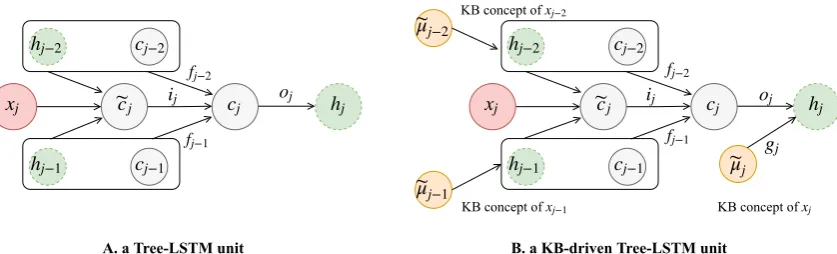
Figure 2: (A): a Tree-LSTM unit. (B): a KB-driven Tree-LSTM unit. The yellow circles withµenotations denote external KB concept embeddings.
We first introduce the Tree-LSTM framework, and then describe the construction of KB concept em-bedding for each entity. Finally we incorporate the KB concept embedding into a Tree-LSTM and ap-ply it for event trigger and argument extraction.
2.1 Tree-LSTM
The Tree-LSTM (Tai et al., 2015) is a variation of LSTM (Hochreiter and Schmidhuber, 1997) to a tree-structured network topology. It shows improvement in representing sentence semantic meaning compared to sequential LSTM such as Bidirectional LSTM (BiLSTM) (Graves et al., 2013). The main difference between sequential LSTM and Tree-LSTM is, at each time step, the former calculates its hidden state from the input at the current time step and the hidden state from pre-vious step, while Tree-LSTM computes its hidden state from the input token and the hidden states of all its children nodes from the tree structure. A Tree-LSTM reduces to sequential LSTM when each node in the tree only has one child. Figure2 (A) shows a Tree-LSTM unit. In order to obtain the hidden statehj of an input tokenxj, the unit calculates all of its children hidden states (hj−1,
hj−2) through depth-first traversal.
2.2 Constructing KB Concept Embedding
For the biomedical event extraction, we mainly ex-plore the Gene Ontology as our external KB since it provides detailed descriptions for each gene and gene product attributes across all species. It csists of two types of information: (1) the gene on-tology (GO) defines all the gene functions, rela-tions between these gene funcrela-tions, and aspects used to describe the gene functions, including molecular function, cellular component and bio-logical process. (2) the gene product annotations
(GO Anno) provide all entity related attributes, such as the full entity name, entity type, as well as the gene functions it is related to. For example, in Figure1, given the entitytax, from the gene prod-uct annotations, we can get its full entity name as tax proteinwhich is a type ofproteinsand it’s re-lated to a function aboutbiological process. From the gene ontology, we can further determine the specific function thattaxis related topositive reg-ulation of transcriptionin terms ofbiological pro-cessaspect.
In order to leverage the external KB informa-tion, we first apply QuickGO API (Binns et al., 2009) to link each entity mention to the Gene On-tology and retrieve all the KB annotations. For each entity, we carefully select two types of prop-erties which are beneficial for event extraction task: the entity type (e.g.,proteinfortax) and the gene ontology function it is related to (e.g., posi-tive regulation of transcriptionfortax). The entity type can facilitate the explicit pattern learning for argument role labeling, for example, the gene ex-pression event pattern (Theme: Protein, Trigger: transduced) is more popular than (Theme: Tax, Trigger: transduced) in Figure 1. The gene on-tology function can provide implicit clues to de-termine the trigger type as aforementioned in Sec-tion1.
[image:3.595.82.501.67.194.2]2.3 Event Trigger Extraction
After obtaining the KB concept embeddings, we further incorporate them into the Tree-LSTM to leverage the domain-specific knowledge.
Given a sentence, for example the sentence shown in Figure 3, we first perform the de-pendency parsing with the Stanford dede-pendency parser (Chen and Manning) and obtain a depen-dency tree structure. For each node j in the tree structure,C(j)is the set of children nodes of node
jandµkis the KB concept embedding of nodek. We setµkto 0 if nodekis not a biomedical entity.
e
µjdenotes the sum of the KB concept embeddings ofj’s children nodes andehj is the sum of the
hid-den states ofj’s children nodes:
e
hj =
X
k∈C(j)
hk
e
µj =
X
k∈C(j)
µk
wherehkis the hidden state of nodek.
Then we incorporate the KB concept embed-dings into the input, forget, and output gates of the Tree-LSTM:
ij =σ(Wi[xj,ehj,µej] +bi)
fjk =σ(Wf[xj, hk,eµk] +bf)
oj =σ(Wo[xj,ehj,µej] +bo)
where ij and oj are the input gate and the out-put gate for nodej respectively. fjk is the forget gate for nodej in terms of its child nodek. Wi,
Wf, andWo are learnable parameters, bi,bf and
boare bias terms. Thus, for each nodej, the input gate gathers all KB information from its children nodes, and the output gate balances the meaning-ful information from its local contexts and the KB concept embeddings of its children nodes.
Besides adding the KB concept embeddings into the three gates to select useful KB formation implicitly, similar to Ma et al. (2018), we also introduce a knowledge specific output gategj to explicitly incorporate knowledge information into each node’s hidden state. While different fromMa et al. (2018) which only considers the knowledge concept embedding of each node itself, we use the sum of the KB concept embeddings of the whole subtree instead:
gj =σ(Wg[xj,ehj, e
µj] +bg)
whereWg is a weight matrix to be learned, bg is the bias term.
As demonstrated in Figure2(B), we eventually combine the implicit way of incorporating KB in-formation into the input, output and forget gates and an explicit way of directly incorporating the KB information into a node’s hidden state:
e
cj = tanh(Wc[xj,ehj] +bc)
cj =
X
k∈C(j)
fjk ck+ij ecj
hj =ojtanh(cj) +gjtanh(Wµeµj)
where cj is the memory cell, Wc and Wµ are weight matrices to be learned.
After getting the hidden state hj of each node
j, we use a softmax classifier to predict a label for each node, and optimize the parameters by mini-mizing a negative log-likelihood loss.
2.4 Event Argument Role Labeling
After detecting all candidate triggers, we further extract arguments for each trigger. The Genia event extraction shared task provides the annota-tions of all entity menannota-tions. Thus, for each trig-ger, we use all the entity mentions that occur in the same sentence as its candidate arguments, and then assign an argument role orNone. Different from trigger extraction, we use the shortest de-pendency path (SDP) within the dede-pendency tree structure instead of the surface contexts to better capture the dependency between the trigger and each argument.
Taking the sentence in Figure3as an example, given a triggertranscriptionand a candidate argu-ment OBF-1, we first perform dependency pars-ing and extract the shortest dependency path be-tweentranscriptionandOBF-1with the Dijkstra’s algorithm (Johnson,1973) and obtain the shortest dependency pathtranscription→of →genes→ OBF-1. We use the same KB-driven Tree-LSTM architecture as introduced in Section2.3to encode each node into a new hidden state representation. We use the hidden state of the root nodeh0as the overall vector representation of the whole depen-dency path. Finally, we feed the concatenation of
... transcription [transcription] of their respective genes ( Oct-2 , OBF-1 [protein] , PU.1 ) ... ... transcription of their respective genes ( Oct-2 , OBF-1 [protein], PU.1 ) ...
transcription of
genes
OBF-1 , their respective Oct-2 PU.1
) ,
( Dependency Tree
transcription [transcription]
of
genes
OBF-1 [protein] Shortest Dependency Path
KB concept of OBF-1
Type: protein
GO name: alanine transmembrane transporter activity
KB concept of OBF-1
Type: protein
GO name: alanine transmembrane transporter activity
. . .
KB-driven Tree-LSTM
KB type embedding
word embedding KB sentence embedding
Task 1. Trigger Labeling
Task 2. Argument Role Labeling
Task 1 input
Task 1 output
Task 2 input
Task 2 output Theme
[image:5.595.81.528.68.322.2]... transcription [transcription] of their respective genes ( Oct-2 , OBF-1 [protein] , PU.1 ) ...
Figure 3: Examples of trigger labeling and argument role labeling via a KB-driven Tree-LSTM.
Event Type Core Arguments Gene expression Theme(P) Transcription Theme(P) Protein catabolism Theme(P) Phosphorylation Theme(P) Localization Theme(P)
Binding Theme(P)+
Regulation Theme(P/E), Cause(P/E) Positive regulation Theme(P/E), Cause(P/E) Negative regulation Theme(P/E), Cause(P/E)
Genia corpus 2011 statistics
events 14496
sentences 11581
nested events 37.2% intersentence events 6.0% abbrev. of entities 15912
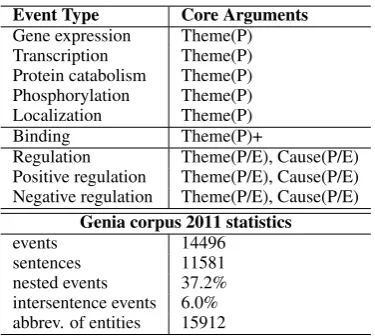
Table 1: Predefined event types with accepted argu-ment roles in Genia event extraction task, and data statistics of Genia event extraction 2011 dataset. P: protein; E: event.
3 Experiment
3.1 Task Description
The Genia Event Extraction task is the main task in the BioNLP Shared Task series (Kim et al., 2009, 2011; N´edellec et al., 2013). The Genia task defines 9 fine-grained event types as shown in Table1. Note that aBinding event may take more than one protein as itsThemearguments. A Regulationevent may take one protein or event as itsTheme argument and also optionally take one
protein or event as itsCauseargument. A Regu-lation event taking an event as its argument will lead to a nested structure. 37.2% nested events are observed in Genia 2011 corpus (Bj¨orne and Salakoski, 2011). There are 6.0% inter-sentence events while our model only focuses on sentence-level event extraction.
3.2 Experimental Setup
We apply our KB-driven Tree-LSTM model on Genia 2011 data set. The entities in Genia data set are manually annotated and given as part of the input.
We evaluate our results on the test set using the official online tool provided by the Genia task organizers.1 Following previous studies (Bj¨orne and Salakoski,2011;Venugopal et al.,2014;Rao et al.,2017;Bj¨orne and Salakoski, 2018), we re-port scores obtained by the approximate span (al-lowing trigger spans to differ from gold spans by single words). As we only focus on matching core arguments, we use recursive matching criterion for evaluation which not requires matching of addi-tional arguments for events referred from other events (Kim et al.,2011).
We use the word embedding pretrained on PubMed and PMC texts (Moen and Ananiadou,
[image:5.595.88.276.367.535.2]2013) for word and type embeddings. The hyper-parameters are tuned on the development set and listed in Table2. Word representations are updated during training with an initial learning rate of 0.1.
Parameter Value
Word embedding size 200
Type embedding size 200
Sentence embedding size 4096 Tree-LSTM hidden size 100
Batch size 25
Epoch size 30
Dropout rate 0.5
Learning rate 0.05
Initial embedding learning rate 0.1
[image:6.595.306.530.62.279.2]Optimizer AdaGrad
Table 2: Hyper-parameters.
3.3 Results and Error Analysis
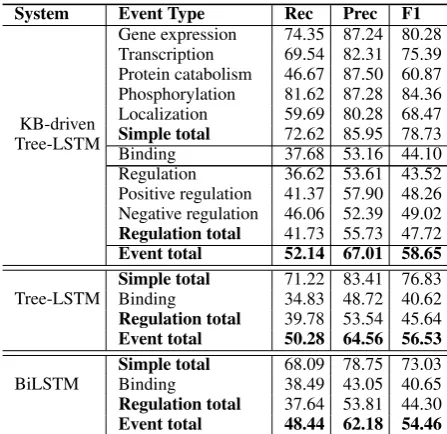
Table3shows the final event extraction results of applying our KB-driven Tree-LSTM model on Ge-nia 2011 dataset with the comparison of only using LSTM and a standard BiLSTM model. Tree-LSTM outperforms the BiTree-LSTM baseline which indicates the power of Tree-LSTM in dealing with long-distance dependency structure in biomedical literature. By incorporating external KB informa-tion, our approach achieves about 2.12% F-score gain comparing to Tree-LSTM, which demon-strates the effectiveness of the KB properties for biomedical event extraction. We will show de-tailed analysis in Section3.4.
Table 4 presents the previous event extrac-tion results from the BioNLP shared task using the same corpus. Our approach outperforms all
previous methods. Among them, the systems
TEES (Bj¨orne and Salakoski, 2011), EventMine-CR (Miwa et al., 2012) and Stacked Generaliza-tion (Majumder et al.,2016) are based on SVMs with well designed features. FAUST (Riedel and McCallum,2011) and BioMLN (Venugopal et al., 2014) use jointed inference models. Bj¨orne and Salakoski (2018) adopts a convolutional neural networks (CNNs) with abundant features derived from TEES system. In our work, instead of using high-dimensional features with manual effort as in these previous models, our approach only requires pretrained distributed word representations as in-put features.
We notice that our approach achieves high scores onSimpleevent types but get relatively low scores on Binding event and Regulation event types. We analyze the results and find that
Bind-System Event Type Rec Prec F1
KB-driven Tree-LSTM
Gene expression 74.35 87.24 80.28 Transcription 69.54 82.31 75.39 Protein catabolism 46.67 87.50 60.87 Phosphorylation 81.62 87.28 84.36 Localization 59.69 80.28 68.47 Simple total 72.62 85.95 78.73
Binding 37.68 53.16 44.10
Regulation 36.62 53.61 43.52 Positive regulation 41.37 57.90 48.26 Negative regulation 46.06 52.39 49.02 Regulation total 41.73 55.73 47.72 Event total 52.14 67.01 58.65
Tree-LSTM
Simple total 71.22 83.41 76.83
Binding 34.83 48.72 40.62
Regulation total 39.78 53.54 45.64 Event total 50.28 64.56 56.53
BiLSTM
Simple total 68.09 78.75 73.03
Binding 38.49 43.05 40.65
[image:6.595.99.266.127.243.2]Regulation total 37.64 53.81 44.30 Event total 48.44 62.18 54.46
Table 3: Precision (Prec), recall (Rec) and F-score (F1) results achieved by the KB-driven Tree-LSTM model on the test set of BioNLP Genia 2011, evaluated on approximate span and recursive criteria.
System Rec Prec F1
TEES(Bj¨orne and Salakoski,2011) 49.56 57.65 53.30 FAUST(Riedel and McCallum,
2011)
49.41 64.75 56.04
EventMine-CR(Miwa et al.,2012) 53.35 63.48 57.98 BioMLN(Venugopal et al.,2014) 53.42 63.61 58.07 Stacked Generalization(Majumder
et al.,2016)
48.96 66.46 56.38
CNN(Bj¨orne and Salakoski,2018) 49.94 69.45 58.07
Table 4: State-of-the-art system results evaluated on BioNLP Genia 2011 test dataset with approximate span and recursive criteria.
ing event extraction is more challenging since it usually has multiple arguments. For example, Fig-ure4shows two sentences which are chosen from the output of the development data set. There are twoBindingevent mentions in the first sentence: E1 (Trigger: interacting, Type: Binding, Theme: RUNX1, Theme2: p3000) and E2 (Trigger: bind-ing, Type: Bindbind-ing, Theme: CREB). Our model mistakenly extractsCREBas aThemeof E1 since CREBis highly related to protein p300 in the de-pendency tree structure.
[image:6.595.309.529.358.451.2]... the EBNA-1 gene in infected thymocytes was transcribedfrom the Fp promoter, rather than from the Cp / Wp promoter ...
[protein] E1:[transcription] E2:[positive_regulation] E3:[positive_regulation] E1:Theme E3:Theme
RUNX1 alone, or together with its interacting partners p300 and CREBbinding protein, ...
[protein] E1:[binding] [protein] [protein]E2:[binding] E1:Theme1 E1:Theme2 E2:Theme
E2:Theme
Figure 4: Case study on binding event and regulation event types.
Gene_expression
Transcription
Protein_catabolism
Phosphorylation
Localization
Binding
Regulation
Positive_regulation
Negative_regulatio
None
Without_KB
With_KB
... transcription [transcription] of their respective genes ( Oct2 [protein] , OBF1 [protein], PU.1[protein] ) ...
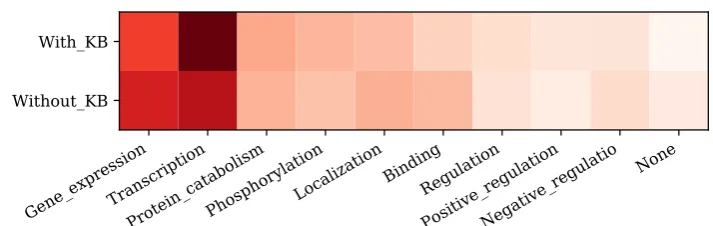
Figure 5: Visualization of the effect of KB concept embeddings on trigger labeling for the wordtranscription.
ing data set according to their frequency, and find that most of spurious errors forRegulation event trigger extraction occur when the trigger words are prepositions or conjunctions. For instance, in Figure4, the second sentence contains two posi-tiveRegulationevents triggered by a preposition fromand a conjunctionrather than. Such function words are rarely annotated as triggers and our KB-aware Tree-LSTM cannot well collect meaningful contexts from their subtrees.
3.4 Effect of KB concepts
As shown in Table3, we achieve about 3.5% and 2.1% F1 score gain on Binding and Regulation event types by leveraging external KB information into the Tree-LSTM. In order to show the effect of KB concept embeddings, we visualize the prob-abilities of wordtranscriptionto be predicted for each event type. As Figure5shows, by adding KB concept embeddings, the function description pos-itive regulation of transcription, DNA-templated provided by the biomedical entityOBF-1 signif-icantly enhances the probability of transcription being predicted to aTranscriptionevent type.
Similarly, Figure 6 visualizes the probabili-ties of the E1 event mention (Trigger:
trans-transduced [gene_expression]/[positive_regulation]
with
mutants
Tax [protein]
E1: (Type:gene expression, Theme: Tax, Trigger: transduced)
E2: (Type:positive regulation, Theme: E1, Trigger: transduced)
E2:(Theme: None)
E2:(Theme: E1)
Theme Theme
Figure 6: Visualization of the effect of KB concept em-bedding on argument role labeling for a Positive Reg-ulation event triggered bytransducedand a Gene Ex-pression event E1 (Theme: Tax, Trigger: transduced).
the information from the function description pos-itive regulation of transcription, DNA-templated for Tax, our approach successfully promotes the probability of E1 being predicted as theThemeof E2.
4 Related Work
As a crucial task in information extraction, event extraction has gained a lot of interest. In gen-eral news domain, previous work on event extrac-tion can be divided into two main categories. The first is feature-based methods which mainly fo-cus on feature design, leveraging local features (Grishman et al., 2005; Ahn, 2006) and global features (Ji and Grishman, 2008; Liao and Gr-ishman, 2011; Huang and Riloff, 2012) to im-prove the performance. Some studies proposed joint models to overcome the error propagation problem (Poon and Vanderwende, 2010; Riedel et al., 2009; Li et al., 2013; Venugopal et al., 2014; Li et al., 2014). The second category in-cludes distributional representation based meth-ods which have been applied into event extrac-tion extensively. Most of these approaches are based on the standard Convolutional Neural Net-works (CNNs) (Chen et al., 2015; Nguyen and Grishman, 2015, 2016), Recurrent Neural Net-works (RNNs) (Nguyen et al., 2016), generative adversarial networks (Hong et al.,2018), zero-shot learning (Huang et al.,2017) and advanced atten-tion mechanisms (Liu et al., 2018b; Chen et al., 2018).
Our work is also related to the studies which leverage the external knowledge base for informa-tion extracinforma-tion. Liu et al.(2017) takes advantage of external resources, such as FrameNet, to label events while Chen et al. (2017) adopts distance supervision to augment the training data. Liu et al.(2018a) develops an attention-based model for event extraction. What’s more, shortest depen-dency path is broadly explored for information ex-traction, especially for relation classification (Xu et al., 2015;Miwa and Bansal, 2016) and shows promising benefits.
Biomedical event extraction task part of the BioNLP Shared Task series (Kim et al., 2009, 2011; N´edellec et al., 2013). Previous stud-ies mainly explore local and global features with SVM model (Miwa et al.,2010,2012;Bj¨orne and Salakoski, 2013;Majumder et al., 2016). Riedel and McCallum(2011) develop a joint model with
dual decomposition. Cohen et al. (2009), Kil-icoglu and Bergler (2011) and Bui et al. (2013) develop rule-based methods and achieve high pre-cision. Venugopal et al. (2014) leverage Markov logic networks for joint inference. Rao et al. (2017) uses the Abstract Meaning Representations (AMR) to extract events based on the assump-tion that an event structure can be derived from an AMR subgraph. Recently, some representation-based models (Jagannatha and Yu, 2016; Rao et al., 2017; Bj¨orne and Salakoski, 2018) have been proposed while most of them adopt the widely used CNNs and RNNs with features de-rived from the biomedical text. Lim et al.(2018) implements a binary Tree-LSTM architecture for biomedical relation extraction. Compared with these methods, our approach only requires pre-trained distributed word representations as input features and incorporates meaningful KB informa-tion into a Tree-LSTM.
5 Conclusions and Future Work
In this paper, we show the effectiveness of using a KB-driven tree-structured LSTM for event ex-traction in biomedical domain. The Tree-LSTM can efficiently capture semantically related con-cepts for each node within the tree structure. By leveraging the external KB concept properties in-cluding the entity type and the function descrip-tion, our approach is able to perform deep under-standing of domain-specific expressions and con-nections. Without using manually designed high-dimensional features, our approach significantly outperforms all previous methods. In the future, we plan to explore a broader range of properties from KB to facilitate biomedical information ex-traction tasks.
Acknowledgments
This work was supported by the U.S. NSF No. 1741634, Air Force No. FA8650-17-C-7715 and
ARL NS-CTA No. W911NF-09-2-0053. The
References
David Ahn. 2006. The stages of event extraction. In Proceedings of the Workshop on Annotating and Reasoning about Time and Events.
Michael Ashburner, Catherine A Ball, Judith A Blake, David Botstein, Heather Butler, J Michael Cherry, Allan P Davis, Kara Dolinski, Selina S Dwight, Janan T Eppig, et al. 2000. Gene ontology: tool for the unification of biology. Nature genetics, 25(1):25.
David Binns, Emily Dimmer, Rachael Huntley, Daniel Barrell, Claire O’donovan, and Rolf Apweiler. 2009. Quickgo: a web-based tool for gene ontology searching. Bioinformatics, 25(22):3045–3046.
Jari Bj¨orne and Tapio Salakoski. 2011. Generalizing biomedical event extraction. InProceedings of the BioNLP Shared Task 2011 Workshop.
Jari Bj¨orne and Tapio Salakoski. 2013. Tees 2.1: Au-tomated annotation scheme learning in the bionlp 2013 shared task. In Proceedings of the BioNLP Shared Task 2013 Workshop.
Jari Bj¨orne and Tapio Salakoski. 2018. Biomedi-cal event extraction using convolutional neural net-works and dependency parsing. In Proceedings of the BioNLP 2018 workshop.
Quoc-Chinh Bui, David Campos, Erik van Mulligen, and Jan Kors. 2013. A fast rule-based approach for biomedical event extraction. Inproceedings of the BioNLP shared task 2013 workshop.
Danqi Chen and Christopher Manning. A fast and ac-curate dependency parser using neural networks. In Proc. EMNLP2014.
Yubo Chen, Shulin Liu, Xiang Zhang, Kang Liu, and Jun Zhao. 2017. Automatically labeled data gen-eration for large scale event extraction. In Proc. ACL2017.
Yubo Chen, Liheng Xu, Kang Liu, Daojian Zeng, and Jun Zhao. 2015. Event extraction via dynamic multi-pooling convolutional neural networks. In Proc. ACL-IJCNLP2015.
Yubo Chen, Hang Yang, Kang Liu, Jun Zhao, and Yan-tao Jia. 2018. Collective event detection via a hier-archical and bias tagging networks with gated multi-level attention mechanisms. InProc. EMNLP2018.
K Bretonnel Cohen, Karin Verspoor, Helen L Johnson, Chris Roeder, Philip V Ogren, William A Baum-gartner Jr, Elizabeth White, Hannah Tipney, and Lawrence Hunter. 2009. High-precision biologi-cal event extraction with a concept recognizer. In Proceedings of the Workshop on Current Trends in Biomedical Natural Language Processing: Shared Task.
Alexis Conneau, Douwe Kiela, Holger Schwenk, Lo¨ıc Barrault, and Antoine Bordes. 2017. Super-vised learning of universal sentence representations from natural language inference data. In Proc. EMNLP2017.
Alex Graves, Navdeep Jaitly, and Abdel-rahman Mo-hamed. 2013. Hybrid speech recognition with deep bidirectional lstm. In2013 IEEE workshop on auto-matic speech recognition and understanding.
Ralph Grishman, David Westbrook, and Adam Meyers. 2005. NYU’s English ACE 2005 system descrip-tion. ACE, 5.
Sepp Hochreiter and J¨urgen Schmidhuber. 1997. Long short-term memory. Neural computation, pages 1735–1780.
Yu Hong, Wenxuan Zhou, jingli zhang jingli, Guodong Zhou, and Qiaoming Zhu. 2018. Self-regulation: Employing a generative adversarial network to im-prove event detection. InProc. ACL2018.
Lifu Huang, Heng Ji, Kyunghyun Cho, and Clare R Voss. 2017. Zero-shot transfer learning for event ex-traction. arXiv preprint arXiv:1707.01066.
Ruihong Huang and Ellen Riloff. 2012. Bootstrapped training of event extraction classifiers. In Proc. EACL2012.
Abhyuday N Jagannatha and Hong Yu. 2016. Bidirec-tional rnn for medical event detection in electronic health records. InProc. NAACL-HLT2016.
Heng Ji and Ralph Grishman. 2008. Refining event extraction through cross-document inference. Pro-ceedings of ACL-08: HLT.
Donald B Johnson. 1973. A note on dijkstra’s short-est path algorithm. Journal of the ACM (JACM), 20(3):385–388.
Halil Kilicoglu and Sabine Bergler. 2011. Adapting a general semantic interpretation approach to biologi-cal event extraction. InProceedings of the BioNLP Shared Task 2011 Workshop.
Jin-Dong Kim, Tomoko Ohta, Sampo Pyysalo, Yoshi-nobu Kano, and Jun’ichi Tsujii. 2009. Overview of bionlp’09 shared task on event extraction. In Pro-ceedings of the BioNLP Shared Task 2009 Work-shop.
Jin-Dong Kim, Yue Wang, Toshihisa Takagi, and Aki-nori Yonezawa. 2011. Overview of genia event task in bionlp shared task 2011. In Proceedings of the BioNLP Shared Task 2011 Workshop.
Qi Li, Heng Ji, and Liang Huang. 2013. Joint event extraction via structured prediction with global fea-tures. InProc. ACL2013.
Shasha Liao and Ralph Grishman. 2011. Acquir-ing topic features to improve event extraction: in pre-selected and balanced collections. In Proc. RANLP2011.
Sangrak Lim, Kyubum Lee, and Jaewoo Kang. 2018. Drug drug interaction extraction from the litera-ture using a recursive neural network. PloS one, 13(1):e0190926.
Jian Liu, Yubo Chen, Kang Liu, and Jun Zhao. 2018a. Event detection via gated multilingual attention mechanism. Statistics, 1000:1250.
Shulin Liu, Yubo Chen, Kang Liu, and Jun Zhao. 2017. Exploiting argument information to improve event detection via supervised attention mechanisms. In Proc. ACL2017.
Xiao Liu, Zhunchen Luo, and Heyan Huang. 2018b. Jointly multiple events extraction via attention-based graph information aggregation. In Proc. EMNLP2018.
Yukun Ma, Haiyun Peng, and Erik Cambria. 2018. Targeted aspect-based sentiment analysis via em-bedding commonsense knowledge into an attentive lstm. InProc. AAAI2018.
Amit Majumder, Asif Ekbal, and Sudip Kumar Naskar. 2016. Biomolecular event extraction using a stacked generalization based classifier. InProc. ICON2016.
Makoto Miwa and Mohit Bansal. 2016. End-to-end re-lation extraction using lstms on sequences and tree structures. arXiv preprint arXiv:1601.00770.
Makoto Miwa, Rune Sætre, Jin-Dong Kim, and Jun’ichi Tsujii. 2010. Event extraction with com-plex event classification using rich features. Jour-nal of bioinformatics and computatioJour-nal biology, 8(01):131–146.
Makoto Miwa, Paul Thompson, and Sophia Ana-niadou. 2012. Boosting automatic event ex-traction from the literature using domain adapta-tion and coreference resoluadapta-tion. Bioinformatics, 28(13):1759–1765.
SPFGH Moen and Tapio Salakoski2 Sophia Anani-adou. 2013. Distributional semantics resources for biomedical text processing. InProc. LBM2013.
Claire N´edellec, Robert Bossy, Jin-Dong Kim, Jung-Jae Kim, Tomoko Ohta, Sampo Pyysalo, and Pierre Zweigenbaum. 2013. Overview of bionlp shared task 2013. In Proceedings of the BioNLP Shared Task 2013 Workshop.
Thien Huu Nguyen, Kyunghyun Cho, and Ralph Gr-ishman. 2016. Joint event extraction via recurrent neural networks. InProc. NAACL-HLT2016.
Thien Huu Nguyen and Ralph Grishman. 2015. Event detection and domain adaptation with convolutional neural networks. InProc. ACL-IJCNLP2015.
Thien Huu Nguyen and Ralph Grishman. 2016. Mod-eling skip-grams for event detection with convolu-tional neural networks. InProc. EMNLP2016.
Hoifung Poon and Lucy Vanderwende. 2010. Joint in-ference for knowledge extraction from biomedical literature. InProc. NAACL-HLT2010.
Sudha Rao, Daniel Marcu, Kevin Knight, and Hal Daum´e III. 2017. Biomedical event extraction us-ing abstract meanus-ing representation. InProceedings of the BioNLP 2017 workshop.
Sebastian Riedel, Hong-Woo Chun, Toshihisa Takagi, and Jun’ichi Tsujii. 2009. A markov logic approach to bio-molecular event extraction. In Proceedings of the Workshop on Current Trends in Biomedical Natural Language Processing: Shared Task.
Sebastian Riedel and Andrew McCallum. 2011. Ro-bust biomedical event extraction with dual decom-position and minimal domain adaptation. In Pro-ceedings of the BioNLP Shared Task 2011 Work-shop.
Kai Sheng Tai, Richard Socher, and Christopher D Manning. 2015. Improved semantic representations from tree-structured long short-term memory net-works. arXiv preprint arXiv:1503.00075.
Deepak Venugopal, Chen Chen, Vibhav Gogate, and Vincent Ng. 2014. Relieving the computational bot-tleneck: Joint inference for event extraction with high-dimensional features. InProc. EMNLP2014.