Single and Cross-domain Polarity Classification
using String Kernels
Rosa M. Gim´enez-P´erez1, Marc Franco-Salvador1,2, and Paolo Rosso1 1 Universitat Polit`ecnica de Val`encia, Valencia, Spain
2Symanto Research, Nuremberg, Germany
[email protected], [email protected], [email protected]
Abstract
The polarity classification task aims at au-tomatically identifying whether a subjec-tive text is posisubjec-tive or negasubjec-tive. When the target domain is different from those where a model was trained, we refer to a cross-domain setting. That setting usu-ally implies the use of a domain adaptation method. In this work, we study the sin-gle and cross-domain polarity classifica-tion tasks from the string kernels perspec-tive. Contrary to classical domain adap-tation methods, which employ texts from both domains to detect pivot features, we do not use the target domain for train-ing. Our approach detects the lexical pe-culiarities that characterise the text polar-ity and maps them into a domain indepen-dent space by means of kernel discrimi-nant analysis. Experimental results show state-of-the-art performance in single and cross-domain polarity classification. 1 Introduction
The polarity classification task, also known as (bi-nary) polarity or sentiment categorisation, aims at identifying whether a subjective text is positive or negative depending on the overall sentiment de-tected. Single domain polarity classification (Pang et al., 2002) refers to the standard text classifica-tion setting (Sebastiani, 2002). The cross-domain level (Blitzer et al., 2007) refers to classify a dif-ferent domain from that or those where a model was trained.
These tasks have become especially important for business purposes. The vastness and accessi-bility of the Internet produced a new generation of event and product reviewers. These reviewers employ channels such as blogs, fora or social me-dia. In consequence, companies are highly inter-ested into identifying reviewers’ opinions on, for
instance, new products in order to improve mar-keting campaigns.
Although polarity classification tasks can be tackled with text classification methods, it has been proven to be a more challenging task (Pang et al., 2002): sentiment may be expressed more sub-tly (Reyes and Rosso, 2013) than categories gener-ally recognised with keywords alone. In addition, the cross-domain variant has the additional diffi-culty of using a different vocabulary among do-mains. This problem is usually drawn by means of domain adaptation techniques (Ben-David et al., 2007). Most of these techniques exploit pivot fea-tures that allow to map vocabularies among do-mains.
String kernels are known for their good perfor-mance in text classification (Lodhi et al., 2002). Recent works with this representation demon-strated its excellent capacity to capture lexical peculiarities of text (Popescu and Grozea, 2012; Ionescu et al., 2014). In this work we study the single and cross-domain polarity classification tasks from the string kernels perspective. The re-search questions we aim to answer are:
• What is the performance of string kernels for single and cross-domain polarity classifica-tion? We are interested in the performance of this representation in these specially chal-lenging classification tasks. Despite the use of string kernels is not new at single-domain level (Bespalov et al., 2011), this is, to the best of our knowledge, the first attempt to use them at cross-domain level. This leads us to our next research question.
• Can this representation classify at cross-domain level without learning from texts of the target domain? We employ Kernel Dis-criminant Analysis (Mika et al., 1999) for the classification, which is based on a non-linear space transformation. We aim to clarify if
the lexical peculiarities captured by this ap-proach characterise the polarity of the texts independently of the domain.
In order to answer these questions, we compare our approach with several state-of-the-art meth-ods with the well-known Multi-Domain Sentiment Dataset (Blitzer et al., 2007). Experimental re-sults show state-of-the-art performance in single and cross-domain polarity classification. In addi-tion, the stability of the proposed approach is re-markable among the different evaluated domains.
2 Related Work
In this section we review the state-of-the-art meth-ods which have been evaluated in the Multi-Domain Sentiment dataset. Focused on single-domain polarity classification, the Confidence-Weighted Learning (CWL) (Dredze et al., 2008) is based on updating more aggressively the weights of features with higher confidence. The Struc-tural Correspondence Learning with Mutual In-formation (SCL-MI) (Blitzer et al., 2007) was the first model evaluating the dataset at cross-domain level. The mutual information was used to select pivot features which are subsequently used for measuring co-occurrence with the rest of the features. Chen et al. (2012) addressed this task, considering the scalability and the compu-tational cost of the approach, with marginalized stacked denoising autoencoders. The use of neu-ral networks has also been proven to be useful for cross-domain classification tasks where un-labeled data from the test domain is employed to extract domain independent features (Ganin et al., 2016). Some approaches have proven to excel both at single and cross-domain levels. Bollegala et al. (2013) proposed the Sentiment-Sensitive Thesaurus (SST) model that groups to-gether words expressing the same sentiment. Re-cently, the Knowledge-Enhanced Meta classifier (KE-Meta) (Franco-Salvador et al., 2015) com-bined surface and word sense disambiguation fea-tures derived from a semantic network.
3 String Kernels
String Kernels (SK) are functions that measure the similarity of string pairs at lexical level. Their dual representation allows to work with a huge num-ber of charactern-grams while keeping the feature space reduced.
In this work, we follow the implementation and formulation of Ionescu et al. (2014).1 A simple measure of the similarity of two stringss,tis the number of shared substrings of length p. The p-grams kernel is estimated as follows:
kp(s, t) = X
v∈Lp
f(numv(s),numv(t)), (1)
where numv(s) is the number of occurrences of stringvas a substring ofs,pis the length ofv, and Lis the alphabet used to generatev. The function f(x, y)variates depending on the type of kernel:
1. f(x, y) =x·yin thep-spectrum kernel;
2. f(x, y) =sgn(x)·sgn(y)in thep-grams pres-ence bits kernel;2
3. f(x, y) =min(x, y)in thep-grams intersec-tion bits kernel.
As we can see, the values off(.)are the highest with the spectrum kernel and the lowest with the presence kernel. This gives us an idea about what these kernels capture. The spectrum kernel offers high values even when the texts are only partially related. The intersection kernel employs the n-gram frequency to provide with a precise lexical similarity measure. Finally, the presence kernel captures the lexicalcore meaning of the texts by smoothing then-gram repetitions.
Our kernels combine differentn-gram lengths3 (see Section 4.2 for details about our parameter se-lection) and are normalised as follows:
ˆk(s, t) = p k(s, t)
k(s, s)·k(t, t) (2)
We perform the classification with Kernel Dis-criminant Analysis (KDA) (Baudat and Anouar, 2000),4 which returns the eigenvector matrix U. We compute the feature matrices Y = KU and Yt = KtU, whereK andKt are the training and test instance kernels. For each class c, we cre-ate the prototypeYcas the average of all vectors of Y that correspond to the instances of class c.
1http://string-kernels.herokuapp.com/ 2sgn is the sign function.
3We combine the n-gram lengths by adding the kernel
values obtained for eachn.
Finally, we classify each test instance by iden-tifying the class of the prototype with the low-est mean squared error between Yt(i) and Yc. Key to our cross-domain classification, without learning from texts of the target domain, is the KDA’s space transformation. It employsthe ker-nel trick(Sch¨olkopf, 2001) and formulates the task as an eigenvalue problem resolution to learn non-linear mappings which transform our features to a new space that captures the most relevant lexical peculiarities for polarity classification.
4 Evaluation
In this section we evaluate and compare our ap-proach in the single and the cross-domain polarity classification tasks.
4.1 Dataset and Tasks Setting
Dataset We employ the Multi-Domain
Senti-ment Dataset (v. 2.0) (Blitzer et al., 2007).5 It contains Amazon product reviews of four differ-ent domains: Books (B), DVDs (D), Electronics (E) and Kitchen appliances (K). Each review con-tains information including a rating in a range of 0 to 5 stars. Reviews rated with more than 3 stars were labeled as positive, and those with less than 3 as negative. There are 1,000 positive and 1,000 negative reviews for each domain.
Methodology We evaluate our approach using
the presence (k0p/1), intersection (k∩p), and spec-trum (kp) kernels. We compare with SST and KE-Meta at single and cross-domain levels (see Sec-tion 2). In addiSec-tion, we compare with CWL at single-domain and with SCL-MI at cross-domain level.6 Finally, we include as a baseline the com-bination of word unigram, bigram, and trigram features using a support vector machine classifier with linear kernel (henceforth referred to as word n-g). We perform our evaluation with a stratified 10-fold cross-validation. We use the accuracy of classification as the evaluation metric. Statistically significant results according to aχ2 test are
high-lighted in bold.
4.2 Parameter Selection
We adjusted the kernel n-gram length and the KDA’s regularisation factorαwith a 80-20%
split-5https://www.cs.jhu.edu/˜mdredze/ datasets/sentiment/
6The results of the compared approaches are taken from
Franco-Salvador et al. (2015).
70 72 74 76 78 80 82 84
86 Books DVDs
70 72 74 76 78 80 82 84 86
0.1 0.3 0.5 0.7 0.9 Electronics
0.1 0.3 0.5 0.7 0.9
Accuracy (%)
Regularisation factor Kitchen
[image:3.595.307.525.62.240.2]intersection (single-domain) presence (single-domain) spectrum (single-domain) intersection (cross-domain) presence (cross-domain) spectrum (cross-domain)
Figure 1: Avg. accuracy among all the fold values depending on the KDA’s regularisation factor.
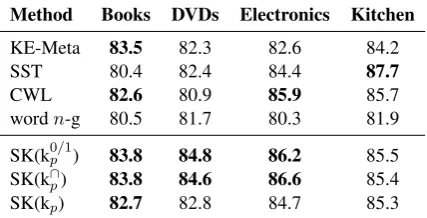
Method Books DVDs Electronics Kitchen
KE-Meta 83.5 82.3 82.6 84.2
SST 80.4 82.4 84.4 87.7
CWL 82.6 80.9 85.9 85.7
wordn-g 80.5 81.7 80.3 81.9 SK(k0p/1) 83.8 84.8 86.2 85.5
SK(k∩
p) 83.8 84.6 86.6 85.4
SK(kp) 82.7 82.8 84.7 85.3
Table 1: Single-domain polarity classification ac-curacy (in %).
ting over the nine training folds of each cross-validation iteration. We first set α to its default value (0.2) and explored different combinations of n-gram lengths, for 2 ≤ n ≤ 10. The best re-sults where obtained when we combined all the n-grams in5≤n≤8. Using that combination, we tested forα ∈ [0.01,1]. The results notably dif-fered depending on the task setting, training do-main, and kernel (see Figure 1). We use the pa-rameters adjusted in this section for the rest of our evaluation.
4.3 Single-domain Polarity Classification
[image:3.595.310.524.294.403.2]Method Books DVDs Electronics Kitchen KE-Meta 77.9 80.4 78.9 82.5
SST 76.3 78.3 83.9 85.2
SCL-MI 74.6 76.3 78.9 82.0 wordn-g 74.4 79.8 77.1 76.9 SK(k0p/1) 82.0 81.9 83.6 85.1
SK(k∩
p) 80.7 80.7 83.0 85.2
SK(kp) 71.2 69.0 73.7 78.0
Table 2: Multi-source cross-domain polarity clas-sification accuracy (in %).
vocabulary richness among the evaluated domains. In addition, they highlighted the KE-Meta stability among domains, i.e., their higher lower-bound in accuracy. However, the results of our presence and intersection string kernels are more stable. What is more, depending on the domain, their results are statistically superior or equal to the best ob-tained by the state of the art. The exception is SST, which obtains the best results in the kitchen domain, where the shorter average review length could penalise other methods. We note that there are not statistically significant differences between the presence and intersection kernels. However, the spectrum kernel obtains lower results in all the cases. In contrast to the other two kernels, the spectrum one assigns a high score even when only one of the texts has a high frequency for a partic-ularn-gram (see Section 3). This produces simi-lar kernel representations for texts which may be not so close at lexical level and, consequently, pe-nalises the model precision.
4.4 Cross-domain Polarity Classification
Following recent works in cross-domain polar-ity classification (Bollegala et al., 2013; Franco-Salvador et al., 2015), in Table 2 we compare with the state of the art using a multi-source cross-domain setting, i.e., we train with all the cross-domains but the one we classify. Similarly to the single-domain results, wordn-g is the baseline, KE-Meta offers higher results in book and DVD reviews, and SST in electronic and kitchen appliance re-views. We note that SCL-MI was designed for single-source cross-domain classification (Blitzer et al., 2007). Therefore, the use of multiple train-ing domains may be the reason of its lower, but still competitive, performance.
Interestingly, despite not using target domain texts for training, the presence and intersection
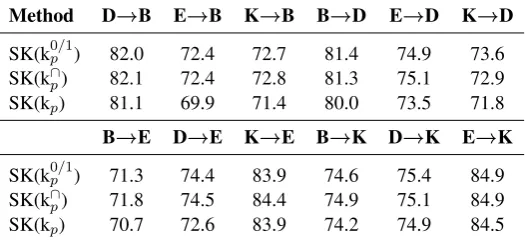
kernels obtain statistically superior or equal results to the best ones obtained by the state of the art. This proves that the non-linear mappings learned by KDA capture the lexical peculiarities that char-acterise polarity in a domain-independent way. We note again the stability of the results of these ker-nels and the non-existent statistically significant difference between them. In contrast, the spectrum kernel obtains the lowest results of the table. In or-der to analyse this fact, we perform an additional experiment where we use a single-source setting to train our cross-domain classifiers. We can see the results in Table 3.
The comparison of the multi-source and the single-source results shows that the presence and intersection kernels are occasionally able to ex-ploit different domain characteristics to obtain bet-ter results, e.g. the presence and inbet-tersection ker-nels with kitchen reviews, and the presence kernel with DVDs reviews. Even in cases when the com-bination of domains do not lead to better results, the results remain close to those of the most com-patible training domain; specially with the pres-ence kernel. We note the relevance of the multi-source setting for the industry: it is easier to use multiple domains to learn a domain-independent classifier than to detect each time which is the most appropriated training domain. Finally, we observe that the spectrum kernel has competitive results when the most compatible domain is used for training. However, the aforementioned score characteristics of that kernel (see Sections 3 and 4.3) exponentially increase its error in the multi-source setting.
5 Conclusions
Method D→B E→B K→B B→D E→D K→D SK(k0p/1) 82.0 72.4 72.7 81.4 74.9 73.6
SK(k∩
p) 82.1 72.4 72.8 81.3 75.1 72.9
SK(kp) 81.1 69.9 71.4 80.0 73.5 71.8
B→E D→E K→E B→K D→K E→K
SK(k0p/1) 71.3 74.4 83.9 74.6 75.4 84.9
SK(k∩
p) 71.8 74.5 84.4 74.9 75.1 84.9
[image:5.595.168.431.64.184.2]SK(kp) 70.7 72.6 83.9 74.2 74.9 84.5
Table 3: SK single-source cross-domain polarity classification accuracy (in %), where each column header follows the ”training domain→test domain“ format.
allowed our approaches to excel at cross-domain level without learning from texts of the target do-main. Finally, the analysis of the single-source and the multi-source cross-domain results proved that the presence kernel tolerates better the inclu-sion of new training domains in the multi-source cross-domain setting. This fact makes it the rec-ommended option for cross-domain polarity clas-sification.
Future work will investigate further how to em-ploy string kernels for single and cross-domain classification tasks.
Acknowledgments
We thank Ionescu et al. (2014) for their support and comments. The work of the third author was partially supported by the SomEMBED TIN2015-71147-C2-1-P MINECO research project and by the Generalitat Valenciana under the grant AL-MAMATER (PrometeoII/2014/030).
References
Gaston Baudat and Fatiha Anouar. 2000. Generalized discriminant analysis using a kernel approach. Neu-ral computation, 12(10):2385–2404.
Shai Ben-David, John Blitzer, Koby Crammer, Fer-nando Pereira, et al. 2007. Analysis of represen-tations for domain adaptation. Advances in neural information processing systems, 19:137.
Dmitriy Bespalov, Bing Bai, Yanjun Qi, and Ali Shok-oufandeh. 2011. Sentiment classification based on supervised latent n-gram analysis. InProceedings of the 20th ACM International Conference on Informa-tion and Knowledge Management (CIKM’11), pages 375–382, Glasgow, Scotland, UK. ACM.
John Blitzer, Mark Dredze, and Fernando Pereira. 2007. Biographies, bollywood, boom-boxes and
blenders: Domain adaptation for sentiment classi-fication. In Proceedings of the 45th Annual Meet-ing of the Association of Computational LMeet-inguistics, pages 440–447, Prague, Czech Republic, June. As-sociation for Computational Linguistics.
Danushka Bollegala, David Weir, and John Carroll. 2013. Cross-domain sentiment classification using a sentiment sensitive thesaurus. IEEE transactions on knowledge and data engineering, 25(8):1719–1731. Minmin Chen, Zhixiang Xu, Kilian Weinberger, and Fei Sha. 2012. Marginalized denoising autoen-coders for domain adaptation. InProceedings of the 29th International Conference on Machine Learning (ICML’12), pages 767–774, Edinburgh, Scotland. Mark Dredze, Koby Crammer, and Fernando Pereira.
2008. Confidence-weighted linear classification. In
Proceedings of the 25th International Conference on Machine Learning (ICML’08), pages 264–271, Helsinki, Finland. ACM.
Marc Franco-Salvador, Ferm´ın L. Cruz, Jos´e A. Troy-ano, and Paolo Rosso. 2015. Cross-domain polar-ity classification using a knowledge-enhanced meta-classifier. Knowledge-Based Systems, 86:46 – 56. Yaroslav Ganin, Evgeniya Ustinova, Hana Ajakan,
Pascal Germain, Hugo Larochelle, Franc¸ois Lavi-olette, Mario Marchand, and Victor Lempitsky. 2016. Domain-adversarial training of neural net-works. Journal of Machine Learning Research, 17(59):1–35.
Radu-Tudor Ionescu, Marius Popescu, and Aoife Cahill. 2014. Can characters reveal your native language? A language-independent approach to na-tive language identification. In Proceedings of the 2014 Conference on Empirical Methods in Natu-ral Language Processing (EMNLP), pages 1363– 1373, Doha, Qatar, October. Association for Com-putational Linguistics.
Sebastian Mika, Gunnar R¨atsch, Jason Weston, Bern-hard Sch¨olkopf, and Klaus-Robert M¨uller. 1999. Fisher discriminant analysis with kernels. In ceedings of IEEE Neural Networks for Signal Pro-cessing Workshop (NNSP’99), pages 41–48, Madi-son, Wisconsin, USA.
Bo Pang, Lillian Lee, and Shivakumar Vaithyanathan. 2002. Thumbs up? sentiment classification using machine learning techniques. InProceedings of the 2002 Conference on Empirical Methods in Natural Language Processing, pages 79–86, Philadelphia, Pennsylvania, USA, July. Association for Compu-tational Linguistics.
Marius Popescu and Cristian Grozea. 2012. Kernel methods and string kernels for authorship analysis. In Online Working Notes/Labs/Workshop Papers of the CLEF 2012 Evaluation Labs (CLEF’12), Rome, Italy.
Antonio Reyes and Paolo Rosso. 2013. On the dif-ficulty of automatically detecting irony: beyond a simple case of negation. Knowledge and Informa-tion Systems, pages 1–20.
Bernhard Sch¨olkopf. 2001. The kernel trick for dis-tances. Advances in neural information processing systems, 13:301–307.