Building Lexical Vector Representations from Concept Definitions
Danilo S. Carvalho and Minh Le Nguyen Japan Advanced Institute of Science and Technology
1-1 Asahidai, Nomi City, Ishikawa, Japan {danilo, nguyenml}@jaist.ac.jp
Abstract
The use of distributional language repre-sentations have opened new paths in solv-ing a variety of NLP problems. However, alternative approaches can take advantage of information unavailable through pure statistical means. This paper presents a method for building vector representations from meaning unit blocks called concept definitions, which are obtained by extract-ing information from a curated lextract-inguistic resource (Wiktionary). The representa-tions obtained in this way can be compared through conventional cosine similarity and are also interpretable by humans. Eval-uation was conducted in semantic simi-larity and relatedness test sets, with re-sults indicating a performance compara-ble to other methods based on single lin-guistic resource extraction. The results also indicate noticeable performance gains when combining distributional similarity scores with the ones obtained using this approach. Additionally, a discussion on the proposed method’s shortcomings is provided in the analysis of error cases.
1 Introduction
Vector-based language representation schemes have gained large popularity in Natural Language Processing (NLP) research in the recent years. Their success comes from both the asserted ben-efits in several NLP tasks and from the ability to built them from unannotated textual data, widely available in the World Wide Web. The tasks bene-fiting from vector representations include Part-of-Speech (POS) tagging (dos Santos and Zadrozny, 2014), dependency parsing (Bansal et al., 2014), Named Entity Recognition (NER) (Seok et al.,
2016), Machine Translation (Sutskever et al., 2014), among others.
Such representation schemes are, however, not an all-in-one solution for the many NLP appli-cation scenarios. Thus, different representation methods were developed, each one focusing in a limited set of concerns, e.g., semantic relatedness measurement (Mikolov et al., 2013; Pennington et al., 2014) and grammatical dependencies (Levy and Goldberg, 2014). Most of the popular meth-ods are based on a distributional approach: the meaning of a word is defined by the context of its use, i.e., the neighboring words. However, distributional representations carry no explicit lin-guistic information and cannot easily represent some important semantic relationships, such as synonymy and antonymy (Nguyen et al., 2016). Further problems include the difficulty in obtain-ing representations for out-of-vocabulary (OOV) words and complex constructs (collocations, id-iomatic expressions), the lack of interpretable rep-resentations (Faruqui and Dyer, 2015), and the ne-cessity of specific model construction for cross-language representation.
This paper presents a linguistically motivated language representation method, aimed at captur-ing and providcaptur-ing information unavailable on dis-tributional approaches. Our contributions are: (i) a technique for building conceptual representa-tions of linguistic elements (morphemes, words, collocations, idiomatic expressions) from a single collaborative language resource (Wiktionary 1);
(ii) a method of combining said representations and comparing them to obtain a semantic sim-ilarity measurement. The conceptual represen-tations, called Term Definition Vectors, address more specifically the issues of semantic relation-ship analysis, out-of-vocabulary word
interpreta-1www.wiktionary.org
tion and cross-language conceptual mapping. Ad-ditionally, they have the advantages of being in-terpretable by humans and easy to operate, due to their sparsity. Experiments were conducted with the SimLex-999 (Hill et al., 2015) test collection for word similarity, indicating a good performance in this task and exceeding the performance of other single information source studies, when combined with a distributional representation and Machine Learning. Error analysis was also conducted to un-derstand the strengths and weaknesses of the pro-posed method.
The remainder of this paper is organized as fol-lows: Section 2 presents relevant related works and highlights their similarities and differences to this research. Section 3 explains our approach in detail, covering its linguistic motivation and the characteristics of both representation model and comparison method. Section 4 describes the ex-perimental evaluation and discusses the evaluation results and error analysis. Finally, Section 5 offers a summary of the findings and some concluding remarks.
2 Related Work
In order to address the limitations of the most popular representation schemes, approaches for all-in-one representation models were also devel-oped (Pilehvar and Navigli, 2015; Derrac and Schockaert, 2015). They comprise a combination of techniques applied over different data sources for different tasks. Pilehvar and Navigli (2015) presented a method for combining Wiktionary and Wordnet (Fellbaum and others, 1998) sense in-formation into a semantic network and a corre-sponding relatedness similarity measurement. The method is called ADW (Align, Disambiguate, Walk), and works by first using a Personalized PageRank (PPR) (Haveliwala, 2002) algorithm for performing a random walk on the semantic net-work and compute a semantic signatureof a lin-guistic item (sense, word or text): a probability distribution over all entities in the network where the weights are estimated on the basis of the net-work’s structural properties. Two linguistic items are then aligned and disambiguated by finding their two closest senses, comparing their seman-tic signatures under a set of vector and rank-based similarity measures (JensenShannon divergence, cosine, Rank-Biased Overlap, and Weighted Over-lap). ADW achieved state-of-the-art performance
in several semantic relatedness test sets, covering words, senses and entire texts.
Recski et al. (2016) presented a hybrid sys-tem for measuring the semantic similarity of word pairs, using a combination of four distributional representations (SENNA (Collobert and Weston, 2008), (Huang et al., 2012), word2vec (Mikolov et al., 2013), andGloVe(Pennington et al., 2014)),
WordNet-based features and4lang(Kornai, 2010) graph-based features to train a RBF kernel Sup-port Vector Regression on the SimLex-999 (Hill et al., 2015) data set. This system achieved state-of-the-art performance in SimLex-999.
The work presented in this paper takes a similar approach to Pilehvar and Navigli (2015), but stops short on obtaining a far reaching concept graph. Instead, it focuses on exploring the details of each sense definition. This includes term etymolo-gies, morphological decomposition and transla-tion links, available in Wiktransla-tionary. Another differ-ence is that the translation links are used to map senses between languages in this work, whereas they are used for bridging gaps between sense sets on monolingual text in Pilehvar and Navigli (2015).
Another concern regarding distributional repre-sentations is their lack of interpretability from a linguistic standpoint. Faruqui and Dyer (2015) addresses this point, relying on linguistic infor-mation from Wordnet, Framenet (F. Baker et al., 1998), among other sources (excluding Wik-tionary), to build interpretable word vectors. Such vectors accommodate several types of informa-tion, ranging from Part-of-Speech (POS) tags to sentiment classification and polarity. The obtained linguistic vectors achieved very good performance in a semantic similarity test. Those vectors, how-ever, do not include morphological and translation information, offering discrete, binary features.
Regarding the extraction of definition data from Wiktionary, an effective approach is presented by Zesch et al. (2008a), which is also used for building a semantic representation (Zesch et al., 2008b). However, the level of detail and structure format obtained by such method was not deemed adequate for this work and an alternative extrac-tion method was developed (Secextrac-tions 3.2 and 3.3).
3 Term Definition Vectors
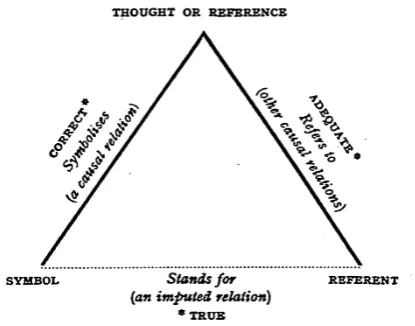
trying to represent knowledge as a set of individual concepts that relate to one another and are related to a set of terms. This idea is closely related to the Ogden/Richardstriangle of reference(Ogden et al., 1923) (Figure 1), which describes a relation-ship between linguistic symbols and the objects they represent. The following notions are then de-fined:
• Concept: The unit of knowledge. Represents an individual meaning, e.g., rain (as in the natural phenomenon), and can be encoded into a term (symbol). It corresponds to the “thought or reference” from the triangle of reference.
• Term: A unit of perception. In text, it can be mapped to fragments ranging from mor-phemes to phrases. Each one can be decoded into one or more concepts. Stands for the “symbol” in the triangle of reference.
[image:3.595.80.288.522.685.2]• Definition: A minimal, but complete explic-itation of a concept. It comprises the tex-tual explanation of the concept (sense) and its links to other concepts in a knowledge base, corresponding to the “symbolizes” relation-ship in the triangle of reference. The sim-plest case is a dictionary definition, consist-ing solely of a short explanation (typically a single sentence), with optional term high-lights, linking to other dictionary entries. The information used for building definitions in this work is described in Section 3.3.
Figure 1: Ogden/Richards triangle of reference, also known as semiotic triangle. Describes a re-lationship between linguistic symbols and the ob-jects they represent. (Ogden et al., 1923)
3.1 Distributional & Definitional Semantics
Distributional approaches for language represen-tation, also known aslatent orstatistical seman-tics, are rooted in what is called thedistributional hypothesis(Sahlgren, 2008). This concept stems from the notion that words are always used in a context, and it is the context that defines their meaning. Thus, the meaning of a term is con-cealed, i.e. latent, and can be revealed by look-ing at its context. In this sense, it is possible to define the meaning of a term to be a function of its neighboring term frequencies (co-occurrence). Using different definitions for “neighbor”, e.g., adjacent words inword2vec(Mikolov et al., 2013) and “modifiers in a dependency tree” (Levy and Goldberg, 2014), it is possible to produce a va-riety of vector spaces, called embeddings. Good embeddings enable the use of vector operations on words, such as comparison by cosine similar-ity. They also solve the data sparsity problem of large vocabularies, working as a dimensionality reduction method. There are, however, semantic elements that are not directly related to context, and thus are not well represented by distributional methods, e.g., the antonymy and hypernymy re-lations. Furthermore, polysemy can bring poten-tial ambiguity problems in cases where the vectors are only indexed by surface form (word→ embed-ding).
An alternative line of thinking is to define the meanings first and then associate the correspond-ing terms (reference→ symbol). In this notion, meanings areexplicitand need only to be resolved, i.e., disambiguated, for any given term. Concepts are thus represented by prior definitions instead of distributions over corpora, hence the name “ defini-tional semantics” is used in this work to generalize such approaches.
in-dependence from any previously compiled knowl-edge base, e.g, a dictionary, which are subject to completeness and correctness concerns. The latter offers answers for the rarer words that are difficult to guess and the possibility to explain exactly how a certain meaning was inferred (interpretability).
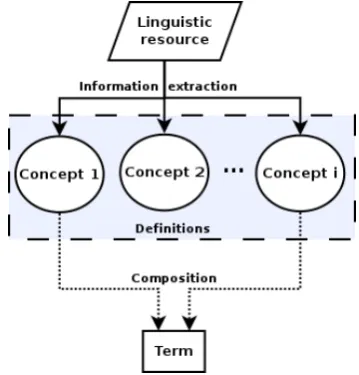
The proposed definitional representation is then obtained through the following strategy:
1. Formalization of the basic unit of knowledge: the concept.
2. Information extraction from a linguistic re-source into a set of concepts.
3. Lexical association: term↔concept.
4. Definition of a term as a composition (mix-ture) of concepts, allowing partial or com-plete disambiguation.
[image:4.595.90.270.479.667.2]Figure 2 illustrates the process. A term is said ambiguous if it is composed by more than one con-cept. Therefore in this context, disambiguation is the action of reducing the number of concepts in a term’s composition. This can be done by col-lecting additional information about the term, such as Part-of-Speech. A complete disambiguation re-duces the composition to a single concept.
Figure 2: Process of definitional representation. Given a set of concepts obtained from a linguis-tic resource, a term can be defined as a composi-tion of concepts. A term is said ambiguous if it is composed by more than one concept.
3.2 Linguistic Information Extraction
Wiktionary2 was used as the single linguistic
source. Wiktionary is a collaborative lexical re-source, comprising millions of vocabulary entries from several languages. It includes contextual in-formation, etymology, semantic relations, transla-tions, inflectransla-tions, among other types of informa-tion for each entry. Its contents are actively cu-rated by a large, global community. This choice was motivated by a several reasons, more impor-tantly:
• It is the largest lexical resource openly avail-able for the public, covering more than 10 million lexical entries from 172 languages.
• It is constantly updated. Daily changes are consolidated in monthly releases.
• Entries are organized in a way that separates each meaning of a term, simplifying defini-tion extracdefini-tion.
• Entries include range from morphemes, e.g., “pre-”, to idiomatic expressions, e.g., “take matters into one’s own hands”.
The data available from Wiktionary is semi-structured, composed of a set of markup docu-ments, one for each entry, following a reasonably consistent standard of annotations for each lan-guage covered. In order to extract the linguistic information, an application was developed to con-vert the markup into a structured (JSON + schema) representation. The structured data was optimized for the retrieval of Wiktionary senses and link types were categorized to produce concept defini-tions.
3.3 Concept Definitions
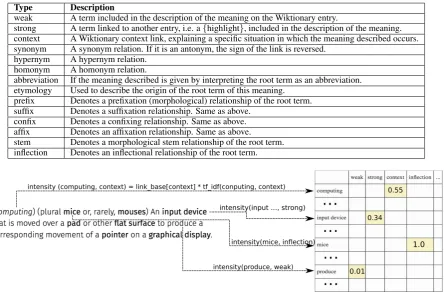
Formalization of the knowledge unit used in this work was done by firstly mapping each concept to a single Wiktionary sense. The concept is repre-sented as a lexical/semantic graph, where a main addressing term, the root node, is connected to other terms through a set of edges. Each edge de-notes a different type of lexical/semantic relation-ship, e.g. prefixation, synonymy/antonymy. The edges are also weighted, denoting the intensity of a relationship. Figure 3 shows a simplified visu-alization of a pair of different concept graphs for
Figure 3: A simplified visualization of two concept graphs for the term “mouse”. The leftmost one denotes the concept of the small rodent and the other denotes the computer input device. The edge labels represent the relationship type and the thickness represent the its intensity.
Table 1: Link types used for the construction of concept graphs. They comprise both lexical (morphol-ogy, etymology) and semantic relationships between the root term, i.e., the Wiktionary entry title, and the terms used to describe the meaning.
Type Description
weak A term included in the description of the meaning on the Wiktionary entry.
strong A term linked to another entry, i.e. a{highlight}, included in the description of the meaning. context A Wiktionary context link, explaining a specific situation in which the meaning described occurs. synonym A synonym relation. If it is an antonym, the sign of the link is reversed.
hypernym A hypernym relation. homonym A homonym relation.
abbreviation If the meaning described is given by interpreting the root term as an abbreviation. etymology Used to describe the origin of the root term of this meaning.
prefix Denotes a prefixation (morphological) relationship of the root term. suffix Denotes a suffixation relationship. Same as above.
confix Denotes a confixing relationship. Same as above. affix Denotes an affixation relationship. Same as above. stem Denotes a morphological stem relationship of the root term. inflection Denotes an inflectional relationship of the root term.
Figure 4: Representation of one Wiktionary sense definition for ”mouse” as an encoded matrix: the
concept definition. Each Wiktionary link is categorized and mapped to a vector space.
a single lexical entry of Wiktionary. The differ-ent link types are used to create a vector space, in which the edges of the definition graph are repre-sented. Table 1 describes the link types used in this work.
Each concept graph is represented by aML×T matrix called concept definition, where L is the
number of link types and T is the vocabulary size. The link intensities are defined for each type, by multiplying a manually defined constant link base (a model parameter) by the TF-IDF score calculated for the vocabulary with respect to the type. Figure 4 illustrates the process.
listing senses in the source language, e.g., English meanings of the French word “avec” in the English language section. Definitions for these terms are also included into the concept definition set. Ad-ditionally, translation links are provided for many sense definitions. Such links, as well as term redi-rections, i.e., distinct terms pointing to the same Wiktionary entry, are mapped to a single concept. This allows foreign terms to take advantage of the same concept graphs as the source language equiv-alents.
3.4 Definition Vectors
Finally, association between the concept defini-tions and terms is established by composition. This is done by simple element-wise sum and av-erage of all concept definition matrices mapped to a Wiktionary entry. The resulting matrix is flat-tened in its row axis, i.e, rows are concatenated in order, producing a L×T-dimensional sparse vector calledterm definition vector. If the term is not a Wiktionary entry, i.e., is out-of-vocabulary (OOV), a character n-gram-based attempt of mor-phological decomposition is done and if a com-plete morpheme match is found in the concept def-inition set, the matched concepts are composed for the OOV term. This decomposition attempt is done as follows:
1. For each character ci, i ∈ [0, n] in a OOV term of lengthn:
i Create empty list morph cand of mor-pheme candidates.
ii Set indexj=i.
iii Find Wiktionary entries that matchcand add them to morph cand. For the first and last characters, include prefixes and suffixes in the search, respectively. iv Concatenatecj+1toc.
v Incrementj. vi Repeat from iii.
This will produce a sequence of n morpheme candidate lists. If a sequence produced by taking a single morpheme candidate from each list matches the entire OOV term, it is considered a candidate decomposition. If there are multiple candidate de-compositions, the one with the shortest stem is se-lected.
Figure 5 illustrates an OOV composition for the nonexistent term “unlockability”, which has
[image:6.595.318.512.125.278.2]a complete morpheme match in the concept def-inition set. If a complete morpheme match is not found, the term is considered a proper noun (if no POS is provided), and given a null (zero) vector.
Figure 5: Morpheme match in concept definitions for the OOV term “unlockability”.
Similarity comparison between two terms is done by measuring the cosine similarity between their definition vectors. A value closer to 1 in-dicates high similarity, a value closer to −1 in-dicates opposition and a value closer to 0 indi-cates unrelatedness. Table 2 shows a compari-son table between semantic matches obtained us-ing this method,word2vec(Mikolov et al., 2013) andGloVe(Pennington et al., 2014).
Table 2: Top closest and farthest to the term “happy” by Term Definition Vector, and clos-est Word2Vec (GoogleNews corpus), and GloVe (Wikipedia2014 + Gigaword) cosine similarities.
Def.Vec Def.Vec (-) Word2Vec GloVe
joyous sad glad glad
dexterous unhappy pleased good
content joyless ecstatic sure
felicitous somber overjoyed proud
lucky depressed thrilled excited
[image:6.595.308.527.520.607.2]stem@(sun:1); pos@(adjective:0.11, noun:0.11). In this example,strong@radiantis a single vec-tor dimension and the term is not disambiguated (multiple POS).
4 Experiments 4.1 Experimental setup
The definition vector representations obtained in this work were evaluated in the SimLex-999 test collection for semantic similarity benchmark (Hill et al., 2015). This test collection contains a set of 999 English word pairs, associated to a sim-ilarity score given by a group of human annota-tors. The set is divided in 666 nouns pairs, 222 verb pairs and 111 adjective pairs. The Part-of-Speech (POS) information allows partial or com-plete disambiguation of the definition vectors. The choice of SimLex-999 was due to the type of sim-ilarity measured by this set, which excludes re-latedness and is closer to the type of information captured by the concept definitions. Addition-ally, the WordSim-353 (Finkelstein et al., 2001),
RG-65 (Rubenstein and Goodenough, 1965) and
MEN (Bruni et al., 2014) test collections for se-mantic relatedness were also included in the eval-uation, to verify the representation performance in measuring relatedness. While the MEN test col-lection also includes POS information, WordSim-353 and RG-65 do not include it, so sense dis-tinction was not applied for the latter. Unfortu-nately, the test collections used in this work did not contain foreign words, so the translation-link features presented in Section 3.3 are solely pre-sented as part of the method’s description, and are not evaluated. This is due to the method being de-veloped without focus on a specific test. The se-mantic similarity measurement was consequence of the method’s design, but not its main target.
Evaluation is done by computing the Spear-man’s rank correlation coefficient (ρ) between the human annotators’ similarity or relatedness scores and the scores given by the automated methods. A coefficient of value 1 means a perfect match between the relative positions of the pairs, when ranked by their similarity scores.
For the SimLex-999 test, the cosine similarity between the term definition vectors was set as the similarity score. For the WordSim-353, RG-65 and MEN tests, the absolute value of the cosine similarity was used instead, since opposite words are related. An additional test was performed to
explore the possibility of combining distributional and definitional approaches. In this test, a small set of features was created to train a Learning-to-Rank model, in order to improve the similarity scores. The features were as follows:
• Presence of synonym, hypernym, strong and weak links3between the pair of words. Each
link type is a separate feature.
• Term definition vector similarity.
• Word2vec similarity.
The features were computed for each pair and passed to SVMrank (Joachims, 2006) for training and validation. A 10-fold cross-validation test us-ing random pairs without replacement was run for the entire sets (5-fold for RG-65), except MEN. The MEN test collection is separated into train-ing and testtrain-ing sets, with 2K and 1K word pairs respectively, so these were used in place of the cross-validation. For each fold, the ranking scores provided by the trained ranker were used as simi-larity scores for calculatingρ. The average of all folds was considered the final result.
Experimental data and model parameters were set as follows:
• Linguistic information source: Wiktionary English database dump (XML + Wiki markup), 2015-12-26, containing more than 4 million entries. A reduced set, with only English, French, Greek, Japanese, Latin and Vietnamese language entries was used in the experiments. This set had about 734K en-tries, from which approx. 1 million concepts where extracted.
• link base constants were set as: weak = 0.2, strong = 2.0, context = 0.5, synonym = 10.0, hypernym = 5.0, homonym = 7.0, etymology = 1.0 (also applied to morphological links) and pos = 1.0. The constants were adjusted by increas-ing or decreasincreas-ing their values individually in intervals of0.2, and observing the effect inρ for SimLex-999 in the first fold of the cross-validation. The optimal values were selected and kept constant for the remaining folds and for the other tests. This was done because
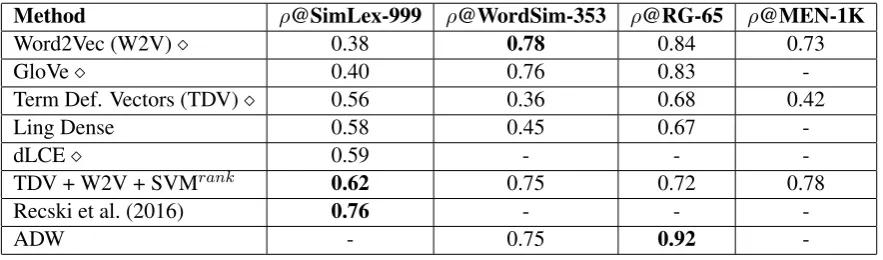
Table 3: Performance of different methods for the SimLex-999, WordSim-353, RG-65, and MEN test sets, reported as Spearman’s rank correlation coefficientrho. The methods marked withuse a single information source. Fields marked with “-” indicate that the results were not available for assessment.
Method ρ@SimLex-999 ρ@WordSim-353 ρ@RG-65 ρ@MEN-1K
Word2Vec (W2V) 0.38 0.78 0.84 0.73
GloVe 0.40 0.76 0.83
-Term Def. Vectors (TDV) 0.56 0.36 0.68 0.42
Ling Dense 0.58 0.45 0.67
-dLCE 0.59 - -
-TDV + W2V + SVMrank 0.62 0.75 0.72 0.78
Recski et al. (2016) 0.76 - -
-ADW - 0.75 0.92
-changinglink basefor each fold would cre-ate an unrealistic use scenario for our sys-tem, which cannot changelink baseonline. The cross-validation was repeated two times, with very minor differences between both test runs. The constant values reported here are from the last run.
• SVMrank was set with a default linear ker-nel andCparameter (training error trade-off) was set to8for MEN and5for the other test collections. The value was increased in unit intervals, until convergence was longer than a time threshold (10 minutes). This parameter was adjusted using the training set for MEN, or inside each CV fold for the rest.
• Both Word2Vec and GloVe were used with pre-trained, 300-dimensional models: 100 billion words GoogleNews corpus and Com-mon Crawl 42 billion token corpus respec-tively.
dLCE (Nguyen et al., 2016) was chosen as base-line, for being the best single information source method in the SimLex-999 test collection. Fur-ther results include Recski et al. (2016) (state-of-the-art), Ling Dense (Faruqui and Dyer, 2015), Word2Vec (Mikolov et al., 2013), and GloVe (Pen-nington et al., 2014). For WordSim-353, GloVe, Word2Vec, Ling Dense, and ADW (Pilehvar and Navigli, 2015) were included. For RG-65, Ling Dense, GloVe, and ADW (state-of-the-art), were included.
4.2 Results
The experimental results are presented in Table 3, where they are compared to other methods.
The results indicate that in the semantic similar-ity test, the term definition vectors perform closely to other representation models taking advantage of curated data, such as WordNet. It also outper-forms the most popular distributional representa-tions. However, they are clearly outclassed in the semantic relatedness test, for which the distribu-tional approaches show superior performance.
An interesting observation can be made when combining word2vec similarity with term defini-tion features through the use of Machine Learning. A performance trade-off seems to exist at the se-mantic relatedness tests, but the same is not true for the similarity test. This allowed the combined model to improve considerably at little cost. Fur-ther analysis helped in understanding the reason for this particularity (Section 4.3).
Lastly, the experiments have also shown that the method for extracting concept definitions is not computationally expensive. The developed implementation took about 6 minutes to extract all concept definitions from the structured Wik-tionary data used in the tests, using a modern desk-top computer (3GHz processor and at least 8GB RAM). Structuring Wiktionary data took less than 20 minutes with the same equipment, and was done a single time.
4.3 Error analysis
this analysis we considered as error any word pair that was put among the top 15% similarity scores by the human annotators, but was ranked in the lower 50% using the definition vectors. The same applies for the bottom 15% scored by humans, that are ranked in the upper half by our approach.
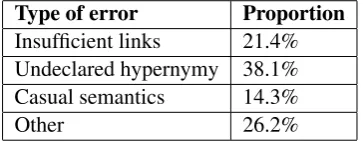
The errors found were classified in four cate-gories:
• Insufficient links in Wiktionary: this type of error occurs when the wiktionary sense cor-responding to a concept lacks annotations. Typical cases contain only a short descrip-tion, with no links. The concept graph is then left with only weak links, which have lit-tle impact on similarity calculation. The pair
drizzle–rain(noun) is one example of this.
• Undeclared hypernymy: certain cases of hy-pernymy are not solved in the concept extrac-tion, since they require multiple hops in the definition links to be found. The pairscop– sheriff andalcohol–gin (noun) are instances of such problem.
• Casual vs. formal language semantics: not a flaw in the method per se, but an error caused by the differences in formal description of a language (in a dictionary), when compared to casual use. The pairnoticeable–obvious (ad-jective) illustrates this.
• Other: flaws in the extraction process or an-notation problems in Wiktionary.
[image:9.595.91.273.589.660.2]Those errors affect the pairs in the top 15% hu-man similarity scores 7 times more than the lower 15%. They are distributed as shown in Table 4.
Table 4: Distribution of definition vector error types in SimLex-999.
Type of error Proportion
Insufficient links 21.4%
Undeclared hypernymy 38.1%
Casual semantics 14.3%
Other 26.2%
Having about one quarter of the errors in the “other” category shows that there is some space for improvement in the concept extraction pro-cess. The insufficient links and undeclared hyper-nymy categories are cases in which distributional approaches may do better if similarity is high, due to the words intrinsic relatedness.
Analysis of SVMrankscores showed that the in-sufficient links category benefited the most from the combination with word2vec. The reason is that the features chosen for use with the ranker made such cases distinguishable and more likely to re-ceive a larger weight from the word2vec similarity score after training. The undeclared hypernymy cases, on the other hand, are not so evident and would require a more complex approach on the concept extraction process.
5 Conclusion
Alternative approaches to distributional language representations can take advantage of information unavailable through pure statistical means. Taking advantage of large curated linguistic resources is a popular way of obtaining such information and of-fers large room for exploration. With this in mind, we propose a novel method for obtaining vector representations of lexical items using Wiktionary sense definitions. The lexical item representations are composed from basic meaning units called concept definitions, which are extracted from the linguistic resource. Results obtained from a se-mantic similarity evaluation test indicate perfor-mance comparable to other methods based on lin-guistic resource extraction. Furthermore, a notice-able performance gain was obtained by applying a Machine Learning approach to combine word2vec similarity scores with the ones obtained using this approach, exceeding both methods’ results.
Planned improvements include the use of a graph traversal approach to capture deeper se-mantic links and also the inclusion of translation links as separate dimensions in the concept vec-tor space, in order to facilitate the use of obtained representations as a machine translation resource. The inclusion of distributional similarity measures as separate dimensions is also under study and provides an alternative way of combining the dis-tributional and definitional approaches.
Acknowledgments
References
Mohit Bansal, Kevin Gimpel, and Karen Livescu. 2014. Tailoring continuous word representations for dependency parsing. InProceedings of the 52nd An-nual Meeting of the Association for Computational Linguistics (Volume 2: Short Papers), pages 809– 815. Association for Computational Linguistics. Elia Bruni, Nam-Khanh Tran, and Marco Baroni.
2014. Multimodal distributional semantics. Journal of Artificial Intelligence Research (JAIR), 49(1-47). Ronan Collobert and Jason Weston. 2008. A unified
architecture for natural language processing: Deep neural networks with multitask learning. In Pro-ceedings of the 25th international conference on Machine learning, pages 160–167. ACM.
Joaqu´ın Derrac and Steven Schockaert. 2015. Induc-ing semantic relations from conceptual spaces: a data-driven approach to plausible reasoning. Arti-ficial Intelligence, 228:66–94.
C´ıcero Nogueira dos Santos and Bianca Zadrozny. 2014. Learning character-level representations for part-of-speech tagging. InICML, pages 1818–1826. Collin F. Baker, Charles J. Fillmore, and John B. Lowe. 1998. The berkeley framenet project. In COLING 1998 Volume 1: The 17th International Conference on Computational Linguistics.
Manaal Faruqui and Chris Dyer. 2015. Non-distributional word vector representations. In Pro-ceedings of the 53rd Annual Meeting of the Associ-ation for ComputAssoci-ational Linguistics and the 7th In-ternational Joint Conference on Natural Language Processing (Volume 2: Short Papers), pages 464– 469. Association for Computational Linguistics. Christiane Fellbaum et al. 1998. Wordnet: An
elec-tronic database.
Lev Finkelstein, Evgeniy Gabrilovich, Yossi Matias, Ehud Rivlin, Zach Solan, Gadi Wolfman, and Ey-tan Ruppin. 2001. Placing search in context: The concept revisited. InProceedings of the 10th inter-national conference on World Wide Web, pages 406– 414. ACM.
Taher H. Haveliwala. 2002. Topic-sensitive pagerank. InProceedings of the 11th international conference on World Wide Web, pages 517–526. ACM.
Felix Hill, Roi Reichart, and Anna Korhonen. 2015. Simlex-999: Evaluating semantic models with (gen-uine) similarity estimation. Computational Linguis-tics, 41(4):665–695.
Eric Huang, Richard Socher, Christopher Manning, and Andrew Ng. 2012. Improving word represen-tations via global context and multiple word proto-types. InProceedings of the 50th Annual Meeting of the Association for Computational Linguistics (Vol-ume 1: Long Papers), pages 873–882. Association for Computational Linguistics.
Thorsten Joachims. 2006. Training linear svms in lin-ear time. InProceedings of the 12th ACM SIGKDD international conference on Knowledge discovery and data mining, pages 217–226. ACM.
Andr´as Kornai. 2010. The algebra of lexical seman-tics. InThe Mathematics of Language, pages 174– 199. Springer.
Omer Levy and Yoav Goldberg. 2014. Dependency-based word embeddings. InProceedings of the 52nd Annual Meeting of the Association for Computa-tional Linguistics (Volume 2: Short Papers), pages 302–308. Association for Computational Linguis-tics.
Tomas Mikolov, Ilya Sutskever, Kai Chen, Greg Cor-rado, and Jeffrey Dean. 2013. Distributed repre-sentations of words and phrases and their composi-tionality. Advances in neural information process-ing systems.
Anh Kim Nguyen, Sabine Schulte im Walde, and Thang Ngoc Vu. 2016. Integrating distributional lexical contrast into word embeddings for antonym-synonym distinction. InProceedings of the 54th An-nual Meeting of the Association for Computational Linguistics (Volume 2: Short Papers), pages 454– 459. Association for Computational Linguistics. Charles Kay Ogden, Ivor Armstrong Richards, Sv
Ran-ulf, and E Cassirer. 1923. The meaning of meaning. a study of the influence of language upon thought and of the science of symbolism.
Jeffrey Pennington, Richard Socher, and Christopher Manning. 2014. Glove: Global vectors for word representation. In Proceedings of the 2014 Con-ference on Empirical Methods in Natural Language Processing (EMNLP), pages 1532–1543. Associa-tion for ComputaAssocia-tional Linguistics.
Mohammad Taher Pilehvar and Roberto Navigli. 2015. From senses to texts: An all-in-one graph-based ap-proach for measuring semantic similarity. Artificial Intelligence, 228:95–128.
G´abor Recski, Eszter Ikl´odi, Katalin Pajkossy, and An-dras Kornai, 2016.Proceedings of the 1st Workshop on Representation Learning for NLP, chapter Mea-suring Semantic Similarity of Words Using Concept Networks, pages 193–200. Association for Compu-tational Linguistics.
Herbert Rubenstein and John B. Goodenough. 1965. Contextual correlates of synonymy. Communica-tions of the ACM, 8(10):627–633.
Magnus Sahlgren. 2008. The distributional hypothe-sis.Italian Journal of Linguistics, 20(1):33–54. Miran Seok, Hye-Jeong Song, Chan-Young Park,
Ilya Sutskever, Oriol Vinyals, and Quoc V. Le. 2014. Sequence to sequence learning with neural net-works. InAdvances in neural information process-ing systems, pages 3104–3112.
Torsten Zesch, Christof M¨uller, and Iryna Gurevych. 2008a. Extracting lexical semantic knowledge from wikipedia and wiktionary. In LREC, volume 8, pages 1646–1652.