Mapping Instructions and Visual Observations to Actions
with Reinforcement Learning
Dipendra Misra†, John Langford‡, and Yoav Artzi†
†Dept. of Computer Science and Cornell Tech, Cornell University, New York, NY 10044 {dkm, yoav}@cs.cornell.edu
‡Microsoft Research, New York, NY 10011 [email protected]
Abstract
We propose to directly map raw visual ob-servations and text input to actions for in-struction execution. While existing ap-proaches assume access to structured envi-ronment representations or use a pipeline of separately trained models, we learn a single model to jointly reason about lin-guistic and visual input. We use reinforce-ment learning in a contextual bandit set-ting to train a neural network agent. To guide the agent’s exploration, we use re-ward shaping with different forms of su-pervision. Our approach does not re-quire intermediate representations, plan-ning procedures, or traiplan-ning different mod-els. We evaluate in a simulated environ-ment, and show significant improvements over supervised learning and common re-inforcement learning variants.
1 Introduction
An agent executing natural language instructions requires robust understanding of language and its environment. Existing approaches addressing this problem assume structured environment represen-tations (e.g.,.Chen and Mooney,2011;Mei et al.,
2016), or combine separately trained models (e.g.,
Matuszek et al.,2010;Tellex et al.,2011), includ-ing for language understandinclud-ing and visual reason-ing. We propose to directly map text and raw im-age input to actions with a single learned model. This approach offers multiple benefits, such as not requiring intermediate representations, plan-ning procedures, or traiplan-ning multiple models.
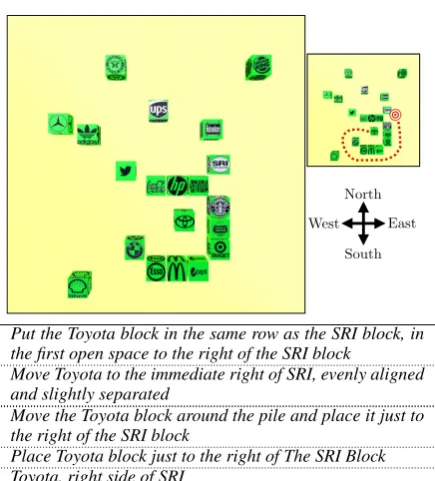
Figure 1 illustrates the problem in the Blocks environment (Bisk et al., 2016). The agent ob-serves the environment as an RGB image using a camera sensor. Given the RGB input, the agent
North
South East West
Put the Toyota block in the same row as the SRI block, in the first open space to the right of the SRI block
Move Toyota to the immediate right of SRI, evenly aligned and slightly separated
Move the Toyota block around the pile and place it just to the right of the SRI block
[image:1.595.308.526.215.456.2]Place Toyota block just to the right of The SRI Block Toyota, right side of SRI
Figure 1: Instructions in the Blocks environment. The instructions all describe the same task. Given the ob-served RGB image of the start state (large image), our goal is to execute such instructions. In this task, the direct-line path to the target position is blocked, and the agent must plan and move the Toyota block around. The small image marks the target and an example path, which includes 34 steps.
must recognize the blocks and their layout. To un-derstand the instruction, the agent must identify the block to move (Toyota block) and the destina-tion (just right of the SRI block). This requires solving semantic and grounding problems. For example, consider the topmost instruction in the figure. The agent needs to identify the phrase re-ferring to the block to move, Toyota block, and ground it. It must resolve and ground the phrase
SRI block as a reference position, which is then modified by the spatial meaning recovered from
the same row as orfirst open space to the right of, to identify the goal position. Finally, the agent needs to generate actions, for example moving the Toyota block around obstructing blocks.
To address these challenges with a single model,
we design a neural network agent. The agent exe-cutes instructions by generating a sequence of ac-tions. At each step, the agent takes as input the instruction text, observes the world as an RGB im-age, and selects the next action. Action execution changes the state of the world. Given an obser-vation of the new world state, the agent selects the next action. This process continues until the agent indicates execution completion. When se-lecting actions, the agent jointly reasons about its observations and the instruction text. This enables decisions based on close interaction between ob-servations and linguistic input.
We train the agent with different levels of su-pervision, including complete demonstrations of the desired behavior and annotations of the goal state only. While the learning problem can be eas-ily cast as a supervised learning problem, learning only from the states observed in the training data results in poor generalization and failure to recover from test errors. We use reinforcement learn-ing (Sutton and Barto,1998) to observe a broader set of states through exploration. Following recent work in robotics (e.g., Levine et al., 2016; Rusu et al.,2016), we assume the training environment, in contrast to the test environment, is instrumented and provides access to the state. This enables a simple problem reward function that uses the state and provides positive reward on task completion only. This type of reward offers two important ad-vantages: (a) it is a simple way to express the ideal agent behavior we wish to achieve, and (b) it cre-ates a platform to add training data information.
We use reward shaping (Ng et al.,1999) to ex-ploit the training data and add to the reward ad-ditional information. The modularity of shap-ing allows varyshap-ing the amount of supervision, for example by using complete demonstrations for only a fraction of the training examples. Shap-ing also naturally associates actions with imme-diate reward. This enables learning in a contex-tual bandit setting (Auer et al., 2002; Langford and Zhang,2007), where optimizing the immedi-ate reward is sufficient and has better sample com-plexity than unconstrained reinforcement learn-ing (Agarwal et al.,2014).
We evaluate with the block world environment and data ofBisk et al.(2016), where each instruc-tion moves one block (Figure1). While the orig-inal task focused on source and target prediction only, we build an interactive simulator and
formu-late the task of predicting the complete sequence of actions. At each step, the agent must select be-tween 81 actions with 15.4 steps required to com-plete a task on average, significantly more than existing environments (e.g., Chen and Mooney,
2011). Our experiments demonstrate that our re-inforcement learning approach effectively reduces execution error by 24% over standard supervised learning and 34-39% over common reinforcement learning techniques. Our simulator, code, models, and execution videos are available at: https: //github.com/clic-lab/blocks. 2 Technical Overview
Task Let X be the set of all instructions, S
the set of all world states, and A the set of all
actions. An instruction x¯ ∈ X is a sequence
hx1, . . . , xni, where eachxiis a token. The agent
executes instructions by generating a sequence of actions, and indicates execution completion with the special action STOP. Action execution mod-ifies the world state following a transition func-tion T : S × A → S. The execution ¯e of an instruction x¯ starting froms1 is an m-length se-quence h(s1, a1), . . . ,(sm, am)i, where sj ∈ S,
aj ∈ A, T(sj, aj) = sj+1 and am = STOP. In
Blocks (Figure 1), a state specifies the positions of all blocks. For each action, the agent moves a single block on the plane in one of four direc-tions (north, south, east, or west). There are 20
blocks, and 81 possible actions at each step, in-cluding STOP. For example, to correctly execute the instructions in the figure, the agent’s likely first action isTOYOTA-WEST, which moves the Toyota block one step west. Blocks can not move over or through other blocks.
Model The agent observes the world state via a visual sensor (i.e., a camera). Given a world states, the agent observes an RGB imageI gen-erated by the function IMG(s). We distinguish be-tween the world statesand theagent context1 ˜s,
which includes the instruction, the observed image IMG(s), images of previous states, and the pre-vious action. To map instructions to actions, the agent reasons about the agent context˜sto generate a sequence of actions. At each step, the agent gen-erates a single action. We model the agent with a
1We use the termcontextsimilar to how it is used in the
neural network policy. At each stepj, the network takes as input the current agent context˜sj, and
pre-dicts the next action to execute aj. We formally
define the agent context and model in Section4.
Learning We assume access to training data withN examples{(¯x(i), s(i)
1 ,e¯(i))}Ni=1, wherex¯(i) is an instruction, s(1i) is a start state, and e¯(i) is an execution demonstration ofx¯(i)starting ats(i)
1 . We use policy gradient (Section 5) with reward shaping derived from the training data to increase learning speed and exploration effectiveness (Sec-tion 6). Following work in robotics (e.g.,Levine et al.,2016), we assume an instrumented environ-ment with access to the world state to compute the reward during training only. We define our ap-proach in general terms with demonstrations, but also experiment with training using goal states.
Evaluation We evaluate task completion error on a test set{(¯x(i), s(i)
1 , s(gi))}iM=1, wherex¯(i)is an instruction,s(1i)is a start state, ands(gi)is the goal
state. We measure execution error as the distance between the final execution state ands(gi).
3 Related Work
Learning to follow instructions was studied ex-tensively with structured environment represen-tations, including with semantic parsing (Chen and Mooney, 2011; Kim and Mooney, 2012,
2013; Artzi and Zettlemoyer, 2013; Artzi et al.,
2014a,b; Misra et al., 2015, 2016), alignment models (Andreas and Klein,2015), reinforcement learning (Branavan et al., 2009,2010;Vogel and Jurafsky,2010), and neural network models (Mei et al.,2016). In contrast, we study the problem of an agent that takes as input instructions and raw vi-sual input. Instruction following with vivi-sual input was studied with pipeline approaches that use sep-arately learned models for visual reasoning ( Ma-tuszek et al.,2010,2012;Tellex et al.,2011;Paul et al.,2016). Rather than decomposing the prob-lem, we adopt a single-model approach and learn from instructions paired with demonstrations or goal states. Our work is related to Sung et al.
(2015). While they use sensory input to select and adjust a trajectory observed during training, we are not restricted to training sequences. Executing instructions in non-learning settings has also re-ceived significant attention (e.g.,Winograd,1972;
Webber et al.,1995;MacMahon et al.,2006). Our work is related to a growing interest in problems that combine language and vision,
in-cluding visual question answering (e.g., Antol et al.,2015;Andreas et al.,2016b,a), caption gen-eration (e.g., Chen et al., 2015, 2016; Xu et al.,
2015), and visual reasoning (Johnson et al.,2016;
Suhr et al.,2017). We address the prediction of the next action given a world image and an instruction. Reinforcement learning with neural networks has been used for various NLP tasks, including text-based games (Narasimhan et al., 2015; He et al.,2016), information extraction (Narasimhan et al., 2016), co-reference resolution (Clark and Manning,2016), and dialog (Li et al.,2016).
Neural network reinforcement learning tech-niques have been recently studied for behavior learning tasks, including playing games (Mnih et al., 2013, 2015, 2016; Silver et al., 2016) and solving memory puzzles (Oh et al.,2016). In con-trast to this line of work, our data is limited. Ob-serving new states in a computer game simply re-quires playing it. However, our agent also consid-ers natural language instructions. As the set of in-structions is limited to the training data, the set of agent contexts seen during learning is constrained. We address the data efficiency problem by learn-ing in a contextual bandit settlearn-ing, which is known to be more tractable (Agarwal et al.,2014), and us-ing reward shapus-ing to increase exploration effec-tiveness. Zhu et al.(2017) address generalization of reinforcement learning to new target goals in vi-sual search by providing the agent an image of the goal state. We address a related problem. How-ever, we provide natural language and the agent must learn to recognize the goal state.
Reinforcement learning is extensively used in robotics (Kober et al., 2013). Similar to recent work on learning neural network policies for robot control (Levine et al.,2016;Schulman et al.,2015;
Rusu et al., 2016), we assume an instrumented training environment and use the state to compute rewards during learning. Our approach adds the ability to specify tasks using natural language. 4 Model
We model the agent policy π with a neural net-work. The agent observes the instruction and an RGB image of the world. Given a world state
s, the image I is generated using the function IMG(s). The instruction execution is generated one step at a time. At each step j, the agent observes an image Ij of the current world state
sj and the instruction x¯, predicts the action aj,
Place the Toyota east of SRI
¯
x:
h1
SOUTH
Visual Statev10
LSTM
hd
hb
TOYOTA
SoftMax Layers Task Specific
TOYOTA-SOUTH Actiona10 TOYOTA-SOUTH
CNN
l1 l2 l3 l4 l5 l6
Instruction Representation¯x
I10
I8 I9
Previous Actiona9
[image:4.595.121.479.61.153.2]Agent Context˜s10
Figure 2: Illustration of the policy architecture showing the 10th step in the execution of the instructionPlace the Toyota east of SRIin the state from Figure1. The network takes as input the instructionx¯, image of the current stateI10, images of previous statesI8andI9(withK = 2), and the previous actiona9. The text and images are
embedded with LSTM and CNN. The actions are selected with the task specific multi-layer perceptron. This process continues untilSTOPis predicted and
the agent stops, indicating instruction completion. The agent also has access to K images of previ-ous states and the previprevi-ous action to distinguish between different stages of the execution (Mnih et al.,2015). Figure2illustrates our architecture.
Formally,2 at step j, the agent
consid-ers an agent context s˜j, which is a tuple
(¯x, Ij, Ij−1, . . . , Ij−K, aj−1), wherex¯is the natu-ral language instruction,Ij is an image of the
cur-rent world state, the imagesIj−1, . . . , Ij−K
repre-sent K previous states, and aj−1 is the previous action. The agent context includes information about the current state and the execution. Consid-ering the previous actionaj−1allows the agent to avoid repeating failed actions, for example when trying to move in the direction of an obstacle. In Figure2, the agent is given the instructionPlace the Toyota east of SRI, is at the10-th execution step, and considersK = 2previous images.
We generate continuous vector representations for all inputs, and jointly reason about both text and image modalities to select the next action. We use a recurrent neural network (RNN;Elman,
1990) with a long short-term memory (LSTM;
Hochreiter and Schmidhuber, 1997) recurrence to map the instruction x¯ = hx1, . . . , xni to
a vector representation ¯x. Each token xi is
mapped to a fixed dimensional vector with the learned embedding function ψ(xi). The
instruc-tion representainstruc-tion¯xis computed by applying the LSTM recurrence to generate a sequence of hid-den statesli=LSTM(ψ(xi),li−1), and comput-ing the mean ¯x= 1
n
Pn
i=1li (Narasimhan et al.,
2015). The current image Ij and previous
im-ages Ij−1,. . . ,Ij−K are concatenated along the
channel dimension and embedded with a convolu-tional neural network (CNN) to generate the
vi-2We use face capital letters for matrices and
bold-face lowercase letters for vectors. Computed input and state representations use bold versions of the symbols. For exam-ple,¯xis the computed representation of an instruction¯x.
sual state v (Mnih et al., 2013). The last ac-tionaj−1is embedded with the functionψa(aj−1). The vectorsvj,¯x, andψa(aj−1)are concatenated to create the agent context vector representation
˜sj = [vj,¯x, ψa(aj−1)].
To compute the action to execute, we use a feed-forward perceptron that decomposes according to the domain actions. This computation selects the next action conditioned on the instruction text and observations from both the current world state and recent history. In the block world domain, where actions decompose to selecting the block to move and the direction, the network computes block and direction probabilities. Formally, we decompose an actionato directionaDand blockaB. We
com-pute the feedforward network:
h1 = max(W(1)˜s
j+b(1),0)
hD = W(D)h1+b(D) hB = W(B)h1+b(B) ,
and the action probability is a product of the com-ponent probabilities:
P(aD
j =d|x, s¯ j, aj−1) ∝ exp(hDd)
P(aB
j =b|x, s¯ j, aj−1) ∝ exp(hBb) .
At the beginning of execution, the first actiona0 is set to the special valueNONE, and previous im-ages are zero matrices. The embedding functionψ
is a learned matrix. The functionψaconcatenates
the embeddings ofaD
j−1 andaBj−1, which are ob-tained from learned matrices, to compute the em-bedding ofaj−1. The model parametersθinclude
W(1),b(1),W(D),b(D),W(B),b(B), the param-eters of the LSTM recurrence, the paramparam-eters of the convolutional network CNN, and the embed-ding matrices. In our experiments (Section7), all parameters are learned without external resources. 5 Learning
We use policy gradient for reinforcement learn-ing (Williams, 1992) to estimate the parameters
training set of N examples {(¯x(i), s(i)
1 ,e¯(i))}Ni=1, wherex¯(i)is an instruction,s(i)
1 is a start state, and
¯
e(i) is an execution demonstration starting from
s(1i) of instruction x¯(i). The main learning chal-lenge is learning how to execute instructions given raw visual input from relatively limited data. We learn in a contextual bandit setting, which provides theoretical advantages over general reinforcement learning. In Section8, we verify this empirically.
Reward Function The instruction execution problem defines a simple problem reward to mea-sure task completion. The agent receives a posi-tive reward when the task is completed, a negaposi-tive reward for incorrect completion (i.e.,STOP in the wrong state) and actions that fail to execute (e.g., when the direction is blocked), and a small penalty otherwise, which induces a preference for shorter trajectories. To compute the reward, we assume access to the world state. This learning setup is inspired by work in robotics, where it is achieved by instrumenting the training environment (Sec-tion 3). The agent, on the other hand, only uses the agent context (Section4). When deployed, the system relies on visual observations and natural language instructions only. The reward function
R(i):S × A →Ris defined for each training ex-ample(¯x(i), s(i)
1 ,e¯(i)),i= 1. . . N:
R(i)(s, a) =
1.0 ifs=sm(i)anda=STOP −1.0 s6=sm(i)anda=STOP −1.0 afails to execute −δ else
,
wherem(i)is the length ofe¯(i).
The reward function does not provide interme-diate positive feedback to the agent for actions that bring it closer to its goal. When the agent explores randomly early during learning, it is unlikely to encounter the goal state due to the large number of steps required to execute tasks. As a result, the agent does not observe positive reward and fails to learn. In Section 6, we describe how reward shaping, a method to augment the reward with ad-ditional information, is used to take advantage of the training data and address this challenge.
Policy Gradient Objective We adapt the policy gradient objective defined bySutton et al.(1999) to multiple starting states and reward functions:
J = 1N XN
i=1 V(i)
π (s(1i)) ,
where Vπ(i)(s1(i)) is the value given by R(i)
start-ing froms(1i) under the policyπ. The summation expresses the goal of learning a behavior
parame-terized by natural language instructions.
Contextual Bandit Setting In contrast to most policy gradient approaches, we apply the objec-tive to a contextual bandit setting where immedi-ate reward is optimized rather than total expected reward. The primary theoretical advantage of con-textual bandits is much tighter sample complexity bounds when comparing upper bounds for contex-tual bandits (Langford and Zhang,2007) even with an adversarial sequence of contexts (Auer et al.,
2002) to lower bounds (Krishnamurthy et al.,
2016) or upper bounds (Kearns et al., 1999) for total reward maximization. This property is par-ticularly suitable for the few-sample regime com-mon in natural language problems. While re-inforcement learning with neural network poli-cies is known to require large amounts of train-ing data (Mnih et al., 2015), the limited number of training sentences constrains the diversity and volume of agent contexts we can observe during training. Empirically, this translates to poor results when optimizing the total reward (REINFORCE baseline in Section8). To derive the approximate gradient, we use the likelihood ratio method:
∇θJ = 1N XN
i=1
E[∇θlogπ(˜s, a)R(i)(s, a)] ,
where reward is computed from the world state but policy is learned on the agent context. We approx-imate the gradient using sampling.
This training regime, where immediate reward optimization is sufficient to optimize policy pa-rameters θ, is enabled by the shaped reward we introduce in Section6. While the objective is de-signed to work best with the shaped reward, the al-gorithm remains the same for any choice of reward definition including the original problem reward or several possibilities formed by reward shaping.
Entropy Penalty We observe that early in train-ing, the agent is overwhelmed with negative re-ward and rarely completes the task. This results in the policyπrapidly converging towards a subopti-mal deterministic policy with an entropy of0. To delay premature convergence we add an entropy term to the objective (Williams and Peng, 1991;
Mnih et al.,2016). The entropy term encourages a uniform distribution policy, and in practice stimu-lates exploration early during training. The regu-larized gradient is:
∇θJ = 1
N
N
X
i=1
Algorithm 1Policy gradient learning
Input: Training set{(¯x(i), s(i)
1 ,¯e(i))}Ni=1, learning rate µ,
epochsT, horizonJ, and entropy regularization termλ.
Definitions: IMG(s)is a camera sensor that reports an RGB image of state s. πis a probabilistic neural network policy parameterized byθ, as described in Section4.
EXECUTE(s, a)executes the actionaat the states, and
returns the new state. R(i) is the reward function for
examplei. ADAM(∆)applies a per-feature learning rate to the gradient∆(Kingma and Ba,2014).
Output: Policy parametersθ. 1: »Iterate over the training data.
2: fort= 1toT,i= 1toNdo
3: I1−K, . . . , I0=~0
4: a0=NONE,s1=s(1i)
5: j= 1
6: »Rollout up to episode limit.
7: whilej≤Jandaj6=STOPdo
8: »Observe world and construct agent context.
9: Ij=IMG(sj)
10: ˜sj= (¯x(i), Ij, Ij−1, . . . , Ij−K, adj−1)
11: »Sample an action from the policy.
12: aj∼π(˜sj, a)
13: sj+1=EXECUTE(sj, aj)
14: »Compute the approximate gradient.
15: ∆j← ∇θlogπ(˜sj, aj)R(i)(sj, aj)
+λ∇θH(π(˜sj,·))
16: j+ = 1
17: θ←θ+µADAM(1jPj
j0=1∆j0)
18: returnθ
where H(π(˜s,·)) is the entropy of π given the agent context s˜, λis a hyperparameter that con-trols the strength of the regularization. While the entropy term delays premature convergence, it does not eliminate it. Similar issues are observed for vanilla policy gradient (Mnih et al.,2016).
Algorithm Algorithm 1 shows our learning al-gorithm. We iterate over the dataT times. In each epoch, for each training example (¯x(i), s(i)
1 ,e¯(i)),
i= 1. . . N, we perform a rollout using our policy to generate an execution (lines7-16). The length of the rollout is bound byJ, but may be shorter if the agent selected theSTOP action. At each step
j, the agent updates the agent contexts˜j (lines9
-10), samples an action from the policyπ(line12), and executes it to generate the new world state
sj+1 (line13). The gradient is approximated us-ing the sampled action with the computed reward
R(i)(sj, aj)(line15). Following each rollout, we update the parametersθwith the mean of the gra-dients using ADAM(Kingma and Ba,2014).
6 Reward Shaping
Reward shaping is a method for transforming a reward function by adding a shaping term to the
[image:6.595.325.509.60.175.2]Low High
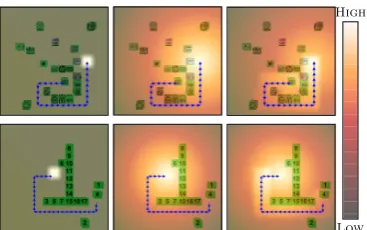
Figure 3: Visualization of the shaping potentials for two tasks. We show demonstrations (blue arrows), but omit instructions. To visualize the potentials intensity, we assume only the target block can be moved, while rewards and potentials are computed for any block movement. We illustrate the sparse problem reward (left column) as a potential function and consider only its positive component, which is focused on the goal. The middle column adds the distance-based potential. The right adds both potentials.
problem reward. The goal is to generate more in-formative updates by adding information to the re-ward. We use this method to leverage the train-ing demonstrations, a common form of supervi-sion for training systems that map language to ac-tions. Reward shaping allows us to fully use this type of supervision in a reinforcement learning framework, and effectively combine learning from demonstrations and exploration.
Adding an arbitrary shaping term can change the optimality of policies and modify the orig-inal problem, for example by making bad poli-cies according to the problem reward optimal ac-cording to the shaped function.3 Ng et al.(1999)
andWiewiora et al.(2003) outline potential-based terms that realize sufficient conditions for safe
shaping.4 Adding a shaping term is safe if the
order of policies according to the shaped reward is identical to the order according to the original problem reward. While safe shaping only applies to optimizing the total reward, we show empiri-cally the effectiveness of the safe shaping terms we design in a contextual bandit setting.
We introduce two shaping terms. The final shaped reward is a sum of them and the problem reward. Similar to the problem reward, we define example-specific shaping terms. We modify the reward function signature as required.
Distance-based Shaping (F1) The first shaping term measures if the agent moved closer to the goal state. We design it to be a safe potential-based
3For example, adding a shaping termF=−Rwill result
in a shaped reward that is always 0, and any policy will be trivially optimal with respect to it.
4For convenience, we briefly overview the theorems ofNg
term (Ng et al.,1999):
F(i)
1 (sj, aj, sj+1) =φ(1i)(sj+1)−φ(1i)(sj) . The potential φ(1i)(s) is proportional to the nega-tive distance from the goal state s(gi). Formally,
φ(1i)(s) =−ηks−s(gi)k, where η is a constant
scaling factor, andk.kis a distance metric. In the block world, the distance between two states is the sum of the Euclidean distances between the posi-tions of each block in the two states, andη is the inverse of block width. The middle column in Fig-ure3visualizes the potentialφ(1i).
Trajectory-based Shaping (F2) Distance-based shaping may lead the agent to sub-optimal states, for example when an obstacle blocks the direct path to the goal state, and the agent must temporarily increase its distance from the goal to bypass it. We incorporate complete trajectories by using a simplification of the shaping term introduced by Brys et al. (2015). Unlike F1, it requires access to the previous state and action. It is based on the look-back advice shaping term of Wiewiora et al. (2003), who introduced safe potential-based shaping that considers the previous state and action. The second term is:
F2(i)(sj−1, aj−1, sj, aj) =φ2(i)(sj, aj)−φ2(i)(sj−1, aj−1) .
Given e¯(i) = h(s1, a1), . . . ,(sm, am)i, to com-pute the potentialφ(2i)(s, a), we identify the closest statesj ine¯(i)tos. Ifηksj−sk<1andaj =a,
φ2(i)(s, a) = 1.0, elseφ2(i)(s, a) =−δf, whereδf
is a penalty parameter. We use the same distance computation and parameterη as inF1. When the agent is in a state close to a demonstration state, this term encourages taking the action taken in the related demonstration state. The right column in Figure3visualizes the effect of the potentialφ(2i). 7 Experimental Setup
Environment We use the environment of Bisk et al.(2016). The original task required predicting the source and target positions for a single block given an instruction. In contrast, we address the task of moving blocks on the plane to execute in-structions given visual input. This requires gen-erating the complete sequence of actions needed to complete the instruction. The environment con-tains up to 20 blocks marked with logos or digits. Each block can be moved in four directions. In-cluding the STOP action, in each step, the agent selects between 81 actions. The set of actions is constant and is not limited to the blocks present.
The transition function is deterministic. The size of each block step is 0.04 of the board size. The agent observes the board from above. We adopt a relatively challenging setup with a large action space. While a simpler setup, for example decom-posing the problem to source and target prediction and using a planner, is likely to perform better, we aim to minimize task-specific assumptions and en-gineering of separate modules. However, to better understand the problem, we also report results for the decomposed task with a planner.
Data Bisk et al.(2016) collected a corpus of in-structions paired with start and goal states. Fig-ure 1 shows example instructions. The original data includes instructions for moving one block or multiple blocks. Single-block instructions are rel-atively similar to navigation instructions and re-ferring expressions. While they present much of the complexity of natural language understanding and grounding, they rarely display the planning complexity of multi-block instructions, which are beyond the scope of this paper. Furthermore, the original data does not include demonstrations. While generating demonstrations for moving a single block is straightforward, disambiguating action ordering when multiple blocks are moved is challenging. Therefore, we focus on instructions where a single block changes its position between the start and goal states, and restrict demonstra-tion generademonstra-tion to move the changed block. The remaining data, and the complexity it introduces, provide an important direction for future work.
To create demonstrations, we compute the shortest paths. While this process may introduce noise for instructions that specify specific trajecto-ries (e.g.,move SRI two steps north and . . .) rather than only describing the goal state, analysis of the data shows this issue is limited. Out of 100 sam-pled instructions, 92 describe the goal state rather than the trajectory. A secondary source of noise is due to discretization of the state space. As a re-sult, the agent often can not reach the exact target position. The demonstrations error illustrates this problem (Table3). To provide task completion re-ward during learning, we relax the state compari-son, and consider states to be equal if the sum of block distances is under the size of one block.
SAIL Blocks Number of instructions 3,237 16,767 Mean instruction length 7.96 15.27
[image:8.595.97.268.61.114.2]Vocabulary 563 1,426 Mean trajectory length 3.12 15.4
Table 1: Corpus statistics for the block environment we use and the SAIL navigation domain.
et al.,2006;Chen and Mooney,2011). While the SAIL agent only observes its immediate surround-ings, overall the blocks domain provides more complex instructions. Furthermore, the SAIL en-vironment includes only 400 states, which is in-sufficient for generalization with vision input. We compare to other data sets in AppendixD.
Evaluation We evaluate task completion error as the sum of Euclidean distances for each block between its position at the end of the execution and in the gold goal state. We divide distances by block size to normalize for the image size. In contrast, Bisk et al.(2016) evaluate the selection of the source and target positions independently.
Systems We report performance of ablations, the upper bound of following the demonstrations (Demonstrations), and five baselines: (a) STOP: the agent immediately stops, (b) RANDOM: the agent takes random actions, (c) SUPERVISED: su-pervised learning with maximum-likelihood es-timate using demonstration state-action pairs, (d) DQN: deep Q-learning with both shaping terms (Mnih et al.,2015), and (e) REINFORCE: policy gradient with cumulative episodic reward with both shaping terms (Sutton et al.,1999). Full system details are given in AppendixB.
Parameters and Initialization Full details are in AppendixC. We considerK = 4previous im-ages, and horizon lengthJ = 40. We initialize our model with the SUPERVISEDmodel.
8 Results
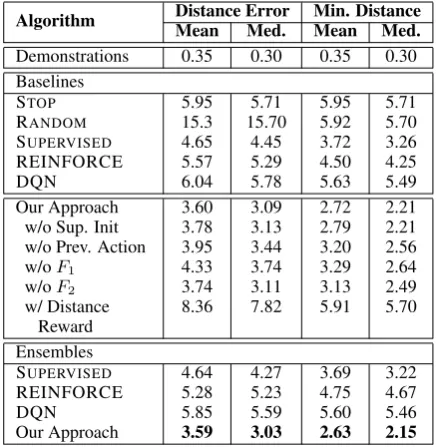
Table2shows development results. We run each experiment three times and report the best result. The RANDOM and STOP baselines illustrate the task complexity of the task. Our approach, includ-ing both shapinclud-ing terms in a contextual bandit set-ting, significantly outperforms the other methods. SUPERVISEDlearning demonstrates lower perfor-mance. A likely explanation is test-time execution errors leading to unfamiliar states with poor later performance (Kakade and Langford,2002), a form of the covariate shift problem. The low perfor-mance of REINFORCE and DQN illustrates the challenge of general reinforcement learning with limited data due to relatively high sample
com-Algorithm Distance ErrorMean Med. Min. DistanceMean Med.
Demonstrations 0.35 0.30 0.35 0.30 Baselines
STOP 5.95 5.71 5.95 5.71
RANDOM 15.3 15.70 5.92 5.70
SUPERVISED 4.65 4.45 3.72 3.26
REINFORCE 5.57 5.29 4.50 4.25
DQN 6.04 5.78 5.63 5.49
Our Approach 3.60 3.09 2.72 2.21 w/o Sup. Init 3.78 3.13 2.79 2.21 w/o Prev. Action 3.95 3.44 3.20 2.56
w/oF1 4.33 3.74 3.29 2.64
w/oF2 3.74 3.11 3.13 2.49
w/ Distance 8.36 7.82 5.91 5.70 Reward
Ensembles
SUPERVISED 4.64 4.27 3.69 3.22
REINFORCE 5.28 5.23 4.75 4.67
DQN 5.85 5.59 5.60 5.46
[image:8.595.307.526.62.286.2]Our Approach 3.59 3.03 2.63 2.15
Table 2: Mean and median (Med.) development results.
Algorithm Distance ErrorMean Med. Min. DistanceMean Med.
Demonstrations 0.37 0.31 0.37 0.31
STOP 6.23 6.12 6.23 6.12
RANDOM 15.11 15.35 6.21 6.09
Ensembles
SUPERVISED 4.95 4.53 3.82 3.33
REINFORCE 5.69 5.57 5.11 4.99
DQN 6.15 5.97 5.86 5.77
Our Approach 3.78 3.14 2.83 2.07
Table 3: Mean and median (Med.) test results. plexity (Kearns et al.,1999;Krishnamurthy et al.,
2016). We also report results using ensembles of the three models.
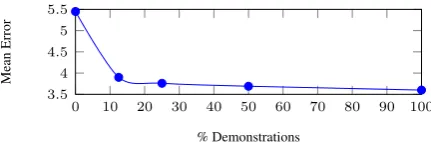
We ablate different parts of our approach. Ab-lations of supervised initialization (our approach w/o sup. init) or the previous action (our ap-proach w/o prev. action) result in increase in er-ror. While the contribution of initialization is mod-est, it provides faster learning. On average, af-ter two epochs, we observe an error of3.94with initialization and 6.01 without. We hypothesize that theF2 shaping term, which uses full demon-strations, helps to narrow the gap at the end of learning. Without supervised initialization andF2, the error increases to 5.45 (the 0% point in Fig-ure4). We observe the contribution of each shap-ing term and their combination. To study the bene-fit of potential-based shaping, we experiment with a negative distance-to-goal reward. This reward replaces the problem reward and encourages get-ting closer to the goal (our approach w/distance reward). With this reward, learning fails to con-verge, leading to a relatively high error.
0 10 20 30 40 50 60 70 80 90 100 3.5
4 4.5 5 5.5
% Demonstrations
Mean
[image:9.595.75.291.65.136.2]Error
Figure 4: Mean distance error as a function of the ratio of training examples that include complete trajectories. The rest of the data includes the goal state only. amount of supervision. We remove demonstra-tions from both supervised initialization and the
F2 shaping term. For example, when only 25% are available, only 25% of the data is available for initialization and the F2 term is only present for this part of the data. While some demonstrations are necessary for effective learning, we get most of the benefit with only 12.5%.
Table 3provides test results, using the ensem-bles to decrease the risk of overfitting the develop-ment. We observe similar trends to development result with our approach outperforming all base-lines. The remaining gap to the demonstrations upper bound illustrates the need for future work.
To understand performance better, we measure
minimal distance (min. distance in Tables2 and
3), the closest the agent got to the goal. We ob-serve a strong trend: the agent often gets close to the goal and fails to stop. This behavior is also reflected in the number of steps the agent takes. While the mean number of steps in development demonstrations is15.2, the agent generates on av-erage 28.7 steps, and55.2% of the time it takes the maximum number of allowed steps (40). Test-ing on the trainTest-ing data shows an average 21.75
steps and exhausts the number of steps 29.3%of the time. The mean number of steps in training demonstrations is15.5. This illustrates the chal-lenge of learning how to be behave at an absorbing state, which is observed relatively rarely during training. This behavior also shows in our video.5
We also evaluate a supervised learning variant that assumes a perfect planner.6 This setup is
sim-ilar toBisk et al.(2016), except using raw image input. It allows us to roughly understand how well the agent generates actions. We observe a mean error of2.78on the development set, an improve-ment of almost two points over supervised learn-ing with our approach. This illustrates the
com-5https://github.com/clic-lab/blocks 6As there is no sequence of decisions, our reinforcement
approach is not appropriate for the planner experiment. The architecture details are described in AppendixB.
plexity of the complete problem.
We conduct a shallow linguistic analysis to un-derstand the agent behavior with regard to dif-ferences in the language input. As expected, the agent is sensitive to unknown words. For instruc-tions without unknown words, the mean develop-ment error is3.49. It increases to3.97for instruc-tions with a single unknown word, and to4.19for two.7 We also study the agent behavior when
ob-serving new phrases composed of known words by looking at instructions with new n-grams and no unknown words. We observe no significant corre-lation between performance and new bi-grams and tri-grams. We also see no meaningful correlation between instruction length and performance. Al-though counterintuitive given the linguistic com-plexities of longer instructions, it aligns with re-sults in machine translation (Luong et al.,2015).
9 Conclusions
We study the problem of learning to execute in-structions in a situated environment given only raw visual observations. Supervised approaches do not explore adequately to handle test time er-rors, and reinforcement learning approaches re-quire a large number of samples for good conver-gence. Our solution provides an effective combi-nation of both approaches: reward shaping to cre-ate relatively stable optimization in a contextual bandit setting, which takes advantage of a signal similar to supervised learning, with a reinforce-ment basis that admits substantial exploration and easy avenues for smart initialization. This com-bination is designed for a few-samples regime, as we address. When the number of samples is un-bounded, the drawbacks observed in this scenario for optimizing longer term reward do not hold.
Acknowledgments
This research was supported by a Google Fac-ulty Award, an Amazon Web Services Research Grant, and a Schmidt Sciences Research Award. We thank Alane Suhr, Luke Zettlemoyer, and the anonymous reviewers for their helpful feedback, and Claudia Yan for technical help. We also thank the Cornell NLP group and the Microsoft Research Machine Learning NYC group for their support and insightful comments.
7This trend continues, although the number of instructions
References
Alekh Agarwal, Daniel J. Hsu, Satyen Kale, John Langford, Lihong Li, and Robert E. Schapire. 2014. Taming the monster: A fast and simple algorithm for contextual bandits. InProceedings of the Inter-national Conference on Machine Learning.
Jacob Andreas and Dan Klein. 2015. Alignment-based compositional semantics for instruction fol-lowing. InProceedings of the 2015 Conference on Empirical Methods in Natural Language Process-ing. https://doi.org/10.18653/v1/D15-1138. Jacob Andreas, Marcus Rohrbach, Trevor Darrell, and
Dan Klein. 2016a. Learning to compose neu-ral networks for question answering. In Proceed-ings of the 2016 Conference of the North Amer-ican Chapter of the Association for Computa-tional Linguistics: Human Language Technologies.
https://doi.org/10.18653/v1/N16-1181.
Jacob Andreas, Marcus Rohrbach, Trevor Darrell, and Dan Klein. 2016b. Neural module networks. In
Conference on Computer Vision and Pattern Recog-nition.
Stanislaw Antol, Aishwarya Agrawal, Jiasen Lu, Mar-garet Mitchell, Dhruv Batra, C. Lawrence Zitnick, and Devi Parikh. 2015. VQA: Visual question an-swering. InInternational Journal of Computer Vi-sion.
Yoav Artzi, Dipanjan Das, and Slav Petrov. 2014a.
Learning compact lexicons for CCG semantic pars-ing. InProceedings of the 2014 Conference on Em-pirical Methods in Natural Language Processing.
https://doi.org/10.3115/v1/D14-1134.
Yoav Artzi, Maxwell Forbes, Kenton Lee, and Maya Cakmak. 2014b. Programming by demonstration with situated semantic parsing. In AAAI Fall Sym-posium Series.
Yoav Artzi and Luke Zettlemoyer. 2013. Weakly supervised learning of semantic parsers for map-ping instructions to actions. Transactions of the Association of Computational Linguistics 1:49–62.
http://aclweb.org/anthology/Q13-1005.
Peter Auer, Nicolò Cesa-Bianchi, Yoav Freund, and Robert E. Schapire. 2002. The nonstochastic multi-armed bandit problem. SIAM J. Comput.32(1):48– 77.
Yonatan Bisk, Deniz Yuret, and Daniel Marcu. 2016.
Natural language communication with robots. In
Proceedings of the 2016 Conference of the North American Chapter of the Association for Computa-tional Linguistics: Human Language Technologies.
https://doi.org/10.18653/v1/N16-1089.
S.R.K. Branavan, Harr Chen, Luke Zettlemoyer, and Regina Barzilay. 2009. Reinforcement learning for mapping instructions to actions. InProceedings of the Joint Conference of the 47th Annual Meeting of
the ACL and the 4th International Joint Conference on Natural Language Processing of the AFNLP.
http://aclweb.org/anthology/P09-1010.
S.R.K. Branavan, Luke Zettlemoyer, and Regina Barzilay. 2010. Reading between the lines: Learning to map high-level instructions to com-mands. In Proceedings of the 48th Annual Meet-ing of the Association for Computational LMeet-inguis- Linguis-tics.http://aclweb.org/anthology/P10-1129. Tim Brys, Anna Harutyunyan, Halit Bener Suay, Sonia
Chernova, Matthew E. Taylor, and Ann Nowé. 2015. Reinforcement learning from demonstration through shaping. InProceedings of the International Joint Conference on Artificial Intelligence.
David L. Chen and Raymond J. Mooney. 2011. Learn-ing to interpret natural language navigation instruc-tions from observainstruc-tions. InProceedings of the Na-tional Conference on Artificial Intelligence. Wenhu Chen, Aurélien Lucchi, and Thomas Hofmann.
2016. Bootstrap, review, decode: Using out-of-domain textual data to improve image captioning.
CoRRabs/1611.05321.
Xinlei Chen, Hao Fang, Tsung-Yi Lin, Ramakr-ishna Vedantam, Saurabh Gupta, Piotr Dollár, and C. Lawrence Zitnick. 2015. Microsoft COCO cap-tions: Data collection and evaluation server. CoRR
abs/1504.00325.
Kevin Clark and D. Christopher Manning. 2016. Deep reinforcement learning for mention-ranking coref-erence models. In Proceedings of the 2016 Con-ference on Empirical Methods in Natural Language Processing.http://aclweb.org/anthology/D16-1245. Jeffrey L. Elman. 1990. Finding structure in time.
Cognitive Science14:179–211.
Ji He, Jianshu Chen, Xiaodong He, Jianfeng Gao, Lihong Li, Li Deng, and Mari Ostendorf. 2016.
Deep reinforcement learning with a natural lan-guage action space. In Proceedings of the 54th Annual Meeting of the Association for Compu-tational Linguistics (Volume 1: Long Papers).
https://doi.org/10.18653/v1/P16-1153.
Sepp Hochreiter and Jürgen Schmidhuber. 1997. Long short-term memory.Neural computation9.
Justin Johnson, Bharath Hariharan, Laurens van der Maaten, Li Fei-Fei, C. Lawrence Zitnick, and Ross B. Girshick. 2016. CLEVR: A diagnostic dataset for compositional language and elementary visual reasoning. CoRRabs/1612.06890.
Michael Kearns, Yishay Mansour, and Andrew Y. Ng. 1999. A sparse sampling algorithm for near-optimal planning in large markov decision processes. In
Proeceediings of the International Joint Conference on Artificial Intelligence.
Joohyun Kim and Raymond Mooney. 2012. Unsu-pervised PCFG induction for grounded language learning with highly ambiguous supervision. In
Proceedings of the 2012 Joint Conference on Em-pirical Methods in Natural Language Processing and Computational Natural Language Learning.
http://aclweb.org/anthology/D12-1040.
Joohyun Kim and Raymond Mooney. 2013. Adapt-ing discriminative rerankAdapt-ing to grounded lan-guage learning. In Proceedings of the 51st Annual Meeting of the Association for Compu-tational Linguistics (Volume 1: Long Papers).
http://aclweb.org/anthology/P13-1022.
Diederik Kingma and Jimmy Ba. 2014. Adam: A method for stochastic optimization. InProceedings of the International Conference on Learning Repre-sentations.
Jens Kober, J. Andrew Bagnell, and Jan Peters. 2013. Reinforcement learning in robotics: A survey. In-ternational Journal of Robotics Research32:1238– 1274.
Akshay Krishnamurthy, Alekh Agarwal, and John Langford. 2016. PAC reinforcement learning with rich observations. In Advances in Neural Informa-tion Processing Systems.
John Langford and Tong Zhang. 2007. The epoch-greedy algorithm for multi-armed bandits with side information. In Advances in Neural Information Processing Systems 20, Proceedings of the Twenty-First Annual Conference on Neural Information Processing Systems, Vancouver, British Columbia, Canada, December 3-6, 2007.
Sergey Levine, Chelsea Finn, Trevor Darrell, and Pieter Abbeel. 2016. End-to-end training of deep visuo-motor policies. Journal of Machine Learning Re-search17.
Jiwei Li, Will Monroe, Alan Ritter, Dan Jurafsky, Michel Galley, and Jianfeng Gao. 2016. Deep re-inforcement learning for dialogue generation. In
Proceedings of the 2016 Conference on Empir-ical Methods in Natural Language Processing.
http://aclweb.org/anthology/D16-1127.
Thang Luong, Hieu Pham, and Christopher D. Manning. 2015. Effective approaches to attention-based neural machine translation. In
Proceedings of the Conference on Empiri-cal Methods in Natural Language Processing.
http://aclweb.org/anthology/D15-1166.
Matthew MacMahon, Brian Stankiewics, and Ben-jamin Kuipers. 2006. Walk the talk: Connecting
language, knowledge, action in route instructions. In Proceedings of the National Conference on Ar-tificial Intelligence.
Cynthia Matuszek, Dieter Fox, and Karl Koscher. 2010. Following directions using statistical machine translation. InProceedings of the international con-ference on Human-robot interaction.
Cynthia Matuszek, Evan Herbst, Luke S. Zettlemoyer, and Dieter Fox. 2012. Learning to parse natural lan-guage commands to a robot control system. In Pro-ceedings of the International Symposium on Experi-mental Robotics.
Hongyuan Mei, Mohit Bansal, and R. Matthew Walter. 2016. What to talk about and how? selective gener-ation using lstms with coarse-to-fine alignment. In
Proceedings of the 2016 Conference of the North American Chapter of the Association for Computa-tional Linguistics: Human Language Technologies.
https://doi.org/10.18653/v1/N16-1086.
Dipendra K. Misra, Jaeyong Sung, Kevin Lee, and Ashutosh Saxena. 2016. Tell me dave: Context-sensitive grounding of natural language to manip-ulation instructions. The International Journal of Robotics Research35(1-3):281–300.
Kumar Dipendra Misra, Kejia Tao, Percy Liang, and Ashutosh Saxena. 2015. Environment-driven lexi-con induction for high-level instructions. In Pro-ceedings of the 53rd Annual Meeting of the As-sociation for Computational Linguistics and the 7th International Joint Conference on Natural Language Processing (Volume 1: Long Papers).
https://doi.org/10.3115/v1/P15-1096.
Volodymyr Mnih, Adrià Puigdomènech Badia, Mehdi Mirza, Alex Graves, Timothy P. Lillicrap, Tim Harley, David Silver, and Koray Kavukcuoglu. 2016. Asynchronous methods for deep reinforce-ment learning. InProceedings of the International Conference on Machine Learning.
Volodymyr Mnih, Koray Kavukcuoglu, David Silver, Alex Graves, Ioannis Antonoglou, Daan Wierstra, and Martin A. Riedmiller. 2013. Playing atari with deep reinforcement learning. InAdvances in Neural Information Processing Systems.
Volodymyr Mnih, Koray Kavukcuoglu, David Silver, Andrei A Rusu, Joel Veness, Marc G Bellemare, Alex Graves, Martin Riedmiller, Andreas K Fidje-land, and Georg Ostrovski. 2015. Human-level con-trol through deep reinforcement learning. Nature
518(7540).
Karthik Narasimhan, Tejas Kulkarni, and Regina Barzilay. 2015. Language understanding for text-based games using deep reinforcement learning. In Proceedings of the 2015 Conference on Em-pirical Methods in Natural Language Processing.
Karthik Narasimhan, Adam Yala, and Regina Barzi-lay. 2016. Improving information extraction by ac-quiring external evidence with reinforcement learn-ing. InProceedings of the 2016 Conference on Em-pirical Methods in Natural Language Processing.
http://aclweb.org/anthology/D16-1261.
Andrew Y. Ng, Daishi Harada, and Stuart J. Russell. 1999. Policy invariance under reward transforma-tions: Theory and application to reward shaping. In
Proceedings of the International Conference on Ma-chine Learning.
Junhyuk Oh, Valliappa Chockalingam, Satinder P. Singh, and Honglak Lee. 2016. Control of mem-ory, active perception, and action in minecraft. In
Proceedings of the International Conference on Ma-chine Learning.
Rohan Paul, Jacob Arkin, Nicholas Roy, and Thomas M. Howard. 2016. Efficient grounding of abstract spatial concepts for natural language inter-action with robot manipulators. In Robotics: Sci-ence and Systems.
Andrei A. Rusu, Matej Vecerik, Thomas Rothörl, Nico-las Heess, Razvan Pascanu, and Raia Hadsell. 2016. Sim-to-real robot learning from pixels with progres-sive nets. CoRR.
John Schulman, Sergey Levine, Philipp Moritz, Michael I. Jordan, and Pieter Abbeel. 2015. Trust region policy optimization .
David Silver, Aja Huang, Chris J Maddison, Arthur Guez, Laurent Sifre, George van den Driessche, Ju-lian Schrittwieser, Ioannis Antonoglou, Veda Pan-neershelvam, Marc Lanctot, Sander Dieleman, Do-minik Grewe, John Nham, Nal Kalchbrenner, Ilya Sutskever, Timothy Lillicrap, Madeleine Leach, Ko-ray Kavukcuoglu, Thore Graepel, and Demis Hass-abis. 2016. Mastering the game of go with deep neu-ral networks and tree search. Nature529 7587:484– 9.
Alane Suhr, Mike Lewis, James Yeh, and Yoav Artzi. 2017. A corpus of compositional language for vi-sual reasoning. InProceedings of the 55th Annual Meeting of the Association for Computational Lin-guistics. Association for Computational Linguistics. Jaeyong Sung, Seok Hyun Jin, and Ashutosh Sax-ena. 2015. Robobarista: Object part based trans-fer of manipulation trajectories from crowd-sourcing in 3d pointclouds. In International Symposium on Robotics Research.
Richard S. Sutton and Andrew G. Barto. 1998. Rein-forcement learning: An introduction. IEEE Trans. Neural Networks9:1054–1054.
Richard S. Sutton, David A. McAllester, Satinder P. Singh, and Yishay Mansour. 1999. Policy gradi-ent methods for reinforcemgradi-ent learning with func-tion approximafunc-tion. In Advances in Neural Infor-mation Processing Systems.
Stefanie Tellex, Thomas Kollar, Steven Dickerson, Matthew Walter, Ashis G. Banerjee, Seth Teller, and Nicholas Roy. 2011. Understanding natural lan-guage commands for robotic navigation and mobile manipulation. InProceedings of the National Con-ference on Artificial Intelligence.
Adam Vogel and Daniel Jurafsky. 2010. Learn-ing to follow navigational directions. In
Proceedings of the 48th Annual Meeting of the Association for Computational Linguistics.
http://aclweb.org/anthology/P10-1083.
Bonnie Webber, Norman Badler, Barbara Di Euge-nio, Christopher Geib, Libby Levison, and Michael Moore. 1995. Instructions, intentions and expecta-tions.Artificial Intelligence73(1):253–269. Eric Wiewiora, Garrison W. Cottrell, and Charles
Elkan. 2003. Principled methods for advising re-inforcement learning agents. InProceedings of the International Conference on Machine Learning. Ronald J. Williams. 1992. Simple statistical
gradient-following algorithms for connectionist reinforce-ment learning. Machine Learning8.
Ronald J Williams and Jing Peng. 1991. Function opti-mization using connectionist reinforcement learning algorithms.Connection Science3(3):241–268. Terry Winograd. 1972. Understanding natural
lan-guage. Cognitive Psychology3(1):1–191.
Kelvin Xu, Jimmy Ba, Jamie Ryan Kiros, Kyunghyun Cho, Aaron C. Courville, Ruslan Salakhutdinov, Richard S. Zemel, and Yoshua Bengio. 2015. Show, attend and tell: Neural image caption generation with visual attention. In Proceedings of the Inter-national Conference on Machine Learning.