Task-Oriented Query Reformulation with Reinforcement Learning
Rodrigo Nogueira
Tandon School of Engineering New York University [email protected]
Kyunghyun Cho
Courant Institute of Mathematical Sciences Center for Data Science
New York University [email protected]
Abstract
Search engines play an important role in our everyday lives by assisting us in find-ing the information we need. When we input a complex query, however, results are often far from satisfactory. In this work, we introduce a query reformula-tion system based on a neural network that rewrites a query to maximize the number of relevant documents returned. We train this neural network with reinforcement learning. The actions correspond to select-ing terms to build a reformulated query, and the reward is the document recall. We evaluate our approach on three datasets against strong baselines and show a rel-ative improvement of 5-20% in terms of recall. Furthermore, we present a simple method to estimate a conservative upper-bound performance of a model in a partic-ular environment and verify that there is still large room for improvements.
1 Introduction
Search engines help us find what we need among the vast array of available data. When we request some information using a long or inexact descrip-tion of it, these systems, however, often fail to de-liver relevant items. In this case, what typically follows is an iterative process in which we try to express our need differently in the hope that the system will return what we want. This is a major issue in information retrieval. For instance,Huang and Efthimiadis (2009) estimate that 28-52% of all the web queries are modifications of previous ones.
To a certain extent, this problem occurs be-cause search engines rely on matching words in the query with words in relevant documents, to
q' Scorer
Reformulator
Ground Truth
D'
Search Engine
q' : cancer treatment state-of-the-art frontiers survey
Reward
q0 :What are the most promising directions to cure cancer and why?
[image:1.595.309.522.220.341.2]D0
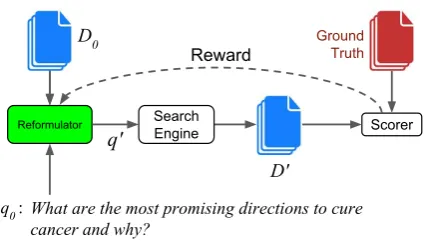
Figure 1: A graphical illustration of the proposed framework for query reformulation. A set of doc-umentsD0is retrieved from a search engine using
the initial queryq0. Our reformulator selects terms
fromq0 andD0 to produce a reformulated query q0 which is then sent to the search engine.
Docu-mentsD0 are returned, and a reward is computed
against the set of ground-truth documents. The re-formulator is trained with reinforcement learning to produce a query, or a series of queries, to maxi-mize the expected return.
perform retrieval. If there is a mismatch between them, a relevant document may be missed.
One way to address this problem is to automati-cally rewrite a query so that it becomes more likely to retrieve relevant documents. This technique is known asautomatic query reformulation. It typi-cally expands the original query by adding terms from, for instance, dictionaries of synonyms such as WordNet (Miller,1995), or from the initial set of retrieved documents (Xu and Croft,1996). This latter type of reformulation is known as pseudo (or blind) relevance feedback (PRF), in which the rel-evance of each term of the retrieved documents is automatically inferred.
The proposed method is built on top of PRF but differs from previous works as we frame the query
reformulation problem as a reinforcement learn-ing (RL) problem. An initial query is the natural language expression of the desired goal, and an agent (i.e. reformulator)learnsto reformulate an initial query to maximize the expected return (i.e. retrieval performance) through actions (i.e. select-ing terms for a new query). The environment is a search engine which produces a new state (i.e. re-trieved documents). Our framework is illustrated in Fig.1.
The most important implication of this frame-work is that a search engine is treated as ablack boxthat an agent learns to use in order to retrieve more relevant items. This opens the possibility of training an agent to use a search engine for a task other than the one it was originally intended for. To support this claim, we evaluate our agent on the task of question answering (Q&A), citation recommendation, and passage/snippet retrieval.
As for training data, we use two publicly avail-able datasets (TREC-CAR and Jeopardy) and in-troduce a new one (MS Academic) with hundreds of thousands of query/relevant document pairs from the academic domain.
Furthermore, we present a method to estimate the upper bound performance of our RL-based model. Based on the estimated upper bound, we claim that this framework has a strong potential for future improvements.
Here we summarize our main contributions:
• A reinforcement learning framework for au-tomatic query reformulation.
• A simple method to estimate the upper-bound performance of an RL-based model in a given environment.
• A new large dataset with hundreds of thou-sands ofquery/relevant documentpairs.1
2 A Reinforcement Learning Approach 2.1 Model Description
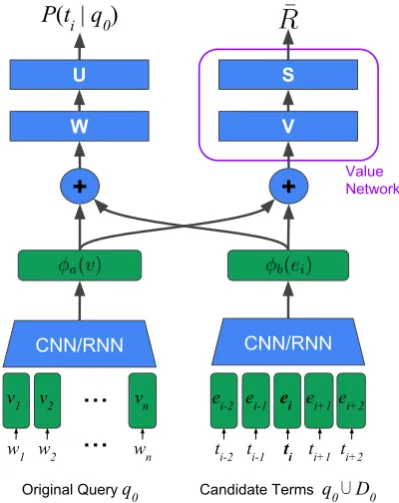
In this section we describe the proposed method, illustrated in Fig.2.
The inputs are a query q0 consisting of a
se-quence of words(w1, ..., wn)and a candidate term tiwith some context words(ti−k, ..., ti+k), where k≥0is the context window size. Candidate terms 1The dataset and code to run the experiments are available at https://github.com/nyu-dl/ QueryReformulator.
CNN/RNN CNN/RNN
Candidate Terms q0 ⋃D0
Original Query q0
W P(ti| q0)
+
U
V
+
S
v
1 v2
...
vn ei-2 ei-1 ei ei+1ei+2Value Network
[image:2.595.319.519.66.318.2]w1 w2
...
wn ti-2 ti-1 ti ti+1 ti+2Figure 2: An illustration of our neural network-based reformulator.
are from q0 ∪D0, the union of the terms in the
original query and those from the documents D0
retrieved usingq0.
We use a dictionary of pretrained word embed-dings (Mikolov et al., 2013) to convert the sym-bolic terms wj and ti to their vector
representa-tionsvj andei ∈ Rd, respectively. We map
out-of-vocabulary terms to an additional vector that is learned during training.
We convert the sequence {vj} to a fixed-size
vectorφa(v)by using either a Convolutional
Neu-ral Network (CNN) followed by a max pooling op-eration over the entire sequence (Kim,2014) or by using the last hidden state of a Recurrent Neural Network (RNN).2
Similarly, we fed the candidate term vectors
ei to a CNN or RNN to obtain a vector
repre-sentation φb(ei) for each term ti. The
convolu-tional/recurrent layers serve an important role of capturing context information, especially for out-of-vocabulary and rare terms. CNNs can pro-cess candidate terms in parallel, and, therefore, are faster for our application than RNNs. RNNs, on the other hand, can encode longer contexts.
tias:
P(ti|q0) =σ(UTtanh(W(φa(v)kφb(ei)) +b)),
(1) where σ is the sigmoid function, k is the vector concatenation operation,W ∈Rd×2dandU ∈Rd
are weights, andb∈Ris a bias.
At test time, we define the set of terms used in the reformulated query as T = {ti |P(ti|q0) > }, whereis a hyper-parameter. At training time, we sample the terms according to their probability distribution,T ={ti|α= 1∧α∼P(ti|q0)}. We
concatenate the terms inT to form a reformulated queryq0, which will then be used to retrieve a new
set of documentsD0. 2.2 Sequence Generation
One problem with the method previously de-scribed is that terms are selected independently. This may result in a reformulated query that con-tains duplicated terms since the same term can ap-pear multiple times in the feedback documents. Another problem is that the reformulated query can be very long, resulting in a slow retrieval.
To solve these problems, we extend the model to sequentially generate a reformulated query, as pro-posed byBuck et al.(2017). We use a Recurrent Neural Network (RNN) that selects one term at a time from the pool of candidate terms and stops when a special token is selected. The advantage of this approach is that the model can remember the terms previously selected through its hidden state. It can, therefore, produce more concise queries.
We define the probability of selectingti as the
k-th term of a reformulated query as:
P(tki|q0)∝exp(φb(ei)Thk), (2)
wherehkis the hidden state vector at the k-th step,
computed as:
hk = tanh(Waφa(v) +Wbφb(tk−1) +Whhk−1),
(3) where tk−1 is the term selected in the previous
step and Wa ∈ Rd×d, Wb ∈ Rd×d, and Wh ∈
Rd×dare weight matrices. In practice, we use an
LSTM (Hochreiter and Schmidhuber,1997) to en-code the hidden state as this variant is known to perform better than a vanilla RNN.
We avoid normalizing over a large vocabulary by using only terms from the retrieved documents. This makes inference faster and training practi-cal since learning to select words from the whole
vocabulary might be too slow with reinforcement learning, although we leave this experiment for a future work.
2.3 Training
We train the proposed model using REIN-FORCE (Williams, 1992) algorithm. The per-example stochastic objective is defined as
Ca= (R−R¯) X
t∈T
−logP(t|q0), (4)
whereRis the reward andR¯is the baseline, com-puted by the value network as:
¯
R=σ(STtanh(V(φa(v)ke¯) +b)), (5)
where¯e= N1 PNi=1φb(ei),N =|q0∪D0|,V ∈ Rd×2d andS ∈ Rd are weights and b ∈ Ris a
bias. We train the value network to minimize
Cb=α||R−R¯||2, (6)
whereαis a small constant (e.g. 0.1) multiplied to the loss in order to stabilize learning. We conjec-ture that the stability is due to the slowly evolving value network which directly affects the learning of the policy. This effectively prevents the value network to fit extreme cases (unexpectedly high or low reward.)
We minimize Ca and Cb using stochastic
gra-dient descent (SGD) with the gragra-dient computed by backpropagation (Rumelhart et al.,1988). This allows the entire model to be trained end-to-end directly to optimize the retrieval performance.
Entropy Regularization We observed that the probability distribution in Eq.(1) became highly peaked in preliminary experiments. This phe-nomenon led to the trained model not being able to explore new terms that could lead to a better-reformulated query. We address this issue by reg-ularizing the negative entropy of the probability distribution. We add the following regularization term to the original cost function in Eq. (4):
CH =−λ X
t∈q0∪D0
P(t|q0) logP(t|q0), (7)
whereλis a regularization coefficient.
3 Related Work
method, which adjusts a query relative to the doc-uments that initially appear to match the query. In this work, we focus on local methods.
A popular instantiation of a local method is the relevance model, which incorporates pseudo-relevance feedback into a language model form (Lavrenko and Croft, 2001). The proba-bility of adding a term to an expanded query is proportional to its probability of being generated by the language models obtained from the orig-inal query and the document the term occurs in. This framework has the advantage of not requiring
query/relevant documents pairs as training data since inference is based on word co-occurrence statistics.
Unlike the relevance model, algorithms can be trained with supervised learning, as proposed by Cao et al. (2008). A training dataset is auto-matically created by labeling each candidate term as relevant or not based on their individual contri-bution to the retrieval performance. Then a binary classifier is trained to select expansion terms. In Section4, we present a neural network-based im-plementation of this supervised approach.
A generalization of this supervised framework is toiterativelyreformulate the query by selecting one candidate term at each retrieval step. This can be viewed as navigating a graph where the nodes represent queries and associated retrieved results and edges exist between nodes whose queries are simple reformulations of each other (Diaz,2016). However, it can be slow to reformulate a query this way as the search engine must be queried for each newly added term. In our method, on the con-trary, the search engine is queried with multiple new terms at once.
An alternative technique based on supervised learning is to learn a common latent representation of queries and relevant documents terms by us-ing aclick-throughdataset (Sordoni et al.,2014). Neighboring document terms of a query in the la-tent space are selected to form an expanded query. Instead of using aclick-throughdataset, which is often proprietary, it is possible to use an alterna-tive dataset consisting of anchor text/title pairs. In contrast, our approach does not require a dataset of paired queries as it learns term selection strategies via reinforcement learning.
Perhaps the closest work to ours is that by Narasimhan et al. (2016), in which a reinforce-ment learning based approach is used to
reformu-late queries iteratively. A key difference is that in their work the reformulation component uses domain-specific template queries. Our method, on the other hand, assumes open-domain queries.
4 Experiments
In this section we describe our experimental setup, including baselines against which we compare the proposed method, metrics, reward for RL-based models, datasets and implementation details.
4.1 Baseline Methods
Raw: The original query is given to a search engine without any modification. We evaluate two search engines in their default configura-tion: Lucene3 (Raw-Lucene) and Google Search4 (Raw-Google).
Pseudo Relevance Feedback (PRF-TFIDF):
A query is expanded with terms from the docu-ments retrieved by a search engine using the orig-inal query. In this work, the top-N TF-IDF terms from each of the top-K retrieved documents are added to the original query, where N and K are selected by a grid search on the validation data.
PRF-Relevance Model (PRF-RM): This is a popular relevance model for query expansion byLavrenko and Croft(2001). The probability of using a termtin an expanded query is given by:
P(t|q0) = (1−λ)P0(t|q0)
+λ X
d∈D0
P(d)P(t|d)P(q0|d), (8)
where P(d) is the probability of retrieving the documentd, assumed uniform over the set,P(t|d)
andP(q0|d) are the probabilities assigned by the
language model obtained from dto tand q0,
re-spectively.P0(t|q0) = tf(t∈q)
|q| , where tf(t, d)is the
term frequency oftind. We set the interpolation parameter λ to 0.5, following Zhai and Lafferty (2001).
We use a Dirichlet smoothed language model (Zhai and Lafferty, 2001) to compute a language model from a documentd∈D0:
P(t|d) = tf(t, d|) +d|+uPu(t|C), (9)
whereuis a scalar constant (u = 1500in our ex-periments), andP(t|C)is the probability oft oc-curring in the entire corpusC.
We use theN terms with the highestP(t|q0)in
an expanded query, whereNis a hyper-parameter.
Embeddings Similarity: Inspired by the meth-ods proposed byRoy et al.(2016) andKuzi et al. (2016), the top-N terms are selected based on the cosine similarity of their embeddings against the original query embedding. Candidate terms come from documents retrieved using the orig-inal query (PRF-Emb), or from a fixed vocab-ulary (Vocab-Emb). We use pretrained embed-dings from Mikolov et al.(2013), and it contains 374,000 words.
4.2 Proposed Methods
Supervised Learning (SL): Here we detail a deep learning-based variant of the method pro-posed byCao et al.(2008). It assumes that query terms contribute independently to the retrieval per-formance. We thus train a binary classifier to se-lect a term if the retrieval performance increases beyond a preset threshold when that term is added to the original query. More specifically, we mark a term as relevant if(R0−R)/R >0.005, whereR
andR0 are the retrieval performances of the
orig-inal query and the query expanded with the term, respectively.
We experiment with two variants of this method: one in which we use a convolutional net-work for both original query and candidate terms (SL-CNN), and the other in which we replace the convolutional network with a single hidden layer feed-forward neural network (SL-FF). In this vari-ant, we average the output vectors of the neural network to obtain a fixed size representation ofq0. Reinforcement Learning (RL): We use multi-ple variants of the proposed RL method. RL-CNN and RL-RNN are the models described in Sec-tion2.1, in which the former uses CNNs to encode query and term features and the latter uses RNNs (more specifically, bidirectional LSTMs). RL-FF is the model in which term and query vectors are encoded by single hidden layer feed-forward neu-ral networks. In the RL-RNN-SEQ model, we add the sequential generator described in Section 2.2 to the RL-RNN variant.
4.3 Datasets
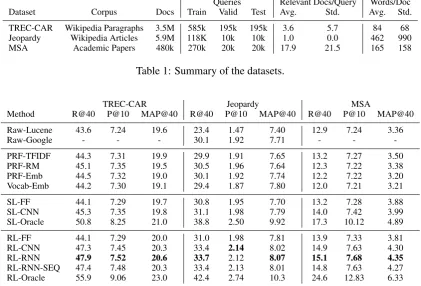
We summarize in Table1the datasets.
TREC - Complex Answer Retrieval (TREC-CAR) This is a publicly available dataset auto-matically created from Wikipedia whose goal is to encourage the development of methods that re-spond to more complex queries with longer an-swers (Dietz and Ben,2017). A query is the con-catenation of an article title and one of its section titles. The ground-truth documents are the para-graphs within that section. For example, a query is “Sea Turtle, Diet” and the ground truth docu-ments are the paragraphs in the section “Diet” of the “Sea Turtle” article. The corpus consists of all the English Wikipedia paragraphs, except the ab-stracts. The released dataset has five predefined folds, and we use the first three as the training set and the remaining two as validation and test sets, respectively.
Jeopardy This is a publicly available Q&A dataset introduced byNogueira and Cho(2016). A query is a question from theJeopardy! TV Show and the corresponding document is a Wikipedia article whose title is the answer. For example, a query is “For the last eight years of his life, Galileo was under house arrest for espousing this mans theory”and the answer is the Wikipedia arti-cle titled“Nicolaus Copernicus”. The corpus con-sists of all the articles in the English Wikipedia.
Microsoft Academic (MSA) This dataset con-sists of academic papers crawled from Microsoft Academic API.5 The crawler started at the pa-perSilver et al.(2016) and traversed the graph of references until 500,000 papers were crawled. We then removed papers that had no reference within or whose abstract had less than 100 characters. We ended up with 480,000 papers.
A query is the title of a paper, and the ground-truth answer consists of the papers cited within. Each document in the corpus consists of its title and abstract.6
4.4 Metrics and Reward
Three metrics are used to evaluate performance:
Recall@K: Recall of the top-K retrieved docu-ments:
R@K= |DK∩D∗|
|D∗| , (10)
5 https://www.microsoft.com/cognitive-services/en-us/academic-knowledge-api
Queries Relevant Docs/Query Words/Doc
Dataset Corpus Docs Train Valid Test Avg. Std. Avg. Std.
TREC-CAR Wikipedia Paragraphs 3.5M 585k 195k 195k 3.6 5.7 84 68 Jeopardy Wikipedia Articles 5.9M 118K 10k 10k 1.0 0.0 462 990
[image:6.595.88.510.63.357.2]MSA Academic Papers 480k 270k 20k 20k 17.9 21.5 165 158
Table 1: Summary of the datasets.
TREC-CAR Jeopardy MSA
Method R@40 P@10 MAP@40 R@40 P@10 MAP@40 R@40 P@10 MAP@40
Raw-Lucene 43.6 7.24 19.6 23.4 1.47 7.40 12.9 7.24 3.36
Raw-Google - - - 30.1 1.92 7.71 - -
-PRF-TFIDF 44.3 7.31 19.9 29.9 1.91 7.65 13.2 7.27 3.50
PRF-RM 45.1 7.35 19.5 30.5 1.96 7.64 12.3 7.22 3.38
PRF-Emb 44.5 7.32 19.0 30.1 1.92 7.74 12.2 7.22 3.20
Vocab-Emb 44.2 7.30 19.1 29.4 1.87 7.80 12.0 7.21 3.21
SL-FF 44.1 7.29 19.7 30.8 1.95 7.70 13.2 7.28 3.88
SL-CNN 45.3 7.35 19.8 31.1 1.98 7.79 14.0 7.42 3.99
SL-Oracle 50.8 8.25 21.0 38.8 2.50 9.92 17.3 10.12 4.89
RL-FF 44.1 7.29 20.0 31.0 1.98 7.81 13.9 7.33 3.81
RL-CNN 47.3 7.45 20.3 33.4 2.14 8.02 14.9 7.63 4.30
RL-RNN 47.9 7.52 20.6 33.7 2.12 8.07 15.1 7.68 4.35
RL-RNN-SEQ 47.4 7.48 20.3 33.4 2.13 8.01 14.8 7.63 4.27
RL-Oracle 55.9 9.06 23.0 42.4 2.74 10.3 24.6 12.83 6.33
Table 2: Results on Test sets. We use R@40 as a reward to the RL-based models.
whereDKare the top-Kretrieved documents and D∗ are the relevant documents. Since one of the
goals of query reformulation is to increase the pro-portion of relevant documents returned, recall is our main metric.
Precision@K: Precision of the top-K retrieved documents:
P@K = |DK|D∩D∗|
K| (11)
Precision captures the proportion of relevant doc-uments among the returned ones. Despite not be-ing the main goal of a reformulation method, im-provements in precision are also expected with a good query reformulation method. Therefore, we include this metric.
Mean Average Precision: The average preci-sion of the top-K retrieved documents is defined as:
AP@K =
PK
k=1P@k×rel(k)
|D∗| , (12)
where
rel(k) = (
1, if the k-th document is relevant;
0, otherwise.
(13)
The mean average precision of a set of queriesQ
is then:
MAP@K = |Q1|X q∈Q
AP@Kq, (14)
where AP@Kqis the average precision atK for a
queryq. This metric values the position of a rele-vant document in a returned list and is, therefore, complementary to precision and recall.
Reward We use R@K as a reward when train-ing the proposed RL-based models as this metric has shown to be effective in improving the other metrics as well.
[image:6.595.88.510.65.351.2]TREC-CAR Jeopardy MSA
SL-Oracle 13% 5% 11%
[image:7.595.79.287.63.108.2]RL-Oracle 29% 27% 31%
Table 3: Percentage of relevant terms over all the candidate terms according to SL- and RL-Oracle.
RL-Oracle Second, we introduce a reinforce-ment learning oracle (RL-Oracle) which estimates a conservative upper-bound performance for the RL models. Unlike the SL-Oracle, it does not assume that each term contributes independently to the retrieval performance. It works as follows: first, the validation or test set is divided into N
small subsets{Ai}Ni=1 (each with 100 examples,
for instance). An RL model is trained on each sub-setAi until it overfits, that is, until the rewardR∗i
stops increasing or an early stop mechanism ends training.7 Finally, we compute the oracle perfor-manceR∗ as the average reward over all the
sub-sets:R∗= 1
N
PN
i=1R∗i.
This upper bound by the RL-Oracle is, however, conservative since there might exist better refor-mulation strategies that the RL model was not able to discover.
4.5 Implementation Details
Search engine We use Lucene and BM25 as the search engine and the ranking function, respec-tively, for all PRF, SL and RL methods. For Raw-Google, we restrict the search to thewikipedia.org
domain when evaluating its performance on the Jeopardy dataset. We could not apply the same re-striction to the two other datasets as Google does not index Wikipedia paragraphs, and as it is not trivial to match papers from MS Academic to the ones returned by Google Search.
Candidate terms We use Wikipedia articles as a source for candidate terms since it is a well cu-rated, clean corpus, with diverse topics.
At training and test times of SL methods, and at test time of RL methods, the candidate terms are from the first M words of the top-K
Wikipedia articles retrieved. We select M and
K using grid search on the validation set over
{50,100,200,300} and {1,3,5,7}, respectively. The best values areM = 300andK = 7. These correspond to the maximum number of terms we could fit in a single GPU.
7The subset should be small enough, or the model should be large enough so it can overfit.
Figure 3: Our RL-based model continues to im-prove recall as more candidate terms are added, whereas a classical PRF method saturates.
At training time of an RL model, we use only
onedocument uniformly sampled from the top-K
retrieved ones as a source for candidate terms, as this leads to a faster learning.
For the PRF methods, the top-M terms ac-cording to a relevance metric (i.e., TF-IDF for PRF-TFIDF, cosine similarity for PRF-Emb, and conditional probability for PRF-RM) from each of the top-K retrieved documents are added to the original query. We select M and K using grid search over {10,50,100,200,300,500} and
{1,3,5,9,11}, respectively. The best values are
M = 300andK= 9.
Multiple Reformulation Rounds Although our framework supports multiple rounds of search and reformulation, we did not find any significant im-provement in reformulating a query more than once. Therefore, the numbers reported in the re-sults section were all obtained from models run-ning two rounds of search and reformulation.
Neural Network Setup For SL-CNN and RL-CNN variants, we use a 2-layer convolutional net-work for the original query. Each layer has a win-dow size of 3 and 256 filters. We use a 2-layer con-volutional network for candidate terms with win-dow sizes of 9 and 3, respectively, and 256 filters in each layer. We set the dimensiondof the weight matrices W, S, U, and V to 256. For the opti-mizer, we use ADAM (Kingma and Ba,2014) with
α = 10−4,β1 = 0.9,β2 = 0.999, and= 10−8.
We set the entropy regularization coefficientλto
10−3.
[image:7.595.314.517.68.180.2]number of generated terms to 50 and we use beam search of size four at test time.
We fix the dictionary of pre-trained word em-beddings during training, except the vector for out-of-vocabulary words. We found that this led to faster convergence and observed no difference in the overall performance when compared to learn-ing embeddlearn-ings durlearn-ing trainlearn-ing.
5 Results and Discussion
Table 2 shows the main result. As expected, re-formulation based methods work better than us-ing the original query alone. Supervised methods (SL-FF and SL-CNN) have in general a better per-formance than unsupervised ones (PRF-TFIDF, PRF-RM, PRF-Emb, and Emb-Vocab), but per-form worse than based models (FF, RL-CNN, RL-RNN, and RL-RNN-SEQ).
RL-RNN-SEQ performs slightly worse than RL-RNN but produces queries that are three times shorter, on average (15 vs 47 words). Thus, RL-RNN-SEQ is faster in retrieving documents and therefore might be a better candidate for a produc-tion implementaproduc-tion.
The performance gap between the oracle and best performing method (Table 2, RL-Oracle vs. RL-RNN) suggests that there is a large room for improvement. The cause for this gap is unknown but we suspect, for instance, an inherent difficulty in learning a good selection strategy and the par-tial observability from using a black box search engine.
5.1 Relevant Terms per Document
The proportion of relevant terms selected by the SL- and RL-Oracles over the total number of can-didate terms (Table3) indicates that only a small subset of terms are useful for the reformulation. Thus, we may conclude that the proposed method was able to learn an efficient term selection strat-egy in an environment where relevant terms are infrequent.
5.2 Scalability: Number of Terms vs Recall
Fig. 3 shows the improvement in recall as more candidate terms are provided to a reformulation method. The RL-based model benefits from more candidate terms, whereas the classical PRF method quickly saturates. In our experiments, the best performing RL-based model uses the maxi-mum number of candidate terms that we could fit
Query Top-3 Retrieved Documents (Original)The Cross -The Cross Entropy Method Entropy Method for for Network Reliability Estim. Fast Policy Search -Robot Weightlifting by
Direct Policy Search
-Off-policy Policy Search (Reformulated)Cross -Near Optimal Reinforcement
Entropy Fast Policy Learning in Polynom. Time
Reinforcement -The Cross Entropy Method Learning policies for Network Reliability Estim. global search -Robot Weightlifting by
optimization biased Direct Policy Search
(Original)Daikon “...many types of pickles are Cultivation made with daikon, includ...” “Certain varieties of daikon can be grown as a winter...” “In Chinese cuisine, turnip cake and chai tow kway...” (Reformulated)Daikon “...many types of pickles are Cultivation root seed “made with daikon, includ...” grow fast-growing “Certain varieties of daikon
Chinese leaves can be grown as a winter...” “The Chinese and Indian varieties tolerate higher....”
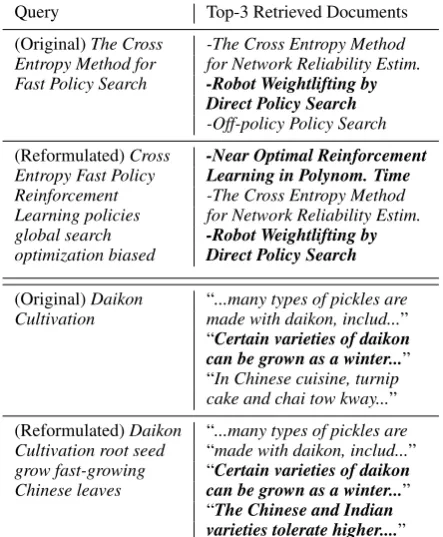
Table 4: Top-3 retrieved documents using the orig-inal query and a query reformulated by our RL-CNN model. In the first example, we only show the titles of the retrieved MSA papers. In the second example, we only show some words of the retrieved TREC-CAR paragraphs. Bold cor-responds to ground-truth documents.
on a single GPU. We, therefore, expect further im-provements with more computational resources.
5.3 Qualitative Analysis
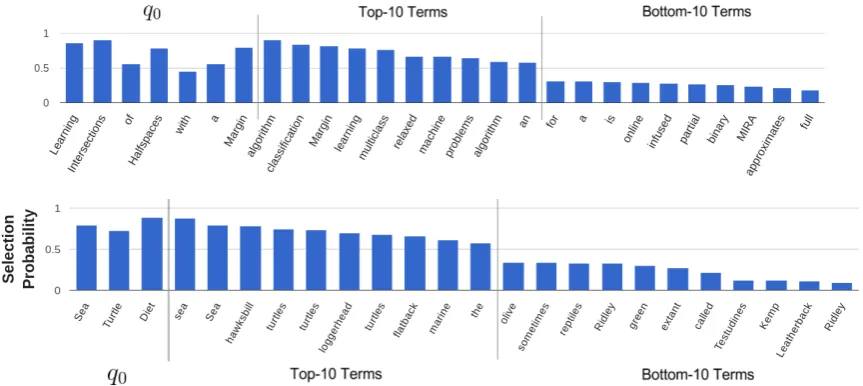
We show two examples of queries and the proba-bilities of each candidate term of being selected by the RL-CNN model in Fig.4.
Notice that terms that are more related to the query have higher probabilities, although common words such as ”the” are also selected. This is a consequence of our choice of a reward that does
Trained on Selected Terms
TREC-CAR serves american national Winsted accreditation
Jeopardy Tunxis Quinebaug Winsted NCCC MSA hospital library arts center cancer center
summer programs
[image:8.595.306.528.62.331.2]Figure 4: Probabilities assigned by the RL-CNN to candidate terms of two sample queries: “Learning Intersections of Halfspaces with a Margin” (top) and “Sea Turtle Diet” (bottom). We show the original query terms and the top-10 and bottom-10 document terms with respect to their probabilities.
not penalize the selection of neutral terms. In Table 4 we show an original and reformu-lated query examples extracted from the MS Aca-demic and TREC-CAR datasets, and their top-3 retrieved documents. Notice that the reformulated query retrieves more relevant documents than the original one. As we conjectured earlier, we see that a search engine tends to return a document simply with the largest overlap in the text, neces-sitating the reformulation of a query to retrieve se-mantically relevant documents.
Same query, different tasks We compare in Ta-ble5the reformulation of a sample query made by models trained on different datasets. The model trained on TREC-CAR selects terms that are sim-ilar to the ones in the original query, such as “serves” and “accreditation”. These selections are expected for this task since similar terms can be effective in retrieving similar paragraphs. On the other hand, the model trained on Jeopardy prefers to select proper nouns, such as “Tunxis”, as these have a higher chance of being an answer to the question. The model trained on MSA selects terms that cover different aspects of the entity being queried, such as “arts center” and “library”, since retrieving a diverse set of documents is necessary for the task the of citation recommendation.
5.4 Training and Inference Times
Our best model, RL-RNN, takes 8-10 days to train on a single K80 GPU. At inference time, it takes
approximately one second to reformulate a batch of 64 queries. Approximately 40% of this time is to retrieve documents from the search engine.
6 Conclusion
We introduced a reinforcement learning frame-work for task-oriented automatic query reformu-lation. An appealing aspect of this framework is that an agent can be trained to use a search en-gine for a specific task. The empirical evaluation has confirmed that the proposed approach outper-forms strong baselines in the three separate tasks. The analysis based on two oracle approaches has revealed that there is a meaningful room for fur-ther development. In the future, more research is necessary in the directions of (1) iterative refor-mulation under the proposed framework, (2) using information from modalities other than text, and (3) better reinforcement learning algorithms for a partially-observable environment.
Acknowledgements
References
Christian Buck, Jannis Bulian, Massimiliano Cia-ramita, Andrea Gesmundo, Neil Houlsby, Wojciech Gajewski, and Wei Wang. 2017. Ask the right ques-tions: Active question reformulation with reinforce-ment learning. arXiv preprint arXiv:1705.07830. Guihong Cao, Jian-Yun Nie, Jianfeng Gao, and
Stephen Robertson. 2008. Selecting good expansion terms for pseudo-relevance feedback. In Proceed-ings of the 31st annual international ACM SIGIR conference on Research and development in infor-mation retrieval, pages 243–250. ACM.
Fernando Diaz. 2016. Pseudo-query reformulation. In European Conference on Information Retrieval, pages 521–532. Springer.
Laura Dietz and Gamari Ben. 2017. Trec car: A data set for complex answer retrieval. http://trec-car.cs.unh.edu.
Sepp Hochreiter and J¨urgen Schmidhuber. 1997. Long short-term memory. Neural computation, 9(8):1735–1780.
Jeff Huang and Efthimis N Efthimiadis. 2009. Analyz-ing and evaluatAnalyz-ing query reformulation strategies in web search logs. InProceedings of the 18th ACM conference on Information and knowledge manage-ment, pages 77–86. ACM.
Yoon Kim. 2014. Convolutional neural
net-works for sentence classification. arXiv preprint arXiv:1408.5882.
Diederik Kingma and Jimmy Ba. 2014. Adam: A method for stochastic optimization. arXiv preprint arXiv:1412.6980.
Saar Kuzi, Anna Shtok, and Oren Kurland. 2016. Query expansion using word embeddings. In Pro-ceedings of the 25th ACM International on Confer-ence on Information and Knowledge Management, pages 1929–1932. ACM.
Victor Lavrenko and W Bruce Croft. 2001. Rele-vance based language models. In Proceedings of the 24th annual international ACM SIGIR confer-ence on Research and development in information retrieval, pages 120–127. ACM.
Tomas Mikolov, Kai Chen, Greg Corrado, and Jef-frey Dean. 2013. Efficient estimation of word representations in vector space. arXiv preprint arXiv:1301.3781.
George A Miller. 1995. Wordnet: a lexical database for english. Communications of the ACM, 38(11):39– 41.
Karthik Narasimhan, Adam Yala, and Regina Barzilay. 2016. Improving information extraction by acquir-ing external evidence with reinforcement learnacquir-ing.
arXiv preprint arXiv:1603.07954.
Rodrigo Nogueira and Kyunghyun Cho. 2016. End-to-end goal-driven web navigation. In Advances in Neural Information Processing Systems, pages 1903–1911.
Dwaipayan Roy, Debjyoti Paul, Mandar Mitra, and Utpal Garain. 2016. Using word embeddings for automatic query expansion. arXiv preprint arXiv:1606.07608.
David E Rumelhart, Geoffrey E Hinton, and Ronald J Williams. 1988. Learning representations by back-propagating errors.Cognitive modeling, 5(3):1. David Silver, Aja Huang, Chris J Maddison, Arthur
Guez, Laurent Sifre, George Van Den Driessche, Ju-lian Schrittwieser, Ioannis Antonoglou, Veda Pan-neershelvam, Marc Lanctot, et al. 2016. Mastering the game of go with deep neural networks and tree search. Nature, 529(7587):484–489.
Alessandro Sordoni, Yoshua Bengio, and Jian-Yun Nie. 2014. Learning concept embeddings for query ex-pansion by quantum entropy minimization. InAAAI, pages 1586–1592.
Ronald J Williams. 1992. Simple statistical gradient-following algorithms for connectionist reinforce-ment learning. Machine learning, 8(3-4):229–256. Jinxi Xu and W Bruce Croft. 1996. Query expansion
using local and global document analysis. In Pro-ceedings of the 19th annual international ACM SI-GIR conference on Research and development in in-formation retrieval, pages 4–11. ACM.