Proceedings of the 12th Conference of the European Chapter of the ACL, pages 675–682,
Semi-Supervised Polarity Lexicon Induction
Delip Rao∗
Department of Computer Science Johns Hopkins University
Baltimore, MD
Deepak Ravichandran
Google Inc.
1600 Amphitheatre Parkway Mountain View, CA
Abstract
We present an extensive study on the prob-lem of detecting polarity of words. We consider the polarity of a word to be ei-ther positive or negative. For example, words such as good, beautiful, and won-derful are considered as positive words; whereas words such as bad, ugly,and sad
are considered negative words. We treat polarity detection as a semi-supervised la-bel propagation problem in a graph. In the graph, each node represents a word whose polarity is to be determined. Each weighted edge encodes a relation that ex-ists between two words. Each node (word) can have two labels: positive or negative. We study this framework in two differ-ent resource availability scenarios using WordNet and OpenOffice thesaurus when WordNet is not available. We report our results on three different languages: En-glish, French, and Hindi. Our results in-dicate that label propagation improves sig-nificantly over the baseline and other semi-supervised learning methods like Mincuts and Randomized Mincuts for this task.
1 Introduction
Opinionated texts are characterized by words or phrases that communicate positive or negative sen-timent. Consider the following example of two movie reviews1 shown in Figure 1. The posi-tive review is peppered with words such as enjoy-able, likeenjoy-able, decent, breathtakinglyand the negative
∗Work done as a summer intern at Google Inc.
1Source: Live Free or Die Hard,
[image:1.595.306.536.245.359.2]rottentomatoes.com
Figure 1: Movie Reviews with positive (left) and negative (right) sentiment.
comment uses words likeear-shattering, humorless, unbearable. These terms and prior knowledge of their polarity could be used as features in a su-pervised classification framework to determine the sentiment of the opinionated text (E.g., (Esuli and Sebastiani, 2006)). Thus lexicons indicating po-larity of such words are indispensable resources not only in automatic sentiment analysis but also in other natural language understanding tasks like textual entailment. This motivation was seen in the General Enquirer effort by Stone et al. (1966) and several others who manually construct such lexicons for the English language.2 While it is possible to manually build these resources for a language, the ensuing effort is onerous. This mo-tivates the need for automatic language-agnostic methods for building sentiment lexicons. The im-portance of this problem has warranted several ef-forts in the past, some of which will be reviewed here.
We demonstrate the application of graph-based semi-supervised learning for induction of polar-ity lexicons. We try several graph-based
semi-2The General Inquirer tries to classify English words
supervised learning methods like Mincuts, Ran-domized Mincuts, and Label Propagation. In par-ticular, we define a graph with nodes consisting of the words or phrases to be classified either as positive or negative. The edges between the nodes encode some notion of similarity. In a transduc-tive fashion, a few of these nodes are labeled us-ing seed examples and the labels for the remainus-ing nodes are derived using these seeds. We explore natural word-graph sources like WordNet and ex-ploit different relations within WordNet like syn-onymy and hypernymy. Our method is not just confined to WordNet; any source listing synonyms could be used. To demonstrate this, we show the use of OpenOffice thesaurus – a free resource available in several languages.3
We begin by discussing some related work in Section 2 and briefly describe the learning meth-ods we use, in Section 3. Section 4 details our evaluation methodology along with detailed ex-periments for English. In Section 5 we demon-strate results in French and Hindi, as an example of how the method could be easily applied to other languages as well.
2 Related Work
The literature on sentiment polarity lexicon induc-tion can be broadly classified into two categories, those based on corpora and the ones using Word-Net.
2.1 Corpora based approaches
One of the earliest work on learning polarity of terms was by Hatzivassiloglou and McKeown (1997) who deduce polarity by exploiting con-straints on conjoined adjectives in the Wall Street Journal corpus. For example, the conjunction “and” links adjectives of the same polarity while “but” links adjectives of opposite polarity. How-ever the applicability of this method for other im-portant classes of sentiment terms like nouns and verbs is yet to be demonstrated. Further they as-sume linguistic features specific to English.
Wiebe (2000) uses Lin (1998a) style distribu-tionally similar adjectives in a cluster-and-label process to generate sentiment lexicon of adjec-tives.
In a different work, Riloff et al. (2003) use man-ually derived pattern templates to extract subjec-tive nouns by bootstrapping.
3
http://www.openoffice.org
Another corpora based method due to Turney and Littman (2003) tries to measure the semantic orientationO(t)for a termtby
O(t) = X
ti∈S+
P M I(t, ti)− X
tj∈S−
P M I(t, tj)
whereS+andS−
are minimal sets of polar terms that contain prototypical positive and negative terms respectively, and P M I(t, ti) is the point-wise mutual information (Lin, 1998b) between the terms tand ti. While this method is general enough to be applied to several languages our aim was to develop methods that exploit more struc-tured sources like WordNet to leverage benefits from the rich network structure.
Kaji and Kitsuregawa (2007) outline a method of building sentiment lexicons for Japanese us-ing structural cues from HTML documents. Apart from being very specific to Japanese, excessive de-pendence on HTML structure makes their method brittle.
2.2 WordNet based approaches
These approaches use lexical relations defined in WordNet to derive sentiment lexicons. A sim-ple but high-precision method proposed by Kim and Hovy (2006) is to add all synonyms of a po-lar word with the same popo-larity and its antonyms with reverse polarity. As demonstrated later, the method suffers from low recall and is unsuitable in situations when the seed polar words are too few – not uncommon in low resource languages.
In line with Turney’s work, Kamps et. al. (2004) try to determine sentiments of adjectives in Word-Net by measuring relative distance of the term from exemplars, such as “good” and “bad”. The polarity orientation of a termtis measured as fol-lows
O(t) = d(t,good)−d(t,bad)
d(good,bad)
where d(.) is a WordNet based relatedness mea-sure (Pedersen et al., 2004). Again they report re-sults for adjectives alone.
only a small fraction of the lexicon entries pre-serve their polarities under translation.
The primary contributions of this paper are :
• An application of graph-based semi-supervised learning methods for inducing sentiment lexicons from WordNet and other thesauri. The label propagation method naturally allows combining several relations from WordNet.
• Our approach works on all classes of words and not just adjectives
• Though we report results for English, Hindi, and French, our methods can be easily repli-cated for other languages where WordNet is available.4 In the absence of WordNet, any thesaurus listing synonyms could be used. We present one such result using the OpenOf-fice thesaurus – a freely available multilin-gual resource scarcely used in NLP literature.
3 Graph based semi-supervised learning
Most natural language data has some structure that could be exploited even in the absence of fully an-notated data. For instance, documents are simi-lar in the terms they contain, words could be syn-onyms of each other, and so on. Such informa-tion can be readily encoded as a graph where the presence of an edge between two nodes would in-dicate a relationship between the two nodes and, optionally, the weight on the edge could encode strength of the relationship. This additional infor-mation aids learning when very few annotated ex-amples are present. We review three well known graph based semi-supervised learning methods – mincuts, randomized mincuts, and label propaga-tion – that we use in inducpropaga-tion of polarity lexicons.
3.1 Mincuts
A mincut of a weighted graph G(V, E) is a par-titioning the vertices V into V1 and V2 such that
sum of the edge weights of all edges between V1
andV2 is minimal (Figure 2).
Mincuts for semi-supervised learning proposed by Blum and Chawla (2001) tries to classify data-points by partitioning the similarity graph such that it minimizes the number of similar points be-ing labeled differently. Mincuts have been used
4As of this writing, WordNet is available for more than 40
[image:3.595.313.519.68.187.2]world languages (http://www.globalwordnet.org)
Figure 2: Semi-supervised classification using mincuts
in semi-supervised learning for various tasks, in-cluding document level sentiment analysis (Pang and Lee, 2004). We explore the use of mincuts for the task of sentiment lexicon learning.
3.2 Randomized Mincuts
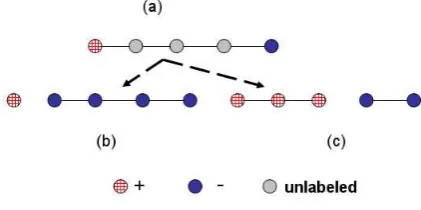
An improvement to the basic mincut algorithm was proposed by Blum et. al. (2004). The deter-ministic mincut algorithm, solved using max-flow, produces only one of the several possible mincuts. Some of these cuts could be skewed thereby nega-tively effecting the results. As an extreme example consider the graph in Figure 3a. Let the nodes with degree one be labeled as positive and negative re-spectively, and for the purpose of illustration let all edges be of the same weight. The graph in Fig-ure 3a. can be partitioned in four equal cost cuts – two of which are shown in (b) and (c). The
min-Figure 3: Problem with mincuts
cut algorithm, depending on the implementation, will return only one of the extreme cuts (as in (b)) while the desired classification might be as shown in Figure 3c.
The randomized mincut approach tries to dress this problem by randomly perturbing the ad-jacency matrix by adding random noise.5 Mincut is then performed on this perturbed graph. This is
5
[image:3.595.309.520.501.606.2]repeated several times and unbalanced partitions are discarded. Finally the remaining partitions are used to deduce the final classification by majority voting. In the unlikely event of the voting result-ing in a tie, we refrain from makresult-ing a decision thus favoring precision over recall.
3.3 Label propagation
Another semi-supervised learning method we use is label propagation by Zhu and Ghahramani (2002). The label propagation algorithm is a trans-ductive learning framework which uses a few ex-amples, or seeds, to label a large number of un-labeled examples. In addition to the seed exam-ples, the algorithm also uses a relation between the examples. This relation should have two require-ments:
1. It should be transitive.
2. It should encode some notion of relatedness between the examples.
To name a few, examples of such relations in-clude, synonymy, hypernymy, and similarity in some metric space. This relation between the ex-amples can be easily encoded as a graph. Thus ev-ery node in the graph is an example and the edge represents the relation. Also associated with each node, is a probability distribution over the labels for the node. For the seed nodes, this distribution is known and kept fixed. The aim is to derive the distributions for the remaining nodes.
Consider a graphG(V, E, W) with verticesV, edgesE, and ann×nedge weight matrixW = [wij], wheren=|V|. The label propagation algo-rithm minimizes a quadratic energy function
E = 1 2
X
(i, j)∈E
wij(yi−yj)2
where yi and yj are the labels assigned to the nodes i and j respectively.6 Thus, to derive the labels atyi, we set ∂y∂iE = 0to obtain the follow-ing update equation
yi= X
(i,j)∈E
wijyj
X
(i,j)∈E
wij
In practice, we use the following iterative algo-rithm as noted by Zhu and Ghahramani (2002). A
6
For binary classificationyk∈ {−1,+1}.
n×nstochastic transition matrixT is derived by row-normalizingW as follows:
Tij =P(j→i) =
wij Pn
k=1wkj
whereTijcan be viewed as the transition probabil-ity from nodejto nodei. The algorithm proceeds as follows:
1. Assign an×C matrixY with the initial as-signment of labels, whereCis the number of classes.
2. Propagate labels for all nodes by computing
Y =T Y
3. Row-normalizeY such that each row adds up to one.
4. Clamp the seed examples inY to their origi-nal values
5. Repeat 2-5 untilY converges.
There are several points to be noted. First, we add a special label “DEFAULT” to existing set of la-bels and setP(DEFAULT|node=u) = 1for all unlabeled nodesu. For all the seed nodesswith class labelLwe defineP(L|node=s) = 1. This ensures nodes that cannot be labeled at all7will
re-tainP(DEFAULT) = 1thereby leading to a quick
convergence. Second, the algorithm produces a probability distribution over the labels for all un-labeled points. This makes this method specially suitable for classifier combination approaches. For this paper, we simply select the most likely label as the predicted label for the point. Third, the al-gorithm eventually converges. For details on the proof for convergence we refer the reader to Zhu and Ghahramani (2002).
4 Evaluation and Experiments
We use the General Inquirer (GI)8 data for eval-uation. General Inquirer is lexicon of English words hand-labeled with categorical information along several dimensions. One such dimension is called valence, with 1915 words labeled “Positiv” (sic) and 2291 words labeled “Negativ” for words with positive and negative sentiments respectively. Since we want to evaluate the performance of the
7
As an example of such a situation, consider a discon-nected component of unlabeled nodes with no seed in it.
8
algorithms alone and not the recall issues in us-ing WordNet, we only consider words from GI that also occur in WordNet. This leaves us the distri-bution of words as enumerated in Table 1.
PoS type No. of Positives No. of Negatives
Nouns 517 579
Verbs 319 562
[image:5.595.327.502.62.118.2]Adjectives 547 438
Table 1: English evaluation data from General In-quirer
All experiments reported in Sections 4.1 to 4.5 use the data described above with a 50-50 split so that the first half is used as seeds and the sec-ond half is used for test. Note that all the exper-iments described below did not involve any pa-rameter tuning thus obviating the need for a sepa-rate development test set. The effect of number of seeds on learning is described in Section 4.6.
4.1 Kim-Hovy method and improvements
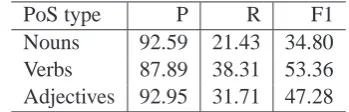
Kim and Hovy (2006) enrich their sentiment lexi-con from WordNet as follows. Synonyms of a pos-itive word are pospos-itive while antonyms are treated as negative. This basic version suffers from a very poor recall as shown in the Figure 4 for adjectives (see iteration 1). The recall can be improved for a slight trade-off in precision if we re-run the above algorithm on the output produced at the previous level. This could be repeated iteratively until there is no noticeable change in precision/recall. We consider this as the best possible F1-score pro-duced by the Kim-Hovy method. The classwise F1 for this method is shown in Table 2. We use these scores as our baseline.
Figure 4: Kim-Hovy method
PoS type P R F1
Nouns 92.59 21.43 34.80
Verbs 87.89 38.31 53.36
[image:5.595.329.506.378.436.2]Adjectives 92.95 31.71 47.28
Table 2: Precision/Recall/F1-scores for Kim-Hovy method
4.2 Using prototypes
We now consider measuring semantic orientation from WordNet using prototypical examples such as “good” and “bad” similar to Kamps et al. (2004). Kamps et. al., report results only for adjectives though their method could be used for other part-of-speech types. The results for us-ing prototypes are listed in Table 3. Note that the seed data was fully unused except for the ex-amples “good” and “bad”. We still test on the same test data as earlier for comparing results. Also note that the recall need not be 100 in this case as we refrain from making a decision when
d(t,good) =d(t,bad).
PoS type P R F1
Nouns 48.03 99.82 64.86
Verbs 58.12 100.00 73.51
Adjectives 57.35 99.59 72.78
Table 3: Precision/Recall/F1-scores for prototype method
4.3 Using mincuts and randomized mincuts
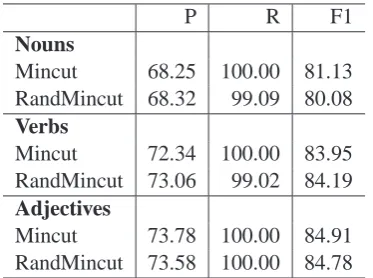
We now report results for mincuts and random-ized mincuts algorithm using the WordNet syn-onym graph. As seen in Table 4, we only observed a marginal improvement (for verbs) over mincuts by using randomized mincuts.
But the overall improvement of using graph-based semi-supervised learning methods over the Kim-Hovy and Prototype methods is quite signifi-cant.
4.4 Using label propagation
[image:5.595.77.298.578.724.2]P R F1 Nouns
Mincut 68.25 100.00 81.13
RandMincut 68.32 99.09 80.08 Verbs
Mincut 72.34 100.00 83.95
RandMincut 73.06 99.02 84.19 Adjectives
Mincut 73.78 100.00 84.91
[image:6.595.89.276.61.200.2]RandMincut 73.58 100.00 84.78
Table 4: Precision/Recall/F1-scores using mincuts and randomized mincuts
PoS type P R F1
Nouns 82.55 58.58 58.53
Verbs 81.00 85.94 83.40
Adjectives 84.76 64.02 72.95
Table 5: Precision/Recall/F1-scores for Label Pro-pogation
Kamps et. al., have high recall as they end up classifying every node as either positive or nega-tive. Note that the recall for randomized mincut is not 100 as we do not make a classification de-cision when there is a tie in majority voting (refer Section 3.2). Observe that the label propagation method performs significantly better than previ-ous graph based methods in precision. The rea-son for lower recall is attributed to the lack of con-nectivity between plausibly related nodes, thereby not facilitating the “spread” of labels from the la-beled seed nodes to the unlala-beled nodes. We ad-dress this problem by adding additional edges to the synonym graph in the next section.
4.5 Incorporating hypernyms
The main reason for low recall in label propaga-tion is that the WordNet synonym graph is highly disconnected. Even nodes which are logically re-lated have paths missing between them. For exam-ple the positive nouns complimentandlaudbelong to different synonym subgraphs without a path between them. But incorporating the hypernym edges the two are connected by the noun praise. So, we incorporated hypernyms of every node to improve connectivity. Performing label propaga-tion on this combined graph gives much better re-sults (Table 6) with much higher recall and even slightly better precision. In Table 6., we do not report results for adjectives as WordNet does not
define hypernyms for adjectives. A natural
ques-PoS type P R F1
Nouns 83.88 99.64 91.08
Verbs 85.49 100.00 92.18
Adjectives N/A N/A N/A
Table 6: Effect of adding hypernyms
tion to ask is if we can use other WordNet relations too. We will defer this until section 6.
4.6 Effect of number of seeds
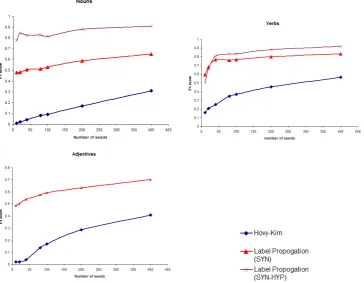
The results reported in Sections 4.1 to 4.5 fixed the number of seeds. We now investigate the per-formance of the various methods on the number of seeds used. In particular, we are interested in performance under conditions when the number of seeds are few – which is the motivation for using semi-supervised learning in the first place. Fig-ure 5 presents our results for English. Observe that Label Propagation performs much better than our baseline even when the number of seeds is as low as ten. Thus label propagation is especially suited when annotation data is extremely sparse.
One reason for mincuts performing badly with few seeds is because they generate degenrate cuts.
5 Adapting to other languages
In order to demonstrate the ease of adaptability of our method for other languages, we used the Hindi WordNet9to derive the adjective synonym graph. We selected 489 adjectives at random from a list of 10656 adjectives and this list was annotated by two native speakers of the language. The anno-tated list was then split 50-50 into seed and test sets. Label propagation was performed using the seed list and evaluated on the test list. The results are listed in Table 7.
Hindi P R F1
90.99 95.10 93.00
Table 7: Evaluation on Hindi dataset
WordNet might not be freely available for all languages or may not exist. In such cases build-ing graph from an existbuild-ing thesaurus might also suffice. As an example, we consider French. Al-though the French WordNet is available10, we
9http://www.cfilt.iitb.ac.in/wordnet/webhwn/
10
Figure 5: Effect of number of seeds on the F-score for Nouns, Verbs, and Adjectives. The X-axis is number of seeds and the Y-axis is the F-score.
found the cost prohibitive to obtain it. Observe that if we are using only the synonymy relation in WordNet then any thesaurus can be used instead. To demonstrate this, we consider the OpenOffice thesaurus for French, that is freely available. The synonym graph of French adjectives has 9707 ver-tices and 1.6M edges. We manually annotated a list of 316 adjectives and derived seed and test sets using a 50-50 split. The results of label propaga-tion on such a graph is shown in Table 8.
French P R F1
73.65 93.67 82.46
Table 8: Evaluation on French dataset
The reason for better results in Hindi compared to French can be attributed to (1) higher inter-annotator agreement (κ = 0.7) in Hindi compared that in French (κ = 0.55).11 (2) The Hindi
ex-periment, like English, used WordNet while the French experiment was performed on graphs de-rived from the OpenOffice thesaurus due lack of freely available French WordNet.
11We do not have
κscores for English dataset derived from
the Harvard Inquirer project.
6 Conclusions and Future Work
This paper demonstrated the utility of graph-based semi-supervised learning framework for building sentiment lexicons in a variety of resource avail-ability situations. We explored how the struc-ture of WordNet could be leveraged to derive polarity lexicons. The paper combines, for the first time, relationships like synonymy and hyper-nymy to improve label propagation results. All of our methods are independent of language as shown in the French and Hindi cases. We demon-strated applicability of our approach on alterna-tive thesaurus-derived graphs when WordNet is not freely available, as in the case of French.
Although our current work uses WordNet and other thesauri, in resource poor situations when only monolingual raw text is available we can per-form label propagation on nearest neighbor graphs derived directly from raw text using distributional similarity methods. This is work in progress.
[image:7.595.104.259.562.589.2]graph for label propagation as antonymy encodes negative similarity (or dissimilarity) and the dis-similarity relation is not transitive.
References
[Blum and Chawla2001] Avrim Blum and Shuchi
Chawla. 2001. Learning from labeled and un-labeled data using graph mincuts. In Proc. 18th
International Conf. on Machine Learning, pages
19–26.
[Blum et al.2004] Blum, Lafferty, Rwebangira, and Reddy. 2004. Semi-supervised learning using ran-domized mincuts. In Proceedings of the ICML.
[Esuli and Sebastiani2006] Andrea Esuli and Fabrizio Sebastiani. 2006. Determining term subjectivity and term orientation for opinion mining. In
Pro-ceedings of the 11th Conference of the European Chapter of the Association for Computational Lin-guistics, pages 193–200.
[Hatzivassiloglou and McKeown1997] Vasileios Hatzi-vassiloglou and Kathleen McKeown. 1997. Predict-ing the semantic orientation of adjectives. In
Pro-ceedings of the ACL, pages 174–181.
[Kaji and Kitsuregawa2007] Nobuhiro Kaji and Masaru Kitsuregawa. 2007. Building lexicon for sentiment analysis from massive collection of HTML docu-ments. In Proceedings of the Joint Conference on
Empirical Methods in Natural Language Process-ing and Computational Natural Language LearnProcess-ing (EMNLP-CoNLL), pages 1075–1083.
[Kamps et al.2004] Jaap Kamps, Maarten Marx, R. ort. Mokken, and Maarten de Rijke. 2004. Using WordNet to measure semantic orientation of adjec-tives. In Proceedings of LREC-04, 4th International
Conference on Language Resources and Evaluation,
volume IV.
[Kim and Hovy2006] Soo-Min Kim and Eduard H. Hovy. 2006. Identifying and analyzing judgment opinions. In Proceedings of the HLT-NAACL.
[Lin1998a] Dekang Lin. 1998a. Automatic retrieval and clustering of similar words. In Proceedings of
COLING, pages 768–774.
[Lin1998b] Dekang Lin. 1998b. An information-theoretic definition of similarity. In Proceedings
of the 15th International Conference in Machine Learning, pages 296–304.
[Mihalcea et al.2007] Rada Mihalcea, Carmen Banea, and Janyce Wiebe. 2007. Learning multilingual subjective language via cross-lingual projections. In
Proceedings of the 45th Annual Meeting of the As-sociation of Computational Linguistics, pages 976–
983.
[Pang and Lee2004] Bo Pang and Lillian Lee. 2004. A sentimental education: Sentiment analysis using subjectivity summarization based on minimum cuts. In Proceedings of the ACL, pages 271–278.
[Pedersen et al.2004] Ted Pedersen, Siddharth
Patward-han, and Jason Michelizzi. 2004.
Word-net::similarity - measuring the relatedness of con-cepts. In Proceeding of the HLT-NAACL.
[Riloff et al.2003] Ellen Riloff, Janyce Wiebe, and Theresa Wilson. 2003. Learning subjective nouns using extraction pattern bootstrapping. In
Proceed-ings of the 7th Conference on Natural Language Learning, pages 25–32.
[Stone et al.1966] Philip J. Stone, Dexter C. Dunphy, Marshall S. Smith, and Daniel M. Ogilvie. 1966.
The General Inquirer: A Computer Approach to Content Analysis. MIT Press.
[Turney and Littman2003] Peter D. Turney and Michael L. Littman. 2003. Measuring praise and criticism: Inference of semantic orientation from association. ACM Transactions on Information Systems, 21(4):315–346.
[Wiebe2000] Janyce M. Wiebe. 2000. Learning sub-jective adsub-jectives from corpora. In Proceedings of
the 2000 National Conference on Artificial Intelli-gence. AAAI.