A metalearning approach to processing the scope of negation
Roser Morante, Walter Daelemans
CNTS - Language Technology Group University of Antwerp
Prinsstraat 13, B-2000 Antwerpen, Belgium
{Roser.Morante,Walter.Daelemans}@ua.ac.be
Abstract
Finding negation signals and their scope in text is an important subtask in information ex-traction. In this paper we present a machine learning system that finds the scope of nega-tion in biomedical texts. The system combines several classifiers and works in two phases. To investigate the robustness of the approach, the system is tested on the three subcorpora of the BioScope corpus representing different text types. It achieves the best results to date for this task, with an error reduction of 32.07% compared to current state of the art results.
1 Introduction
In this paper we present a machine learning system that finds the scope of negation in biomedical texts. The system works in two phases: in the first phase, negation signals are identified (i.e., words indicating negation), and in the second phase the full scope of these negation signals is determined. Although the system was developed and tested on biomedical text, the same approach can also be used for text from other domains.
Finding the scope of a negation signal means de-termining at sentence level the sequence of words in the sentence that is affected by the negation. This task is different from determining whether a word is negated or not. For a sentence like the one in Exam-ple (1) taken from the BioScope corpus (Szarvas et
al., 2008), the system detects thatlack, neither, and
norare negation signals; that lack has as its scope
lack of CD5 expression, and that the discontinuous
negation signalneither ... nor has as its scope
nei-ther to segregation of human autosome 11, on which the CD5 gene has been mapped, nor to deletion of the CD5 structural gene.
(1) <sentence id=“S334.5”>Analysis at the phenotype and genetic level showed that<xcope id“X334.5.3”><cue type=“negation” ref=“X334.5.3”>lack</cue>of CD5 expression</xcope>was due<xcope id=“X334.5.1”> <cue type=“negation” ref=“X334.5.1”>neither</cue> to segregation of human autosome 11, on which the CD5 gene has been mapped,<cue type=“negation”
ref=“X334.5.1”>nor</cue>to deletion of the CD5 structural gene</xcope>.</sentence>
Predicting the scope of negation is relevant for text mining and information extraction purposes. As Vincze et al. (2008) put it, extracted information that falls in the scope of negation signals cannot be pre-sented as factual information. It should be discarded or presented separately. Szarvas et al. (2008) report that 13.45% of the sentences in the abstracts section of the BioScope corpus and 12.70% of the sentences in the full papers section contain negations. A sys-tem that does not deal with negation would treat the facts in these cases incorrectly as positives. Addi-tionally, information about the scope of negation is useful for entailment recognition purposes.
The approach to the treatment of negation in NLP presented in this paper was introduced in Morante et al. (2008). This system achieved a 50.05 percent-age of correct scopes but had a number of impor-tant shortcomings. The system presented here uses a different architecture and different classification task definitions, it can deal with multiword negation signals, and it is tested on three subcorpora of the BioScope corpus. It achieves an error reduction of
32.07% compared to the previous system.
The paper is organised as follows. In Section 2, we summarise related work. In Section 3, we scribe the corpus on which the system has been de-veloped. In Section 4, we introduce the task to be performed by the system, which is described in tion 5. Results are presented and discussed in Sec-tion 6. Finally, SecSec-tion 7 puts forward some conclu-sions.
2 Related work
Negation has been a neglected area in open-domain natural language processing. Most research has been performed in the biomedical domain and has focused on detecting whether a medical term is negated or not, whereas in our approach we focus on detecting the full scope of negation signals.
Chapman et al. (2001) developed NegEx, a reg-ular expression based algorithm for determining whether a finding or disease mentioned within nar-rative medical reports is present or absent. The ported results are 94.51% precision and 77.84% re-call. Mutalik et al. (2001) developed Negfinder, a rule-based system that recognises negated patterns in medical documents. It consists of two tools: a lex-ical scanner that uses regular expressions to generate a finite state machine, and a parser. The reported re-sults are 95.70% recall and 91.80% precision.
Sanchez-Graillet and Poesio (2007) present an analysis of negated interactions in 50 biomedical articles and a heuristics-based system that extracts such information. The preliminary results reported range from 54.32% F-score to 76.68%, depending on the method applied. Elkin et al. (2005) describe a rule-based system that assigns to concepts a level of certainty as part of the generation of a dyadic parse tree in two phases: First a preprocessor breaks each sentence into text and operators. Then, a rule based system is used to decide if a concept has been pos-itively, negatively, or uncertainly asserted. The sys-tem achieves 97.20% recall and 98.80% precision.
The systems mentioned above are essentially
based on lexical information. Huang and
Lowe (2007) propose a classification scheme of negations based on syntactic categories and patterns in order to locate negated concepts, regardless of their distance from the negation signal. Their
hy-brid system that combines regular expression match-ing with grammatical parsmatch-ing achieves 92.60% re-call and 99.80% precision. Additionally, Boytcheva et al. (2005) incorporate the treatment of negation in a system, MEHR, that extracts from electronic health records all the information required to gen-erate automatically patient chronicles. They report 57% of negations correctly recognised.
The above-mentioned research applies rule-based algorithms to negation finding. Machine learning techniques have been used in some cases. Averbuch et al. (2004) developed an algorithm that uses infor-mation gain to learn negative context patterns. Gold-ing and Chapman (2003) experiment with Naive Bayes and Decision Trees to distinguish whether a
medical observation is negated by the wordnotin a
corpus of hospital reports. They report a maximum of 90% F-score.
Goryachev et al. (2006) compare the perfor-mance of four different methods of negation de-tection, two regular expression-based methods and two classification-based methods trained on 1745
discharge reports. They show that the regular
expression-based methods show better agreement with humans and better accuracy than the classifica-tion methods. Like in most of the work menclassifica-tioned, the task consists in determining whether a medi-cal term is negated. Rokach et al. (2008) present a new pattern-based algorithm for identifying context in free-text medical narratives.The originality of the algorithm lies in that it automatically learns patterns similar to the manually written patterns for negation detection.
We are not aware of any research that has focused on learning the full scope of negation signals outside biomedical natural language processing.
3 Negation in the BioScope Corpus
The system has been developed using the BioScope
corpus (Szarvas et al., 2008; Vincze et al., 2008)1,
a freely available resource that consists of medical and biological texts. In the corpus, every sentence is annotated with information about negation and speculation. The annotation indicates the bound-aries of the scope and the keywords, as shown in (1) above. In the annotation, scopes are extended to the
biggest syntactic unit possible, so that scopes have the maximal length, and the negation signal is al-ways included in the scope. The annotation guide-lines and the inter-annotator agreement information can be found on the web page.
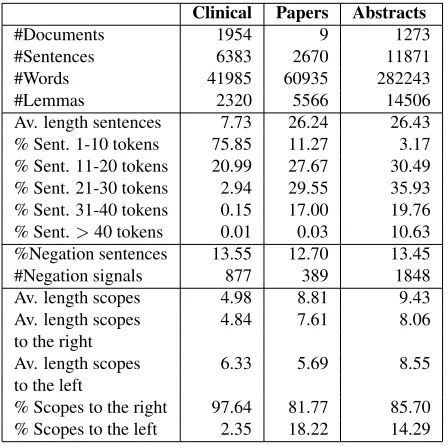
Clinical Papers Abstracts
#Documents 1954 9 1273
#Sentences 6383 2670 11871
#Words 41985 60935 282243
#Lemmas 2320 5566 14506
Av. length sentences 7.73 26.24 26.43 % Sent. 1-10 tokens 75.85 11.27 3.17 % Sent. 11-20 tokens 20.99 27.67 30.49 % Sent. 21-30 tokens 2.94 29.55 35.93 % Sent. 31-40 tokens 0.15 17.00 19.76 % Sent.>40 tokens 0.01 0.03 10.63 %Negation sentences 13.55 12.70 13.45
#Negation signals 877 389 1848
Av. length scopes 4.98 8.81 9.43
Av. length scopes 4.84 7.61 8.06
to the right
Av. length scopes 6.33 5.69 8.55
to the left
[image:3.612.71.295.133.356.2]% Scopes to the right 97.64 81.77 85.70 % Scopes to the left 2.35 18.22 14.29
Table 1: Statistics about the subcorpora in the BioScope corpus and the negation scopes (“Av”. stands for aver-age).
The BioScope corpus consists of three parts: clin-ical free-texts (radiology reports), biologclin-ical full pa-pers and biological paper abstracts from the GENIA corpus (Collier et al., 1999). Table 1 shows statistics about the corpora. Negation signals are represented by one or more tokens.
Only one negation signal (exclude) that occurs in
the papers subcorpus does not occur in the abstracts
subcorpus, and six negation signals (absence of,
ex-clude, favor, favor over, may, rule outthat appear in the clinical subcorpus do not appear in the abstracts
subcorpus. The negation signalno(determiner)
ac-counts for 11.74 % of the negation signals in the ab-stracts subcorpus, 12.88 % in the papers subcorpus, and 76.65 % in the clinical subcorpus. The
nega-tion signalnot(adverb) accounts for 58.89 % of the
negation signals in the abstracts subcorpus, 53.22 % in the papers subcorpus, and 6.72 % in the clinical subcorpus.
The texts have been processed with the GENIA tagger (Tsuruoka and Tsujii, 2005; Tsuruoka et al.,
2005), a bidirectional inference based tagger that an-alyzes English sentences and outputs the base forms, part-of-speech tags, chunk tags, and named entity tags in a tab-separated format. Additionally, we con-verted the annotation about scope of negation into a token-per-token representation, following the stan-dard format of the 2006 CoNLL Shared Task (Buch-holz and Marsi, 2006), where sentences are sepa-rated by a blank line and fields are sepasepa-rated by a single tab character. A sentence consists of a se-quence of tokens, each one starting on a new line.
4 Finding the scope of negation
We model the scope finding task as two consecutive classification tasks: a first one that consists of classi-fying the tokens of a sentence as being at the begin-ning of a negation signal, inside or outside. This al-lows the system to find multiword negation signals.
The second classification task consists of classi-fying the tokens of a sentence as being the first ele-ment of the scope, the last, or neither. This happens as many times as there are negation signals in the sentence. We have chosen this classification model after experimenting with two additional models that produced worse results: in one case we classifed to-kens as being inside or outside of the scope. In an-other case we classified chunks, instead of tokens, as being inside or outside of the scope.
5 System description
The two classification tasks (identifying negation signals and finding the scope) are implemented us-ing supervised machine learnus-ing methods trained on part of the annotated corpus.
5.1 Identifying negation signals
In this phase, a classifier predicts whether a token is the first token of a negation signal, inside a nega-tion signal, or outside of it. We use IGTREE as implemented in TiMBL (version 6.1.2) (Daelemans
et al., 2007). TiMBL2 is a software package that
contains implementations of memory-based learn-ing algorithms like IB1 and IGTREE. We also ex-perimented with IB1, but it produced lower results. 2TiMBL can be downloaded from the web page
The classifier was parameterised by using gain ra-tio for feature weighting. The instances represent all tokens in the corpus and they have features of the token (lemma) and of the token context: word form,
POS, and chunk IOB tag3 of one token to the left
and to the right; word form of the second token to the left and to the right. According to the gain ratio scores, the most informative feature is the lemma of the token, followed by the chunk IOB tag of the to-ken to the right, and the features relative to the toto-ken to the left.
The test file is preprocessed using a list of nega-tion signals extracted from the training corpus, that are unambiguous in the training corpus. The list
comprises the following negation signals: absence,
absent, fail, failure, impossible, lack, loss, miss, neg-ative, neither, never, no, none, nor, not, unable,
with-out. Instances with this negation signals are directly
assigned their class. The classifier predicts the class of the rest of tokens.
5.2 Scope finding
In this phase three classifiers predict whether a token is the first token in the scope sequence, the last, or neither. A fourth classifier is a metalearner that uses the predictions of the three classifiers to predict the scope classes. The three object classifiers that pro-vide input to the metalearner were trained using the following machine learning methods:
• Memory-based learning as implemented in TiMBL
(version 6.1.2) (Daelemans et al., 2007), a super-vised inductive algorithm for learning classification tasks based on thek-nearest neighbor classification
rule (Cover and Hart, 1967). In this lazy learning approach, all training data is kept in memory and classification of a new item is achieved by extrap-olation from the most similar remembered training items.
• Support vector machines (SVM) as implemented in SVMlightV6.01 (Joachims, 1999). SVMs are
de-fined on a vector space and try to find a decision surface that best separates the data points into two classes. This is achieved by using quadratic pro-gramming techniques. Kernel functions can be used to map the original vectors to a higher-dimensional space that is linearly separable.
3Tags produced by the GENIA tagger that indicate if a token is inside a certain chunk, outside, or at the beginning.
• Conditional random fields (CRFs) as implemented in CRF++-0.51 (Lafferty et al., 2001). CRFs de-fine a conditional probability distribution over label sequences given a particular observation sequence rather than a joint distribution over label and ob-servation sequences, and are reported to avoid the label bias problem of HMMs and other learning ap-proaches.
The memory-based learning algorithm was pa-rameterised by using overlap as the similarity
met-ric, gain ratio for feature weighting, using 7 k
-nearest neighbors, and weighting the class vote of neighbors as a function of their inverse linear dis-tance. The SVM was parameterised in the learning phase for classification, cost factor of 1 and biased hyperplane, and it used a linear kernel function. The CRFs classifier used regularization algorithm L2 for training, the hyper-parameter and the cut-off thresh-old of features were set to 1.
An instance represents a pair of a negation signal and a token from the sentence. This means that all tokens in a sentence are paired with all negation sig-nals that occur in the sentence. Negation sigsig-nals are those that have been classified as such in the previ-ous phase. Only sentences that have negation signals are selected for this phase.
We started with a larger, extensive pool of 131 features which encoded information about the nega-tion signal, the paired token, their contexts, and the tokens in between. Feature selection experiments were carried out with the memory-based learning classifier. Features were selected based on their gain ratio, starting with all the features and elimi-nating the least informative features. We also per-formed experiments applying the feature selection process reported in Tjong Kim Sang et al. (2005), a bi-directional hill climbing process. However, ex-periments with this method did not produce a better selection of features.
The features of the first three classifers are:
• Of the negation signal: Chain of words.
right.
• Of the tokens between the negation signal and the token in focus: Chain of POS types, distance in number of tokens, and chain of chunk IOB tags.
• Others: A feature indicating the location of the to-ken relative to the negation signal (pre, post, same). The fourth classifier, a metalearner, is also a CRF as implemented in CRF++. The features of this clas-sifier are:
• Of the negation signal: Chain of words, chain of POS, word of the two tokens to the right and two tokens to the left, token number divided by the total number of tokens in the sentence.
• Of the paired token: Lemma, POS, word of two to-kens to the right and two toto-kens to the left, token number divided by the total number of tokens in the sentence.
• Of the tokens between the negation signal and the token in focus: Binary features indicating if there are commas, colons, semicolons, verbal phrases or one of the following words between the negation signal and the token in focus:
Whereas, but, although, nevertheless, notwith-standing, however, consequently, hence, therefore, thus, instead, otherwise, alternatively, furthermore, moreover.
• About the predictions of the three classifiers: pre-diction, previous and next predictions of each of the classifiers, full sequence of previous and full se-quence of next predictions of each of the classifiers.
• Others: A feature indicating the location of the
to-ken relative to the negation signal (pre, post, same).
Negation signals in the BioScope corpus always have one consecutive block of scope tokens, includ-ing the signal token itself. However, the classifiers only predict the first and last element of the scope. We need to process the output of the classifers in order to build the complete sequence of tokens that constitute the scope. We apply the following post-processing:
(2) - If one token has been predicted as FIRST and one as LAST, the sequence is formed by the tokens between first and last.
- If one token has been predicted as FIRST and none has been predicted as LAST, the sequence is formed by the token predicted as FIRST.
- If one token has been predicted as LAST and none as FIRST, the sequence will start at the negation signal and it will finish at the token predicted as LAST.
- If one token has been predicted as FIRST and more than one as LAST, the sequence will end with the first token predicted as LAST after the token predicted as FIRST, if there is one.
- If one token has been predicted as LAST and more than one as FIRST, the sequence will start at the negation signal.
- If no token has been predicted as FIRST and more than one as LAST, the sequence will start at the negation signal and will end at the first token predicted as LAST after the negation signal.
6 Results
The results provided for the abstracts part of the cor-pus have been obtained by performing 10-fold cross validation experiments, whereas the results provided for papers and clinical reports have been obtained by training on the full abstracts subcorpus and testing on the papers and clinical reports subcorpus. The latter experiment is therefore a test of the robustness of the system when applied to different text types within the same domain.
6.1 Negation signal finding
An informed baseline system has been created by tagging as negation signals the tokens with the
words: absence, absent, fail, failure, impossible,
in-stead of, lack, loss, miss, negative, neither, never, no, none, nor, not, rather than, unable, with the excep-tion of, without. The list has been extracted from the training corpus. Baseline results and inter-annotator agreement scores are shown in Table 2.
Corpus Prec. Recall F1 Correct IAA
Abstracts 100.00 95.17 97.52 95.09 91.46 Papers 100.00 92.46 96.08 92.15 79.42 Clinical 100.00 97.53 98.75 97.72 90.70
Table 2: Baseline results of the negation finding system and inter-annotator agreement (IAA) in %.
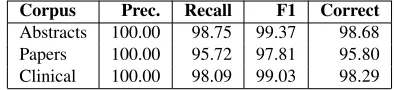
Table 3 shows the results of the system, which are significantly higher than the results of the baseline system. With a more comprehensive list of negation signals it would be possible to identify all of them in a text.
Corpus Prec. Recall F1 Correct
[image:6.612.91.288.359.404.2]Abstracts 100.00 98.75 99.37 98.68 Papers 100.00 95.72 97.81 95.80 Clinical 100.00 98.09 99.03 98.29
Table 3: Results of the negation finding system in %.
The lower result of the papers subcorpus is caused
by the high frequency of the negation signalnotin
this corpus (53.22 %), that is correct in 93.68 % of the cases. The same negation signal is also frequent in the abstracts subcorpus (58.89 %), but in this case it is correct in 98.25 % of the cases. In the clinical
subcorpus not has low frequency (6.72 %), which
means that the performance of the classifer for this negation signal (91.22 % correct) does not affect so much the global results of the classifier. Most errors
in the classification ofnotare caused by the system
predicting it as a negation signal in cases not marked as such in the corpus. The following sentences are some examples:
(3) However, programs for tRNA identification [...] do not necessarily perform well on unknown ones.
The evaluation of this ratio is difficult because not all true interactions are known.
However, the Disorder module does not contribute significantly to the prediction.
6.2 Scope finding
An informed baseline system has been created by calculating the average length of the scope to the right of the negation signal in each corpus and tag-ging that number of tokens as scope tokens. We take the scope to the right for the baseline because it is much more frequent than the scope to the left, as is shown by the statistics contained in Table 1 of Sec-tion 3.
Corpus Prec. Recall F1 PCS PCS-2 IAA
Abstracts 76.68 78.26 77.46 7.11 37.45 92.46 Papers 69.34 66.92 68.11 4.76 24.86 70.86 Clinical 86.85 74.96 80.47 12.95 62.27 76.29
Table 4: Baseline results of the scope finding system and inter-annotator agreement (IAA) in %.
Baseline results and inter-annotator agreement scores are presented in Table 4. The percentage of correct scopes has been measured in two ways: PCS measures the proportion of correctly classified tokens in the scope sequence, whereas PCS-2 mea-sures the proportion of nouns and verbs that are cor-rectly classifed in the scope sequence. This less strict way of computing correctness is motivated by the fact that being able to determine the concepts and relations that are negated (indicated by content words) is the most important use of the negation scope finder. The low PCS for the three subcorpora indicates that finding the scope of negations is not a trivial task. The higher PCS for the clinical subcor-pus follows a trend that applies also to the results of the system. The fact that, despite a very low PCS, precision, recall and F1 are relatively high indicates that these measures are in themselves not reliable to evaluate the performance of the system.
The upper-bound results of the metalearner sys-tem assuming gold standard identification of nega-tion signals are shown in Table 5.
Corpus Prec. Recall F1 PCS PCS-2
Abstracts 90.68 90.68 90.67 73,36 74.10 Papers 84.47 84.95 84.71 50.26 54.23 Clinical 91.65 92.50 92.07 87.27 87.95
Table 5: Results of the scope finding system with gold-standard negation signals.
nega-tion signals are especially better for the clinical
sub-corpus because except for lack, negative and not,
all negation signals score a PCS higher than 90 %. Thus, in the clinical subcorpus, if the negation sig-nals are identified, their scope will be correctly found. This does not apply to the abstracts and pa-pers subcorpus.
Corpus Prec. Recall F1 PCS PCS-2
[image:7.612.314.548.106.296.2]Abstracts 81.76 83.45 82.60 66.07 66.93 Papers 72.21 69.72 70.94 41.00 44.44 Clinical 86.38 82.14 84.20 70.75 71.21
Table 6: Results of the scope finding system with pre-dicted negation signals.
In terms of PCS, results are considerably higher than baseline results, whereas in terms of precision, recall and F1, results are slightly higher. Com-pared to state of the art results (50.05 % PCS in (anonymous reference) for the abstracts subcorpus), the system achieves an error reduction of 32.07 %, which shows that the system architecture presented in this paper leads to more accurate results.
Evaluating the system in terms of a more relaxed measure (PCS-2) does not reflect a significant in-crease in its performance. This suggests that when a scope is incorrectly predicted, main content to-kens are also incorrectly left out of the scope or added. An alternative to the PCS-2 measure would be to mark in the corpus the relevant negated content words and evaluate if they are under the scope.
Results also show that the system is portable to different types of documents, although performance varies depending on the characteristics of the corpus. Clinical reports are easier to process than papers and abstracts, which can be explained by several factors. One factor is the length of sentences: 75.85 % of the sentences in the clinical reports have 10 or less words, whereas this rate is 3.17 % for abstracts and 11.27 % for papers. The average length of a sen-tence for clinical reports is 7.73 tokens, whereas for abstracts it is 26.43 and for papers 26.24. Shorter sentences imply shorter scopes. In the scope finding phase, when we process the output of the classifiers to build the complete sequence of tokens that con-stitute the scope, we give preference to short scopes by choosing as LAST the token classified as LAST that is the closest to the negation signal. A way to
make the system better portable to texts with longer sentences would be to optimise the choice of the last token in the scope.
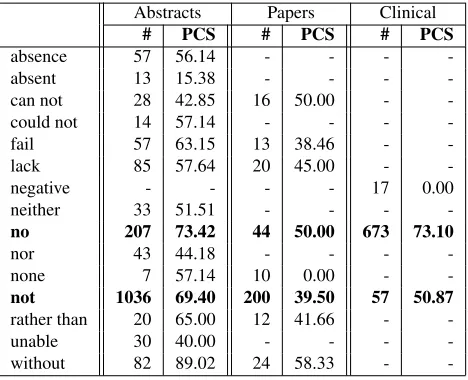
Abstracts Papers Clinical
# PCS # PCS # PCS
absence 57 56.14 - - -
-absent 13 15.38 - - -
-can not 28 42.85 16 50.00 -
-could not 14 57.14 - - -
-fail 57 63.15 13 38.46 -
-lack 85 57.64 20 45.00 -
-negative - - - - 17 0.00
neither 33 51.51 - - -
-no 207 73.42 44 50.00 673 73.10
nor 43 44.18 - - -
-none 7 57.14 10 0.00 -
-not 1036 69.40 200 39.50 57 50.87
rather than 20 65.00 12 41.66 -
-unable 30 40.00 - - -
-without 82 89.02 24 58.33 -
-Table 7: PCS per negation signal for negation signals that occur more than 10 times in one of the subcorpus.
Another factor that causes a higher performance on the clinical subcorpus is the frequency of the
negation signalno(76.65 %), which has also a high
PCS in abstracts, as shown in Table 7. Typical ex-ample sentences with this negation signal are shown in (4). Its main characteristics are that the scope is very short (5 tokens average in clinical reports) and that it scopes to the right over a noun phrase.
(4) No findings to account for symptoms. No signs of tuberculosis.
The lower performance of the system on the pa-pers subcorpus compared to the abstracts subcorpus is due to the high proportion of the negation signal
not(53.22 %), which scores a low PCS (39.50), as
shown in Table 7. Table 7 also shows that, except forcan not, all negation signals score a lower PCS on the papers subcorpus. This difference can not be caused by the sentence length, since the average sentence length in the abstracts subcorpus (26.43 to-kens) is similar to the average sentence length in the papers subcorpus (26.24). The difference may be related to the difference in the length of the scopes and their direction. For example, the average length
of the scope ofnotis 8.85 in the abstracts subcorpus
[image:7.612.80.295.161.206.2]left fornotamount to 23.28 % in the papers subcor-pus and to 16.41 % in the abstracts subcorsubcor-pus, and the average scope to the left is 5.6 tokens in the pa-pers subcorpus and 8.82 in the abstracts subcorpus.
As for the results per negation signal on the ab-stracts corpus, the negation signals that score higher
PCS have a low (none) or null (absence, fail, lack,
neither, no, rather than, without) percentage of
scopes to the left. An exception is notwith a high
score and 16.41% of scopes to the left. The negation signals with lower PCS have a higher percentage of
scopes to the left (absent, can not, nor, unable). A
typical error for the negation signalunableis
exem-plified by the sentenceVDR DNA-binding mutants
were unable to either bind to this element in vitro or repress in vivo, in which the gold scope starts at the beginning of the sentence, where the predicted scopes starts at the negation signal.
6.2.1 Results of the metalearner versus results of the first three classifiers
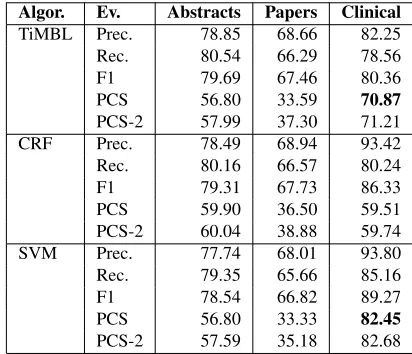
The choice of a metalearner approach has been motivated by the significantly higher results that the metalearner produces compared to the results of the first three classifiers. The results of each of the clas-sifiers independently are presented in Table 8.
Algor. Ev. Abstracts Papers Clinical
TiMBL Prec. 78.85 68.66 82.25
Rec. 80.54 66.29 78.56
F1 79.69 67.46 80.36
PCS 56.80 33.59 70.87
PCS-2 57.99 37.30 71.21
CRF Prec. 78.49 68.94 93.42
Rec. 80.16 66.57 80.24
F1 79.31 67.73 86.33
PCS 59.90 36.50 59.51
PCS-2 60.04 38.88 59.74
SVM Prec. 77.74 68.01 93.80
Rec. 79.35 65.66 85.16
F1 78.54 66.82 89.27
PCS 56.80 33.33 82.45
[image:8.612.83.289.413.590.2]PCS-2 57.59 35.18 82.68
Table 8: Results for the first three classifiers of the scope finding system.
PCS results show that the metalearner system per-forms significantly better than the three classifiers for the abstracts and papers subcorpora, but not for the clinical subcorpus, in which case TiMBL and SVM produce higher scores, although only the SVM
results are significantly better with a difference of 11.7 PCS. An analysis in detail of the SVM scores per negation signal shows that the main difference between the scores of the metalearner and SVM is that the SVM is good at predicting the scopes of the
negation signalno when it occurs as the first token
in the sentence, like in (4) above. Whennooccurs
in other positions, SVM scores 1.17 PCS better. We plan to perform experiments with the three classifiers using the features of the metalearner that are not related to the predictions, in order to check if the three classifiers would perform better.
7 Conclusions
In this paper we have presented a metalearning ap-proach to processing the scope of negation signals. Its performance is evaluated in terms of percent-age of correct scopes on three test sets. With 66.07 % PCS on the abstracts corpus the system achieves 32.07 % of error reduction over current state of the art results. The architecture of the system is new for this problem, with three classifiers and a metalearner that takes as input the output of the first classifiers. The classification task definition is also original.
We have shown that the system is portable to dif-ferent corpora, although performance fluctuates de-pending on the characteristics of the corpora. The results per corpus are determined to a certain extent
by the scores of the negation signalsnoandnot, that
are very frequent and difficult to process in some text types. Shorter scopes are easier to learn as reflected
in the results of the clinical corpus, wherenois the
most frequent negation signal. We have also shown that the metalearner performs better than the three
first classifiers, except for the negation signalnoin
clinical reports, for which the SVM classifier pro-duces the highest scores.
Acknowledgments
Our work was made possible through financial sup-port from the University of Antwerp (GOA project BIOGRAPH). We are grateful to four anonymous reviewers for their valuable comments and sugges-tions.
References
M. Averbuch, T. Karson, B. Ben-Ami, O. Maimon, and L. Rokach. 2004. Context-sensitive medical informa-tion retrieval. In Proc. of the 11th World Congress on Medical Informatics (MEDINFO-2004), pages 1– 8, San Francisco, CA. IOS Press.
S. Boytcheva, A. Strupchanska, E. Paskaleva, and D. Tcharaktchiev. 2005. Some aspects of negation processing in electronic health records. In Proc. of International Workshop Language and Speech Infras-tructure for Information Access in the Balkan Coun-tries, pages 1–8, Borovets, Bulgaria.
S. Buchholz and E. Marsi. 2006. CoNLL-X shared task on multilingual dependency parsing. InProc. of the X CoNLL Shared Task, New York. SIGNLL.
W. W. Chapman, W. Bridewell, P. Hanbury, G. F. Cooper, and B.G. Buchanan. 2001. A simple algorithm for identifying negated findings and diseases in discharge summaries. J Biomed Inform, 34:301–310.
N. Collier, H.S. Park, N. Ogata, Y. Tateisi, C. Nobata, T. Sekimizu, H. Imai, and J. Tsujii. 1999. The GE-NIA project: corpus-based knowledge acquisition and information extraction from genome research papers. InProceedings of EACL-99.
T. M. Cover and P. E. Hart. 1967. Nearest neighbor pattern classification. Institute of Electrical and Elec-tronics Engineers Transactions on Information The-ory, 13:21–27.
W. Daelemans, J. Zavrel, K. Van der Sloot, and A. Van den Bosch. 2007. TiMBL: Tilburg memory based learner, version 6.1, reference guide. Technical Report Series 07-07, ILK, Tilburg, The Netherlands.
P. L. Elkin, S. H. Brown, B. A. Bauer, C.S. Husser, W. Carruth, L.R. Bergstrom, and D. L. Wahner-Roedler. 2005. A controlled trial of automated classi-fication of negation from clinical notes. BMC Medical Informatics and Decision Making, 5(13).
l. M. Goldin and W.W. Chapman. 2003. Learning to detect negation with ‘Not’ in medical texts. In Pro-ceedings of ACM-SIGIR 2003.
S. Goryachev, M. Sordo, Q.T. Zeng, and L. Ngo. 2006. Implementation and evaluation of four different meth-ods of negation detection. Technical report, DSG.
Y. Huang and H.J. Lowe. 2007. A novel hybrid approach to automated negation detection in clinical radiology reports. J Am Med Inform Assoc, 14(3):304–311. T. Joachims, 1999. Advances in Kernel Methods
-Support Vector Learning, chapter Making large-Scale SVM Learning Practical, pages 169–184. MIT-Press, Cambridge, MA.
J. Lafferty, A. McCallum, and F. Pereira. 2001. Con-ditional random fields: Probabilistic models for seg-menting and labeling sequence data. InProc. of ICML 2001, pages 282–289.
R. Morante, A. Liekens, and W. Daelemans. 2008. A combined memory-based semantic role labeler of en-glish. In Proc. of the EMNLP 2008, pages 715–724, Honolulu, Hawaii.
A.G. Mutalik, A. Deshpande, and P.M. Nadkarni. 2001. Use of general-purpose negation detection to augment concept indexing of medical documents. a quantita-tive study using the UMLS. J Am Med Inform Assoc, 8(6):598–609.
L. Rokach, R.Romano, and O. Maimon. 2008. Negation recognition in medical narrative reports. Information Retrieval Online.
O. Sanchez-Graillet and M. Poesio. 2007. Negation of protein-protein interactions: analysis and extraction.
Bioinformatics, 23(13):424–432.
G. Szarvas, V. Vincze, R. Farkas, and J. Csirik. 2008. The BioScope corpus: annotation for negation, uncer-tainty and their scopein biomedical texts. InProc. of BioNLP 2008, pages 38–45, Columbus, Ohio, USA. ACL.
E. Tjong Kim Sang, S. Canisius, A.van den Bosch, and T. Bogers. 2005. Applying spelling error correction techniques for improving semantic role labelling. In
Proc. of CoNLL 2005, pages 229–232.
Y. Tsuruoka and J. Tsujii. 2005. Bidirectional in-ference with the easiest-first strategy for tagging se-quence data. In Proc. of HLT/EMNLP 2005, pages 467–474.
Y. Tsuruoka, Y. Tateishi, J. Kim, T. Ohta, J. McNaught, S. Ananiadou, and J. Tsujii, 2005. Advances in Infor-matics - 10th Panhellenic Conference on InforInfor-matics, volume 3746 of Lecture Notes in Computer Science, chapter Part-of-Speech Tagger for Biomedical Text, Advances in Informatics, pages 382–392. Springer, Berlin/Heidelberg.
C.J. Van Rijsbergen. 1979. Information Retrieval. But-terworths, London.