T r a n s d u c e r s f r o m R e w r i t e R u l e s w i t h B a c k r e f e r e n c e s
Dale Gerdemann
University of Tuebingen
K1. Wilhelmstr. 113
D-72074 Tuebingen
dg@sf s. nphil, u n i - t u e b i n g e n , de
Gertjan van Noord
Groningen University
PO Box 716
NL 9700 AS Groningen
v a n n o o r d @ l e t , rug. nl
Abstract
Context sensitive rewrite rules have been widely used in several areas of natural language processing, including syntax, morphology, phonology and speech pro- cessing. Kaplan and Kay, Karttunen, and Mohri & Sproat have given vari- ous algorithms to compile such rewrite rules into finite-state transducers. The present paper extends this work by al- lowing a limited form of backreferencing in such rules. The explicit use of backref- erencing leads to more elegant and gen- eral solutions.
1 Introduction
Context sensitive rewrite rules have been widely used in several areas of natural language pro- cessing. Johnson (1972) has shown that such rewrite rules are equivalent to finite state trans- ducers in the special case t h a t they are not al- lowed to rewrite their own output. An algo- rithm for compilation into transducers was pro- vided by Kaplan and Kay (1994). Improvements and extensions to this algorithm have been pro- vided by K a r t t u n e n (1995), K a r t t u n e n (1997), Karttunen (1996) and Mohri and Sproat (1996). In this paper, the algorithm will be ex- tended to provide a limited form of back- referencing. Backreferencing has been im- plicit in previous research, such as in the "batch rules" of Kaplan and Kay (1994), brack- eting transducers for finite-state parsing (Kart- tunen, 1996), and the "LocalExtension" operation of Roche and Schabes (1995). The explicit use of backreferencing leads to more elegant and general solutions.
Backreferencing is widely used in editors, script- ing languages and other tools employing regular expressions (Friedl, 1997). For example, Emacs
uses the special brackets \ ( and \ ) to capture strings along with the notation \ n to recall the n t h such string. T h e expression \ ( a * \ ) b \ l matches strings of the form anba n. Unrestricted use of backreferencing thus can introduce non-regular languages. For NLP finite state calculi (Kart- tunen et al., 1996; van Noord, 1997) this is unac- ceptable. T h e form of backreferences introduced in this paper will therefore be restricted.
The central case of an allowable backreference is:
x ~ T ( x ) / A _ _ p (1) This says t h a t each string x preceded by A and followed by p is replaced by T ( x ) , where A and p are arbitrary regular expressions, and T is a trans- d u c e r ) This contrasts sharply with the rewriting rules that follow the tradition of Kaplan & Kay:
¢ ~ ¢l:~__p
(2)
In this case, any string from the language ¢ is replaced by any string independently chosen from the language ¢.
We also allow multiple (non-permuting) back- references of the form:
~The syntax at this point is merely suggestive. As an example, suppose that T,c,. transduces phrases into acronyms. Then
x =¢~ T=cr(x)/(abbr)__(/abbr>
would transduce <abbr>non-deterministic finite automaton</abbr> into <abbr>NDFA</abbr>.
x l x 2 . . , xn ~ T l ( x l ) T 2 ( x 2 ) . . . T n ( x , O / A - - p (3) Since transducers are closed under concatenation, handling multiple backreferences reduces to the problem of handling a single backreference:
x ~ (TI" T 2 . . . T,O(x)/A--p (4) A problem arises if we want capturing to fol- low the POSIX standard requiring a longest- capture strategy. ~riedl (1997) (p. 117), for example, discusses matching the regular expres- sion (toltop)(olpolo)?(gicallo?logical) against the word: t o p o l o g i c a l . The desired result is that (once an overall match is established) the first set of parentheses should capture the longest string possible (top); the second set should then match the longest string possible from what's left (o), and so on. Such a left-most longest match con- catenation operation is described in §3.
In the following section, we initially concentrate on the simple Case in (1) and show how (1) may be compiled assuming left-to-right processing along with the overall longest match strategy described by Karttunen (1996).
The major components of the algorithm are not new, but straightforward modifications of components presented in K a r t t u n e n (1996) and Mohri and Sproat (1996). We improve upon ex- isting approaches because we solve a problem con- cerning the use of special marker symbols (§2.1.2). A further contribution is that all steps are imple- mented in a freely available system, the FSA Util- ities of van Noord (1997) (§2.1.1).
2 T h e A l g o r i t h m
2.1 P r e l i m i n a r y C o n s i d e r a t i o n s
Before presenting the algorithm proper, we will deal with a couple of meta issues. First, we in- troduce our version of the finite state calculus in §2.1.1. The treatment of special marker symbols is discussed in §2.1.2. Then in §2.1.3, we discuss various utilities that will be essential for the algo- rithm.
2.1.1 F S A U t i l i t i e s
The algorithm is implemented in the FSA Util- ities (van Noord, 1997). We use the notation pro- vided by the toolbox throughout this paper. Ta- ble 1 lists the relevant regular expression opera- tors. FSA Utilities offers the possibility to de- fine new regular expression operators. For exam- ple, consider the definition of the nullary operator vowel as the union of the five vowels:
[] e m p t y string
[El,... En] concatenation of E1 ... E n
{} empty language
<El,...En} union of E l , . . . E n
E* Kleene closure
E ^ o p t i o n a l i t y
-E complement
EI-E2 difference
$ E containment
E1 ~ E2 intersection
any symbol A : B pair
E1 x E2 cross-product
A o B composition
domain(E) domain of a transduction
range (E) range of a transduction
ident ity (E) identity transduction
inverse (E) inverse transduction
Table 1: Regular expression operators.
macro ( v o w e l , {a, e, i , o , u } ) .
In such macro definitions, Prolog variables can be used in order to define new n-ary regular expres- sion operators in terms of existing operators. For instance, the lenient_composition operator (Kart- tunen, 1998) is defined by:
macro (priorityiunion (Q ,R), {Q, -domain(Q) o R}). macro (lenient_composition (R, C),
priority_union(R o C,R)).
Here, priority_union of two regular expressions Q and R is defined as the union of Q and the compo- sition of the complement of the d o m a i n of Q with R. Lenient composition of R and C is defined as the priority union of the composition of R and C (on the one hand) and R (on the other hand).
Some operators, however, require something more than simple macro expansion for their def- inition. For example, suppose a user wanted to match n occurrences of some pattern. The FSA Utilities already has the '*' and ' + ' quantifiers, but any other operators like this need to be user defined. For this purpose, the FSA Utilities sup- plies simple Prolog hooks allowing this general quantifier to be defined as:
macro (mat c h n (N, X), Regex) • - mat ch_n (N, X, Regex).
match_n(O, _X, [] ) .
match_n(N,X, [XIRest]) :- N > O ,
N1 is N-l,
For example: m a t c h _ n ( 3 , a ) is equivalent to the ordinary finite s t a t e calculus expression [ a , a , a]. Finally, regular expression operators can be defined in terms of operations on the un- derlying a u t o m a t o n . In such cases, Prolog hooks for manipulating states and transitions m a y be used. This functionality has been used in van Noord and G e r d e m a n n (1999) to pro- vide an implementation of the algorithm in Mohri and Sproat (1996).
2.1.2 T r e a t m e n t o f M a r k e r s
Previous algorithms for compiling rewrite rules into transducers have followed K a p l a n and K a y (1994) by introducing spe- cial m a r k e r symbols
(markers)
into strings in order to m a r k off candidate regions for replace- ment. T h e assumption is t h a t these markers are outside the resulting t r a n s d u c e r ' s alphabets. But previous algorithms have not ensured t h a t the assumption holds.This problem was recognized by
K a r t t u n e n (1996), whose algorithm starts with a filter transducer which filters out any string containing a marker. This is problematic for two reasons. First, when applied to a string t h a t does h a p p e n to contain a marker, t h e algorithm will simply fail. Second, it leads to logical problems in the interpretation of complementation. Since the complement of a regular expression R is defined as E - R, one needs to know whether the marker symbols are in E or not. This has not been clearly addressed in previous literature.
We have taken a different a p p r o a c h by providing a contextual way of distinguishing markers from non-markers. Every symbol used in the algorithm is replaced by a pair of symbols, where the second m e m b e r of the pair is either a 0 or a 1 depending on whether the first m e m b e r is a marker or not. 2 As the first step in the algorithm, O's are inserted after every symbol in the input string to indicate t h a t initially every symbol is a non-marker. This is defined as:
m a c r o ( n o n _ m a r k e r s , [?, [] :0] *) .
Similarly, the following m a c r o can be used to
insert a 0 after every symbol in an arbitrary ex-
pression E.
2This approach is similar to the idea of laying d o w n tracks as in the compilation of monadic second-order logic into automata Klarlund (1997, p. 5). In fact, this technique could possibly be used for a more efficient implementation of our algorithm: instead of adding transitions over 0 and 1, one could represent the al- phabet as bit sequences and then add a final 0 bit for any ordinary symbol and a final 1 bit for a marker symbol.
m a c r o ( n o n _ m a r k e r s (E),
r a n g e (E o n o n _ m a r k e r s ) ) .
Since E is a recognizer, it is first coerced to
identity(E). This form of implicit conversion is
standard in the finite state calculus.
N o t e that 0 and 1 are perfectly ordinary alpha-
bet symbols, which m a y also be used within a re-
placement. For example, the sequence [i,0] repre-
sents a non-marker use of the s y m b o l I.
2.1.3 U t i l i t i e s
Before describing the algorithm, it will be helpful to have at our disposal a few general tools, most of which were described already in K a p l a n and K a y (1994). These tools, however, have been modified so t h a t t h e y work with our approach of distinguishing m a r k e r s from ordinary symbols. So to begin with, we provide m a c r o s to describe the a l p h a b e t and t h e alphabet extended with marker symbols:
macro ( s i g , [ ? , 0] ) . macro ( x s i g , [ ? , { 0 , 1 } ] ) .
T h e macro x s i g is useful for defining a special- ized version of c o m p l e m e n t a t i o n and containment: m a c r o ( n o t (X) , x s i g * - X).
macro ($$ (X), [ x s i g * , X, x s i g * ] ) .
T h e algorithm uses four kinds of brackets, so it will be convenient to define macros for each of these brackets, a n d for a few disjunctions.
macro ( l b l , [ ' <1 ' , 1] ) macro ( l b 2 , [ ' < 2 ' , 1] ) macro ( r b 2 , [ ' 2> ' , 1] ) macro ( r b l , [ ' 1> ' , 1] ) macro ( l b , { l b l , l b 2 } ) macro ( r b , { r b l , r b 2 } ) macro ( b l , { l b l , r b l } ) macro (b2, { l b 2 , r b 2 } ) macro ( b r a c k , { l b , r b } ) .
As in Kaplan & Kay, we define an Intro(S) op- erator t h a t produces a transducer t h a t freely in- troduces instances of S into an input string. We extend this idea to create a family of I n t r o oper- ators. It is often the case t h a t we want to freely introduce marker symbols into a string at any po- sition
except
the beginning or the end.%% F r e e i n t r o d u c t i o n
m a c r o ( i n t r o ( S ) ,{xsig-S, [] x S}*) .
~.7. I n t r o d u c t i o n , except at b e g i n
m a c r o (xintro (S) , ( [] , [xsig-S, intro (S) ] }) .
°/.~. I n t r o d u c t i o n , e x c e p t at end
%% Introduction, except at begin & end macro (xintrox (S), { [], [xsig-S] ,
[xsig-S, intro (S), xsig-S] }).
This family of Intro operators is useful for defin- ing a family of Ignore operators:
m a c r o ( i g n ( E 1 , S ) , r a n g e ( E 1 o i n t r o ( S ) ) ) . m a c r o ( x i g n ( E l , S ) , r a n g e ( E 1 o x i n t r o ( S ) ) ) . m a c r o ( i g n x ( E 1 , S ) , r a n g e ( E 1 o i n t r o x ( S ) ) ) . macro ( x i g a x ( E l , S ) , r a n g e (El o x i n t r o x (S)) ) .
In order to create filter transducers to en- sure t h a t markers are placed in the correct po- sitions, Kaplan & Kay introduce the operator P - i f f - S ( L 1 , L 2 ) . A string is described by this expression iff each prefix in L1 is followed by a suffix in L2 and each suffix in L2 is preceded by a prefix in L1. In our approach, this is defined as: m a c r o ( i f _ p t h e n s ( L 1 , L 2 ) ,
n o t ( iLl , n o t (L2) ] ) ) . macro ( i f s t h e n _ p ( L 1 , L 2 ) , not ( [not (al), L2] ) ). macro (p_iff_s (LI, L2),
if_p_then_s (LI, L2)
if_s_then_p (LI ,L2) ).
T o m a k e the use ofp_iff_s m o r e convenient, w e introduce a n e w operator l_if f_r (L, R), which de- scribes strings where every string position is pre- ceded by a string in L just in case it is followed by a string in R:
macro (l_iff_r (L ,R),
p_iff_s([xsig*,L] , [R,xsig*])) .
Finally, we introduce a n e w operator
if (Condit ion, Then, Else) for conditionals.
This operator is extremely useful, but in order for it to work within the finite state calculus, one needs a convention as to what counts as a boolean true or false for the condition argument. It is possible to define t r u e as the universal language
and false as the empty language:
macro(true,? *). macro(false,{}).
W i t h these definitions, we can use the comple- ment operator as negation, the intersection opera- tor as conjunction and the union operator as dis- junction. Arbitrary expressions m a y be coerced to booleans using the following macro:
macro ( c o e r c e _ t o b o o l e a n ( E ) , r a n g e ( E o ( t r u e x t r u e ) ) ) .
Here, E should describe a recognizer. E is com- posed with the universal transducer, which trans- duces from anything (?*) to anything (?*). Now with this background, we can define the condi- tionah
macro ( if (Cond, Then, Else),
{ coerce_to_boolean(Cond) o Then,
-coerce_to_boolean(Cond) o Else
}).
2.2 Implementation
A rule of the form x ~ T ( x ) / A _ _ p will be written as r e p l a c e ( T , L a m b d a , R h o ) . Rules of the more general form x l . . . z , , ~ T l ( x l ) . . . T , ~ ( X n ) / A _ - p
will be discussed in §3. The algorithm consists of nine steps composed as in figure 1.
The names of these steps are mostly derived from K a r t t u n e n (1995) and Mohri and Sproat (1996) even though the transductions involved are not exactly the same. In particular, the steps derived from Mohri & Sproat (r, f, 11 and 12) will all be defined in terms of the finite state calculus as opposed to Mohri & S p r o a t ' s approach of using low-level manipulation of states and transitions, z
The first step, non_markers, was already de- fined above. For the second step, we first consider a simple special case. If the e m p t y string is in the language described by R i g h t , then r ( R i g h t ) should insert an r b 2 in every string position. T h e definition of r ( R i g h t ) is b o t h simpler and more efficient if this is treated as a special case. To in- sert a bracket in every possible string position, we u s e :
[[[] x rb2,sig]*,[] x rb2]
If the e m p t y string is not in Right, then we must use intro(rb2) to introduce the marker rb2, fol]owed by l_iff_r to ensure that such markers are immediately followed by a string in Right, or more precisely a string in Right where additional instances of rb2 are freely inserted in any position other than the beginning. This ex- pression is written as:
intro (rb2)
o
i_ if f _r (rb2, xign (non_markers (Right) , rb2) )
Putting these two pieces together with the con- ditional yields:
macro (r (R),
if([] ~ R, % If: [] is in R:
[[[] x rb2,sig]*,[] x rb2],
intro (rb2) % Else:
o
l_iff_r (rb2, xign (non_markers (R) , rb2) ) ) ) .
T h e third step, f ( d o m a i n ( T ) ) is i m p l e m e n t e d as:
macro(replace(T,Left,Right),
non_markers
0 r(Right)
0
f(domain(T))
0
l e f t _ t o r i g h t (domain(T))
0
longest_match(domain(T))
0
aux_replace(T)
0 ll(Left)
0 12(Left)
O
inverse(non_markers)).
% introduce 0 after every symbol % (a b c => a 0 b 0 c 0).
% introduce rb2 before any string % in Right.
% introduce ib2 before any string in % domain(T) followed by rb2.
% ib2 ... rb2 around domain(T) optionally % replaced by Ibl ... rbl
% filter out non-longest matches m a r k e d % in previous step.
% p e r f o r m T's t r a n s d u c t i o n on regions m a r k e d % off by bl's.
% ensure that Ibl must be preceded % by a string in Left.
% ensure that Ib2 must not occur p r e c e d e d % by a string in Left.
% remove the auxiliary O's.
Figure 1: Definition of r e p l a c e operator.
macro (f (Phi), intro (lb2)
O
l_iff_r (Ib2, [xignx (non_markers (Phi), b2), l b 2 " , r b 2 ] ) ) .
The l b 2 is first introduced and then, using t _ i f f_.r, it is constrained to occur immediately be- fore every instance of (ignoring complexities) P h i followed by an rb2. P h i needs to be marked as normal text using non_markers and then xign_x is used to allow freely inserted l b 2 and rb2 any- where except at the beginning and end. The fol- lowing l b 2 " allows an optional lb2, which occurs when the empty string is in Phi.
The fourth step is a guessing component which (ignoring complexities) looks for sequences of the form l b 2 Phi rb2 and converts some of these into l b l Phi r b l , where the b l marking indicates that the sequence is a candidate for replacement. The complication is t h a t Phi, as always, must be converted to non_markers ( P h i ) and instances of b2 need to be ignored. Furthermore, between pairs of l b l and r b l , instances of l b 2 are deleted. These l b 2 markers have done their job and are no longer needed. P u t t i n g this all together, the definition is:
macro (left_to_right (Phi), [ [xsig*,
lib2 x ibl,
( ign (non_markers (Phi) , b2)
O
inverse (intro (ib2)) ),
rb2 x rbl]
]*, xsig*]).
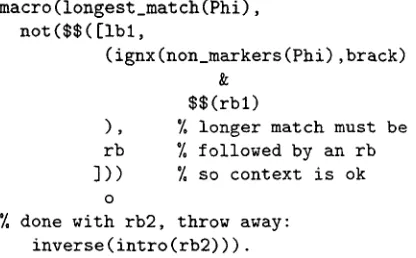
T h e fifth step filters out non-longest matches produced in the previous step. For example (and simplifying a bit), if Phi is ab*, then a string of the form ... rbl a b Ibl b ... should be ruled out since there is an instance of Phi (ignoring brackets except at the end) where there is an internal Ibl. This is implemented as:~
macro (longest_mat ch (Phi), not ($$ ( [lbl,
(ignx (non_markers (Phi) , brack)
$ $ ( r b l )
), % longer m a t c h must be
rb % followed by an rb
])) % so context is ok
0
~, done with rb2, throw away: inverse (intro (rb2)) ) .
T h e sixth step performs the transduction de-
scribed by T. This step is straightforwardly imple-
mented, where the main difficulty is getting T to apply to our specially marked string:
macro ( a u x _ r e p l a c e (T), {{sig, Ib2},
[Ibl,
inverse (non_markers)
4The line with $$ (rbl) (:an be oI)ti-
mized a bit: Since we know that an r b l
must be preceded by Phi, we can write!
[image:5.596.306.514.440.569.2]o T o
non_markers,
r b l x [] ]
}*).
The seventh step ensures that lbl is preceded by a string in Left:
macro (ii (L), ign ( if _s_then p (
ignx ( [xsig*, non_markers (L) ], lbl), [lbl,xsig*] ),
ib2)
O
inverse (intro (ib i) ) ).
The eighth step ensures that ib2 is not preceded by a string in L e f t . This is implemented similarly to the previous step:
m a c r o (12 ( L ) , if_s_then_p (
ignx (not ( [xsig*,non_markers (L) ] ), lb2), [lb2, xsig*] )
0
inverse ( intro (lb2) ) ).
Finally the ninth step, inverse (non_markers), removes "the O's so that the final result in not marked up in any special way.
3
Longest Match Capturing
As discussed in §1 the POSIX standard requires that multiple captures follow a longest m a t c h strategy. For multiple captures as in (3), one es- tablishes first a longest match for domain(T1). . . . . domain( T~ ). T h e n we ensure t h a t each of domain(Ti) in turn is required to match as long as possible, with each one having priority over its rightward neighbors. To implement this, we define a macro l m _ c o n c a t ( T s ) and use it as:
r e p l a c e ( l m _ c o n c a t ( T s ) , L e f t , R i g h t )
Ensuring the longest overall m a t c h is delegated to the r e p l a c e macro, so l m _ c o n c a t ( T s ) needs only ensure t h a t each individual transducer within Ts gets its proper left-to-right longest matching priority. This problem is mostly solved by the same techniques used to ensure the longest m a t c h within the r e p l a c e macro. T h e only complica- tion here is t h a t Ts can be of unbounded length. So it is not possible to have a single expression in the finite state calculus that applies to all possi- ble lenghts. This means that we need something a little more powerful t h a n mere macro expan- sion to construct the proper finite state calculus expression. T h e FSA Utilities provides a Prolog
hook for this purpose. T h e resulting definition of lm_concat is given in figure 2.
Suppose (as in Friedl (1997)), we want to m a t c h the following list of recognizers against the string t o p o l o g i c a l and insert a marker in each bound- ary position. This reduces to applying:
im_concat (
[
[ { [ t , o ] , [ t , o , p ] } , [ ] : ' # ' ] ,
[ { o , [ p , o , l , o ] } , [ ] :
' # ' ] ,
{ [g,i,c,a,l], [o',l,o,g,i,c,a,l] } ])
This expression transduces the string
topological only to the string top#o#1ogical. 5
4
Conclusions
The algorithm presented here has extended previ- ous algorithms for rewrite rules by adding a lim- ited version of backreferencing. This allows the output of rewriting to be dependent on the form of the strings which are rewritten. This new feature brings techniques used in Perl-like languages into the finite state calculus. Such an integration is needed in practical applications where simple text processing needs to be combined with more so- phisticated computational linguistics techniques.
One particularly interesting example where backreferences are essential is cascaded determin- istic (longest match) finite state parsing as de- scribed for example in Abney (Abney, 1996) and various papers in (Roche and Schabes, 1997a). Clearly, the standard rewrite rules do not apply in this domain. If NP is an NP recognizer, it would not do t o . s a y NP ~ [NP]/A_p. Nothing would force the string matched by the NP to the left of the arrow to be the same as the string matched by the NP to the right of the arrow.
One advantage of using our algorithm for fi- nite state parsing is t h a t the left and right con- texts may be used to bring in top-down filter- ing. 6 An often cited advantage of finite state 5An anonymous reviewer suggested theft lm_concat could be implemented in the frame- work of Karttunen (1996) as:
[ t o l t o p l o l p o l o ] - + . . . #;
Indeed the resulting transducer from this expression would transduce t o p o l o g i c a l into top#o#1ogical. But unfortunately this transducer would also trans- duce polotopogical into polo#top#o#gical, since the notion of left-right ordering is lost in this expres- sion.
macro(im_concat(Ts),mark_boundaries(Domains) o ConcatTs):- domains(Ts,Domains), concatT(Ts,ConcatTs).
domains([],[]).
domains([FIRO],[domain(F) IR]):- domains(RO,R). concatT([],[]).
concatT([TlTs], [inverse(non_markers) o T,ibl x []IRest]):- concatT(Ts,Rest).
%% macro(mark_boundaries(L),Exp): This is the central component of im_concat. For our %% "toplological" example we will have:
%% mark_boundaries ([domain( [{ [t, o] , [t, o ,p] }, [] : #] ),
%% domain([{o,[p,o,l,o]},[]: #]),
%% domain({ [g,i, c,a, i] , [o^,l,o,g,i,c,a,l] })]) %% which simplifies to:
%% mark_boundaries([{[t,o],[t,o,p]}, {o,[p,o,l,o]}, {[g,i,c,a,l],[o^,l,o,g,i,c,a,l]}]). %% Then by macro expansion, we get:
%% [{[t,o], [t,o,p]} o non_markers,[]x ibl, %% {o,[p,o,l,o]} o non_markers,[]x ibl,
%% {[g,i,c,a,l],[o',l,o,g,i,c,a,l]} o non_markers,[]x ibl]
%% o
%% % Filter i: {[t,o],[t,o,p]} gets longest match %% - [ignx_l(non_markers({ [t,o] , [t,o,p] }),ibl) ,
%% ign(non_markers({o, [p,o,l,o] }) ,ibl) ,
%% ign(non_markers({ [g,i,c,a,l] , [o^,l,o,g,i,c,a,l] }) ,ibl)]
%% o
%% % Filter 2: {o,[p,o,l,o]} gets longest match %% ~ [non_markers ({ [t, o] , [t, o, p] }) , Ib i,
%% ignx_l(non_markers ({o, [p,o,l,o] }) ,ibl),
%% ign(non_markers({ [g, i,c,a,l] , [o',l,o,g,i,c,a,l] }) ,ibl)] macro(mark_boundaries(L),Exp):-
boundaries(L,ExpO), % guess boundary positions greed(L,ExpO,Exp). % filter non-longest matches boundaries([],[]).
boundaries([FIRO],[F o non_markers, [] x ibl ]R]):- boundaries(RO,R). greed(L,ComposedO,Composed) :-
aux_greed(L,[],Filters), compose_list(Filters,ComposedO,Composed).
aux_greed([HIT],Front,Filters):- aux_greed(T,H,Front,Filters,_CurrentFilter). aux_greed([],F,_,[],[ign(non_markers(F),Ibl)]).
aux_greed([HlRO],F,Front,[-LiIR],[ign(non_markers(F),ibl)IRl]) "- append(Front,[ignx_l(non_markers(F),Ibl)IRl],Ll),
append(Front,[non_markers(F),ibl],NewFront), aux_greed(RO,H,NewFront,R,Rl).
%% ignore at least one instance of E2 except at end macro(ignx_l(E1,E2), range(El o [[? *,[] x E2]+,? +])). compose_list([],SoFar,SoFar).
compose_list([FlR],SoFar,Composed):- compose_list(R,(SoFar o F),Composed).
parsing is robustness. A constituent is found bot- tom up in an early level in the cascade even if that constituent does not ultimately contribute to an S in a later level of the cascade. While this is undoubtedly an advantage for certain ap- plications, our approach would allow the intro- duction of some top-down filtering while main- taining the robustness of a bottom-up approach. A second advantage for robust finite state pars- ing is that bracketing could also include the no- tion of "repair" as in Abney (1990). One might, for example, want to say something like: xy
[NP
RepairDet(x) RepairN(y) ]/)~__p 7 so that an NP could be parsed as a slightly malformed Det followed by a slightly malformed N. RepairDet and RepairN, in this example, could be doing a variety of things such as: contextualized spelling correction, reordering of function words, replace- ment of phrases by acronyms, or any other oper- ation implemented as a transducer.Finally, we should mention the problem of com- plexity. A critical reader might see the nine steps in our algorithm and conclude that the algorithm is overly complex. This would be a false conclu- sion. To begin with, the problem itself is complex. It is easy to create examples where the resulting transducer created by any algorithm would be- come unmanageably large. B u t there exist strate- gies for keeping the transducers smaller. For ex- ample, it is not necessary for all nine steps to be composed. They can also be cascaded. In that case it will be possible to implement different steps by different strategies, e.g. by determinis- tic or non-deterministic transducers or bimachines (Roche and Schabes, 1997b). The range of possi- bilities leaves plenty of room for future research.
R e f e r e n c e s
Steve Abney. 1990. Rapid incremental parsing with repair. In Proceedings of the 6th New OED Conference: Electronic Text Rese arch, pages 1-9.
Steven Abney. 1996. Partial parsing via finite- state cascades. In Proceedings of the ESSLLI
'96 Robust Parsing Workshop.
.Jeffrey Friedl. 1997. Mastering Regular Expres- sions. O'Reilly & Associates, Inc.
C. Douglas Johnson. 1 9 7 2 . Formal Aspects of Phonological Descriptions. Mouton, The Hague.
7The syntax here has been simplified. The rule should be understood as: replace(lm_concat([[]:'[np', repair_det, repair_n, []:']'],lambda, rho).
Ronald Kaplan and Martin Kay. 1994. Regular models of phonological rule systems. Computa- tional Linguistics, 20(3):331-379.
L. Karttunen, J-P. Chanod, G. Grefenstette, and A. Schiller. 1996. Regular expressions for lan- guage engineering. Natural Language Engineer- ing, 2(4):305-238.
Lauri Karttunen. 1995. The replace operator. In 33th Annual Meeting of the Association for Computational Linguistics, M.I.T. Cambridge Mass.
Lauri Karttunen. 1996. Directed replacement. In 34th Annual Meeting of the Association for
Computational Linguistics, Santa Cruz. Lauri Karttunen. 1997. The replace operator.
In Emannual Roche and Yves Schabes, editors, Finite-State Language Processing, pages 117- 147. Bradford, MIT Press.
Lauri Karttunen. 1998. The proper treatment of optimality theory in computational phonol- ogy. In Finite-state Methods in Natural Lan- guage Processing, pages 1-12, Ankara, June. Nils Klarlund. 1997. Mona & Fido: The logic
automaton connection in practice. In CSL '97. Mehryar Mohri and Richard Sproat. 1996. An efficient compiler for weighted rewrite rules. In 3~th Annual Meeting of the Association for Computational Linguistics, Santa Cruz. Emmanuel Roche and Yves Schabes. 1995. De-
terministic part-of-speech tagging with finite- state transducers. Computational Linguistics, 21:227-263. Reprinted in Roche & Schabes (1997).
Emmanuel Roche and Yves Schabes, editors. 1997a. Finite-State Language Processing. MIT Press, Cambridge.
Emmanuel Roche and Yves Schabes. 1997b. In- troduction. In Emmanuel Roche and Yves Sch- abes, editors, Finite-State Language Processing. MIT Press, Cambridge, Mass.
Gertjan van Noord and Dale Gerdemann. 1999. An extendible regular expression compiler for finite-state approaches in natural language pro- cessing. In Workshop on Implementing Au- tomata 99, Potsdam Germany.