Semantic Parsing to Probabilistic Programs for
Situated Question Answering
Jayant Krishnamurthy and Oyvind Tafjord and Aniruddha Kembhavi
Allen Institute for Artificial Intelligence
jayantk,oyvindt,[email protected]
Abstract
Situated question answering is the problem of answering questions about an environment such as an image or diagram. This problem requires jointly interpreting a question and an environment using background knowledge to select the correct answer. We present Parsing to Probabilistic Programs (P3), a novel
situ-ated question answering model that can use background knowledge and global features of the question/environment interpretation while retaining efficient approximate inference. Our key insight is to treat semantic parses as prob-abilistic programs that execute nondetermin-istically and whose possible executions repre-sent environmental uncertainty. We evaluate our approach on a new, publicly-released data set of 5000 science diagram questions, outper-forming several competitive classical and neu-ral baselines.
1 Introduction
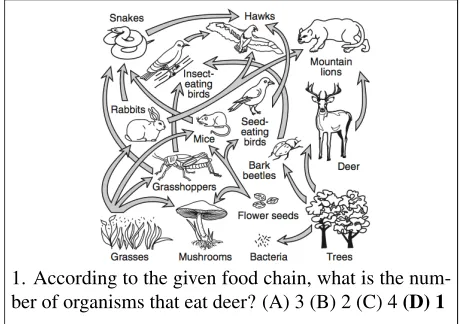
Situated question answering is a challenging prob-lem that requires reasoning about uncertain inter-pretations of both a question and an environment together with background knowledge to determine the answer. To illustrate these challenges, consider the 8th grade science diagram questions in Figure 1, which are motivated by the Aristo project (Clark and Etzioni, 2016). These questions require both com-puter vision to interpret the diagram and composi-tional question understanding. These components, being imperfect, introduce uncertainty that must be jointly reasoned about to avoid implausible interpre-tations. These uncertain interpretations must further
[image:1.612.311.541.238.400.2]1. According to the given food chain, what is the num-ber of organisms that eat deer? (A) 3 (B) 2 (C) 4(D) 1 2. Which organism is both predator and prey? (A) Bark Beetles(B) Insect-eating birds(C) Deer (D) Hawks 3. Based on the given food web, what would happen if there were no insect-eating birds? (A) The grasshop-per population would increase. (B) The grasshop-per population would decrease. (C) There would be no change in grasshopper number.
Figure 1: Example food web questions. A food web depicts a collection of organisms in an ecosystem with an arrow from organismxtoyindicating thatyeatsx. Questions may require counting (1), knowing animal roles (2) and reasoning about population changes (3).
be combined with background knowledge, such as the definition of a “predator,” to determine the cor-rect answer.
The challenges of situated question answering have not been completely addressed by prior work. Early “possible worlds” models (Matuszek et al., 2012; Krishnamurthy and Kollar, 2013; Mali-nowski and Fritz, 2014) were capable of composi-tional question understanding and using background knowledge, but did not jointly reason about
ment/question uncertainty. These models also used unscalable inference algorithms for reasoning about the environment, despite the lack of joint reasoning. More recent neural models (Antol et al., 2015; Mali-nowski et al., 2015; Yang et al., 2015) are incapable of using background knowledge and it remains un-clear to what extent these models can represent com-positionality in language.
We present Parsing to Probabilistic Programs (P3), a novel approach to situated question
answer-ing that addresses these challenges. It is motivated by two observations: (1) situated question answer-ing can be formulated as semantic parsanswer-ing with an execution model that is a learned function of the environment, and (2) probabilistic programmingis a natural and powerful method for specifying the space of permissible execution models and learning over it. InP3, we define a domain theory for the task as a probabilistic program, then train a joint loglin-ear model to semantically parse questions to logi-cal forms in this theory and execute them in an en-vironment. Importantly, the model includes global features over parsing and execution that enable it to avoid unlikely joint configurations. P3 lever-ages semantic parsing to represent compositionality in language and probabilistic programming to spec-ify background knowledge and perform linear-time approximate inference over the environment.
We present an experimental evaluation ofP3on a
new data set of 5000 food web diagram questions (Figure 1). We compare our approach to several baselines, including possible worlds and neural net-work approaches, finding thatP3outperforms both. An ablation study demonstrates that global features help the model achieve high accuracy. We also demonstrate thatP3 improves accuracy on a previ-ously published data set. Finally, we have released our data and code to facilitate further research.
2 Prior Work
Situated question answering is often formulated in terms of parsing both the question and environment into a common meaning representation where they can be combined to select the answer. This gen-eral approach has been implemented using different meaning representations:
Possible world models use a logical meaning
representation defined by a knowledge base schema. These models train a semantic parser to map ques-tions to queries and an environment model to map environments to knowledge bases in this schema. Executing the queries against the knowledge bases produces answers. These models assume that the parser and environment model are independent and furthermore that the knowledge base consists of independent predicate instances (Matuszek et al., 2012; Krishnamurthy and Kollar, 2013; Malinowski and Fritz, 2014). Despite these strong independence assumptions, these models have intractable infer-ence. An exception is Seo et al., (2015) who in-corporate hard constraints on the joint question/envi-ronment interpretation; however, this approach does not generalize to soft constraints or arbitrary logical forms. In some work only the environment model is learned (Kollar et al., 2010; Tellex et al., 2011; Howard et al., 2014b; Howard et al., 2014a; Berant et al., 2014; Krishnamurthy and Mitchell, 2015).
Neural networks use a vector meaning repre-sentation that encodes both the question and envi-ronment as vectors. These networks have mostly been applied to visual question answering (Antol et al., 2015), where many architectures have been pro-posed (Malinowski et al., 2015; Yang et al., 2015; Fukui et al., 2016). It is unclear to what extent these networks can represent compositionality in language using their vector encodings. Dynamic Neural Mod-ule Networks (Andreas et al., 2016a; Andreas et al., 2016b) are the exception to the above generaliza-tion. This approach constructs a neural network to represent the meaning of the question via semantic parsing, then executes this network against the im-age to produce an answer. Our approach is similar except that we construct and execute a probabilistic program. Advantages of our approach are that it nat-urally represents the discrete structure of food webs and can use background knowledge.
(Chen and Mooney, 2011; Artzi and Zettlemoyer, 2013), and information extraction (Krishnamurthy and Mitchell, 2012; Choi et al., 2015). Semantic parsing alone is insufficient for situated question an-swering because it does not interpret the environ-ment; many of the above approaches use semantic parsing as a component in a larger model.
Probabilistic programming languages extend pro-gramming languages with primitives for nondeter-ministic choice (McCarthy, 1963; Goodman and Stuhlm¨uller, 2014). We express logical forms in a probabilistic variant of Scheme similar to Church (Goodman et al., 2008); however, this paper uses Python-like pseudocode for clarity. The lan-guage has a single choice primitive calledchoose
that nondeterministically returns one of its argu-ments. For example choose(1,2,3)can execute
three ways, returning either 1, 2, or 3. Multiple calls to choose can be combined. For example, choose(1,2)+choose(1,2) adds two
nondeter-ministically chosen values, and therefore has four executions that return 2, 3, 3 and 4. Each execution also has a probability; in our case, these probabili-ties are assigned by a trained model given the envi-ronment and not explicitly specified in the program.
3 Parsing to Probabilistic Programs (P3)
The P3 model is motivated by two observations.
The first is that situated question answering can be formulated as semantic parsing with an execution model that is a learned function of the environment. Consider the first question in Figure 1. The meaning of this question could be represented by a logical form such as COUNT(λx.EATS(x,DEER)), which we could train a semantic parser to predict given a suitabledomain theoryof functions such asCOUNT and EATS. However, the information required to execute this logical form and answer the question must be extracted from the diagram. Specifically, EATS(x, y)depends on whether an arrow is present between x and y, which we must train a vision model to determine. Thus,EATSshould be alearned
function of the environment.
This first observation suggests a need for a for-malism for representing uncertainty and performing learning over the domain theory’s functions. Our second observation is that probabilistic
program-ming is a natural fit for this task. In this paradigm, the domain theory is a probabilistic program that de-fines the information to be extracted from the envi-ronment by usingchoose. To a first approximation,
the diagram question theory includes: def eats(x, y)
choose(true, false)
Logical forms are then probabilistic programs, each of whose possible executions represents a dif-ferent interpretation of the environment. For exam-ple, executing EATS(LION,DEER) hits the choose
in the above definition, resulting in two executions where the lion either eats or does not eat the deer. In the COUNT example above, each execution rep-resents a different set of animals that eat the deer. To learn the correct environment interpretation, we train an execution model to assign a probability to each execution given features of the environment. Using probabilistic programming enables us to com-bine learned functions, such as EATS, with back-ground knowledge functions, such as COUNT, and also facilitates inference.
According to these observations, applyingP3has
two steps. The first step is to define an appropriate domain theory. This theory is the main design de-cision in instantiating P3 and provides a powerful
way to encode domain knowledge. The second step is to train a loglinear model consisting of a semantic parser and an execution model. This model learns to semantically parse questions into logical forms in the theory and execute them in the environment to answer questions correctly. We defer discussion of the diagram question domain theory to Section 4 and focus on the loglinear model in this section.
3.1 Model Overview
The input to theP3 model is a question and an
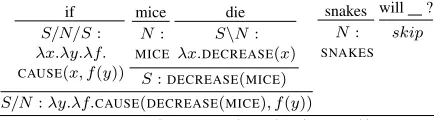
if S/N/S:
λx.λy.λf.
CAUSE(x, f(y))
mice N: MICE
die S\N:
λx.DECREASE(x)
S:DECREASE(MICE)
S/N:λy.λf.CAUSE(DECREASE(MICE), f(y))
snakes N: SNAKES
will ? skip
[image:4.612.77.294.57.117.2]S:λf.CAUSE(DECREASE(MICE), f(SNAKES))
Figure 2:Example CCG parse of a question as predicted by the semantic parserfp. The logical form`for the question is shown on the bottom line.
the model predicts a denotationγfor a questionqin an environmentvusing three latent variables:
P(γ|v, q;θ) =X
e,`,t
P(e, `, t|v, q;θ)1(ret(e) =γ)
P(e, `, t|v, q;θ) = 1
Zq,v
fex(e, `, v;θex)fp(`, t, q;θp)
The model is composed of two factors. fp repre-sents the semantic parser that scores logical forms ` and syntactic parse trees t given question q and parametersθp. fex represents the execution model. Given parametersθex, this factor assigns a score to a logical form`and its executionein environmentv. The denotationγ, i.e., the formal answer to the ques-tion, is simply the value returned by e. Zq,v repre-sents the model’s partition function. The following sections describe these factors in more detail.
3.2 Semantic Parser
The factor fp represents a Combinatory Categorial Grammar (CCG) semantic parser (Zettlemoyer and Collins, 2005) that scores logical forms for a ques-tion. Given a lexicon1 mapping words to syntactic categories and logical forms, CCG defines a set of possible syntactic parses t and logical forms ` for a question q. Figure 3.2 shows an example CCG parse.fpis a loglinear model over parses(`, t):
fp(`, t, q;θp) = exp{θTpφ(`, t, q)}
The functionφmaps parses to feature vectors. We use a rich set of features similar to those for syn-tactic CCG parsing (Clark and Curran, 2007); a full description is provided in an online appendix.
3.3 Execution Model
The factorfex is a loglinear model over the execu-tions of a logical form given an environment. Log-ical forms in P3 are probabilistic programs with a 1In our experiments, we automatically learn the lexicon in a preprocessing step. See Section 5.2 for details.
set of possible executions, where each executione is a sequence,e= [e0, e1, e2, ..., en]. e0 is the
pro-gram’s starting state,eirepresents the state immedi-ately after theith call tochoose, andenis the state at termination. The score of an execution is:
fex(e, `, v;θex) = n
Y
i=1
exp{θTexφ(ei−1, ei, `, v)}
In the above equation,θexrepresents the model’s parameters andφrepresents a feature function that produces a feature vector for the difference between sequential program statesei−1andeigiven environ-mentv and logical form`. φcan include arbitrary features of the execution, logical form and environ-ment, which is important, for example, to detect cy-cles in a food web (Section 4.3).
3.4 Inference
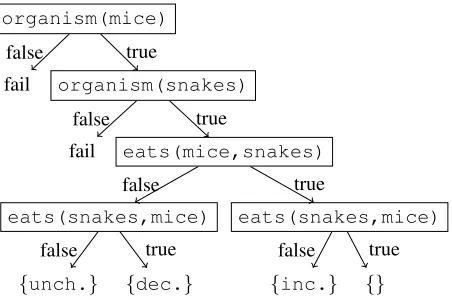
P3 is designed to rely on approximate inference: our goal is to use rich features to accurately make local decisions, as in linear-time parsers (Nivre et al., 2006). We perform approximate inference us-ing a two-stage beam search. Given a question q, the first stage performs a beam search over CCG parses to produce a list of logical forms scored by fp. This step is performed by using a CKY-style chart parsing algorithm then marginalizing out the syntactic parses. The second stage performs a beam search over executions of each logical form. The space of possible executions of a logical form is a tree (Figure 4.2) where each internal node rep-resents a partial execution up to a choose call.
The search maintains a beam of partial executions at the same depth, and each iteration advances the beam to the next depth, discarding the lowest-scoring executions according to fex to maintain a fixed size beam. This procedure runs in time linear to the number ofchoosecalls. We implement the
search by rewriting the probabilistic program into continuation-passing style, which allowschooseto
3.5 Training
P3 is trained by maximizing loglikelihood with stochastic gradient ascent. The training data {(qi, vi, ci)}n
i=1 is a collection of questions qi and
environmentsvi paired withsupervision oraclesci. ci(e) = 1for a correct execution eandci(e) = 0 otherwise. The oracle ci can implement various kinds of supervision, including: (1) labeled denota-tions, by verifying the value returned byeand (2) la-beled environments, by verifying each choice made by e. The oracle for diagram question answering combines both forms of supervision (Section 4.5).
The objective function O is the loglikelihood of predicting a correct execution:
O(θ) =
n
X
i=1
logX
e,l,t
ci(e)P(e, `, t|qi, vi;θ)
We optimize this objective function using stochastic gradient ascent, using the approximate in-ference algorithm from Section 3.4 to estimate the necessary marginals. When computing the marginal distribution over correct executions, we filter each step of the beam search using the supervision oracle cito improve the approximation.
4 Diagram Question Answering withP3
As a case study, we applyP3to the task of answer-ing food web diagram questions from an 8th grade science domain. A few steps are required to apply P3. First, we create a domain theory of food webs that represents extracted information from the dia-gram and background knowledge for the domain. Second, we define the features of the execution model that are used to learn how programs in the domain theory execute given a diagram. Third, we define a component to select a multiple-choice an-swer given a denotation. Finally, we define the su-pervision oracle used for training.
4.1 Food Web Diagram Questions
We consider the task of answering food web diagram questions. The input consists of a diagram depicting a food web, a natural language question and a list of natural language answer options (Figure 1). The goal is to select the correct answer option. This task has many regularities that require global features:
for example, food webs are usually acyclic and cer-tain animals usually have cercer-tain roles (e.g., mice are herbivores). We have collected and released a data set for this task (Section 5.1).
We preprocess the diagrams in the data set us-ing a computer vision system that identifies can-didate diagram elements (Kembhavi et al., 2016). This system extracts a collection of text labels (via OCR), arrows, arrowheads and objects, each with corresponding scores. It also extracts a collection of scored linkages between these elements. These ex-tractions are noisy and contain many discrepancies such as overlapping text labels and spurious link-ages. We use these extractions to define a set of can-didate organisms (using the text labels), and also to define features of the execution model.
4.2 Domain Theory
The domain theory is a probabilistic program encod-ing the information to extract from the environment as well as background knowledge about food webs. It represents the structure of a food web using two functions. These functions are predicates that invoke
chooseto return either true or false. The execution
model learns to predict which of these values is cor-rect for each set of arguments given the diagram. It furthermore has a collection of deterministic func-tions that encode domain knowledge, including def-initions of animal roles such as HERBIVOREand a model of population change causation.
Figure 4.2 shows pseudocode for a portion of the domain theory. Food webs are represented using two functions over the extracted text la-bels: ORGANISM(x) indicates whether the label
x is an organism (as opposed to, e.g., the dia-gram title); and EATS(x, y). The definitions of these functions invokechoosewhile remembering
previously chosen values to avoid double counting probabilities when executing logical forms such as ORGANISM(DEER) ∧ORGANISM(DEER). The
re-membered values are stored in a global variable that is also used to implement the supervision oracle. Deterministic functions such asCAUSE are defined in terms of these learned functions.
The uses ofchoosein the domain theory create
# initialize predicate instance variables # from text labels in environment
world = {"mice": undef,
("mice", "snakes"): undef, ...}
def organism(name)
if (world[name] == undef)
world[name] = choose(true, false)
return world[name]
def eats(x, y)
# same as organism but with pairs.
# entities referenced in the logical form # must be organisms. choose() represents # failure; it returns no values.
def getOrganism(x)
if (organism(x)) return x else choose()
# change events are direction/ # text label tuples
def decrease(x)
return ("decrease", x)
def cause(e1, e2)
e12 = eats(e1[1], e2[1]) e21 = eats(e2[1], e1[1])
# deterministic model with cases. e.g. # if eats(y, x) then (cause (decrease x) # (decrease y)) -> true
[image:6.612.72.297.54.392.2]return doCause(e1[0], e2[0], e12, e21) Figure 3:Domain theory pseudocode for diagram question an-swering.
corresponds to the question “what happens to the snakes when the mice decrease?” This logical form is shorthand for the following program:
filter(lambda f.cause(
decrease(getOrganism("mice")), f(getOrganism("snakes"))),
set(decrease, increase, unchanged))
Specifically, entities such as MICEare created by callinggetOrganismand logical forms with
func-tional types implicitly represent filters over the ap-propriate argument type. Executing this program first applies the filter predicate todecrease. Next,
it evaluates getOrganism("mice"), which calls organismand encounters the first call tochoose.
This call is shown as the first branch of the tree in Figure 4.2. The successful branch proceeds to eval-uategetOrganism("snakes"), shown as the
sec-ond branch. Finally, the successful branch evaluates
cause, which callseatstwice, resulting in the final
two branches. The value returned by each branch is determined by the causation model which performs
organism(mice)
fail organism(snakes)
fail eats(mice,snakes)
eats(snakes,mice)
{unch.} {dec.}
eats(snakes,mice)
{inc.} {}
false true
false true
false
false true
true
[image:6.612.316.542.56.206.2]false true
Figure 4: Tree of possible executions for the logical form λf.CAUSE(DECREASE(MICE), f(SNAKES)). Each path from root to leaf represents a single execution that returns the indi-cated denotation or fails, and each internal node represents a nondeterministic choice made withchoose.
some deterministic logic on the truth values of the two eats relations.
4.3 Execution Features
The execution model uses three sets of features: in-stance features, predicate features, and denotation features. Instance features treat each predicate in-stance independently, while the remainder are global features of multiple predicate instances and the log-ical form. We provide a complete listing of features in an online appendix.
Instance features fire whenever an execution chooses a truth value for a predicate instance. These features are similar to the per-predicate-instance fea-tures used in prior work to produce a distribution over possible worlds. ForORGANISM(x), our
fea-tures are the vision model’s extraction score for x and indicator features for the number of tokens in x. For EATS(x, y), our features are various
combi-nations of the vision model’s scores for arrows that may connect the text labelsxandy.
Denotation featuresfire on the return value of an execution. There are two kinds of denotation fea-tures: size features that count the number of entities in denotations of various types and denotation ele-ment features for specific logical forms. The sec-ond kind of feature can be used to learn that the de-notation of λx.HERBIVORE(x) is likely to contain
MOUSE, but unlikely to containWOLF.
4.4 Answer Selection
P3 predicts a distribution over denotations for each
question, which for our problem must be mapped to a distribution over multiple choice answers. An-swer selection performs this task using string match heuristics and an LSTM (Hochreiter and Schmidhu-ber, 1997). The string match heuristics score each answer option given a denotation then select the highest scoring answer, abstaining in the case of a tie. The score computation depends on the denota-tion’s type. If the denotation is a set of entities, the score is an approximate count of the number of enti-ties in the denotation mentioned in the answer using a fuzzy string match. If the denotation is a set of change events, the score is a fuzzy match of both the change direction and the animal name. If the denota-tion is a number, string matching is straightforward. Applying these heuristics and marginalizing out de-notations yields a distribution over answer options.
A limitation of the above approach is that it does not directly incorporate linguistic prior knowledge about likely answers. For example, “snake” is usu-ally a good answer to “what eats mice?” regardless of the diagram. Such knowledge is known to be es-sential for visual question answering (Antol et al., 2015; Andreas et al., 2016b) and important in our task as well. We incorporate this knowledge in a standard way, by training a neural network on ques-tion/answer pairs (without the diagram) and combin-ing its predictions with the strcombin-ing match heuristics above. The network is a sequence LSTM that is ap-plied to the question concatenated with each answer optionato produce a 50-dimensional vector vafor each answer. The distribution over answers is the softmax of the inner product of these vectors with a learned parameter vector w. For simplicity, we combine these two components using a 50/50 mix of their answer distributions.
4.5 Supervision Oracle
The supervision oracle for diagram question answer-ing combines supervision of both answers and envi-ronment interpretations. We assume that each dia-gram has been labeled with a food web. An exe-cution is correct if and only if (1) all of the chosen values in the global variable encoding the food web are consistent with the labeled food web, and (2) string match answer selection applied to its denota-tion chooses the correct answer. The first constraint guarantees that every logical form has at most one correct execution for any given diagram.
5 Evaluation
Our evaluation comparesP3to both possible worlds
and neural network approaches on our data set of food web diagram questions. An ablation study demonstrates that both sets of global features im-prove accuracy. Finally, we demonstrateP3’s gen-erality by applying it to a previously-published data set, obtaining state-of-the-art results.
Code, data and supplementary material for this paper are available at: http://www.allenai. org/paper-appendix/emnlp2016-p3
5.1 FOODWEBSData Set
FOODWEBS consists of ∼500 food web diagrams and ∼5000 questions designed to imitate actual questions encountered on 8th grade science exams. The train/validation/test sets contain∼300/100/100 diagrams and their corresponding questions. The data set has three kinds of annotations in addition to the correct answer for each question. First, each di-agram is annotated with the food web that it depicts usingORGANISM andEATS. Second, each diagram has predictions from a vision system for various dia-gram elements such as arrows and text labels (Kem-bhavi et al., 2016). These are noisy predictions, not ground truth. Finally, each question is annotated by the authors with a logical form (or null if its mean-ing is not representable in the domain theory). These logical forms are not used to trainP3 but are useful
to measure per-component error.
us-ing an image search engine. Second, we generated questions for these diagrams using Mechanical Turk. Workers were shown a diagram and a real question for inspiration and asked to write a new question and its answer options. We validated each gener-ated question by asking 3 workers to answer it, dis-carding questions where at least 2 did not choose the correct answer. We also manually corrected any am-biguous (e.g., two answer options are correct) and poorly-formatted (e.g., two answer options have the same letter) questions. The final data set has high quality: a human domain expert correctly answered 95 out of 100 randomly-sampled questions.
5.2 Baseline Comparison
Our first experiment comparesP3with several lines for situated question answering. The first base-line, WORLDS, is a possible worlds model based on Malinowski and Fritz (2014). This baseline learns a semantic parser P(`, t|q) and a distribution over
food webs P(w|v), then evaluates ` on w to pro-duce a distribution over denotations. This model is implemented by independently training P3’s CCG
parser (on question/answer pairs and labeled food webs) and a possible-worlds execution model (on la-beled food webs). The CCG lexicon for bothP3and WORLDSwas generated by applying PAL (Krishna-murthy, 2016) to the same data. Both models select answers as described in Section 4.4.
We also compared P3 to several neural network baselines. The first baseline, LSTM, is the text-only answer selection model described in Section 4.4. The second baseline, VQA, is a neural net-work for visual question answering. This model represents each image as a vector by using the fi-nal layer of a pre-trained VGG19 model (Simonyan and Zisserman, 2014) and applying a single fully-connected layer. It scores answer options by using the answer selection LSTM to encode question/an-swer pairs, then computing a dot product between the text and image vectors. This model is somewhat limited because VGG features are unlikely to encode important diagram structure, such as the content of text labels. Our third baseline, DQA, is a neural net-work that rectifies this limitation (Kembhavi et al., 2016). It encodes the diagram predictions from the vision system as vectors and attends to them using the LSTM-encoded question vector to select an
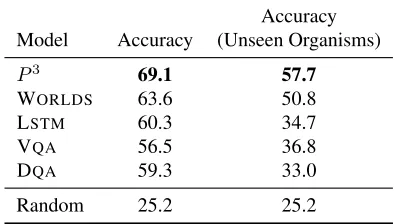
an-Accuracy Model Accuracy (Unseen Organisms)
P3 69.1 57.7
WORLDS 63.6 50.8
LSTM 60.3 34.7
VQA 56.5 36.8
DQA 59.3 33.0
[image:8.612.326.523.59.171.2]Random 25.2 25.2
Table 1: Accuracy ofP3and several baselines on theFOOD
-WEBStest set and a modified test set with unseen organisms.
Model Accuracy ∆
P3 69.1
-LSTM 59.8 -9.3
-LSTM -denotation 55.8 -13.3 -LSTM -denotation -predicate 52.4 -16.7
Table 2: Test set accuracy ofP3removing LSTM answer se-lection (Section 4.4), denotation features and predicate features (Section 4.3).
swer. This model is trained with question/answer pairs and diagram parses, which is roughly compa-rable to the supervision used to trainP3.
Table 5.2 compares the accuracy of P3 to these baselines. Accuracy is the fraction of questions an-swered correctly. LSTMperforms well on this data set, suggesting that many questions can be answered without using the image. This result is consistent with results on visual question answering (Antol et al., 2015). The other neural network models have similar performance to LSTM, whereas both WORLDS and P3 outperform it. We also find that P3 outperforms WORLDS likely due to its global features, which we investigate in the next section.
[image:8.612.318.537.202.274.2]5.3 Ablation Study
We performed an ablation study to further under-stand the impact of LSTM answer selection and global features. Table 5.2 shows the accuracy of P3 trained without these components. We find that LSTM answer selection improves accuracy by 9 points, as expected due to the importance of linguis-tic prior knowledge. Global features improve accu-racy by 7 points, which is roughly comparable to the delta betweenP3and WORLDSin Table 5.2.
5.4 Component Error Analysis
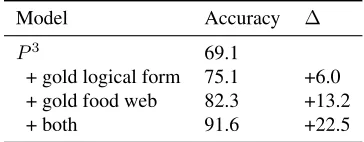
Our third experiment analyses sources of error by training and evaluatingP3 while providing the gold logical form, food web, or both as input. Table 5.5 shows the accuracy of these three models. The final entry shows the maximum accuracy possible given our domain theory and answer selection. The larger accuracy improvement with gold food webs suggests that the execution model is responsible for more error than semantic parsing, though both com-ponents contribute.
5.5 SCENEExperiments
Our final experiment applies P3 to theSCENEdata set of Krishnamurthy and Kollar (2013). In this data set, the input is a natural language expression, such as “blue mug to the left of the monitor,” and the output is the set of objects in an image that the ex-pression denotes. The images are annotated with a bounding box for each candidate object. The data set includes a domain theory that was automatically generated by creating a category and/or relation per word based on its part of speech. It also includes a CCG lexicon and image features. We use these re-sources, adding predicate and denotation features.
Table 5.5 compares P3 to prior work onSCENE.
The evaluation metric is exact match accuracy be-tween the predicted and labeled sets of objects. We consider three supervision conditions: QA trains with question/answer pairs, QA+E further includes labeled environments, and QA+E+LF further in-cludes labeled logical forms. We trainedP3 in the
first two conditions, while prior work trained in the first and third conditions. KK2013 is a possible worlds model with a max-margin training objective. P3slightly outperforms in the QA condition andP3
Model Accuracy ∆
P3 69.1
+ gold logical form 75.1 +6.0 + gold food web 82.3 +13.2
[image:9.612.335.517.58.129.2]+ both 91.6 +22.5
Table 3: Accuracy ofP3when trained and evaluated with la-beled logical forms, food webs, or both.
Supervision Model QA QA+E QA+E+LF
P3 68 75 –
KK2013 67 – 70
Table 4:Accuracy on theSCENEdata set. KK2013 results are
from Krishnamurthy and Kollar (2013).
trained with labeled environments outperforms prior work trained with additional logical form labels.
6 Conclusion
Parsing to Probabilistic Programs (P3) is a novel model for situated question answering that jointly reasons about question and environment interpreta-tions using background knowledge to produce an-swers. P3 uses a domain theory – a probabilistic program – to define the information to be extracted from the environment and background knowledge. A semantic parser maps questions to logical forms in this theory, which are probabilistic programs whose possible executions represent possible interpreta-tions of the environment. An execution model scores these executions given features of the environment. Both the semantic parser and execution model are jointly trained in a loglinear model, which thereby learns to both parse questions and interpret environ-ments. Importantly, the model includes global fea-tures of the logical form and executions, which help the model avoid implausible interpretations. We demonstrate P3 on a challenging new data set of
5000 science diagram questions, where it outper-forms several competitive baselines.
Acknowledgments
[image:9.612.340.510.160.217.2]References
Jacob Andreas, Marcus Rohrbach, Trevor Darrell, and Dan Klein. 2016a. Deep compositional question an-swering with neural module networks. InCVPR. Jacob Andreas, Marcus Rohrbach, Trevor Darrell, and
Dan Klein. 2016b. Learning to compose neural net-works for question answering. InNAACL.
Stanislaw Antol, Aishwarya Agrawal, Jiasen Lu, Mar-garet Mitchell, Dhruv Batra, C. Lawrence Zitnick, and Devi Parikh. 2015. VQA: Visual question answer-ing. InInternational Conference on Computer Vision (ICCV).
Yoav Artzi and Luke Zettlemoyer. 2013. Weakly su-pervised learning of semantic parsers for mapping in-structions to actions. Transactions of the Association for Computational Linguistics.
Jonathan Berant, Andrew Chou, Roy Frostig, and Percy Liang. 2013. Semantic parsing on Freebase from question-answer pairs. In Proceedings of the 2013 Conference on Empirical Methods in Natural Lan-guage Processing.
Jonathan Berant, Vivek Srikumar, Pei-Chun Chen, Abby Vander Linden, Brittany Harding, Brad Huang, Peter Clark, and Christopher D. Manning. 2014. Modeling biological processes for reading comprehen-sion. InProceedings of EMNLP.
David L. Chen and Raymond J. Mooney. 2011. Learn-ing to interpret natural language navigation instruc-tions from observainstruc-tions. In Proceedings of the 25th AAAI Conference on Artificial Intelligence.
Eunsol Choi, Tom Kwiatkowski, and Luke Zettlemoyer. 2015. Scalable semantic parsing with partial ontolo-gies. InProceedings of the 2015 Association for Com-putational Linguistics.
Stephen Clark and James R. Curran. 2007. Wide-coverage efficient statistical parsing with CCG and log-linear models. Computational Linguistics, 33(4):493–552.
Peter Clark and Oren Etzioni. 2016. My computer is an honor student - but how intelligent is it? standardized tests as a measure of ai. AI Magazine, 37:5–12. Akira Fukui, Dong Huk Park, Daylen Yang, Anna
Rohrbach, Trevor Darrell, and Marcus Rohrbach. 2016. Multimodal compact bilinear pooling for visual question answering and visual grounding. arXiv:1606.01847.
Noah D Goodman and Andreas Stuhlm¨uller. 2014. The Design and Implementation of Probabilistic Program-ming Languages. http://dippl.org. Accessed: 2016-2-25.
Noah D. Goodman, Vikash K. Mansinghka, Daniel M. Roy, Keith Bonawitz, and Joshua B. Tenenbaum.
2008. Church: A language for generative models. In Uncertainty in Artificial Intelligence.
Sepp Hochreiter and J¨urgen Schmidhuber. 1997. Long short-term memory. Neural computation, 9(8):1735– 1780.
Thomas M. Howard, Istvan Chung, Oron Propp, Matthew R. Walter, and Nicholas Roy. 2014a. Effi-cient natural language interfaces for assistive robots. In IEEE/RSJ International Conference on Intelligent Robots and Systems (IROS) Workshop on Rehabilita-tion and Assistive Robotics, September.
Thomas M Howard, Stefanie Tellex, and Nicholas Roy. 2014b. A natural language planner interface for mo-bile manipulators. In2014 IEEE International Con-ference on Robotics and Automation (ICRA).
Aniruddha Kembhavi, Mike Salvato, Eric Kolve, Min Joon Seo, Hannaneh Hajishirzi, and Ali Farhadi. 2016. A diagram is worth a dozen images. In Euro-pean Conference on Computer Vision (ECCV). Thomas Kollar, Stefanie Tellex, Deb Roy, and Nicholas
Roy. 2010. Toward understanding natural language directions. InProceedings of the 5th ACM/IEEE In-ternational Conference on Human-Robot Interaction. Jayant Krishnamurthy and Thomas Kollar. 2013. Jointly
learning to parse and perceive: Connecting natural lan-guage to the physical world.Transactions of the Asso-ciation of Computational Linguistics – Volume 1. Jayant Krishnamurthy and Tom M. Mitchell. 2012.
Weakly supervised training of semantic parsers. In Proceedings of the 2012 Joint Conference on Empir-ical Methods in Natural Language Processing and Computational Natural Language Learning.
Jayant Krishnamurthy and Tom M. Mitchell. 2015. Learning a compositional semantics for freebase with an open predicate vocabulary. Transactions of the As-sociation for Computational Linguistics, 3:257–270. Jayant Krishnamurthy. 2016. Probabilistic models for
learning a semantic parser lexicon. InNAACL. Tom Kwiatkowski, Eunsol Choi, Yoav Artzi, and Luke
Zettlemoyer. 2013. Scaling semantic parsers with on-the-fly ontology matching. In Proceedings of the 2013 Conference on Empirical Methods in Natural Language Processing.
Percy Liang, Michael I. Jordan, and Dan Klein. 2011. Learning dependency-based compositional semantics. In Proceedings of the Association for Computational Linguistics.
Mateusz Malinowski and Mario Fritz. 2014. A multi-world approach to question answering about real-world scenes based on uncertain input. In Advances in Neural Information Processing Systems.
answering questions about images. In International Conference on Computer Vision.
Cynthia Matuszek, Nicholas FitzGerald, Luke Zettle-moyer, Liefeng Bo, and Dieter Fox. 2012. A joint model of language and perception for grounded at-tribute learning. InProceedings of the 29th Interna-tional Conference on Machine Learning.
John McCarthy. 1963. A basis for a mathematical the-ory of computation. In Computer Programming and Formal Systems.
Joakim Nivre, Johan Hall, and Jens Nilsson. 2006. Malt-parser: A data-driven parser-generator for dependency parsing. InProceedings of the 21st International Con-ference on Computational Linguistics and 44th Annual Meeting of the Association for Computational Linguis-tics.
Siva Reddy, Mirella Lapata, and Mark Steedman. 2014. Large-scale semantic parsing without question-answer pairs. Transactions of the Association for Computa-tional Linguistics.
Minjoon Seo, Hannaneh Hajishirzi, Ali Farhadi, Oren Et-zioni, and Clint Malcolm. 2015. Solving geometry problems: Combining text and diagram interpretation. In Proceedings of the 2015 Conference on Empirical Methods in Natural Language Processing.
Karen Simonyan and Andrew Zisserman. 2014. Very deep convolutional networks for large-scale image recognition. CoRR, abs/1409.1556.
Stefanie Tellex, Thomas Kollar, Steven Dickerson, Matthew Walter, Ashis Banerjee, Seth Teller, and Nicholas Roy. 2011. Understanding natural language commands for robotic navigation and mobile manipu-lation. InAAAI Conference on Artificial Intelligence. Kun Xu, Siva Reddy, Yansong Feng, Songfang Huang,
and Dongyan Zhao. 2016. Question Answering on Freebase via Relation Extraction and Textual Ev-idence. InProceedings of the Association for Compu-tational Linguistics (ACL 2016).
Zichao Yang, Xiaodong He, Jianfeng Gao, Li Deng, and Alexander J. Smola. 2015. Stacked attention net-works for image question answering. arXiv preprint arXiv:1511.02274.
Wen-tau Yih, Ming-Wei Chang, Xiaodong He, and Jian-feng Gao. 2015. Semantic parsing via staged query graph generation: Question answering with knowl-edge base. InProceedings of the 53rd Annual Meet-ing of the Association for Computational LMeet-inguistics and the 7th International Joint Conference on Natural Language Processing (Volume 1: Long Papers). John M. Zelle and Raymond J. Mooney. 1993. Learning
semantic grammars with constructive inductive logic programming. In Proceedings of the 11th National Conference on Artificial Intelligence.