Proceedings of the 2019 Conference on Empirical Methods in Natural Language Processing and the 9th International Joint Conference on Natural Language Processing, pages 1129–1139,
1129
Look-up and Adapt: A One-shot Semantic Parser
Zhichu Lu⇤Carnegie Mellon University Pittsburgh, PA [email protected]
Forough Arabshahi⇤
Carnegie Mellon University Pittsburgh, PA [email protected]
Igor Labutov
LAER AI, Inc. New York, NY
Tom Mitchell
Carnegie Mellon University Pittsburgh, PA
Abstract
Computing devices have recently become ca-pable of interacting with their end users via natural language. However, they can only op-erate within a limited “supported” domain of discourse and fail drastically when faced with an out-of-domain utterance, mainly due to the limitations of their semantic parser. In this pa-per, we propose a semantic parser that gener-alizes to out-of-domain examples by learning a general strategy for parsing an unseen ut-terance through adapting the logical forms of seenutterances, instead of learning to generate a logical form from scratch. Our parser main-tains a memory consisting of a representative subset of the seen utterances paired with their logical forms. Given an unseen utterance, our parser works by looking up a similar utterance from the memory and adapting its logical form until it fits the unseen utterance. Moreover, we present a data generation strategy for con-structing utterance-logical form pairs from dif-ferent domains. Our results show an improve-ment of up to 68.8% on one-shot parsing un-der two different evaluation settings compared to the baselines.
1 Introduction and Background
Speech recognition technologies are achieving hu-man parity (Xiong et al.,2016). As a result, end users can now access different functionalities of their phones and computers through spoken in-structions via a natural language processing inter-face referred to as a conversational agent. Current commercial conversational agents such as Siri, Alexa or Google Assistant come with a fixed set of simple functions like setting alarms and mak-ing reminders, but are often not able to cater to the specific phrasing of a user or the specific action a
⇤These two authors contributed equally
user needs. However, it has recently been shown that it is possible to add new functionalities to an agent through natural languageinstruction(Azaria et al.,2016;Labutov et al.,2018).
For example, assume that the user wants to add a functionality for resetting an alarm based on the weather forecast for the next day, as demonstrated by the following utterance: “whenever it snows at night, wake me up 30 minutes early”. The user can instruct this task to the agent by breaking it down into a sequence of actions that the agent already knows.
• check the weather app,
• see if the forecast is calling for snow,
• if yes, then reset the time of the alarm to 30 minutes earlier.
This set of instructions result in a logical form or a semantic parse for this specific new utterance. However, this approach can be used in practice only if the agent is capable of generalizing from this single new utterance to similar utterances such as “if the weather is rainy, then set an alarm for 1 hour later”. We refer to this problem asone-shot semantic parsing.
the data sparsity of the one-shot semantic parsing task. We present a general strategy for “adapt-ing” logical forms rather than constructing them from scratch by “looking up” similar sentences that we know how to parse and changing their log-ical forms until they fit the new utterances. These logical forms are looked-up from a memory that contains a representative subset of previously seen utterance-logical form pairs. Once this general strategy is learned, the parser can be extended to parse an utterance from a new domain by adding one new example of that domain to the memory.
We propose a dataset generation method that al-lows us to evaluate the effectiveness of our model in a one-shot setting. We show that we generate reasonably good utterances while creating differ-ent experimdiffer-ental setups and scenarios for evalua-tion.
Summary of Results In this paper we propose a
novel neural semantic parser for the task of one-shot semantic parsing. We design two different experiments to evaluate the parsing accuracy. We show that our approach improves the performance of neural semantic parsers by a significant margin across 6 different domains of discourse. More-over, we present a detailed analysis of our pro-posed model and the performance of its different components through an oracle study.
2 Problem Definition
In this section, we introduce the basic terminology used in the paper and formally define the task of one-shot semantic parsing.
A semantic parser takes as input an utterance and outputs a correspondinglogical form. An ut-terance is a sequence of words and a logical form is an s-expression capturing the meaning of the ut-terance.
For example, “parents of John’s friends” is an utterance and (field parent (field friend John))is its logical form.
We use a synchronous context free grammar (SCFG), which is a generalization of the context-free grammar (CFG), to generate grammar rules (Chiang,2006). A rule in an SCFG has a left hand side, which is a non-terminal category, and two right hand sides, referred to as the source and the target. For our semantic parsing task, the source corresponds to an utterance, and the target cor-responds to a logical form. We denote a gram-mar rule with the small letter g. A set of
gram-mar rules, denoted by the capital letter G, span a domain of utterances. In this paper, we define
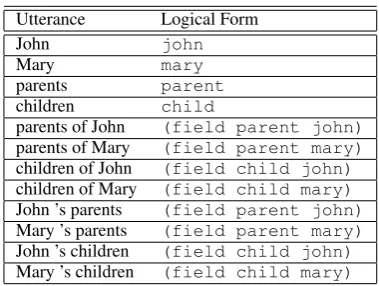
domain(G)as the set of allutterance-logical form pairs generated by a set of grammar rulesG. A sample SCFG Gsample with its domain are pro-vided in Tables5of AppendixAand Table1 be-low, respectively.
Utterance Logical Form
John john
Mary mary
parents parent
children child
[image:2.595.321.511.165.308.2]parents of John (field parent john) parents of Mary (field parent mary) children of John (field child john) children of Mary (field child mary) John ’s parents (field parent john) Mary ’s parents (field parent mary) John ’s children (field child john) Mary ’s children (field child mary)
Table 1: Domain of the sample SCFGGsample. The
rules of this SCFG are presented in the AppendixA. The domain of the sample SCFG is the set of all
hsource,targetipairs listed in this table.
Inone-shot semantic parsingwe are given as
input a subset of utterance and logical form pairs fromdomain(G)and a single utterance and logi-cal form pair fromdomain(G0). The goal of one-shot semantic parsing is to parse utterances from
domain(G0)that are not in the input.
Let us provide an example to make this more clear. Consider that we are given utterance and logical form pairs from domain(Gsample) in
Ta-ble1as well as the following utterance and logical form pair as input.
hfriends of John,(field friend john)i The goal of one-shot semantic parsing is to parse examples such as
hfriends of Mary, (1)
(field friend Mary)i
hparents of Mary’s friends, (2)
(field parent(field friend Mary)i which are not indomain(Gsample).
rely on string matching which limits their robust-ness to natural language variation. Neural seman-tic parsers are more robust compared to grammar-based parsers. However, their performance signif-icantly drops in such a data-hungry setting. In the next section, we present our look-up adapt seman-tic parser that addresses the challenges of neural semantic parsers in a data-sparse scenario.
3 Look-up and Adapt
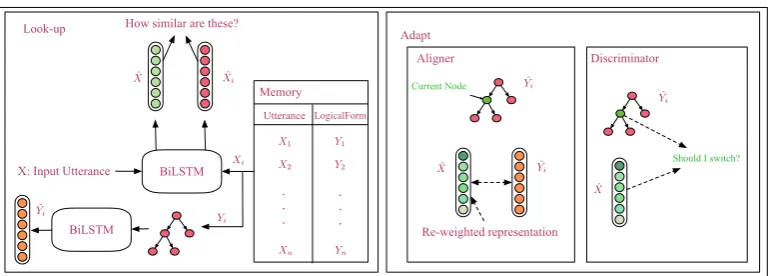
In this section, we propose a novel neural network architecture for one-shot semantic parsing. We are given a set of utterance-logical form pairs as input and our goal is to output a semantic parse for an unseen query utterance. Our model is able to gen-erate a logical form for the utterance by “looking up” a similar utterance from a pool of utterance-logical form pairs and “adapting” its utterance-logical form. This pool of utterances is maintained in a “mem-ory” and consist of a representative subset of the input utterance-logical form pairs. We will show that in the data-sparse scenario of one-shot seman-tic parsing, adapting known logical forms is eas-ier compared to generating a logical form from scratch. We will also discuss that it is important what subset of the data is included in the memory. Our model consists of two main modules, namely look-up § 3.1 and adapt § 3.2. Figure1 shows a sketch of our proposed model and the main look-up adapt algorithm is given in Algo-rithm 1. The look-up module is responsible for retrieving utterance-logical form pairs from the memory, using two Bidirectional LSTM encoders. The adapt module is responsible for adapting the retrieved logical form until it results in the correct semantic parse. The adapt module has two sub-modules, namely the aligner and the discriminator. The aligner is responsible for aligning the logical form with the query utterance and the discrimina-tor decides which parts of the logical form should be swapped with a new one from the memory. In the following sections, we will define each sub-module of our proposed model in detail and pro-pose a loss for training the model in an end-to-end fashion.
Before describing the model components, let us start by introducing the notation we will use in the following sections. Bold capital letters represent matrices, and bold lower case letters represent vec-tors. X denotes a distributed representation of an utterance, where each column ofX is the
repre-sentation for a word in the utterance.Y denotes a distributed representation of a logical form, where each column ofY is the representation for a pred-icate in the logical form.Tis a tree representation of the logical form. w and w0 denote attention weights that sum to at least 0 and at most 1.
Algorithm 1LookUpAndAdapt
1: functionLOOKUPANDADAPT(Memory,X0,w0)
2: (X,Y,T) LOOKUP(Memory,X0,w0) 3: for alltinT.children do
4: t0 ADAPT(Memory,X0,Y,t,w0)
5: T.children.replace(t, t’)
6: returnT
3.1 Look-up
In this section, we describe our look-up strategy and discuss its sub-modules in detail.
Encoder Bidirectional RNNs have been
suc-cessfully used to represent sentences in many ar-eas of natural language processing such as ques-tion answering, neural machine translaques-tion, and semantic parsing (Bengio and LeCun,2015; Her-mann et al., 2015; Dong and Lapata, 2016). We use Bidirectional LSTMs where the forward LSTM reads the input in the utterance word or-der (x1, x2, ..., xT) and the backward LSTM reads the input in reversed order (xT, xT 1, ..., x1). The
output for each word xi is the concatenation of the ith hidden state hf wdi of the forward LSTM
and the T ith hidden state hbck
T i of the back-ward LSTM. As shown in Figure 1, we use two Bidirectional LSTMs, one to encode the utterance, and one to encode the logical form. The utter-ance is treated as a sequence of words, where each word is represented as a pretrained GloVe (Pennington et al., 2014) embedding. The log-ical form is treated as a sequence of predicates and parentheses, each of which is also represented as a pretrained GloVe embedding. The motiva-tion to use GloVe embeddings for both words and predicates is to avoid the problem of unknown words/predicates encountered in the one-shot ut-terance’s domain.
Retrieving from the memory The memory
consists of a subset of the utterance-logical form pairs given as input to the algorithm. We refer to the number of pairs in the memory as its size and denote it withn. We would like to note that the
Look-up Adapt
Look-up Adapt
Memory
BiLSTM X: Input Utterance
Utterance LogicalForm
X1
X2
. . .
Xn Yn
. . .
Y1
Y2 ˆ
X Xiˆ
How similar are these?
Xi
Yi BiLSTM
ˆ
Yi
Aligner Discriminator
Current Node
ˆ X
Re-weighted representation
ˆ X
Should I switch?
ˆ
Yi
ˆ
Yi
ˆ
[image:4.595.107.493.73.211.2]Yi
Figure 1: Look-up Adapt semantic parser. Our model consists of two main modules, namely “Look-up” (left box) and “Adapt” (right box). The look-up module is responsible for retrieving utterance-logical form pairs from the memory that are similar to an input query utteranceX. The ‘Adapt” module is further broken down into two
modules “Aligner” and “Discriminator”. Given a looked-up utterance and logical form pair, the aligner module traverses the logical form tree and updates the utterance representation accordingly while the discriminator module decides weather to switch the current node with another one from the memory or keep it as is.
paper, we make a simplifying assumption that the memory is given by an oracle, and it consists of one example per grammar rule. Other choices for the memory are also possible but exploring them falls out of the scope of this paper. An interested reader is referred to Appendix B for a more de-tailed discussion. In the future we wish to auto-mate the acquisition of this memory.
Given an encoded query utterance X0, we model the retrieval as a classification over exam-ples in the memory. We compute a fixed size query vectorx0 =X0·w0which is a weighted average of the column vectors inX0. We compute a fixed-size key vector for every example in the memory x=PTi=1Xi, as the mean of the column vectors ofX.
Given a query vectorx0and vectorsxifrom the memory fori= 1,2, ..., nwherenis the memory
size, we model the probability of retrieving theith
entry from memory using equation3
P(i|x0) = Pnexp(ei) j=1exp(ej)
(3)
where
ei=f([x0,xi,x0 xi,|x0 xi|,x0TW1xi]) (4)
where is element-wise product,[a, b]is concate-nation of vectorsaandb, andf is a
Multi-Layer-Perceptron with a single hidden layer and ReLU activation function. This way of featurizing x0 and x was adapted from (Kumar et al., 2016). LOOKUP greedily returns the example with the
highest probability of being selected.
3.2 Adapt
The algorithm for ADAPTis given in Algorithm2.
The adaptation is two phase. First an alignment fromTto relevant words in the new utteranceX0 is computed. Then a decision is made on whether this subtree fails to match the relevant words in the utterance and needs to be replaced. If yes, a re-cursive call to LOOKUPANDADAPTwill be made
with an updated attentionwto focus on words rel-evant to the subtree, and the returned value will be propagated and eventually used as a replacement for the current subtree. Otherwise, recursive calls to ADAPT will be made to check the children of
the current subtree. For an example see Table9. The input Memory to the algorithm is used in case a recursive call to LookUpAndAdapt is needed. X0 is the representation of the new ut-terance.Y is the representation of the current log-ical form. T is a subtree of Y that we wish to adapt. w0 is the attention weights of the parent of T, to be used as a mask when the alignment ofTis computed. In the following space we describe the aligner module for alignment and the discrimina-tor module for scoring a match between a subtree and part of the new utterance.
Aligner Module The aligner module produces
Algorithm 2Adapt
1: functionADAPT(Memory,X0,Y,T,w0) 2: Phase 1: aligningTto relevant words inX0
3: w ALIGN(X0,Y,T,w0) 4: x0 X0·w
5: ifPiwi>1then
6: x0 x0÷Piwi
7:
8: Phase 2: deciding whether to replaceTand then recurse
9: P(f ail to match) DISCRIMINATE(x0,Y,T)
10: ifP(f ail to match)>0.5then
11: returnLOOKUPANDADAPT(Memory,X0,w) 12: else
13: for alltinT.children do
14: t0 ADAPT(Memory,X0,Y,t,w)
15: T.children.replace(t, t’)
16: returnT
wi = max
j2span(T) (sij) (5)
where is the sigmoid function and
sij =g([Xi,Yj,Yp,Xi Yj,Xi Yp, (6)
|Xi Yj|,|Xi Yp|,XiTW2Yj,XiTWpYp])
where is element-wise product,[a, b]is concate-nation of vectorsaandb,Xiis theith column of X,Yiis theith column ofY, andgis a learnable linear transformation. Yp is the representation of the parent predicate of the subtreeT(e.g. the par-ent predicate isfieldfor subtreejohnof logi-cal form(field parent john)). We found that adding this feature helps the model learn to align arguments of predicates better.
We also found that constraining the attention further by requiring that the attention of a child nodewbe a refinement of the attention of a parent nodew0 facilitates good alignment. This is mod-eled by the update rule
wi wi·
q
w0
i (7)
Observe that if the attention score of the parent node is very low for some word, the child is not going to be able to look at it. This encourages the parent node to attend to words not just relevant to itself but also the children, and encourages the child to refine rather than drastically change from the alignment of the parent node.
Given the output weights of the aligner module, we compute a fixed-size representation for the rel-evant words in the utterance to the current subtree Tby first taking the weighted averagex0=X0·w where·is matrix product. IfPiw0i >1, we will
dividex0byPiw0ito normalize it.x0is then com-pared against the representation of the subtree by the discriminator to produce a confidence score in-dicating whether the subtree matches the words it aligns to in the utterance.
Discriminator Module The discriminator
mod-ule learns to tell when a subtree fails to match the meaning of the words in its alignment. Given a subtree Tof a logical formY, its fixed-size rep-resentation is computed as a mean of the repre-sentations for each predicate in the subtree using the formula y = Pi2span(T)Yi, whereYi is the
ith column of Y, and span(T) is the set of in-dices corresponding to all the predicates in the subtreeT. For example, the fixed-size representa-tion for the subtreejohnin logical form(field parent john)is justY4(indexing from 1, and
also counting parentheses because they are also encoded inY).
We model the confidence that the subtree rep-resentation y fails to match the meaning of the aligned wordsx0as
P(f ail to match|x0,y) = (d) (8)
where is the sigmoid function and
d=h([x0,y,x0 y,|x0 y|,x0TW3y]) (9)
is element-wise product,[a, b]is concatenation of vectorsaandb, andhis a learnable linear trans-formation. This confidence score is used by Algo-rithm2to decide whether to replace the subtree or to keep it.
4 Training
In training, we maximize the log conditional like-lihood of the data. Due to our selection of memory (one example for each grammar rule in G), for a
givenxthere is a unique sequence of retrieval and
adaptation actions that lead to the production of the correcty. Specifically, lettingai be theith ac-tion in the correct sequence oflactions, we define
the probability of producingygivenxas the
prob-ability of taking the sequence of actionsa1, ..., al. We decompose this joint probability into products of conditional probabilities of taking actionigiven
the previous actions and the inputx
P(y|x) = l
Y
i=1
Ifaiis a retrieval action,
P(ai|a1, a2, ..., ai 1, x) =P(i|x0) (11)
where P(i|x0) is defined in Equation3. If ai is an adaptation decision, i.e. to replace a particular subtree
P(ai|a1, a2, ..., ai 1, x) =P(f ail to match|x0,y)
(12) whereP(f ail to match|x0,y)is defined in Equa-tion8.
5 Dataset Generation
Using existing semantic parsing datasets to di-rectly evaluate one-shot parsing is difficult, be-cause evaluation of one-shot parsing requires grouping of utterances by structural similarity to construct domains.
Therefore, we generate our own data 1 based
on a synchronous context free grammar. We eval-uate our approach on the generated dataset. Al-though our dataset is synthetic, it has the proper-ties needed to evaluate one-shot parsing:
• clear distinction of domains
• plenty of examples for rules in the old domain • one example for each rule in the new domain • a separate evaluation set containing
varia-tions of the new rules
It is worth noting that although datasets such as OVERNIGHT (Wang et al., 2015) do have clear domain distinction, they do not have the other properties needed for a good evaluation of one-shot parsing. In the future, we are planning to use crowd-sourcing to rephrase the generated ut-terances in order to make them more natural.
We have two topics of discourse in the SCFG that we use to generate our data. The first is ac-cessing some field of some object, and the second is setting some field of some object to some value or some field of another object. These are general purpose instructions that can express many com-mon intents, such as looking up the location of a restaurant, getting the phone number of a contact, and setting reminders and alarms.
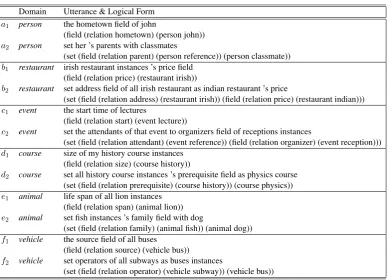
We have six domains of discourse in the SCFG that we use to generate our data –person, restau-rant, event, course, animal, andvehicle. Table2
1Our dataset can be accessed at
https://github.com/zhichul/
lookup-and-adapt-parser-data.
includes sample sentences and their logical form for every domain of discourse.
Since one-shot parsing has two phases, our dataset is slightly different from a typical dataset consisting of a single collection of utterance -logical formpairs. In the following space we de-scribe the sets of data generated for each domain. In the next section we describe how we can use this dataset to design two different one-shot pars-ing evaluation setups.
For each domain d, we define a Gd and ran-domly generate examples from domain(Gd) to construct an “old” set of examples Dold,d. We also generate a representative subsetMold,dto be used as the memory of our model. As described in §3.1,Mold,dcontains one example for each gram-mar rule inGd.
In addition, we define a set of new rules G0d
disjoint from Gd for each domain and generate one example ei,d for each new rule gi,d0 2 G0d, and store them into the memory Mnew,d0 . These
are the one-shot examples. The extended memory
Mnew,d=Mold,d[Mnew,d0 .
Finally, we generate evaluation sets Eold,d ⇢
domain(Gd)andEnew,d ⇢domain(Gd[G0d)
domain(Gd) where denotes set difference. In our experiments we split the evaluation sets ran-domly into a development set and a test set of the same size.
Some statistics of our generated dataset is pre-sented in AppendixD. In the next section, we de-scribe how we use this data to generate two differ-ent experimdiffer-ental scenarios for evaluating one-shot semantic parsing.
6 Results and Evaluation
We evaluate our approach in six domains, namely person, restaurant, event, course, animal, and vehi-cle, and in two one-shot parsing scenarios, namely extensionandtransfer. In the next section we de-fine these two different scenarios. We compare the performance to a sequence-to-sequence parser with attention which is defined in the following paragraphs.
Baseline Our baseline is a
Domain Utterance & Logical Form a1 person the hometown field of john
(field (relation hometown) (person john)) a2 person set her ’s parents with classmates
(set (field (relation parent) (person reference)) (person classmate)) b1 restaurant irish restaurant instances ’s price field
(field (relation price) (restaurant irish))
b2 restaurant set address field of all irish restaurant as indian restaurant ’s price
(set (field (relation address) (restaurant irish)) (field (relation price) (restaurant indian))) c1 event the start time of lectures
(field (relation start) (event lecture))
c2 event set the attendants of that event to organizers field of receptions instances
(set (field (relation attendant) (event reference)) (field (relation organizer) (event reception))) d1 course size of my history course instances
(field (relation size) (course history))
d2 course set all history course instances ’s prerequisite field as physics course
(set (field (relation prerequisite) (course history)) (course physics)) e1 animal life span of all lion instances
(field (relation span) (animal lion)) e2 animal set fish instances ’s family field with dog
(set (field (relation family) (animal fish)) (animal dog)) f1 vehicle the source field of all buses
(field (relation source) (vehicle bus)) f2 vehicle set operators of all subways as buses instances
[image:7.595.106.497.58.338.2](set (field (relation operator) (vehicle subway)) (vehicle bus))
Table 2: Sample utterance-logical form pairs from each domain of discourse. Sentencesa1... f1parse to
com-mands that retrieve a field of an object. Sentencesa2... f2parse to commands which set a field of an object to
a constant or a field of another object. The grammar we use do not constrain the type of the set command. As a consequence, some sentences generated are not semantically correct according to a human interpreter but still they preserve the sentence structure. Sentenceb2,e2, andf2are examples of this phenomena.
word embeddings, and the inputs to the decoder are concatenations of embeddings of logical predicates and context vectors. Context vectors are attention weighted averages of projected encoder states. The attention weights over the utterance for each decoding steptis computed by
taking the dot product of the hidden state of the decoder at step tand the projected encoder state
for each word in the utterance, normalized using the softmax function. The output of a decoding step t is a probability distribution over all the
logical predicates. The distribution is modeled as a dot product between a projection of the overall decoding state at time t, and the embedding for each logical predicate, normalized using the softmax function. The overall decoding state at time tis the concatenation of the hidden state of the decoder at timetand the context vector at time t. Decoding of a logical form given an utterance
is done as a greedy search over all possible logical forms to output.
Evaluation Metric Our evaluation metric is
parsing accuracy. We define parsing accuracy as the ratio of the correctly parsed utterances in the
test set. An utterance is parsed correctly if its generated logical form matches the annotated log-ical form exactly. E.g. (field (relation parent) (person john))is a correct parse of “parents of John”. We report accuracy percent-age in Tables3and4.
6.1 Discussion
We design two different scenarios for one-shot parsing evaluation, namely the extension and the transferscenarios. We define and discuss the re-sults of each scenario in the following sections.
Extension This scenario tests one-shot parsing
of new rules within the same domain that the model is trained on. In this case, we hold out several rules and their corresponding utterance-logical form pairs for evaluation and train on the remaining ones.
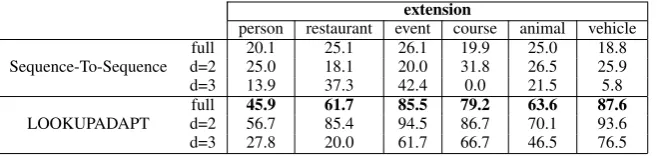
depth 2 and thed=3scores refer to the percentage of correct parses on examples with logical form depth 3.
As it can be seen in the table, our model is able to consistently improve the sequence-to-sequence baseline on all the domains by a significant margin of68.8%.
Transfer This scenario tests one-shot parsing of
new rules in a domain different from the one that the model is trained on. For example, in the transfer scenario for domain person the model is trained on examples from the other domains restaurant,event,course,animal, andvehicleand tested on samples from domain person. This is harder compared to the extension setup since it re-quires generalization to a completely new domain. The results of this section are reported in Ta-ble 4. As it can be seen, the performance is im-proved by up to36.6%compared to the baseline model.
In order to have a better understanding of the model and indicate why it is performing compara-ble to the baseline on some of the domains setting, we carry out a model analysis in the next section.
Model Analysis We add two variations of
our model ORACLE-DISCRIM and PRETRAIN-ENC for the transfer scenario to see the perfor-mance improvements gained from replacing dif-ferent components of our model with an ora-cle/near oracle. This identifies potential bottle-necks of the model.
In ORACLE-DISCRIM, we load a trained model from LOOKUPADAPT but replace the dis-criminator with an oracle during evaluation. As the numbers in row 3 of Table 4 show, using an oracle discriminator improves the model perfor-mance by more than 10% in the vehicle domain andcoursedomain, and by smaller amounts in the other domains. On one hand, this suggests that the discriminator has room for improvement. On the other hand, the numbers suggest that there is still a much larger room for improvement for the en-coder, aligner, and look-up components. Our hy-pothesis is that the encoder components are likely the main bottleneck because during evaluation in the transfer scenario they have to produce good representations for utterances and logical forms very different from the ones which they have seen during training. We found evidence supporting this hypothesis in the PRETRAIN-ENC variation.
In PRETRAIN-ENC, we pretrain our model on all the domains, which ensures that the two en-coders see all domains. We then use the encoder parameters of this all-domain pretrained model to initialize the encoders in the experiments for the transfer scenario. We then fix the encoders and train only the aligner, discriminator, and look-up parameters. This results in near perfect general-ization to the test domain by the aligner, discrimi-nator, and look-up components, which are trained only on the other domains. This suggests that the encoder is the main bottleneck of our model since using a near-oracle version boosts its performance to perfect. The results for this variation is shown in row 4 of Table 4.
7 Related Work
Semantic parsing is the task of mapping utterances to a formal representation of their meaning. Re-searchers have used grammar-based methods as well as machine learning-based methods to ad-dress this problem. Grammar-based parsers work by having a set of grammar rules that are either learned or hand-written, an algorithm for generat-ing a set of candidate logical forms by recursive application of the grammar rules, and a criterion for picking the best candidate logical form within that set (Liang and Potts, 2015;Zettlemoyer and Collins,2005,2007). However, they are brittle to the flexibility of language. To improve this lim-itation, supervised sequence-based neural seman-tic parsers have been proposed (Dong and Lapata,
2016). Herzig and Berant (2017) improved the performance of neural semantic parsers by train-ing over multiple knowledge bases and providtrain-ing the domain encoding at decoding time. In addi-tion to supervised learning, reinforcement learning methods for neural semantic parsing have been ex-plored in (Zhong et al.,2017).
extension
person restaurant event course animal vehicle
Sequence-To-Sequence d=2full 20.125.0 25.118.1 26.120.0 19.931.8 25.026.5 18.825.9
d=3 13.9 37.3 42.4 0.0 21.5 5.8
LOOKUPADAPT d=2full 45.956.7 61.785.4 85.594.5 79.286.7 63.670.1 87.693.6
d=3 27.8 20.0 61.7 66.7 46.5 76.5
Table 3: Test Accuracy on theextensionDataset.
transfer
person restaurant event course animal vehicle
Sequence-To-Sequence d=2full 5.26.4 29.241.7 5.24.9 19.927.5 35.544.9 12.515.6
d=3 3.1 8.4 5.7 6.0 13.8 6.3
LOOKUPADAPT d=2full 41.852.5 43.853.4 13.28.4 16.724.2 28.337.3 11.514.1
d=3 21.4 27.8 0.0 3.0 6.9 6.3
ORACLE-DISCRIM d=2full 46.955.6 45.856.7 12.518.0 29.241.8 33.344.8 25.029.7
d=3 30.3 27.8 2.9 5.9 6.9 15.6
PRETRAIN-ENC d=2full 100.098.0 100.0100.0 100.0100.0 100.099.0 100.0100.0 100.096.9
[image:9.595.136.465.62.140.2]d=3 94.0 100.0 100.0 97.1 100.0 90.1
Table 4: Test Accuracy on thetransferDataset.
Gu et al.(2018).
Another line of research maps semantic parsing under cross-domain setting to a domain adaptation problem (Su and Yan, 2017). In their work, the model is trained on a certain domain and then fine tuned to parse data from another domain. This is in essence different from our work in that we do not adapt the model, rather we adapt seen samples to form parses of new samples. Moreover, We do not fine-tune any part of the model in the new domain and focus on one-shot semantic parsing.
Most of these models need many data-points to train. Therefore, there has been recent attempts at zero-shot semantic parsing. Dadashkarimi et al.(2018) proposed a transfer learning approach where a domain label is predicted first and then the parse. Ferreira et al. (2015) and Herzig and Berant (2018) proposed slot-filling methods for semantic parsing based on general word embed-dings. Bapna et al. (2017) focuses on zero-shot frame semantic parsing by leveraging the descrip-tion of slots to be filled.
8 Conclusion and Future Work
As speech recognition technologies mature, more computing devices support spoken instructions via a conversational agent. However, most agents do not adapt to the phrasing and interest of a spe-cific end user. It has recently been shown that new functionalities can be added to an agent from
user instruction (Azaria et al.,2016;Labutov et al.,
2018). However, the user instruction only pro-vides one instance of a general instruction tem-plate and the agent is challenged to generalize to variations of the instance given during instruction. We define theone-shot parsingtask for measuring a semantic parser’s ability to generalize to new in-stances of user-taught commands from only one example. We propose a new semantic parser ar-chitecture that learns a general strategy of retriev-ing seen utterances similar to an unseen utterance and adapting the logical forms of seen utterances to fit the unseen utterance. Our results show an improvement of up to 68.8% on one-shot parsing under two different evaluation settings compared to the baselines. We found that the BiLSTM en-coders are likely bottlenecks for the model. Some future directions include exploring the effects of contents in the memory, automating memory ex-traction from dataset, and improving the encoder.
Acknowledgments
References
Amos Azaria, Jayant Krishnamurthy, and Tom Mitchell. 2016. Instructable intelligent personal agent. InProceedings of the Thirtieth AAAI Con-ference on Artificial Intelligence, pages 2681–2689.
Ankur Bapna, Gokhan Tur, Dilek Hakkani-Tur, and Larry Heck. 2017. Towards Zero-Shot Frame Se-mantic Parsing for Domain Scaling. arXiv e-prints, page arXiv:1707.02363.
Yoshua Bengio and Yann LeCun, editors. 2015. 3rd International Conference on Learning Representa-tions, ICLR 2015, San Diego, CA, USA, May 7-9, 2015, Conference Track Proceedings.
David Chiang. 2006. An introduction to synchronous grammars.
Javid Dadashkarimi, Alexander Fabbri, Sekhar Tatikonda, and Dragomir R. Radev. 2018. Zero-shot Transfer Learning for Semantic Parsing. arXiv e-prints, page arXiv:1808.09889.
Li Dong and Mirella Lapata. 2016. Language to logi-cal form with neural attention. InProceedings of the 54th Annual Meeting of the Association for Compu-tational Linguistics (Volume 1: Long Papers), pages 33–43, Berlin, Germany. Association for Computa-tional Linguistics.
Emmanuel Ferreira, Bassam Jabaian, and Fabrice Lef`evre. 2015. Zero-shot semantic parser for spoken language understanding. InSixteenth Annual Con-ference of the International Speech Communication Association.
Jiatao Gu, Yong Wang, Kyunghyun Cho, and Vic-tor OK Li. 2018. Search engine guided neural ma-chine translation. In Thirty-Second AAAI Confer-ence on Artificial IntelligConfer-ence.
Kelvin Guu, Tatsunori B Hashimoto, Yonatan Oren, and Percy Liang. 2018. Generating sentences by editing prototypes. Transactions of the Association for Computational Linguistics, 6:437–450.
Tatsunori B Hashimoto, Kelvin Guu, Yonatan Oren, and Percy S Liang. 2018. A retrieve-and-edit frame-work for predicting structured outputs. In S. Bengio, H. Wallach, H. Larochelle, K. Grauman, N. Cesa-Bianchi, and R. Garnett, editors,Advances in Neural Information Processing Systems 31, pages 10052– 10062. Curran Associates, Inc.
Karl Moritz Hermann, Tomas Kocisky, Edward Grefenstette, Lasse Espeholt, Will Kay, Mustafa Su-leyman, and Phil Blunsom. 2015. Teaching ma-chines to read and comprehend. In C. Cortes, N. D. Lawrence, D. D. Lee, M. Sugiyama, and R. Garnett, editors,Advances in Neural Information Processing Systems 28, pages 1693–1701. Curran Associates, Inc.
Jonathan Herzig and Jonathan Berant. 2017. Neural semantic parsing over multiple knowledge-bases. In Proceedings of the 55th Annual Meeting of the As-sociation for Computational Linguistics (Volume 2: Short Papers), pages 623–628, Vancouver, Canada. Association for Computational Linguistics.
Jonathan Herzig and Jonathan Berant. 2018. Decou-pling structure and lexicon for zero-shot semantic parsing. InProceedings of the 2018 Conference on Empirical Methods in Natural Language Process-ing, pages 1619–1629, Brussels, Belgium. Associ-ation for ComputAssoci-ational Linguistics.
Ankit Kumar, Ozan Irsoy, Peter Ondruska, Mohit Iyyer, James Bradbury, Ishaan Gulrajani, Victor Zhong, Romain Paulus, and Richard Socher. 2016.
Ask me anything: Dynamic memory networks for natural language processing. InProceedings of The 33rd International Conference on Machine Learn-ing, volume 48 ofProceedings of Machine Learning Research, pages 1378–1387, New York, New York, USA. PMLR.
Igor Labutov, Shashank Srivastava, and Tom Mitchell. 2018. LIA: A natural language programmable per-sonal assistant. InProceedings of the 2018 Con-ference on Empirical Methods in Natural Language Processing: System Demonstrations, pages 145– 150, Brussels, Belgium. Association for Computa-tional Linguistics.
Percy Liang and Christopher Potts. 2015. Bringing machine learning and compositional semantics to-gether.Annual Review of Linguistics, 1:355–376.
Jeffrey Pennington, Richard Socher, and Christo-pher D. Manning. 2014. Glove: Global vectors for word representation. InEmpirical Methods in Nat-ural Language Processing (EMNLP), pages 1532– 1543.
Yu Su and Xifeng Yan. 2017. Cross-domain se-mantic parsing via paraphrasing. In Proceedings of the 2017 Conference on Empirical Methods in Natural Language Processing, pages 1235–1246, Copenhagen, Denmark. Association for Computa-tional Linguistics.
Yushi Wang, Jonathan Berant, and Percy Liang. 2015.
Building a semantic parser overnight. In Proceed-ings of the 53rd Annual Meeting of the Association for Computational Linguistics and the 7th Interna-tional Joint Conference on Natural Language Pro-cessing (Volume 1: Long Papers), pages 1332–1342, Beijing, China. Association for Computational Lin-guistics.
W. Xiong, J. Droppo, X. Huang, F. Seide, M. Seltzer, A. Stolcke, D. Yu, and G. Zweig. 2016. Achiev-ing Human Parity in Conversational Speech Recog-nition.arXiv e-prints, page arXiv:1610.05256.
to logical form. In Proceedings of the 2007 Joint Conference on Empirical Methods in Natural guage Processing and Computational Natural Lan-guage Learning (EMNLP-CoNLL), pages 678–687, Prague, Czech Republic. Association for Computa-tional Linguistics.
Luke S. Zettlemoyer and Michael Collins. 2005.
Learning to map sentences to logical form: Struc-tured classification with probabilistic categorial grammars. InProceedings of the Twenty-First Con-ference on Uncertainty in Artificial Intelligence, UAI’05, pages 658–666, Arlington, Virginia, United States. AUAI Press.