Optimal Operation of Energy Storage Using Linear
Programming Technique
Luis T. Youn and Sohyung Cho,
Member, IIE and SME
Abstract - The utility deregulation allows a small power
producing facility to operate in parallel with a local electric grid, thus making it possible to buy and sell energies under the spot prices to the power grid. This paper deals with the optimal operation of an energy storage unit when it is installed in a small power producing facility. The assumption of the modified Gaussian distribution for the electric load and a binomial distribution for the on-site generation and the power grid are used in determining the optimal operation of energy storage unit and the optimal initial storage energy level.
Index Terms - Optimal Operation of Energy Storage
I. INTRODUCTION
The utility deregulation allows commercial and industrial utility customers to install a small power producing facility on their premises to minimize their energy expenses. It is common to operate this facility in parallel with a local utility grid (simply 'power grid') to further minimize their energy expenses and to improve the reliability of power supply to their system. The installation of an energy storage unit in a small power producing facility can further reduce energy cost and improve the reliability of power supply, especially for the critical loads of the customer's system.
This paper studies the optimal operation of an energy storage unit (simply 'energy storage') installed in a small power producing facility (simply 'on-site facility') by using the stochastic power producing model which is based upon the assumption of the modified Gaussian distribution of a load and a binomial distribution of on-site facility and power grid. The cost minimization of the electric system consisting of small power producing facility and the energy storage unit is carried out under the energy spot prices[1,2,3]. There have been several studies of optimal energy storage operation using
Luis Youn is with the Department of Electrical & Computer Engineering, Southern Illinois University Edwarsville, IL 62026 USA (e-mail: [email protected])
Sohyung Cho is with the Department of Industrial & Manufacturing Engineering, Southern Illinois University Edwarsville, IL 62026 USA (e-mail: [email protected])
techniques such as Multi-pass Iteration Particle Swarm Optimization Approach, decomposition technique, dynamic programming, nonlinear programming, etc, to reduce computational effort [4,5,6]. The mathematical model used in this paper allows the formulation of the cost optimization of the energy storage problem to be linear, thus making it possible to determine the optimal operation of energy storage and the optimal initial energy storage level using a conventional linear programming technique.
Fig, 1 shows the electric system consisting of power grid, on-site facility, energy storage, and electric load. Arrows indicate energy flows among them. A load curve is assumed to have N time-bands and can be a daily, weekly, monthly, or seasonal one as long as its repeatability is assumed. Without the energy storage, in each time-band, provider and on-site generation would be loaded according to the loading order to meet the energy demand(dotted arrows). The loading order is determined based upon their energy costs in each time-band. Once the optimal schedule of the energy storage operation is determined in a given time-band, the discharge of energy from the energy storage (zij + wij) is first loaded to meet the energy demand and then provider and on-site facility are followed according to their loading order.
xii yii
zij wij
Fig, 1. Energy Flow Diagram Energy
Storage S00 ,xij , yij
Power Grid On-Site Generation
where
S00= Initial storage energy level [MWH]
Energy purchased from provider in time-band i [MWH] when i = j
xij=
Remaining portion of energy in time-band j from energy purchased in time-band i from provider [MWH] when i ≠ j
Energy charged from on-site generation in time-band i [MWH] when i = j
yij=
Remaining portion of energy in time-band j from energy charged in time-band i by energy storage [MWH] when i ≠ j
Energy supplied to electric load in time-band j
zij= from energy purchased from provider in time-band i [MWH]
Energy supplied to electric load in time-band j
wij= from energy charged by on-site generation in time-band i [MWH]
II. PROBLEM FORMULATION
The goal of optimal storage operation is to minimize energy purchase from the power grid under the given energy spot prices. Thus, the problem is to maximize storage operation revenue (SOR) over the optimization period subject to constraints.
Maximize SOR Subject to constraints
To build SOR, the following concepts are used.
A. Energy Effective Price (EEP)
EEPij is a j time-band energy price of energy stored in
time-band i considering energy charging loss, energy discharging loss, and energy loss due to storage time from one time-band to another. It is assumed that charging and discharging from the energy storage cannot occur simultaneously in the same time-band and the initial energy level at the energy storage is zero.
i j i u
ij
B
EEP
=
−)
(
δ
αβ
[$/MWH] for provider [1]i j o
ij
G
EEP
=
−)
(
δ
αβ
[$/MWH] for on-site facility [2]where
u = provider
o = on-site generation facility
Bi = Energy buying price from provider in time-band i [$/MWH]
G = On-site generation cost [$/MWH] α = Energy charging efficiency β = Energy discharging efficiency ( = 1, if i=j )
δ = Energy loss rate with time
B. Energy Discharged to Load from Energy Purchased from Power Grid, zij
zij is the energy discharged to the load in time-band j from the energy purchased from the provider in time-band i and is given by
(xiiαδ - xij) β , j-i =1
zij = [MWH] [3] (xijδ- xij+1 ) β , j-i ≠1
C. Energy Discharged to Load due to On-Site Generation,wij
wij is the energy discharged to the load in time-band j from the energy stored by the on-site generation in time-band i and is given by
(yiiαδ - yij) β , j-i =1
wij = [MWH] [4] (yijδ- yij+1 ) β , j-i ≠1
D. Total Energy Discharged to Load in Time-Band i
Eiis the total energy discharged to the load by the energy storage in time-band i and is expressed as follows:
∑ ∑
−= =+
+
=
11 1
)
(
N
i N
i j
ij ij
i
z
w
E
[MWH] [5]E. Storage Energy Level (SEL)
SELi is the amount of energy stored in the storage unit in
time-band t and is limited by its storage capacity. It is given by
SELi =
∑
−
=
+
+
+
11
)
(
)
(
ik
ki ki ii
ii
y
x
y
F. Storage Operation Revenue (SOR)
SOR is a total profit [$] consisting of individual profits generated by wij and zij over the period of the load curve. Thus, it is
SOR =
∑∑
= −
=
−
+
−
N
j j
k
kj o kj j
kj u kj
j
EEP
z
B
EEP
w
B
2 1
1
]
)
(
)
[(
[7]
where
N = number of time-bands in load curve
III. CONSTRAINTS
The following are constraints required for the operation of the small power producing system shown in Figure 1.
A. Energy Storage Level, Charging Rate, and Discharging Rate
The energy that can be stored in the energy storage unit is limited by its size. Thus, the initial storage energy level and the energy levels in each time-band are limited as follows:
0 ≤ SELi or S00 ≤ Smax [8]
where
Smax = Maximum storage energy capacity [MWH]
Also, the amount of energy stored in the energy storage is limited by the maximum power charging and discharging rates of the energy storage, C [MW] and D [MW] respectively.
xii ≤ C τ [9]
yii ≤ C τ [10]
wii ≤ D τ [11]
zii ≤ D τ [12]
where
τ = duration of each time-band
B. xii and yii
The energy purchased from the provider in each time-band is limited by the storage unit capacity and the maximum power charging rate. The energy supplied by the on-site generation facility is limited by its available generation capacity and its power output in each time-band. The energy charged in the energy storage by the on-site generation occurs only when the on-site generation cost is less than the energy buying price from the provider and when there is an energy surplus from the on-site generation after meeting the load demand. By
comparing the power output of the on-site generation facility and its available generating capacity the maximum energy available for the energy storage Oi can
be found.
Thus,
0 ≤xiiα≤ Smax [13]
0 ≤yiiα≤ Oi [14]
where
Oi = Maximum energy supplied by on-site generation
during time-band i [MWH]
C. xij and yij
xij and yij are remaining portions of the energy charged during time-band i by the provider and the on-site generation facility in time-band j respectively. Thus, in each time-band they are limited by the leftover energy in the previous time-band.
0 ≤xij ≤xi(j-1)δ, j>i [15] 0 ≤xij ≤xi(j-1)αδ, j-1=i [16]
0 ≤ yij ≤ yi(j-1) δ, j>i [17] 0 ≤ yij ≤ yi(j-1) αδ, j-1=i [18]
D. wij and zij
The total power supplied to the electric load in time-band j cannot exceed the demand in time-band j.
(wij + zij )/ τ < Lj
τ = duration of each time-band Lj = demand in time-band j
IV. SIMULATION EXAMPLE
A – System Data
I and III. In this simulation, for the maximum profit, the charging and discharging rates (C and D) are unconstrained and the optimal operation schedule of the energy storage is obtained by minimizing the energy purchase from the provider. If C and D are constrained, the profit amount will decrease. The following data were used in the simulation.
N = 8 τ = 3 hours
α = 0.89 β = 0.89 δ = 0.95 S = 40 MWH
G = $54/MWH Simulation Period = one day
B. Scenario 1
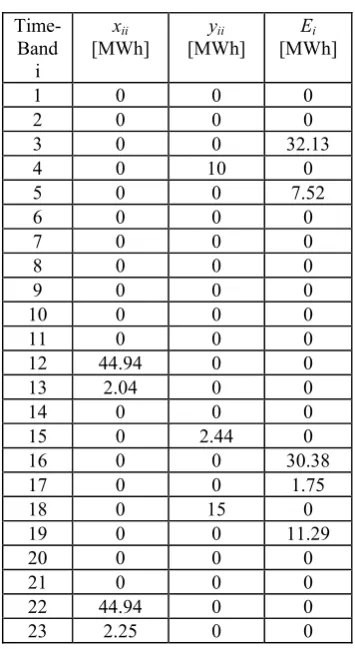
[image:4.595.340.518.105.430.2]In this scenario, as energy buying prices from a provider are high at the beginning of time-bands, the optimization result recommends the maximum initial energy storage of 40 MWH. Table I shows the data for the electric demand, energy buying price from a local provider, and available energy from on-site generation. Table II shows the optimal scheduling of the operation of the energy
Table I. Demand, Energy Buying Price and Available Energy from On-Site Facility in Each Time-Band
Time-Band
i
Li
[MW]
Bi [$/ MWH]
Oi
[MWH]
1 50 70 0 2 55 87 0 3 50 69 0 4 50 63 10 5 40 56 0 6 35 44 5 7 35 36 0 8 25 37 0 9 28 33 8 10 31 31 0 11 29 31 0 12 34 32 0 13 36 38 0 14 36 47 0 15 36 54 5 16 36 63 0 17 45 63 0 18 45 58 15 19 45 44 0 20 38 37 0 21 38 34 0 22 38 34 0 23 40 42 0
Table II. Simulation Results
Time-Band i
xii [MWh]
yii [MWh]
Ei [MWh]
1 0 0 0 2 0 0 0 3 0 0 32.13 4 0 10 0 5 0 0 7.52 6 0 0 0 7 0 0 0 8 0 0 0 9 0 0 0 10 0 0 0 11 0 0 0
12 44.94 0 0
13 2.04 0 0
14 0 0 0 15 0 2.44 0 16 0 0 30.38 17 0 0 1.75 18 0 15 0 19 0 0 11.29 20 0 0 0 21 0 0 0
22 44.94 0 0
23 2.25 0 0
storage unit. The second and the third columns show the energy purchase from provider for the storage and the energy charged to the storage from the on-site generation facility respectively. The fourth column shows the total energy discharged to the load by the energy storage in time-band i. In this scenario the initial storage energy is discharged to the load and recharged in time band 12 for a maximum profit. In time-band 22 another recharge occurs to maintain the initial energy storage level. As a result of the optimization of the energy storage operation, the savings is $453 over the simulation period. The size of the energy storage was chosen to be large to show the savings impact.
C. Scenario 2
[image:4.595.78.255.403.727.2]Table IV shows the optimal scheduling of the operation of the energy storage unit. The second and the third columns show the energy purchase from provider for the storage and the energy charged to the storage from the on-site. In this scenario the charging of the energy storage occurs in time-bands 5 and 15 from the provider and in time-bands 10 and 19 from the on-site generation for a maximum profit. As a result of the optimization of the energy storage operation, the savings is $1,365 over the simulation period.
V. CONCLUSION
[image:5.595.339.518.104.426.2]In this paper the optimization of an energy storage operation was presented including the determination of the optimal initial energy storage level for the maximum storage operation revenue. As the mathematical model is linear, it can be solved using a standard linear programming technique without much computational effort.
Table III. Demand, Energy Buying Price and Available Energy from On-Site Facility in Each Time-Band
Time-Band
i
Li
[MW]
Bi [$/ MWH]
Oi
[MWH]
1 25 37 0 2 28 33 0 3 31 31 10 4 29 31 0 5 34 32 0 6 36 38 0 7 36 47 0 8 36 54 0 9 36 63 0 10 38 63 5 11 35 58 0 12 30 44 0 13 38 37 0 14 38 36 10 15 38 36 0 16 40 42 0 17 36 70 0 18 40 87 0 19 32 67 10 20 30 63 0 21 30 56 0 22 30 44 0 23 25 36 0
Table IV. Simulation Results
Time-Band i
xii [MWh]
yii [MWh]
Ei [MWh] 1 0 0 0 2 0 0 0 3 0 0 0 4 0 0 0
5 44.94 0 0
6 2.25 0 0 7 0 0 0 8 0 0 0 9 0 0 30.52 10 0 5 0 11 0 0 3.76 12 0 0 0 13 0 0 0 14 0 0 0
15 44.94 0 0
16 2.25 0 0
17 0 0 0 18 0 0 32.13 19 0 10 0 20 0 0 7.53 21 0 0 0 22 0 0 0 23 0 0 0
REFEFENCES
[1] Fred C. Schweppe, Michael C. Caramanis, Richard D. Tabors, Roger E. Bohn, 'Spot Pricing of
Electricity', Springer, 1st edition, September 2006, 32-35
[2] Koreneff, G., Seppala, A., Lehtonen, M., Kekkonen, V., Laitinen, E., Hakli, J., Antila, E., 'Electricity spot
price forecasting as a part of energy management de-regulated power market', Proceedings of Energy Management and Power Delivery, Volume 1, Issue 3-5, Mar 1998, 223 – 228
[3] Tsung-Ying Lee, 'Operating Schedule of Battery Energy Storage System in a Time-of-Use Rate Industrial User With Wind Turbine Generators: A Multipass Iteration Particle Swarm Optimization Approach, Accepted for publication on IEEE Transaction on Energy Conversion, 2006
[image:5.595.79.254.393.716.2][5] D. K. Maly and K. S. Kwan, 'Optimal battery energy storage system (BESS) charge scheduling with dynamic programming, ' IEE Proc. Sce. Meas. Technol., vol. 142, no. 6, Nov. 1995, 454-458
[6] P. Rupanagunta, M. L. Baughman, and J. W. Jones, 'Scheduling of cool storage using non-linear programming techniques, ' IEEE Trans. Power. Syst., vol. 10, no. 3, Aug. 1995, 1279-1285