Online learning for Deterministic Dependency Parsing
Prashanth Reddy Mannem Language Technologies Research Center
IIIT-Hyderabad, India
Abstract
Deterministic parsing has emerged as an ef-fective alternative for complex parsing algo-rithms which search the entire search space to get the best probable parse tree. In this pa-per, we present an online large margin based training framework for deterministic pars-ing uspars-ing Nivre’s Shift-Reduce parspars-ing al-gorithm. Online training facilitates the use of high dimensional features without cre-ating memory bottlenecks unlike the popu-lar SVMs. We participated in the CoNLL Shared Task-2007 and evaluated our system for ten languages. We got an average multi-lingual labeled attachment score of 74.54 % (with 65.50% being the average and 80.32% the highest) and an average multilingual un-labeled attachment score of 80.30% (with 71.13% being the average and 86.55% the highest).
1 Introduction
CoNLL-X had a shared task on multilingual depen-dency parsing (Buchholz et al., 2006) by providing treebanks for 13 languages in the same dependency format. A look at the performance sheet in the con-test shows that two systems with quite different ap-proaches (one using deterministic parsing with SVM and the other using MIRA with nondeterministic and dynamic programming based MST approach ) per-formed with good results (McDonald et al., 2006; Nivre et al., 2006).
More recently, deterministic parsing has gener-ated a lot of interest because of their simplicity
(Nivre, 2003). One of the main advantages of de-terministic parsing lies in the ability to use the sub-tree information in the features to decide the next step. Parsing algorithms which search the entire space (Eisner, 1996; McDonald, 2006) are restricted in the features they use to score a relation. They rely only on the context information and not the history information to score a relation. Using history infor-mation makes the search intractable. Whereas, since deterministic parsers are at worst O(n2) (Yamada and Matsumoto, 2003) (Nivre (2003) is onlyO(2n)
in the worst case), they can use the crucial history information to make parsing decisions. So, in our work Nivre’s parsing algorithm has been used to ar-rive at the dependency parse tree.
Popular learning algorithms for deterministic parsing like Support Vector Machines (SVM) run into memory issues for large data since they are batch learning algorithms. Though more informa-tion is available in deterministic parsing in terms of subtree information, high dimensional features can’t be used due to the large training times for SVMs. This is where online methods come into the picture.
Unlike batch algorithms, online algorithms con-sider only one training instance at a time when optimizing parameters. This restriction to single-instance optimization might be seen as a weakness, since the algorithm uses less information about the objective function and constraints than batch algo-rithms. However, McDonald (2006) argues that this potential weakness is balanced by the simplicity of online learning, which allows for more streamlined training methods. This work focuses purely on on-line learning for deterministic parsing.
In the remaining part of the paper, we introduce Nivre’s parsing algorithm, propose a framework for online learning for deterministic parsing and present the results for all the languages with various feature models.
2 Parsing Algorithm
We used Nivre’s top-down/bottom-up linear time parsing algorithm proposed in Nivre (2003). A parser configuration is represented by triples
(S, I, E)where S is the stack (represented as a list),
I is the list of (remaining) tokens and E is the set of
edges for the dependency graph D.Sis a list of par-tially processed tokens, whose subtrees are incom-plete i.e tokens whose parent or children have not yet been established. topis the top of the stack S, nextis the next token in the listI.
Nivre’s algorithm consists of four elementary ac-tions Shif t, Lef t, Right and Reduce to build the dependency tree from the initial configuration
(nil,W,∅), where W is the input sentence. Shif t
pushes next onto the stack S. Reduce pops the stack. Right adds an arc from top to next and pushes next onto the stack S. Lef t adds an arc fromnexttotopand pops the stack. The parser ter-minates when it reaches a configuration (S,nil,E)
( for any list S and set of edges E).
The labels for each relation are determined after a new arc is formed (by lef t and right actions). The parser always constructs a dependency graph that is acyclic and projective. For non-projective parsing, we followed the pseudo projective pars-ing approach proposed by Nivre and Nilson (2005). In this approach, the training data is projectivized by a minimal transformation, lifting non-projective arcs one step at a time, and extending the arc label of the lifted arcs using the encoding scheme called HEAD+PATH. The non-projective arcs can be re-covered by applying an inverse transformation to the output of the parser, using a left-to-right, top-down, breadth-first search, guided by the extended arc la-bels. This method has been used for all the lan-guages.
3 Online Learning
McDonald (2005) applied online learning by scoring edges in a connected graph and finding the
Maxi-mum Spanning Tree (MST) of the graph. McDonald et al. (2005) used Edge Based Factorization , where the score of a dependency tree is factored as the sum of scores of all edges in the tree. Let, x=x1· · ·xn
represents a generic input sentence , and y represents a generic dependency tree for sentence x. (i, j) ∈y
denotes the presence of a dependency relation in y from wordxi(parent) to wordxj (child).
In Nivre’s parsing algorithm the dependency graph can be viewed as a graph resulting from a set of parsing decisions (in this case Shift, Reduce
, Left & Right) made, starting with the initial
con-figuration(nil,W,∅) . We define this sequence of
parsing decisions as d=d1· · ·dm. So, d is the
se-quence of parsing decisions made by the parser to obtain a dependency tree y, from an input sentence
x. Lets also define c = c1· · ·cm to be the
config-uration sequence starting from initial configconfig-uration
(nil,W,∅)to the final configuration(S,nil,E).
We define the score of a parsing decision for a par-ticular configuration to be the dot product between a high dimensional feature vector (based on both the decision and the configuration) and a weight vector. So,
s(di, ci) =w.f(di, ci)
where ci is the configuration at the ith instance
anddiis any one of the four actions{Shift, Reduce,
Left, Right}.
the training data, then concat their feature vectors and finally run the normal updates with the edge based loss (since the resulting decisions will produce a parse tree). This method gave very poor results.
So we do a factored MIRA for Nivre’s algorithm by factoring the output by decisions to obtain the following constraints:
minkw(i+1)−w(i)k
s.ts(di, ci)−s(d
′
i, ci)≥1
∀ci∈dt(c)and (di, d
′
i)∈(Shif t, Lef t, Right, Reduce)
where di represents the correct decision and d
′
i
represents all the other decisions for the same con-figurationci. This states that the weight of the
cor-rect decision for a particular configuration and the weight of all other decisions must be separated by a margin of 1. For every sentence in the training data, starting with the initial configuration (nil,W,∅), weights are adjusted to satisfy the above constraints before proceeding to the next correct configuration. This process is repeated till we reach the final con-figuration(S,nil,E).
4 Features
The two central elements in any configuration are the token on the top of the stack (t) and the next input token (n),the tokens which may be connected by a dependency relation in the current configuration. We categorize our features intobasic,context,history and in−between feature sets. The basic feature set contains information about these two tokens t andn. This includes unigram, bigram combinations of the word forms (FORM), root word (LEMMA), features (FEATS) and the part-of-speech tags (both CPOS and POS) of these words. The coarse POS tag (CPOS) is useful and helps solve data sparseness to some extent.
The existence or non-existence of a relation be-tween two words is heavily dependent on the words surrounding tand nwhich is the contextual infor-mation. The context feature set has the information about the surrounding wordst−1,t+1,n−1,n+1, n+ 2, n+ 3. Unigram and trigram combinations (withtandn) of the lexical items, POS tags, CPOS
tags of these words are part of this context feature set. We also included the second topmost element in the stack (st−1) word too.
The third feature set, which is the history feature set contains the info about the subtree at a partic-ular parser state. One of the advantages of using deterministic parsing algorithm over nondeterminis-tic algorithm is that history can be used as features. History features have information about the Parent (par), Left Sibling (ls) and Right Sibling (rs) of t. Unigram and trigram combinations (withtandn) of POS, CPOS, DEPREL tags of these words are in-cluded in theHistoryFeatures.
The features in the in − between feature set take the form of POS and CPOS trigrams: the POS/CPOS of t, that of the word in between and that ofn.
All the features in these feature sets are conjoined with distance between t&n and the parsing deci-sion. We experimented with a combination of these feature sets in our training. We define feature mod-elsφ1,φ2andφ3for our experiments. φ1is a com-bination onbasicand contextfeature sets. φ2 is a mixture of basic, context and in −between fea-ture sets whereas φ3 contains basic, context and history feature sets. The feature models φ1−3 are the same for all the languages.
5 Results and Discussion
The system with online learning and Nivre’s pars-ing algorithm was trained on the data released by CoNLL Shared Task Organizers for all the ten lan-guages (Hajiˇc et al., 2004; Aduriz et al., 2003; Mart´ı et al., 2007; Chen et al., 2003; B ¨ohmov´a et al., 2003; Marcus et al., 1993; Johansson and Nugues, 2007; Prokopidis et al., 2005; Csendes et al., 2005; Mon-temagni et al., 2003; Oflazer et al., 2003). We evalu-ated our system using the standard evaluation script provided by the organizers (Nivre et al., 2007). The evaluation metrics are Unlabeled Attachment Score(UAS) and Labeled Attachment Score(LAS).
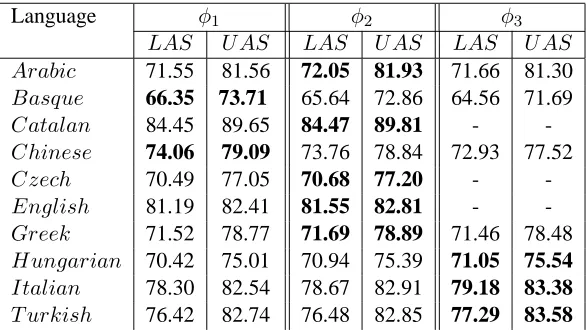
The results of our system with various feature models are listed in Table 11. The history
infor-mation in φ3 contributed to a marginal improve-ment in accuracy of Hungarian, Italian and Turkish. Whereas, Arabic, Catalan, Czech, English, Greek
1
Language φ1 φ2 φ3
LAS U AS LAS U AS LAS U AS
Arabic 71.55 81.56 72.05 81.93 71.66 81.30
Basque 66.35 73.71 65.64 72.86 64.56 71.69
Catalan 84.45 89.65 84.47 89.81 -
-Chinese 74.06 79.09 73.76 78.84 72.93 77.52
Czech 70.49 77.05 70.68 77.20 -
-English 81.19 82.41 81.55 82.81 -
-Greek 71.52 78.77 71.69 78.89 71.46 78.48
Hungarian 70.42 75.01 70.94 75.39 71.05 75.54
Italian 78.30 82.54 78.67 82.91 79.18 83.38
[image:4.612.160.453.62.227.2]T urkish 76.42 82.74 76.48 82.85 77.29 83.58
Table 1: Results of Online learning with Nivre’s parsing algorithm for feature modelsφ1,φ2,φ3
got their highest accuracies with feature model φ2 containingbasic,contextandin−betweenfeature sets. The rest of the languages, Basque and Chinese achieved highest accuracies withφ1. But, a careful look at the results table shows that there isn’t any significant difference in the accuracies of the sys-tem across different feature models. This is true for all the languages. The feature models φ2 and φ3 did not show any significant difference in accuracies even though they contain more information. Feature model φ1 with basic and contextfeature sets has achieved good accuracies.
5.1 K-Best Deterministic Parsing
The deterministic parsing algorithm does not han-dle ambiguity. By choosing a single parser action at each opportunity, the input string is parsed determin-istically and a single dependency tree is built during the parsing process from beginning to end (no other trees are even considered). A simple extension to this idea is to eliminate determinism by allowing the parser to choose several actions at each opportunity, creating different action sequences that lead to dif-ferent parse trees. Since a score is assigned to every parser action, the score of a parse tree can be com-puted simply as the average of the scores of all ac-tions that resulted in that parse tree (the derivation of the tree). We performed a beam search by carry-ing out a K-best search through the set of possible sequences of actions as proposed by Johansson and Nugues (2006). However, this did not increase the accuracy. Moreover, with larger values of K, there was a decrease in the parsing accuracy. The
best-first search proposed by Sagae and Lavie (2006) was also tried out but there was similar drop in accuracy.
6 Conclusion
The evaluation shows that the labeled pseudo projec-tive deterministic parsing with online learning gives competitive parsing accuracy for most of the lan-guages involved in the shared task. The level of ac-curacy varies considerably between the languages. Analyzing the results and the effects of various fea-tures with online learning will be an important re-search goal in the future.
References
A. Abeill´e, editor. 2003. Treebanks: Building and Using
Parsed Corpora. Kluwer.
I. Aduriz, M. J. Aranzabe, J. M. Arriola, A. Atutxa, A. Diaz de Ilarraza, A. Garmendia, and M. Oronoz. 2003. Construction of a Basque dependency treebank. In Proc. of the 2nd Workshop on Treebanks and
Lin-guistic Theories (TLT), pages 201–204.
A. B¨ohmov´a, J. Hajiˇc, E. Hajiˇcov´a, and B. Hladk´a. 2003. The PDT: a 3-level annotation scenario. In Abeill´e (Abeill´e, 2003), chapter 7, pages 103–127.
S. Buchholz, E. Marsi, A. Dubey, and Y. Krymolowski. 2006. Conll-x shared task on multilingual dependency parsing. In Proceedings of the Conference on
Compu-tational Natural Language Learning (CoNLL).
K. Crammer, O. Dekel, S. Shalev-Shwartz, and Y. Singer. 2003. Online passive aggressive algorithms. In
Pro-ceedings of Neural Information Processing Systems (NIPS).
D. Csendes, J. Csirik, T. Gyim´othy, and A. Kocsor. 2005.
The Szeged Treebank. Springer.
J. Eisner. 1996. Three new probabilistic models for de-pendency parsing: An exploration. In Proceedings of
the 16th International Conference on Computational Linguistics (COLING), pages 340–345.
J. Hajiˇc, O. Smrˇz, P. Zem´anek, J. ˇSnaidauf, and E. Beˇska. 2004. Prague Arabic dependency treebank: Develop-ment in data and tools. In Proc. of the NEMLAR
In-tern. Conf. on Arabic Language Resources and Tools,
pages 110–117.
R. Johansson and P. Nugues. 2006. Investigating
multilingual dependency parsing. In Proceedings of
the Tenth Conference on Computational Natural Lan-guage Learning (CoNLL-X), pages 206–210.
R. Johansson and P. Nugues. 2007. Extended
constituent-to-dependency conversion for English. In
Proc. of the 16th Nordic Conference on Computational Linguistics (NODALIDA).
M. Marcus, B. Santorini, and M. Marcinkiewicz. 1993. Building a large annotated corpus of English: the Penn Treebank. Computational Linguistics, 19(2):313–330.
M. A. Mart´ı, M. Taul´e, L. M`arquez, and M. Bertran.
2007. CESS-ECE: A multilingual and multilevel
annotated corpus. Available for download from:
http://www.lsi.upc.edu/∼mbertran/cess-ece/.
R. McDonald, K. Crammer, and F. Pereira. 2005. Online large-margin training of dependency parsers. In
Pro-ceedings of the Annual Meeting of the Association for Computational Linguistics (ACL).
R. McDonald, K. Lerman, and F. Pereira. 2006. Multi-lingual dependency analysis with a two-stage discrim-inative parser. In Proceedings of the Conference on
Computational Natural Language Learning (CoNLL).
R. McDonald. 2006. Discriminative learning and
span-ning tree algorithms for dependency parsing. Ph.D.
thesis, University of Pennsylvania.
S. Montemagni, F. Barsotti, M. Battista, N. Calzolari, O. Corazzari, A. Lenci, A. Zampolli, F. Fanciulli, M. Massetani, R. Raffaelli, R. Basili, M. T. Pazienza, D. Saracino, F. Zanzotto, N. Nana, F. Pianesi, and R. Delmonte. 2003. Building the Italian Syntactic-Semantic Treebank. In Abeill´e (Abeill´e, 2003), chap-ter 11, pages 189–210.
J. Nivre and J. Nilsson. 2005. Pseudo-projective de-pendency parsing. In Proceedings of the 43rd Annual
Meeting of the Association for Computational Linguis-tics (ACL), pages 99–106.
J. Nivre, J. Hall, J. Nilson, G. Eryigit, and S. Marinov.
2006. Labeled pseudo-projective dependency
pars-ing with support vector machines. In Proceedpars-ings of
the Conference on Computational Natural Language Learning (CoNLL).
J. Nivre, J. Hall, S. K ¨ubler, R. McDonald, J. Nilsson, S. Riedel, and D. Yuret. 2007. The CoNLL 2007 shared task on dependency parsing. In Proc. of the
Joint Conf. on Empirical Methods in Natural guage Processing and Computational Natural Lan-guage Learning (EMNLP-CoNLL).
J. Nivre. 2003. An efficient algorithm for projective dependency parsing. In Proceedings of International
Workshop on Parsing Technologies, pages 149–160.
K. Oflazer, B. Say, D. Zeynep Hakkani-T¨ur, and G. T¨ur.
2003. Building a Turkish treebank. In Abeill´e
(Abeill´e, 2003), chapter 15, pages 261–277.
P. Prokopidis, E. Desypri, M. Koutsombogera, H.
Papa-georgiou, and S. Piperidis. 2005. Theoretical and
practical issues in the construction of a Greek depen-dency treebank. In Proc. of the 4th Workshop on
Tree-banks and Linguistic Theories (TLT), pages 149–160.
K. Sagae and A. Lavie. 2006. A best-first probabilis-tic shift-reduce parser. In Proceedings of the
COL-ING/ACL 2006 Main Conference Poster Sessions.
H. Yamada and Y. Matsumoto. 2003. Statistical depen-dency analysis with support vector machines. In